Important Equations in Physics for IGCSE course

General Physics:

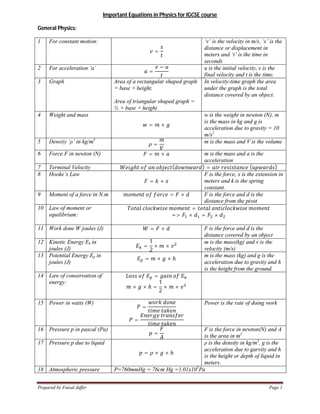
1    For constant motion:                                                        ‘v’ is the velocity in m/s, ‘s’ is the
                                                                                 distance or displacement in
                                                      =
                                                                                 meters and ‘t’ is the time in
                                                                                 seconds
2    For acceleration ‘a’                                 −                      u is the initial velocity, v is the
                                                 =
                                                                                 final velocity and t is the time.
3    Graph                       Area of a rectangular shaped graph              In velocity-time graph the area
                                 = base × height.                                under the graph is the total
                                                                                 distance covered by an object.
                                 Area of triangular shaped graph =
                                 ½ × base × height
4    Weight and mass                                                             w is the weight in newton (N), m
                                                                                 is the mass in kg and g is
                                                 =        ×
                                                                                 acceleration due to gravity = 10
                                                                                 m/s2
5    Density ‘ρ’ in kg/m3                            =                           m is the mass and V is the volume

6    Force F in newton (N)                       =        ×                       m is the mass and a is the
                                                                                  acceleration
7    Terminal Velocity                   ℎ                        (              )=                     (          )
8    Hooke’s Law                                                                  F is the force, x is the extension in
                                                  =       ×                       meters and k is the spring
                                                                                  constant.
9    Moment of a force in N.m                                     =       ×       F is the force and d is the
                                                                                  distance from the pivot
10 Law of moment or                                                            =
   equilibrium:                                                   =>          ×  =    ×

11 Work done W joules (J)                         =       ×                      F is the force and d is the
                                                                                 distance covered by an object
12 Kinetic Energy Ek in                           1                              m is the mass(kg) and v is the
   joules (J)                                =      ×         ×                  velocity (m/s)
                                                  2
13 Potential Energy Ep in                                                        m is the mass (kg) and g is the
                                              =       ×       ×ℎ
   joules (J)                                                                    acceleration due to gravity and h
                                                                                 is the height from the ground.
14 Law of conservation of                             =
   energy:                                                1
                                         ×   ×ℎ=            ×         ×
                                                          2

15 Power in watts (W)                                                            Power is the rate of doing work
                                             =

                                         =
16 Pressure p in pascal (Pa)                                    F is the force in newton(N) and A
                                                      =         is the area in m2
17 Pressure p due to liquid                                     ρ is the density in kg/m3, g is the
                                                                acceleration due to garvity and h
                                          = × ×ℎ
                                                                is the height or depth of liquid in
                                                                meters.
18 Atmospheric pressure          P=760mmHg = 76cm Hg =1.01x10⁵Pa


Prepared by Faisal Jaffer                                                                                       Page 1
Thermal Physics:

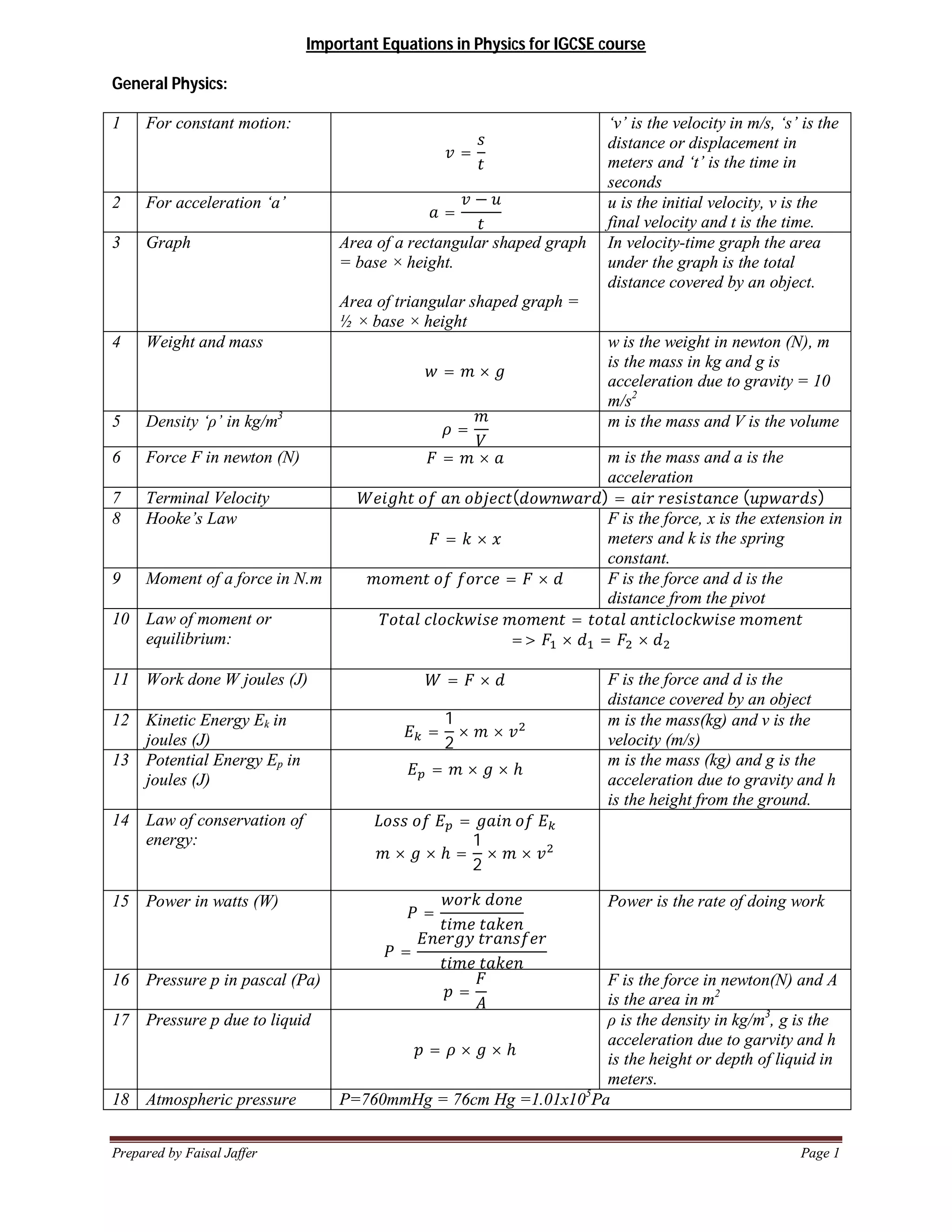
1      Pressure and volume relationship               pV=constant         p1 and p2 are the two pressures in Pa
       (Boyle’s law)                              ×       = ×             and V1 and V2 are the two volumes in m3
2      Thermal Expansion (Linear)                     L =  ×Lo ×
                                             Lo is the original length in meters,
                                              is the change in temperature in oC,
                                             L is the change in length in meters (L1- Lo) and
                                              is the linear expansivity of the material
3      Thermal Expansion (Cubical)
                                                      V =  Vo 
                                             Vo is the original volume in m3,
                                              is the change in temperature in oC,
                                             V is the change in volume in m3 (V1- Vo) and
                                              is the cubical expansivity of the material.
4      Relationship between linear and                 = 3
       cubical expansivities
5      Charle’s Law:                                                       V is the volume in m3 and T is the
                                                    =
        Volume is directly proportional to                                 temperature in Kelvin (K).
       absolute temperature
                                                          =
                        ∝

6      Pressure Law:                                =                      p is the pressure in Pa and T is the
       Pressure of a gas is directly                                       temperature in Kelvin (K).
       proportional to the absolute                       =
       temperature
                        ∝
7      Gas Law:                                                            In thermal physics the symbol θ is used
                                                          =
                                                                           of celsius scale and T is used for Kelvin
                       =                                                   scale.
8  Specific Heat Capacity:                                                 c is the specific heat capacity in J/kgoC,
   The amount of heat required to                     =                    Q is the total heat in joules (J),
                                                              ×∆
   raise the temperature of 1 kg mass                                      m is the mass in kg and
   by 1oC.                                                                 Δθ is the change in temperature
9 Thermal Capacity: amount of heat           Thermal capacity=m×c          The unit of thermal capacity is J/oC.
   require to raise the temperature of        ℎ                    =
   a substance of any mass by 1oC                                      ∆
10 Specific latent heat of fusion                                          Lf is the specific latent heat of fusion in
   (from Ice to liquid)                                   =                J/kg or J/g,
                                                                           Q is the total heat in joules (J),
                                                                           m is the mass of liquid change from ice
                                                                           in kg or g.
11 Specific latent heat of vaporization                                    Lv is the specific latent heat of
   (from liquid to vapour)                                =                vaporization in J/kg or J/g,
                                                                           Q is the total heat in joules (J),
                                                                           m is the mass of vapour change from
                                                                           liquid in kg or g.
12 Thermal or heat transfer                  In solid = conduction
                                             In liquid and gas = convection and also convection current
                                             In vacuum = radiation
13 Emitters and Radiators                    Dull black surface = good emitter, good radiator, bad reflector
                                             Bright shiny surface = poor emitter, poor radiator, good reflector


    Prepared by Faisal Jaffer                                                                                Page 2
Waves, light and sound:

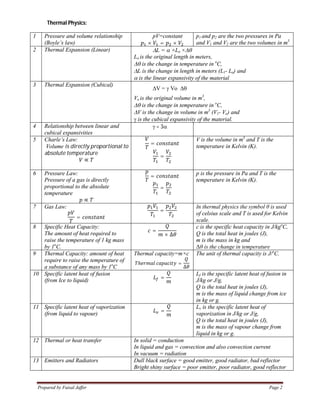
   1       Wave equation 1                          =    ×               v is the speed of wave in m/s
                                                                         f is the frequency in Hz
                                                                         λ is the wavelength in meters
   2       Wave equation 2                              1                T is the time period of wave in
                                                      =
                                                                         seconds
   3       Movement of the particles Longitudinal waves=> back and forth in the direction of the
           of the medium             waves
                                     Transverse waves=> perpendicular to the direction of the waves
   4       Law of reflection         Angle of incidence i = angel of reflection
                                                                      =
   5       Refraction                From lighter to denser medium → light bend towards the normal
                                     From denser to lighter medium →light bend away from the
                                     normal
   6       Refractive index n                             ∠              Refractive index has no unit
                                                   =
                                                         ∠
   7       Refractive index n                                        ℎ
                                                   =
                                                                   ℎ             ℎ
   8       Image from a plane mirror Virtual, upright, same size and laterally inverted,
                                     same distance from the mirror inside
   9       Image from a convex lens  When close: virtual, enlarge, upright
                                     When far: real, small, upside down
   10      Image from a concave lens Virtual, upright, small
   11      Critical angle            When light goes from denser to lighter medium, the incident
                                     angle at which the reflected angle is 90o,is called critical angle.
   12      Total internal            When light goes from denser to lighter medium, the refracted ray
           reflection(TIR)           bend inside the same medium then this is called (TIR)
   13      Electromagnetic Spectrum:→ this way the frequency decreases and wavelength increases
           Gamma rays ↔ X-rays ↔ UV ↔ Visible light ↔ IR ↔ Micro waves ↔ Radio waves
   14      Colours of visible        VIBGYOR (from bottom-up)
           spectrum (light)
   15      Speed of light            In air: 3×10⁸m/s                    In glass: 2×10⁸m/s
   16      Light wave                Electromagnetic waves
   17      Sound wave                longitudinal waves
                                     particle of the medium come close → compression
                                     particles of the medium far apart → rarefaction
   18      Echo                                       2×                 v is the speed of sound waves,
                                                    =                    d is the distance in meters
                                                                         between source and the
                                                                         reflection surface and
                                                                         t is the time for echo
   19      Properties of sound waves Pitch means the frequency of the wave
                                     Loudness means the amplitude of the wave
   20      Speed of sound waves      Air : 330-340 m/s
                                     Water: 1400 m/s
                                     Concrete : 5000 m/s
                                     Steel: 6000 – 7000 m/s


Prepared by Faisal Jaffer                                                                          Page 3
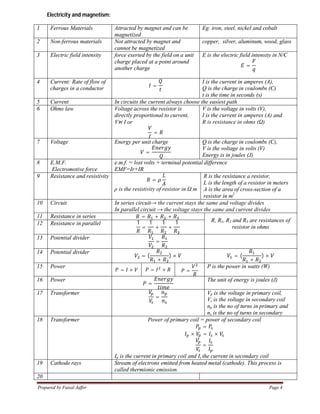
Electricity and magnetism:

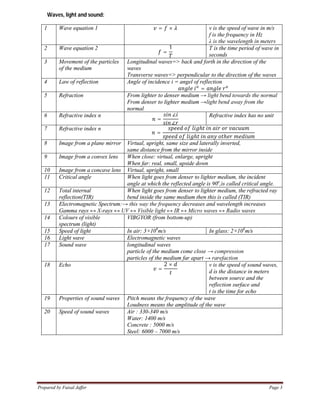
1     Ferrous Materials           Attracted by magnet and can be          Eg. iron, steel, nickel and cobalt
                                  magnetized
2     Non-ferrous materials       Not attracted by magnet and             copper, silver, aluminum, wood, glass
                                  cannot be magnetized
3     Electric field intensity    force exerted by the field on a unit    E is the electric field intensity in N/C
                                  charge placed at a point around
                                  another charge                                               =

4     Current: Rate of flow of                                           I is the current in amperes (A),
      charges in a conductor                         =                   Q is the charge in coulombs (C)
                                                                         t is the time in seconds (s)
5     Current                     In circuits the current always choose the easiest path
6     Ohms law                    Voltage across the resistor is         V is the voltage in volts (V),
                                  directly proportional to current,      I is the current in amperes (A) and
                                  V⋉ I or                                R is resistance in ohms (Ω)
                                                     =
7     Voltage                     Energy per unit charge                 Q is the charge in coulombs (C),
                                                                         V is the voltage in volts (V)
                                                =                        Energy is in joules (J)
8     E.M.F.                     e.m.f. = lost volts + terminal potential difference
      Electromotive force        EMF=Ir+IR
9     Resistance and resistivity                                          R is the resistance a resistor,
                                                    =                     L is the length of a resistor in meters
                                 ρ is the resistivity of resistor in Ω.m A is the area of cross-section of a
                                                                          resistor in m2
10    Circuit                    In series circuit→ the current stays the same and voltage divides
                                 In parallel circuit → the voltage stays the same and current divides
11    Resistance in series                    =      +     +
                                            1     1      1     1              R, R1, R2 and R3 are resistances of
12    Resistance in parallel
                                              =      +     +                            resistor in ohms
13    Potential divider
                                                       =
14    Potential divider
                                              =(                 )×                       =(          )×
                                                         +                                       +
15    Power                                                                   P is the power in watts (W)
                                     = ×           =         ×        =
16    Power                                                                   The unit of energy is joules (J)
                                                 =
17    Transformer                                                         Vp is the voltage in primary coil,
                                                       =                  Vs is the voltage in secondary coil
                                                                          np is the no of turns in primary and
                                                                          ns is the no of turns in secondary
18    Transformer                                Power of primary coil = power of secondary coil
                                                                        =
                                                                  × = ×
                                                                          =
                                  Ip is the current in primary coil and Is the current in secondary coil
19    Cathode rays                Stream of electrons emitted from heated metal (cathode). This process is
                                  called thermionic emission.
20
Prepared by Faisal Jaffer                                                                                 Page 4
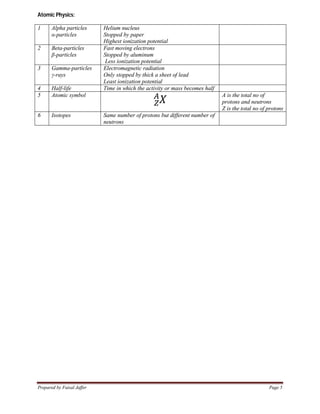
Atomic Physics:

1      Alpha particles      Helium nucleus
       α-particles          Stopped by paper
                            Highest ionization potential
2      Beta-particles       Fast moving electrons
       β-particles          Stopped by aluminum
                             Less ionization potential
3      Gamma-particles      Electromagnetic radiation
       γ-rays               Only stopped by thick a sheet of lead
                            Least ionization potential
4      Half-life            Time in which the activity or mass becomes half
5      Atomic symbol                                                          A is the total no of
                                                                              protons and neutrons
                                                                              Z is the total no of protons
6      Isotopes             Same number of protons but different number of
                            neutrons


Prepared by Faisal Jaffer                                                                          Page 5

Important equation in physics2

  • 1.
    Important Equations inPhysics for IGCSE course General Physics: 1 For constant motion: ‘v’ is the velocity in m/s, ‘s’ is the distance or displacement in = meters and ‘t’ is the time in seconds 2 For acceleration ‘a’ − u is the initial velocity, v is the = final velocity and t is the time. 3 Graph Area of a rectangular shaped graph In velocity-time graph the area = base × height. under the graph is the total distance covered by an object. Area of triangular shaped graph = ½ × base × height 4 Weight and mass w is the weight in newton (N), m is the mass in kg and g is = × acceleration due to gravity = 10 m/s2 5 Density ‘ρ’ in kg/m3 = m is the mass and V is the volume 6 Force F in newton (N) = × m is the mass and a is the acceleration 7 Terminal Velocity ℎ ( )= ( ) 8 Hooke’s Law F is the force, x is the extension in = × meters and k is the spring constant. 9 Moment of a force in N.m = × F is the force and d is the distance from the pivot 10 Law of moment or = equilibrium: => × = × 11 Work done W joules (J) = × F is the force and d is the distance covered by an object 12 Kinetic Energy Ek in 1 m is the mass(kg) and v is the joules (J) = × × velocity (m/s) 2 13 Potential Energy Ep in m is the mass (kg) and g is the = × ×ℎ joules (J) acceleration due to gravity and h is the height from the ground. 14 Law of conservation of = energy: 1 × ×ℎ= × × 2 15 Power in watts (W) Power is the rate of doing work = = 16 Pressure p in pascal (Pa) F is the force in newton(N) and A = is the area in m2 17 Pressure p due to liquid ρ is the density in kg/m3, g is the acceleration due to garvity and h = × ×ℎ is the height or depth of liquid in meters. 18 Atmospheric pressure P=760mmHg = 76cm Hg =1.01x10⁵Pa Prepared by Faisal Jaffer Page 1
  • 2.
    Thermal Physics: 1 Pressure and volume relationship pV=constant p1 and p2 are the two pressures in Pa (Boyle’s law) × = × and V1 and V2 are the two volumes in m3 2 Thermal Expansion (Linear) L =  ×Lo × Lo is the original length in meters,  is the change in temperature in oC, L is the change in length in meters (L1- Lo) and  is the linear expansivity of the material 3 Thermal Expansion (Cubical) V =  Vo  Vo is the original volume in m3,  is the change in temperature in oC, V is the change in volume in m3 (V1- Vo) and  is the cubical expansivity of the material. 4 Relationship between linear and  = 3 cubical expansivities 5 Charle’s Law: V is the volume in m3 and T is the = Volume is directly proportional to temperature in Kelvin (K). absolute temperature = ∝ 6 Pressure Law: = p is the pressure in Pa and T is the Pressure of a gas is directly temperature in Kelvin (K). proportional to the absolute = temperature ∝ 7 Gas Law: In thermal physics the symbol θ is used = of celsius scale and T is used for Kelvin = scale. 8 Specific Heat Capacity: c is the specific heat capacity in J/kgoC, The amount of heat required to = Q is the total heat in joules (J), ×∆ raise the temperature of 1 kg mass m is the mass in kg and by 1oC. Δθ is the change in temperature 9 Thermal Capacity: amount of heat Thermal capacity=m×c The unit of thermal capacity is J/oC. require to raise the temperature of ℎ = a substance of any mass by 1oC ∆ 10 Specific latent heat of fusion Lf is the specific latent heat of fusion in (from Ice to liquid) = J/kg or J/g, Q is the total heat in joules (J), m is the mass of liquid change from ice in kg or g. 11 Specific latent heat of vaporization Lv is the specific latent heat of (from liquid to vapour) = vaporization in J/kg or J/g, Q is the total heat in joules (J), m is the mass of vapour change from liquid in kg or g. 12 Thermal or heat transfer In solid = conduction In liquid and gas = convection and also convection current In vacuum = radiation 13 Emitters and Radiators Dull black surface = good emitter, good radiator, bad reflector Bright shiny surface = poor emitter, poor radiator, good reflector Prepared by Faisal Jaffer Page 2
  • 3.
    Waves, light andsound: 1 Wave equation 1 = × v is the speed of wave in m/s f is the frequency in Hz λ is the wavelength in meters 2 Wave equation 2 1 T is the time period of wave in = seconds 3 Movement of the particles Longitudinal waves=> back and forth in the direction of the of the medium waves Transverse waves=> perpendicular to the direction of the waves 4 Law of reflection Angle of incidence i = angel of reflection = 5 Refraction From lighter to denser medium → light bend towards the normal From denser to lighter medium →light bend away from the normal 6 Refractive index n ∠ Refractive index has no unit = ∠ 7 Refractive index n ℎ = ℎ ℎ 8 Image from a plane mirror Virtual, upright, same size and laterally inverted, same distance from the mirror inside 9 Image from a convex lens When close: virtual, enlarge, upright When far: real, small, upside down 10 Image from a concave lens Virtual, upright, small 11 Critical angle When light goes from denser to lighter medium, the incident angle at which the reflected angle is 90o,is called critical angle. 12 Total internal When light goes from denser to lighter medium, the refracted ray reflection(TIR) bend inside the same medium then this is called (TIR) 13 Electromagnetic Spectrum:→ this way the frequency decreases and wavelength increases Gamma rays ↔ X-rays ↔ UV ↔ Visible light ↔ IR ↔ Micro waves ↔ Radio waves 14 Colours of visible VIBGYOR (from bottom-up) spectrum (light) 15 Speed of light In air: 3×10⁸m/s In glass: 2×10⁸m/s 16 Light wave Electromagnetic waves 17 Sound wave longitudinal waves particle of the medium come close → compression particles of the medium far apart → rarefaction 18 Echo 2× v is the speed of sound waves, = d is the distance in meters between source and the reflection surface and t is the time for echo 19 Properties of sound waves Pitch means the frequency of the wave Loudness means the amplitude of the wave 20 Speed of sound waves Air : 330-340 m/s Water: 1400 m/s Concrete : 5000 m/s Steel: 6000 – 7000 m/s Prepared by Faisal Jaffer Page 3
  • 4.
    Electricity and magnetism: 1 Ferrous Materials Attracted by magnet and can be Eg. iron, steel, nickel and cobalt magnetized 2 Non-ferrous materials Not attracted by magnet and copper, silver, aluminum, wood, glass cannot be magnetized 3 Electric field intensity force exerted by the field on a unit E is the electric field intensity in N/C charge placed at a point around another charge = 4 Current: Rate of flow of I is the current in amperes (A), charges in a conductor = Q is the charge in coulombs (C) t is the time in seconds (s) 5 Current In circuits the current always choose the easiest path 6 Ohms law Voltage across the resistor is V is the voltage in volts (V), directly proportional to current, I is the current in amperes (A) and V⋉ I or R is resistance in ohms (Ω) = 7 Voltage Energy per unit charge Q is the charge in coulombs (C), V is the voltage in volts (V) = Energy is in joules (J) 8 E.M.F. e.m.f. = lost volts + terminal potential difference Electromotive force EMF=Ir+IR 9 Resistance and resistivity R is the resistance a resistor, = L is the length of a resistor in meters ρ is the resistivity of resistor in Ω.m A is the area of cross-section of a resistor in m2 10 Circuit In series circuit→ the current stays the same and voltage divides In parallel circuit → the voltage stays the same and current divides 11 Resistance in series = + + 1 1 1 1 R, R1, R2 and R3 are resistances of 12 Resistance in parallel = + + resistor in ohms 13 Potential divider = 14 Potential divider =( )× =( )× + + 15 Power P is the power in watts (W) = × = × = 16 Power The unit of energy is joules (J) = 17 Transformer Vp is the voltage in primary coil, = Vs is the voltage in secondary coil np is the no of turns in primary and ns is the no of turns in secondary 18 Transformer Power of primary coil = power of secondary coil = × = × = Ip is the current in primary coil and Is the current in secondary coil 19 Cathode rays Stream of electrons emitted from heated metal (cathode). This process is called thermionic emission. 20 Prepared by Faisal Jaffer Page 4
  • 5.
    Atomic Physics: 1 Alpha particles Helium nucleus α-particles Stopped by paper Highest ionization potential 2 Beta-particles Fast moving electrons β-particles Stopped by aluminum Less ionization potential 3 Gamma-particles Electromagnetic radiation γ-rays Only stopped by thick a sheet of lead Least ionization potential 4 Half-life Time in which the activity or mass becomes half 5 Atomic symbol A is the total no of protons and neutrons Z is the total no of protons 6 Isotopes Same number of protons but different number of neutrons Prepared by Faisal Jaffer Page 5