© Farah Dinah Hassan, SMK Tasek Utara 2, JB 2012
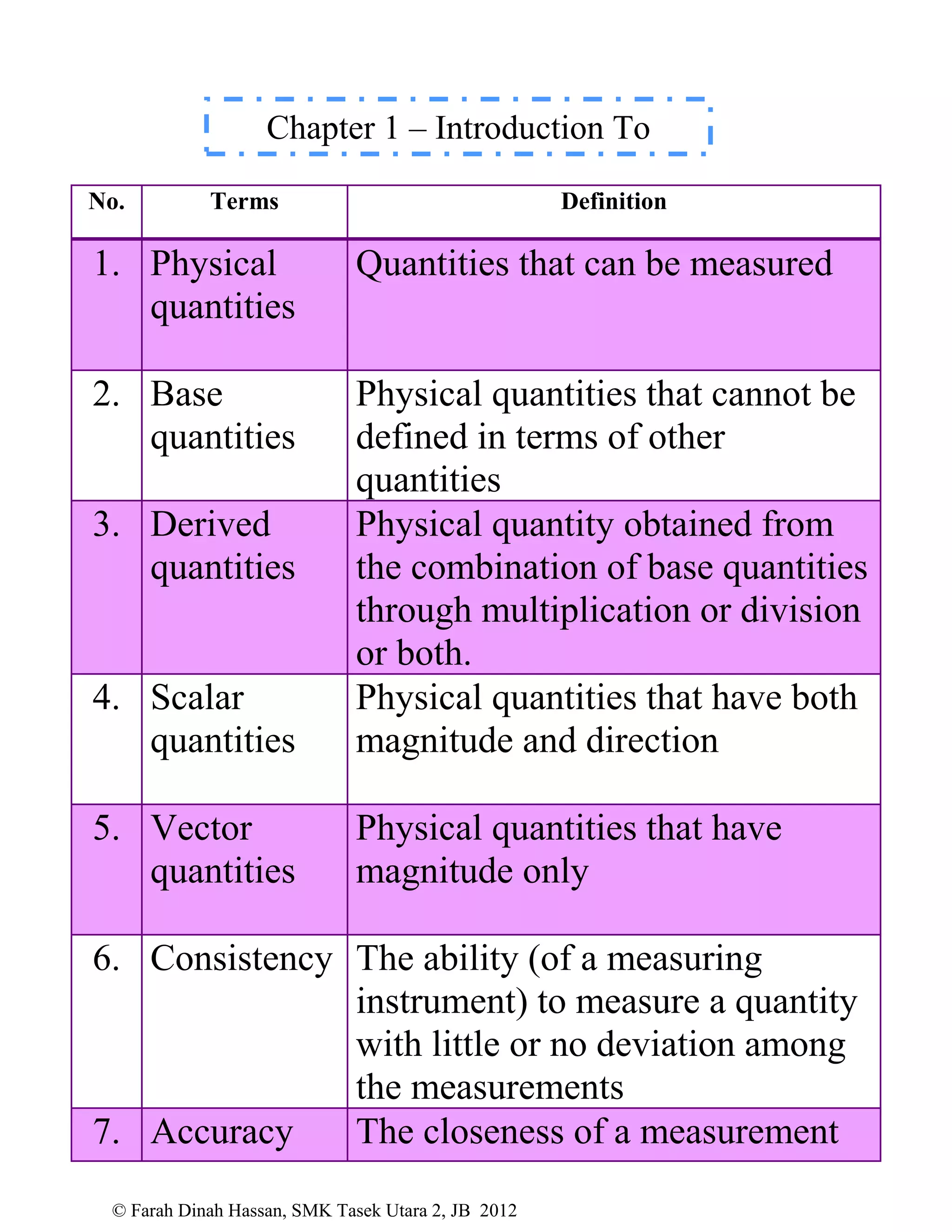
No. Terms Definition
1. Physical
quantities
Quantities that can be measured
2. Base
quantities
Physical quantities that cannot be
defined in terms of other
quantities
3. Derived
quantities
Physical quantity obtained from
the combination of base quantities
through multiplication or division
or both.
4. Scalar
quantities
Physical quantities that have both
magnitude and direction
5. Vector
quantities
Physical quantities that have
magnitude only
6. Consistency The ability (of a measuring
instrument) to measure a quantity
with little or no deviation among
the measurements
7. Accuracy The closeness of a measurement
Chapter 1 – Introduction To
Physics
© Farah Dinah Hassan, SMK Tasek Utara 2, JB 2012
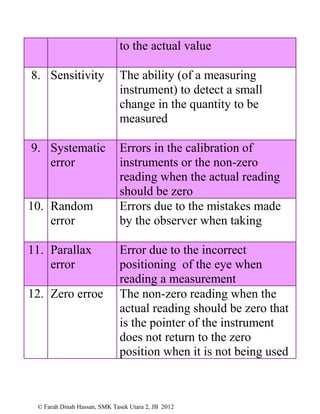
to the actual value
8. Sensitivity The ability (of a measuring
instrument) to detect a small
change in the quantity to be
measured
9. Systematic
error
Errors in the calibration of
instruments or the non-zero
reading when the actual reading
should be zero
10. Random
error
Errors due to the mistakes made
by the observer when taking
11. Parallax
error
Error due to the incorrect
positioning of the eye when
reading a measurement
12. Zero erroe The non-zero reading when the
actual reading should be zero that
is the pointer of the instrument
does not return to the zero
position when it is not being used
© Farah Dinah Hassan, SMK Tasek Utara 2, JB 2012
Chapter 2 – Force And Motion
© Farah Dinah Hassan, SMK Tasek Utara 2, JB 2012
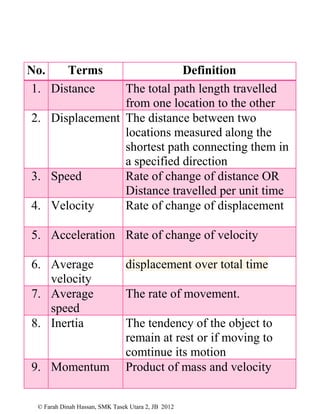
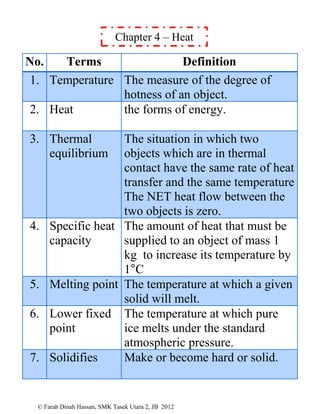
No. Terms Definition
1. Distance The total path length travelled
from one location to the other
2. Displacement The distance between two
locations measured along the
shortest path connecting them in
a specified direction
3. Speed Rate of change of distance OR
Distance travelled per unit time
4. Velocity Rate of change of displacement
5. Acceleration Rate of change of velocity
6. Average
velocity
displacement over total time
7. Average
speed
The rate of movement.
8. Inertia The tendency of the object to
remain at rest or if moving to
comtinue its motion
9. Momentum Product of mass and velocity
© Farah Dinah Hassan, SMK Tasek Utara 2, JB 2012
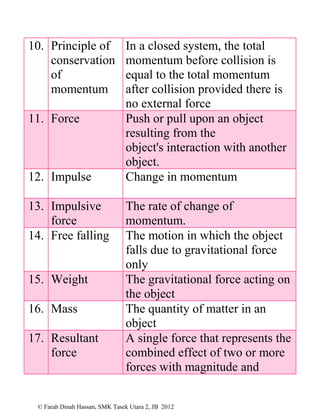
10. Principle of
conservation
of
momentum
In a closed system, the total
momentum before collision is
equal to the total momentum
after collision provided there is
no external force
11. Force Push or pull upon an object
resulting from the
object's interaction with another
object.
12. Impulse Change in momentum
13. Impulsive
force
The rate of change of
momentum.
14. Free falling The motion in which the object
falls due to gravitational force
only
15. Weight The gravitational force acting on
the object
16. Mass The quantity of matter in an
object
17. Resultant
force
A single force that represents the
combined effect of two or more
forces with magnitude and
© Farah Dinah Hassan, SMK Tasek Utara 2, JB 2012
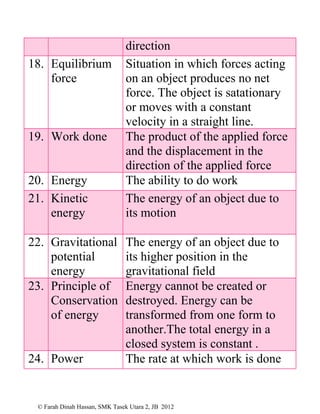
direction
18. Equilibrium
force
Situation in which forces acting
on an object produces no net
force. The object is satationary
or moves with a constant
velocity in a straight line.
19. Work done The product of the applied force
and the displacement in the
direction of the applied force
20. Energy The ability to do work
21. Kinetic
energy
The energy of an object due to
its motion
22. Gravitational
potential
energy
The energy of an object due to
its higher position in the
gravitational field
23. Principle of
Conservation
of energy
Energy cannot be created or
destroyed. Energy can be
transformed from one form to
another.The total energy in a
closed system is constant .
24. Power The rate at which work is done
© Farah Dinah Hassan, SMK Tasek Utara 2, JB 2012
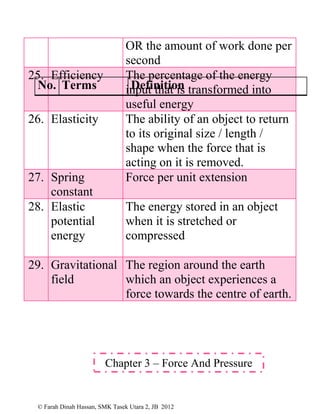
OR the amount of work done per
second
25. Efficiency The percentage of the energy
input that is transformed into
useful energy
26. Elasticity The ability of an object to return
to its original size / length /
shape when the force that is
acting on it is removed.
27. Spring
constant
Force per unit extension
28. Elastic
potential
energy
The energy stored in an object
when it is stretched or
compressed
29. Gravitational
field
The region around the earth
which an object experiences a
force towards the centre of earth.
No. Terms Definition
Chapter 3 – Force And Pressure
© Farah Dinah Hassan, SMK Tasek Utara 2, JB 2012
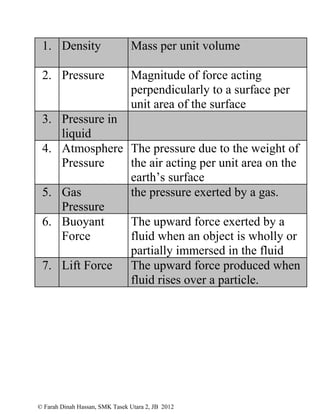
1. Density Mass per unit volume
2. Pressure Magnitude of force acting
perpendicularly to a surface per
unit area of the surface
3. Pressure in
liquid
4. Atmosphere
Pressure
The pressure due to the weight of
the air acting per unit area on the
earth’s surface
5. Gas
Pressure
the pressure exerted by a gas.
6. Buoyant
Force
The upward force exerted by a
fluid when an object is wholly or
partially immersed in the fluid
7. Lift Force The upward force produced when
fluid rises over a particle.
© Farah Dinah Hassan, SMK Tasek Utara 2, JB 2012
No. Terms Definition
1. Temperature The measure of the degree of
hotness of an object.
2. Heat the forms of energy.
3. Thermal
equilibrium
The situation in which two
objects which are in thermal
contact have the same rate of heat
transfer and the same temperature
The NET heat flow between the
two objects is zero.
4. Specific heat
capacity
The amount of heat that must be
supplied to an object of mass 1
kg to increase its temperature by
1°C
5. Melting point The temperature at which a given
solid will melt.
6. Lower fixed
point
The temperature at which pure
ice melts under the standard
atmospheric pressure.
7. Solidifies Make or become hard or solid.
Chapter 4 – Heat
© Farah Dinah Hassan, SMK Tasek Utara 2, JB 2012
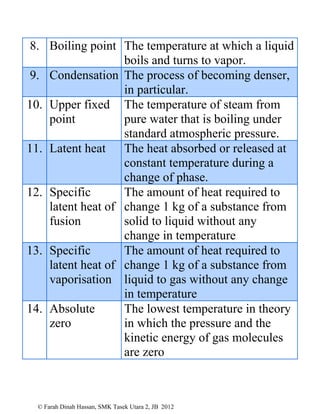
8. Boiling point The temperature at which a liquid
boils and turns to vapor.
9. Condensation The process of becoming denser,
in particular.
10. Upper fixed
point
The temperature of steam from
pure water that is boiling under
standard atmospheric pressure.
11. Latent heat The heat absorbed or released at
constant temperature during a
change of phase.
12. Specific
latent heat of
fusion
The amount of heat required to
change 1 kg of a substance from
solid to liquid without any
change in temperature
13. Specific
latent heat of
vaporisation
The amount of heat required to
change 1 kg of a substance from
liquid to gas without any change
in temperature
14. Absolute
zero
The lowest temperature in theory
in which the pressure and the
kinetic energy of gas molecules
are zero
© Farah Dinah Hassan, SMK Tasek Utara 2, JB 2012
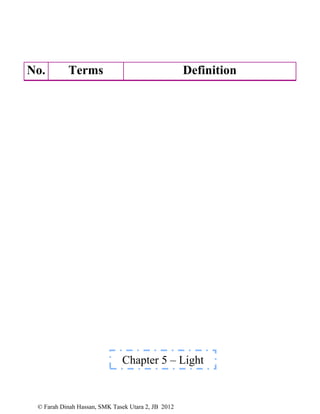
No. Terms Definition
Chapter 5 – Light
© Farah Dinah Hassan, SMK Tasek Utara 2, JB 2012
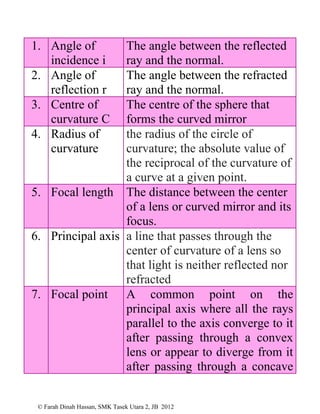
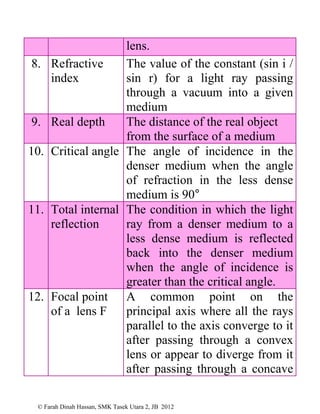
1. Angle of
incidence i
The angle between the reflected
ray and the normal.
2. Angle of
reflection r
The angle between the refracted
ray and the normal.
3. Centre of
curvature C
The centre of the sphere that
forms the curved mirror
4. Radius of
curvature
the radius of the circle of
curvature; the absolute value of
the reciprocal of the curvature of
a curve at a given point.
5. Focal length The distance between the center
of a lens or curved mirror and its
focus.
6. Principal axis a line that passes through the
center of curvature of a lens so
that light is neither reflected nor
refracted
7. Focal point A common point on the
principal axis where all the rays
parallel to the axis converge to it
after passing through a convex
lens or appear to diverge from it
after passing through a concave
© Farah Dinah Hassan, SMK Tasek Utara 2, JB 2012
lens.
8. Refractive
index
The value of the constant (sin i /
sin r) for a light ray passing
through a vacuum into a given
medium
9. Real depth The distance of the real object
from the surface of a medium
10. Critical angle The angle of incidence in the
denser medium when the angle
of refraction in the less dense
medium is 90°
11. Total internal
reflection
The condition in which the light
ray from a denser medium to a
less dense medium is reflected
back into the denser medium
when the angle of incidence is
greater than the critical angle.
12. Focal point
of a lens F
A common point on the
principal axis where all the rays
parallel to the axis converge to it
after passing through a convex
lens or appear to diverge from it
after passing through a concave
© Farah Dinah Hassan, SMK Tasek Utara 2, JB 2012
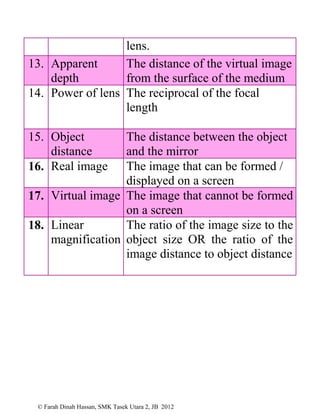
lens.
13. Apparent
depth
The distance of the virtual image
from the surface of the medium
14. Power of lens The reciprocal of the focal
length
15. Object
distance
The distance between the object
and the mirror
16. Real image The image that can be formed /
displayed on a screen
17. Virtual image The image that cannot be formed
on a screen
18. Linear
magnification
The ratio of the image size to the
object size OR the ratio of the
image distance to object distance
© Farah Dinah Hassan, SMK Tasek Utara 2, JB 2012
Chapter 6 – Waves
© Farah Dinah Hassan, SMK Tasek Utara 2, JB 2012
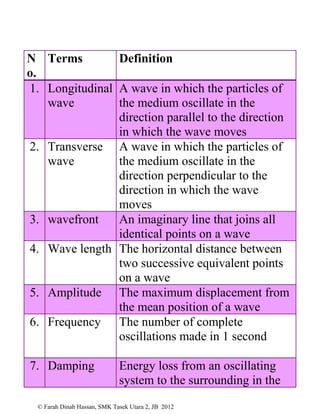
N
o.
Terms Definition
1. Longitudinal
wave
A wave in which the particles of
the medium oscillate in the
direction parallel to the direction
in which the wave moves
2. Transverse
wave
A wave in which the particles of
the medium oscillate in the
direction perpendicular to the
direction in which the wave
moves
3. wavefront An imaginary line that joins all
identical points on a wave
4. Wave length The horizontal distance between
two successive equivalent points
on a wave
5. Amplitude The maximum displacement from
the mean position of a wave
6. Frequency The number of complete
oscillations made in 1 second
7. Damping Energy loss from an oscillating
system to the surrounding in the
© Farah Dinah Hassan, SMK Tasek Utara 2, JB 2012
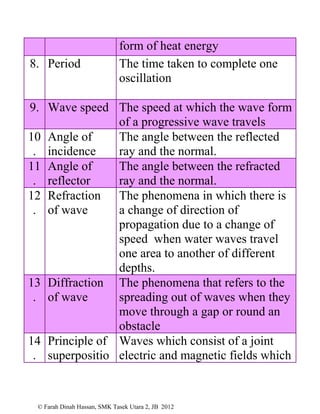
form of heat energy
8. Period The time taken to complete one
oscillation
9. Wave speed The speed at which the wave form
of a progressive wave travels
10
.
Angle of
incidence
The angle between the reflected
ray and the normal.
11
.
Angle of
reflector
The angle between the refracted
ray and the normal.
12
.
Refraction
of wave
The phenomena in which there is
a change of direction of
propagation due to a change of
speed when water waves travel
one area to another of different
depths.
13
.
Diffraction
of wave
The phenomena that refers to the
spreading out of waves when they
move through a gap or round an
obstacle
14
.
Principle of
superpositio
Waves which consist of a joint
electric and magnetic fields which
© Farah Dinah Hassan, SMK Tasek Utara 2, JB 2012
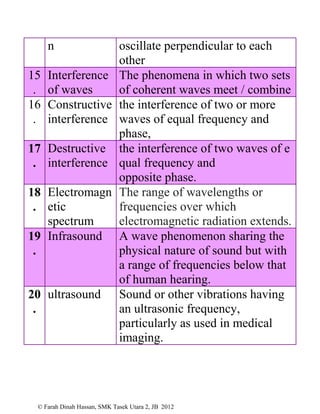
n oscillate perpendicular to each
other
15
.
Interference
of waves
The phenomena in which two sets
of coherent waves meet / combine
16
.
Constructive
interference
the interference of two or more
waves of equal frequency and
phase,
17
.
Destructive
interference
the interference of two waves of e
qual frequency and
opposite phase.
18
.
Electromagn
etic
spectrum
The range of wavelengths or
frequencies over which
electromagnetic radiation extends.
19
.
Infrasound A wave phenomenon sharing the
physical nature of sound but with
a range of frequencies below that
of human hearing.
20
.
ultrasound Sound or other vibrations having
an ultrasonic frequency,
particularly as used in medical
imaging.
© Farah Dinah Hassan, SMK Tasek Utara 2, JB 2012
Chapter 7 –
Electricity
© Farah Dinah Hassan, SMK Tasek Utara 2, JB 2012
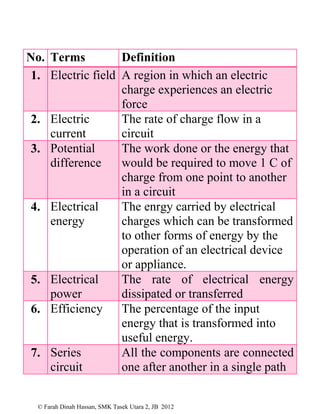
No. Terms Definition
1. Electric field A region in which an electric
charge experiences an electric
force
2. Electric
current
The rate of charge flow in a
circuit
3. Potential
difference
The work done or the energy that
would be required to move 1 C of
charge from one point to another
in a circuit
4. Electrical
energy
The enrgy carried by electrical
charges which can be transformed
to other forms of energy by the
operation of an electrical device
or appliance.
5. Electrical
power
The rate of electrical energy
dissipated or transferred
6. Efficiency The percentage of the input
energy that is transformed into
useful energy.
7. Series
circuit
All the components are connected
one after another in a single path
© Farah Dinah Hassan, SMK Tasek Utara 2, JB 2012
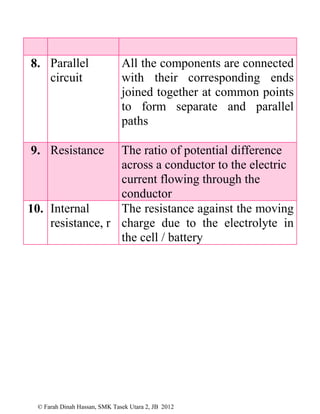
8. Parallel
circuit
All the components are connected
with their corresponding ends
joined together at common points
to form separate and parallel
paths
9. Resistance The ratio of potential difference
across a conductor to the electric
current flowing through the
conductor
10. Internal
resistance, r
The resistance against the moving
charge due to the electrolyte in
the cell / battery
© Farah Dinah Hassan, SMK Tasek Utara 2, JB 2012
Chapter 8 –
Electromagnetism
© Farah Dinah Hassan, SMK Tasek Utara 2, JB 2012
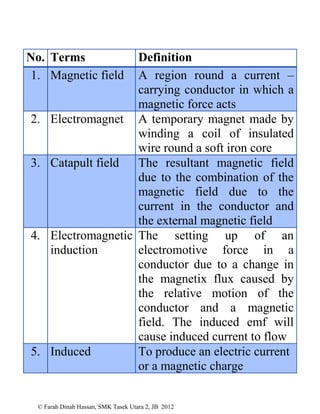
No. Terms Definition
1. Magnetic field A region round a current –
carrying conductor in which a
magnetic force acts
2. Electromagnet A temporary magnet made by
winding a coil of insulated
wire round a soft iron core
3. Catapult field The resultant magnetic field
due to the combination of the
magnetic field due to the
current in the conductor and
the external magnetic field
4. Electromagnetic
induction
The setting up of an
electromotive force in a
conductor due to a change in
the magnetix flux caused by
the relative motion of the
conductor and a magnetic
field. The induced emf will
cause induced current to flow
5. Induced To produce an electric current
or a magnetic charge
© Farah Dinah Hassan, SMK Tasek Utara 2, JB 2012
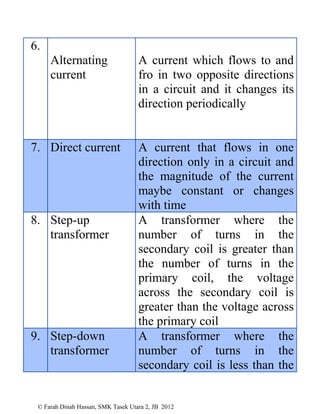
6.
Alternating
current
A current which flows to and
fro in two opposite directions
in a circuit and it changes its
direction periodically
7. Direct current A current that flows in one
direction only in a circuit and
the magnitude of the current
maybe constant or changes
with time
8. Step-up
transformer
A transformer where the
number of turns in the
secondary coil is greater than
the number of turns in the
primary coil, the voltage
across the secondary coil is
greater than the voltage across
the primary coil
9. Step-down
transformer
A transformer where the
number of turns in the
secondary coil is less than the
© Farah Dinah Hassan, SMK Tasek Utara 2, JB 2012
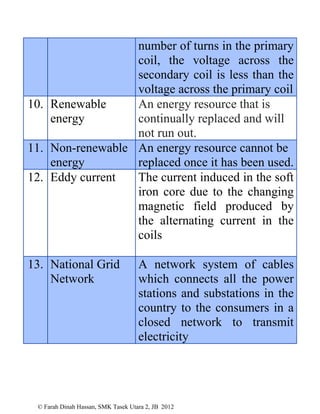
number of turns in the primary
coil, the voltage across the
secondary coil is less than the
voltage across the primary coil
10. Renewable
energy
An energy resource that is
continually replaced and will
not run out.
11. Non-renewable
energy
An energy resource cannot be
replaced once it has been used.
12. Eddy current The current induced in the soft
iron core due to the changing
magnetic field produced by
the alternating current in the
coils
13. National Grid
Network
A network system of cables
which connects all the power
stations and substations in the
country to the consumers in a
closed network to transmit
electricity
© Farah Dinah Hassan, SMK Tasek Utara 2, JB 2012
No. Terms Definition
Chapter 9 –
Electronics
© Farah Dinah Hassan, SMK Tasek Utara 2, JB 2012
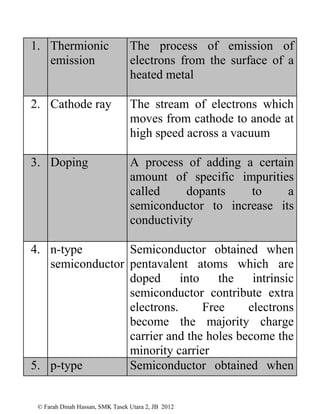
1. Thermionic
emission
The process of emission of
electrons from the surface of a
heated metal
2. Cathode ray The stream of electrons which
moves from cathode to anode at
high speed across a vacuum
3. Doping A process of adding a certain
amount of specific impurities
called dopants to a
semiconductor to increase its
conductivity
4. n-type
semiconductor
Semiconductor obtained when
pentavalent atoms which are
doped into the intrinsic
semiconductor contribute extra
electrons. Free electrons
become the majority charge
carrier and the holes become the
minority carrier
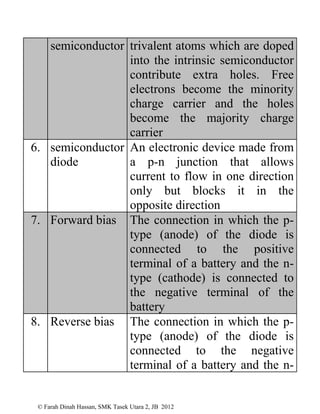
5. p-type Semiconductor obtained when
© Farah Dinah Hassan, SMK Tasek Utara 2, JB 2012
semiconductor trivalent atoms which are doped
into the intrinsic semiconductor
contribute extra holes. Free
electrons become the minority
charge carrier and the holes
become the majority charge
carrier
6. semiconductor
diode
An electronic device made from
a p-n junction that allows
current to flow in one direction
only but blocks it in the
opposite direction
7. Forward bias The connection in which the p-
type (anode) of the diode is
connected to the positive
terminal of a battery and the n-
type (cathode) is connected to
the negative terminal of the
battery
8. Reverse bias The connection in which the p-
type (anode) of the diode is
connected to the negative
terminal of a battery and the n-
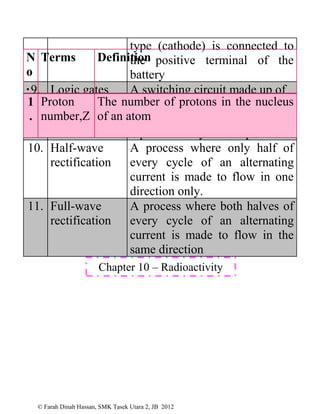
© Farah Dinah Hassan, SMK Tasek Utara 2, JB 2012
type (cathode) is connected to
the positive terminal of the
battery
9. Logic gates A switching circuit made up of
a combination of transistor
switches which has one or more
inputs but only one output
10. Half-wave
rectification
A process where only half of
every cycle of an alternating
current is made to flow in one
direction only.
11. Full-wave
rectification
A process where both halves of
every cycle of an alternating
current is made to flow in the
same direction
N
o
.
Terms Definition
1
.
Proton
number,Z
The number of protons in the nucleus
of an atom
Chapter 10 – Radioactivity
© Farah Dinah Hassan, SMK Tasek Utara 2, JB 2012
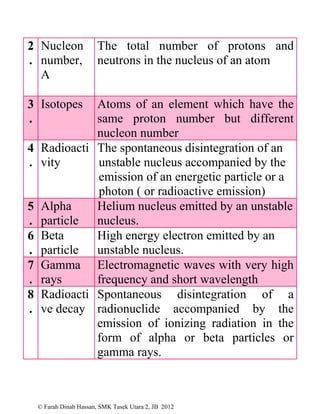
2
.
Nucleon
number,
A
The total number of protons and
neutrons in the nucleus of an atom
3
.
Isotopes Atoms of an element which have the
same proton number but different
nucleon number
4
.
Radioacti
vity
The spontaneous disintegration of an
unstable nucleus accompanied by the
emission of an energetic particle or a
photon ( or radioactive emission)
5
.
Alpha
particle
Helium nucleus emitted by an unstable
nucleus.
6
.
Beta
particle
High energy electron emitted by an
unstable nucleus.
7
.
Gamma
rays
Electromagnetic waves with very high
frequency and short wavelength
8
.
Radioacti
ve decay
Spontaneous disintegration of a
radionuclide accompanied by the
emission of ionizing radiation in the
form of alpha or beta particles or
gamma rays.
© Farah Dinah Hassan, SMK Tasek Utara 2, JB 2012
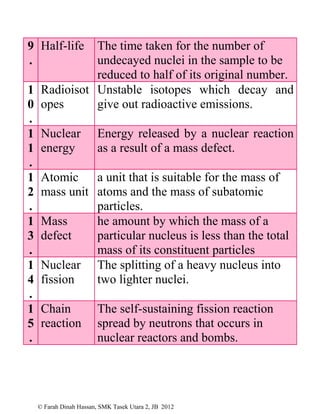
9
.
Half-life The time taken for the number of
undecayed nuclei in the sample to be
reduced to half of its original number.
1
0
.
Radioisot
opes
Unstable isotopes which decay and
give out radioactive emissions.
1
1
.
Nuclear
energy
Energy released by a nuclear reaction
as a result of a mass defect.
1
2
.
Atomic
mass unit
a unit that is suitable for the mass of
atoms and the mass of subatomic
particles.
1
3
.
Mass
defect
he amount by which the mass of a
particular nucleus is less than the total
mass of its constituent particles
1
4
.
Nuclear
fission
The splitting of a heavy nucleus into
two lighter nuclei.
1
5
.
Chain
reaction
The self-sustaining fission reaction
spread by neutrons that occurs in
nuclear reactors and bombs.
© Farah Dinah Hassan, SMK Tasek Utara 2, JB 2012
Physics Pocket Notes
By
Farah Dinah Hassan
5 Hibiscus

Pocket Notes Physics

  • 1.
    © Farah DinahHassan, SMK Tasek Utara 2, JB 2012 No. Terms Definition 1. Physical quantities Quantities that can be measured 2. Base quantities Physical quantities that cannot be defined in terms of other quantities 3. Derived quantities Physical quantity obtained from the combination of base quantities through multiplication or division or both. 4. Scalar quantities Physical quantities that have both magnitude and direction 5. Vector quantities Physical quantities that have magnitude only 6. Consistency The ability (of a measuring instrument) to measure a quantity with little or no deviation among the measurements 7. Accuracy The closeness of a measurement Chapter 1 – Introduction To Physics
  • 2.
    © Farah DinahHassan, SMK Tasek Utara 2, JB 2012 to the actual value 8. Sensitivity The ability (of a measuring instrument) to detect a small change in the quantity to be measured 9. Systematic error Errors in the calibration of instruments or the non-zero reading when the actual reading should be zero 10. Random error Errors due to the mistakes made by the observer when taking 11. Parallax error Error due to the incorrect positioning of the eye when reading a measurement 12. Zero erroe The non-zero reading when the actual reading should be zero that is the pointer of the instrument does not return to the zero position when it is not being used
  • 3.
    © Farah DinahHassan, SMK Tasek Utara 2, JB 2012 Chapter 2 – Force And Motion
  • 4.
    © Farah DinahHassan, SMK Tasek Utara 2, JB 2012 No. Terms Definition 1. Distance The total path length travelled from one location to the other 2. Displacement The distance between two locations measured along the shortest path connecting them in a specified direction 3. Speed Rate of change of distance OR Distance travelled per unit time 4. Velocity Rate of change of displacement 5. Acceleration Rate of change of velocity 6. Average velocity displacement over total time 7. Average speed The rate of movement. 8. Inertia The tendency of the object to remain at rest or if moving to comtinue its motion 9. Momentum Product of mass and velocity
  • 5.
    © Farah DinahHassan, SMK Tasek Utara 2, JB 2012 10. Principle of conservation of momentum In a closed system, the total momentum before collision is equal to the total momentum after collision provided there is no external force 11. Force Push or pull upon an object resulting from the object's interaction with another object. 12. Impulse Change in momentum 13. Impulsive force The rate of change of momentum. 14. Free falling The motion in which the object falls due to gravitational force only 15. Weight The gravitational force acting on the object 16. Mass The quantity of matter in an object 17. Resultant force A single force that represents the combined effect of two or more forces with magnitude and
  • 6.
    © Farah DinahHassan, SMK Tasek Utara 2, JB 2012 direction 18. Equilibrium force Situation in which forces acting on an object produces no net force. The object is satationary or moves with a constant velocity in a straight line. 19. Work done The product of the applied force and the displacement in the direction of the applied force 20. Energy The ability to do work 21. Kinetic energy The energy of an object due to its motion 22. Gravitational potential energy The energy of an object due to its higher position in the gravitational field 23. Principle of Conservation of energy Energy cannot be created or destroyed. Energy can be transformed from one form to another.The total energy in a closed system is constant . 24. Power The rate at which work is done
  • 7.
    © Farah DinahHassan, SMK Tasek Utara 2, JB 2012 OR the amount of work done per second 25. Efficiency The percentage of the energy input that is transformed into useful energy 26. Elasticity The ability of an object to return to its original size / length / shape when the force that is acting on it is removed. 27. Spring constant Force per unit extension 28. Elastic potential energy The energy stored in an object when it is stretched or compressed 29. Gravitational field The region around the earth which an object experiences a force towards the centre of earth. No. Terms Definition Chapter 3 – Force And Pressure
  • 8.
    © Farah DinahHassan, SMK Tasek Utara 2, JB 2012 1. Density Mass per unit volume 2. Pressure Magnitude of force acting perpendicularly to a surface per unit area of the surface 3. Pressure in liquid 4. Atmosphere Pressure The pressure due to the weight of the air acting per unit area on the earth’s surface 5. Gas Pressure the pressure exerted by a gas. 6. Buoyant Force The upward force exerted by a fluid when an object is wholly or partially immersed in the fluid 7. Lift Force The upward force produced when fluid rises over a particle.
  • 9.
    © Farah DinahHassan, SMK Tasek Utara 2, JB 2012 No. Terms Definition 1. Temperature The measure of the degree of hotness of an object. 2. Heat the forms of energy. 3. Thermal equilibrium The situation in which two objects which are in thermal contact have the same rate of heat transfer and the same temperature The NET heat flow between the two objects is zero. 4. Specific heat capacity The amount of heat that must be supplied to an object of mass 1 kg to increase its temperature by 1°C 5. Melting point The temperature at which a given solid will melt. 6. Lower fixed point The temperature at which pure ice melts under the standard atmospheric pressure. 7. Solidifies Make or become hard or solid. Chapter 4 – Heat
  • 10.
    © Farah DinahHassan, SMK Tasek Utara 2, JB 2012 8. Boiling point The temperature at which a liquid boils and turns to vapor. 9. Condensation The process of becoming denser, in particular. 10. Upper fixed point The temperature of steam from pure water that is boiling under standard atmospheric pressure. 11. Latent heat The heat absorbed or released at constant temperature during a change of phase. 12. Specific latent heat of fusion The amount of heat required to change 1 kg of a substance from solid to liquid without any change in temperature 13. Specific latent heat of vaporisation The amount of heat required to change 1 kg of a substance from liquid to gas without any change in temperature 14. Absolute zero The lowest temperature in theory in which the pressure and the kinetic energy of gas molecules are zero
  • 11.
    © Farah DinahHassan, SMK Tasek Utara 2, JB 2012 No. Terms Definition Chapter 5 – Light
  • 12.
    © Farah DinahHassan, SMK Tasek Utara 2, JB 2012 1. Angle of incidence i The angle between the reflected ray and the normal. 2. Angle of reflection r The angle between the refracted ray and the normal. 3. Centre of curvature C The centre of the sphere that forms the curved mirror 4. Radius of curvature the radius of the circle of curvature; the absolute value of the reciprocal of the curvature of a curve at a given point. 5. Focal length The distance between the center of a lens or curved mirror and its focus. 6. Principal axis a line that passes through the center of curvature of a lens so that light is neither reflected nor refracted 7. Focal point A common point on the principal axis where all the rays parallel to the axis converge to it after passing through a convex lens or appear to diverge from it after passing through a concave
  • 13.
    © Farah DinahHassan, SMK Tasek Utara 2, JB 2012 lens. 8. Refractive index The value of the constant (sin i / sin r) for a light ray passing through a vacuum into a given medium 9. Real depth The distance of the real object from the surface of a medium 10. Critical angle The angle of incidence in the denser medium when the angle of refraction in the less dense medium is 90° 11. Total internal reflection The condition in which the light ray from a denser medium to a less dense medium is reflected back into the denser medium when the angle of incidence is greater than the critical angle. 12. Focal point of a lens F A common point on the principal axis where all the rays parallel to the axis converge to it after passing through a convex lens or appear to diverge from it after passing through a concave
  • 14.
    © Farah DinahHassan, SMK Tasek Utara 2, JB 2012 lens. 13. Apparent depth The distance of the virtual image from the surface of the medium 14. Power of lens The reciprocal of the focal length 15. Object distance The distance between the object and the mirror 16. Real image The image that can be formed / displayed on a screen 17. Virtual image The image that cannot be formed on a screen 18. Linear magnification The ratio of the image size to the object size OR the ratio of the image distance to object distance
  • 15.
    © Farah DinahHassan, SMK Tasek Utara 2, JB 2012 Chapter 6 – Waves
  • 16.
    © Farah DinahHassan, SMK Tasek Utara 2, JB 2012 N o. Terms Definition 1. Longitudinal wave A wave in which the particles of the medium oscillate in the direction parallel to the direction in which the wave moves 2. Transverse wave A wave in which the particles of the medium oscillate in the direction perpendicular to the direction in which the wave moves 3. wavefront An imaginary line that joins all identical points on a wave 4. Wave length The horizontal distance between two successive equivalent points on a wave 5. Amplitude The maximum displacement from the mean position of a wave 6. Frequency The number of complete oscillations made in 1 second 7. Damping Energy loss from an oscillating system to the surrounding in the
  • 17.
    © Farah DinahHassan, SMK Tasek Utara 2, JB 2012 form of heat energy 8. Period The time taken to complete one oscillation 9. Wave speed The speed at which the wave form of a progressive wave travels 10 . Angle of incidence The angle between the reflected ray and the normal. 11 . Angle of reflector The angle between the refracted ray and the normal. 12 . Refraction of wave The phenomena in which there is a change of direction of propagation due to a change of speed when water waves travel one area to another of different depths. 13 . Diffraction of wave The phenomena that refers to the spreading out of waves when they move through a gap or round an obstacle 14 . Principle of superpositio Waves which consist of a joint electric and magnetic fields which
  • 18.
    © Farah DinahHassan, SMK Tasek Utara 2, JB 2012 n oscillate perpendicular to each other 15 . Interference of waves The phenomena in which two sets of coherent waves meet / combine 16 . Constructive interference the interference of two or more waves of equal frequency and phase, 17 . Destructive interference the interference of two waves of e qual frequency and opposite phase. 18 . Electromagn etic spectrum The range of wavelengths or frequencies over which electromagnetic radiation extends. 19 . Infrasound A wave phenomenon sharing the physical nature of sound but with a range of frequencies below that of human hearing. 20 . ultrasound Sound or other vibrations having an ultrasonic frequency, particularly as used in medical imaging.
  • 19.
    © Farah DinahHassan, SMK Tasek Utara 2, JB 2012 Chapter 7 – Electricity
  • 20.
    © Farah DinahHassan, SMK Tasek Utara 2, JB 2012 No. Terms Definition 1. Electric field A region in which an electric charge experiences an electric force 2. Electric current The rate of charge flow in a circuit 3. Potential difference The work done or the energy that would be required to move 1 C of charge from one point to another in a circuit 4. Electrical energy The enrgy carried by electrical charges which can be transformed to other forms of energy by the operation of an electrical device or appliance. 5. Electrical power The rate of electrical energy dissipated or transferred 6. Efficiency The percentage of the input energy that is transformed into useful energy. 7. Series circuit All the components are connected one after another in a single path
  • 21.
    © Farah DinahHassan, SMK Tasek Utara 2, JB 2012 8. Parallel circuit All the components are connected with their corresponding ends joined together at common points to form separate and parallel paths 9. Resistance The ratio of potential difference across a conductor to the electric current flowing through the conductor 10. Internal resistance, r The resistance against the moving charge due to the electrolyte in the cell / battery
  • 22.
    © Farah DinahHassan, SMK Tasek Utara 2, JB 2012 Chapter 8 – Electromagnetism
  • 23.
    © Farah DinahHassan, SMK Tasek Utara 2, JB 2012 No. Terms Definition 1. Magnetic field A region round a current – carrying conductor in which a magnetic force acts 2. Electromagnet A temporary magnet made by winding a coil of insulated wire round a soft iron core 3. Catapult field The resultant magnetic field due to the combination of the magnetic field due to the current in the conductor and the external magnetic field 4. Electromagnetic induction The setting up of an electromotive force in a conductor due to a change in the magnetix flux caused by the relative motion of the conductor and a magnetic field. The induced emf will cause induced current to flow 5. Induced To produce an electric current or a magnetic charge
  • 24.
    © Farah DinahHassan, SMK Tasek Utara 2, JB 2012 6. Alternating current A current which flows to and fro in two opposite directions in a circuit and it changes its direction periodically 7. Direct current A current that flows in one direction only in a circuit and the magnitude of the current maybe constant or changes with time 8. Step-up transformer A transformer where the number of turns in the secondary coil is greater than the number of turns in the primary coil, the voltage across the secondary coil is greater than the voltage across the primary coil 9. Step-down transformer A transformer where the number of turns in the secondary coil is less than the
  • 25.
    © Farah DinahHassan, SMK Tasek Utara 2, JB 2012 number of turns in the primary coil, the voltage across the secondary coil is less than the voltage across the primary coil 10. Renewable energy An energy resource that is continually replaced and will not run out. 11. Non-renewable energy An energy resource cannot be replaced once it has been used. 12. Eddy current The current induced in the soft iron core due to the changing magnetic field produced by the alternating current in the coils 13. National Grid Network A network system of cables which connects all the power stations and substations in the country to the consumers in a closed network to transmit electricity
  • 26.
    © Farah DinahHassan, SMK Tasek Utara 2, JB 2012 No. Terms Definition Chapter 9 – Electronics
  • 27.
    © Farah DinahHassan, SMK Tasek Utara 2, JB 2012 1. Thermionic emission The process of emission of electrons from the surface of a heated metal 2. Cathode ray The stream of electrons which moves from cathode to anode at high speed across a vacuum 3. Doping A process of adding a certain amount of specific impurities called dopants to a semiconductor to increase its conductivity 4. n-type semiconductor Semiconductor obtained when pentavalent atoms which are doped into the intrinsic semiconductor contribute extra electrons. Free electrons become the majority charge carrier and the holes become the minority carrier 5. p-type Semiconductor obtained when
  • 28.
    © Farah DinahHassan, SMK Tasek Utara 2, JB 2012 semiconductor trivalent atoms which are doped into the intrinsic semiconductor contribute extra holes. Free electrons become the minority charge carrier and the holes become the majority charge carrier 6. semiconductor diode An electronic device made from a p-n junction that allows current to flow in one direction only but blocks it in the opposite direction 7. Forward bias The connection in which the p- type (anode) of the diode is connected to the positive terminal of a battery and the n- type (cathode) is connected to the negative terminal of the battery 8. Reverse bias The connection in which the p- type (anode) of the diode is connected to the negative terminal of a battery and the n-
  • 29.
    © Farah DinahHassan, SMK Tasek Utara 2, JB 2012 type (cathode) is connected to the positive terminal of the battery 9. Logic gates A switching circuit made up of a combination of transistor switches which has one or more inputs but only one output 10. Half-wave rectification A process where only half of every cycle of an alternating current is made to flow in one direction only. 11. Full-wave rectification A process where both halves of every cycle of an alternating current is made to flow in the same direction N o . Terms Definition 1 . Proton number,Z The number of protons in the nucleus of an atom Chapter 10 – Radioactivity
  • 30.
    © Farah DinahHassan, SMK Tasek Utara 2, JB 2012 2 . Nucleon number, A The total number of protons and neutrons in the nucleus of an atom 3 . Isotopes Atoms of an element which have the same proton number but different nucleon number 4 . Radioacti vity The spontaneous disintegration of an unstable nucleus accompanied by the emission of an energetic particle or a photon ( or radioactive emission) 5 . Alpha particle Helium nucleus emitted by an unstable nucleus. 6 . Beta particle High energy electron emitted by an unstable nucleus. 7 . Gamma rays Electromagnetic waves with very high frequency and short wavelength 8 . Radioacti ve decay Spontaneous disintegration of a radionuclide accompanied by the emission of ionizing radiation in the form of alpha or beta particles or gamma rays.
  • 31.
    © Farah DinahHassan, SMK Tasek Utara 2, JB 2012 9 . Half-life The time taken for the number of undecayed nuclei in the sample to be reduced to half of its original number. 1 0 . Radioisot opes Unstable isotopes which decay and give out radioactive emissions. 1 1 . Nuclear energy Energy released by a nuclear reaction as a result of a mass defect. 1 2 . Atomic mass unit a unit that is suitable for the mass of atoms and the mass of subatomic particles. 1 3 . Mass defect he amount by which the mass of a particular nucleus is less than the total mass of its constituent particles 1 4 . Nuclear fission The splitting of a heavy nucleus into two lighter nuclei. 1 5 . Chain reaction The self-sustaining fission reaction spread by neutrons that occurs in nuclear reactors and bombs.
  • 32.
    © Farah DinahHassan, SMK Tasek Utara 2, JB 2012 Physics Pocket Notes By Farah Dinah Hassan 5 Hibiscus