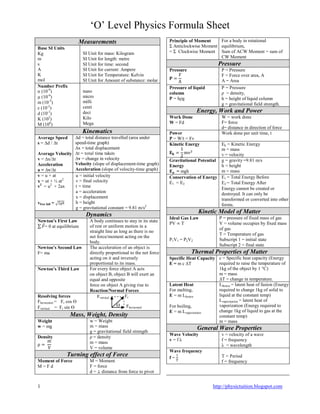
‘O’ Level Physics Formula Sheet
                         Measurements                                 Principle of Moment    For a body in rotational
Base SI Units                                                         Σ Anticlockwise Moment equilibrium,
Kg                        SI Unit for mass: Kilogram                  = Σ Clockwise Moment Sum of ACW Moment = sum of
m                         SI Unit for length: metre                                          CW Moment
                                                                                                Pressure
                                                                           F
s                         SI Unit for time: second


                                                                       =
A                         SI Unit for current: Ampere                 Pressure                   P = Pressure

                                                                           A
K                         SI Unit for Temperature: Kelvin                                        F = Force over area, A
mol                       SI Unit for Amount of substance: molar                                 A = Area
Number Prefix                                                         Pressure of liquid         P = Pressure
n (10-9)                  nano                                        column                     ρ = density,
µ (10-6)                  micro                                       P = hρg                    h = height of liquid column
m (10-3)                  milli
                                                                                                 g = gravitational field strength.
c (10-2)                  centi
d (10-1)                  deci                                                      Energy, Work and Power
K (103)                   Kilo                                        Work Done                  W = work done
M (106)                   Mega                                        W = Fd                     F= force
                                                                                                 d= distance in direction of force
                          Kinematics                                  Power                      Work done per unit time, t
                   ∆d = total distance travelled (area under

                                                                            1
Average Speed                                                         P = W/t = Fv


                                                                       = mv 2
s = ∆d / ∆t        speed-time graph)                                  Kinetic Energy             Ek = Kinetic Energy

                                                                            2
                   ∆x = total displacement                                                       m = mass
Average Velocity ∆t = total time taken                                                           v = velocity
v = ∆x/∆t          ∆v = change in velocity                            Gravitational Potential    g = gravity =9.81 m/s
Acceleration       Velocity (slope of displacement-time graph)        Energy                     h = height
a = ∆v/∆t          Acceleration (slope of velocity-time graph)        Ep = mgh                   m = mass
v = u + at         u = initial velocity                               Conservation of Energy     E1 = Total Energy Before
x = ut + ½ at2     v = final velocity                                 E1 = E2                    E2 = Total Energy After
v2 = u2 + 2ax      t = time
                                                                                                 Energy cannot be created or
                   a = acceleration                                                              destroyed. It can only be
vfree fall = �2ℎ
                   x = displacement
                                                                                                 transformed or converted into other
                   h = height
                                                                                                 forms.
                   g = gravitational constant = 9.81 m/s2
                           Dynamics                                                 Kinetic Model of Matter

   ⃑
∑ = 0 at equilibrium
                                                                      Ideal Gas Law             P = pressure of fixed mass of gas
Newton’s First Law           A body continues to stay in its state
                                                                      PV ∞ T                    V = volume occupies by fixed mass
                             of rest or uniform motion in a
                                                                                                of gas
                             straight line as long as there is no
                                                                                                T = Temperature of gas
                             net force/moment acting on the
                                                                      P1V1 = P2V2               Subscript 1 = initial state
                             body.
                                                                                                Subscript 2 = final state
Newton’s Second Law          The acceleration of an object is
F= ma                        directly proportional to the net force              Thermal Properties of Matter
                             acting on it and inversely               Specific Heat Capacity c = Specific heat capacity (Energy
                             proportional to its mass.                E = m c ∆T             required to raise the temperature of
Newton’s Third Law           For every force object A acts                                   1kg of the object by 1 °C)
                             on object B, object B will exert an                             m = mass
                             equal and opposite                                              ∆T = change in temperature.
                             force on object A giving rise to         Latent Heat            Lfusion = latent heat of fusion (Energy
                             Reaction/Normal Forces                   For melting,           required to change 1kg of solid to
Resolving forces                 Fvertical       Fr                   E = m Lfusion          liquid at the constant temp)
Fhorizontal = Fr cos Ө                                                                       Lvaporization = latent heat of
Fvertical = Fr sin Ө                       Ө     Fhorizontal          For boiling,           vaporization (Energy required to
                                                                      E = m Lvaporization    change 1kg of liquid to gas at the
                  Mass, Weight, Density                                                      constant temp)
Weight                       w = Weight                                                      m = mass
w = mg                       m = mass                                               General Wave Properties

    m
                             g = gravitational field strength

ρ=
                                                                      Wave Velocity              v = velocity of a wave
                             ρ = density

    V
Density
                                                                      v=fλ                       f = frequency
                             m = mass
                                                                                                 λ = wavelength

                                                                         1
                             V = volume
                                                                      Wave frequency
                                                                         T
                Turning effect of Force                               f=                         T = Period


                             d = ⊥ distance from force to pivot
Moment of Force              M = Moment                                                          f = frequency
M=Fd                         F = force


1                                                                                           http://physictuition.blogspot.com
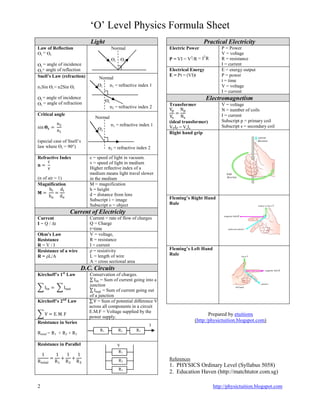
‘O’ Level Physics Formula Sheet
                           Light                                                     Practical Electricity
Law of Reflection                         Normal                    Electric Power            P = Power
Өi = Өr                                                                                       V = voltage
                                                                                     2
                                          Өi    Өr                  P = VI = V2/R = I R       R = resistance
Өi = angle of incidence                                                                       I = current
Өr= angle of reflection                                             Electrical Energy         E = energy output
Snell’s Law (refraction)                                            E = Pt = (VI)t            P = power
                                Normal
                                                                                              t = time
n1Sin Өi = n2Sin Өr            Өi         n1 = refractive index 1                             V = voltage
                                                                                              I = current
Өi = angle of incidence                                                                 Electromagnetism
                                                                    Vp Np
                                     Өr

                                                                       =
Өr = angle of refraction                                            Transformer               V = voltage

                                                                    Vs Ns
                                          n2 = refractive index 2
                                                                                              N = number of coils

           n2
Critical angle                                                                                I = current

sin  =
                              Normal

           n1
                                                                    (ideal transformer)       Subscript p = primary coil
                                          n1 = refractive index 1   VPIP = VsIs               Subscript s = secondary coil
                               Өc
                                                                    Right hand grip
(special case of Snell’s
law where Өr = 90°)                   n2 = refractive index 2

     c
 =
     v
Refractive Index           c = speed of light in vacuum.
                           v = speed of light in medium
                           Higher reflective index of a
                           medium means light travel slower
(n of air ≈ 1)

       hi    di
                           in the medium


 =      =
Magnification              M = magnification

      ho do
                           h = height
                           d = distance from lens
                           Subscript i = image                      Fleming’s Right Hand
                           Subscript o = object                     Rule
                  Current of Electricity
Current                    Current = rate of flow of charges
I = Q / ∆t                 Q = Charge
                           t=time
Ohm’s Law                  V = voltage,
Resistance                 R = resistance
R=V/I                      I = current
Resistance of a wire       ρ = resistivity                          Fleming’s Left Hand
R = ρL/A                   L = length of wire                       Rule
                           A = cross sectional area
                        D.C. Circuits
                           ∑ Iin = Sum of current going into a
Kirchoff’s 1st Law         Conservation of charges.

� Iin = � Iout
                           ∑ Iout = Sum of current going out
                           junction


                           ∑ V = Sum of potential difference V
                           of a junction
Kirchoff’s 2nd Law

� V = E. M. F
                           across all components in a circuit
                           E.M.F = Voltage supplied by the
                           power supply.
                                                                                        Prepared by etuitionx
Resistance in Series                                                             (http:/physictuition.blogspot.com)
                                                               I
                                R1             R2       R3
Rtotal = R1 + R2 + R3


   1     1   1   1
Resistance in Parallel                         V


       =   +   +
R total R1 R 2 R 3
                                               R1

                                               R2                   References
                                                                    1. PHYSICS Ordinary Level (Syllabus 5058)
                                               R3
                                                                    2. Education Haven (http://matchtutor.com.sg)

2                                                                                         http://physictuition.blogspot.com

O level physics formula sheet

  • 1.
    ‘O’ Level PhysicsFormula Sheet Measurements Principle of Moment For a body in rotational Base SI Units Σ Anticlockwise Moment equilibrium, Kg SI Unit for mass: Kilogram = Σ Clockwise Moment Sum of ACW Moment = sum of m SI Unit for length: metre CW Moment Pressure F s SI Unit for time: second = A SI Unit for current: Ampere Pressure P = Pressure A K SI Unit for Temperature: Kelvin F = Force over area, A mol SI Unit for Amount of substance: molar A = Area Number Prefix Pressure of liquid P = Pressure n (10-9) nano column ρ = density, µ (10-6) micro P = hρg h = height of liquid column m (10-3) milli g = gravitational field strength. c (10-2) centi d (10-1) deci Energy, Work and Power K (103) Kilo Work Done W = work done M (106) Mega W = Fd F= force d= distance in direction of force Kinematics Power Work done per unit time, t ∆d = total distance travelled (area under 1 Average Speed P = W/t = Fv = mv 2 s = ∆d / ∆t speed-time graph) Kinetic Energy Ek = Kinetic Energy 2 ∆x = total displacement m = mass Average Velocity ∆t = total time taken v = velocity v = ∆x/∆t ∆v = change in velocity Gravitational Potential g = gravity =9.81 m/s Acceleration Velocity (slope of displacement-time graph) Energy h = height a = ∆v/∆t Acceleration (slope of velocity-time graph) Ep = mgh m = mass v = u + at u = initial velocity Conservation of Energy E1 = Total Energy Before x = ut + ½ at2 v = final velocity E1 = E2 E2 = Total Energy After v2 = u2 + 2ax t = time Energy cannot be created or a = acceleration destroyed. It can only be vfree fall = �2ℎ x = displacement transformed or converted into other h = height forms. g = gravitational constant = 9.81 m/s2 Dynamics Kinetic Model of Matter ⃑ ∑ = 0 at equilibrium Ideal Gas Law P = pressure of fixed mass of gas Newton’s First Law A body continues to stay in its state PV ∞ T V = volume occupies by fixed mass of rest or uniform motion in a of gas straight line as long as there is no T = Temperature of gas net force/moment acting on the P1V1 = P2V2 Subscript 1 = initial state body. Subscript 2 = final state Newton’s Second Law The acceleration of an object is F= ma directly proportional to the net force Thermal Properties of Matter acting on it and inversely Specific Heat Capacity c = Specific heat capacity (Energy proportional to its mass. E = m c ∆T required to raise the temperature of Newton’s Third Law For every force object A acts 1kg of the object by 1 °C) on object B, object B will exert an m = mass equal and opposite ∆T = change in temperature. force on object A giving rise to Latent Heat Lfusion = latent heat of fusion (Energy Reaction/Normal Forces For melting, required to change 1kg of solid to Resolving forces Fvertical Fr E = m Lfusion liquid at the constant temp) Fhorizontal = Fr cos Ө Lvaporization = latent heat of Fvertical = Fr sin Ө Ө Fhorizontal For boiling, vaporization (Energy required to E = m Lvaporization change 1kg of liquid to gas at the Mass, Weight, Density constant temp) Weight w = Weight m = mass w = mg m = mass General Wave Properties m g = gravitational field strength ρ= Wave Velocity v = velocity of a wave ρ = density V Density v=fλ f = frequency m = mass λ = wavelength 1 V = volume Wave frequency T Turning effect of Force f= T = Period d = ⊥ distance from force to pivot Moment of Force M = Moment f = frequency M=Fd F = force 1 http://physictuition.blogspot.com
  • 2.
    ‘O’ Level PhysicsFormula Sheet Light Practical Electricity Law of Reflection Normal Electric Power P = Power Өi = Өr V = voltage 2 Өi Өr P = VI = V2/R = I R R = resistance Өi = angle of incidence I = current Өr= angle of reflection Electrical Energy E = energy output Snell’s Law (refraction) E = Pt = (VI)t P = power Normal t = time n1Sin Өi = n2Sin Өr Өi n1 = refractive index 1 V = voltage I = current Өi = angle of incidence Electromagnetism Vp Np Өr = Өr = angle of refraction Transformer V = voltage Vs Ns n2 = refractive index 2 N = number of coils n2 Critical angle I = current sin = Normal n1 (ideal transformer) Subscript p = primary coil n1 = refractive index 1 VPIP = VsIs Subscript s = secondary coil Өc Right hand grip (special case of Snell’s law where Өr = 90°) n2 = refractive index 2 c = v Refractive Index c = speed of light in vacuum. v = speed of light in medium Higher reflective index of a medium means light travel slower (n of air ≈ 1) hi di in the medium = = Magnification M = magnification ho do h = height d = distance from lens Subscript i = image Fleming’s Right Hand Subscript o = object Rule Current of Electricity Current Current = rate of flow of charges I = Q / ∆t Q = Charge t=time Ohm’s Law V = voltage, Resistance R = resistance R=V/I I = current Resistance of a wire ρ = resistivity Fleming’s Left Hand R = ρL/A L = length of wire Rule A = cross sectional area D.C. Circuits ∑ Iin = Sum of current going into a Kirchoff’s 1st Law Conservation of charges. � Iin = � Iout ∑ Iout = Sum of current going out junction ∑ V = Sum of potential difference V of a junction Kirchoff’s 2nd Law � V = E. M. F across all components in a circuit E.M.F = Voltage supplied by the power supply. Prepared by etuitionx Resistance in Series (http:/physictuition.blogspot.com) I R1 R2 R3 Rtotal = R1 + R2 + R3 1 1 1 1 Resistance in Parallel V = + + R total R1 R 2 R 3 R1 R2 References 1. PHYSICS Ordinary Level (Syllabus 5058) R3 2. Education Haven (http://matchtutor.com.sg) 2 http://physictuition.blogspot.com