How to Use This Presentation To View the presentation as a slideshow with effects  select  “View”  on the menu bar and click on  “Slide Show.” To advance through the presentation, click the right-arrow key or the space bar. From the resources slide, click on any resource to see a presentation for that resource. From the Chapter menu screen click on any lesson to go directly to that lesson’s presentation. You may exit the slide show at any time by pressing  the  Esc  key.
Chapter Presentation Transparencies Sample Problems Visual Concepts Standardized Test Prep Resources
Table of Contents Section 1  Electricity from Magnetism Section 2  Generators, Motors, and Mutual Inductance Section 3  AC Circuits and Transformers Section 4  Electromagnetic Waves Electromagnetic Induction Chapter  20
Objectives Recognize   that relative motion between a conductor and a magnetic field induces an emf in the conductor. Describe  how the change in the number of magnetic field lines through a circuit loop affects the magnitude and direction of the induced electric current. Apply   Lenz’s law and Faraday’s law of induction to solve problems involving induced emf and current. Section 1  Electricity from Magnetism Chapter  20
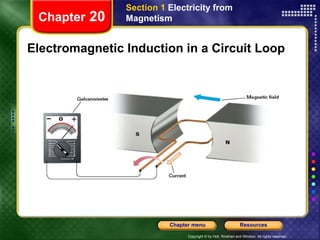
Electromagnetic Induction Electromagnetic induction   is the process of creating a current in a circuit by a changing magnetic field. A  change in the magnetic flux  through a conductor induces an electric current in the conductor. The  separation of charges  by the magnetic force induces an emf. Section 1  Electricity from Magnetism Chapter  20
Electromagnetic Induction in a Circuit Loop Chapter  20 Section 1  Electricity from Magnetism
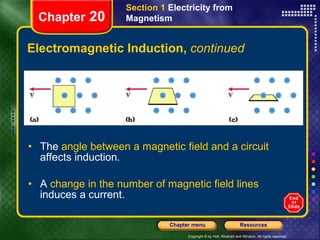
Electromagnetic Induction,  continued The  angle between a magnetic field and a circuit  affects induction. A  change in the number of magnetic field lines  induces a current. Section 1  Electricity from Magnetism Chapter  20
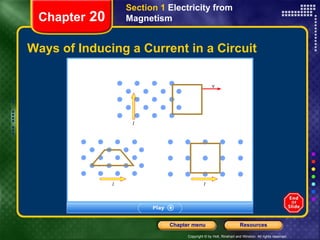
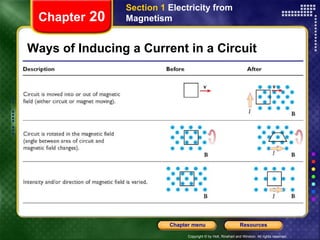
Ways of Inducing a Current in a Circuit Chapter  20 Section 1  Electricity from Magnetism
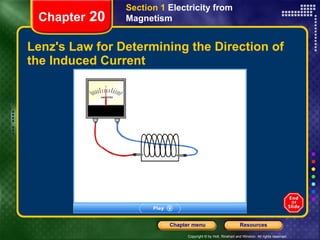
Characteristics of Induced Current Lenz’s Law The magnetic field of the induced current is in a direction to produce a field that opposes the change causing it. Note:   the induced current does not oppose the applied field, but rather the  change  in the applied field. Section 1  Electricity from Magnetism Chapter  20
Lenz's Law for Determining the Direction of the Induced Current Chapter  20 Section 1  Electricity from Magnetism
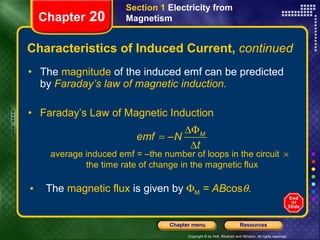
Characteristics of Induced Current,  continued The  magnitude  of the induced emf can be predicted by   Faraday’s law of magnetic induction. Faraday’s Law of Magnetic Induction Section 1  Electricity from Magnetism Chapter  20 The  magnetic flux  is given by   M  = AB cos 
Sample Problem Induced emf and Current A coil with 25 turns of wire is wrapped around a hollow tube with an area of 1.8 m 2 . Each turn has the same area as the tube. A uniform magnetic field is applied at a right angle to the plane of the coil. If the field increases uniformly from 0.00 T to 0.55 T in 0.85 s, find the magnitude of the induced emf in the coil. If the resistance in the coil is 2.5 Ω, find the magnitude of the induced current in the coil. Section 1  Electricity from Magnetism Chapter  20
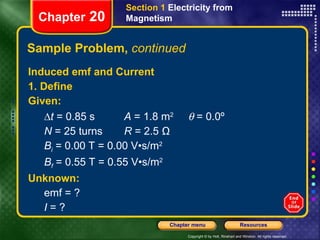
Sample Problem,  continued Induced emf and Current 1. Define Given: ∆ t  = 0.85 s A  = 1.8 m 2   = 0.0º N  = 25 turns R  = 2.5 Ω B i  = 0.00 T = 0.00 V•s/m 2 B f  = 0.55 T = 0.55 V•s/m 2 Unknown: emf = ? I  = ? Section 1  Electricity from Magnetism Chapter  20
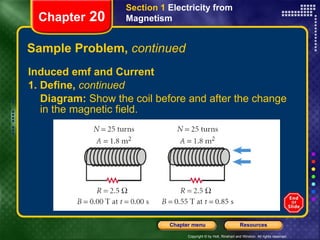
Sample Problem,  continued Induced emf and Current 1. Define,  continued Diagram:  Show the coil before and after the change in the magnetic field. Section 1  Electricity from Magnetism Chapter  20
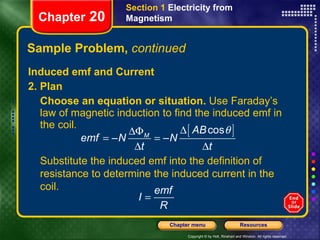
Sample Problem,  continued Induced emf and Current 2. Plan Choose an equation or situation.  Use Faraday’s law of magnetic induction to find the induced emf in the coil. Section 1  Electricity from Magnetism Chapter  20 Substitute the induced emf into the definition of resistance to determine the induced current in the coil.
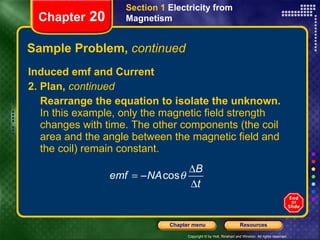
Sample Problem,  continued Induced emf and Current 2. Plan,  continued Rearrange the equation to isolate the unknown.  In this example, only the magnetic field strength changes with time. The other components (the coil area and the angle between the magnetic field and the coil) remain constant. Section 1  Electricity from Magnetism Chapter  20
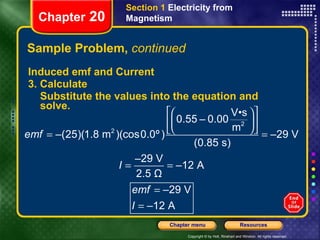
Sample Problem,  continued Induced emf and Current 3. Calculate Substitute the values into the equation and solve.   Section 1  Electricity from Magnetism Chapter  20
Sample Problem,  continued Induced emf and Current 4. Evaluate The induced emf, and therefore the induced current, is directed through the coil so that the magnetic field produced by the induced current opposes the change in the applied magnetic field. For the diagram shown on the previous page, the induced magnetic field is directed to the right and the current that produces it is directed from left to right through the resistor. Section 1  Electricity from Magnetism Chapter  20
Objectives Describe   how generators and motors operate. Explain   the energy conversions that take place in generators and motors. Describe   how mutual induction occurs in circuits. Section 2  Generators, Motors, and Mutual Inductance Chapter  20
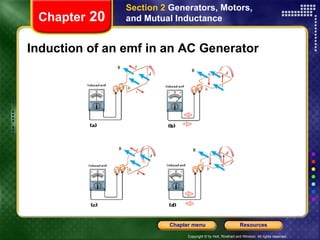
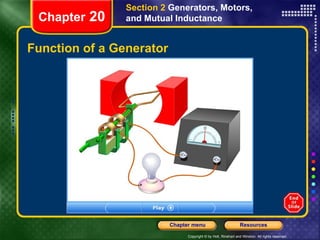
Generators and Alternating Current A   generator  is a machine that converts mechanical energy into electrical energy. Generators   use induction to convert mechanical energy into electrical energy. A generator produces a  continuously changing emf. Section 2  Generators, Motors, and Mutual Inductance Chapter  20
Induction of an emf in an AC Generator Chapter  20 Section 2  Generators, Motors, and Mutual Inductance
Function of a Generator Chapter  20 Section 2  Generators, Motors, and Mutual Inductance
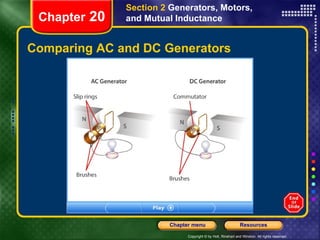
Generators and Alternating Current,  continued Alternating current  is an electric current that changes direction at regular intervals.  Alternating current  can be converted to direct current by using a device called a  commutator  to change the direction of the current. Section 2  Generators, Motors, and Mutual Inductance Chapter  20
Comparing AC and DC Generators Chapter  20 Section 2  Generators, Motors, and Mutual Inductance
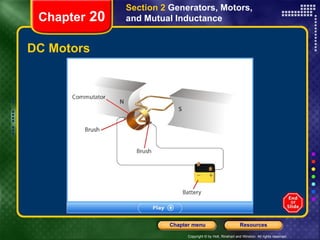
Motors Motors  are machines that convert electrical energy to mechanical energy. Motors  use an arrangement similar to that of generators. Back emf  is the emf induced in a motor’s coil that tends to reduce the current in the coil of a motor. Section 2  Generators, Motors, and Mutual Inductance Chapter  20
DC Motors Chapter  20 Section 2  Generators, Motors, and Mutual Inductance
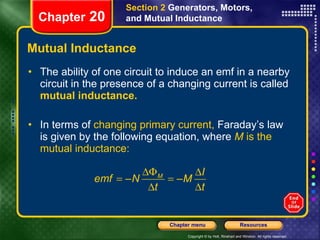
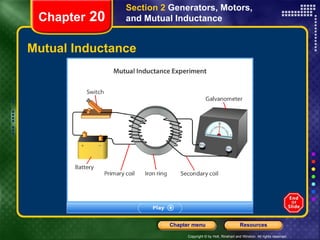
Mutual Inductance The ability of one circuit to induce an emf in a nearby circuit in the presence of a changing current is called  mutual inductance. In terms of  changing primary current,  Faraday’s law is given by the following equation, where  M  is the mutual inductance: Section 2  Generators, Motors, and Mutual Inductance Chapter  20
Mutual Inductance Chapter  20 Section 2  Generators, Motors, and Mutual Inductance
Objectives Distinguish   between rms values and maximum values of current and potential difference. Solve   problems involving rms and maximum values of current and emf for ac circuits. Apply   the transformer equation to solve problems involving step-up and step-down transformers. Section 3  AC Circuits and Transformers Chapter  20
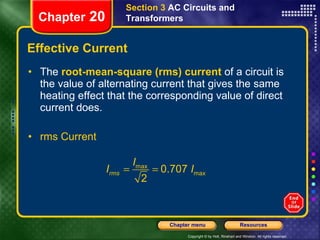
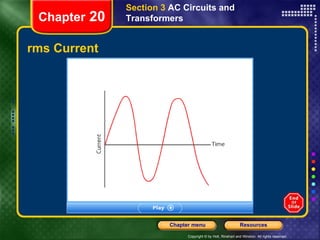
Effective Current The   root-mean-square (rms) current   of a circuit is the value of alternating current that gives the same heating effect that the corresponding value of direct current does. rms Current Section 3  AC Circuits and Transformers Chapter  20
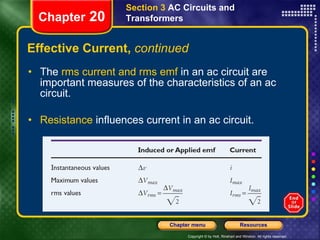
Effective Current,  continued The  rms current and rms emf  in an ac circuit are important measures of the characteristics of an ac circuit. Resistance  influences current in an ac circuit. Section 3  AC Circuits and Transformers Chapter  20
rms Current Chapter  20 Section 3  AC Circuits and Transformers
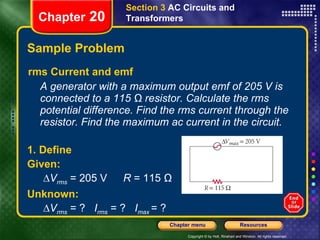
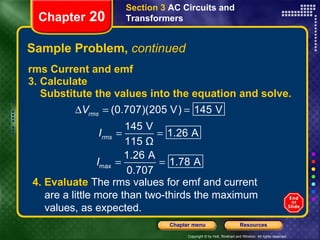
Sample Problem rms Current and emf A generator with a maximum output emf of 205 V is connected to a 115 Ω resistor. Calculate the rms potential difference. Find the rms current through the resistor. Find the maximum ac current in the circuit. Section 3  AC Circuits and Transformers Chapter  20 1. Define Given: ∆ V rms  = 205 V R  = 115 Ω Unknown: ∆ V rms   = ?  I rms  = ?  I max   = ?
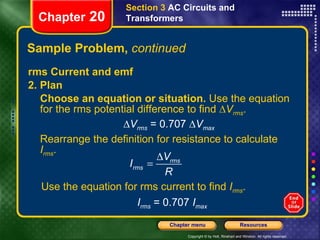
Sample Problem,  continued rms Current and emf 2. Plan Choose an equation or situation.  Use the equation for the rms potential difference to find ∆ V rms . ∆ V rms  = 0.707 ∆ V max Rearrange the definition for resistance to calculate  I rms . Section 3  AC Circuits and Transformers Chapter  20 Use the equation for rms current to find  I rms . I rms  = 0.707  I max
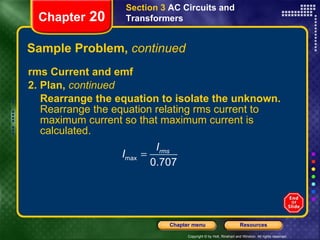
Sample Problem,  continued rms Current and emf 2. Plan,  continued Rearrange the equation to isolate the unknown.  Rearrange the equation relating rms current to maximum current so that maximum current is calculated. Section 3  AC Circuits and Transformers Chapter  20
Sample Problem,  continued rms Current and emf 3. Calculate Substitute the values into the equation and solve.   Section 3  AC Circuits and Transformers Chapter  20 4. Evaluate  The rms values for emf and current are a little more than two-thirds the maximum values, as expected.
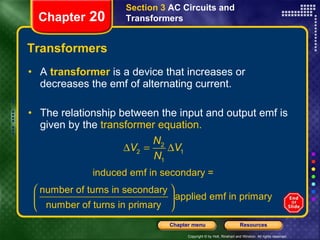
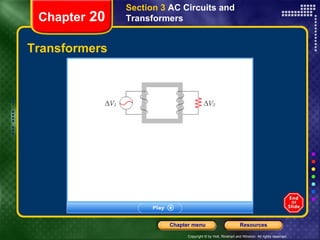
Transformers A   transformer   is a device that increases or decreases the emf of alternating current. The relationship between the input and output emf is given by the  transformer equation.  Section 3  AC Circuits and Transformers Chapter  20
Transformers Chapter  20 Section 3  AC Circuits and Transformers
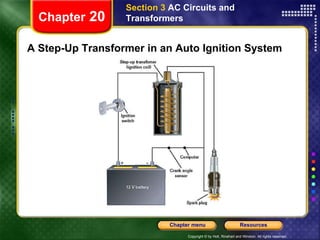
Transformers,  continued The transformer equation assumes that no power is lost between the primary and secondary coils. However,  real transformers are not perfectly efficient. Real transformers  typically have efficiencies ranging from  90% to 99%. The  ignition coil  in a gasoline engine is a transformer. Section 3  AC Circuits and Transformers Chapter  20
A Step-Up Transformer in an Auto Ignition System Chapter  20 Section 3  AC Circuits and Transformers
Objectives Describe   what electromagnetic waves are and how they are produced. Recognize   that electricity and magnetism are two aspects of a single electromagnetic force. Explain   how electromagnetic waves transfer energy. Describe   various applications of electromagnetic waves. Section 4  Electromagnetic Waves Chapter  20
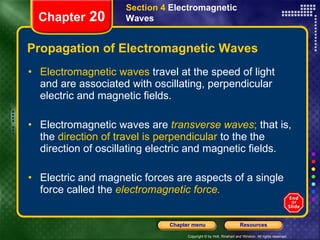
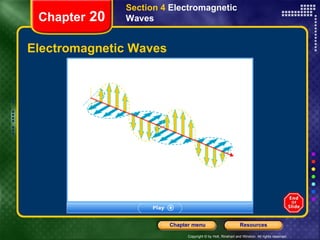
Propagation of Electromagnetic Waves Electromagnetic waves  travel at the speed of light and are associated with oscillating, perpendicular electric and magnetic fields. Electromagnetic waves are   transverse waves ;  that is, the  direction of travel is perpendicular  to the the direction of oscillating electric and magnetic fields. Electric and magnetic forces are aspects of a single force called the   electromagnetic force. Section 4  Electromagnetic Waves Chapter  20
Electromagnetic Waves Chapter  20 Section 4  Electromagnetic Waves
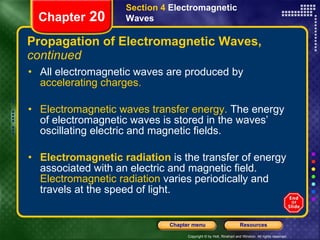
Propagation of Electromagnetic Waves,  continued All electromagnetic waves are produced by  accelerating charges. Electromagnetic waves transfer energy.  The energy of electromagnetic waves is stored in the waves’ oscillating electric and magnetic fields. Electromagnetic radiation  is the transfer of energy associated with an electric and magnetic field.  Electromagnetic   radiation  varies periodically and travels at the speed of light. Section 4  Electromagnetic Waves Chapter  20
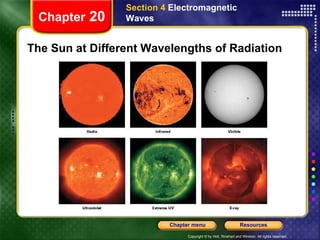
The Sun at Different Wavelengths of Radiation Chapter  20 Section 4  Electromagnetic Waves
Propagation of Electromagnetic Waves,  continued High-energy electromagnetic waves behave like  particles. An electromagnetic wave’s frequency makes the wave behave more like a particle. This notion is called the   wave-particle duality. A   photon   is a unit or quantum of light. Photons can be thought of as particles of electromagnetic radiation that have zero mass and carry one quantum of energy. Section 4  Electromagnetic Waves Chapter  20
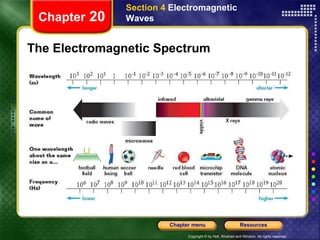
The Electromagnetic Spectrum The electromagnetic spectrum  ranges from very long radio waves to very short-wavelength gamma waves. The electromagnetic spectrum has a  wide variety of applications and characteristics  that cover a broad range of wavelengths and frequencies. Section 4  Electromagnetic Waves Chapter  20
The Electromagnetic Spectrum,  continued Radio Waves longest wavelengths communications, tv Microwaves 30 cm to 1 mm radar, cell phones Infrared 1 mm to 700 nm heat, photography Visible light 700 nm (red) to 400 nm (violet) Ultraviolet 400 nm to 60 nm disinfection, spectroscopy X rays 60 nm to 10 –4  nm medicine, astronomy, security screening Gamma Rays less than 0.1 nm cancer treatment, astronomy Section 4  Electromagnetic Waves Chapter  20
The Electromagnetic Spectrum Chapter  20 Section 4  Electromagnetic Waves
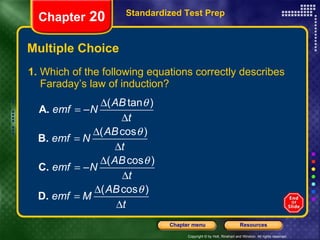
Multiple Choice 1.  Which of the following equations correctly describes Faraday’s law of induction? Standardized Test Prep Chapter  20
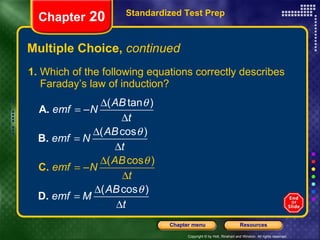
Multiple Choice,  continued 1.  Which of the following equations correctly describes Faraday’s law of induction? Standardized Test Prep Chapter  20
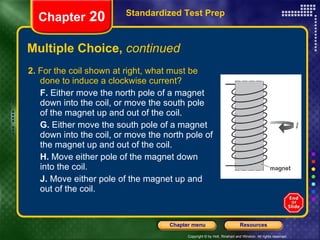
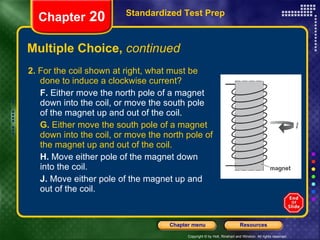
Multiple Choice,  continued 2.  For the coil shown at right, what must be done to induce a clockwise current? F.  Either move the north pole of a magnet down into the coil, or move the south pole of the magnet up and out of the coil. G.  Either move the south pole of a magnet down into the coil, or move the north pole of the magnet up and out of the coil. H.  Move either pole of the magnet down into the coil. J.  Move either pole of the magnet up and out of the coil. Standardized Test Prep Chapter  20
Multiple Choice,  continued 3.  Which of the following would not increase the emf produced by a generator? A.  rotating the generator coil faster B.  increasing the strength of the generator magnets C.  increasing the number of turns of wire in the coil D.  reducing the cross-sectional area of the coil Standardized Test Prep Chapter  20
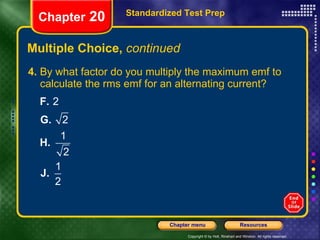
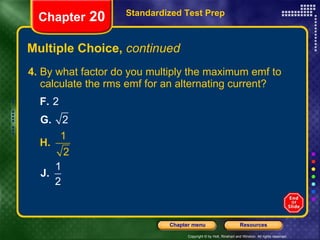
Multiple Choice,  continued 4.  By what factor do you multiply the maximum emf to calculate the rms emf for an alternating current? Standardized Test Prep Chapter  20
Multiple Choice,  continued 5.   Which of the following correctly describes the composition of an electromagnetic wave? A.  a transverse electric wave and a magnetic transverse wave that are parallel and are moving in the same direction B.  a transverse electric wave and a magnetic transverse wave that are perpendicular and are moving in the same direction C.  a transverse electric wave and a magnetic transverse wave that are parallel and are moving at right angles to each other D.  a transverse electric wave and a magnetic transverse wave that are perpendicular and are moving at right angles to each other Standardized Test Prep Chapter  20
Multiple Choice,  continued 6.   A coil is moved out of a magnetic field in order to induce an emf. The wire of the coil is then rewound so that the area of the coil is increased by 1.5 times. Extra wire is used in the coil so that the number of turns is doubled. If the time in which the coil is removed from the field is reduced by half and the magnetic field strength remains unchanged, how many times greater is the new induced emf than the original induced emf ? F.  1.5 times G.  2 times H.  3 times J.  6 times Standardized Test Prep Chapter  20
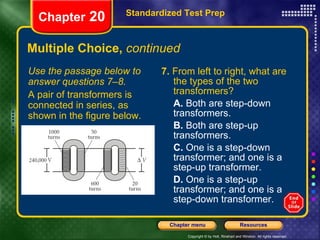
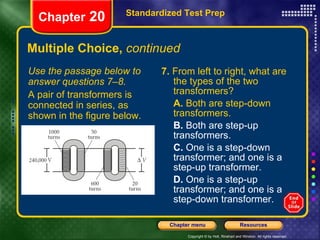
Multiple Choice,  continued 7.  From left to right, what are the types of the two transformers? A.  Both are step-down transformers. B.  Both are step-up transformers. C.  One is a step-down transformer; and one is a step-up transformer. D.  One is a step-up transformer; and one is a step-down transformer. Standardized Test Prep Chapter  20 Use the passage below to answer questions 7–8. A pair of transformers is connected in series, as shown in the figure below.
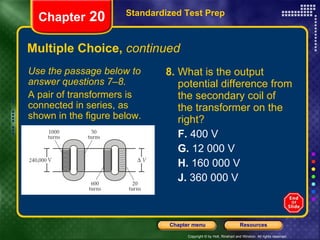
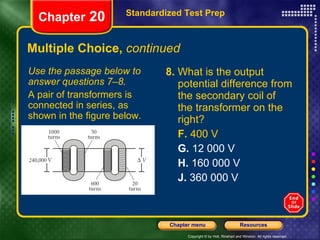
Multiple Choice,  continued 8.  What is the output potential difference from the secondary coil of the transformer on the right? F.  400 V G.  12 000 V H.  160 000 V J.  360 000 V Standardized Test Prep Chapter  20 Use the passage below to answer questions 7–8. A pair of transformers is connected in series, as shown in the figure below.
Multiple Choice,  continued 9.  What are the particles that can be used to describe electromagnetic radiation called? A.  electrons B.  magnetons C.  photons D.  protons Standardized Test Prep Chapter  20
Multiple Choice,  continued 10.  The maximum values for the current and potential difference in an ac circuit are 3.5 A and 340 V, respectively. How much power is dissipated in this circuit? F.  300 W G.  600 W H.  1200 W J.  2400 W Standardized Test Prep Chapter  20
Short Response 11.  The alternating current through an electric toaster has a maximum value of 12.0 A. What is the rms value of this current? Standardized Test Prep Chapter  20
Short Response,  continued 11.  The alternating current through an electric toaster has a maximum value of 12.0 A. What is the rms value of this current? Answer: 8.48 A Standardized Test Prep Chapter  20
Short Response,  continued 12.  What is the purpose of a commutator in an ac generator? Standardized Test Prep Chapter  20
Short Response,  continued 12.  What is the purpose of a commutator in an ac generator? Answer: It converts ac to a changing current in one direction only. Standardized Test Prep Chapter  20
Short Response,  continued 13.  How does the energy of one photon of an electromagnetic wave relate to the wave’s frequency? Standardized Test Prep Chapter  20
Short Response,  continued 13.  How does the energy of one photon of an electromagnetic wave relate to the wave’s frequency? Answer: The energy is directly proportional to the wave’s frequency ( E  =  hf  ). Standardized Test Prep Chapter  20
Short Response,  continued 14.  A transformer has 150 turns of wire on the primary coil and 75 000 turns on the secondary coil. If the input potential difference across the primary is 120 V, what is the output potential difference across the secondary? Standardized Test Prep Chapter  20
Short Response,  continued 14.  A transformer has 150 turns of wire on the primary coil and 75 000 turns on the secondary coil. If the input potential difference across the primary is 120 V, what is the output potential difference across the secondary? Answer: 6.0    10 4  V Standardized Test Prep Chapter  20
Extended Response 15.  Why is alternating current used for power transmission instead of direct current? Be sure to include power dissipation and electrical safety considerations in your answer. Standardized Test Prep Chapter  20
Extended Response,  continued 15.  Answer: For electric power to be transferred over long distances without a large amount of power dissipation, the electric power must have a high potential difference and low current. However, to be safely used in homes, the potential difference must be lower than that used for long-distance power transmission. Because of induction, the potential difference and current of electricity can be transformed to higher or lower values, but the current must change continuously (alternate) for this to happen. Standardized Test Prep Chapter  20
Extended Response,  continued 16.  Why must the current enter the coil just as someone comes up to the table? Standardized Test Prep Chapter  20 Base your answers to questions 16–18 on the information below. A device at a carnival’s haunted house involves a metal ring that flies upward from a table when a patron passes near the table’s edge. The device consists of a photoelectric switch that activates the circuit when anyone walks in front of the switch and of a coil of wire into which a current is suddenly introduced when the switch is triggered.
Extended Response,  continued 16.  Why must the current enter the coil just as someone comes up to the table? Answer:  The change in current in the coil will produce a changing magnetic field, which will induce a current in the ring. The induced current produces a magnetic field that interacts with the magnetic field from the coil, causing the ring to rise from the table. Standardized Test Prep Chapter  20 Base your answers to questions 16–18 on the information below. A device at a carnival’s haunted house involves a metal ring that flies upward from a table when a patron passes near the table’s edge. The device consists of a photoelectric switch that activates the circuit when anyone walks in front of the switch and of a coil of wire into which a current is suddenly introduced when the switch is triggered.
Extended Response,  continued 17.  Using Lenz’s law, explain why the ring flies upward when there is an increasing current in the coil? Standardized Test Prep Chapter  20 Base your answers to questions 16–18 on the information below. A device at a carnival’s haunted house involves a metal ring that flies upward from a table when a patron passes near the table’s edge. The device consists of a photoelectric switch that activates the circuit when anyone walks in front of the switch and of a coil of wire into which a current is suddenly introduced when the switch is triggered.
Extended Response,  continued 17.  Using Lenz’s law, explain why the ring flies upward when there is an increasing current in the coil? Answer:  According to Lenz’s law, the magnetic field induced in the ring must oppose the magnetic field that induces the current in the ring. The opposing fields cause the ring, which can move freely, to rise upward from the coil under the table’s surface. Standardized Test Prep Chapter  20 Base your answers to questions 16–18 on the information below. A device at a carnival’s haunted house involves a metal ring that flies upward from a table when a patron passes near the table’s edge. The device consists of a photoelectric switch that activates the circuit when anyone walks in front of the switch and of a coil of wire into which a current is suddenly introduced when the switch is triggered.
Extended Response,  continued 18.  Suppose the change in the magnetic field is 0.10 T/s. If the radius of the ring is 2.4 cm and the ring is assumed to consist of one turn of wire, what is the emf induced in the ring? Standardized Test Prep Chapter  20 Base your answers to questions 16–18 on the information below. A device at a carnival’s haunted house involves a metal ring that flies upward from a table when a patron passes near the table’s edge. The device consists of a photoelectric switch that activates the circuit when anyone walks in front of the switch and of a coil of wire into which a current is suddenly introduced when the switch is triggered.
Extended Response,  continued 18.  Suppose the change in the magnetic field is 0.10 T/s. If the radius of the ring is 2.4 cm and the ring is assumed to consist of one turn of wire, what is the emf induced in the ring? Answer:  1.8    10 –4  V Standardized Test Prep Chapter  20 Base your answers to questions 16–18 on the information below. A device at a carnival’s haunted house involves a metal ring that flies upward from a table when a patron passes near the table’s edge. The device consists of a photoelectric switch that activates the circuit when anyone walks in front of the switch and of a coil of wire into which a current is suddenly introduced when the switch is triggered.
Ways of Inducing a Current in a Circuit Chapter  20 Section 1  Electricity from Magnetism

Hp 20 win

  • 1.
    How to UseThis Presentation To View the presentation as a slideshow with effects select “View” on the menu bar and click on “Slide Show.” To advance through the presentation, click the right-arrow key or the space bar. From the resources slide, click on any resource to see a presentation for that resource. From the Chapter menu screen click on any lesson to go directly to that lesson’s presentation. You may exit the slide show at any time by pressing the Esc key.
  • 2.
    Chapter Presentation TransparenciesSample Problems Visual Concepts Standardized Test Prep Resources
  • 3.
    Table of ContentsSection 1 Electricity from Magnetism Section 2 Generators, Motors, and Mutual Inductance Section 3 AC Circuits and Transformers Section 4 Electromagnetic Waves Electromagnetic Induction Chapter 20
  • 4.
    Objectives Recognize that relative motion between a conductor and a magnetic field induces an emf in the conductor. Describe how the change in the number of magnetic field lines through a circuit loop affects the magnitude and direction of the induced electric current. Apply Lenz’s law and Faraday’s law of induction to solve problems involving induced emf and current. Section 1 Electricity from Magnetism Chapter 20
  • 5.
    Electromagnetic Induction Electromagneticinduction is the process of creating a current in a circuit by a changing magnetic field. A change in the magnetic flux through a conductor induces an electric current in the conductor. The separation of charges by the magnetic force induces an emf. Section 1 Electricity from Magnetism Chapter 20
  • 6.
    Electromagnetic Induction ina Circuit Loop Chapter 20 Section 1 Electricity from Magnetism
  • 7.
    Electromagnetic Induction, continued The angle between a magnetic field and a circuit affects induction. A change in the number of magnetic field lines induces a current. Section 1 Electricity from Magnetism Chapter 20
  • 8.
    Ways of Inducinga Current in a Circuit Chapter 20 Section 1 Electricity from Magnetism
  • 9.
    Characteristics of InducedCurrent Lenz’s Law The magnetic field of the induced current is in a direction to produce a field that opposes the change causing it. Note: the induced current does not oppose the applied field, but rather the change in the applied field. Section 1 Electricity from Magnetism Chapter 20
  • 10.
    Lenz's Law forDetermining the Direction of the Induced Current Chapter 20 Section 1 Electricity from Magnetism
  • 11.
    Characteristics of InducedCurrent, continued The magnitude of the induced emf can be predicted by Faraday’s law of magnetic induction. Faraday’s Law of Magnetic Induction Section 1 Electricity from Magnetism Chapter 20 The magnetic flux is given by  M = AB cos 
  • 12.
    Sample Problem Inducedemf and Current A coil with 25 turns of wire is wrapped around a hollow tube with an area of 1.8 m 2 . Each turn has the same area as the tube. A uniform magnetic field is applied at a right angle to the plane of the coil. If the field increases uniformly from 0.00 T to 0.55 T in 0.85 s, find the magnitude of the induced emf in the coil. If the resistance in the coil is 2.5 Ω, find the magnitude of the induced current in the coil. Section 1 Electricity from Magnetism Chapter 20
  • 13.
    Sample Problem, continued Induced emf and Current 1. Define Given: ∆ t = 0.85 s A = 1.8 m 2  = 0.0º N = 25 turns R = 2.5 Ω B i = 0.00 T = 0.00 V•s/m 2 B f = 0.55 T = 0.55 V•s/m 2 Unknown: emf = ? I = ? Section 1 Electricity from Magnetism Chapter 20
  • 14.
    Sample Problem, continued Induced emf and Current 1. Define, continued Diagram: Show the coil before and after the change in the magnetic field. Section 1 Electricity from Magnetism Chapter 20
  • 15.
    Sample Problem, continued Induced emf and Current 2. Plan Choose an equation or situation. Use Faraday’s law of magnetic induction to find the induced emf in the coil. Section 1 Electricity from Magnetism Chapter 20 Substitute the induced emf into the definition of resistance to determine the induced current in the coil.
  • 16.
    Sample Problem, continued Induced emf and Current 2. Plan, continued Rearrange the equation to isolate the unknown. In this example, only the magnetic field strength changes with time. The other components (the coil area and the angle between the magnetic field and the coil) remain constant. Section 1 Electricity from Magnetism Chapter 20
  • 17.
    Sample Problem, continued Induced emf and Current 3. Calculate Substitute the values into the equation and solve. Section 1 Electricity from Magnetism Chapter 20
  • 18.
    Sample Problem, continued Induced emf and Current 4. Evaluate The induced emf, and therefore the induced current, is directed through the coil so that the magnetic field produced by the induced current opposes the change in the applied magnetic field. For the diagram shown on the previous page, the induced magnetic field is directed to the right and the current that produces it is directed from left to right through the resistor. Section 1 Electricity from Magnetism Chapter 20
  • 19.
    Objectives Describe how generators and motors operate. Explain the energy conversions that take place in generators and motors. Describe how mutual induction occurs in circuits. Section 2 Generators, Motors, and Mutual Inductance Chapter 20
  • 20.
    Generators and AlternatingCurrent A generator is a machine that converts mechanical energy into electrical energy. Generators use induction to convert mechanical energy into electrical energy. A generator produces a continuously changing emf. Section 2 Generators, Motors, and Mutual Inductance Chapter 20
  • 21.
    Induction of anemf in an AC Generator Chapter 20 Section 2 Generators, Motors, and Mutual Inductance
  • 22.
    Function of aGenerator Chapter 20 Section 2 Generators, Motors, and Mutual Inductance
  • 23.
    Generators and AlternatingCurrent, continued Alternating current is an electric current that changes direction at regular intervals. Alternating current can be converted to direct current by using a device called a commutator to change the direction of the current. Section 2 Generators, Motors, and Mutual Inductance Chapter 20
  • 24.
    Comparing AC andDC Generators Chapter 20 Section 2 Generators, Motors, and Mutual Inductance
  • 25.
    Motors Motors are machines that convert electrical energy to mechanical energy. Motors use an arrangement similar to that of generators. Back emf is the emf induced in a motor’s coil that tends to reduce the current in the coil of a motor. Section 2 Generators, Motors, and Mutual Inductance Chapter 20
  • 26.
    DC Motors Chapter 20 Section 2 Generators, Motors, and Mutual Inductance
  • 27.
    Mutual Inductance Theability of one circuit to induce an emf in a nearby circuit in the presence of a changing current is called mutual inductance. In terms of changing primary current, Faraday’s law is given by the following equation, where M is the mutual inductance: Section 2 Generators, Motors, and Mutual Inductance Chapter 20
  • 28.
    Mutual Inductance Chapter 20 Section 2 Generators, Motors, and Mutual Inductance
  • 29.
    Objectives Distinguish between rms values and maximum values of current and potential difference. Solve problems involving rms and maximum values of current and emf for ac circuits. Apply the transformer equation to solve problems involving step-up and step-down transformers. Section 3 AC Circuits and Transformers Chapter 20
  • 30.
    Effective Current The root-mean-square (rms) current of a circuit is the value of alternating current that gives the same heating effect that the corresponding value of direct current does. rms Current Section 3 AC Circuits and Transformers Chapter 20
  • 31.
    Effective Current, continued The rms current and rms emf in an ac circuit are important measures of the characteristics of an ac circuit. Resistance influences current in an ac circuit. Section 3 AC Circuits and Transformers Chapter 20
  • 32.
    rms Current Chapter 20 Section 3 AC Circuits and Transformers
  • 33.
    Sample Problem rmsCurrent and emf A generator with a maximum output emf of 205 V is connected to a 115 Ω resistor. Calculate the rms potential difference. Find the rms current through the resistor. Find the maximum ac current in the circuit. Section 3 AC Circuits and Transformers Chapter 20 1. Define Given: ∆ V rms = 205 V R = 115 Ω Unknown: ∆ V rms = ? I rms = ? I max = ?
  • 34.
    Sample Problem, continued rms Current and emf 2. Plan Choose an equation or situation. Use the equation for the rms potential difference to find ∆ V rms . ∆ V rms = 0.707 ∆ V max Rearrange the definition for resistance to calculate I rms . Section 3 AC Circuits and Transformers Chapter 20 Use the equation for rms current to find I rms . I rms = 0.707 I max
  • 35.
    Sample Problem, continued rms Current and emf 2. Plan, continued Rearrange the equation to isolate the unknown. Rearrange the equation relating rms current to maximum current so that maximum current is calculated. Section 3 AC Circuits and Transformers Chapter 20
  • 36.
    Sample Problem, continued rms Current and emf 3. Calculate Substitute the values into the equation and solve. Section 3 AC Circuits and Transformers Chapter 20 4. Evaluate The rms values for emf and current are a little more than two-thirds the maximum values, as expected.
  • 37.
    Transformers A transformer is a device that increases or decreases the emf of alternating current. The relationship between the input and output emf is given by the transformer equation. Section 3 AC Circuits and Transformers Chapter 20
  • 38.
    Transformers Chapter 20 Section 3 AC Circuits and Transformers
  • 39.
    Transformers, continuedThe transformer equation assumes that no power is lost between the primary and secondary coils. However, real transformers are not perfectly efficient. Real transformers typically have efficiencies ranging from 90% to 99%. The ignition coil in a gasoline engine is a transformer. Section 3 AC Circuits and Transformers Chapter 20
  • 40.
    A Step-Up Transformerin an Auto Ignition System Chapter 20 Section 3 AC Circuits and Transformers
  • 41.
    Objectives Describe what electromagnetic waves are and how they are produced. Recognize that electricity and magnetism are two aspects of a single electromagnetic force. Explain how electromagnetic waves transfer energy. Describe various applications of electromagnetic waves. Section 4 Electromagnetic Waves Chapter 20
  • 42.
    Propagation of ElectromagneticWaves Electromagnetic waves travel at the speed of light and are associated with oscillating, perpendicular electric and magnetic fields. Electromagnetic waves are transverse waves ; that is, the direction of travel is perpendicular to the the direction of oscillating electric and magnetic fields. Electric and magnetic forces are aspects of a single force called the electromagnetic force. Section 4 Electromagnetic Waves Chapter 20
  • 43.
    Electromagnetic Waves Chapter 20 Section 4 Electromagnetic Waves
  • 44.
    Propagation of ElectromagneticWaves, continued All electromagnetic waves are produced by accelerating charges. Electromagnetic waves transfer energy. The energy of electromagnetic waves is stored in the waves’ oscillating electric and magnetic fields. Electromagnetic radiation is the transfer of energy associated with an electric and magnetic field. Electromagnetic radiation varies periodically and travels at the speed of light. Section 4 Electromagnetic Waves Chapter 20
  • 45.
    The Sun atDifferent Wavelengths of Radiation Chapter 20 Section 4 Electromagnetic Waves
  • 46.
    Propagation of ElectromagneticWaves, continued High-energy electromagnetic waves behave like particles. An electromagnetic wave’s frequency makes the wave behave more like a particle. This notion is called the wave-particle duality. A photon is a unit or quantum of light. Photons can be thought of as particles of electromagnetic radiation that have zero mass and carry one quantum of energy. Section 4 Electromagnetic Waves Chapter 20
  • 47.
    The Electromagnetic SpectrumThe electromagnetic spectrum ranges from very long radio waves to very short-wavelength gamma waves. The electromagnetic spectrum has a wide variety of applications and characteristics that cover a broad range of wavelengths and frequencies. Section 4 Electromagnetic Waves Chapter 20
  • 48.
    The Electromagnetic Spectrum, continued Radio Waves longest wavelengths communications, tv Microwaves 30 cm to 1 mm radar, cell phones Infrared 1 mm to 700 nm heat, photography Visible light 700 nm (red) to 400 nm (violet) Ultraviolet 400 nm to 60 nm disinfection, spectroscopy X rays 60 nm to 10 –4 nm medicine, astronomy, security screening Gamma Rays less than 0.1 nm cancer treatment, astronomy Section 4 Electromagnetic Waves Chapter 20
  • 49.
    The Electromagnetic SpectrumChapter 20 Section 4 Electromagnetic Waves
  • 50.
    Multiple Choice 1. Which of the following equations correctly describes Faraday’s law of induction? Standardized Test Prep Chapter 20
  • 51.
    Multiple Choice, continued 1. Which of the following equations correctly describes Faraday’s law of induction? Standardized Test Prep Chapter 20
  • 52.
    Multiple Choice, continued 2. For the coil shown at right, what must be done to induce a clockwise current? F. Either move the north pole of a magnet down into the coil, or move the south pole of the magnet up and out of the coil. G. Either move the south pole of a magnet down into the coil, or move the north pole of the magnet up and out of the coil. H. Move either pole of the magnet down into the coil. J. Move either pole of the magnet up and out of the coil. Standardized Test Prep Chapter 20
  • 53.
    Multiple Choice, continued 2. For the coil shown at right, what must be done to induce a clockwise current? F. Either move the north pole of a magnet down into the coil, or move the south pole of the magnet up and out of the coil. G. Either move the south pole of a magnet down into the coil, or move the north pole of the magnet up and out of the coil. H. Move either pole of the magnet down into the coil. J. Move either pole of the magnet up and out of the coil. Standardized Test Prep Chapter 20
  • 54.
    Multiple Choice, continued 3. Which of the following would not increase the emf produced by a generator? A. rotating the generator coil faster B. increasing the strength of the generator magnets C. increasing the number of turns of wire in the coil D. reducing the cross-sectional area of the coil Standardized Test Prep Chapter 20
  • 55.
    Multiple Choice, continued 3. Which of the following would not increase the emf produced by a generator? A. rotating the generator coil faster B. increasing the strength of the generator magnets C. increasing the number of turns of wire in the coil D. reducing the cross-sectional area of the coil Standardized Test Prep Chapter 20
  • 56.
    Multiple Choice, continued 4. By what factor do you multiply the maximum emf to calculate the rms emf for an alternating current? Standardized Test Prep Chapter 20
  • 57.
    Multiple Choice, continued 4. By what factor do you multiply the maximum emf to calculate the rms emf for an alternating current? Standardized Test Prep Chapter 20
  • 58.
    Multiple Choice, continued 5. Which of the following correctly describes the composition of an electromagnetic wave? A. a transverse electric wave and a magnetic transverse wave that are parallel and are moving in the same direction B. a transverse electric wave and a magnetic transverse wave that are perpendicular and are moving in the same direction C. a transverse electric wave and a magnetic transverse wave that are parallel and are moving at right angles to each other D. a transverse electric wave and a magnetic transverse wave that are perpendicular and are moving at right angles to each other Standardized Test Prep Chapter 20
  • 59.
    Multiple Choice, continued 5. Which of the following correctly describes the composition of an electromagnetic wave? A. a transverse electric wave and a magnetic transverse wave that are parallel and are moving in the same direction B. a transverse electric wave and a magnetic transverse wave that are perpendicular and are moving in the same direction C. a transverse electric wave and a magnetic transverse wave that are parallel and are moving at right angles to each other D. a transverse electric wave and a magnetic transverse wave that are perpendicular and are moving at right angles to each other Standardized Test Prep Chapter 20
  • 60.
    Multiple Choice, continued 6. A coil is moved out of a magnetic field in order to induce an emf. The wire of the coil is then rewound so that the area of the coil is increased by 1.5 times. Extra wire is used in the coil so that the number of turns is doubled. If the time in which the coil is removed from the field is reduced by half and the magnetic field strength remains unchanged, how many times greater is the new induced emf than the original induced emf ? F. 1.5 times G. 2 times H. 3 times J. 6 times Standardized Test Prep Chapter 20
  • 61.
    Multiple Choice, continued 6. A coil is moved out of a magnetic field in order to induce an emf. The wire of the coil is then rewound so that the area of the coil is increased by 1.5 times. Extra wire is used in the coil so that the number of turns is doubled. If the time in which the coil is removed from the field is reduced by half and the magnetic field strength remains unchanged, how many times greater is the new induced emf than the original induced emf ? F. 1.5 times G. 2 times H. 3 times J. 6 times Standardized Test Prep Chapter 20
  • 62.
    Multiple Choice, continued 7. From left to right, what are the types of the two transformers? A. Both are step-down transformers. B. Both are step-up transformers. C. One is a step-down transformer; and one is a step-up transformer. D. One is a step-up transformer; and one is a step-down transformer. Standardized Test Prep Chapter 20 Use the passage below to answer questions 7–8. A pair of transformers is connected in series, as shown in the figure below.
  • 63.
    Multiple Choice, continued 7. From left to right, what are the types of the two transformers? A. Both are step-down transformers. B. Both are step-up transformers. C. One is a step-down transformer; and one is a step-up transformer. D. One is a step-up transformer; and one is a step-down transformer. Standardized Test Prep Chapter 20 Use the passage below to answer questions 7–8. A pair of transformers is connected in series, as shown in the figure below.
  • 64.
    Multiple Choice, continued 8. What is the output potential difference from the secondary coil of the transformer on the right? F. 400 V G. 12 000 V H. 160 000 V J. 360 000 V Standardized Test Prep Chapter 20 Use the passage below to answer questions 7–8. A pair of transformers is connected in series, as shown in the figure below.
  • 65.
    Multiple Choice, continued 8. What is the output potential difference from the secondary coil of the transformer on the right? F. 400 V G. 12 000 V H. 160 000 V J. 360 000 V Standardized Test Prep Chapter 20 Use the passage below to answer questions 7–8. A pair of transformers is connected in series, as shown in the figure below.
  • 66.
    Multiple Choice, continued 9. What are the particles that can be used to describe electromagnetic radiation called? A. electrons B. magnetons C. photons D. protons Standardized Test Prep Chapter 20
  • 67.
    Multiple Choice, continued 9. What are the particles that can be used to describe electromagnetic radiation called? A. electrons B. magnetons C. photons D. protons Standardized Test Prep Chapter 20
  • 68.
    Multiple Choice, continued 10. The maximum values for the current and potential difference in an ac circuit are 3.5 A and 340 V, respectively. How much power is dissipated in this circuit? F. 300 W G. 600 W H. 1200 W J. 2400 W Standardized Test Prep Chapter 20
  • 69.
    Multiple Choice, continued 10. The maximum values for the current and potential difference in an ac circuit are 3.5 A and 340 V, respectively. How much power is dissipated in this circuit? F. 300 W G. 600 W H. 1200 W J. 2400 W Standardized Test Prep Chapter 20
  • 70.
    Short Response 11. The alternating current through an electric toaster has a maximum value of 12.0 A. What is the rms value of this current? Standardized Test Prep Chapter 20
  • 71.
    Short Response, continued 11. The alternating current through an electric toaster has a maximum value of 12.0 A. What is the rms value of this current? Answer: 8.48 A Standardized Test Prep Chapter 20
  • 72.
    Short Response, continued 12. What is the purpose of a commutator in an ac generator? Standardized Test Prep Chapter 20
  • 73.
    Short Response, continued 12. What is the purpose of a commutator in an ac generator? Answer: It converts ac to a changing current in one direction only. Standardized Test Prep Chapter 20
  • 74.
    Short Response, continued 13. How does the energy of one photon of an electromagnetic wave relate to the wave’s frequency? Standardized Test Prep Chapter 20
  • 75.
    Short Response, continued 13. How does the energy of one photon of an electromagnetic wave relate to the wave’s frequency? Answer: The energy is directly proportional to the wave’s frequency ( E = hf ). Standardized Test Prep Chapter 20
  • 76.
    Short Response, continued 14. A transformer has 150 turns of wire on the primary coil and 75 000 turns on the secondary coil. If the input potential difference across the primary is 120 V, what is the output potential difference across the secondary? Standardized Test Prep Chapter 20
  • 77.
    Short Response, continued 14. A transformer has 150 turns of wire on the primary coil and 75 000 turns on the secondary coil. If the input potential difference across the primary is 120 V, what is the output potential difference across the secondary? Answer: 6.0  10 4 V Standardized Test Prep Chapter 20
  • 78.
    Extended Response 15. Why is alternating current used for power transmission instead of direct current? Be sure to include power dissipation and electrical safety considerations in your answer. Standardized Test Prep Chapter 20
  • 79.
    Extended Response, continued 15. Answer: For electric power to be transferred over long distances without a large amount of power dissipation, the electric power must have a high potential difference and low current. However, to be safely used in homes, the potential difference must be lower than that used for long-distance power transmission. Because of induction, the potential difference and current of electricity can be transformed to higher or lower values, but the current must change continuously (alternate) for this to happen. Standardized Test Prep Chapter 20
  • 80.
    Extended Response, continued 16. Why must the current enter the coil just as someone comes up to the table? Standardized Test Prep Chapter 20 Base your answers to questions 16–18 on the information below. A device at a carnival’s haunted house involves a metal ring that flies upward from a table when a patron passes near the table’s edge. The device consists of a photoelectric switch that activates the circuit when anyone walks in front of the switch and of a coil of wire into which a current is suddenly introduced when the switch is triggered.
  • 81.
    Extended Response, continued 16. Why must the current enter the coil just as someone comes up to the table? Answer: The change in current in the coil will produce a changing magnetic field, which will induce a current in the ring. The induced current produces a magnetic field that interacts with the magnetic field from the coil, causing the ring to rise from the table. Standardized Test Prep Chapter 20 Base your answers to questions 16–18 on the information below. A device at a carnival’s haunted house involves a metal ring that flies upward from a table when a patron passes near the table’s edge. The device consists of a photoelectric switch that activates the circuit when anyone walks in front of the switch and of a coil of wire into which a current is suddenly introduced when the switch is triggered.
  • 82.
    Extended Response, continued 17. Using Lenz’s law, explain why the ring flies upward when there is an increasing current in the coil? Standardized Test Prep Chapter 20 Base your answers to questions 16–18 on the information below. A device at a carnival’s haunted house involves a metal ring that flies upward from a table when a patron passes near the table’s edge. The device consists of a photoelectric switch that activates the circuit when anyone walks in front of the switch and of a coil of wire into which a current is suddenly introduced when the switch is triggered.
  • 83.
    Extended Response, continued 17. Using Lenz’s law, explain why the ring flies upward when there is an increasing current in the coil? Answer: According to Lenz’s law, the magnetic field induced in the ring must oppose the magnetic field that induces the current in the ring. The opposing fields cause the ring, which can move freely, to rise upward from the coil under the table’s surface. Standardized Test Prep Chapter 20 Base your answers to questions 16–18 on the information below. A device at a carnival’s haunted house involves a metal ring that flies upward from a table when a patron passes near the table’s edge. The device consists of a photoelectric switch that activates the circuit when anyone walks in front of the switch and of a coil of wire into which a current is suddenly introduced when the switch is triggered.
  • 84.
    Extended Response, continued 18. Suppose the change in the magnetic field is 0.10 T/s. If the radius of the ring is 2.4 cm and the ring is assumed to consist of one turn of wire, what is the emf induced in the ring? Standardized Test Prep Chapter 20 Base your answers to questions 16–18 on the information below. A device at a carnival’s haunted house involves a metal ring that flies upward from a table when a patron passes near the table’s edge. The device consists of a photoelectric switch that activates the circuit when anyone walks in front of the switch and of a coil of wire into which a current is suddenly introduced when the switch is triggered.
  • 85.
    Extended Response, continued 18. Suppose the change in the magnetic field is 0.10 T/s. If the radius of the ring is 2.4 cm and the ring is assumed to consist of one turn of wire, what is the emf induced in the ring? Answer: 1.8  10 –4 V Standardized Test Prep Chapter 20 Base your answers to questions 16–18 on the information below. A device at a carnival’s haunted house involves a metal ring that flies upward from a table when a patron passes near the table’s edge. The device consists of a photoelectric switch that activates the circuit when anyone walks in front of the switch and of a coil of wire into which a current is suddenly introduced when the switch is triggered.
  • 86.
    Ways of Inducinga Current in a Circuit Chapter 20 Section 1 Electricity from Magnetism

Editor's Notes

  • #3 Links as follows. Chapter Presentation: “Table of Contents” Visual Concepts: all Visual Concepts in order of occurrence Transparencies: all sheets which instruct pickup of transparency art Standardized Test Prep: First page of “Standardized Test Prep” Sample Problems: all sample problems in order of occurrence
  • #4 Link each section title to the first page of that section (“Objectives”)
  • #7 Insert High-Res image from Figure 1, page 708
  • #8 Insert High-Res art from Figure 3 page 709
  • #9 Pick up Visual Concepts: Chapter 20, Section 1: Ways of Inducing a Current in a Circuit #70689
  • #11 Pick up Visual Concepts: Chapter 20, Section 1: Lenz's Law for Determining the Direction of the Induced Current #70690
  • #22 Insert High-Res image from TR109
  • #23 Pick up Visual Concepts: Chapter 20, Section 2:Function of a Generator #70691
  • #25 Pick up Visual Concepts: Chapter 20, Section 2: Comparing AC and DC Generators #70692
  • #27 Pick up Visual Concepts: Chapter 20, Section 2: DC Motors #70693
  • #29 Pick up Visual Concepts: Chapter 20, Section 2: Mutual Inductance #70694
  • #33 Pick up Visual Concepts: Chapter 20, Section 2: RMS Current #70441
  • #39 Pick up Visual Concepts: Chapter 20, Section 3: Transformer #70717
  • #41 Insert High-Res image from TR112
  • #44 Pick up Visual Concepts: Chapter 20, Section 4: Electromagnetic Waves #70120
  • #46 Insert High-Res image from TR113
  • #50 Insert High-Res image from TR114
  • #87 Insert High-Res image from TR114