How to Use This Presentation To View the presentation as a slideshow with effects  select  “View”  on the menu bar and click on  “Slide Show.” To advance through the presentation, click the right-arrow key or the space bar. From the resources slide, click on any resource to see a presentation for that resource. From the Chapter menu screen click on any lesson to go directly to that lesson’s presentation. You may exit the slide show at any time by pressing  the  Esc  key.
Chapter Presentation Transparencies Standardized Test Prep Sample Problems Visual Concepts Resources
Table of Contents Section 1  Magnets and Magnetic Fields Section 2  Magnetism from Electricity Section 3  Magnetic Force Magnetism Chapter  19
Objectives For given situations,   predict   whether magnets will repel or attract each other. Describe   the magnetic field around a permanent magnet. Describe   the orientation of Earth’s magnetic field. Section 1  Magnets and Magnetic Fields Chapter  19
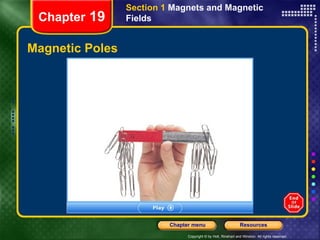
Magnets Magnets  attract iron-containing objects. Magnets  have two distinct poles called the   north   pole   and the   south pole .  These names are derived from a magnet’s behavior on Earth. Like poles of magnets  repel  each other; unlike poles  attract  each other. Section 1  Magnets and Magnetic Fields Chapter  19
Magnetic Poles Chapter  19 Section 1  Magnets and Magnetic Fields
Magnetic Domains Magnetic Domain A region composed of a group of atoms whose magnetic fields are aligned in the same direction is called a   magnetic domain . Some materials can be made into  permanent magnets. Soft  magnetic materials (for example  iron ) are easily magnetized but tend to lose their magnetism easily. Hard  magnetic materials (for example  nickel ) tend to retain their magnetism. Section 1  Magnets and Magnetic Fields Chapter  19
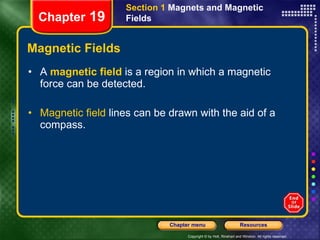
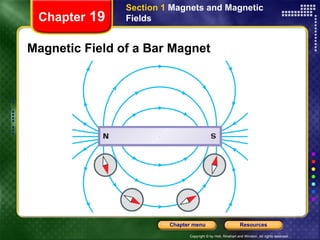
Magnetic Fields A   magnetic field   is a region in which a magnetic force can be detected. Magnetic field  lines can be drawn with the aid of a compass. Section 1  Magnets and Magnetic Fields Chapter  19
Magnetic Field of a Bar Magnet Chapter  19 Section 1  Magnets and Magnetic Fields
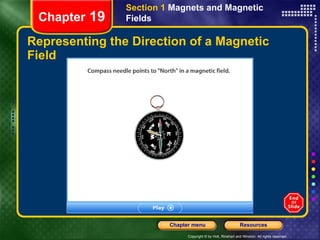
Representing the Direction of a Magnetic Field Chapter  19 Section 1  Magnets and Magnetic Fields
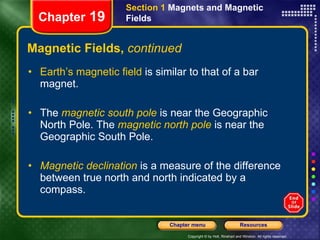
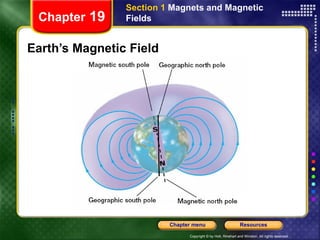
Magnetic Fields,  continued Earth’s magnetic field  is similar to that of a bar magnet. The  magnetic south pole   is near the Geographic North Pole. The   magnetic north pole   is near the Geographic South Pole. Magnetic declination  is a measure of the difference between true north and north indicated by a compass. Section 1  Magnets and Magnetic Fields Chapter  19
Earth’s Magnetic Field Chapter  19 Section 1  Magnets and Magnetic Fields
Objectives Describe   the magnetic field produced by current in a straight conductor and in a solenoid. Use   the right-hand rule to determine the direction of the magnetic field in a current-carrying wire. Section 2  Magnetism from Electricity Chapter  19
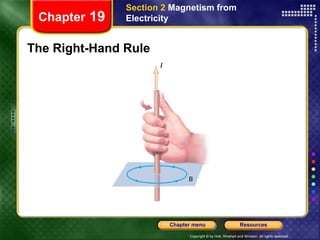
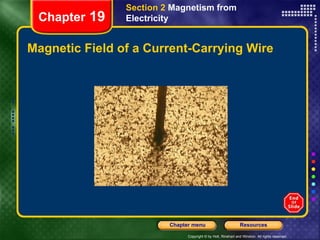
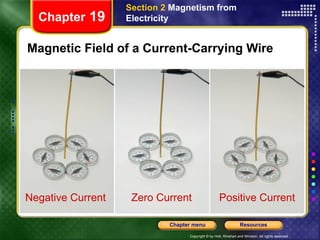
Magnetic Field of a Current-Carrying Wire A long, straight, current-carrying wire has a  cylindrical magnetic field. Compasses  can be used to shown the direction of the magnetic field induced by the wire. The  right-hand rule can  be used to determine the direction of the magnetic field in a current-carrying wire. Chapter  19 Section 2  Magnetism from Electricity
The Right-Hand Rule Chapter  19 Section 2  Magnetism from Electricity
Magnetic Field of a Current-Carrying Wire Chapter  19 Section 2  Magnetism from Electricity
Magnetic Field of a Current-Carrying Wire Chapter  19 Section 2  Magnetism from Electricity Negative Current Positive Current Zero Current
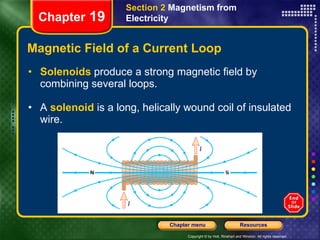
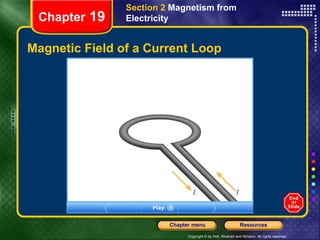
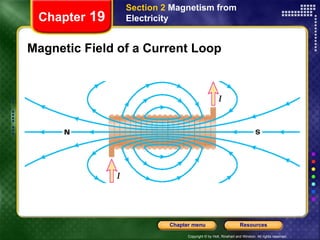
Magnetic Field of a Current Loop Solenoids   produce a strong magnetic field by combining several loops. A  solenoid   is a long, helically wound coil of insulated wire. Chapter  19 Section 2  Magnetism from Electricity
Magnetic Field of a Current Loop Chapter  19 Section 2  Magnetism from Electricity
Objectives Given the force on a charge in a magnetic field,  determine   the strength of the magnetic field. Use   the right-hand rule to find the direction of the force on a charge moving through a magnetic field. Determine  the magnitude and direction of the force on a wire carrying current in a magnetic field. Section 3  Magnetic Force Chapter  19
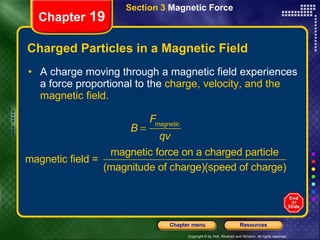
Charged Particles in a Magnetic Field A charge moving through a magnetic field experiences a force proportional to the  charge, velocity, and the   magnetic field. Section 3  Magnetic Force Chapter  19
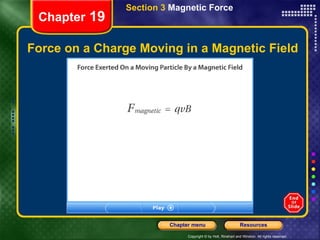
Force on a Charge Moving in a Magnetic Field Chapter  19 Section 3  Magnetic Force
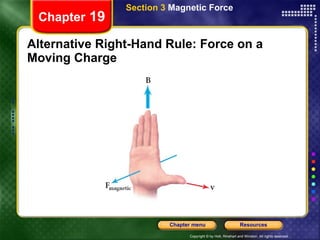
Charged Particles in a Magnetic Field,  continued The  direction of the magnetic force on a moving charge  is always perpendicular to both the magnetic field and the velocity of the charge. An  alternative right-hand rule  can be used to find the direction of the magnetic force. A charge moving through a magnetic field follows a  circular path. Chapter  19 Section 3  Magnetic Force
Alternative Right-Hand Rule: Force on a Moving Charge Chapter  19 Section 3  Magnetic Force
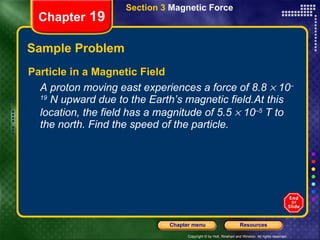
Sample Problem Particle in a Magnetic Field A proton moving east experiences a force of 8.8    10 –19  N upward due to the Earth’s magnetic field.At this location, the field has a magnitude of 5.5    10 –5  T to the north. Find the speed of the particle. Chapter  19 Section 3  Magnetic Force
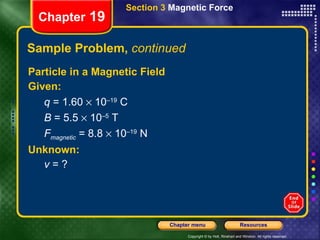
Sample Problem,  continued Particle in a Magnetic Field Given: q  = 1.60    10 –19  C B  = 5.5    10 –5  T F magnetic  = 8.8    10 –19  N Unknown: v  = ? Chapter  19 Section 3  Magnetic Force
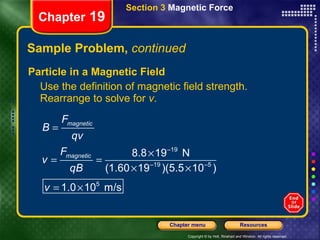
Sample Problem,  continued Particle in a Magnetic Field Use the definition of magnetic field strength. Rearrange to solve for  v . Chapter  19 Section 3  Magnetic Force
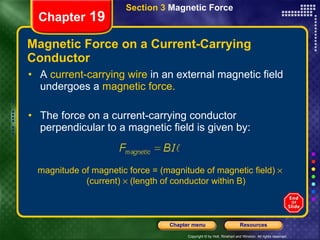
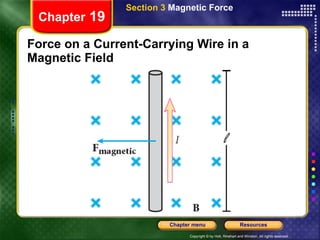
Magnetic Force on a Current-Carrying Conductor A  current-carrying wire  in an external magnetic field undergoes a  magnetic force. The force on a current-carrying conductor perpendicular to a magnetic field is given by: Section 3  Magnetic Force Chapter  19 magnitude of magnetic force = (magnitude of magnetic field)    (current)    (length of conductor within B)
Force on a Current-Carrying Wire in a Magnetic Field Chapter  19 Section 3  Magnetic Force
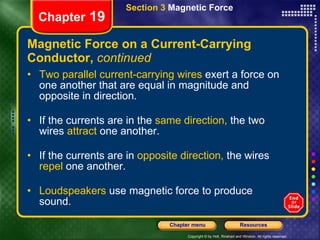
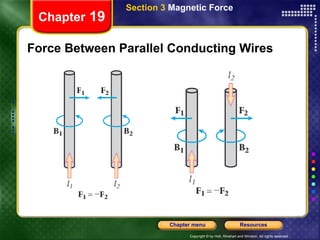
Magnetic Force on a Current-Carrying Conductor,  continued Two parallel current-carrying wires  exert a force on one another that are equal in magnitude and opposite in direction. If the currents are in the  same direction,  the two wires  attract  one another. If the currents are in  opposite direction,  the wires  repel  one another. Loudspeakers  use magnetic force to produce sound. Section 3  Magnetic Force Chapter  19
Force Between Parallel Conducting Wires Chapter  19 Section 3  Magnetic Force
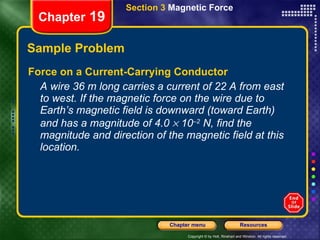
Sample Problem Force on a Current-Carrying Conductor A wire 36 m long carries a current of 22 A from east to west. If the magnetic force on the wire due to Earth’s magnetic field is downward (toward Earth) and has a magnitude of 4.0    10 –2  N, find the magnitude and direction of the magnetic field at this location. Chapter  19 Section 3  Magnetic Force
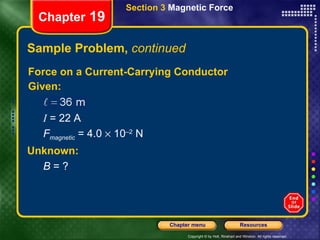
Sample Problem,  continued Force on a Current-Carrying Conductor Given: Chapter  19 Section 3  Magnetic Force I   = 22 A F magnetic  = 4.0    10 –2  N Unknown: B  = ?
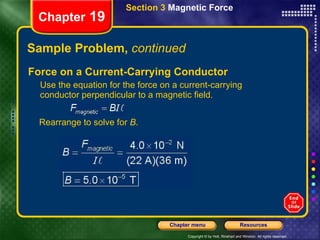
Sample Problem,  continued Force on a Current-Carrying Conductor Use the equation for the force on a current-carrying conductor perpendicular to a magnetic field. Chapter  19 Section 3  Magnetic Force Rearrange to solve for  B .
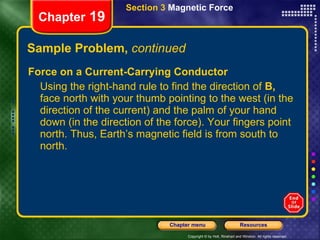
Sample Problem,  continued Force on a Current-Carrying Conductor Using the right-hand rule to find the direction of  B,  face north with your thumb pointing to the west (in the direction of the current) and the palm of your hand down (in the direction of the force). Your fingers point north. Thus, Earth’s magnetic field is from south to north. Chapter  19 Section 3  Magnetic Force
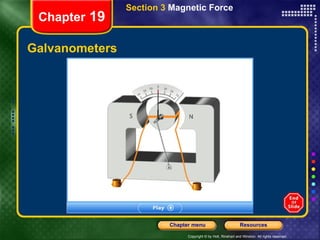
Galvanometers Chapter  19 Section 3  Magnetic Force
Multiple Choice 1.  Which of the following statements best describes the domains in unmagnetized iron? A.  There are no domains. B.  There are domains, but the domains are smaller than in magnetized iron. C.  There are domains, but the domains are oriented randomly. D.  There are domains, but the domains are not magnetized. Chapter  19 Standardized Test Prep
Multiple Choice,  continued 1.  Which of the following statements best describes the domains in unmagnetized iron? A.  There are no domains. B.  There are domains, but the domains are smaller than in magnetized iron. C.  There are domains, but the domains are oriented randomly. D.  There are domains, but the domains are not magnetized. Chapter  19 Standardized Test Prep
Multiple Choice,  continued 2.  Which of the following statements is most correct? F.  The north pole of a freely rotating magnet points north because the magnetic pole near the geographic North Pole is like the north pole of a magnet. G.  The north pole of a freely rotating magnet points north because the magnetic pole near the geographic North Pole is like the south pole of a magnet. H.  The north pole of a freely rotating magnet points south because the magnetic pole near the geographic South Pole is like the north pole of a magnet. J.  The north pole of a freely rotating magnet points south because the magnetic pole near the geographic South Pole is like the south pole of a magnet. Chapter  19 Standardized Test Prep
Multiple Choice,  continued 3.  If you are standing at Earth’s magnetic north pole and holding a bar magnet that is free to rotate in three dimensions, which direction will the south pole of the magnet point? A.  straight up B.  straight down C.  parallel to the ground, toward the north D.  parallel to the ground, toward the south Chapter  19 Standardized Test Prep
Multiple Choice,  continued 4.  How can you increase the strength of a magnetic field inside a solenoid? F.  increase the number of coils per unit length G.  increase the current H.  place an iron rod inside the solenoid J.  all of the above Chapter  19 Standardized Test Prep
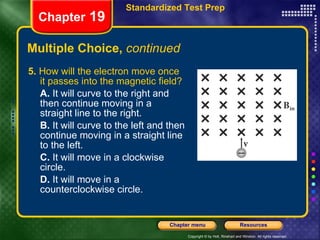
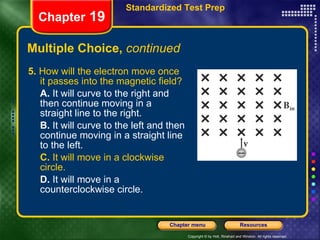
Multiple Choice,  continued 5.  How will the electron move once it passes into the magnetic field? A.  It will curve to the right and then continue moving in a straight line to the right. B.  It will curve to the left and then continue moving in a straight line to the left. C.  It will move in a clockwise circle. D.  It will move in a counterclockwise circle. Chapter  19 Standardized Test Prep
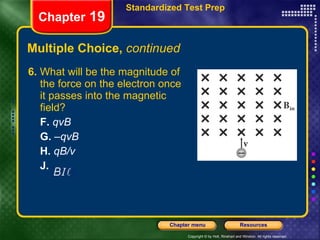
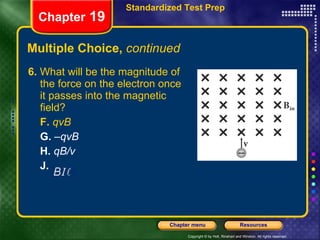
Multiple Choice,  continued 6.  What will be the magnitude of the force on the electron once it passes into the magnetic field? F.   qvB G.  – qvB H.   qB/v J.   Chapter  19 Standardized Test Prep
Multiple Choice,  continued 7.  An alpha particle ( q  = 3.2    10 –19  C) moves at a speed of 2.5    10 6  m/s perpendicular to a magnetic field of strength 2.0    10 –4  T. What is the magnitude of the magnetic force on the particle? A.  1.6    10 –16  N  B.  –1.6    10 –16  N C.  4.0    10 –9  N  D.  zero Chapter  19 Standardized Test Prep
Multiple Choice,  continued 7.  An alpha particle ( q  = 3.2    10 –19  C) moves at a speed of 2.5    10 6  m/s perpendicular to a magnetic field of strength 2.0    10 –4  T. What is the magnitude of the magnetic force on the particle? A.  1.6    10 –16  N   B.  –1.6    10 –16  N C.  4.0    10 –9  N  D.  zero Chapter  19 Standardized Test Prep
Multiple Choice,  continued Use the passage below to answer questions 8–9. A wire 25 cm long carries a 12 A current from east to west. Earth’s magnetic field at the wire’s location has a magnitude of 4.8    10 –5  T and is directed from south to north. 8.  What is the magnitude of the magnetic force on the wire? F.  2.3    10 –5  N G.  1.4    10 –4  N H.  2.3    10 –3  N J.  1.4    10 –2  N Chapter  19 Standardized Test Prep
Multiple Choice,  continued Use the passage below to answer questions 8–9. A wire 25 cm long carries a 12 A current from east to west. Earth’s magnetic field at the wire’s location has a magnitude of 4.8    10 –5  T and is directed from south to north. 9.  What is the direction of the magnetic force on the wire? A.  north B.  south C.  up, away from Earth D.  down, toward Earth Chapter  19 Standardized Test Prep
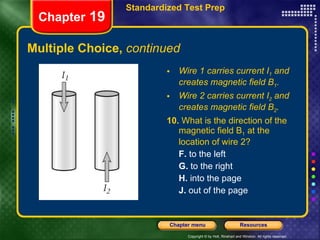
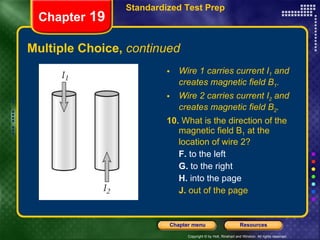
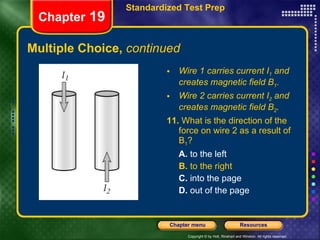
Multiple Choice,  continued Wire 1 carries current I 1  and creates magnetic field B 1 . Wire 2 carries current I 2  and creates magnetic field B 2 . 10.  What is the direction of the magnetic field B 1  at the location of wire 2? F.  to the left G.  to the right H.  into the page J.  out of the page Chapter  19 Standardized Test Prep
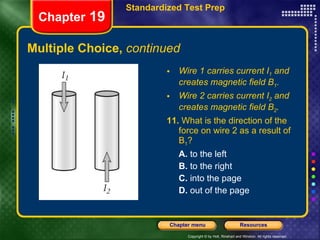
Multiple Choice,  continued Wire 1 carries current I 1  and creates magnetic field B 1 . Wire 2 carries current I 2  and creates magnetic field B 2 . 11.  What is the direction of the force on wire 2 as a result of B 1 ? A.  to the left B.  to the right C.  into the page D.  out of the page Chapter  19 Standardized Test Prep
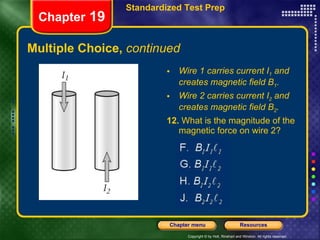
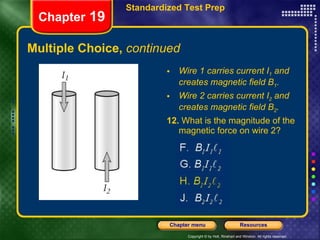
Multiple Choice,  continued Wire 1 carries current I 1  and creates magnetic field B 1 . Wire 2 carries current I 2  and creates magnetic field B 2 . 12.  What is the magnitude of the magnetic force on wire 2? Chapter  19 Standardized Test Prep
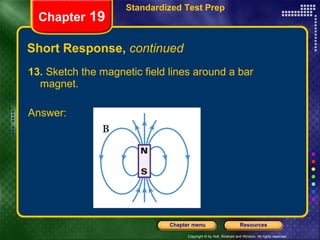
Short Response 13.  Sketch the magnetic field lines around a bar magnet. Chapter  19 Standardized Test Prep
Short Response,  continued 13.  Sketch the magnetic field lines around a bar magnet. Answer: Chapter  19 Standardized Test Prep
Short Response,  continued 14.  Describe how to use the right-hand rule to determine the direction of a magnetic field around a current-carrying wire. Chapter  19 Standardized Test Prep
Short Response,  continued 14.  Describe how to use the right-hand rule to determine the direction of a magnetic field around a current-carrying wire. Answer:  Imagine wrapping the fingers of your right hand around the wire and pointing your thumb in the direction of the current. The magnetic field lines form concentric circles that are centered on the wire and curve in the same direction as your fingers. Chapter  19 Standardized Test Prep
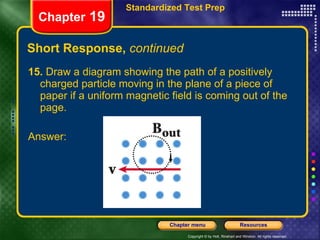
Short Response,  continued 15.  Draw a diagram showing the path of a positively charged particle moving in the plane of a piece of paper if a uniform magnetic field is coming out of the page. Chapter  19 Standardized Test Prep
Short Response,  continued 15.  Draw a diagram showing the path of a positively charged particle moving in the plane of a piece of paper if a uniform magnetic field is coming out of the page. Answer: Chapter  19 Standardized Test Prep
Magnetic Field of a Current Loop Chapter  19 Section 2  Magnetism from Electricity

Hp 19 win

  • 1.
    How to UseThis Presentation To View the presentation as a slideshow with effects select “View” on the menu bar and click on “Slide Show.” To advance through the presentation, click the right-arrow key or the space bar. From the resources slide, click on any resource to see a presentation for that resource. From the Chapter menu screen click on any lesson to go directly to that lesson’s presentation. You may exit the slide show at any time by pressing the Esc key.
  • 2.
    Chapter Presentation TransparenciesStandardized Test Prep Sample Problems Visual Concepts Resources
  • 3.
    Table of ContentsSection 1 Magnets and Magnetic Fields Section 2 Magnetism from Electricity Section 3 Magnetic Force Magnetism Chapter 19
  • 4.
    Objectives For givensituations, predict whether magnets will repel or attract each other. Describe the magnetic field around a permanent magnet. Describe the orientation of Earth’s magnetic field. Section 1 Magnets and Magnetic Fields Chapter 19
  • 5.
    Magnets Magnets attract iron-containing objects. Magnets have two distinct poles called the north pole and the south pole . These names are derived from a magnet’s behavior on Earth. Like poles of magnets repel each other; unlike poles attract each other. Section 1 Magnets and Magnetic Fields Chapter 19
  • 6.
    Magnetic Poles Chapter 19 Section 1 Magnets and Magnetic Fields
  • 7.
    Magnetic Domains MagneticDomain A region composed of a group of atoms whose magnetic fields are aligned in the same direction is called a magnetic domain . Some materials can be made into permanent magnets. Soft magnetic materials (for example iron ) are easily magnetized but tend to lose their magnetism easily. Hard magnetic materials (for example nickel ) tend to retain their magnetism. Section 1 Magnets and Magnetic Fields Chapter 19
  • 8.
    Magnetic Fields A magnetic field is a region in which a magnetic force can be detected. Magnetic field lines can be drawn with the aid of a compass. Section 1 Magnets and Magnetic Fields Chapter 19
  • 9.
    Magnetic Field ofa Bar Magnet Chapter 19 Section 1 Magnets and Magnetic Fields
  • 10.
    Representing the Directionof a Magnetic Field Chapter 19 Section 1 Magnets and Magnetic Fields
  • 11.
    Magnetic Fields, continued Earth’s magnetic field is similar to that of a bar magnet. The magnetic south pole is near the Geographic North Pole. The magnetic north pole is near the Geographic South Pole. Magnetic declination is a measure of the difference between true north and north indicated by a compass. Section 1 Magnets and Magnetic Fields Chapter 19
  • 12.
    Earth’s Magnetic FieldChapter 19 Section 1 Magnets and Magnetic Fields
  • 13.
    Objectives Describe the magnetic field produced by current in a straight conductor and in a solenoid. Use the right-hand rule to determine the direction of the magnetic field in a current-carrying wire. Section 2 Magnetism from Electricity Chapter 19
  • 14.
    Magnetic Field ofa Current-Carrying Wire A long, straight, current-carrying wire has a cylindrical magnetic field. Compasses can be used to shown the direction of the magnetic field induced by the wire. The right-hand rule can be used to determine the direction of the magnetic field in a current-carrying wire. Chapter 19 Section 2 Magnetism from Electricity
  • 15.
    The Right-Hand RuleChapter 19 Section 2 Magnetism from Electricity
  • 16.
    Magnetic Field ofa Current-Carrying Wire Chapter 19 Section 2 Magnetism from Electricity
  • 17.
    Magnetic Field ofa Current-Carrying Wire Chapter 19 Section 2 Magnetism from Electricity Negative Current Positive Current Zero Current
  • 18.
    Magnetic Field ofa Current Loop Solenoids produce a strong magnetic field by combining several loops. A solenoid is a long, helically wound coil of insulated wire. Chapter 19 Section 2 Magnetism from Electricity
  • 19.
    Magnetic Field ofa Current Loop Chapter 19 Section 2 Magnetism from Electricity
  • 20.
    Objectives Given theforce on a charge in a magnetic field, determine the strength of the magnetic field. Use the right-hand rule to find the direction of the force on a charge moving through a magnetic field. Determine the magnitude and direction of the force on a wire carrying current in a magnetic field. Section 3 Magnetic Force Chapter 19
  • 21.
    Charged Particles ina Magnetic Field A charge moving through a magnetic field experiences a force proportional to the charge, velocity, and the magnetic field. Section 3 Magnetic Force Chapter 19
  • 22.
    Force on aCharge Moving in a Magnetic Field Chapter 19 Section 3 Magnetic Force
  • 23.
    Charged Particles ina Magnetic Field, continued The direction of the magnetic force on a moving charge is always perpendicular to both the magnetic field and the velocity of the charge. An alternative right-hand rule can be used to find the direction of the magnetic force. A charge moving through a magnetic field follows a circular path. Chapter 19 Section 3 Magnetic Force
  • 24.
    Alternative Right-Hand Rule:Force on a Moving Charge Chapter 19 Section 3 Magnetic Force
  • 25.
    Sample Problem Particlein a Magnetic Field A proton moving east experiences a force of 8.8  10 –19 N upward due to the Earth’s magnetic field.At this location, the field has a magnitude of 5.5  10 –5 T to the north. Find the speed of the particle. Chapter 19 Section 3 Magnetic Force
  • 26.
    Sample Problem, continued Particle in a Magnetic Field Given: q = 1.60  10 –19 C B = 5.5  10 –5 T F magnetic = 8.8  10 –19 N Unknown: v = ? Chapter 19 Section 3 Magnetic Force
  • 27.
    Sample Problem, continued Particle in a Magnetic Field Use the definition of magnetic field strength. Rearrange to solve for v . Chapter 19 Section 3 Magnetic Force
  • 28.
    Magnetic Force ona Current-Carrying Conductor A current-carrying wire in an external magnetic field undergoes a magnetic force. The force on a current-carrying conductor perpendicular to a magnetic field is given by: Section 3 Magnetic Force Chapter 19 magnitude of magnetic force = (magnitude of magnetic field)  (current)  (length of conductor within B)
  • 29.
    Force on aCurrent-Carrying Wire in a Magnetic Field Chapter 19 Section 3 Magnetic Force
  • 30.
    Magnetic Force ona Current-Carrying Conductor, continued Two parallel current-carrying wires exert a force on one another that are equal in magnitude and opposite in direction. If the currents are in the same direction, the two wires attract one another. If the currents are in opposite direction, the wires repel one another. Loudspeakers use magnetic force to produce sound. Section 3 Magnetic Force Chapter 19
  • 31.
    Force Between ParallelConducting Wires Chapter 19 Section 3 Magnetic Force
  • 32.
    Sample Problem Forceon a Current-Carrying Conductor A wire 36 m long carries a current of 22 A from east to west. If the magnetic force on the wire due to Earth’s magnetic field is downward (toward Earth) and has a magnitude of 4.0  10 –2 N, find the magnitude and direction of the magnetic field at this location. Chapter 19 Section 3 Magnetic Force
  • 33.
    Sample Problem, continued Force on a Current-Carrying Conductor Given: Chapter 19 Section 3 Magnetic Force I = 22 A F magnetic = 4.0  10 –2 N Unknown: B = ?
  • 34.
    Sample Problem, continued Force on a Current-Carrying Conductor Use the equation for the force on a current-carrying conductor perpendicular to a magnetic field. Chapter 19 Section 3 Magnetic Force Rearrange to solve for B .
  • 35.
    Sample Problem, continued Force on a Current-Carrying Conductor Using the right-hand rule to find the direction of B, face north with your thumb pointing to the west (in the direction of the current) and the palm of your hand down (in the direction of the force). Your fingers point north. Thus, Earth’s magnetic field is from south to north. Chapter 19 Section 3 Magnetic Force
  • 36.
    Galvanometers Chapter 19 Section 3 Magnetic Force
  • 37.
    Multiple Choice 1. Which of the following statements best describes the domains in unmagnetized iron? A. There are no domains. B. There are domains, but the domains are smaller than in magnetized iron. C. There are domains, but the domains are oriented randomly. D. There are domains, but the domains are not magnetized. Chapter 19 Standardized Test Prep
  • 38.
    Multiple Choice, continued 1. Which of the following statements best describes the domains in unmagnetized iron? A. There are no domains. B. There are domains, but the domains are smaller than in magnetized iron. C. There are domains, but the domains are oriented randomly. D. There are domains, but the domains are not magnetized. Chapter 19 Standardized Test Prep
  • 39.
    Multiple Choice, continued 2. Which of the following statements is most correct? F. The north pole of a freely rotating magnet points north because the magnetic pole near the geographic North Pole is like the north pole of a magnet. G. The north pole of a freely rotating magnet points north because the magnetic pole near the geographic North Pole is like the south pole of a magnet. H. The north pole of a freely rotating magnet points south because the magnetic pole near the geographic South Pole is like the north pole of a magnet. J. The north pole of a freely rotating magnet points south because the magnetic pole near the geographic South Pole is like the south pole of a magnet. Chapter 19 Standardized Test Prep
  • 40.
    Multiple Choice, continued 2. Which of the following statements is most correct? F. The north pole of a freely rotating magnet points north because the magnetic pole near the geographic North Pole is like the north pole of a magnet. G. The north pole of a freely rotating magnet points north because the magnetic pole near the geographic North Pole is like the south pole of a magnet. H. The north pole of a freely rotating magnet points south because the magnetic pole near the geographic South Pole is like the north pole of a magnet. J. The north pole of a freely rotating magnet points south because the magnetic pole near the geographic South Pole is like the south pole of a magnet. Chapter 19 Standardized Test Prep
  • 41.
    Multiple Choice, continued 3. If you are standing at Earth’s magnetic north pole and holding a bar magnet that is free to rotate in three dimensions, which direction will the south pole of the magnet point? A. straight up B. straight down C. parallel to the ground, toward the north D. parallel to the ground, toward the south Chapter 19 Standardized Test Prep
  • 42.
    Multiple Choice, continued 3. If you are standing at Earth’s magnetic north pole and holding a bar magnet that is free to rotate in three dimensions, which direction will the south pole of the magnet point? A. straight up B. straight down C. parallel to the ground, toward the north D. parallel to the ground, toward the south Chapter 19 Standardized Test Prep
  • 43.
    Multiple Choice, continued 4. How can you increase the strength of a magnetic field inside a solenoid? F. increase the number of coils per unit length G. increase the current H. place an iron rod inside the solenoid J. all of the above Chapter 19 Standardized Test Prep
  • 44.
    Multiple Choice, continued 4. How can you increase the strength of a magnetic field inside a solenoid? F. increase the number of coils per unit length G. increase the current H. place an iron rod inside the solenoid J. all of the above Chapter 19 Standardized Test Prep
  • 45.
    Multiple Choice, continued 5. How will the electron move once it passes into the magnetic field? A. It will curve to the right and then continue moving in a straight line to the right. B. It will curve to the left and then continue moving in a straight line to the left. C. It will move in a clockwise circle. D. It will move in a counterclockwise circle. Chapter 19 Standardized Test Prep
  • 46.
    Multiple Choice, continued 5. How will the electron move once it passes into the magnetic field? A. It will curve to the right and then continue moving in a straight line to the right. B. It will curve to the left and then continue moving in a straight line to the left. C. It will move in a clockwise circle. D. It will move in a counterclockwise circle. Chapter 19 Standardized Test Prep
  • 47.
    Multiple Choice, continued 6. What will be the magnitude of the force on the electron once it passes into the magnetic field? F. qvB G. – qvB H. qB/v J. Chapter 19 Standardized Test Prep
  • 48.
    Multiple Choice, continued 6. What will be the magnitude of the force on the electron once it passes into the magnetic field? F. qvB G. – qvB H. qB/v J. Chapter 19 Standardized Test Prep
  • 49.
    Multiple Choice, continued 7. An alpha particle ( q = 3.2  10 –19 C) moves at a speed of 2.5  10 6 m/s perpendicular to a magnetic field of strength 2.0  10 –4 T. What is the magnitude of the magnetic force on the particle? A. 1.6  10 –16 N B. –1.6  10 –16 N C. 4.0  10 –9 N D. zero Chapter 19 Standardized Test Prep
  • 50.
    Multiple Choice, continued 7. An alpha particle ( q = 3.2  10 –19 C) moves at a speed of 2.5  10 6 m/s perpendicular to a magnetic field of strength 2.0  10 –4 T. What is the magnitude of the magnetic force on the particle? A. 1.6  10 –16 N B. –1.6  10 –16 N C. 4.0  10 –9 N D. zero Chapter 19 Standardized Test Prep
  • 51.
    Multiple Choice, continued Use the passage below to answer questions 8–9. A wire 25 cm long carries a 12 A current from east to west. Earth’s magnetic field at the wire’s location has a magnitude of 4.8  10 –5 T and is directed from south to north. 8. What is the magnitude of the magnetic force on the wire? F. 2.3  10 –5 N G. 1.4  10 –4 N H. 2.3  10 –3 N J. 1.4  10 –2 N Chapter 19 Standardized Test Prep
  • 52.
    Multiple Choice, continued Use the passage below to answer questions 8–9. A wire 25 cm long carries a 12 A current from east to west. Earth’s magnetic field at the wire’s location has a magnitude of 4.8  10 –5 T and is directed from south to north. 8. What is the magnitude of the magnetic force on the wire? F. 2.3  10 –5 N G. 1.4  10 –4 N H. 2.3  10 –3 N J. 1.4  10 –2 N Chapter 19 Standardized Test Prep
  • 53.
    Multiple Choice, continued Use the passage below to answer questions 8–9. A wire 25 cm long carries a 12 A current from east to west. Earth’s magnetic field at the wire’s location has a magnitude of 4.8  10 –5 T and is directed from south to north. 9. What is the direction of the magnetic force on the wire? A. north B. south C. up, away from Earth D. down, toward Earth Chapter 19 Standardized Test Prep
  • 54.
    Multiple Choice, continued Use the passage below to answer questions 8–9. A wire 25 cm long carries a 12 A current from east to west. Earth’s magnetic field at the wire’s location has a magnitude of 4.8  10 –5 T and is directed from south to north. 9. What is the direction of the magnetic force on the wire? A. north B. south C. up, away from Earth D. down, toward Earth Chapter 19 Standardized Test Prep
  • 55.
    Multiple Choice, continued Wire 1 carries current I 1 and creates magnetic field B 1 . Wire 2 carries current I 2 and creates magnetic field B 2 . 10. What is the direction of the magnetic field B 1 at the location of wire 2? F. to the left G. to the right H. into the page J. out of the page Chapter 19 Standardized Test Prep
  • 56.
    Multiple Choice, continued Wire 1 carries current I 1 and creates magnetic field B 1 . Wire 2 carries current I 2 and creates magnetic field B 2 . 10. What is the direction of the magnetic field B 1 at the location of wire 2? F. to the left G. to the right H. into the page J. out of the page Chapter 19 Standardized Test Prep
  • 57.
    Multiple Choice, continued Wire 1 carries current I 1 and creates magnetic field B 1 . Wire 2 carries current I 2 and creates magnetic field B 2 . 11. What is the direction of the force on wire 2 as a result of B 1 ? A. to the left B. to the right C. into the page D. out of the page Chapter 19 Standardized Test Prep
  • 58.
    Multiple Choice, continued Wire 1 carries current I 1 and creates magnetic field B 1 . Wire 2 carries current I 2 and creates magnetic field B 2 . 11. What is the direction of the force on wire 2 as a result of B 1 ? A. to the left B. to the right C. into the page D. out of the page Chapter 19 Standardized Test Prep
  • 59.
    Multiple Choice, continued Wire 1 carries current I 1 and creates magnetic field B 1 . Wire 2 carries current I 2 and creates magnetic field B 2 . 12. What is the magnitude of the magnetic force on wire 2? Chapter 19 Standardized Test Prep
  • 60.
    Multiple Choice, continued Wire 1 carries current I 1 and creates magnetic field B 1 . Wire 2 carries current I 2 and creates magnetic field B 2 . 12. What is the magnitude of the magnetic force on wire 2? Chapter 19 Standardized Test Prep
  • 61.
    Short Response 13. Sketch the magnetic field lines around a bar magnet. Chapter 19 Standardized Test Prep
  • 62.
    Short Response, continued 13. Sketch the magnetic field lines around a bar magnet. Answer: Chapter 19 Standardized Test Prep
  • 63.
    Short Response, continued 14. Describe how to use the right-hand rule to determine the direction of a magnetic field around a current-carrying wire. Chapter 19 Standardized Test Prep
  • 64.
    Short Response, continued 14. Describe how to use the right-hand rule to determine the direction of a magnetic field around a current-carrying wire. Answer: Imagine wrapping the fingers of your right hand around the wire and pointing your thumb in the direction of the current. The magnetic field lines form concentric circles that are centered on the wire and curve in the same direction as your fingers. Chapter 19 Standardized Test Prep
  • 65.
    Short Response, continued 15. Draw a diagram showing the path of a positively charged particle moving in the plane of a piece of paper if a uniform magnetic field is coming out of the page. Chapter 19 Standardized Test Prep
  • 66.
    Short Response, continued 15. Draw a diagram showing the path of a positively charged particle moving in the plane of a piece of paper if a uniform magnetic field is coming out of the page. Answer: Chapter 19 Standardized Test Prep
  • 67.
    Magnetic Field ofa Current Loop Chapter 19 Section 2 Magnetism from Electricity