This document contains a series of conceptual tests about magnetic flux and induced currents based on textbook material. It includes diagrams and explanations of the direction of induced currents in different scenarios involving moving magnets and wire loops in magnetic fields.
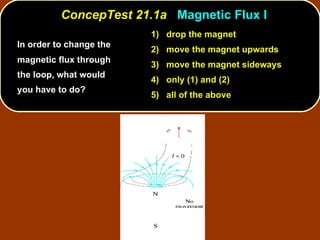
ConcepTest 21.1a Magnetic Flux I In order to change the magnetic flux through the loop, what would you have to do? 1) drop the magnet 2) move the magnet upwards 3) move the magnet sideways 4) only (1) and (2) 5) all of the above
3.
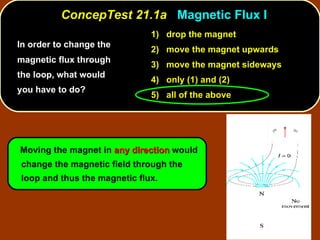
ConcepTest 21.1a Magnetic Flux I In order to change the magnetic flux through the loop, what would you have to do? Moving the magnet in any direction would change the magnetic field through the loop and thus the magnetic flux. 1) drop the magnet 2) move the magnet upwards 3) move the magnet sideways 4) only (1) and (2) 5) all of the above
4.
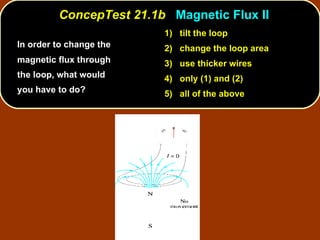
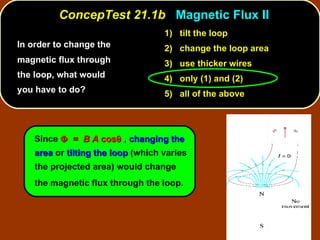
ConcepTest 21.1b Magnetic Flux II In order to change the magnetic flux through the loop, what would you have to do? 1) tilt the loop 2) change the loop area 3) use thicker wires 4) only (1) and (2) 5) all of the above
5.
ConcepTest 21.1b Magnetic Flux II In order to change the magnetic flux through the loop, what would you have to do? 1) tilt the loop 2) change the loop area 3) use thicker wires 4) only (1) and (2) 5) all of the above Since = B A cos , changing the area or tilting the loop (which varies the projected area) would change the magnetic flux through the loop.
6.
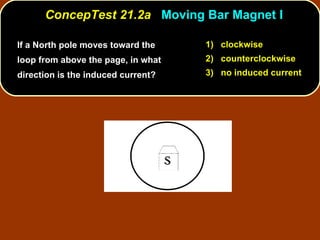
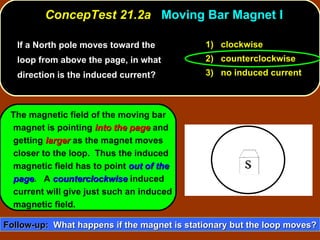
If a Northpole moves toward the loop from above the page, in what direction is the induced current? ConcepTest 21.2a Moving Bar Magnet I 1) clockwise 2) counterclockwise 3) no induced current
7.
If a Northpole moves toward the loop from above the page, in what direction is the induced current? ConcepTest 21.2a Moving Bar Magnet I 1) clockwise 2) counterclockwise 3) no induced current The magnetic field of the moving bar magnet is pointing into the page and getting larger as the magnet moves closer to the loop. Thus the induced magnetic field has to point out of the page . A counterclockwise induced current will give just such an induced magnetic field. Follow-up: What happens if the magnet is stationary but the loop moves?
8.
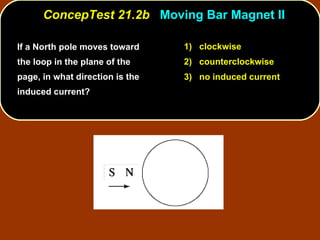
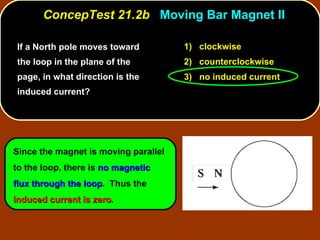
If a Northpole moves toward the loop in the plane of the page, in what direction is the induced current? ConcepTest 21.2b Moving Bar Magnet II 1) clockwise 2) counterclockwise 3) no induced current
9.
If a Northpole moves toward the loop in the plane of the page, in what direction is the induced current? ConcepTest 21.2b Moving Bar Magnet II Since the magnet is moving parallel to the loop, there is no magnetic flux through the loop . Thus the induced current is zero . 1) clockwise 2) counterclockwise 3) no induced current
10.
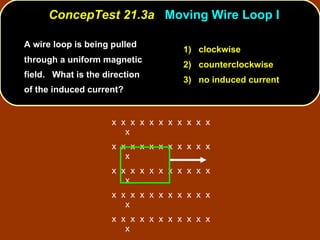
A wire loopis being pulled through a uniform magnetic field. What is the direction of the induced current? ConcepTest 21.3a Moving Wire Loop I 1) clockwise 2) counterclockwise 3) no induced current x x x x x x x x x x x x x x x x x x x x x x x x x x x x x x x x x x x x x x x x x x x x x x x x x x x x x x x x x x x x x x x x x x x x x x x x x x x x x x x x x x x x
11.
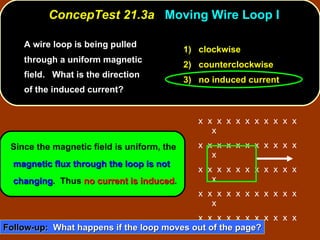
A wire loopis being pulled through a uniform magnetic field. What is the direction of the induced current? ConcepTest 21.3a Moving Wire Loop I Since the magnetic field is uniform, the magnetic flux through the loop is not changing . Thus no current is induced . 1) clockwise 2) counterclockwise 3) no induced current Follow-up: What happens if the loop moves out of the page? x x x x x x x x x x x x x x x x x x x x x x x x x x x x x x x x x x x x x x x x x x x x x x x x x x x x x x x x x x x x x x x x x x x x x x x x x x x x x x x x x x x x
12.
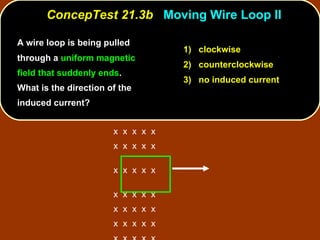
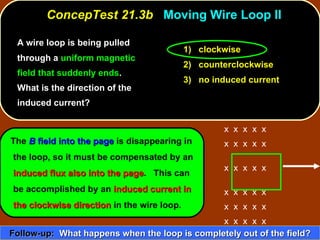
A wire loopis being pulled through a uniform magnetic field that suddenly ends . What is the direction of the induced current? ConcepTest 21.3b Moving Wire Loop II 1) clockwise 2) counterclockwise 3) no induced current x x x x x x x x x x x x x x x x x x x x x x x x x x x x x x x x x x x
13.
A wire loopis being pulled through a uniform magnetic field that suddenly ends . What is the direction of the induced current? ConcepTest 21.3b Moving Wire Loop II 1) clockwise 2) counterclockwise 3) no induced current The B field into the page is disappearing in the loop, so it must be compensated by an induced flux also into the page . This can be accomplished by an induced current in the clockwise direction in the wire loop. Follow-up: What happens when the loop is completely out of the field? x x x x x x x x x x x x x x x x x x x x x x x x x x x x x x x x x x x
14.
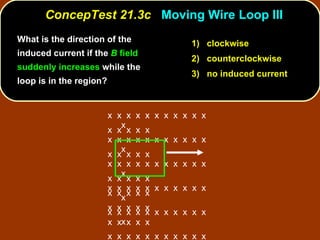
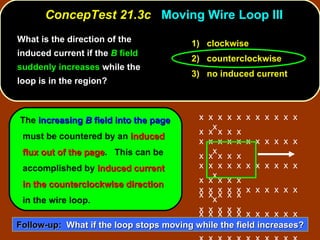
ConcepTest 21.3c Moving Wire Loop III 1) clockwise 2) counterclockwise 3) no induced current What is the direction of the induced current if the B field suddenly increases while the loop is in the region? x x x x x x x x x x x x x x x x x x x x x x x x x x x x x x x x x x x x x x x x x x x x x x x x x x x x x x x x x x x x x x x x x x x x x x x x x x x x x x x x x x x x x x x x x x x x x x x x x x x x x x x x x x x x x x x x x x x x x x x
15.
ConcepTest 21.3c Moving Wire Loop III 1) clockwise 2) counterclockwise 3) no induced current What is the direction of the induced current if the B field suddenly increases while the loop is in the region? The increasing B field into the page must be countered by an induced flux out of the page . This can be accomplished by induced current in the counterclockwise direction in the wire loop. Follow-up: What if the loop stops moving while the field increases? x x x x x x x x x x x x x x x x x x x x x x x x x x x x x x x x x x x x x x x x x x x x x x x x x x x x x x x x x x x x x x x x x x x x x x x x x x x x x x x x x x x x x x x x x x x x x x x x x x x x x x x x x x x x x x x x x x x x x x x
16.
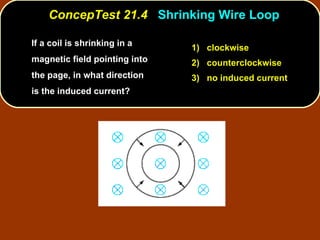
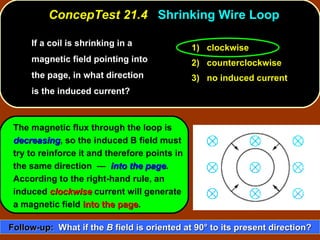
If a coilis shrinking in a magnetic field pointing into the page, in what direction is the induced current? ConcepTest 21.4 Shrinking Wire Loop 1) clockwise 2) counterclockwise 3) no induced current
17.
If a coilis shrinking in a magnetic field pointing into the page, in what direction is the induced current? ConcepTest 21.4 Shrinking Wire Loop The magnetic flux through the loop is decreasing , so the induced B field must try to reinforce it and therefore points in the same direction — into the page . According to the right-hand rule, an induced clockwise current will generate a magnetic field into the page . 1) clockwise 2) counterclockwise 3) no induced current Follow-up: What if the B field is oriented at 90 ° to its present direction?
18.
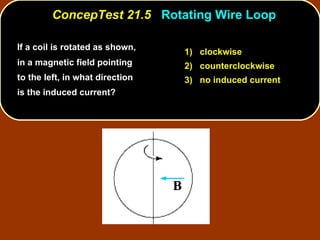
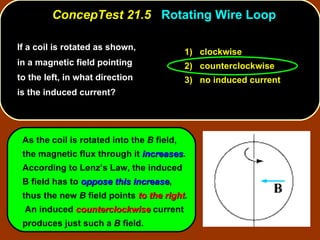
If a coilis rotated as shown, in a magnetic field pointing to the left, in what direction is the induced current? ConcepTest 21.5 Rotating Wire Loop 1) clockwise 2) counterclockwise 3) no induced current
19.
If a coilis rotated as shown, in a magnetic field pointing to the left, in what direction is the induced current? ConcepTest 21.5 Rotating Wire Loop As the coil is rotated into the B field, the magnetic flux through it increases . According to Lenz’s Law, the induced B field has to oppose this increase , thus the new B field points to the right . An induced counterclockwise current produces just such a B field. 1) clockwise 2) counterclockwise 3) no induced current
20.
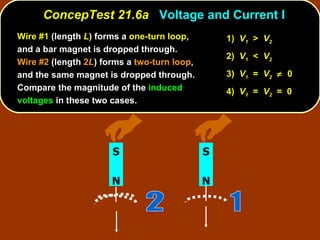
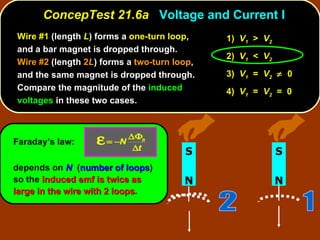
Wire #1 (length L ) forms a one-turn loop , and a bar magnet is dropped through. Wire #2 (length 2 L ) forms a two-turn loop , and the same magnet is dropped through. Compare the magnitude of the induced voltages in these two cases. ConcepTest 21.6a Voltage and Current I 1) V 1 > V 2 2) V 1 < V 2 3) V 1 = V 2 0 4) V 1 = V 2 = 0 N S N S 1 2
21.
Wire #1 (length L ) forms a one-turn loop , and a bar magnet is dropped through. Wire #2 (length 2 L ) forms a two-turn loop , and the same magnet is dropped through. Compare the magnitude of the induced voltages in these two cases. ConcepTest 21.6a Voltage and Current I Faraday’s law: depends on N ( number of loops ) so the induced emf is twice as large in the wire with 2 loops . 1) V 1 > V 2 2) V 1 < V 2 3) V 1 = V 2 0 4) V 1 = V 2 = 0 N S N S 1 2
22.
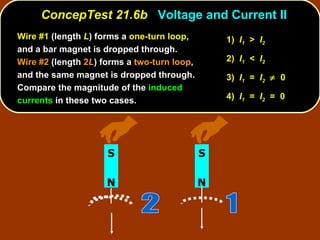
ConcepTest 21.6b Voltage and Current II Wire #1 (length L ) forms a one-turn loop , and a bar magnet is dropped through. Wire #2 (length 2 L ) forms a two-turn loop , and the same magnet is dropped through. Compare the magnitude of the induced currents in these two cases. 1) I 1 > I 2 2) I 1 < I 2 3) I 1 = I 2 0 4) I 1 = I 2 = 0 N S N S 1 2
23.
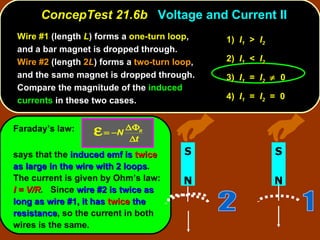
ConcepTest 21.6b Voltage and Current II Wire #1 (length L ) forms a one-turn loop , and a bar magnet is dropped through. Wire #2 (length 2 L ) forms a two-turn loop , and the same magnet is dropped through. Compare the magnitude of the induced currents in these two cases. Faraday’s law: says that the induced emf is twice as large in the wire with 2 loops . The current is given by Ohm’s law: I = V/R . Since wire #2 is twice as long as wire #1, it has twice the resistance , so the current in both wires is the same. 1) I 1 > I 2 2) I 1 < I 2 3) I 1 = I 2 0 4) I 1 = I 2 = 0 N S N S 1 2
24.
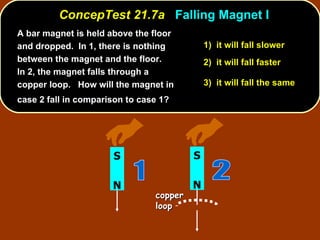
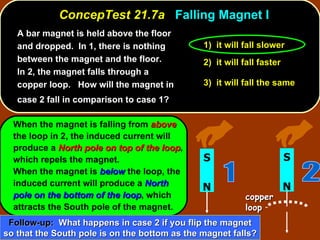
A bar magnetis held above the floor and dropped. In 1, there is nothing between the magnet and the floor. In 2, the magnet falls through a copper loop. How will the magnet in case 2 fall in comparison to case 1? ConcepTest 21.7a Falling Magnet I 1) it will fall slower 2) it will fall faster 3) it will fall the same copper loop N S 2 N S 1
25.
A bar magnetis held above the floor and dropped. In 1, there is nothing between the magnet and the floor. In 2, the magnet falls through a copper loop. How will the magnet in case 2 fall in comparison to case 1? ConcepTest 21.7a Falling Magnet I When the magnet is falling from above the loop in 2, the induced current will produce a North pole on top of the loop , which repels the magnet. When the magnet is below the loop, the induced current will produce a North pole on the bottom of the loop , which attracts the South pole of the magnet. 1) it will fall slower 2) it will fall faster 3) it will fall the same Follow-up: What happens in case 2 if you flip the magnet so that the South pole is on the bottom as the magnet falls? copper loop N S 2 N S 1
26.
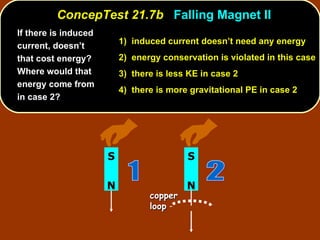
If there isinduced current, doesn’t that cost energy? Where would that energy come from in case 2? ConcepTest 21.7b Falling Magnet II 1) induced current doesn’t need any energy 2) energy conservation is violated in this case 3) there is less KE in case 2 4) there is more gravitational PE in case 2 N S 2 copper loop N S 1
27.
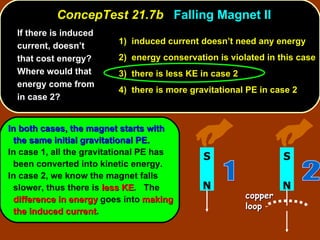
If there isinduced current, doesn’t that cost energy? Where would that energy come from in case 2? ConcepTest 21.7b Falling Magnet II 1) induced current doesn’t need any energy 2) energy conservation is violated in this case 3) there is less KE in case 2 4) there is more gravitational PE in case 2 In both cases, the magnet starts with the same initial gravitational PE. In case 1, all the gravitational PE has been converted into kinetic energy. In case 2, we know the magnet falls slower, thus there is less KE . The difference in energy goes into making the induced current . N S 2 copper loop N S 1
28.
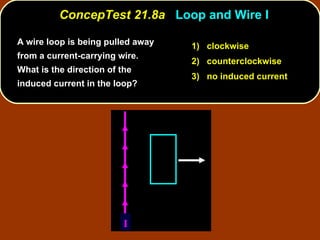
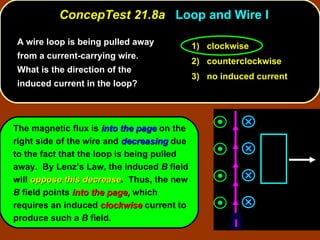
A wire loopis being pulled away from a current-carrying wire. What is the direction of the induced current in the loop? ConcepTest 21.8a Loop and Wire I 1) clockwise 2) counterclockwise 3) no induced current I
29.
ConcepTest 21.8a Loop and Wire I A wire loop is being pulled away from a current-carrying wire. What is the direction of the induced current in the loop? The magnetic flux is into the page on the right side of the wire and decreasing due to the fact that the loop is being pulled away. By Lenz’s Law, the induced B field will oppose this decrease . Thus, the new B field points into the page, which requires an induced clockwise current to produce such a B field. 1) clockwise 2) counterclockwise 3) no induced current I
30.
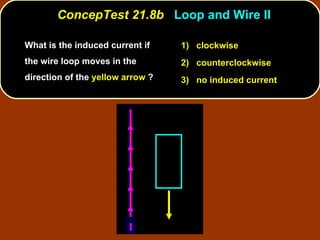
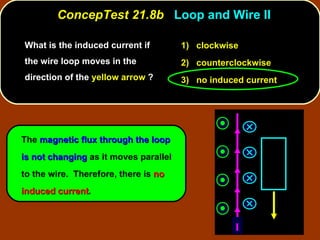
What is theinduced current if the wire loop moves in the direction of the yellow arrow ? ConcepTest 21.8b Loop and Wire II 1) clockwise 2) counterclockwise 3) no induced current I
31.
What is theinduced current if the wire loop moves in the direction of the yellow arrow ? ConcepTest 21.8b Loop and Wire II The magnetic flux through the loop is not changing as it moves parallel to the wire. Therefore, there is no induced current . 1) clockwise 2) counterclockwise 3) no induced current I
32.
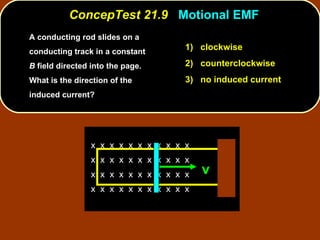
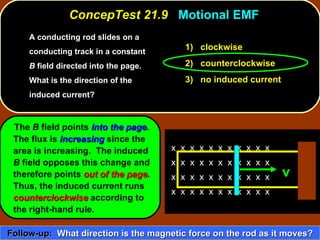
A conducting rodslides on a conducting track in a constant B field directed into the page. What is the direction of the induced current? ConcepTest 21.9 Motional EMF 1) clockwise 2) counterclockwise 3) no induced current x x x x x x x x x x x x x x x x x x x x x x x x x x x x x x x x x x x x x x x x x x x x v
33.
A conducting rodslides on a conducting track in a constant B field directed into the page. What is the direction of the induced current? ConcepTest 21.9 Motional EMF The B field points into the page . The flux is increasing since the area is increasing. The induced B field opposes this change and therefore points out of the page . Thus, the induced current runs counterclockwise according to the right-hand rule. 1) clockwise 2) counterclockwise 3) no induced current Follow-up: What direction is the magnetic force on the rod as it moves? x x x x x x x x x x x x x x x x x x x x x x x x x x x x x x x x x x x x x x x x x x x x v
34.
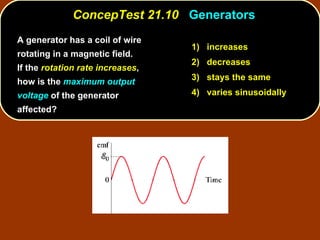
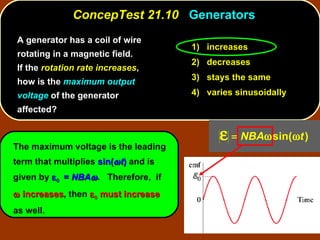
A generator hasa coil of wire rotating in a magnetic field. If the rotation rate increases , how is the maximum output voltage of the generator affected? ConcepTest 21.10 Generators 1) increases 2) decreases 3) stays the same 4) varies sinusoidally
35.
A generator hasa coil of wire rotating in a magnetic field. If the rotation rate increases , how is the maximum output voltage of the generator affected? ConcepTest 21.10 Generators The maximum voltage is the leading term that multiplies sin( t ) and is given by = NBA . Therefore, if increases , then must increase as well. 1) increases 2) decreases 3) stays the same 4) varies sinusoidally
36.
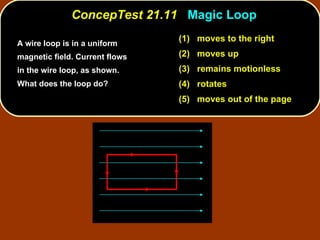
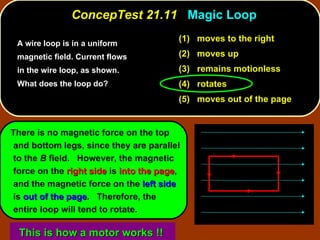
A wire loopis in a uniform magnetic field. Current flows in the wire loop, as shown. What does the loop do? ConcepTest 21.11 Magic Loop (1) moves to the right (2) moves up (3) remains motionless (4) rotates (5) moves out of the page
37.
A wire loopis in a uniform magnetic field. Current flows in the wire loop, as shown. What does the loop do? ConcepTest 21.11 Magic Loop There is no magnetic force on the top and bottom legs, since they are parallel to the B field. However, the magnetic force on the right side is into the page , and the magnetic force on the left side is out of the page . Therefore, the entire loop will tend to rotate. (1) moves to the right (2) moves up (3) remains motionless (4) rotates (5) moves out of the page This is how a motor works !!
38.
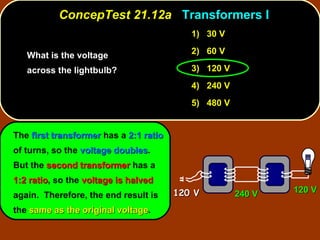
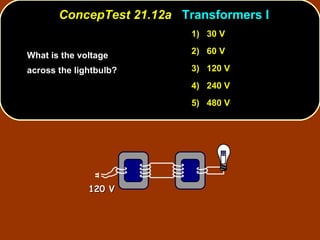
What is thevoltage across the lightbulb? ConcepTest 21.12a Transformers I 1) 30 V 2) 60 V 3) 120 V 4) 240 V 5) 480 V 120 V
39.
What is thevoltage across the lightbulb? ConcepTest 21.12a Transformers I The first transformer has a 2:1 ratio of turns, so the voltage doubles . But the second transformer has a 1:2 ratio , so the voltage is halved again. Therefore, the end result is the same as the original voltage . 1) 30 V 2) 60 V 3) 120 V 4) 240 V 5) 480 V 120 V 240 V 120 V
40.
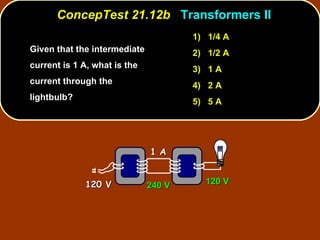
Given that theintermediate current is 1 A, what is the current through the lightbulb? ConcepTest 21.12b Transformers II 1) 1/4 A 2) 1/2 A 3) 1 A 4) 2 A 5) 5 A 1 A 120 V 240 V 120 V
41.
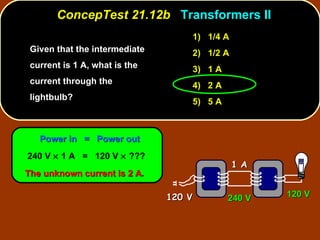
Given that theintermediate current is 1 A, what is the current through the lightbulb? ConcepTest 21.12b Transformers II Power in = Power out 240 V 1 A = 120 V ??? The unknown current is 2 A . 1) 1/4 A 2) 1/2 A 3) 1 A 4) 2 A 5) 5 A 1 A 120 V 240 V 120 V
42.
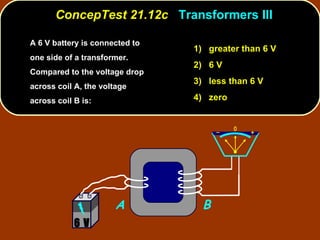
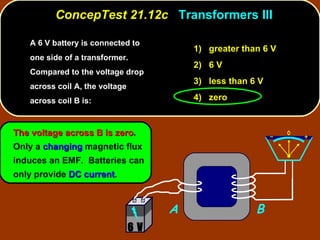
A 6 Vbattery is connected to one side of a transformer. Compared to the voltage drop across coil A, the voltage across coil B is: ConcepTest 21.12c Transformers III 1) greater than 6 V 2) 6 V 3) less than 6 V 4) zero A B 6 V
43.
ConcepTest 21.12c Transformers III A 6 V battery is connected to one side of a transformer. Compared to the voltage drop across coil A, the voltage across coil B is: The voltage across B is zero . Only a changing magnetic flux induces an EMF. Batteries can only provide DC current . 1) greater than 6 V 2) 6 V 3) less than 6 V 4) zero A B 6 V