SciDoc
Orbits & escape velocity 13/02/2024
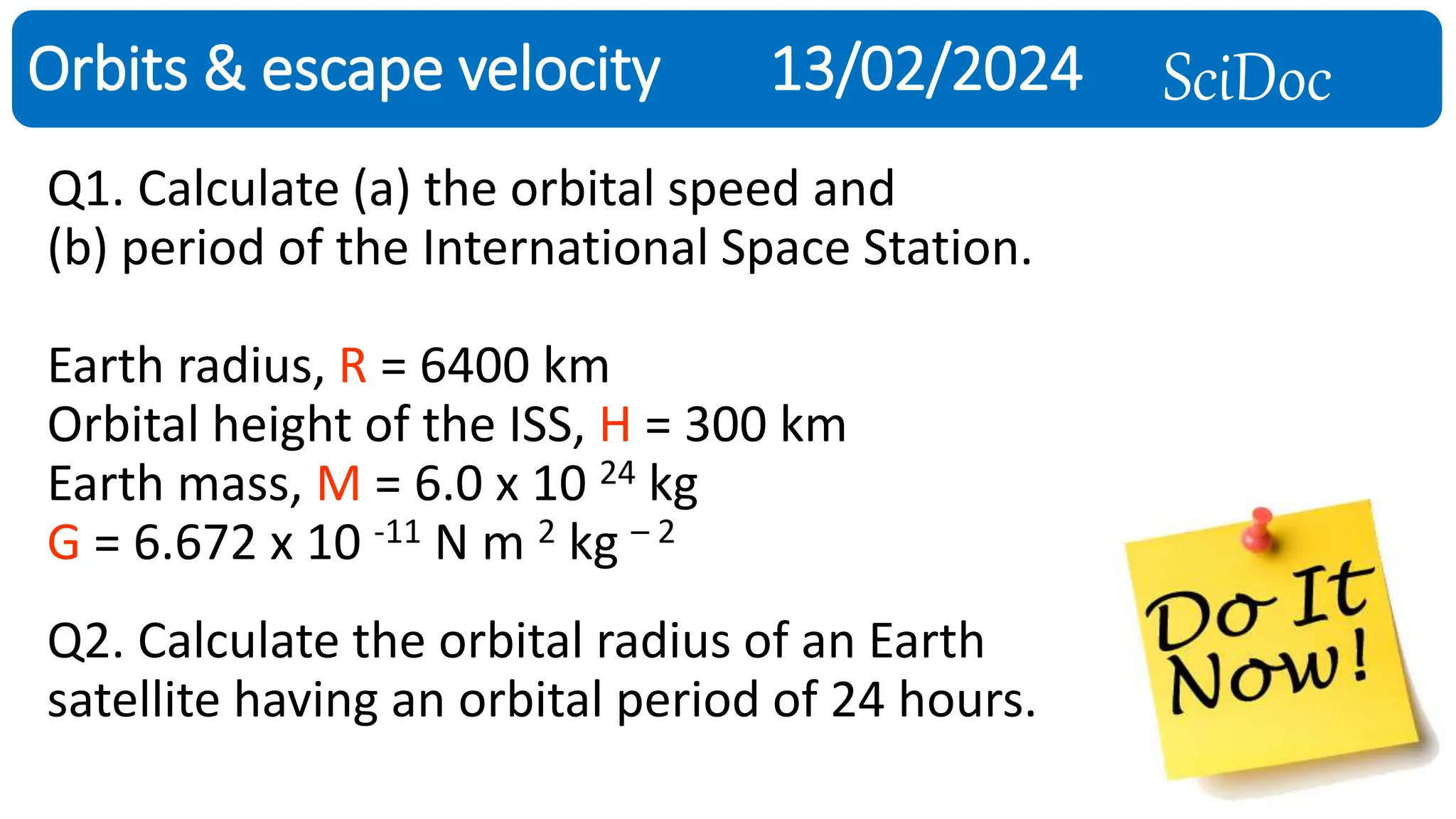
Q1. Calculate (a) the orbital speed and
(b) period of the International Space Station.
Earth radius, R = 6400 km
Orbital height of the ISS, H = 300 km
Earth mass, M = 6.0 x 10 24 kg
G = 6.672 x 10 -11 N m 2 kg – 2
Q2. Calculate the orbital radius of an Earth
satellite having an orbital period of 24 hours.
SciDoc
Q1 review
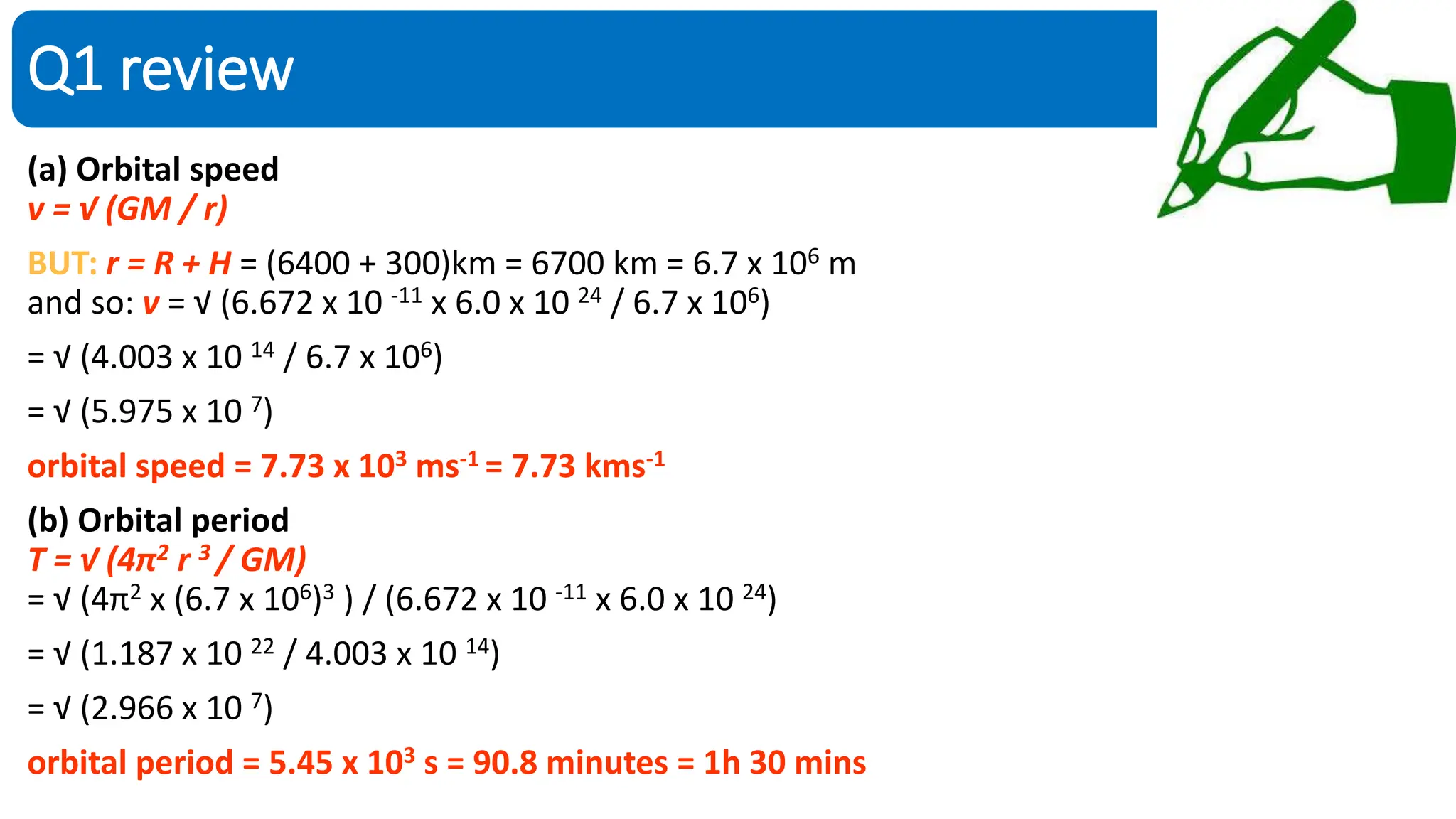
(a) Orbital speed
v = √ (GM / r)
BUT: r = R + H = (6400 + 300)km = 6700 km = 6.7 x 10⁶ m
and so: v = √ (6.672 x 10 -11 x 6.0 x 10 24 / 6.7 x 10⁶)
= √ (4.003 x 10 14 / 6.7 x 10⁶)
= √ (5.975 x 10 7)
orbital speed = 7.73 x 10³ ms-1 = 7.73 kms-1
(b) Orbital period
T = √ (4π2 r 3 / GM)
= √ (4π2 x (6.7 x 106)3 ) / (6.672 x 10 -11 x 6.0 x 10 24)
= √ (1.187 x 10 22 / 4.003 x 10 14)
= √ (2.966 x 10 7)
orbital period = 5.45 x 10³ s = 90.8 minutes = 1h 30 mins
SciDoc
Q2 review
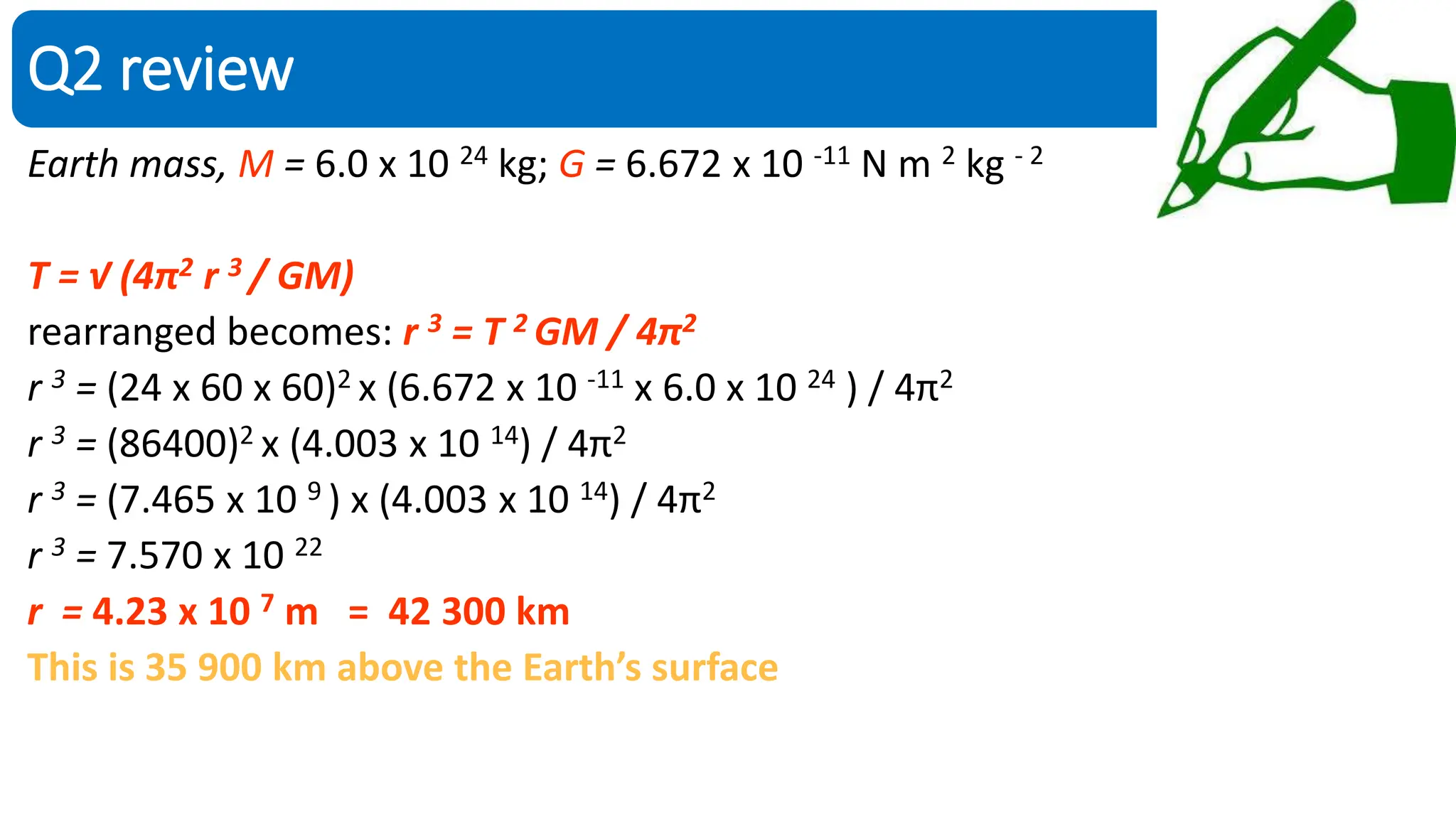
Earth mass, M = 6.0 x 10 24 kg; G = 6.672 x 10 -11 N m 2 kg - 2
T = √ (4π2 r 3 / GM)
rearranged becomes: r 3 = T 2 GM / 4π2
r 3 = (24 x 60 x 60)2 x (6.672 x 10 -11 x 6.0 x 10 24 ) / 4π2
r 3 = (86400)2 x (4.003 x 10 14) / 4π2
r 3 = (7.465 x 10 9 ) x (4.003 x 10 14) / 4π2
r 3 = 7.570 x 10 22
r = 4.23 x 10 7 m = 42 300 km
This is 35 900 km above the Earth’s surface
SciDoc
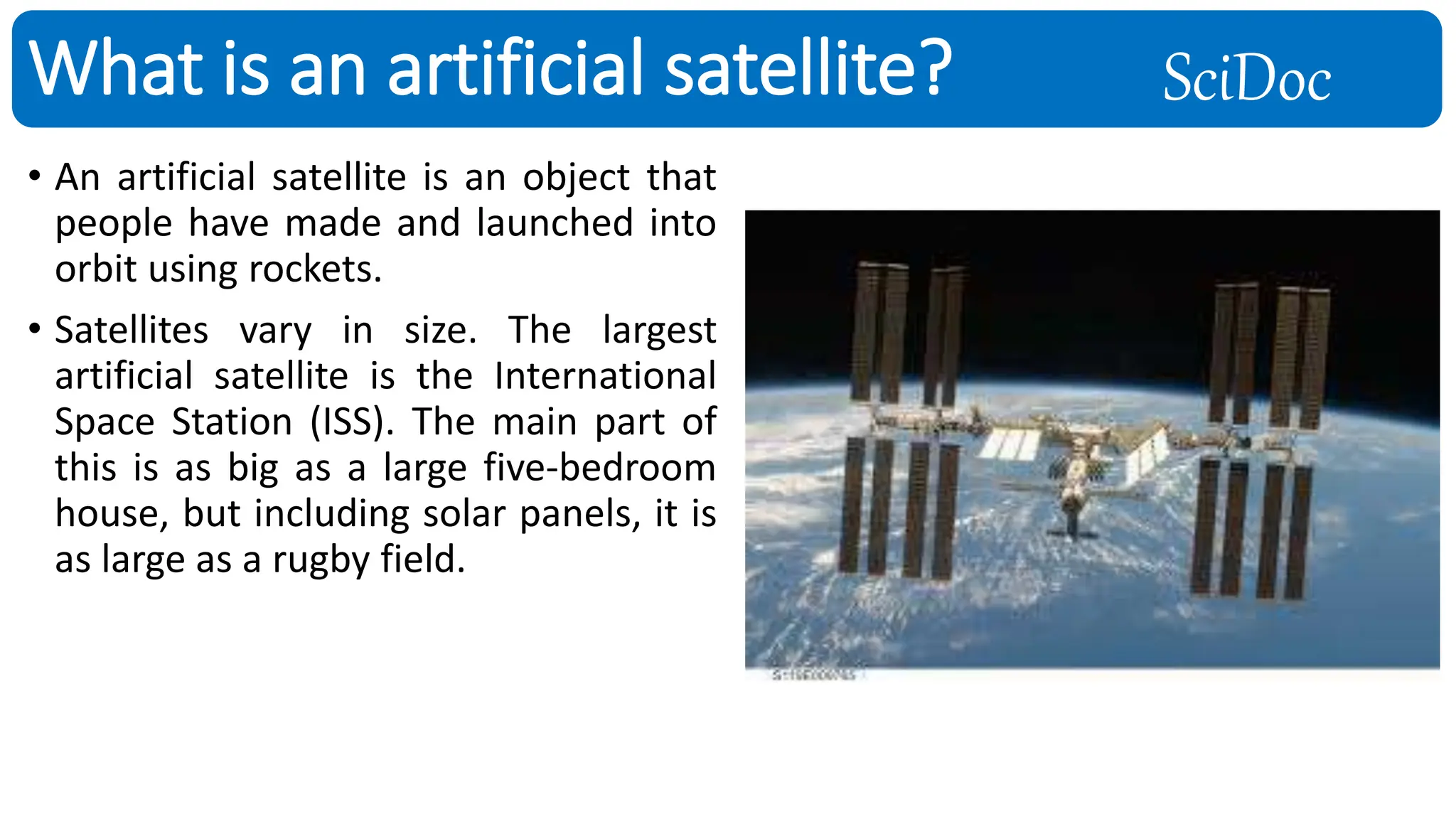
• An artificial satellite is an object that
people have made and launched into
orbit using rockets.
• Satellites vary in size. The largest
artificial satellite is the International
Space Station (ISS). The main part of
this is as big as a large five-bedroom
house, but including solar panels, it is
as large as a rugby field.
What is an artificial satellite?
SciDoc
• Altitudes of satellites above the Earth’s surface:
• Low Earth orbit (LEO) – from 200 to 2000 km, for example, the ISS orbits at 400
km with a speed of 28 000 km/h, and time for one orbit is about 90 minutes.
• Medium Earth orbit (MEO) – most MEO satellites are at an altitude of 20 000
km, and time for one orbit is 12 hours.
• Geostationary orbit (GEO) – 36 000 km above the Earth. Time for one orbit is
24 hours. This is to match the rotation of the Earth so that the satellite appears
to stay above the same point above the Earth’s surface. This is used for many
communications and weather satellites.
Types of orbit
SciDoc
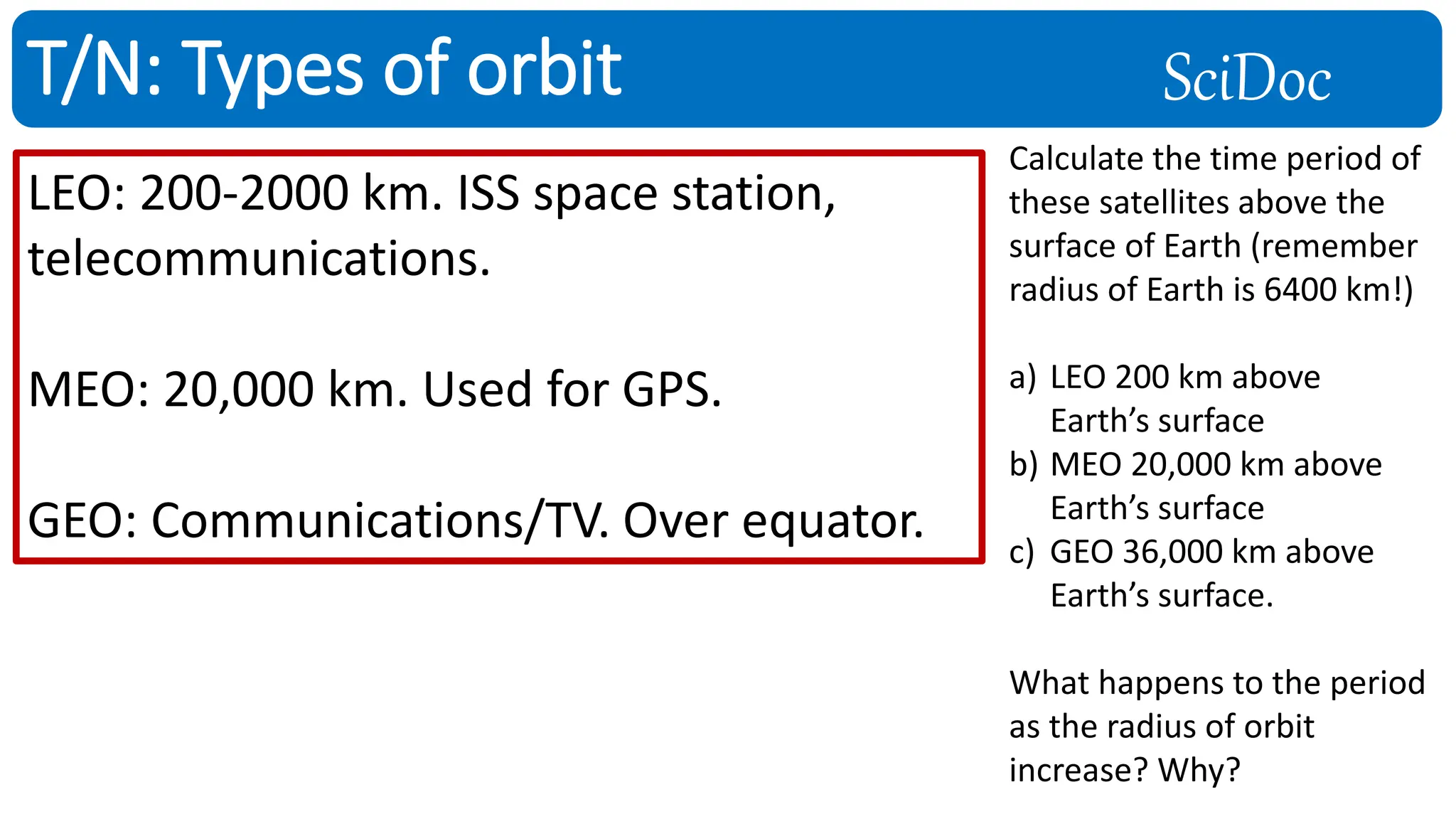
T/N: Types of orbit
LEO: 200-2000 km. ISS space station,
telecommunications.
MEO: 20,000 km. Used for GPS.
GEO: Communications/TV. Over equator.
Calculate the time period of
these satellites above the
surface of Earth (remember
radius of Earth is 6400 km!)
a) LEO 200 km above
Earth’s surface
b) MEO 20,000 km above
Earth’s surface
c) GEO 36,000 km above
Earth’s surface.
What happens to the period
as the radius of orbit
increase? Why?
SciDoc
The escape velocity from a planet is the minimum velocity an object must be
given to escape from the planet when projected vertically from the surface.
The gravitational potential V at a distance r from the centre of the planet of
mass M is given by
𝑉 = −
𝐺𝑀
𝑟
To move an object of mass m from the surface to infinity, the work that must be
done is ∆𝑊 = 𝑚∆𝑉 =
𝐺𝑀𝑚
𝑟
Escape velocity
Stretch: How can we use this expression to obtain the velocity needed to
escape the Earth’s gravitational field (i.e. the escape velocity)?
SciDoc
For the object to escape, the kinetic energy must be
more than the work required:
1
2
𝑚𝑣2 ≥ ∆𝑊
Therefore
1
2
𝑚𝑣2 ≥
𝐺𝑀𝑚
𝑅
Escape velocity is then given by 𝑣esc =
2𝐺𝑀
𝑅
And by using 𝑔 =
𝐺𝑀
𝑅
, we obtain a final expression for
the escape velocity which is:
𝑣esc = 2𝑔𝑅
Escape velocity
Stretch: What is the
escape velocity for Earth?
(Earth’s radius = 6400 km)
SciDoc
Consider a satellite of mass m in a circular orbit of radius r, about a spherical
planet or star of mass M. The speed of the satellite v is given by:
𝑣2 =
𝐺𝑀
𝑟
as derived last lesson.
What is the kinetic energy Ek of the satellite?
1
2
𝑚𝑣2 =
1
2
𝑚 ×
𝐺𝑀
𝑟
=
𝐺𝑀𝑚
2𝑟
Energy of orbiting satellite
SciDoc
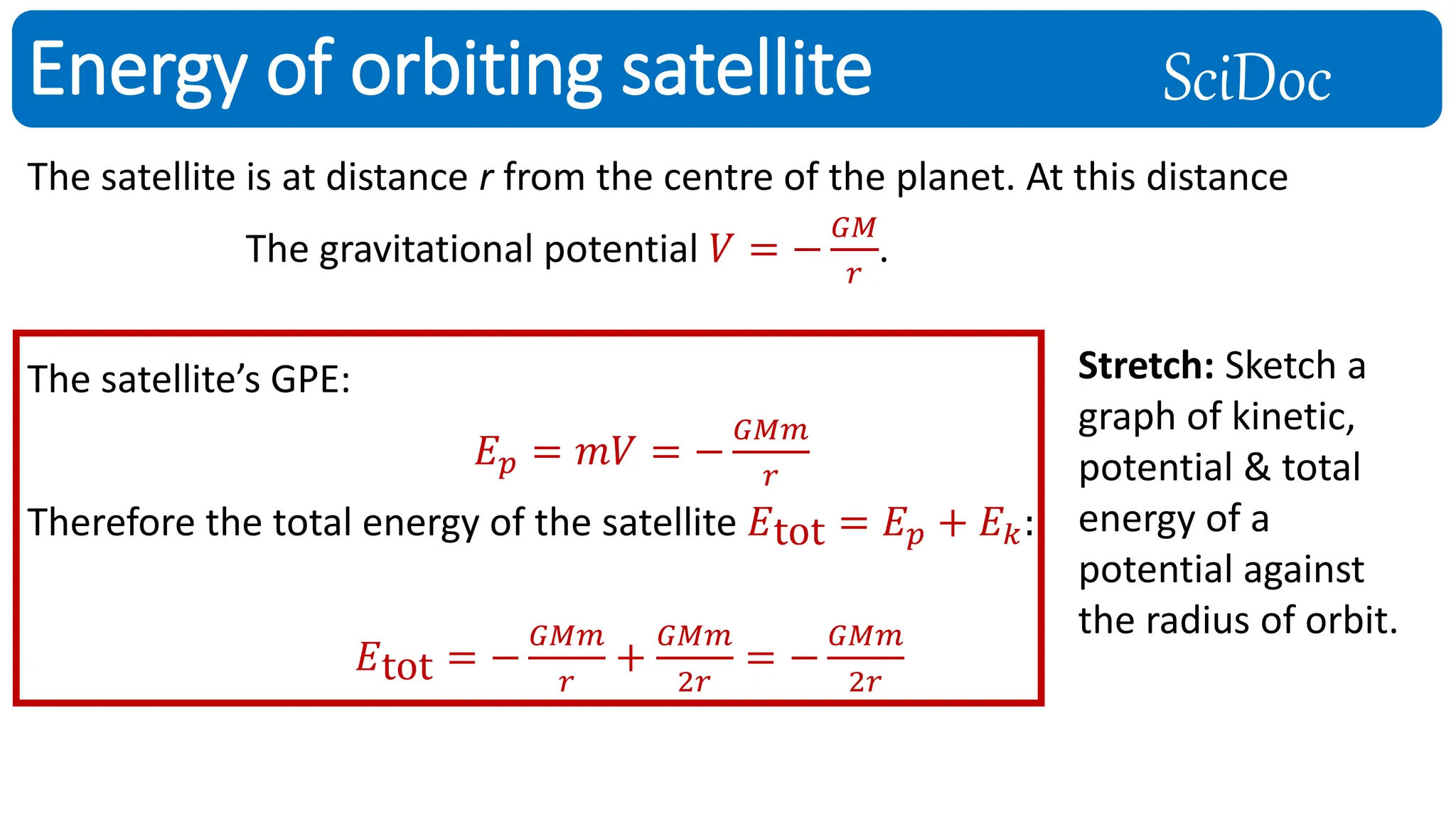
The satellite is at distance r from the centre of the planet. At this distance
The gravitational potential 𝑉 = −
𝐺𝑀
𝑟
.
The satellite’s GPE:
𝐸𝑝 = 𝑚𝑉 = −
𝐺𝑀𝑚
𝑟
Therefore the total energy of the satellite 𝐸tot = 𝐸𝑝 + 𝐸𝑘:
𝐸tot = −
𝐺𝑀𝑚
𝑟
+
𝐺𝑀𝑚
2𝑟
= −
𝐺𝑀𝑚
2𝑟
Energy of orbiting satellite
Stretch: Sketch a
graph of kinetic,
potential & total
energy of a
potential against
the radius of orbit.
SciDoc
Therefore, for a satellite in a circular orbit of radius r, its total energy is equal to:
𝐸tot = −
𝐺𝑀𝑚
2𝑟
Energy of orbiting satellite
SciDoc
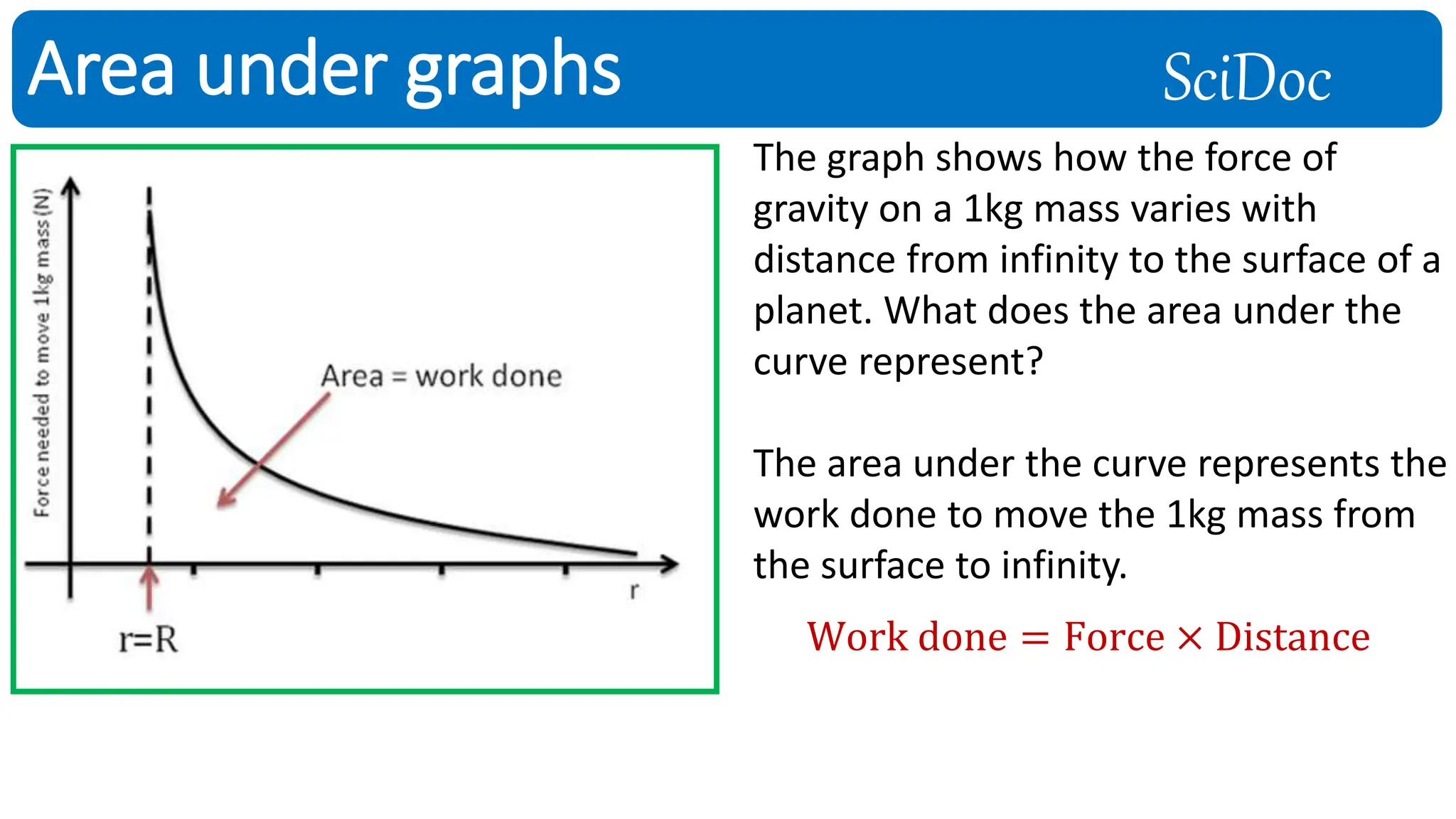
Area under graphs
Work done = Force × Distance
The graph shows how the force of
gravity on a 1kg mass varies with
distance from infinity to the surface of a
planet. What does the area under the
curve represent?
The area under the curve represents the
work done to move the 1kg mass from
the surface to infinity.
SciDoc
Area under graphs
What does the area under this graph represent? (look
at your equation sheet if it helps).
∆V from area under graph of g against r.
SciDoc
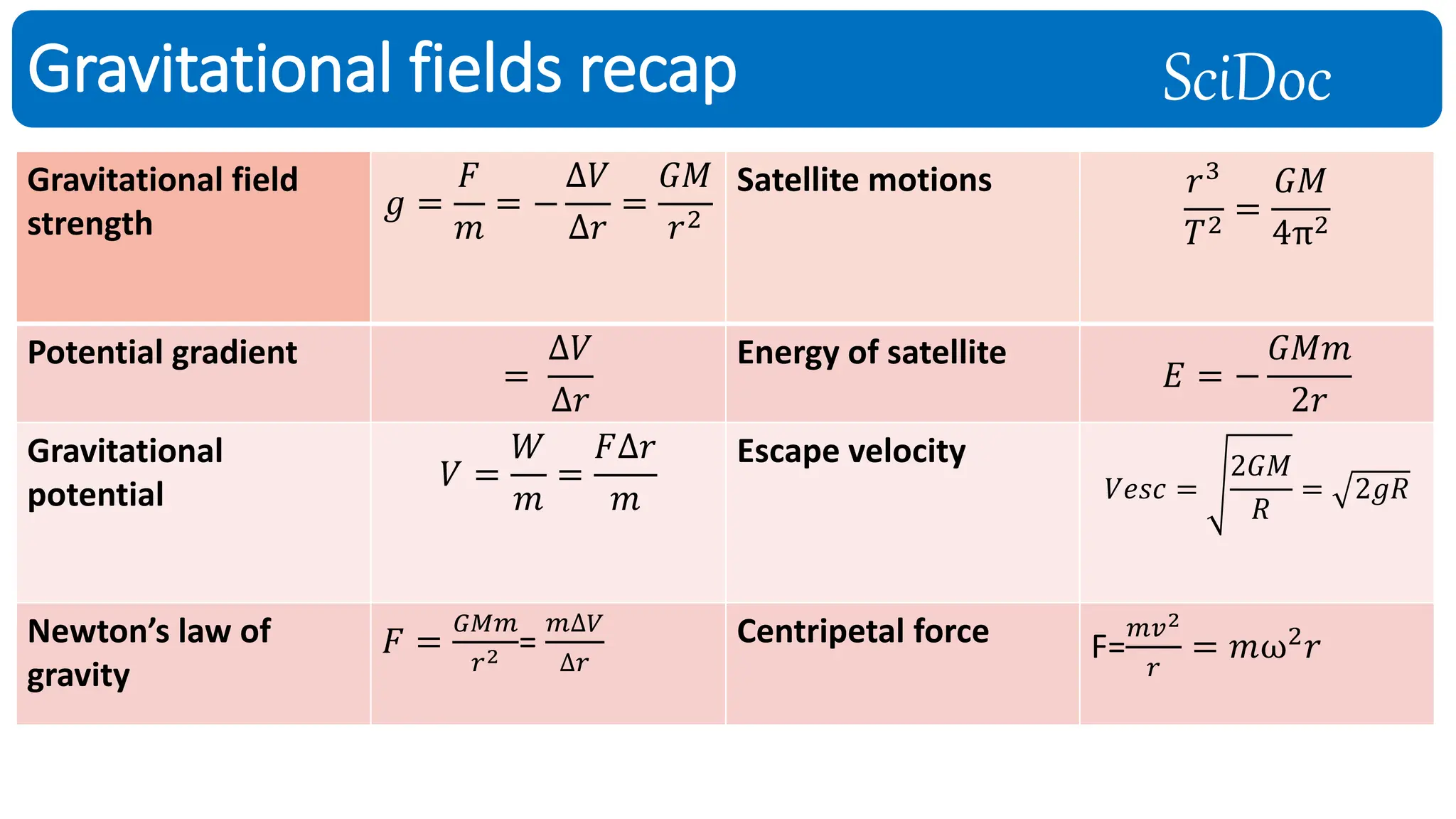
Gravitational fields recap
Gravitational field
strength
𝑔 =
𝐹
𝑚
= −
∆𝑉
∆𝑟
=
𝐺𝑀
𝑟2
Satellite motions 𝑟3
𝑇2
=
𝐺𝑀
4π2
Potential gradient
=
∆𝑉
∆𝑟
Energy of satellite
𝐸 = −
𝐺𝑀𝑚
2𝑟
Gravitational
potential
𝑉 =
𝑊
𝑚
=
𝐹∆𝑟
𝑚
Escape velocity
𝑉𝑒𝑠𝑐 =
2𝐺𝑀
𝑅
= 2𝑔𝑅
Newton’s law of
gravity
𝐹 =
𝐺𝑀𝑚
𝑟2 =
𝑚∆𝑉
∆𝑟
Centripetal force F=
𝑚𝑣2
𝑟
= 𝑚ω2𝑟
SciDoc
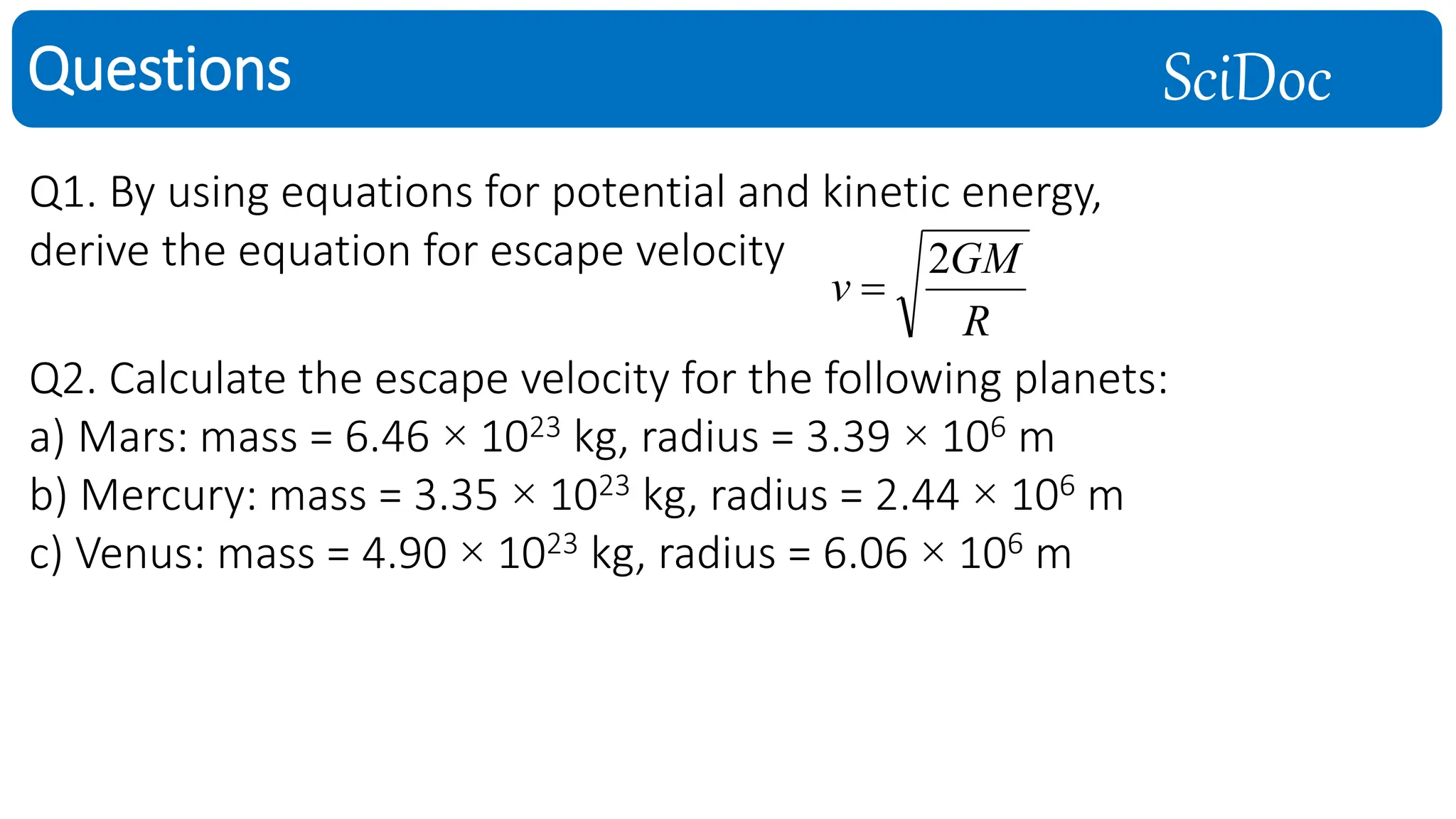
Questions
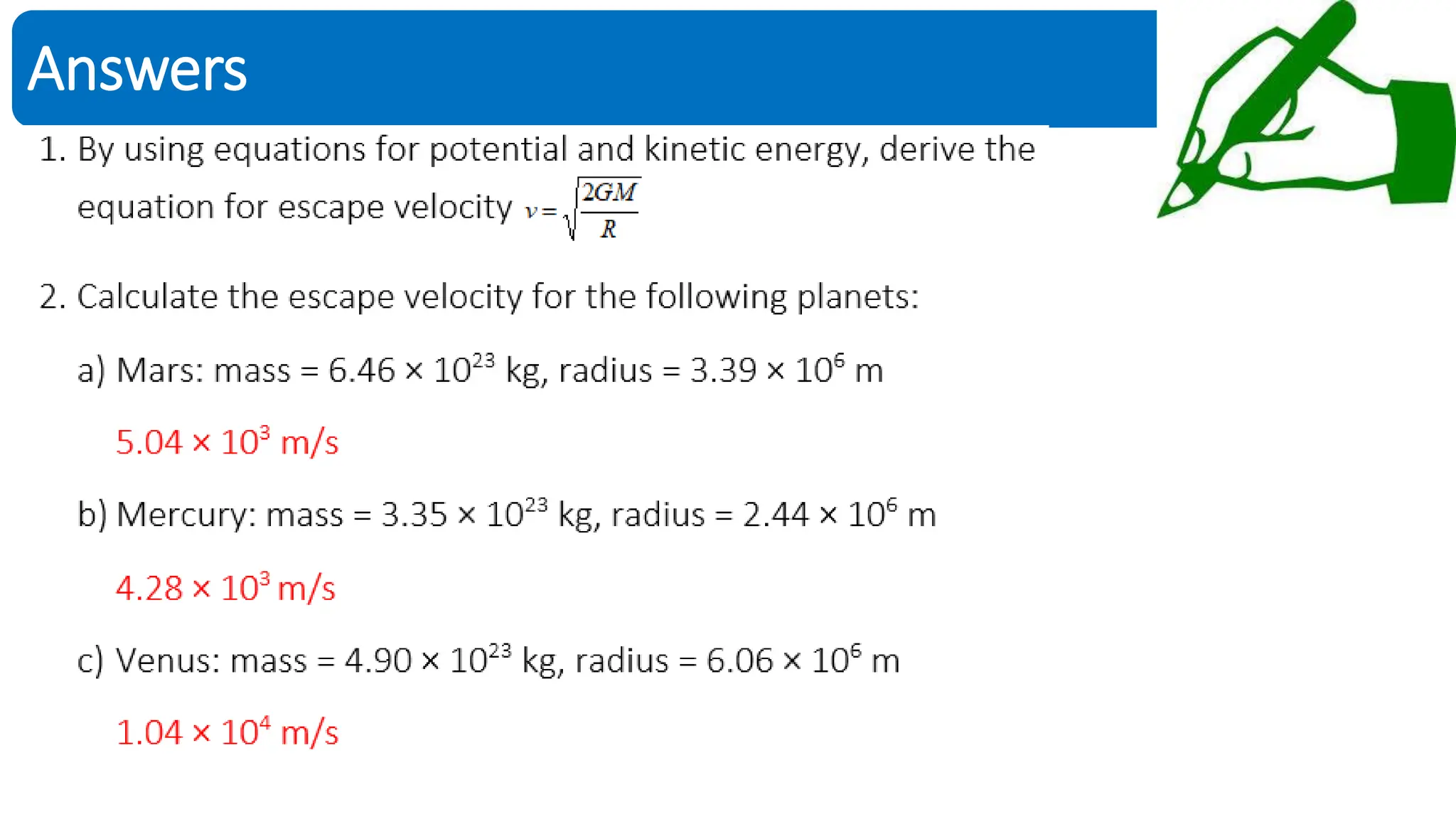
Q1. By using equations for potential and kinetic energy,
derive the equation for escape velocity
R
GM
v
2

Q2. Calculate the escape velocity for the following planets:
a) Mars: mass = 6.46 × 10²³ kg, radius = 3.39 × 10⁶ m
b) Mercury: mass = 3.35 × 10²³ kg, radius = 2.44 × 10⁶ m
c) Venus: mass = 4.90 × 10²³ kg, radius = 6.06 × 10⁶ m
SciDoc
Answers
SciDoc
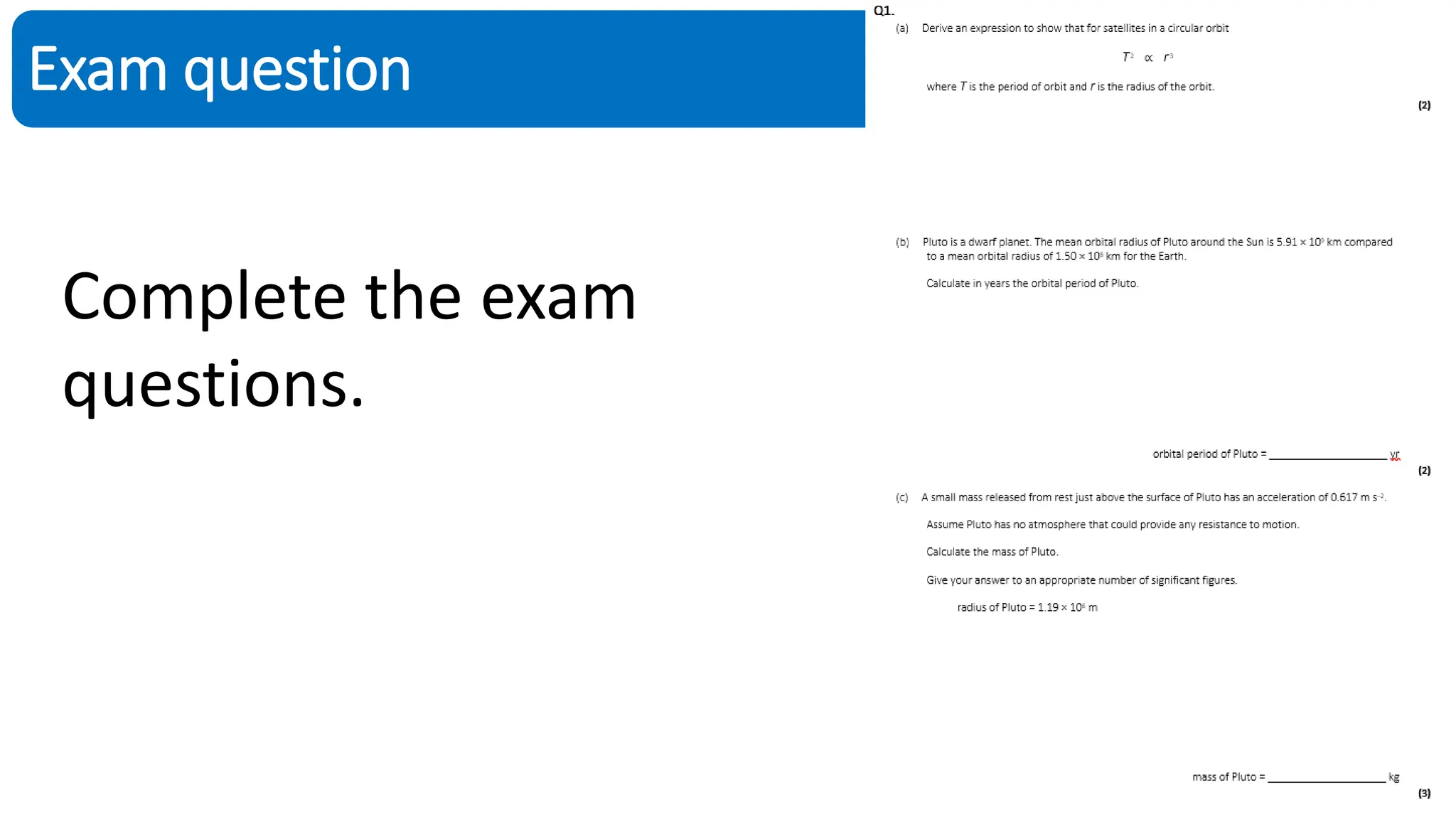
Exam question
Complete the exam
questions.

orbits-escape-velocity.pptx

  • 1.
    SciDoc Orbits & escapevelocity 13/02/2024 Q1. Calculate (a) the orbital speed and (b) period of the International Space Station. Earth radius, R = 6400 km Orbital height of the ISS, H = 300 km Earth mass, M = 6.0 x 10 24 kg G = 6.672 x 10 -11 N m 2 kg – 2 Q2. Calculate the orbital radius of an Earth satellite having an orbital period of 24 hours.
  • 2.
    SciDoc Q1 review (a) Orbitalspeed v = √ (GM / r) BUT: r = R + H = (6400 + 300)km = 6700 km = 6.7 x 10⁶ m and so: v = √ (6.672 x 10 -11 x 6.0 x 10 24 / 6.7 x 10⁶) = √ (4.003 x 10 14 / 6.7 x 10⁶) = √ (5.975 x 10 7) orbital speed = 7.73 x 10³ ms-1 = 7.73 kms-1 (b) Orbital period T = √ (4π2 r 3 / GM) = √ (4π2 x (6.7 x 106)3 ) / (6.672 x 10 -11 x 6.0 x 10 24) = √ (1.187 x 10 22 / 4.003 x 10 14) = √ (2.966 x 10 7) orbital period = 5.45 x 10³ s = 90.8 minutes = 1h 30 mins
  • 3.
    SciDoc Q2 review Earth mass,M = 6.0 x 10 24 kg; G = 6.672 x 10 -11 N m 2 kg - 2 T = √ (4π2 r 3 / GM) rearranged becomes: r 3 = T 2 GM / 4π2 r 3 = (24 x 60 x 60)2 x (6.672 x 10 -11 x 6.0 x 10 24 ) / 4π2 r 3 = (86400)2 x (4.003 x 10 14) / 4π2 r 3 = (7.465 x 10 9 ) x (4.003 x 10 14) / 4π2 r 3 = 7.570 x 10 22 r = 4.23 x 10 7 m = 42 300 km This is 35 900 km above the Earth’s surface
  • 4.
    SciDoc • An artificialsatellite is an object that people have made and launched into orbit using rockets. • Satellites vary in size. The largest artificial satellite is the International Space Station (ISS). The main part of this is as big as a large five-bedroom house, but including solar panels, it is as large as a rugby field. What is an artificial satellite?
  • 5.
    SciDoc • Altitudes ofsatellites above the Earth’s surface: • Low Earth orbit (LEO) – from 200 to 2000 km, for example, the ISS orbits at 400 km with a speed of 28 000 km/h, and time for one orbit is about 90 minutes. • Medium Earth orbit (MEO) – most MEO satellites are at an altitude of 20 000 km, and time for one orbit is 12 hours. • Geostationary orbit (GEO) – 36 000 km above the Earth. Time for one orbit is 24 hours. This is to match the rotation of the Earth so that the satellite appears to stay above the same point above the Earth’s surface. This is used for many communications and weather satellites. Types of orbit
  • 6.
    SciDoc T/N: Types oforbit LEO: 200-2000 km. ISS space station, telecommunications. MEO: 20,000 km. Used for GPS. GEO: Communications/TV. Over equator. Calculate the time period of these satellites above the surface of Earth (remember radius of Earth is 6400 km!) a) LEO 200 km above Earth’s surface b) MEO 20,000 km above Earth’s surface c) GEO 36,000 km above Earth’s surface. What happens to the period as the radius of orbit increase? Why?
  • 7.
    SciDoc The escape velocityfrom a planet is the minimum velocity an object must be given to escape from the planet when projected vertically from the surface. The gravitational potential V at a distance r from the centre of the planet of mass M is given by 𝑉 = − 𝐺𝑀 𝑟 To move an object of mass m from the surface to infinity, the work that must be done is ∆𝑊 = 𝑚∆𝑉 = 𝐺𝑀𝑚 𝑟 Escape velocity Stretch: How can we use this expression to obtain the velocity needed to escape the Earth’s gravitational field (i.e. the escape velocity)?
  • 8.
    SciDoc For the objectto escape, the kinetic energy must be more than the work required: 1 2 𝑚𝑣2 ≥ ∆𝑊 Therefore 1 2 𝑚𝑣2 ≥ 𝐺𝑀𝑚 𝑅 Escape velocity is then given by 𝑣esc = 2𝐺𝑀 𝑅 And by using 𝑔 = 𝐺𝑀 𝑅 , we obtain a final expression for the escape velocity which is: 𝑣esc = 2𝑔𝑅 Escape velocity Stretch: What is the escape velocity for Earth? (Earth’s radius = 6400 km)
  • 9.
    SciDoc Consider a satelliteof mass m in a circular orbit of radius r, about a spherical planet or star of mass M. The speed of the satellite v is given by: 𝑣2 = 𝐺𝑀 𝑟 as derived last lesson. What is the kinetic energy Ek of the satellite? 1 2 𝑚𝑣2 = 1 2 𝑚 × 𝐺𝑀 𝑟 = 𝐺𝑀𝑚 2𝑟 Energy of orbiting satellite
  • 10.
    SciDoc The satellite isat distance r from the centre of the planet. At this distance The gravitational potential 𝑉 = − 𝐺𝑀 𝑟 . The satellite’s GPE: 𝐸𝑝 = 𝑚𝑉 = − 𝐺𝑀𝑚 𝑟 Therefore the total energy of the satellite 𝐸tot = 𝐸𝑝 + 𝐸𝑘: 𝐸tot = − 𝐺𝑀𝑚 𝑟 + 𝐺𝑀𝑚 2𝑟 = − 𝐺𝑀𝑚 2𝑟 Energy of orbiting satellite Stretch: Sketch a graph of kinetic, potential & total energy of a potential against the radius of orbit.
  • 11.
    SciDoc Therefore, for asatellite in a circular orbit of radius r, its total energy is equal to: 𝐸tot = − 𝐺𝑀𝑚 2𝑟 Energy of orbiting satellite
  • 12.
    SciDoc Area under graphs Workdone = Force × Distance The graph shows how the force of gravity on a 1kg mass varies with distance from infinity to the surface of a planet. What does the area under the curve represent? The area under the curve represents the work done to move the 1kg mass from the surface to infinity.
  • 13.
    SciDoc Area under graphs Whatdoes the area under this graph represent? (look at your equation sheet if it helps). ∆V from area under graph of g against r.
  • 14.
    SciDoc Gravitational fields recap Gravitationalfield strength 𝑔 = 𝐹 𝑚 = − ∆𝑉 ∆𝑟 = 𝐺𝑀 𝑟2 Satellite motions 𝑟3 𝑇2 = 𝐺𝑀 4π2 Potential gradient = ∆𝑉 ∆𝑟 Energy of satellite 𝐸 = − 𝐺𝑀𝑚 2𝑟 Gravitational potential 𝑉 = 𝑊 𝑚 = 𝐹∆𝑟 𝑚 Escape velocity 𝑉𝑒𝑠𝑐 = 2𝐺𝑀 𝑅 = 2𝑔𝑅 Newton’s law of gravity 𝐹 = 𝐺𝑀𝑚 𝑟2 = 𝑚∆𝑉 ∆𝑟 Centripetal force F= 𝑚𝑣2 𝑟 = 𝑚ω2𝑟
  • 15.
    SciDoc Questions Q1. By usingequations for potential and kinetic energy, derive the equation for escape velocity R GM v 2  Q2. Calculate the escape velocity for the following planets: a) Mars: mass = 6.46 × 10²³ kg, radius = 3.39 × 10⁶ m b) Mercury: mass = 3.35 × 10²³ kg, radius = 2.44 × 10⁶ m c) Venus: mass = 4.90 × 10²³ kg, radius = 6.06 × 10⁶ m
  • 16.
  • 17.