Soil Water Relationships
Vijitha Vikneshwaran
Lecturer (Temporary)
Faculty of Technology
University of Jaffna
Introduction
• Knowledge about soil water relationships is important for
decision-making process in agricultural operations like,
• What crops to plant
• When to plant them
• When other management practices should be done.
• Soil water relationships affect the,
• Rate of entry of water into soil
• Retention of water
• Movement of water
• Availability of water to plant 2
Soil composition and texture
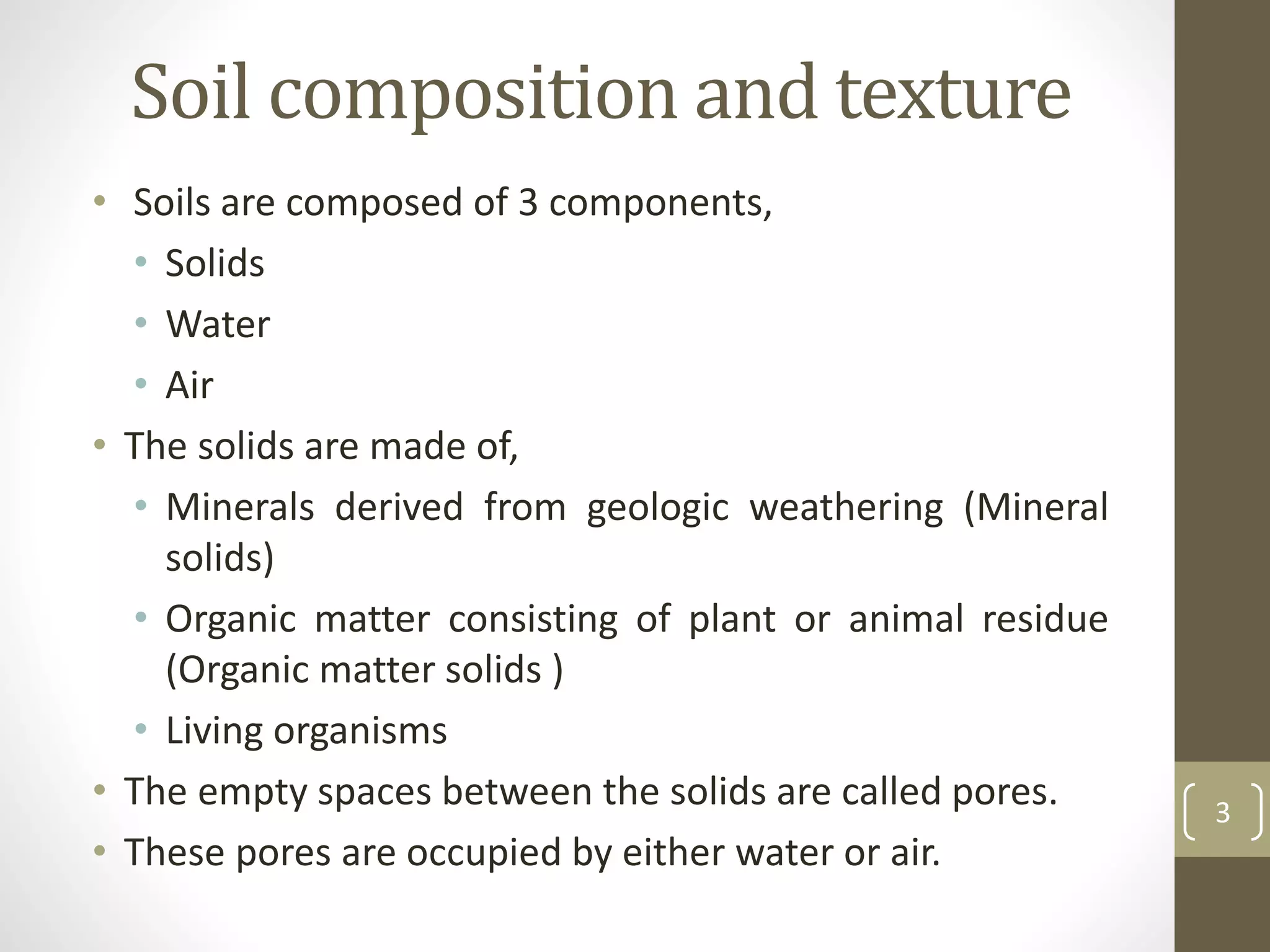
• Soils are composed of 3 components,
• Solids
• Water
• Air
• The solids are made of,
• Minerals derived from geologic weathering (Mineral
solids)
• Organic matter consisting of plant or animal residue
(Organic matter solids )
• Living organisms
• The empty spaces between the solids are called pores.
• These pores are occupied by either water or air.
3
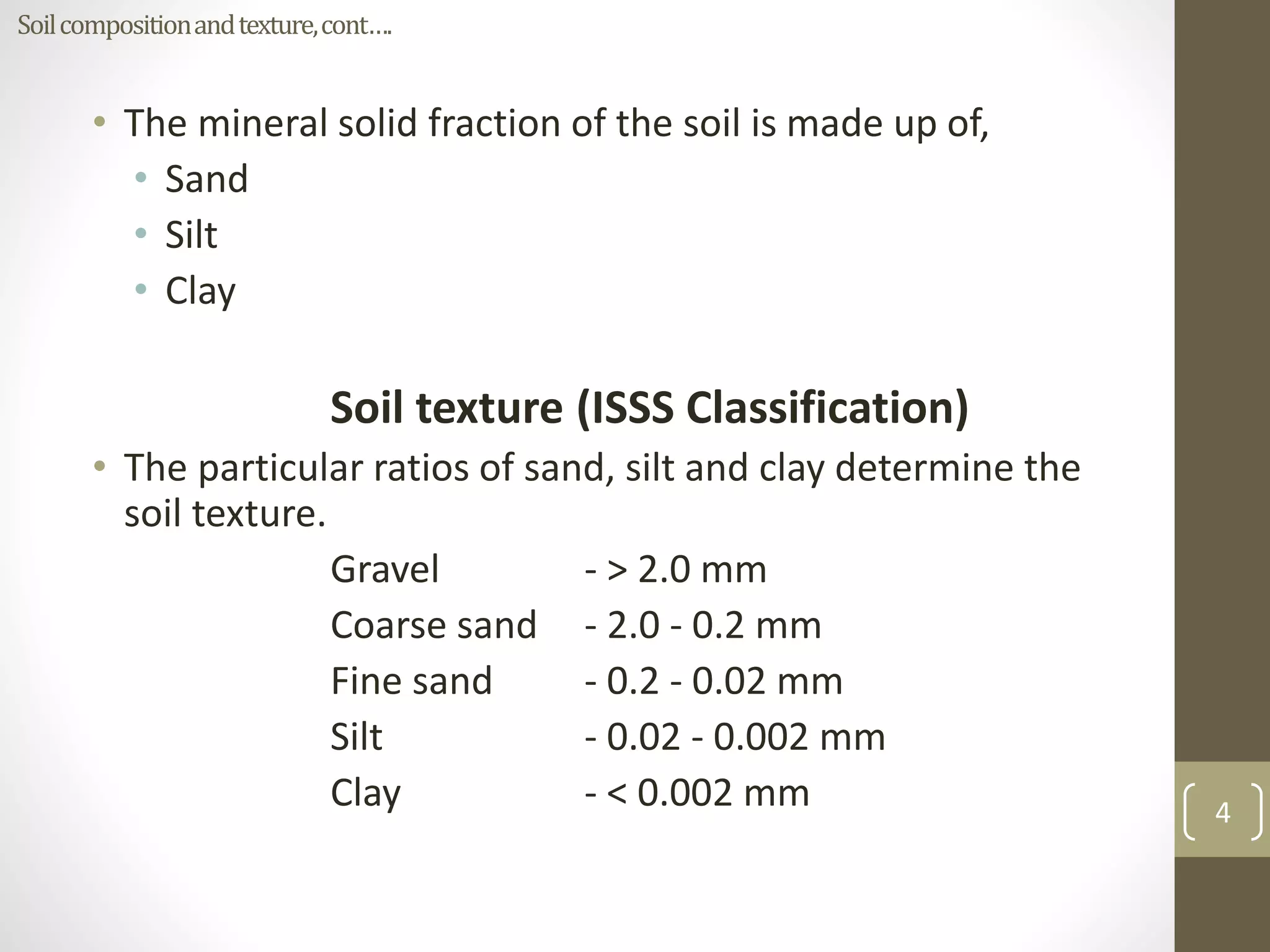
• The mineral solid fraction of the soil is made up of,
• Sand
• Silt
• Clay
Soil texture (ISSS Classification)
• The particular ratios of sand, silt and clay determine the
soil texture.
Gravel - > 2.0 mm
Coarse sand - 2.0 - 0.2 mm
Fine sand - 0.2 - 0.02 mm
Silt - 0.02 - 0.002 mm
Clay - < 0.002 mm 4
Soilcompositionandtexture,cont….
• Particles larger than 2.0 mm are referred to as rock
fragments.
• These rock fragments are not considered in determining
soil texture.
• But they can influence both soil structure and soil water
relationships.
• By volume, most soils are composed of about,
• 35-55% pore space
• 45-65% solid material
• Larger fraction of solid material is mineral-based whereas
only 2-5% is organic-based residue.
5
Soilcompositionandtexture,cont….
• Agricultural soils contain less organic matter compared to
forested or undisturbed soils.
• When organic matter is exposed to soil microorganisms
in aerobic conditions, it becomes oxidized and degraded.
• This process is called as mineralization.
• Organic matter is a beneficial soil component.
• It provides,
• Good water-holding capacity
• Slowly releases nutrients for plant growth and
• Improves the soil structure
6
Soilcompositionandtexture,cont….
• Air and water occupy the pore space in a soil
• The proportion of air and water varies by soil type and
over time.
• After a large precipitation event,
• Pore space occupied by water will increase
• Air-filled pore space will decrease
• During prolonged dry periods,
• Water-filled pore space will decrease
• Air-filled pore space will increase
7
Soilcompositionandtexture,cont….
Soil textural triangle
• It is used to determine the textural class of the soil when
the fraction of sand, silt and clay are known.
• Soil texture determination is important because many
soil properties are influenced by texture.
• Those are,
• Drainage
• Water-holding capacity
• Aeration
• Susceptibility to erosion
• Cation exchange capacity
• pH buffering capacity
• Soil tilth
8
9
Soiltexturaltriangle,cont…..
Figure 01: Textural triangle (USDA)
Characteristics of different soil
Sandy soil
• > 85% sand
• Simple
• Round
• Large volume of non-capillary pores
• Low water holding capacity
• Good drainage
• Chemically inert
• Loose
• Non cohesive 10
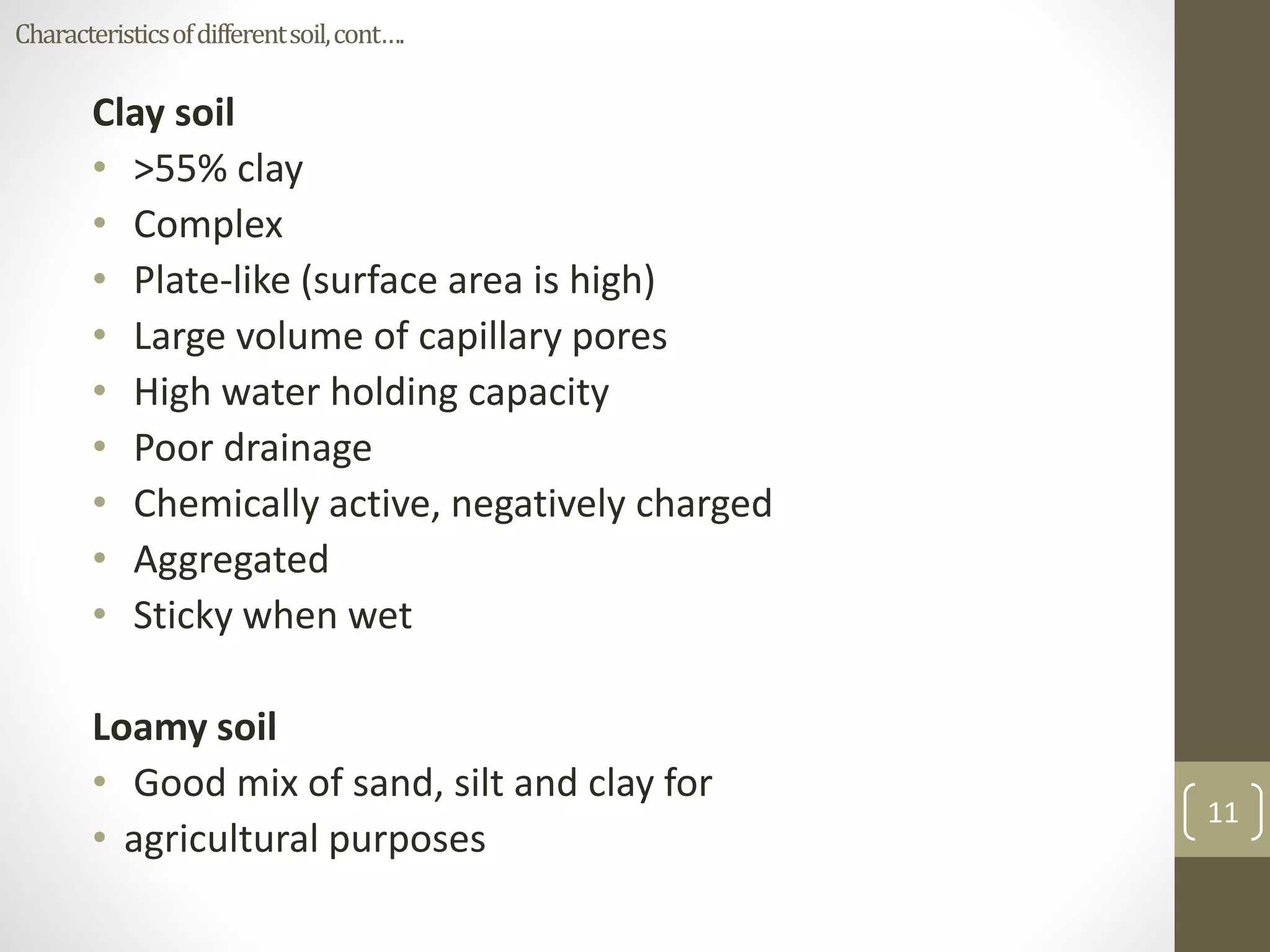
Clay soil
• >55% clay
• Complex
• Plate-like (surface area is high)
• Large volume of capillary pores
• High water holding capacity
• Poor drainage
• Chemically active, negatively charged
• Aggregated
• Sticky when wet
Loamy soil
• Good mix of sand, silt and clay for
• agricultural purposes
11
Characteristicsofdifferentsoil,cont….
Soil structure
• It refers to how the soil particles are shaped and
organized into units of aggregation.
• There are six primary soil structural classes,
• Platy
• Prismatic
• Columnar
• Blocky
• Single-grained
• Granular
12
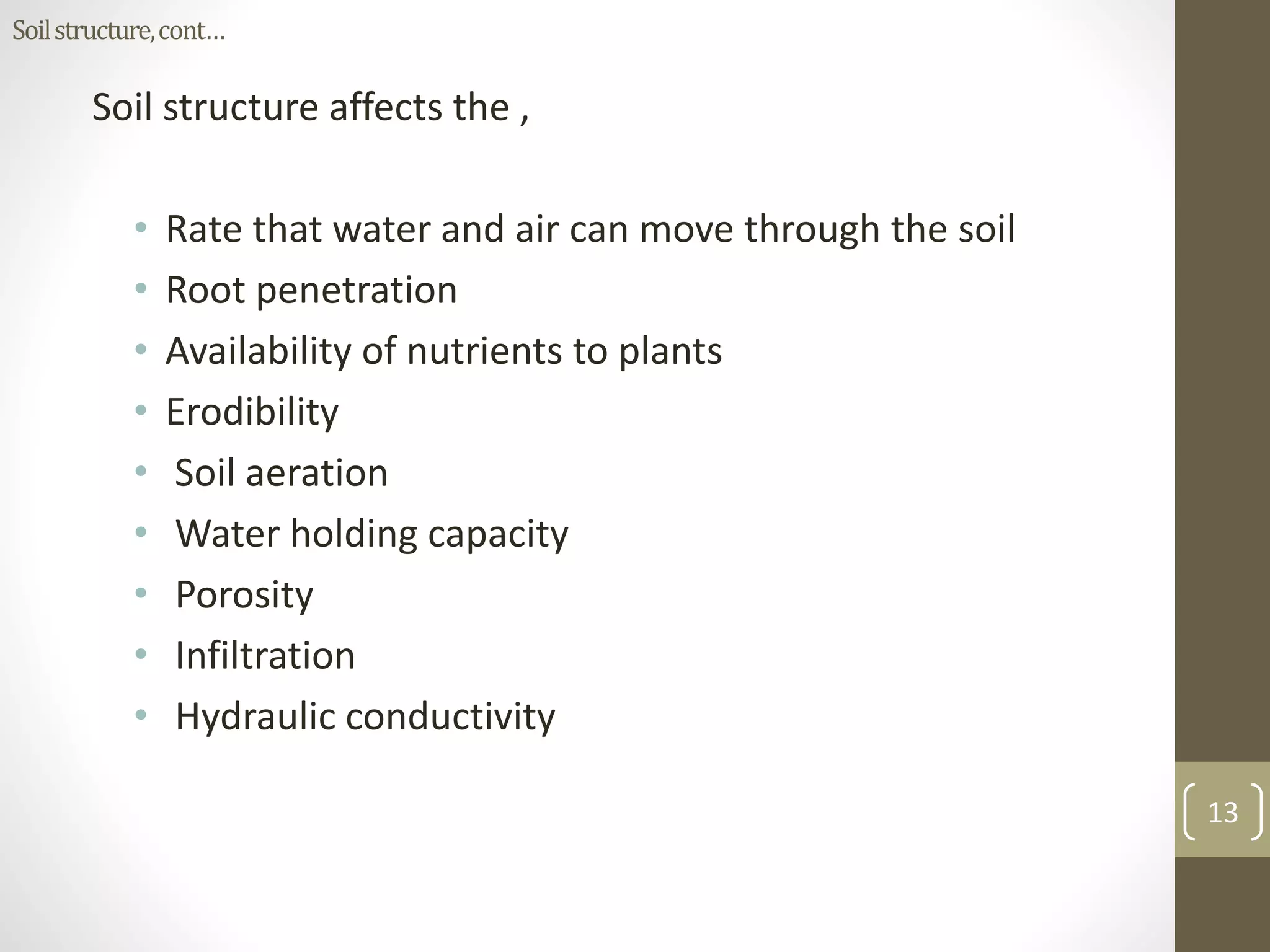
Soil structure affects the ,
• Rate that water and air can move through the soil
• Root penetration
• Availability of nutrients to plants
• Erodibility
• Soil aeration
• Water holding capacity
• Porosity
• Infiltration
• Hydraulic conductivity
13
Soilstructure,cont…
Classification of soil based on horizontal and vertical axis
1. Blocky - cube shaped with sharp corners
2. Columnar - vertically rectangular with rounded ends
3. Crumbly - rounded, but larger than grains
4. Granular - rounded surfaces; sand
5. Platy - horizontally rectangular
6. Prismatic - vertically rectangular with flat ends
7. Single grain/structureless - no aggregation of particles when dry
8. Sub angular blocky - cube shaped with rounded corners
14
Soilstructure,cont…
• In single-grained soils like sand, water percolates very
quickly through the soil.
• In massive soils such as dense clays, water movement is
very slow.
• In granular and crumb structured soil the water circulates
very easily through such soils.
• They are commonly found in the A-horizon of the soil
profile
• In blocky and sub angular blocky structured soil,
relatively large blocks indicate that the soil resists
penetration and movement of water.
• They are commonly found in the B-horizon where clay
has accumulated
15
Soilstructure,cont………
• Prismatic and columnar structured soil have formed into
vertical columns or pillars separated by miniature but
definite vertical cracks.
• Water circulates with greater difficulty and drainage is
poor.
• They are commonly found in the B-horizon where clay
has accumulated.
• Platy structure is made up of soil particles aggregated in
thin plates or sheets piled horizontally on one another.
• Plates often overlap, greatly impairing water circulation.
• It is commonly found in forest soils, in part of the
A- horizon and in clay pan soils.
16
Soilstructure,cont…
• More favorable water movement characteristics for crop
production are generally found in soils that have
granular, prismatic or blocky structure.
• Well-structured soils are usually more desirable for
agricultural production.
• Because structured soils can hold and conduct water and
gasses.
• In addition it will support load-bearing activities, such as
field traffic.
17
Soilstructure,cont…
• Tillage of some fine-textured soils, particularly when they
are wet can destroy the soil structure.
• Irrigation with high salt content can causes dispersion of
soil particles.
• Biological activity of organisms such as earthworms,
mammals, termites and ants can also change the soil
structure by creating large pores from burrowing and
deposition of organic matter.
18
Changes in soil structure
Soil Bulk Density
• Soil bulk density expresses the ratio of the mass of dry
soil to the total volume occupied in the soil.
• The total volume includes both the solids and the pore
spaces.
• Soil bulk density is important because it is an indicator of
the soil’s porosity.
Bulk density =
𝑴𝒂𝒔𝒔 𝒐𝒇 𝒔𝒐𝒍𝒊𝒅 (𝒈)
𝑻𝒐𝒕𝒂𝒍 𝒗𝒐𝒍𝒖𝒎𝒆 (𝒄𝒎𝟑
)
ρb =
Ms
Vt
19
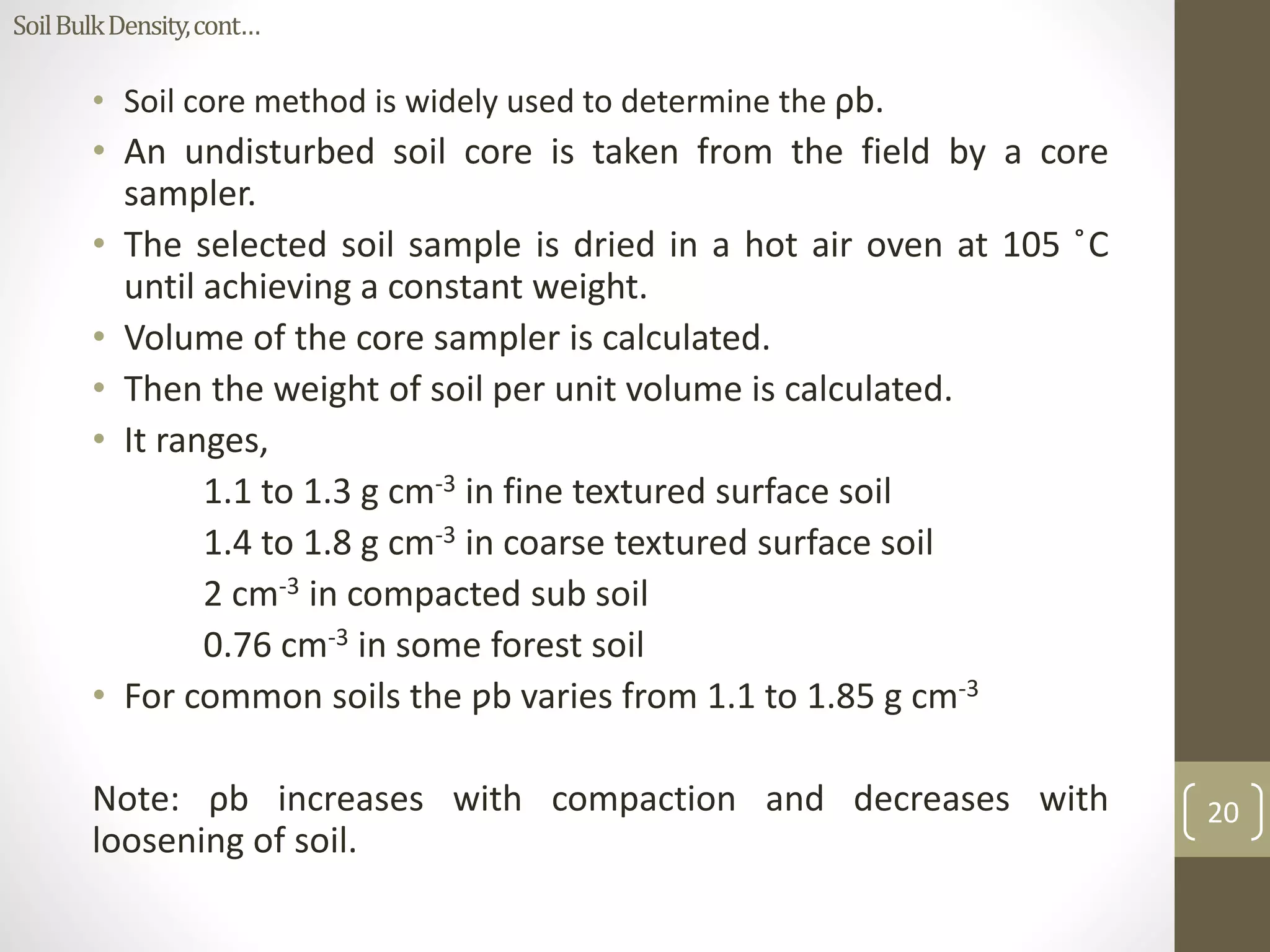
• Soil core method is widely used to determine the ρb.
• An undisturbed soil core is taken from the field by a core
sampler.
• The selected soil sample is dried in a hot air oven at 105 ̊C
until achieving a constant weight.
• Volume of the core sampler is calculated.
• Then the weight of soil per unit volume is calculated.
• It ranges,
1.1 to 1.3 g cm-3 in fine textured surface soil
1.4 to 1.8 g cm-3 in coarse textured surface soil
2 cm-3 in compacted sub soil
0.76 cm-3 in some forest soil
• For common soils the ƿb varies from 1.1 to 1.85 g cm-3
Note: ρb increases with compaction and decreases with
loosening of soil.
20
SoilBulkDensity,cont…
• Bulk density also provides information about the
potential for,
• Leaching of agrochemicals
• Erosion
• Crop productivity
• On soils with a high bulk density, removal of nutrients
needed by crops can occur due to surface runoff and
erosion of soil
• Because water is restricted from moving through the soil
and thus ends up as surface runoff and carry away soil
and soil-bound nutrients.
21
SoilBulkDensity,cont…
• Soils with lower bulk density (sands), can promote
vertical leaching of nutrients and reduce their availability
to crops.
• Soil bulk density can be affected by,
• Physical management practices (Eg: Tillage)
• Biological activity (Eg: Tunneling of earthworms)
• Organic matter content
22
SoilBulkDensity,cont…
Particle density
• It is determined similarly to bulk density.
• But it is the mass of the dry soil divided by the volume of
the solid soil components only.
• Therefore, particle density will be greater than bulk
density.
• It represents the average density of all the solids
composing the soil (True density).
• The particle density of most soils is around 2.65 g/cm3
• Because quartz has a density of 2.65 g/cm3 and is usually
one of the dominant minerals in soils.
23
• Clay has a particle density of 2.83 g/cm3
• Organic matter has a particle density of 0.8 g/cm3
• So soils with significant amounts of either clay or organic
matter will deviate from particle density of 2.65 g/cm3
Particle density =
𝑴𝒂𝒔𝒔 𝒐𝒇 𝒔𝒐𝒍𝒊𝒅
𝑽𝒐𝒍𝒖𝒎𝒆 𝒐𝒇 𝒔𝒐𝒍𝒊𝒅
ρp =
Ms
Vs
• It does not change with tillage or crop practices.
• Presence of organic matter lowers its value.
• Pycnometer or specific gravity bottle is used to find the ρp.
24
Particledensity,cont….
Water content
• The amount of soil water is usually measured in terms of
water content as percentage by volume or mass, or as
soil water potential.
• It is the relative amount of water in the soil.
• The gravimetric water content is determined by,
Extracting the soil sample
Oven drying the sample
Determine the amount of water lost through the
drying
25
• The water content is expressed as,
Gravimetric water content (θ g), wet basis =
𝑊𝑒𝑖𝑔ℎ𝑡 𝑜𝑓 𝑤𝑎𝑡𝑒𝑟
𝑊𝑒𝑖𝑔ℎ𝑡 𝑜𝑓 𝑠𝑜𝑙𝑖𝑑+𝑊𝑒𝑖𝑔ℎ𝑡 𝑜𝑓 𝑤𝑎𝑡𝑒𝑟
*100%
=
𝑊𝑤 (𝑔)
𝑊𝑠+𝑊𝑤 (𝑔)
*100%
Gravimetric water content (θ g), dry basis =
𝑊𝑒𝑖𝑔ℎ𝑡 𝑜𝑓 𝑤𝑎𝑡𝑒𝑟
𝑊𝑒𝑖𝑔ℎ𝑡 𝑜𝑓 𝑠𝑜𝑙𝑖𝑑
*100%
=
𝑊𝑤 (𝑔)
𝑊𝑠 (𝑔)
*100%
• The volumetric water content is more useful for field and laboratory
studies.
Volumetric water content (θ v) =
𝑉𝑜𝑙𝑢𝑚𝑒 𝑜𝑓 𝑤𝑎𝑡𝑒𝑟
𝑇𝑜𝑡𝑎𝑙 𝑣𝑜𝑙𝑢𝑚𝑒
*100%
=
𝑉𝑤
𝑉𝑡
*100% 26
Watercontent,cont….
• Conversion of water content from gravimetric to volumetric basis.
Volumetric water content = Gravimetric water content*
bulk density of soil
Density of water
θ v = θ g *
ρb
𝐷𝑤
Since density of water = 1 g/cm3
Volumetric water content (θ v) = Gravimetric water content (θ g), db* bulk density (ρb)
27
Watercontent,cont….
Porosity
• It is defined as the volume percentage of pores in a soil.
• It is the inverse of the volume percentage of solids.
• Within a soil of similar texture,
• Compacted soil has lower porosity and thus a greater
bulk density
• Loose soil has a greater porosity and a lower bulk
density
28
Porosity can be estimated by the following equation;
Porosity (P) =
𝑽𝒐𝒍𝒖𝒎𝒆 𝒐𝒇 𝒗𝒐𝒊𝒅𝒔
𝑻𝒐𝒕𝒂𝒍 𝒗𝒐𝒍𝒖𝒎𝒆
*100
P =
Vv
Vt
∗ 𝟏𝟎𝟎
Where,
𝑽𝒐𝒍𝒖𝒎𝒆 𝒐𝒇 𝒗𝒐𝒊𝒅𝒔 = 𝑽𝒐𝒍𝒖𝒎𝒆 𝒐𝒇 𝒘𝒂𝒕𝒆𝒓 + 𝑽𝒐𝒍𝒖𝒎𝒆 𝒐𝒇 𝒂𝒊𝒓
Vv =Vw+Va
• Mean while, the ratio between volume of voids and the
volume of solids can be expressed as,
Void ratio (e) =
𝑽𝒐𝒍𝒖𝒎𝒆 𝒐𝒇 𝒗𝒐𝒊𝒅𝒔
𝑽𝒐𝒍𝒖𝒎𝒆 𝒐𝒇 𝒔𝒐𝒍𝒊𝒅
*100
e =
Vv
Vs
∗ 𝟏𝟎𝟎
29
Porosity,cont….
• Relationship between porosity with bulk density and particle
density.
P =[(1- (ρb/ ρp)] x 100%
• Let’s check the validity
P = (Vt/Vt)- [(Ms / Vt)/(Ms / Vs)] x 100%
= [(Vt/Vt) - (Vs/Vt)] *100
= [(Vt-Vs)/Vt)]*100
= (Vv/Vt)*100
• P = Saturation MC volume basis
30
Porosity,cont….
• Soil porosity is influenced primarily by,
• Soil aggregation
• Soil texture
• Root penetration
• Other biological activity (Activities of earthworm, etc.)
• Coarse-textured (sandy) soils are less porous compare to
fine-textured (clayey) soils.
• Because although the average size of individual pores is
usually larger in sandy soils, the smaller pores in the
clayey soils are more numerous.
• Organic matter content increases porosity by enhancing
soil aggregation.
31
Porosity,cont….
Micropores and Macropores
• Macropores are larger than 0.08 mm in diameter.
• These are the pore spaces between aggregates.
• They promote,
• Aeration
• Evaporation
• Gas exchange in the soil profile
• Free drainage of water along with dissolved nutrients
and agrochemicals
32
• The free drainage is referred as “preferential flow”.
• Preferential flow can cause rapid leaching and bypass
flow of nutrients and agrochemicals.
• There fore, it potentially reduces the effectiveness of
fertilizer and agrochemical applications.
• Macropores are mostly found in loamy and well-
aggregated soils.
• But it can be converted to micropores by compaction
through tillage and vehicle traffic.
33
MicroporesandMacropores,cont…
• Micropores are 0.08 mm or smaller.
• These occur inside soil aggregates.
• Micropores retain water and agrochemicals.
• These are responsible for capillary water distribution.
• However, most of the water they contain is not available
to plants.
34
MicroporesandMacropores,cont…
• Clays promote aggregation but can also be readily
compacted.
• Therefore, clays increase water storage, but not
necessarily plant-available water.
• Because the clay is having an abundance of micropores.
• Clays can, however, increase storage of plant-available
water through the formation of stable soil aggregates.
35
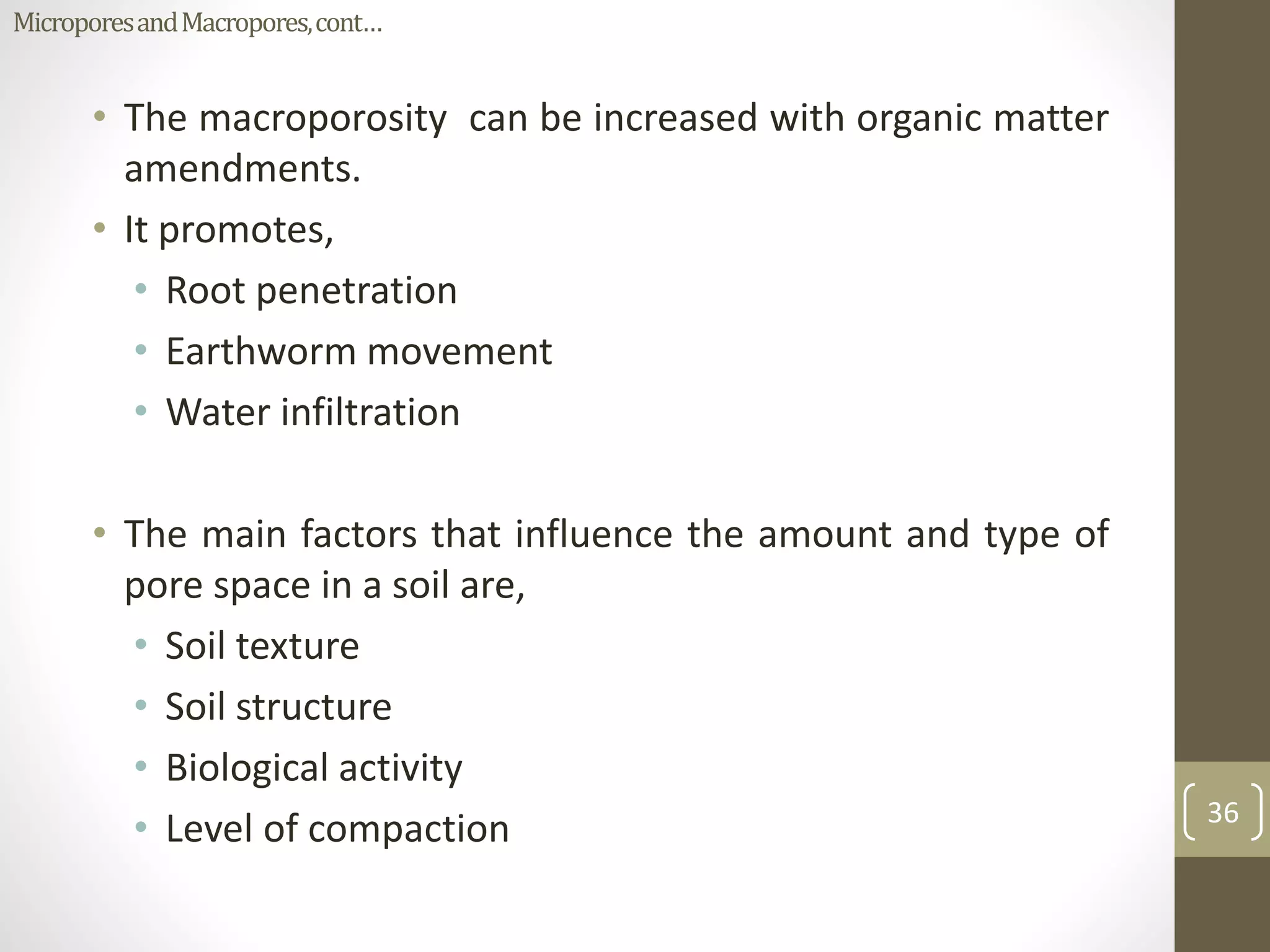
MicroporesandMacropores,cont…
• The macroporosity can be increased with organic matter
amendments.
• It promotes,
• Root penetration
• Earthworm movement
• Water infiltration
• The main factors that influence the amount and type of
pore space in a soil are,
• Soil texture
• Soil structure
• Biological activity
• Level of compaction 36
MicroporesandMacropores,cont…
Related equations
Ms - Mass of solid Mw - Mass of water
Vs - Volume of solid Vw - Volume of water
Va - Volume of air Vt - Total volume
• Vt = Vs + Vw + Va Vv = Vw + Va
• VR= (Vw + Va) / Vs x 100% ρb = Ms / Vt
• P = (Vw + Va) / Vt x 100% ρp = Ms / Vs
37
• MCwb = Mw/(Ms+Mw) x 100%
• MCdb = Mw / Ms x 100 %
• MCv = Vw / Vt x 100%
• MCv = MCdb x ρb
• P = (1- ρb/ ρp ) x 100%
• P = Saturation MC volume basis
38
Relatedequations,cont…
Calculation
• An undisturbed soil core sample was collected from the field
by driving a sampling cylinder of 100 cm3 in the soil. The
sample was subsequently dried in an oven set at 105 ̊C during
24 hrs. The net mass of the dried soil sampe is 0.143 kg.
determine the bulk density and total porosity of the soil
sample
• A soil sample is taken from the root zone of a cereal crop and
weighted. The mass of the soil sample before and after drying
is respectively 0.1852 kg and 0.1613 kg. Express the soil water
content on the sample as mass water content 39
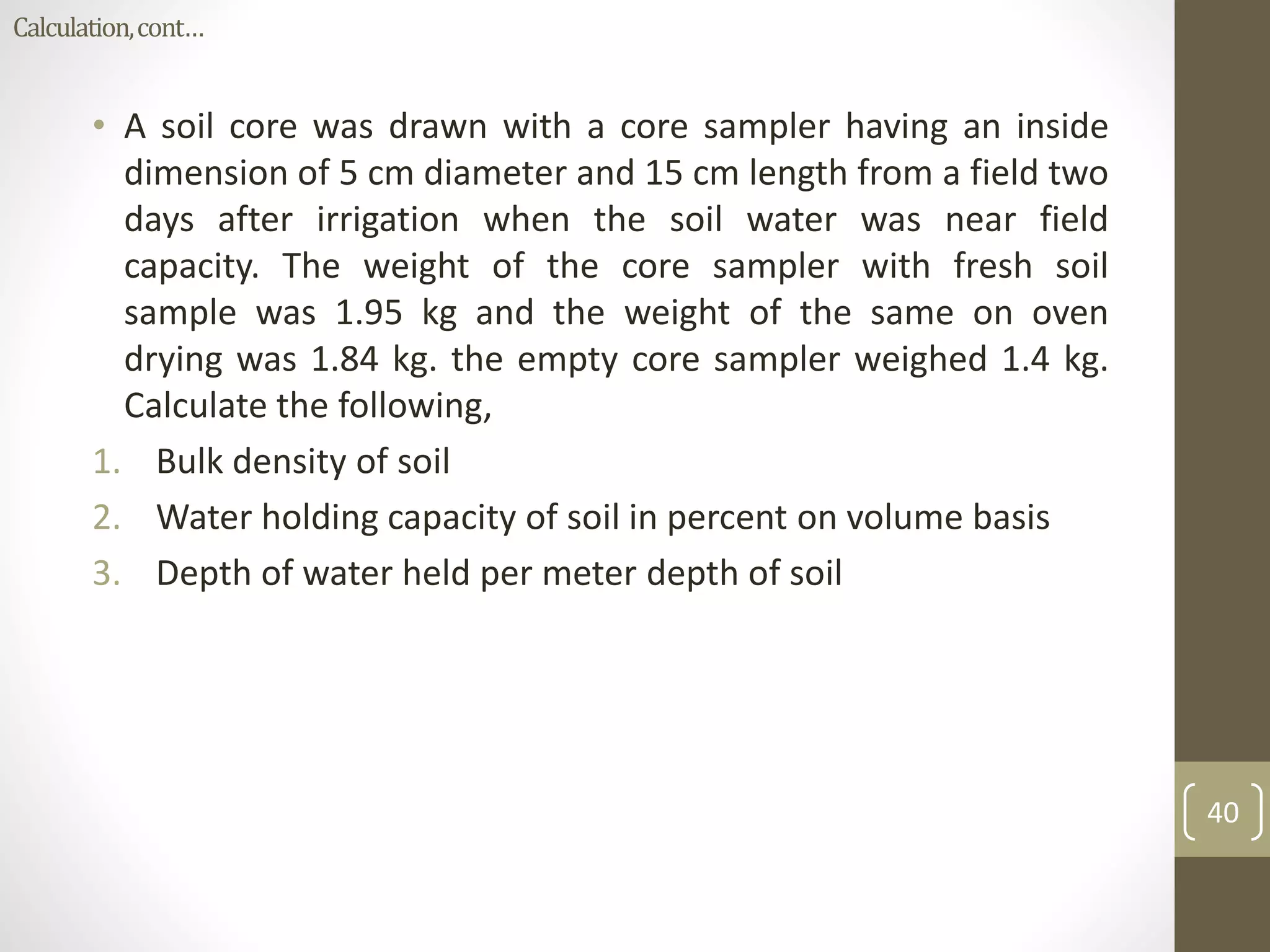
• A soil core was drawn with a core sampler having an inside
dimension of 5 cm diameter and 15 cm length from a field two
days after irrigation when the soil water was near field
capacity. The weight of the core sampler with fresh soil
sample was 1.95 kg and the weight of the same on oven
drying was 1.84 kg. the empty core sampler weighed 1.4 kg.
Calculate the following,
1. Bulk density of soil
2. Water holding capacity of soil in percent on volume basis
3. Depth of water held per meter depth of soil
40
Calculation,cont…
THANK YOU
41

Soil water relationship

  • 1.
    Soil Water Relationships VijithaVikneshwaran Lecturer (Temporary) Faculty of Technology University of Jaffna
  • 2.
    Introduction • Knowledge aboutsoil water relationships is important for decision-making process in agricultural operations like, • What crops to plant • When to plant them • When other management practices should be done. • Soil water relationships affect the, • Rate of entry of water into soil • Retention of water • Movement of water • Availability of water to plant 2
  • 3.
    Soil composition andtexture • Soils are composed of 3 components, • Solids • Water • Air • The solids are made of, • Minerals derived from geologic weathering (Mineral solids) • Organic matter consisting of plant or animal residue (Organic matter solids ) • Living organisms • The empty spaces between the solids are called pores. • These pores are occupied by either water or air. 3
  • 4.
    • The mineralsolid fraction of the soil is made up of, • Sand • Silt • Clay Soil texture (ISSS Classification) • The particular ratios of sand, silt and clay determine the soil texture. Gravel - > 2.0 mm Coarse sand - 2.0 - 0.2 mm Fine sand - 0.2 - 0.02 mm Silt - 0.02 - 0.002 mm Clay - < 0.002 mm 4 Soilcompositionandtexture,cont….
  • 5.
    • Particles largerthan 2.0 mm are referred to as rock fragments. • These rock fragments are not considered in determining soil texture. • But they can influence both soil structure and soil water relationships. • By volume, most soils are composed of about, • 35-55% pore space • 45-65% solid material • Larger fraction of solid material is mineral-based whereas only 2-5% is organic-based residue. 5 Soilcompositionandtexture,cont….
  • 6.
    • Agricultural soilscontain less organic matter compared to forested or undisturbed soils. • When organic matter is exposed to soil microorganisms in aerobic conditions, it becomes oxidized and degraded. • This process is called as mineralization. • Organic matter is a beneficial soil component. • It provides, • Good water-holding capacity • Slowly releases nutrients for plant growth and • Improves the soil structure 6 Soilcompositionandtexture,cont….
  • 7.
    • Air andwater occupy the pore space in a soil • The proportion of air and water varies by soil type and over time. • After a large precipitation event, • Pore space occupied by water will increase • Air-filled pore space will decrease • During prolonged dry periods, • Water-filled pore space will decrease • Air-filled pore space will increase 7 Soilcompositionandtexture,cont….
  • 8.
    Soil textural triangle •It is used to determine the textural class of the soil when the fraction of sand, silt and clay are known. • Soil texture determination is important because many soil properties are influenced by texture. • Those are, • Drainage • Water-holding capacity • Aeration • Susceptibility to erosion • Cation exchange capacity • pH buffering capacity • Soil tilth 8
  • 9.
  • 10.
    Characteristics of differentsoil Sandy soil • > 85% sand • Simple • Round • Large volume of non-capillary pores • Low water holding capacity • Good drainage • Chemically inert • Loose • Non cohesive 10
  • 11.
    Clay soil • >55%clay • Complex • Plate-like (surface area is high) • Large volume of capillary pores • High water holding capacity • Poor drainage • Chemically active, negatively charged • Aggregated • Sticky when wet Loamy soil • Good mix of sand, silt and clay for • agricultural purposes 11 Characteristicsofdifferentsoil,cont….
  • 12.
    Soil structure • Itrefers to how the soil particles are shaped and organized into units of aggregation. • There are six primary soil structural classes, • Platy • Prismatic • Columnar • Blocky • Single-grained • Granular 12
  • 13.
    Soil structure affectsthe , • Rate that water and air can move through the soil • Root penetration • Availability of nutrients to plants • Erodibility • Soil aeration • Water holding capacity • Porosity • Infiltration • Hydraulic conductivity 13 Soilstructure,cont…
  • 14.
    Classification of soilbased on horizontal and vertical axis 1. Blocky - cube shaped with sharp corners 2. Columnar - vertically rectangular with rounded ends 3. Crumbly - rounded, but larger than grains 4. Granular - rounded surfaces; sand 5. Platy - horizontally rectangular 6. Prismatic - vertically rectangular with flat ends 7. Single grain/structureless - no aggregation of particles when dry 8. Sub angular blocky - cube shaped with rounded corners 14 Soilstructure,cont…
  • 15.
    • In single-grainedsoils like sand, water percolates very quickly through the soil. • In massive soils such as dense clays, water movement is very slow. • In granular and crumb structured soil the water circulates very easily through such soils. • They are commonly found in the A-horizon of the soil profile • In blocky and sub angular blocky structured soil, relatively large blocks indicate that the soil resists penetration and movement of water. • They are commonly found in the B-horizon where clay has accumulated 15 Soilstructure,cont………
  • 16.
    • Prismatic andcolumnar structured soil have formed into vertical columns or pillars separated by miniature but definite vertical cracks. • Water circulates with greater difficulty and drainage is poor. • They are commonly found in the B-horizon where clay has accumulated. • Platy structure is made up of soil particles aggregated in thin plates or sheets piled horizontally on one another. • Plates often overlap, greatly impairing water circulation. • It is commonly found in forest soils, in part of the A- horizon and in clay pan soils. 16 Soilstructure,cont…
  • 17.
    • More favorablewater movement characteristics for crop production are generally found in soils that have granular, prismatic or blocky structure. • Well-structured soils are usually more desirable for agricultural production. • Because structured soils can hold and conduct water and gasses. • In addition it will support load-bearing activities, such as field traffic. 17 Soilstructure,cont…
  • 18.
    • Tillage ofsome fine-textured soils, particularly when they are wet can destroy the soil structure. • Irrigation with high salt content can causes dispersion of soil particles. • Biological activity of organisms such as earthworms, mammals, termites and ants can also change the soil structure by creating large pores from burrowing and deposition of organic matter. 18 Changes in soil structure
  • 19.
    Soil Bulk Density •Soil bulk density expresses the ratio of the mass of dry soil to the total volume occupied in the soil. • The total volume includes both the solids and the pore spaces. • Soil bulk density is important because it is an indicator of the soil’s porosity. Bulk density = 𝑴𝒂𝒔𝒔 𝒐𝒇 𝒔𝒐𝒍𝒊𝒅 (𝒈) 𝑻𝒐𝒕𝒂𝒍 𝒗𝒐𝒍𝒖𝒎𝒆 (𝒄𝒎𝟑 ) ρb = Ms Vt 19
  • 20.
    • Soil coremethod is widely used to determine the ρb. • An undisturbed soil core is taken from the field by a core sampler. • The selected soil sample is dried in a hot air oven at 105 ̊C until achieving a constant weight. • Volume of the core sampler is calculated. • Then the weight of soil per unit volume is calculated. • It ranges, 1.1 to 1.3 g cm-3 in fine textured surface soil 1.4 to 1.8 g cm-3 in coarse textured surface soil 2 cm-3 in compacted sub soil 0.76 cm-3 in some forest soil • For common soils the ƿb varies from 1.1 to 1.85 g cm-3 Note: ρb increases with compaction and decreases with loosening of soil. 20 SoilBulkDensity,cont…
  • 21.
    • Bulk densityalso provides information about the potential for, • Leaching of agrochemicals • Erosion • Crop productivity • On soils with a high bulk density, removal of nutrients needed by crops can occur due to surface runoff and erosion of soil • Because water is restricted from moving through the soil and thus ends up as surface runoff and carry away soil and soil-bound nutrients. 21 SoilBulkDensity,cont…
  • 22.
    • Soils withlower bulk density (sands), can promote vertical leaching of nutrients and reduce their availability to crops. • Soil bulk density can be affected by, • Physical management practices (Eg: Tillage) • Biological activity (Eg: Tunneling of earthworms) • Organic matter content 22 SoilBulkDensity,cont…
  • 23.
    Particle density • Itis determined similarly to bulk density. • But it is the mass of the dry soil divided by the volume of the solid soil components only. • Therefore, particle density will be greater than bulk density. • It represents the average density of all the solids composing the soil (True density). • The particle density of most soils is around 2.65 g/cm3 • Because quartz has a density of 2.65 g/cm3 and is usually one of the dominant minerals in soils. 23
  • 24.
    • Clay hasa particle density of 2.83 g/cm3 • Organic matter has a particle density of 0.8 g/cm3 • So soils with significant amounts of either clay or organic matter will deviate from particle density of 2.65 g/cm3 Particle density = 𝑴𝒂𝒔𝒔 𝒐𝒇 𝒔𝒐𝒍𝒊𝒅 𝑽𝒐𝒍𝒖𝒎𝒆 𝒐𝒇 𝒔𝒐𝒍𝒊𝒅 ρp = Ms Vs • It does not change with tillage or crop practices. • Presence of organic matter lowers its value. • Pycnometer or specific gravity bottle is used to find the ρp. 24 Particledensity,cont….
  • 25.
    Water content • Theamount of soil water is usually measured in terms of water content as percentage by volume or mass, or as soil water potential. • It is the relative amount of water in the soil. • The gravimetric water content is determined by, Extracting the soil sample Oven drying the sample Determine the amount of water lost through the drying 25
  • 26.
    • The watercontent is expressed as, Gravimetric water content (θ g), wet basis = 𝑊𝑒𝑖𝑔ℎ𝑡 𝑜𝑓 𝑤𝑎𝑡𝑒𝑟 𝑊𝑒𝑖𝑔ℎ𝑡 𝑜𝑓 𝑠𝑜𝑙𝑖𝑑+𝑊𝑒𝑖𝑔ℎ𝑡 𝑜𝑓 𝑤𝑎𝑡𝑒𝑟 *100% = 𝑊𝑤 (𝑔) 𝑊𝑠+𝑊𝑤 (𝑔) *100% Gravimetric water content (θ g), dry basis = 𝑊𝑒𝑖𝑔ℎ𝑡 𝑜𝑓 𝑤𝑎𝑡𝑒𝑟 𝑊𝑒𝑖𝑔ℎ𝑡 𝑜𝑓 𝑠𝑜𝑙𝑖𝑑 *100% = 𝑊𝑤 (𝑔) 𝑊𝑠 (𝑔) *100% • The volumetric water content is more useful for field and laboratory studies. Volumetric water content (θ v) = 𝑉𝑜𝑙𝑢𝑚𝑒 𝑜𝑓 𝑤𝑎𝑡𝑒𝑟 𝑇𝑜𝑡𝑎𝑙 𝑣𝑜𝑙𝑢𝑚𝑒 *100% = 𝑉𝑤 𝑉𝑡 *100% 26 Watercontent,cont….
  • 27.
    • Conversion ofwater content from gravimetric to volumetric basis. Volumetric water content = Gravimetric water content* bulk density of soil Density of water θ v = θ g * ρb 𝐷𝑤 Since density of water = 1 g/cm3 Volumetric water content (θ v) = Gravimetric water content (θ g), db* bulk density (ρb) 27 Watercontent,cont….
  • 28.
    Porosity • It isdefined as the volume percentage of pores in a soil. • It is the inverse of the volume percentage of solids. • Within a soil of similar texture, • Compacted soil has lower porosity and thus a greater bulk density • Loose soil has a greater porosity and a lower bulk density 28
  • 29.
    Porosity can beestimated by the following equation; Porosity (P) = 𝑽𝒐𝒍𝒖𝒎𝒆 𝒐𝒇 𝒗𝒐𝒊𝒅𝒔 𝑻𝒐𝒕𝒂𝒍 𝒗𝒐𝒍𝒖𝒎𝒆 *100 P = Vv Vt ∗ 𝟏𝟎𝟎 Where, 𝑽𝒐𝒍𝒖𝒎𝒆 𝒐𝒇 𝒗𝒐𝒊𝒅𝒔 = 𝑽𝒐𝒍𝒖𝒎𝒆 𝒐𝒇 𝒘𝒂𝒕𝒆𝒓 + 𝑽𝒐𝒍𝒖𝒎𝒆 𝒐𝒇 𝒂𝒊𝒓 Vv =Vw+Va • Mean while, the ratio between volume of voids and the volume of solids can be expressed as, Void ratio (e) = 𝑽𝒐𝒍𝒖𝒎𝒆 𝒐𝒇 𝒗𝒐𝒊𝒅𝒔 𝑽𝒐𝒍𝒖𝒎𝒆 𝒐𝒇 𝒔𝒐𝒍𝒊𝒅 *100 e = Vv Vs ∗ 𝟏𝟎𝟎 29 Porosity,cont….
  • 30.
    • Relationship betweenporosity with bulk density and particle density. P =[(1- (ρb/ ρp)] x 100% • Let’s check the validity P = (Vt/Vt)- [(Ms / Vt)/(Ms / Vs)] x 100% = [(Vt/Vt) - (Vs/Vt)] *100 = [(Vt-Vs)/Vt)]*100 = (Vv/Vt)*100 • P = Saturation MC volume basis 30 Porosity,cont….
  • 31.
    • Soil porosityis influenced primarily by, • Soil aggregation • Soil texture • Root penetration • Other biological activity (Activities of earthworm, etc.) • Coarse-textured (sandy) soils are less porous compare to fine-textured (clayey) soils. • Because although the average size of individual pores is usually larger in sandy soils, the smaller pores in the clayey soils are more numerous. • Organic matter content increases porosity by enhancing soil aggregation. 31 Porosity,cont….
  • 32.
    Micropores and Macropores •Macropores are larger than 0.08 mm in diameter. • These are the pore spaces between aggregates. • They promote, • Aeration • Evaporation • Gas exchange in the soil profile • Free drainage of water along with dissolved nutrients and agrochemicals 32
  • 33.
    • The freedrainage is referred as “preferential flow”. • Preferential flow can cause rapid leaching and bypass flow of nutrients and agrochemicals. • There fore, it potentially reduces the effectiveness of fertilizer and agrochemical applications. • Macropores are mostly found in loamy and well- aggregated soils. • But it can be converted to micropores by compaction through tillage and vehicle traffic. 33 MicroporesandMacropores,cont…
  • 34.
    • Micropores are0.08 mm or smaller. • These occur inside soil aggregates. • Micropores retain water and agrochemicals. • These are responsible for capillary water distribution. • However, most of the water they contain is not available to plants. 34 MicroporesandMacropores,cont…
  • 35.
    • Clays promoteaggregation but can also be readily compacted. • Therefore, clays increase water storage, but not necessarily plant-available water. • Because the clay is having an abundance of micropores. • Clays can, however, increase storage of plant-available water through the formation of stable soil aggregates. 35 MicroporesandMacropores,cont…
  • 36.
    • The macroporositycan be increased with organic matter amendments. • It promotes, • Root penetration • Earthworm movement • Water infiltration • The main factors that influence the amount and type of pore space in a soil are, • Soil texture • Soil structure • Biological activity • Level of compaction 36 MicroporesandMacropores,cont…
  • 37.
    Related equations Ms -Mass of solid Mw - Mass of water Vs - Volume of solid Vw - Volume of water Va - Volume of air Vt - Total volume • Vt = Vs + Vw + Va Vv = Vw + Va • VR= (Vw + Va) / Vs x 100% ρb = Ms / Vt • P = (Vw + Va) / Vt x 100% ρp = Ms / Vs 37
  • 38.
    • MCwb =Mw/(Ms+Mw) x 100% • MCdb = Mw / Ms x 100 % • MCv = Vw / Vt x 100% • MCv = MCdb x ρb • P = (1- ρb/ ρp ) x 100% • P = Saturation MC volume basis 38 Relatedequations,cont…
  • 39.
    Calculation • An undisturbedsoil core sample was collected from the field by driving a sampling cylinder of 100 cm3 in the soil. The sample was subsequently dried in an oven set at 105 ̊C during 24 hrs. The net mass of the dried soil sampe is 0.143 kg. determine the bulk density and total porosity of the soil sample • A soil sample is taken from the root zone of a cereal crop and weighted. The mass of the soil sample before and after drying is respectively 0.1852 kg and 0.1613 kg. Express the soil water content on the sample as mass water content 39
  • 40.
    • A soilcore was drawn with a core sampler having an inside dimension of 5 cm diameter and 15 cm length from a field two days after irrigation when the soil water was near field capacity. The weight of the core sampler with fresh soil sample was 1.95 kg and the weight of the same on oven drying was 1.84 kg. the empty core sampler weighed 1.4 kg. Calculate the following, 1. Bulk density of soil 2. Water holding capacity of soil in percent on volume basis 3. Depth of water held per meter depth of soil 40 Calculation,cont…
  • 41.