Physical assessment
HIPPIRONEL can be used
to find most diagnosis.
history--OPQRST
inspection---scars, redness,symetry,gait
palpation--nodule, pain, spasm
percussion--heart/abdomen
instrumentation--stethoscope,tuning fork
range of motion---spine and extremities
orthopedic test--many tests
neurologic test---dermatomes, reflex,motor
related test---xray, MRI,ect
lab tests----CBC,ect
History--OPQRST
• Onset--when?
• Palliative--makes it better?
• Provacative--irritates?
• Quality--stab,burn,numb?
• Radiation/Referral--shoot down
arm/leg?
• Severity---0-10 or mild/moderate/severe
• Timing--after dinner, 2am?
History
• Past history---happened before?
• Family history--stroke,MI, cancer
• medications/vitamins
• other clinics?
• Medical history--surgeries
• Social history---alcohol,drugs,STD
• Occupational history--hard job,work
comp
Vital signs
• BP
• pulse
• resp
• temp
• height/weight
• pain rating
ROM--range of motion
• neck--flexion,extension, lateral flexion,
rotation
• lumbar--flexion,extension, lateral
flexion, rotation
• elbow--flexion,extension
• forearm--supination,pronation
• wrist--flexion, extension, radial
deviation ulnar deviation
• fingers--flexion, extension
• shoulder--flexion,extension, abduction,
adduction, internal rotation, external
rotation, circumduction
Integumentary
skin---dehydrated(tugor),color,
temp,ulcer
nails--clubbing,spooning, cap refill
less 2 sec
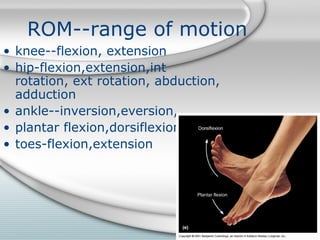
ROM--range of motion
• knee--flexion, extension
• hip-flexion,extension,int
rotation, ext rotation, abduction,
adduction
• ankle--inversion,eversion,
• plantar flexion,dorsiflexion
• toes-flexion,extension
eye exam
• http://www.youtube.com/watch?v=
• ear exam
• http://www.youtube.com/watc
h?v=iIbaq15t1L0
Musculoskeletal
• motor stength--0 to 5
• 5--Full ROM with gravity & full
resistance
• 4--Full ROM with gravity & some
resistance
• 3--Full ROM with gravity & No
resistance
• 2-Full ROM with gravity eliminated
• 1--slight contractility; no joint motion
• 0--No evidence of contractility
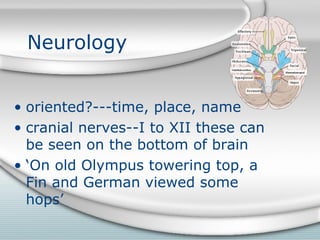
Neurology
• oriented?---time, place, name
• cranial nerves--I to XII these can
be seen on the bottom of brain
• ‘On old Olympus towering top, a
Fin and German viewed some
hops’
Cranial nerves
I Olfactory - olfaction (smell) s
IIOptic - vision (Contain 38% of all the axons connecting
to the brain.) s
III Oculomotor - eyelid and eyeball muscles m
IV Trochlear - eyeball muscles m
V Trigeminal - facial and mouth sensation , chewing b
VI Abducens - eyeball movement m
VII Facial - taste, facial muscles and salivary glands b
VIII Auditory - hearing and balance s
IX Glossopharyngeal - taste, swallowing b
X Vagus - long nerve goes to heart, GI, lungs b
XI Accessory - moving head and shoulder m
XII Hypoglossal - tongue muscles m
Some cranial nerves give sensation, some give muscle
control, some do both.
test your nerves
I Olfactory - olfaction (smell) s
IIOptic - vision (Contain 38% of all the axons connecting to the brain.) s
III Oculomotor - eyelid and eyeball muscles m
IV Trochlear - eyeball muscles m
V Trigeminal - facial and mouth sensation , chewing b
VI Abducens - eyeball movement m
VII Facial - taste, facial muscles and salivary glands b
VIII Auditory - hearing and balance s
IX Glossopharyngeal - taste, swallowing b
X Vagus - long nerve goes to heart, GI, lungs---gag b
XI Accessory - moving head and shoulder m
XII Hypoglossal - tongue muscles m
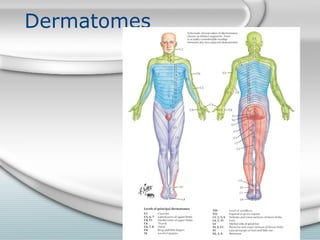
Dermatomes
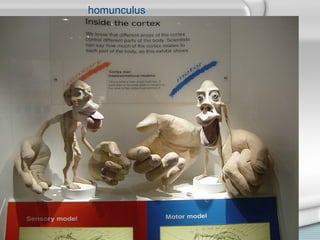
homunculus
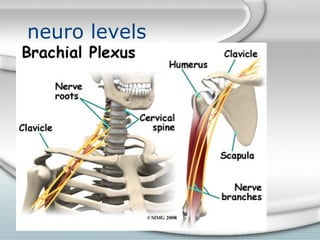
neuro levels
Abdomen
• RUQ LUQ RLQ LLQ--any bruises, bulges, discoloration
• sounds of borborygmus-normal 3-30? sound/minute
• no sounds after 5 minutes----severe GI problem
• McBurneys point---for appendix. between navel and
ASIS
• Murphy sign--------press under liver then release.
severe pain=cholecystitis
• murphys punch-----fist tap over kidneys
Orthopedic tests
stressing a body part to determine cause of pain
• neck
• lumbar
• elbow
• knee
• ankle
• hip
• shoulder
dermatome, motor, reflex
• http://www.youtube.com/watch?
v=esEWwFq940g
check your own
borborygmus
• normal, hyperactive, hypoactive
Cardiac
• percussion to find heart size
• systole (S1 sound)--ventricles contract
and aortic/pulmunary valves
open.mitral/tricuspid close.= lub
• diastole (S2 sound)--ventricles relax,
mitral/tricuspid open to let in blood,
aortic/pulmunary valves close.= dub
Cardiac
• pulses---
• 0 absent
• 1 weak/thready
• 2 palpable
• 3 strong
• 4 bounding
Pulses
• radial
• brachial
• popliteal
• dorsalis pedis
• carotid
• femoral
• http://www.youtube.com/watch?
v=74v4mEWhOao
check your pulses
Lungs
14-20 bpm
labored breathing?
scalene muscles used?
finger,lips color, coughing, sputum
chest shape--barrel, excavatus
palpation--hands on back,symetric
movement with breathing
‘99’ hand on back---fremitis vibration
auscultation---crackles, rales, wheezes

HIPPIRONEL---physical assessment

  • 1.
    Physical assessment HIPPIRONEL canbe used to find most diagnosis. history--OPQRST inspection---scars, redness,symetry,gait palpation--nodule, pain, spasm percussion--heart/abdomen instrumentation--stethoscope,tuning fork range of motion---spine and extremities orthopedic test--many tests neurologic test---dermatomes, reflex,motor related test---xray, MRI,ect lab tests----CBC,ect
  • 2.
    History--OPQRST • Onset--when? • Palliative--makesit better? • Provacative--irritates? • Quality--stab,burn,numb? • Radiation/Referral--shoot down arm/leg? • Severity---0-10 or mild/moderate/severe • Timing--after dinner, 2am?
  • 3.
    History • Past history---happenedbefore? • Family history--stroke,MI, cancer • medications/vitamins • other clinics? • Medical history--surgeries • Social history---alcohol,drugs,STD • Occupational history--hard job,work comp
  • 4.
    Vital signs • BP •pulse • resp • temp • height/weight • pain rating
  • 5.
    ROM--range of motion •neck--flexion,extension, lateral flexion, rotation • lumbar--flexion,extension, lateral flexion, rotation • elbow--flexion,extension • forearm--supination,pronation • wrist--flexion, extension, radial deviation ulnar deviation • fingers--flexion, extension • shoulder--flexion,extension, abduction, adduction, internal rotation, external rotation, circumduction
  • 6.
  • 7.
    ROM--range of motion •knee--flexion, extension • hip-flexion,extension,int rotation, ext rotation, abduction, adduction • ankle--inversion,eversion, • plantar flexion,dorsiflexion • toes-flexion,extension
  • 8.
    eye exam • http://www.youtube.com/watch?v= •ear exam • http://www.youtube.com/watc h?v=iIbaq15t1L0
  • 9.
    Musculoskeletal • motor stength--0to 5 • 5--Full ROM with gravity & full resistance • 4--Full ROM with gravity & some resistance • 3--Full ROM with gravity & No resistance • 2-Full ROM with gravity eliminated • 1--slight contractility; no joint motion • 0--No evidence of contractility
  • 10.
    Neurology • oriented?---time, place,name • cranial nerves--I to XII these can be seen on the bottom of brain • ‘On old Olympus towering top, a Fin and German viewed some hops’
  • 11.
    Cranial nerves I Olfactory- olfaction (smell) s IIOptic - vision (Contain 38% of all the axons connecting to the brain.) s III Oculomotor - eyelid and eyeball muscles m IV Trochlear - eyeball muscles m V Trigeminal - facial and mouth sensation , chewing b VI Abducens - eyeball movement m VII Facial - taste, facial muscles and salivary glands b VIII Auditory - hearing and balance s IX Glossopharyngeal - taste, swallowing b X Vagus - long nerve goes to heart, GI, lungs b XI Accessory - moving head and shoulder m XII Hypoglossal - tongue muscles m Some cranial nerves give sensation, some give muscle control, some do both.
  • 12.
    test your nerves IOlfactory - olfaction (smell) s IIOptic - vision (Contain 38% of all the axons connecting to the brain.) s III Oculomotor - eyelid and eyeball muscles m IV Trochlear - eyeball muscles m V Trigeminal - facial and mouth sensation , chewing b VI Abducens - eyeball movement m VII Facial - taste, facial muscles and salivary glands b VIII Auditory - hearing and balance s IX Glossopharyngeal - taste, swallowing b X Vagus - long nerve goes to heart, GI, lungs---gag b XI Accessory - moving head and shoulder m XII Hypoglossal - tongue muscles m
  • 13.
  • 14.
  • 15.
  • 16.
    Abdomen • RUQ LUQRLQ LLQ--any bruises, bulges, discoloration • sounds of borborygmus-normal 3-30? sound/minute • no sounds after 5 minutes----severe GI problem • McBurneys point---for appendix. between navel and ASIS • Murphy sign--------press under liver then release. severe pain=cholecystitis • murphys punch-----fist tap over kidneys
  • 17.
    Orthopedic tests stressing abody part to determine cause of pain • neck • lumbar • elbow • knee • ankle • hip • shoulder
  • 18.
    dermatome, motor, reflex •http://www.youtube.com/watch? v=esEWwFq940g
  • 19.
    check your own borborygmus •normal, hyperactive, hypoactive
  • 20.
    Cardiac • percussion tofind heart size • systole (S1 sound)--ventricles contract and aortic/pulmunary valves open.mitral/tricuspid close.= lub • diastole (S2 sound)--ventricles relax, mitral/tricuspid open to let in blood, aortic/pulmunary valves close.= dub
  • 21.
    Cardiac • pulses--- • 0absent • 1 weak/thready • 2 palpable • 3 strong • 4 bounding
  • 22.
    Pulses • radial • brachial •popliteal • dorsalis pedis • carotid • femoral • http://www.youtube.com/watch? v=74v4mEWhOao
  • 23.
  • 24.
    Lungs 14-20 bpm labored breathing? scalenemuscles used? finger,lips color, coughing, sputum chest shape--barrel, excavatus palpation--hands on back,symetric movement with breathing ‘99’ hand on back---fremitis vibration auscultation---crackles, rales, wheezes