Properties of Matter 
Ch 2
What is Matter? 
 Matter is anything that: 
◦ Has mass 
◦ Takes up space (volume) 
◦ Made up of tiny particles called atoms 
 Mass: 
◦ A measure of the amount of matter in an 
object 
◦ An object’s mass doesn’t really change 
◦ This is different than an object’s weight 
 Weight: 
◦ A measure of the pull of gravity on an object 
◦ Weight can change depending on where you 
are in the universe!
Measuring Matter 
 Volume: 
◦ A measure of the amount of space an 
object takes up (how many particles are in 
it) 
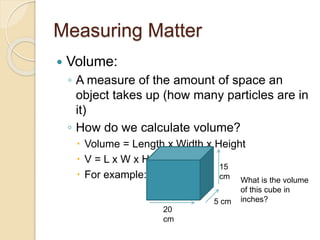
◦ How do we calculate volume? 
 Volume = Length x Width x Height 
 V = L x W x H 
 For example: 
15 
cm 
5 cm 
20 
cm 
What is the volume 
of this cube in 
inches?
Another way to find volume 
 Volume can sometimes be measured 
using water displacement 
◦ Water displacement method = putting an 
object in a container of water and 
measuring how much the water rises 
 The amount of water displaced will be equal to 
the object’s volume 
 This can only be done with solid objects!
Practice 
 A rock is dropped into a container of 
water. Before the rock was added, the 
container had 15 mL of water. Now, 
the measurement reads 32 mL of 
water. 
◦ What is the volume of the rock? 
 Find the volume of the following 
objects: 5 cm 
5 cm 
5 cm 
4 in 
2 in 
10 
cm
Density 
 Density: 
◦ A measure of how tightly packed the 
particles are in an object 
◦ It is the ratio of the mass to its volume 
 Formula: D=m/V (mass / volume) 
 For example 
 D= 400 g / 25 cm3 
 D= 16g/cm3
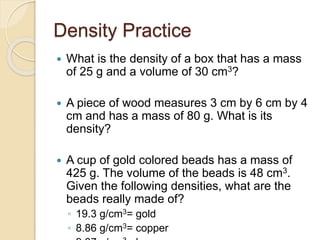
Density Practice 
 What is the density of a box that has a mass 
of 25 g and a volume of 30 cm3? 
 A piece of wood measures 3 cm by 6 cm by 4 
cm and has a mass of 80 g. What is its 
density? 
 A cup of gold colored beads has a mass of 
425 g. The volume of the beads is 48 cm3. 
Given the following densities, what are the 
beads really made of? 
◦ 19.3 g/cm3= gold 
◦ 8.86 g/cm3= copper 
◦ 9.87 g/cm3= bronze

Physical Science Powerpoint (Grade 8: Class A and Class B)

  • 1.
  • 2.
    What is Matter?  Matter is anything that: ◦ Has mass ◦ Takes up space (volume) ◦ Made up of tiny particles called atoms  Mass: ◦ A measure of the amount of matter in an object ◦ An object’s mass doesn’t really change ◦ This is different than an object’s weight  Weight: ◦ A measure of the pull of gravity on an object ◦ Weight can change depending on where you are in the universe!
  • 3.
    Measuring Matter Volume: ◦ A measure of the amount of space an object takes up (how many particles are in it) ◦ How do we calculate volume?  Volume = Length x Width x Height  V = L x W x H  For example: 15 cm 5 cm 20 cm What is the volume of this cube in inches?
  • 4.
    Another way tofind volume  Volume can sometimes be measured using water displacement ◦ Water displacement method = putting an object in a container of water and measuring how much the water rises  The amount of water displaced will be equal to the object’s volume  This can only be done with solid objects!
  • 5.
    Practice  Arock is dropped into a container of water. Before the rock was added, the container had 15 mL of water. Now, the measurement reads 32 mL of water. ◦ What is the volume of the rock?  Find the volume of the following objects: 5 cm 5 cm 5 cm 4 in 2 in 10 cm
  • 6.
    Density  Density: ◦ A measure of how tightly packed the particles are in an object ◦ It is the ratio of the mass to its volume  Formula: D=m/V (mass / volume)  For example  D= 400 g / 25 cm3  D= 16g/cm3
  • 7.
    Density Practice What is the density of a box that has a mass of 25 g and a volume of 30 cm3?  A piece of wood measures 3 cm by 6 cm by 4 cm and has a mass of 80 g. What is its density?  A cup of gold colored beads has a mass of 425 g. The volume of the beads is 48 cm3. Given the following densities, what are the beads really made of? ◦ 19.3 g/cm3= gold ◦ 8.86 g/cm3= copper ◦ 9.87 g/cm3= bronze