Today in Science
You will Need:
1)Pencil, Colored Pencils, Highlighters or
Markers
2)Log #2 – Bookshelf + Update
3)Power Notes – Phases of Matter– 2
page 4 sides- Bookshelf- Please Staple
Check
Off
Date
Given
Date Due Name of Assignment Possible
Pts.
Earned
Pts.
9/12 9/19 Binder Check #1 130
9/17 9/23 Power Notes – Phases of
Matter
135
9/19 9/19 Test #1 + ½ page of notes
http://www.buzzle.com/articles/phases-of-matter.html
What Makes a
Substance a Solid,
Liquid, Gas or
Plasma?
E
N
E
R
G
Y
E
N
E
R
G
Y
Plasma
Gas
Liquid
Solid
Task List:
Timer/Designer:
1)Log on to Learning Point
2)Select Mori Classroom
3)Select Daily Assignments
4)Select: Week of Sept. 16th
-20th
5)Complete Power Notes – Phase
Changes – Due Monday of next
week
6) Review & Reflect +, , -
E
N
E
R
G
Y
E
N
E
R
G
Y
Plasma
Gas
Liquid
Solid
Topic:
Power Notes- Phases of
Matter
Matter
What are some differences
you already know about these
phases?
Look at slide 3 to help with
this answer
Most of the elements
on the Periodic Table of
Elements exist in what
state?
Very few of the
elements exist on the
Periodic Table as?
What state of matter
makes up only about 11
elements on the
Periodic Table?
-SOLID – at standard
temperature and pressure.
LIQUIDS – However, ¾ of our
planet is covered with the
liquid known as water.
GASES – they have no definite
shape or volume. They expand
to fill the container they
occupy.
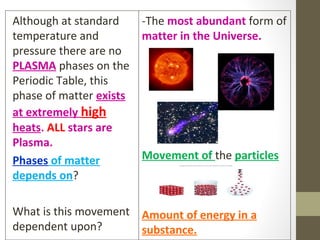
Although at standard
temperature and
pressure there are no
PLASMA phases on the
Periodic Table, this
phase of matter exists
at extremely high
heats. ALL stars are
Plasma.
Phases of matter
depends on?
What is this movement
dependent upon?
-The most abundant form of
matter in the Universe.
Movement of the particles
Amount of energy in a
substance.
Matter with lots of
kinetic energy usually
have what?
Which phase has the
most kinetic energy?
Which phase has the
least kinetic energy?
-higher temperatures
-particles that are moving
wildly
-particles that are far apart
Plasmas
Solids (BEC)-Bose Einstein
Condensates – particles do
NOT move.
Energy Scale
High
Energy
Low
EnergyPhase
Plasma Gas Liquid Solid BEC*
Illustrate, Color and Label an example of each Phase.
Each member of the group should have their own
UNIQUE picture example.
*No illustration for BEC’s .Just copy what is in the yellow
box.
*Rubidiu
m at 0
Kelvin
What words describe
Phase Change?
(Examples should be
UNIQUE for each
person in the group)
-MELTING– when a solid
moves to the liquid state
when heat is added.
FREEZING – when a liquid
moves to the solid state.
This happens when heat is
released.
EVAPORATION – when a
liquid moves to the gaseous
state. Heat needs to be
added for this to happen.
What words describe
Phase Change?
(Examples should be
UNIQUE for each
person in the group)
-CONDENSATION– when a
gas moves to the liquid
state when heat is released.
SUBLIMATION– when a
solid moves to the gas state
skipping the liquid state.
This happens when heat is
added.
DEPOSITION– when a gas
moves to the solid state
skipping the liquid state.
Heat needs to be released
for this to happen.
Graphic Organizer
• Use the vocabulary words from your Phase
Change chart to determine the fill in boxes’
content.
Identify the following phase
changes
• Using the vocabulary words from your Phase
Change chart, tell what word applies to the
change being described.
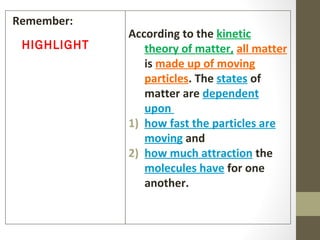
Remember:
According to the kinetic
theory of matter, all matter
is made up of moving
particles. The states of
matter are dependent
upon
1) how fast the particles are
moving and
2) how much attraction the
molecules have for one
another.
HIGHLIGHT
In order for matter to change
from one state to another,
energy must be added or
removed.
Each type of substance has its
own freezing, melting and
boiling points. In other words,
different substances change
states at different
temperatures.
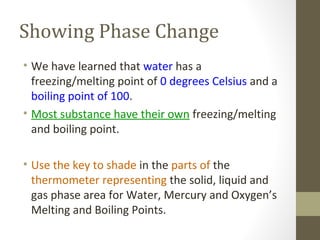
Showing Phase Change
• We have learned that water has a
freezing/melting point of 0 degrees Celsius and a
boiling point of 100.
• Most substance have their own freezing/melting
and boiling point.
• Use the key to shade in the parts of the
thermometer representing the solid, liquid and
gas phase area for Water, Mercury and Oxygen’s
Melting and Boiling Points.
Phase Changes
Different Substances have their own
unique melting & boiling points.
Color each thermometer according to the
key to indicate at which and/or between
which temperatures it is a solid, liquid
or gas.
1) Answer each question using your
power notes for Phase Change.
2) Do a Review and Reflect on all your
notes. +, , -
Questions & Review & Check
Questions 1-15
•NO COMPLETE SENTENCES
•BULLET your ANSWERS
•USE YOUR NOTES TO
COMPLETE…..all your answers are in
the notes.
•Don’t forget to Review and Reflect
on ALL four pages.
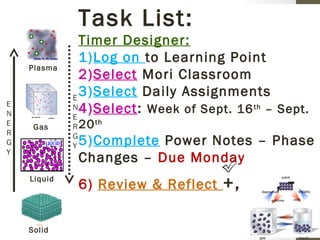
Task List:
Timer Designer:
1)Log on to Learning Point
2)Select Mori Classroom
3)Select Daily Assignments
4)Select: Week of Sept. 16th
– Sept.
20th
5)Complete Power Notes – Phase
Changes – Due Monday
6) Review & Reflect +, , -
E
N
E
R
G
Y
E
N
E
R
G
Y
Plasma
Gas
Liquid
Solid
Homework
1) Binder Check#1 – Due Thursday at
the beginning of class
2)Test #1 – ½ sheet of paper, front
side only, done by hand– Due
Thursday

Power Notes Phase Changes of Matter

  • 1.
    Today in Science Youwill Need: 1)Pencil, Colored Pencils, Highlighters or Markers 2)Log #2 – Bookshelf + Update 3)Power Notes – Phases of Matter– 2 page 4 sides- Bookshelf- Please Staple
  • 2.
    Check Off Date Given Date Due Nameof Assignment Possible Pts. Earned Pts. 9/12 9/19 Binder Check #1 130 9/17 9/23 Power Notes – Phases of Matter 135 9/19 9/19 Test #1 + ½ page of notes
  • 3.
    http://www.buzzle.com/articles/phases-of-matter.html What Makes a Substancea Solid, Liquid, Gas or Plasma? E N E R G Y E N E R G Y Plasma Gas Liquid Solid
  • 4.
    Task List: Timer/Designer: 1)Log onto Learning Point 2)Select Mori Classroom 3)Select Daily Assignments 4)Select: Week of Sept. 16th -20th 5)Complete Power Notes – Phase Changes – Due Monday of next week 6) Review & Reflect +, , - E N E R G Y E N E R G Y Plasma Gas Liquid Solid
  • 5.
    Topic: Power Notes- Phasesof Matter Matter What are some differences you already know about these phases? Look at slide 3 to help with this answer
  • 6.
    Most of theelements on the Periodic Table of Elements exist in what state? Very few of the elements exist on the Periodic Table as? What state of matter makes up only about 11 elements on the Periodic Table? -SOLID – at standard temperature and pressure. LIQUIDS – However, ¾ of our planet is covered with the liquid known as water. GASES – they have no definite shape or volume. They expand to fill the container they occupy.
  • 7.
    Although at standard temperatureand pressure there are no PLASMA phases on the Periodic Table, this phase of matter exists at extremely high heats. ALL stars are Plasma. Phases of matter depends on? What is this movement dependent upon? -The most abundant form of matter in the Universe. Movement of the particles Amount of energy in a substance.
  • 8.
    Matter with lotsof kinetic energy usually have what? Which phase has the most kinetic energy? Which phase has the least kinetic energy? -higher temperatures -particles that are moving wildly -particles that are far apart Plasmas Solids (BEC)-Bose Einstein Condensates – particles do NOT move.
  • 9.
    Energy Scale High Energy Low EnergyPhase Plasma GasLiquid Solid BEC* Illustrate, Color and Label an example of each Phase. Each member of the group should have their own UNIQUE picture example. *No illustration for BEC’s .Just copy what is in the yellow box. *Rubidiu m at 0 Kelvin
  • 10.
    What words describe PhaseChange? (Examples should be UNIQUE for each person in the group) -MELTING– when a solid moves to the liquid state when heat is added. FREEZING – when a liquid moves to the solid state. This happens when heat is released. EVAPORATION – when a liquid moves to the gaseous state. Heat needs to be added for this to happen.
  • 11.
    What words describe PhaseChange? (Examples should be UNIQUE for each person in the group) -CONDENSATION– when a gas moves to the liquid state when heat is released. SUBLIMATION– when a solid moves to the gas state skipping the liquid state. This happens when heat is added. DEPOSITION– when a gas moves to the solid state skipping the liquid state. Heat needs to be released for this to happen.
  • 12.
    Graphic Organizer • Usethe vocabulary words from your Phase Change chart to determine the fill in boxes’ content. Identify the following phase changes • Using the vocabulary words from your Phase Change chart, tell what word applies to the change being described.
  • 13.
    Remember: According to thekinetic theory of matter, all matter is made up of moving particles. The states of matter are dependent upon 1) how fast the particles are moving and 2) how much attraction the molecules have for one another. HIGHLIGHT
  • 14.
    In order formatter to change from one state to another, energy must be added or removed. Each type of substance has its own freezing, melting and boiling points. In other words, different substances change states at different temperatures.
  • 15.
    Showing Phase Change •We have learned that water has a freezing/melting point of 0 degrees Celsius and a boiling point of 100. • Most substance have their own freezing/melting and boiling point. • Use the key to shade in the parts of the thermometer representing the solid, liquid and gas phase area for Water, Mercury and Oxygen’s Melting and Boiling Points.
  • 16.
    Phase Changes Different Substanceshave their own unique melting & boiling points. Color each thermometer according to the key to indicate at which and/or between which temperatures it is a solid, liquid or gas.
  • 17.
    1) Answer eachquestion using your power notes for Phase Change. 2) Do a Review and Reflect on all your notes. +, , - Questions & Review & Check
  • 18.
    Questions 1-15 •NO COMPLETESENTENCES •BULLET your ANSWERS •USE YOUR NOTES TO COMPLETE…..all your answers are in the notes. •Don’t forget to Review and Reflect on ALL four pages.
  • 19.
    Task List: Timer Designer: 1)Logon to Learning Point 2)Select Mori Classroom 3)Select Daily Assignments 4)Select: Week of Sept. 16th – Sept. 20th 5)Complete Power Notes – Phase Changes – Due Monday 6) Review & Reflect +, , - E N E R G Y E N E R G Y Plasma Gas Liquid Solid
  • 20.
    Homework 1) Binder Check#1– Due Thursday at the beginning of class 2)Test #1 – ½ sheet of paper, front side only, done by hand– Due Thursday