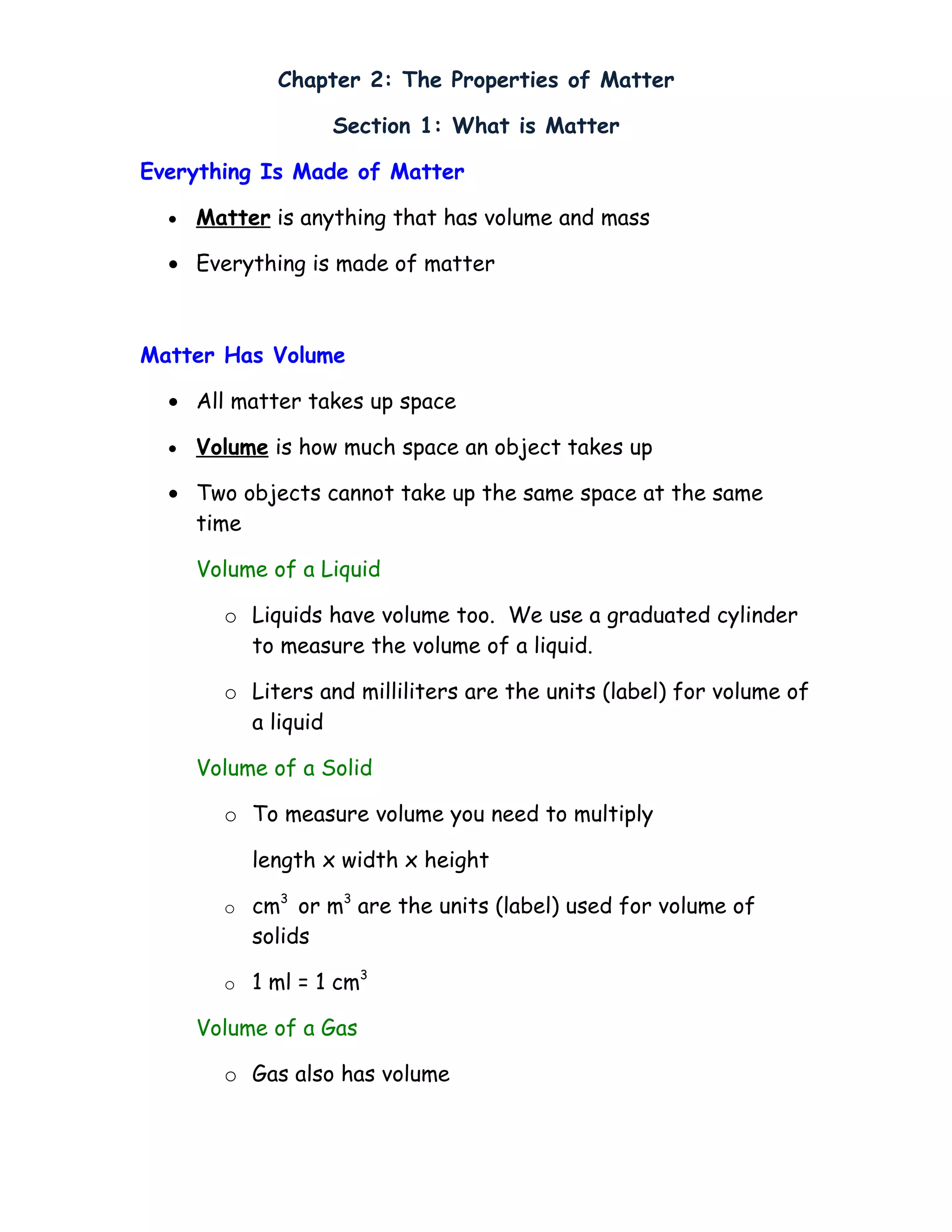
Chapter 2: The Properties of Matter

                    Section 1: What is Matter

Everything Is Made of Matter

  •   Matter is anything that has volume and mass

  • Everything is made of matter


Matter Has Volume

  • All matter takes up space

  •   Volume is how much space an object takes up

  • Two objects cannot take up the same space at the same
    time

      Volume of a Liquid

        o Liquids have volume too. We use a graduated cylinder
          to measure the volume of a liquid.

        o Liters and milliliters are the units (label) for volume of
          a liquid

      Volume of a Solid

        o To measure volume you need to multiply

           length x width x height

        o cm or m are the units (label) used for volume of
              3     3


           solids

        o 1 ml = 1 cm
                        3


      Volume of a Gas

        o Gas also has volume
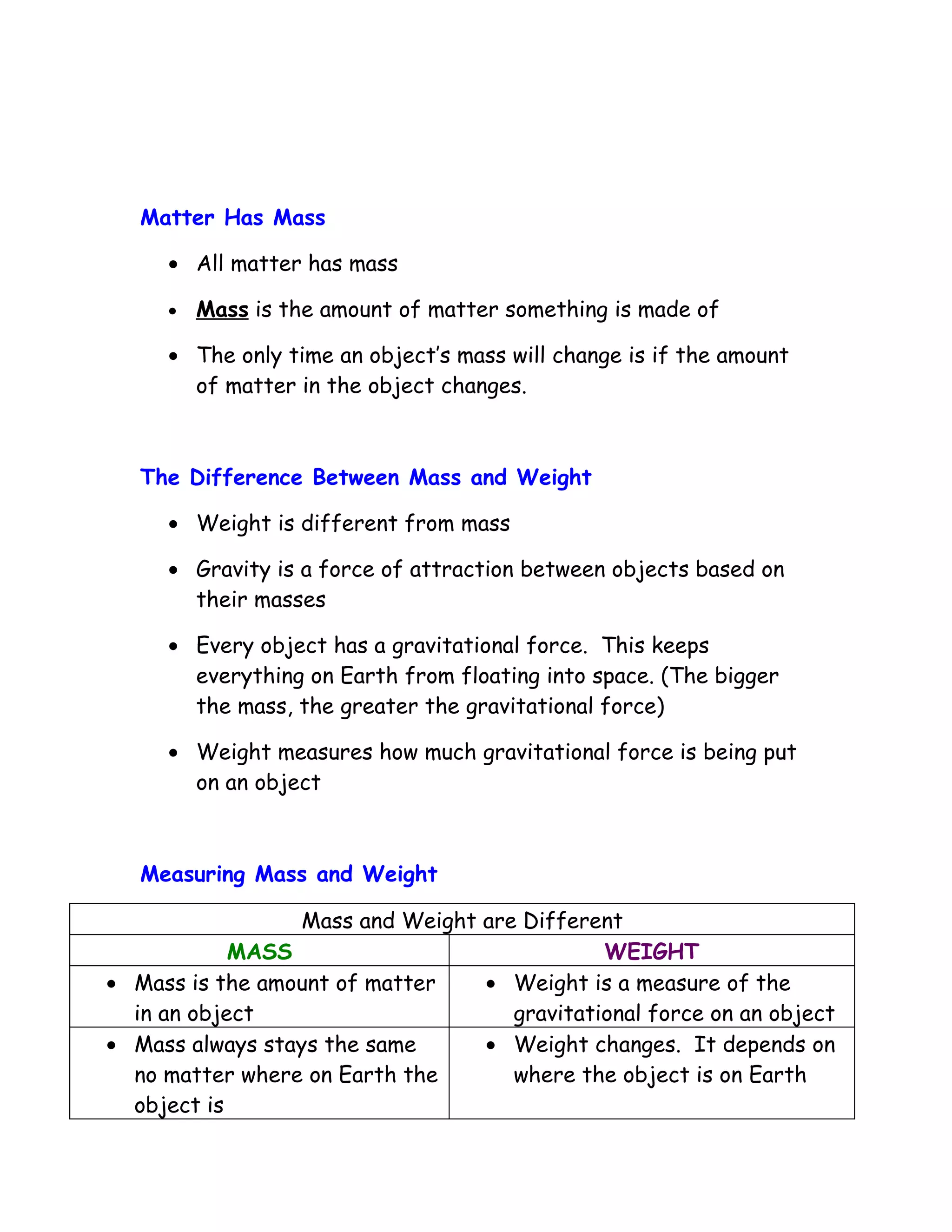
Matter Has Mass

     • All matter has mass

     •   Mass is the amount of matter something is made of

     • The only time an object’s mass will change is if the amount
       of matter in the object changes.


   The Difference Between Mass and Weight

     • Weight is different from mass

     • Gravity is a force of attraction between objects based on
       their masses

     • Every object has a gravitational force. This keeps
       everything on Earth from floating into space. (The bigger
       the mass, the greater the gravitational force)

     • Weight measures how much gravitational force is being put
       on an object


   Measuring Mass and Weight

                 Mass and Weight are Different
            MASS                             WEIGHT
• Mass is the amount of matter   • Weight is a measure of the
  in an object                      gravitational force on an object
• Mass always stays the same     • Weight changes. It depends on
  no matter where on Earth the      where the object is on Earth
  object is
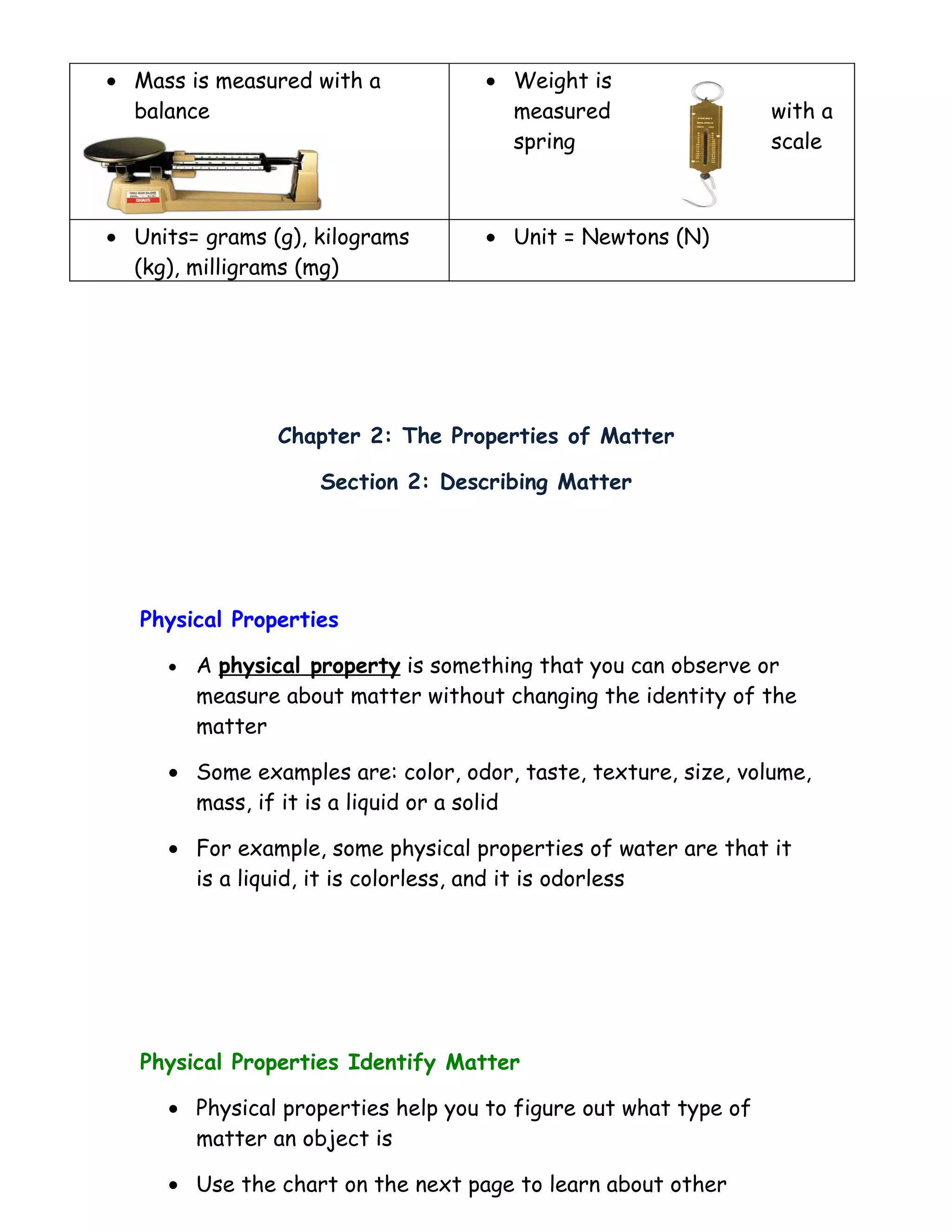
• Mass is measured with a           • Weight is
  balance                             measured                   with a
                                      spring                     scale


• Units= grams (g), kilograms       • Unit = Newtons (N)
  (kg), milligrams (mg)


                Chapter 2: The Properties of Matter

                    Section 2: Describing Matter


   Physical Properties

     •   A physical property is something that you can observe or
         measure about matter without changing the identity of the
         matter

     • Some examples are: color, odor, taste, texture, size, volume,
       mass, if it is a liquid or a solid

     • For example, some physical properties of water are that it
       is a liquid, it is colorless, and it is odorless


   Physical Properties Identify Matter

     • Physical properties help you to figure out what type of
       matter an object is

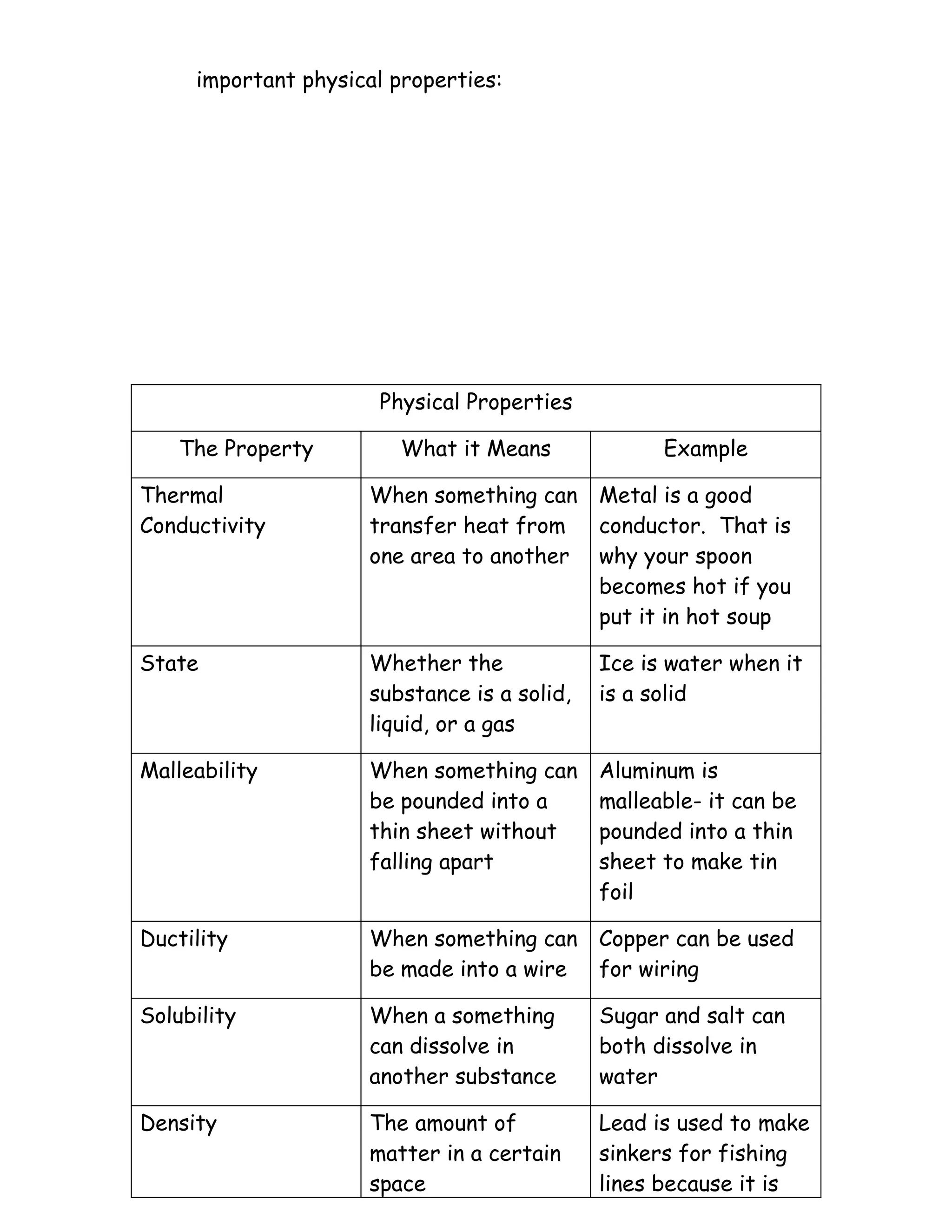
     • Use the chart on the next page to learn about other
important physical properties:


                      Physical Properties

    The Property         What it Means             Example

Thermal              When something can Metal is a good
Conductivity         transfer heat from  conductor. That is
                     one area to another why your spoon
                                         becomes hot if you
                                         put it in hot soup

State                Whether the             Ice is water when it
                     substance is a solid,   is a solid
                     liquid, or a gas

Malleability         When something can      Aluminum is
                     be pounded into a       malleable- it can be
                     thin sheet without      pounded into a thin
                     falling apart           sheet to make tin
                                             foil

Ductility            When something can Copper can be used
                     be made into a wire for wiring

Solubility           When a something        Sugar and salt can
                     can dissolve in         both dissolve in
                     another substance       water

Density              The amount of           Lead is used to make
                     matter in a certain     sinkers for fishing
                     space                   lines because it is
more dense than
                                            water and will sink


Spotlight on Density

  • You find density by dividing mass by volume.

  Density = mass/volume

  •   The units used for density are g/cm3, g/mL


Using Density to Identify Substances

  • Density is useful for identifying substance.

  • It is the reason why a golf ball feels heavier than a table-
    tennis ball even through they are the same size. A golf ball
    feels heavier because it is more dense (it has more mass in
    the same amount of space than a table-tennis ball)

  • The density of an object does not change

  • The density of one substance is usually different than the
    density of another substance (every substance has its own
    density)


Liquid Layers and The Density Challenge

  • Look at the picture on page 46 of your textbook (Figure 12).
    The jar is filled with 4 different liquids with different
    densities.

The green substance is the most dense because it all sinks to the
bottom. The yellow substance is the least dense because it floats
to the top. It does not matter how much of each of these liquids
you have, the green substance will always sink to the bottom and
the yellow will always float to the top because of their densities.


Chemical Properties

  •   Chemical Properties describe a substance based on its
      ability to change into a new substance with different
      properties. (Example: wood burning and turning into ash and
      smoke)

  • Some common chemical properties are:

        o Flammability (the ability for an object to catch fire)

        o Reactivity with oxygen, acid, or water


      Observing Chemical Properties

  • Chemical properties aren’t as easy to observe as physical
    properties


      Some Chemical Properties of Car Maintenance

  • Most cars are made of steel. Steel is made from iron. A
    chemical property of iron is that it reacts with oxygen, so
    when iron and oxygen come into contact, the iron rusts.


Physical Vs. Chemical Properties

  • Characteristic properties are the properties that are the
most useful in identifying a substance. (Physical and
      chemical properties)

  • Examples are density, reactivity with acids, and solubility
    (able to dissolve)

  • Characteristic properties of a substance do not change


Physical Changes Don’t Form New Substances

  •   A physical change is a change that affects physical
      properties of a substance.

  • For example- if you break a piece of chalk into two pieces,
    you change the physical properties of size and shape. But
    no matter how many times you break it, chalk is still chalk.


  Examples of Physical Changes

      • Melting and dissolving are both examples of physical
        changes.

      • Freezing water

      • Sanding a piece of wood

      • Cutting your hair

      • Bending a paper clip

      • Crushing an aluminum can


Can Physical Change Be Undone?

  • Physical changes do not change the identity of substances.
    During physical changes, the substance does not turn into a
    new substance

  • Physical changes are easy to undo
Chemical Changes Form New Substances

  • A chemical change happens when substances are changed
    into new substances with different properties

  • Example- When you bake a cake, you combine eggs, flour,
    sugar, and butter. Each ingredient has its own set of
    properties. When you mix the ingredients and bake them,
    you get something completely different, a cake, with
    different properties than any of the ingredients.


  Clues to Chemical Change

    • Chemical changes usually cause substances to change
      color, fizz, foam, bubble, heat, or produce sound, light, or
      an odor.


Can Chemical Changes Be Undone?

    • Since new substances are formed during a chemical
      change, it is not easy to be undone

    • Example- You cannot unbake a cake
Phys sci ch 2 sec 1 & 2mod reading

Phys sci ch 2 sec 1 & 2mod reading

  • 1.
    Chapter 2: TheProperties of Matter Section 1: What is Matter Everything Is Made of Matter • Matter is anything that has volume and mass • Everything is made of matter Matter Has Volume • All matter takes up space • Volume is how much space an object takes up • Two objects cannot take up the same space at the same time Volume of a Liquid o Liquids have volume too. We use a graduated cylinder to measure the volume of a liquid. o Liters and milliliters are the units (label) for volume of a liquid Volume of a Solid o To measure volume you need to multiply length x width x height o cm or m are the units (label) used for volume of 3 3 solids o 1 ml = 1 cm 3 Volume of a Gas o Gas also has volume
  • 2.
    Matter Has Mass • All matter has mass • Mass is the amount of matter something is made of • The only time an object’s mass will change is if the amount of matter in the object changes. The Difference Between Mass and Weight • Weight is different from mass • Gravity is a force of attraction between objects based on their masses • Every object has a gravitational force. This keeps everything on Earth from floating into space. (The bigger the mass, the greater the gravitational force) • Weight measures how much gravitational force is being put on an object Measuring Mass and Weight Mass and Weight are Different MASS WEIGHT • Mass is the amount of matter • Weight is a measure of the in an object gravitational force on an object • Mass always stays the same • Weight changes. It depends on no matter where on Earth the where the object is on Earth object is
  • 3.
    • Mass ismeasured with a • Weight is balance measured with a spring scale • Units= grams (g), kilograms • Unit = Newtons (N) (kg), milligrams (mg) Chapter 2: The Properties of Matter Section 2: Describing Matter Physical Properties • A physical property is something that you can observe or measure about matter without changing the identity of the matter • Some examples are: color, odor, taste, texture, size, volume, mass, if it is a liquid or a solid • For example, some physical properties of water are that it is a liquid, it is colorless, and it is odorless Physical Properties Identify Matter • Physical properties help you to figure out what type of matter an object is • Use the chart on the next page to learn about other
  • 4.
    important physical properties: Physical Properties The Property What it Means Example Thermal When something can Metal is a good Conductivity transfer heat from conductor. That is one area to another why your spoon becomes hot if you put it in hot soup State Whether the Ice is water when it substance is a solid, is a solid liquid, or a gas Malleability When something can Aluminum is be pounded into a malleable- it can be thin sheet without pounded into a thin falling apart sheet to make tin foil Ductility When something can Copper can be used be made into a wire for wiring Solubility When a something Sugar and salt can can dissolve in both dissolve in another substance water Density The amount of Lead is used to make matter in a certain sinkers for fishing space lines because it is
  • 5.
    more dense than water and will sink Spotlight on Density • You find density by dividing mass by volume. Density = mass/volume • The units used for density are g/cm3, g/mL Using Density to Identify Substances • Density is useful for identifying substance. • It is the reason why a golf ball feels heavier than a table- tennis ball even through they are the same size. A golf ball feels heavier because it is more dense (it has more mass in the same amount of space than a table-tennis ball) • The density of an object does not change • The density of one substance is usually different than the density of another substance (every substance has its own density) Liquid Layers and The Density Challenge • Look at the picture on page 46 of your textbook (Figure 12). The jar is filled with 4 different liquids with different densities. The green substance is the most dense because it all sinks to the bottom. The yellow substance is the least dense because it floats
  • 6.
    to the top.It does not matter how much of each of these liquids you have, the green substance will always sink to the bottom and the yellow will always float to the top because of their densities. Chemical Properties • Chemical Properties describe a substance based on its ability to change into a new substance with different properties. (Example: wood burning and turning into ash and smoke) • Some common chemical properties are: o Flammability (the ability for an object to catch fire) o Reactivity with oxygen, acid, or water Observing Chemical Properties • Chemical properties aren’t as easy to observe as physical properties Some Chemical Properties of Car Maintenance • Most cars are made of steel. Steel is made from iron. A chemical property of iron is that it reacts with oxygen, so when iron and oxygen come into contact, the iron rusts. Physical Vs. Chemical Properties • Characteristic properties are the properties that are the
  • 7.
    most useful inidentifying a substance. (Physical and chemical properties) • Examples are density, reactivity with acids, and solubility (able to dissolve) • Characteristic properties of a substance do not change Physical Changes Don’t Form New Substances • A physical change is a change that affects physical properties of a substance. • For example- if you break a piece of chalk into two pieces, you change the physical properties of size and shape. But no matter how many times you break it, chalk is still chalk. Examples of Physical Changes • Melting and dissolving are both examples of physical changes. • Freezing water • Sanding a piece of wood • Cutting your hair • Bending a paper clip • Crushing an aluminum can Can Physical Change Be Undone? • Physical changes do not change the identity of substances. During physical changes, the substance does not turn into a new substance • Physical changes are easy to undo
  • 8.
    Chemical Changes FormNew Substances • A chemical change happens when substances are changed into new substances with different properties • Example- When you bake a cake, you combine eggs, flour, sugar, and butter. Each ingredient has its own set of properties. When you mix the ingredients and bake them, you get something completely different, a cake, with different properties than any of the ingredients. Clues to Chemical Change • Chemical changes usually cause substances to change color, fizz, foam, bubble, heat, or produce sound, light, or an odor. Can Chemical Changes Be Undone? • Since new substances are formed during a chemical change, it is not easy to be undone • Example- You cannot unbake a cake