BY BHAGYANARAYAN YADAV (Z-BY)
NAME FACULTY
NEMATHELMINTHES OR
ASCHELMINTHES
Nematos-thread,helmins-worms , Comprises Roundworms.
Body :made up of fixed number of somatic cells is known as EUTELY.
Body unsegmented,Triploblastic and unsymmetrical.
Grade of organization: organ –system.
Body plan:Tube within tube.
1st –unisexual phylum.
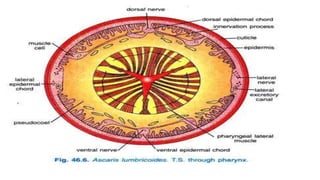
Body wall consist
1.cuticle-thick for parasitic adaptation.sometimes secrete antienzymes.
2.Epidermis-Syncytical,energy storage in the form of glycogen and fat.
Cuticle is composed of scleroprotein secreted by Epidermis.
Cuticle is formed by Epidermis.
3.muscle –only longitudinal muscle present.circular and oblique muscle
absent.
1.DIGESTIVE SYSTEM-
well developed,from mouth to anus.
2.RESPIRATORY SYSTEM-
Aerobic in free living ,anaerobic in parasitic form.
EXCRETORY SYSTEM-
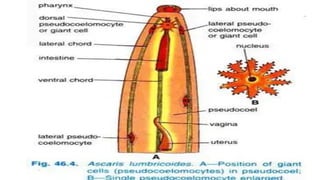
Also called protonephridia having Rennete
cell or Giant cell.
Excretory product-more urea,less ammonia,
fatty acid and CO2.
CO2 is discharged through General body
surface.
CIRCULATORTY SYSTEM-
Circulatory system is absent and takes place through general body surface.
Circulatory system compensated by Pseudocoelomic fluid.
Function of pseudocoelomic fluid-
1.food transport.
2.Maintain shape of body.
3.Serve as Hydrostatic skelton.(Movement)
Pseudocoelomatocyte –helps in immune respose.i.e.immune response.
REPRODUCTEVE SYSTEM-
1st unisexual phylum.
Fertilization-Cross and internal.
Endoparasite :well developed and complex.
Development:indirect.
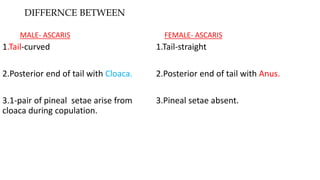
DIFFERNCE BETWEEN
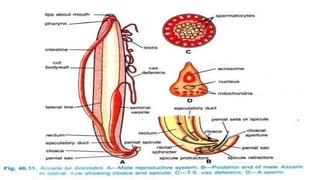
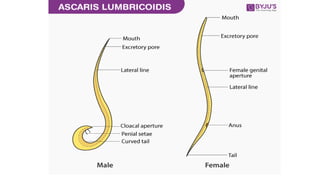
MALE- ASCARIS
1.Tail-curved
2.Posterior end of tail with Cloaca.
3.1-pair of pineal setae arise from
cloaca during copulation.
FEMALE- ASCARIS
1.Tail-straight
2.Posterior end of tail with Anus.
3.Pineal setae absent.
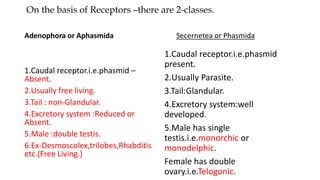
On the basis of Receptors –there are 2-classes.
1.Caudal receptor.i.e.phasmid –
Absent.
2.Usually free living.
3.Tail : non-Glandular.
4.Excretory system :Reduced or
Absent.
5.Male :double testis.
6.Ex-Desmoscolex,trilobes,Rhabditis
etc.(Free Living.)
Secernetea or Phasmida
1.Caudal receptor.i.e.phasmid
present.
2.Usually Parasite.
3.Tail:Glandular.
4.Excretory system:well
developed.
5.Male has single
testis.i.e.monorchic or
monodelphic.
Female has double
ovary.i.e.Telogonic.
Adenophora or Aphasmida
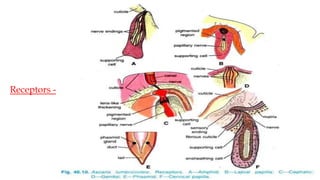
Receptors -
Mouth is triradiate and bounded by Lips (Labia).
1.Mid dorsal lip has –
@ DSP-double sensory papillae.(1).
2.Ventrolateral lips has-
@ SSP-single sensory papilla (2) called Amphids.
3.Phasmids-present in tail region also called Caudal receptors.
In male phasmid present near Cloaca,but in female phasmid present near
Anus.
Tangoreceptors- function
1.Touch (mainly)
2.pressure
Q.Double sensory papillae is
a.Tangoreceptors
Thigmoreceptors
ANS-B
Chemoreceptors-function
1.Guastatoreceptors
2.Olfactoreceptors (Mainly).
NOTE-
Amphid-Smell and non –glandular.
Phasmid-Glandular.
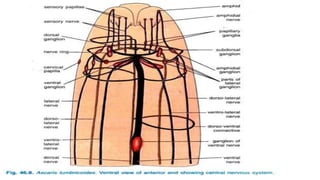
Nervous system-
Nervous system is located in the body wall.
It is Made up of circumpharyngeal ring or nerve ring .
Sense organ –
1.Labial papillae
2.Anal papillae
3.Amphid
4.Phasmid
Life cycle of Ascaries-
1.monogenetic parasites.
2.Largest parasitie is Ascaris while Longest is Dracunculus
medinensis.(Guinea worm).
3.
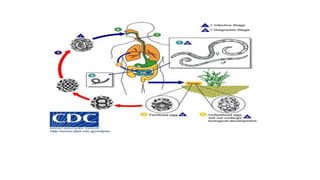
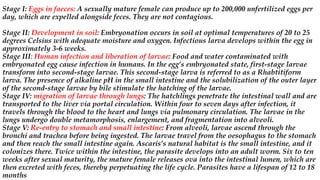
Stage I: Eggs in faeces: A sexually mature female can produce up to 200,000 unfertilized eggs per
day, which are expelled alongside feces. They are not contagious.
Stage II: Development in soil: Embryonation occurs in soil at optimal temperatures of 20 to 25
degrees Celsius with adequate moisture and oxygen. Infectious larva develops within the egg in
approximately 3-6 weeks.
Stage III: Human infection and liberation of larvae: Food and water contaminated with
embryonated egg cause infection in humans. In the egg’s embryonated state, first-stage larvae
transform into second-stage larvae. This second-stage larva is referred to as a Rhabtitiform
larva. The presence of alkaline pH in the small intestine and the solubilization of the outer layer
of the second-stage larvae by bile stimulate the hatching of the larvae.
Stage IV: migration of larvae through lungs: The hatchlings penetrate the intestinal wall and are
transported to the liver via portal circulation. Within four to seven days after infection, it
travels through the blood to the heart and lungs via pulmonary circulation. The larvae in the
lungs undergo double metamorphosis, enlargement, and fragmentation into alveoli.
Stage V: Re-entry to stomach and small intestine: From alveoli, larvae ascend through the
bronchi and trachea before being ingested. The larvae travel from the oesophagus to the stomach
and then reach the small intestine again. Ascaris’s natural habitat is the small intestine, and it
colonizes there. Twice within the intestine, the parasite develops into an adult worm. Six to ten
weeks after sexual maturity, the mature female releases ova into the intestinal lumen, which are
then excreted with feces, thereby perpetuating the life cycle. Parasites have a lifespan of 12 to 18
months
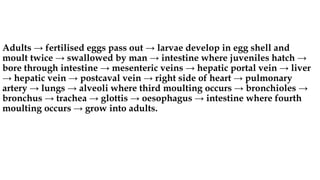
Adults → fertilised eggs pass out → larvae develop in egg shell and
moult twice → swallowed by man → intestine where juveniles hatch →
bore through intestine → mesenteric veins → hepatic portal vein → liver
→ hepatic vein → postcaval vein → right side of heart → pulmonary
artery → lungs → alveoli where third moulting occurs → bronchioles →
bronchus → trachea → glottis → oesophagus → intestine where fourth
moulting occurs → grow into adults.
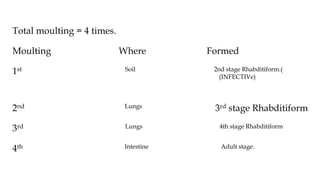
Total moulting = 4 times.
Moulting Where Formed
1st Soil 2nd stage Rhabditiform.(
(INFECTIVe)
2nd Lungs 3rd stage Rhabditiform
3rd Lungs 4th stage Rhabditiform
4th Intestine Adult stage.
Wandering journey-
refers to duration by rhabditiform larva to return back to the intestine after
it hatches in intestine .
It takes about 20 days.
The Route through which developmental stage of Ascaries serially pass in
man is –
intestine-Liver –Lungs-Trachea-Oesophagus-Intestine.(iom,CEE).
Disease-ASCARIASIS
Symptoms-
1.Abdominal pain
2.intestinal blockage
3.vomiting
Treatment-
drugs like-
1.Piperazine
2.oil of chenopodium
3.Alcopar
Antipar
Wucheria Bancrofti=(Filarial worm)
it causes Filaria or filariasis or Elephantiasis.
Adult lives in Lymph vessels and lymph gland or Lymphatic system of human.
Females are -ovoviviparous .
Digenetic parasite –
primary host-man
2ndary host-culex mosquito.
Larva-microfilaria (IOM)
infective stage -3rd stage microfilaria. (IOM)
Ancylostoma Duodenale (=Hookworm)
1.Old world hookworm.
2.Most dangerous Roundworm.
3.Monogenetic parasite.
4.Location-small intestine.
5.Sanguivorous.
6.Mode of transmission-by skin of feet and hands (CEE-2023).
7.Disease-Ancylostomiasis.
8.infective stage -3rd stage Filariform larva.
Note-
Name of parasite - Also called -
1.Wucheria bancrofti 1. Filarial worm
2.Ancylostoma duodenalem 2. Hookworm
3.Enterobius vermicularis 3.Pin or seat worm or Thread
worm
4.Trichenella spiralis 4.Trichinea worm
5.Trichuris trichuria 5.Whipworm
6.Loa- Loa 6.Eye worm
7.Dracunculus medinesis 7.Guinea worm
Dracunculus medinesis –Longest nematode.
Trichenella spiralis –smallest nematode.
Q.1.which of the following statement is true about alimentary canal of Roundworm?
a.only mouth
b.only Anus
c.both a and b
d.none of these.
ANS-C
2.Special modification of Ascaries to its parasitic mode of life is?
a.Straight and uncoiled alimentary canal.
b.Segmented body.
c.Resistant cuticle on the body surface.
d.Cylindrical body.
ANS-C
3.Filaria is a ?
a.protozoan
b.virus
c.Bacteria
d.Helminth
ANS-D
4.Amphid and phasmid gland are found in ?
a.Annelida
b.Nematode
c.Mollusca
d.porifera
ANS-B
5.The wandering Journey of Ascaris in days is ?
a.10
b.40
c.20
d.60
ANS-C
6.Filaria can be eradicated if the population of following is is exterminated?
a.Anopheles
b.Cules anopheles
c.Housefly
d.Aedes
ANS-B
7.Which of the following disease is caused by nematodes?
a.Leprosy
b.Malaria
c.Filariasis
d.Dum-dum fever
ANS-C
8.Which of the following parasite caused iron deficiency Anemia?
a.Pin worm
b.Roundworm
c.Tapeworm
d.Hookworm
ANS-D
9.The animals in which sex can be differentiated from external Morphology
is?
a.Taenia
b.karait
c.Ascaries
d.Amoeba
ANS-C
Q.10.The space b/n the body wall and the alimentary canal of ascaris is?
a.Haemocoel
b.pseudocoel
c.Enterocoel
d.schizocoel
ANS-B
11.Amphid present on ventrolateral Lips of ascaries is ?
a.phonoreceptor
b.Chemoreceptors
c.olfactoreceptors
d.Tangorecepors
ANS-B
12.Which system of Ascaris is H-shaped?
a.Reproductive system
b.Excretory system
c.Nervous system
d.Circulatory system
ANS B
NEMATYHELMINTHES PDF.pdf

NEMATYHELMINTHES PDF.pdf

  • 2.
    BY BHAGYANARAYAN YADAV(Z-BY) NAME FACULTY
  • 3.
  • 4.
    Nematos-thread,helmins-worms , ComprisesRoundworms. Body :made up of fixed number of somatic cells is known as EUTELY. Body unsegmented,Triploblastic and unsymmetrical. Grade of organization: organ –system. Body plan:Tube within tube. 1st –unisexual phylum.
  • 5.
    Body wall consist 1.cuticle-thickfor parasitic adaptation.sometimes secrete antienzymes. 2.Epidermis-Syncytical,energy storage in the form of glycogen and fat. Cuticle is composed of scleroprotein secreted by Epidermis. Cuticle is formed by Epidermis. 3.muscle –only longitudinal muscle present.circular and oblique muscle absent.
  • 6.
    1.DIGESTIVE SYSTEM- well developed,frommouth to anus. 2.RESPIRATORY SYSTEM- Aerobic in free living ,anaerobic in parasitic form.
  • 8.
    EXCRETORY SYSTEM- Also calledprotonephridia having Rennete cell or Giant cell. Excretory product-more urea,less ammonia, fatty acid and CO2. CO2 is discharged through General body surface.
  • 9.
    CIRCULATORTY SYSTEM- Circulatory systemis absent and takes place through general body surface. Circulatory system compensated by Pseudocoelomic fluid. Function of pseudocoelomic fluid- 1.food transport. 2.Maintain shape of body. 3.Serve as Hydrostatic skelton.(Movement) Pseudocoelomatocyte –helps in immune respose.i.e.immune response.
  • 11.
    REPRODUCTEVE SYSTEM- 1st unisexualphylum. Fertilization-Cross and internal. Endoparasite :well developed and complex. Development:indirect.
  • 14.
    DIFFERNCE BETWEEN MALE- ASCARIS 1.Tail-curved 2.Posteriorend of tail with Cloaca. 3.1-pair of pineal setae arise from cloaca during copulation. FEMALE- ASCARIS 1.Tail-straight 2.Posterior end of tail with Anus. 3.Pineal setae absent.
  • 15.
    On the basisof Receptors –there are 2-classes. 1.Caudal receptor.i.e.phasmid – Absent. 2.Usually free living. 3.Tail : non-Glandular. 4.Excretory system :Reduced or Absent. 5.Male :double testis. 6.Ex-Desmoscolex,trilobes,Rhabditis etc.(Free Living.) Secernetea or Phasmida 1.Caudal receptor.i.e.phasmid present. 2.Usually Parasite. 3.Tail:Glandular. 4.Excretory system:well developed. 5.Male has single testis.i.e.monorchic or monodelphic. Female has double ovary.i.e.Telogonic. Adenophora or Aphasmida
  • 16.
  • 17.
    Mouth is triradiateand bounded by Lips (Labia). 1.Mid dorsal lip has – @ DSP-double sensory papillae.(1). 2.Ventrolateral lips has- @ SSP-single sensory papilla (2) called Amphids. 3.Phasmids-present in tail region also called Caudal receptors. In male phasmid present near Cloaca,but in female phasmid present near Anus.
  • 18.
    Tangoreceptors- function 1.Touch (mainly) 2.pressure Q.Doublesensory papillae is a.Tangoreceptors Thigmoreceptors ANS-B
  • 19.
  • 20.
    Nervous system- Nervous systemis located in the body wall. It is Made up of circumpharyngeal ring or nerve ring . Sense organ – 1.Labial papillae 2.Anal papillae 3.Amphid 4.Phasmid
  • 22.
    Life cycle ofAscaries- 1.monogenetic parasites. 2.Largest parasitie is Ascaris while Longest is Dracunculus medinensis.(Guinea worm). 3.

  • 24.
    Stage I: Eggsin faeces: A sexually mature female can produce up to 200,000 unfertilized eggs per day, which are expelled alongside feces. They are not contagious. Stage II: Development in soil: Embryonation occurs in soil at optimal temperatures of 20 to 25 degrees Celsius with adequate moisture and oxygen. Infectious larva develops within the egg in approximately 3-6 weeks. Stage III: Human infection and liberation of larvae: Food and water contaminated with embryonated egg cause infection in humans. In the egg’s embryonated state, first-stage larvae transform into second-stage larvae. This second-stage larva is referred to as a Rhabtitiform larva. The presence of alkaline pH in the small intestine and the solubilization of the outer layer of the second-stage larvae by bile stimulate the hatching of the larvae. Stage IV: migration of larvae through lungs: The hatchlings penetrate the intestinal wall and are transported to the liver via portal circulation. Within four to seven days after infection, it travels through the blood to the heart and lungs via pulmonary circulation. The larvae in the lungs undergo double metamorphosis, enlargement, and fragmentation into alveoli. Stage V: Re-entry to stomach and small intestine: From alveoli, larvae ascend through the bronchi and trachea before being ingested. The larvae travel from the oesophagus to the stomach and then reach the small intestine again. Ascaris’s natural habitat is the small intestine, and it colonizes there. Twice within the intestine, the parasite develops into an adult worm. Six to ten weeks after sexual maturity, the mature female releases ova into the intestinal lumen, which are then excreted with feces, thereby perpetuating the life cycle. Parasites have a lifespan of 12 to 18 months
  • 25.
    Adults → fertilisedeggs pass out → larvae develop in egg shell and moult twice → swallowed by man → intestine where juveniles hatch → bore through intestine → mesenteric veins → hepatic portal vein → liver → hepatic vein → postcaval vein → right side of heart → pulmonary artery → lungs → alveoli where third moulting occurs → bronchioles → bronchus → trachea → glottis → oesophagus → intestine where fourth moulting occurs → grow into adults.
  • 26.
    Total moulting =4 times. Moulting Where Formed 1st Soil 2nd stage Rhabditiform.( (INFECTIVe) 2nd Lungs 3rd stage Rhabditiform 3rd Lungs 4th stage Rhabditiform 4th Intestine Adult stage.
  • 27.
    Wandering journey- refers toduration by rhabditiform larva to return back to the intestine after it hatches in intestine . It takes about 20 days. The Route through which developmental stage of Ascaries serially pass in man is – intestine-Liver –Lungs-Trachea-Oesophagus-Intestine.(iom,CEE).
  • 28.
  • 29.
    Wucheria Bancrofti=(Filarial worm) itcauses Filaria or filariasis or Elephantiasis. Adult lives in Lymph vessels and lymph gland or Lymphatic system of human. Females are -ovoviviparous . Digenetic parasite – primary host-man 2ndary host-culex mosquito. Larva-microfilaria (IOM) infective stage -3rd stage microfilaria. (IOM)
  • 30.
    Ancylostoma Duodenale (=Hookworm) 1.Oldworld hookworm. 2.Most dangerous Roundworm. 3.Monogenetic parasite. 4.Location-small intestine. 5.Sanguivorous. 6.Mode of transmission-by skin of feet and hands (CEE-2023). 7.Disease-Ancylostomiasis. 8.infective stage -3rd stage Filariform larva.
  • 31.
    Note- Name of parasite- Also called - 1.Wucheria bancrofti 1. Filarial worm 2.Ancylostoma duodenalem 2. Hookworm 3.Enterobius vermicularis 3.Pin or seat worm or Thread worm 4.Trichenella spiralis 4.Trichinea worm 5.Trichuris trichuria 5.Whipworm 6.Loa- Loa 6.Eye worm 7.Dracunculus medinesis 7.Guinea worm Dracunculus medinesis –Longest nematode. Trichenella spiralis –smallest nematode.
  • 32.
    Q.1.which of thefollowing statement is true about alimentary canal of Roundworm? a.only mouth b.only Anus c.both a and b d.none of these. ANS-C 2.Special modification of Ascaries to its parasitic mode of life is? a.Straight and uncoiled alimentary canal. b.Segmented body. c.Resistant cuticle on the body surface. d.Cylindrical body. ANS-C
  • 33.
    3.Filaria is a? a.protozoan b.virus c.Bacteria d.Helminth ANS-D 4.Amphid and phasmid gland are found in ? a.Annelida b.Nematode c.Mollusca d.porifera ANS-B
  • 34.
    5.The wandering Journeyof Ascaris in days is ? a.10 b.40 c.20 d.60 ANS-C 6.Filaria can be eradicated if the population of following is is exterminated? a.Anopheles b.Cules anopheles c.Housefly d.Aedes ANS-B
  • 35.
    7.Which of thefollowing disease is caused by nematodes? a.Leprosy b.Malaria c.Filariasis d.Dum-dum fever ANS-C 8.Which of the following parasite caused iron deficiency Anemia? a.Pin worm b.Roundworm c.Tapeworm d.Hookworm ANS-D
  • 36.
    9.The animals inwhich sex can be differentiated from external Morphology is? a.Taenia b.karait c.Ascaries d.Amoeba ANS-C Q.10.The space b/n the body wall and the alimentary canal of ascaris is? a.Haemocoel b.pseudocoel c.Enterocoel d.schizocoel ANS-B
  • 37.
    11.Amphid present onventrolateral Lips of ascaries is ? a.phonoreceptor b.Chemoreceptors c.olfactoreceptors d.Tangorecepors ANS-B 12.Which system of Ascaris is H-shaped? a.Reproductive system b.Excretory system c.Nervous system d.Circulatory system ANS B