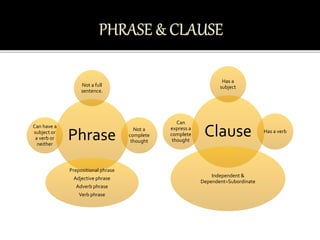

Phrase
Not a full
sentence.
Not a
complete
thought
Prepositional phrase
Adjective phrase
Adverb phrase
Verb phrase
Can have a
subject or
a verb or
neither
Clause
Has a
subject
Has a verb
Independent &
Dependent=Subordinate
Can
express a
complete
thought
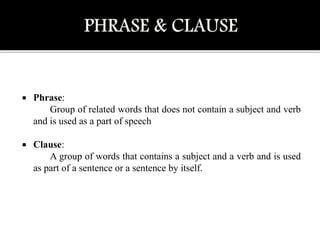
 Phrase:
Group of related words that does not contain a subject and verb
and is used as a part of speech
 Clause:
A group of words that contains a subject and a verb and is used
as part of a sentence or a sentence by itself.
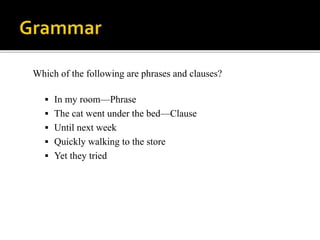
Which of the following are phrases and clauses?
 In my room—Phrase
 The cat went under the bed—Clause
 Until next week
 Quickly walking to the store
 Yet they tried
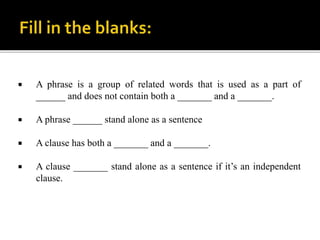
 A phrase is a group of related words that is used as a part of
______ and does not contain both a _______ and a _______.
 A phrase ______ stand alone as a sentence
 A clause has both a _______ and a _______.
 A clause _______ stand alone as a sentence if it’s an independent
clause.
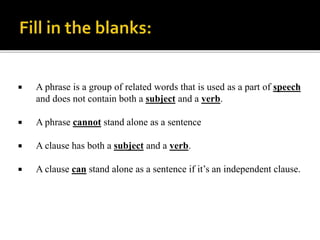
 A phrase is a group of related words that is used as a part of speech
and does not contain both a subject and a verb.
 A phrase cannot stand alone as a sentence
 A clause has both a subject and a verb.
 A clause can stand alone as a sentence if it’s an independent clause.
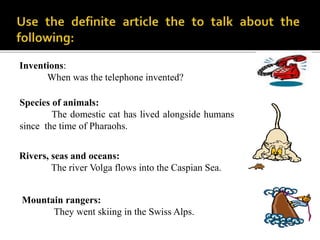
Inventions:
When was the telephone invented?
Mountain rangers:
They went skiing in the Swiss Alps.
Rivers, seas and oceans:
The river Volga flows into the Caspian Sea.
Species of animals:
The domestic cat has lived alongside humans
since the time of Pharaohs.
Island groups:
The Seychelles are a group of islands in the
Indian Ocean.
Deserts:
The sand on this beach was imported from the
Sahara.
Hotels:
The Grand Hotel is in Baker Street.
Cinemas, Theatre:
We are going to the Odeon this evening.
Newspapers:
Which newspaper shall I buy – the Independent
or the Herald?
National groups:
The Welsh are famous for their singing.
Museums, Art galleries:
You should go to the Science Museum. It’s very
interesting.
Organizations:
He used to work for the BBC
With superlatives:
He is the tallest boy in our class.
When there is only one of something:
The earth goes round the sun.
To talk about particular nouns when it is clear what we are referring to:
Where is the dog? I want to take him for a walk.
To talk about previously mentioned things:
There is a cat in the yard. The cat is black.
With names of shops:
• I'll get the card at Smith's.
• Can you go to Boots for me?
With uncountable nouns:
• Rice is the main food in Asia.
• Milk is often added to tea in England.
War is destructive. With years:
• 1948 was a wonderful year.
• Do you remember 1995?
With the names of individual mountains, lakes and islands:
• Mount McKinley is the highest mountain in Alaska.
• She lives near Lake Windermere.
• Have you visited Long Island?
There is no article:
With most names of towns,
streets, stations and airports:
• Victoria Station is in the centre
of London.
• Can you direct me to Bond
Street?
• She lives in Florence.
• They're flying from Heathrow.
There is no article:
In some fixed expressions, for
example:
• by car
• by train
• by air
• on foot
• on holiday
• on air (in broadcasting)
• at school
• at work
• at University
• in church
• in prison
• in bed
 The use of a and an indicates that the noun modified is indefinite (no
particular member of a group). They are used when the noun modified
is singular and general.
 A and an are used when the noun can be counted
ex.: a vehicle, an apple
 Place the word ‘a’ in front of any noun referring to one thing within a
type but not constrained to one token thing. In other words, use ‘a’ for
any one dog but not necessarily that dog.
ex.: A cat jumped onto my lap.
 If an amount is referred to (any or one) the ‘a’ is no longer required.
ex.: Any box will do.
 A precedes singular nouns that begin with a consonant
ex.: a student
Exception #1: When a singular noun begins with a vowel that sounds like
a consonant, a is used (a uniform; u in uniform sounds like yoo).
Exception #2: An before an h mute - an hour, an honor.
 An precedes singular nouns that begin with a vowel
ex.: an address
 When the article and the noun are separated by an adjective, the article
that agrees with the initial sound of the adjective is used (ex.: an English
student; a wrong address).
 Neither a/an or the should be used when referring to proper names
unless it is part of the name.
ex.: George went to Cedar Point.
ex.: Kelly’s favorite book is The Lion, the Witch, and the
Wardrobe.
 When a pronoun replaces the noun in a sentence, the a/an or the is
no longer needed.
ex.: The cat came running, or it came running.
 To refer to something for the first time.
ex.: An elephant and a mouse fell in love.
 To refer to a particular member of a group or class: such as the names of
jobs, nationalities, religions, musical instruments and days of the week.
ex.: John is a doctor, John is an Englishman, I was born on a
Thursday
 To refer to a “kind of,” or “example of” something.
ex.: The mouse had a tiny nose, The elephant had a long trunk, It was a
very strange car
 With singular nouns, after the words 'what' and 'such‘.
ex.: What a shame!, She's such a beautiful girl
 Meaning 'one', referring to a single object or person.
ex.: I'd like an orange and two lemons please, The burglar took a
diamond necklace and a valuable painting
Use a, an or the in each sentence.
 Ismail spoke to _______ woman who had waved to him (a / the)
 My mother bought me _____ expensive watch (a / an)
 Cheryl borrowed _____ book from the library.(a / an)
 Ali wore _____ new uniform to school. (a / an)
 Did you see _____ new car which my father bought? (the/a)
 Kiran is ____ Indian girl. (a / an)
 Singapore lies quite near to ____ equator. (the / an)
 Suman has travelled across _____ Atlantic Ocean. (an /the)
 Ismail spoke to the woman who had waved to him (a / the)
 My mother bought me an expensive watch (a / an)
 Cheryl borrowed a book from the library.(a / an)
 Ali wore a new uniform to school. (a / an)
 Did you see a new car which my father bought? (the/a)
 Kiran is an Indian girl. (a / an)
 Singapore lies quite near to the equator. (the / an)
 Suman has travelled across the Atlantic Ocean. (an /the)

Phrase, clause & articles

  • 2.
    Phrase Not a full sentence. Nota complete thought Prepositional phrase Adjective phrase Adverb phrase Verb phrase Can have a subject or a verb or neither Clause Has a subject Has a verb Independent & Dependent=Subordinate Can express a complete thought
  • 3.
     Phrase: Group ofrelated words that does not contain a subject and verb and is used as a part of speech  Clause: A group of words that contains a subject and a verb and is used as part of a sentence or a sentence by itself.
  • 4.
    Which of thefollowing are phrases and clauses?  In my room—Phrase  The cat went under the bed—Clause  Until next week  Quickly walking to the store  Yet they tried
  • 5.
     A phraseis a group of related words that is used as a part of ______ and does not contain both a _______ and a _______.  A phrase ______ stand alone as a sentence  A clause has both a _______ and a _______.  A clause _______ stand alone as a sentence if it’s an independent clause.
  • 6.
     A phraseis a group of related words that is used as a part of speech and does not contain both a subject and a verb.  A phrase cannot stand alone as a sentence  A clause has both a subject and a verb.  A clause can stand alone as a sentence if it’s an independent clause.
  • 9.
    Inventions: When was thetelephone invented? Mountain rangers: They went skiing in the Swiss Alps. Rivers, seas and oceans: The river Volga flows into the Caspian Sea. Species of animals: The domestic cat has lived alongside humans since the time of Pharaohs.
  • 10.
    Island groups: The Seychellesare a group of islands in the Indian Ocean. Deserts: The sand on this beach was imported from the Sahara. Hotels: The Grand Hotel is in Baker Street. Cinemas, Theatre: We are going to the Odeon this evening.
  • 11.
    Newspapers: Which newspaper shallI buy – the Independent or the Herald? National groups: The Welsh are famous for their singing. Museums, Art galleries: You should go to the Science Museum. It’s very interesting. Organizations: He used to work for the BBC
  • 12.
    With superlatives: He isthe tallest boy in our class. When there is only one of something: The earth goes round the sun. To talk about particular nouns when it is clear what we are referring to: Where is the dog? I want to take him for a walk. To talk about previously mentioned things: There is a cat in the yard. The cat is black.
  • 13.
    With names ofshops: • I'll get the card at Smith's. • Can you go to Boots for me? With uncountable nouns: • Rice is the main food in Asia. • Milk is often added to tea in England. War is destructive. With years: • 1948 was a wonderful year. • Do you remember 1995? With the names of individual mountains, lakes and islands: • Mount McKinley is the highest mountain in Alaska. • She lives near Lake Windermere. • Have you visited Long Island? There is no article:
  • 14.
    With most namesof towns, streets, stations and airports: • Victoria Station is in the centre of London. • Can you direct me to Bond Street? • She lives in Florence. • They're flying from Heathrow. There is no article: In some fixed expressions, for example: • by car • by train • by air • on foot • on holiday • on air (in broadcasting) • at school • at work • at University • in church • in prison • in bed
  • 15.
     The useof a and an indicates that the noun modified is indefinite (no particular member of a group). They are used when the noun modified is singular and general.  A and an are used when the noun can be counted ex.: a vehicle, an apple  Place the word ‘a’ in front of any noun referring to one thing within a type but not constrained to one token thing. In other words, use ‘a’ for any one dog but not necessarily that dog. ex.: A cat jumped onto my lap.  If an amount is referred to (any or one) the ‘a’ is no longer required. ex.: Any box will do.
  • 16.
     A precedessingular nouns that begin with a consonant ex.: a student Exception #1: When a singular noun begins with a vowel that sounds like a consonant, a is used (a uniform; u in uniform sounds like yoo). Exception #2: An before an h mute - an hour, an honor.  An precedes singular nouns that begin with a vowel ex.: an address  When the article and the noun are separated by an adjective, the article that agrees with the initial sound of the adjective is used (ex.: an English student; a wrong address).
  • 17.
     Neither a/anor the should be used when referring to proper names unless it is part of the name. ex.: George went to Cedar Point. ex.: Kelly’s favorite book is The Lion, the Witch, and the Wardrobe.  When a pronoun replaces the noun in a sentence, the a/an or the is no longer needed. ex.: The cat came running, or it came running.  To refer to something for the first time. ex.: An elephant and a mouse fell in love.
  • 18.
     To referto a particular member of a group or class: such as the names of jobs, nationalities, religions, musical instruments and days of the week. ex.: John is a doctor, John is an Englishman, I was born on a Thursday  To refer to a “kind of,” or “example of” something. ex.: The mouse had a tiny nose, The elephant had a long trunk, It was a very strange car  With singular nouns, after the words 'what' and 'such‘. ex.: What a shame!, She's such a beautiful girl
  • 19.
     Meaning 'one',referring to a single object or person. ex.: I'd like an orange and two lemons please, The burglar took a diamond necklace and a valuable painting
  • 20.
    Use a, anor the in each sentence.  Ismail spoke to _______ woman who had waved to him (a / the)  My mother bought me _____ expensive watch (a / an)  Cheryl borrowed _____ book from the library.(a / an)  Ali wore _____ new uniform to school. (a / an)  Did you see _____ new car which my father bought? (the/a)  Kiran is ____ Indian girl. (a / an)  Singapore lies quite near to ____ equator. (the / an)  Suman has travelled across _____ Atlantic Ocean. (an /the)
  • 21.
     Ismail spoketo the woman who had waved to him (a / the)  My mother bought me an expensive watch (a / an)  Cheryl borrowed a book from the library.(a / an)  Ali wore a new uniform to school. (a / an)  Did you see a new car which my father bought? (the/a)  Kiran is an Indian girl. (a / an)  Singapore lies quite near to the equator. (the / an)  Suman has travelled across the Atlantic Ocean. (an /the)