Conjunctive Adverbs
Kristi Reyes
MiraCosta College
Noncredit ESL Program
Review: Conjunctions
• Do you remember?
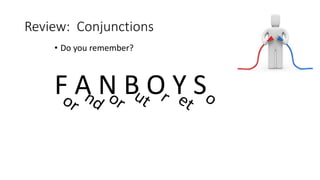
F A N B O Y S
Conjunctions
• Can join two or more …
• Words: soup or salad
• Phrases: go to school, go to work, and go to bed
• Sentences: I want to get a better job, so I am learning
English.
Conjunctive Adverbs
•Similar to conjunctions, but …
•Typically join only sentences
•Have different punctuation options
•More academic, formal
What are the conjunctive adverbs?
• There are many; here are a few and what they
mean (on handout):
• Furthermore
• Moreoverand
• However
• Nevertheless
• Nonetheless
but/ yet
• Therefore
• Consequently
• Hence
• Thus
so
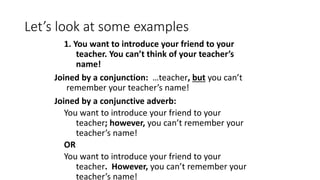
Let’s look at some examples
1. You want to introduce your friend to your
teacher. You can’t think of your teacher’s
name!
Joined by a conjunction: …teacher, but you can’t
remember your teacher’s name!
Joined by a conjunctive adverb:
You want to introduce your friend to your
teacher; however, you can’t remember your
teacher’s name!
OR
You want to introduce your friend to your
teacher. However, you can’t remember your
teacher’s name!
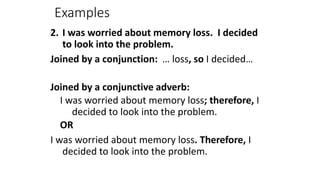
Examples
2. I was worried about memory loss. I decided
to look into the problem.
Joined by a conjunction: … loss, so I decided…
Joined by a conjunctive adverb:
I was worried about memory loss; therefore, I
decided to look into the problem.
OR
I was worried about memory loss. Therefore, I
decided to look into the problem.
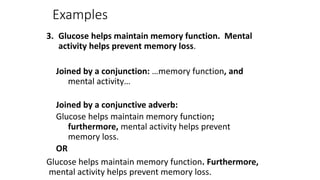
Examples
3. Glucose helps maintain memory function. Mental
activity helps prevent memory loss.
Joined by a conjunction: …memory function, and
mental activity…
Joined by a conjunctive adverb:
Glucose helps maintain memory function;
furthermore, mental activity helps prevent
memory loss.
OR
Glucose helps maintain memory function. Furthermore,
mental activity helps prevent memory loss.
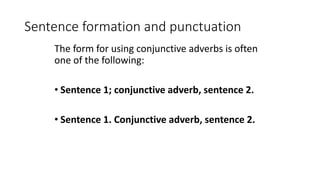
Sentence formation and punctuation
The form for using conjunctive adverbs is often
one of the following:
• Sentence 1; conjunctive adverb, sentence 2.
• Sentence 1. Conjunctive adverb, sentence 2.
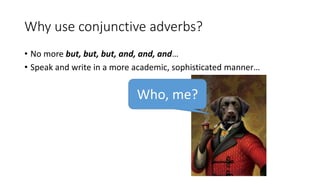
Why use conjunctive adverbs?
• No more but, but, but, and, and, and…
• Speak and write in a more academic, sophisticated manner…
Who, me?
Any questions?
• Let’s practice …

Conjunctive Adverbs

  • 1.
    Conjunctive Adverbs Kristi Reyes MiraCostaCollege Noncredit ESL Program
  • 2.
    Review: Conjunctions • Doyou remember? F A N B O Y S
  • 3.
    Conjunctions • Can jointwo or more … • Words: soup or salad • Phrases: go to school, go to work, and go to bed • Sentences: I want to get a better job, so I am learning English.
  • 4.
    Conjunctive Adverbs •Similar toconjunctions, but … •Typically join only sentences •Have different punctuation options •More academic, formal
  • 5.
    What are theconjunctive adverbs? • There are many; here are a few and what they mean (on handout): • Furthermore • Moreoverand • However • Nevertheless • Nonetheless but/ yet • Therefore • Consequently • Hence • Thus so
  • 6.
    Let’s look atsome examples 1. You want to introduce your friend to your teacher. You can’t think of your teacher’s name! Joined by a conjunction: …teacher, but you can’t remember your teacher’s name! Joined by a conjunctive adverb: You want to introduce your friend to your teacher; however, you can’t remember your teacher’s name! OR You want to introduce your friend to your teacher. However, you can’t remember your teacher’s name!
  • 7.
    Examples 2. I wasworried about memory loss. I decided to look into the problem. Joined by a conjunction: … loss, so I decided… Joined by a conjunctive adverb: I was worried about memory loss; therefore, I decided to look into the problem. OR I was worried about memory loss. Therefore, I decided to look into the problem.
  • 8.
    Examples 3. Glucose helpsmaintain memory function. Mental activity helps prevent memory loss. Joined by a conjunction: …memory function, and mental activity… Joined by a conjunctive adverb: Glucose helps maintain memory function; furthermore, mental activity helps prevent memory loss. OR Glucose helps maintain memory function. Furthermore, mental activity helps prevent memory loss.
  • 9.
    Sentence formation andpunctuation The form for using conjunctive adverbs is often one of the following: • Sentence 1; conjunctive adverb, sentence 2. • Sentence 1. Conjunctive adverb, sentence 2.
  • 10.
    Why use conjunctiveadverbs? • No more but, but, but, and, and, and… • Speak and write in a more academic, sophisticated manner… Who, me?
  • 11.