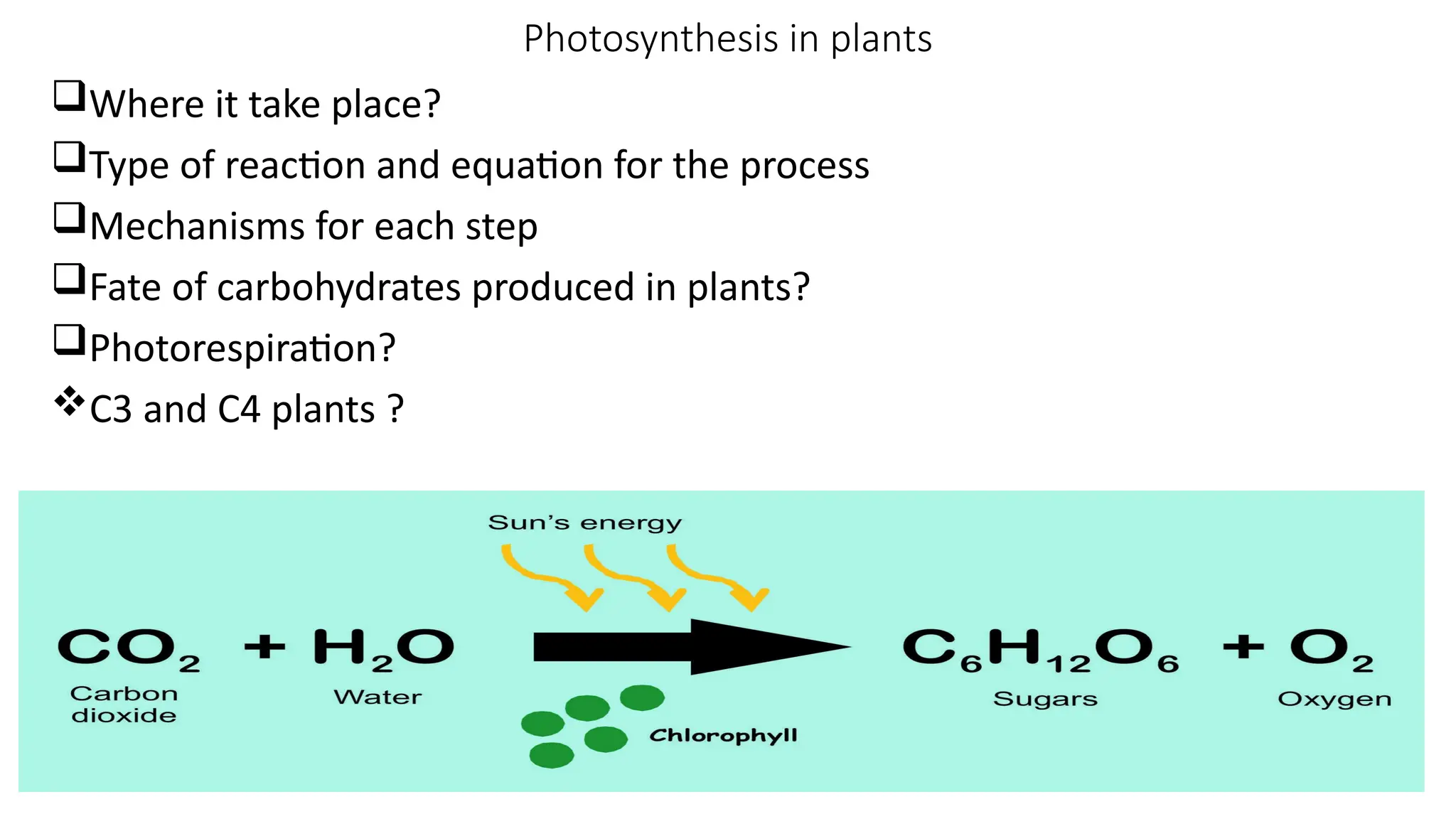
Photosynthesis in plants
Whereit take place?
Type of reaction and equation for the process
Mechanisms for each step
Fate of carbohydrates produced in plants?
Photorespiration?
C3 and C4 plants ?
3.
Photosynthesis
Take place inchloroplast
Driven By water, carbon dioxide, sunlight and chlorophyll
Two stage
Light reaction
Light energy is trapped by green pigment called chlorophyll
Energy absorbs split water into hydrogen and oxygen, a process called
photolysis
Hydrogen released is fed in dark reaction while oxygen released as gas outside
stomata
Dark reaction
No light required
Hydrogen produced from light reaction combine with carbon dioxide to form
carbohydrates
4.
MECHANISM FOR EACHSTEPS
•Light dependent reaction
• In the plants during photosynthesis light reaction occur in the
chloroplast thylakoids. HOW
When light energy reaches the chlorophyll pigments, it energizes the
electrons within them
The electrons are shunted to electron transport chain in the thylakoid
membranes
The process produce ATP and NADP
It involve cyclic and non-cyclic photophosphorylation
5.
CYCLIC PHOTOPHOSPHORYLATION
• Isthe process which results in the movement of the
electrons in a cyclic manner for synthesizing ATP molecules
• In this process, plant cells just accomplish the ADP to ATP for
immediate energy for the cells.
• This process usually takes place in the thylakoid membrane
and uses Photosystem I (P700) and the chlorophyll.
6.
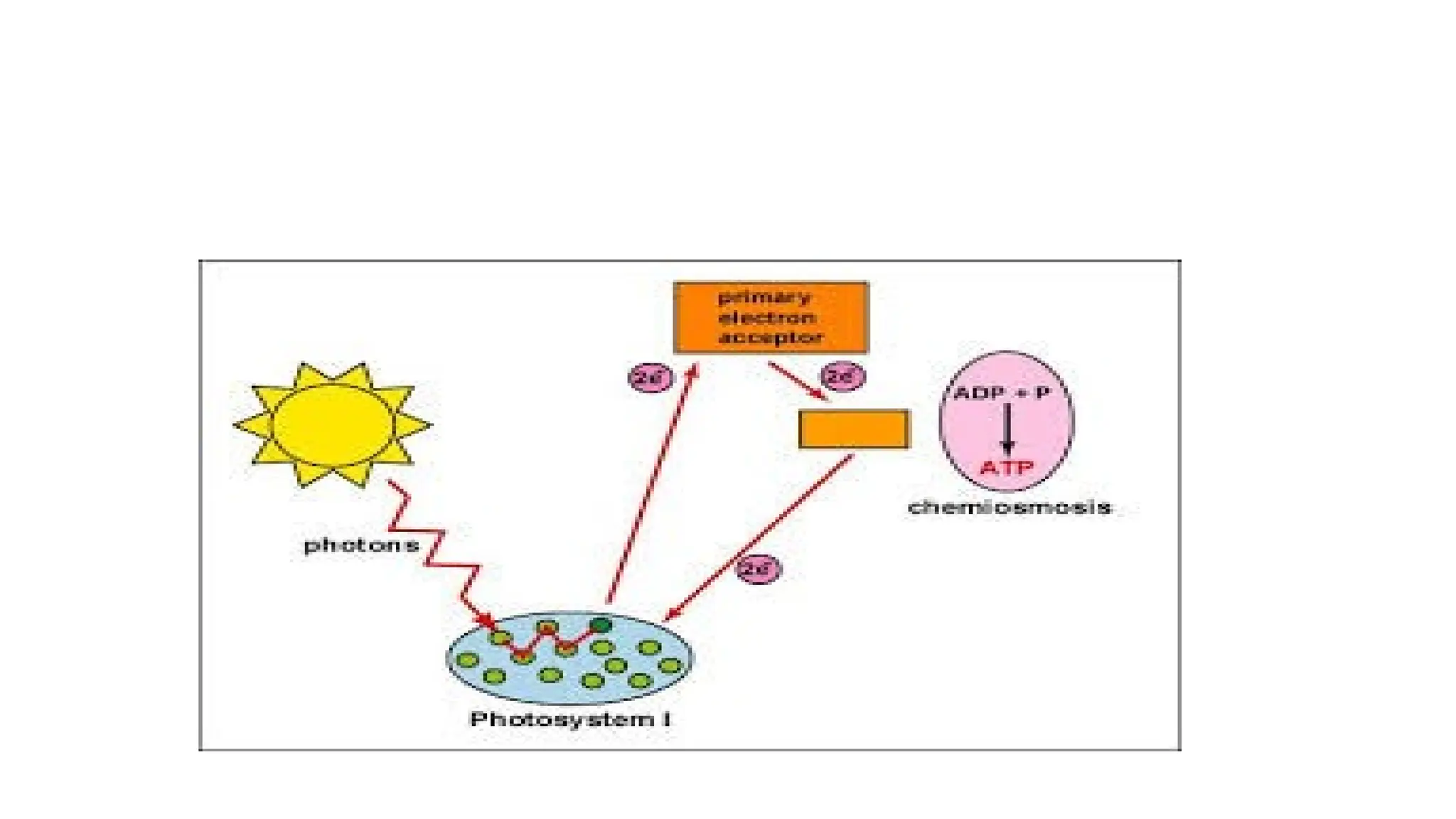
• During cyclicphotophosphorylation, the electrons are
transferred back to P700 instead of moving into the NADP from
the electron acceptor.
• This downward movement of electrons from an acceptor to P700
results in the formation of ATP molecules.
8.
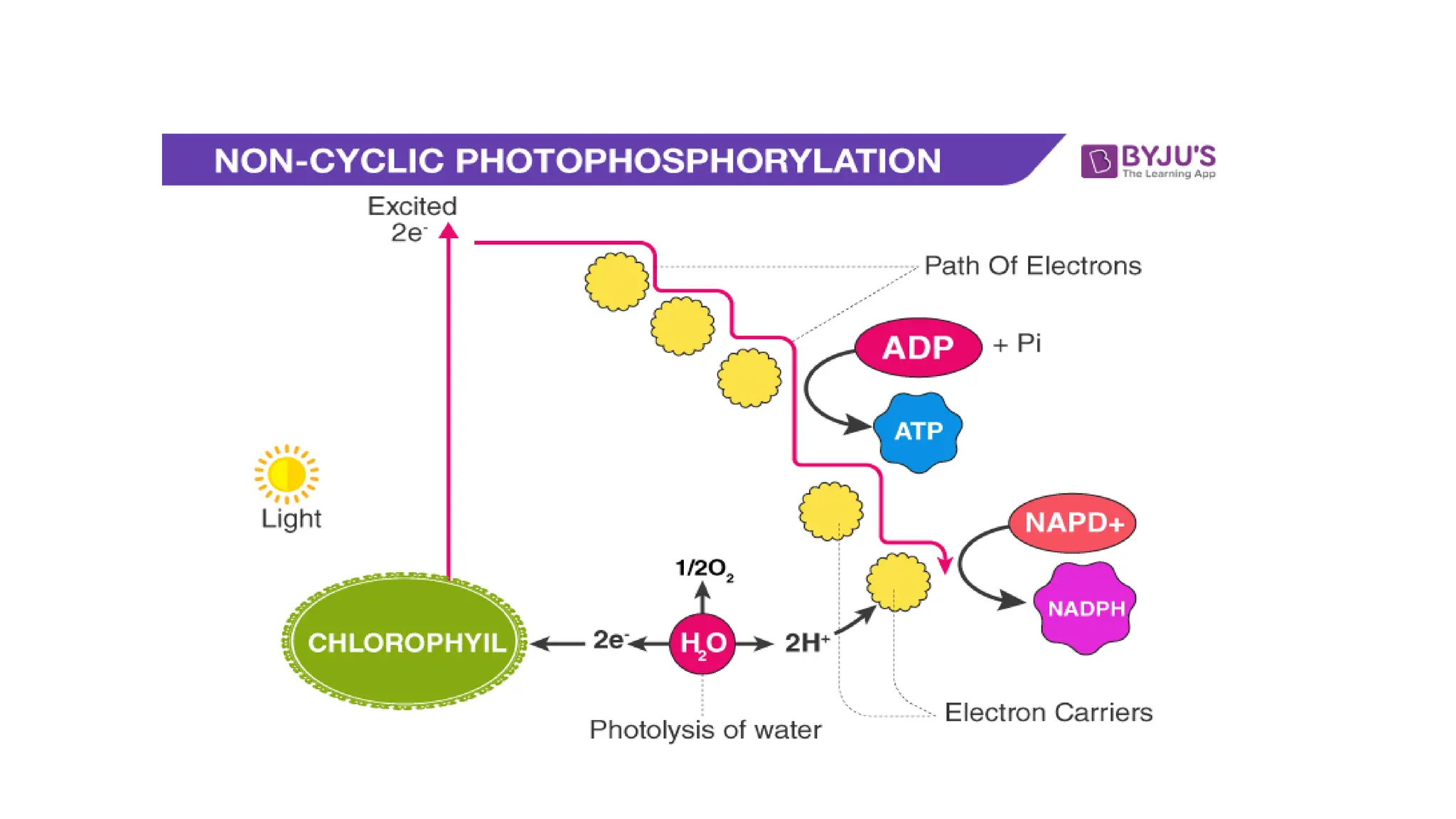
Non- cyclic photophosphorylation
•Involve two photosystems (P 680nm, P 700nm)
• The photosystem contain chlorophyll a and b and other
accessory pigments
• Flow of electrons is non cyclic
• The process results in the movement of the electrons in a
non-cyclic manner for synthesizing ATP molecules using the
energy from excited electrons provided by photosystem II (p
680nm)
9.
• This processis referred to as non- cyclic
photophosphorylation because the lost electrons by P680 of
Photosystem II are occupied by P700 of Photosystem I and
are not reverted to P680. Here the complete movement of
the electrons is in a unidirectional or in a non- cyclic manner.
• During non-cyclic photophosphorylation, the electrons
released by P700 are carried by primary acceptor and are
finally passed on to NADP.
• Here, the electrons combine with the protons – H+ which is
produced by splitting up of the water molecule and reduces
NADP to NADPH2.
11.
LIGHT INDEPENDENT REACTION
•Also known as calvin cycle
• Takes place in the stroma of the chloroplast
• No light required but need the end products from light
reaction (reduce NADP and ATP ) to produce simple sugars
• Need enzyme RUBISCO ( Ribulose Biphosphate Carboxylase)
and carbonidioxide
12.
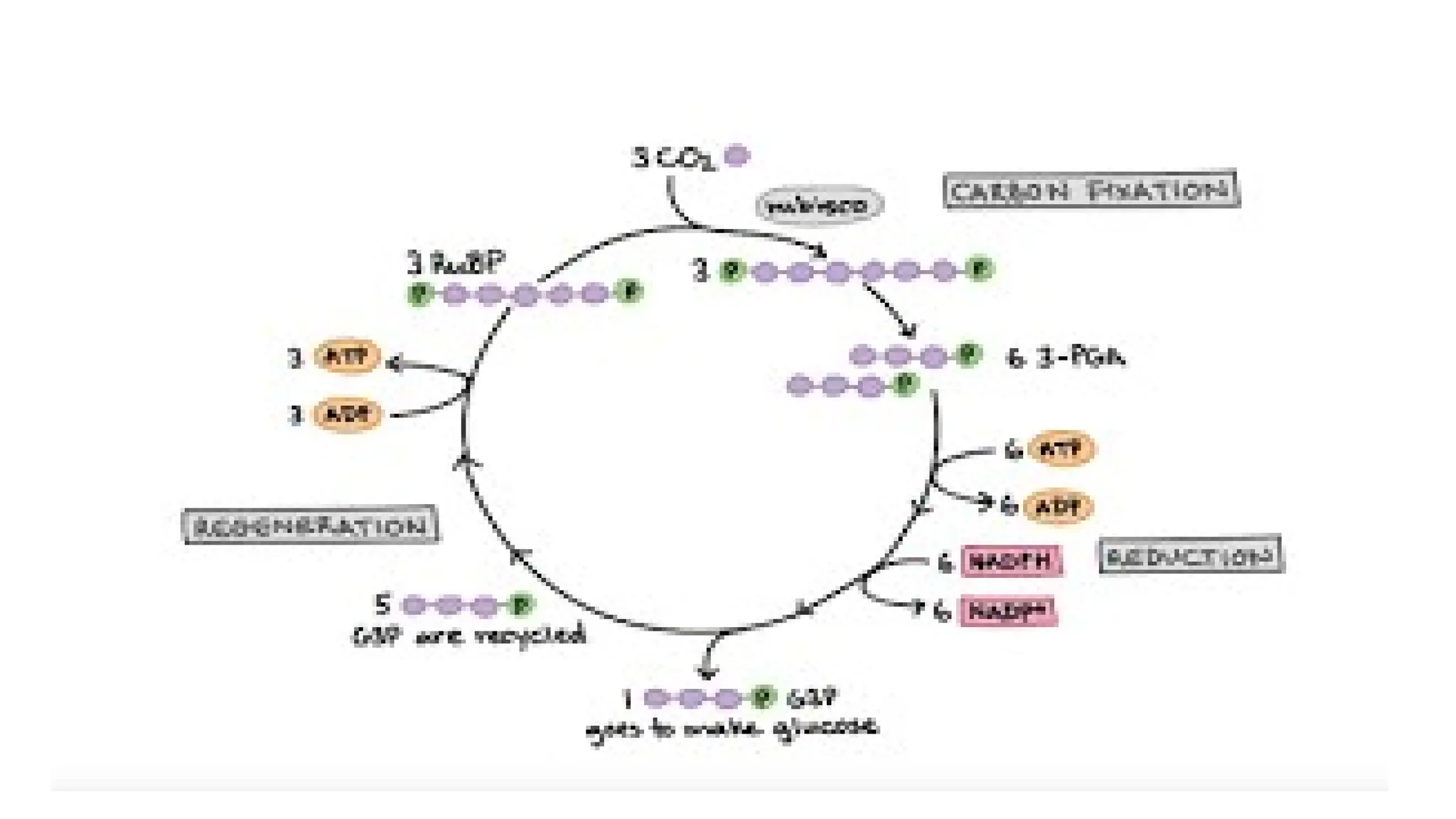
MECHANISM OF CALVINCYCLE
1. Carbon dioxide fixation
• Carbon dioxide is accepted by 5C compound called ribulose biphosphate
• The addition of C from C02 in the RuBP, result in six unstable carbon comp
• Compound break to form two molecules of glycerate phosphate(GP 3C).
2. Reduction phase.
GP(phospho glycerate) is reduced to aldehyde (glyceraldehyde phosphate)
3C sugar
3. Regeneration of RuBP
Some of the triose phosphate will be used to regenerate RuBP through
series of enzyme catalaysed reaction.
14.
PRODUCTS IN PHOTOSYNTHESIS
Glucoseand starch
which product stored in plants?
• Glucose is soluble. It is transported in the plant as soluble sugars but stored as
starch - which is insoluble, so it cannot escape from the cells
• The stored starch can be turned back into glucose later and used to release
energy by respiration
Glucose and sucrose
Why conversion of glucose to sucrose before translocation?
Glucose is highly reactive and this may result in some intermediate reactions
while transporting glucose. Being a complex structure, sucrose is not as much
reactive as glucose. So plants uses the sucrose as a medium to transfer efficient
energy.
15.
Glucose and proteins
Carbohydratesproduced in plants(glucose) under go a series of
reaction to form amino acid which when joined together to form
protein
Summary
-Starch and glucose are used by plant to make: cellulose for their
cell walls,
-proteins for growth and repair
-fats and oils for storage by the plant
Light intensity
• Therate of photosynthesis will go up as light intensity increases
• Because the more light is absorbed the more rate of photosynthesis
which will lead to more production of ATP
• However, very high intensity of light slows down the rate as it
bleaches the chlorophylls
• Normal sunlight is sufficient for normal rate of photosynthesis
18.
Wavelength
• Different colorof light can affect how much photosynthesis
can occur
• Because only certain colours are absorbed, the more colour
that is absorbed, the light that is absorbed, will increase rate
of phoyosynthesis and more production of ATP
• Photosynthesis depends upon the absorption of light by
pigments in the leaves of plants.
• The most important of these is chlorophyll a.
19.
Carbon dioxide concentration
•As carbon dioxide rises, the rate at which sugar are made by
light independent reaction increases
• In the atmosphere the amount of carbon dioxide ranges
from 0.03 t0 0.04 %
20.
Temperature
• Temperature hasan affect on the rate of photosynthesis
• Optimum temp. ranging from 25 to 35 degree centigrade is
required for a good rate
• At temp. around zero the enzymes will stop working and at
very high temp. the enzyme will denatured.
21.
Water supply
• Wateris an essential factor in photosynthesis
• Lack of water not only cause the plant to wilt ( and thereby
loss its ability to capture sunlight energy), but also limits the
quantity of carbon dioxide
• These happens when the leaves are dry, they close their
stomata in order to conserve water being lost as water
vapour through them.
22.
Chlorophyll concentration
• Theconcentration of chlorophyll affect the rate of reaction as
they absorb the light energy need for the reactions
• Lack of chlorophyll or sufficient of chlorophyll, results in
chlorosis or yellowish of leaves
• It can occur due to diseases, mineral deficient or natural
process of aging ( senescence)
• Lack of iron, magnesium, nitrogen and light affect the
formation of chlorophyll and thereby causes chlorosis.
23.
Pollution
• Pollution ofatmosphere with industrial gases produce soot
(dust) that blocks stomata and reduce the transparency of
the leaves
• Pollution of water affects the hydrophytes. Capacity of water
to dissolve gases like carbon dioxide and oxygen is greatly
affected
24.
Photorespiration
• Photorespiration isa process that occurs in Calvin Cycle
during plant metabolism.
• In this process, the key enzyme RuBisCO that is responsible
for the fixing of carbon dioxide reacts with oxygen rather
than carbon dioxide
• It occurs because of the conditions in which carbon dioxide
concentration falls down and rubisco does not have enough
carbon dioxide to fix and it starts fixing oxygen.
25.
• Photorespiration isinfluenced by high temperature as well as
light intensity and accelerating the formation of glycolate
and the flow through the photorespiratory pathway.
• Photorespiration takes place mostly on warm arid days
when plants are compelled to shut their stomata to prevent
surplus water loss.
26.
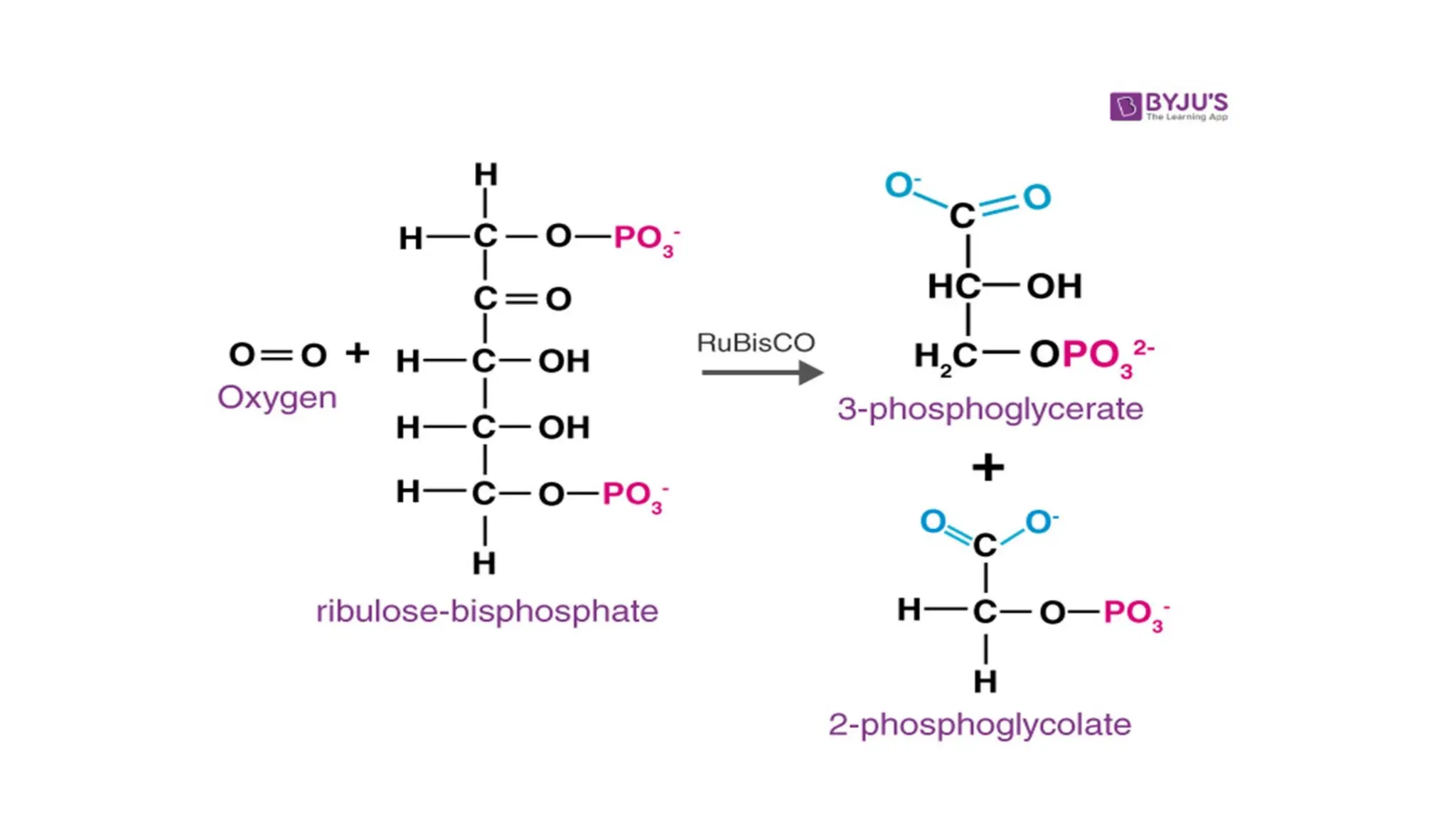
• When thecarbon dioxide levels inside the leaf dip to about
50 ppm, RuBisCO begins combining Oxygen with RuBP as an
alternative to Carbon dioxide.
• The final result of this is that as an alternative to
manufacturing 2 molecules of 3C- PGA units, merely one unit
of PGA is formed with a noxious(toxic) 2C molecule termed
phosphoglycolate
28.
• The toxicphosphoglycolate takes different steps/ series to be
transformed into serine
• Primarily, it instantly purges itself from the phosphate
cluster, transforming those units into glycolic acid.
• After that, this glycolic acid is transferred to the peroxisome
and then transformed into glycine.
• The conversion of glycine into serine takes place in the
mitochondria of the plant cell
• The serine produced after that is used to create other
organic units in the plants.
30.
C3, C4 andCAM PLANTS/PATHWAY
C3 Plants
• The C3 pathway gets its name from the first molecule
produced in the cycle (a 3-carbon molecule) called 3-
phosphoglyceric acid.
• About 85% of the plants on Earth use the C3 pathway to fix
carbon via the Calvin Cycle.
• During the one-step process, the enzyme RuBisCO (ribulose
bisphosphate carboxylase/oxygenase) causes an oxidation
reaction in which some of the energy used in photosynthesis
is lost in a process known as photorespiration.
31.
• The resultis about a 25% reduction in the amount of carbon
that is fixed by the plant and released back into the
atmosphere as carbon dioxide.
• Some common C3 plant species are spinach, peanuts, cotton,
wheat, rice, barley and most trees and grasses.
32.
C4 Plants
• InC4 plants, the C4 process is also known as the Hatch-
Slack pathway and is named for the 4-carbon
intermediate molecules that are produced, malic acid or
aspartic acid
• C4 photosynthesis reduces photorespiration by
concentrating CO2 around RuBisCO.
• To ensure that RuBisCO works in an environment where
there is a lot of carbon dioxide and very little oxygen,
C4 leaves generally differentiate two partially isolated
compartments called mesophyll and bundle-
sheath cells.
33.
• CO2 isinitially fixed in the mesophyll cells by the enzyme PEP
carboxylase which reacts the three
carbon phosphoenolpyruvate (PEP) with CO2 to form the
four carbon oxaloacetic acid (OAA).
• OAA can be chemically reduced to malate or transaminated
to aspartate.
34.
• These intermediatesdiffuse to the bundle sheath cells,
where they are decarboxylated, creating a CO2-rich
environment around RuBisCO and thereby suppressing
photorespiration.
• The resulting pyruvate (PYR), together with about half of the
phosphoglycerate (PGA) produced by RuBisCO, diffuses back
to the mesophyll.
• PGA is then chemically reduced and diffuses back to the
bundle sheath to complete the reductive pentose phosphate
cycle (RPP)
• C4 plants include corn, sugar cane, millet, sorghum,
pineapple, daisies and cabbage.
35.
CAM Plants
• CAMplants are the plants, which fix carbon dioxide by CAM pathway
or Crassulacean acid metabolism.
• It was first discovered in the plants of the Crassulaceae family.
• The word crassulacean comes from the Latin word crassus which
means “thick.”
• These plants are present in dry and arid environments.
• The CAM pathway is adapted to minimize water loss and
photorespiration.
• Examples of CAM plants include Orchids, Cacti,
Aloe, Pineapple, Agave, Moringa etc
36.
CAM Photosynthesis
•CAM pathwayis adapted in plants to perform
photosynthesis under stress and reduces
photorespiration.
•In CAM plants stomata are open at night and they
absorb carbon dioxide at night to reduce water loss
during the daytime (daytime stomata are closed).
37.
Steps in CAMPathway
•The first step in carbon dioxide fixation is the
combination of CO2 with PEP (phosphoenolpyruvate)
to form 4 carbon oxaloacetate (same as C4 plants) in
the chloroplast of mesophyll cells.
•The reaction is catalysed by PEPcarboxylase and the
reaction occurs at night.
•Oxaloacetate is converted to malate and other
C4 acids.
•Malate is stored in vacuoles at night.
38.
• During thedaytime, stomata remain closed, so there is no gas
exchange.
• Malate is transported out of the vacuole and CO2 is released by
the process of decarboxylation.
• This CO2 finally enters the Calvin cycle and carbon fixation
completes.
• The CO2 which gets accumulated around RuBisCO increases the
efficiency of the photosynthesis process and minimizes
photorespiration.










![[DSC Europe 25] Dusan Nesic - Securing Tomorrow’s Infrastructure: Why Cyber-P...](https://cdn.slidesharecdn.com/ss_thumbnails/qikbszfftyowjm2q6duw-1-251211083848-8f2ead6b-thumbnail.jpg?width=640&height=640&fit=bounds)
![[DSC Europe 25] Jon Dajci - Bridging TradFi and DeFi: Building the Future of ...](https://cdn.slidesharecdn.com/ss_thumbnails/fqmhfvlbqhkihjvqvhmu-7-251211083849-6af7e325-thumbnail.jpg?width=640&height=640&fit=bounds)
![[DSC Europe 25] Hans Kleinsman - The Compliance Gearbox: How Tax Tech Mediate...](https://cdn.slidesharecdn.com/ss_thumbnails/dxdytie1toel0hr90bjs-2-251212103250-174fdbe7-thumbnail.jpg?width=640&height=640&fit=bounds)

![[DSC Europe 25] Nikolay Burlutskiy - Best Practices for Building Enterprise M...](https://cdn.slidesharecdn.com/ss_thumbnails/uirvaiuvq8y1w8hzd9tx-7-251212103249-2619edb4-thumbnail.jpg?width=640&height=640&fit=bounds)


![[DSC Europe 25] Jovan Bogicevic - Legacy to AI-Driven Defense: Transforming D...](https://cdn.slidesharecdn.com/ss_thumbnails/rsarluadt563hntyfc8q-3-251211083849-3e7bc4c0-thumbnail.jpg?width=640&height=640&fit=bounds)


![[DSC Europe 25] Debmalya Biswas - Agentification: the art of transforming man...](https://cdn.slidesharecdn.com/ss_thumbnails/r5azlggvtqiaiiusrqdr-4-251212103249-5a12c89b-thumbnail.jpg?width=640&height=640&fit=bounds)
![[DSC Europe 25] Miodrag Pesovic & Vladislav Radonjic - Federated Data Archite...](https://cdn.slidesharecdn.com/ss_thumbnails/gsbe3y5it5uhndi4e08e-1-251212103249-f1008e0c-thumbnail.jpg?width=640&height=640&fit=bounds)

