P5 Home-Based Learning MAINSTREAM  SCIENCE
Plant Transport System You may refer to Textbook pages 6 to 10.
Parts of the  Plant Transport System Roots Stem Leaves Water-carrying Tubes Food-carrying Tubes


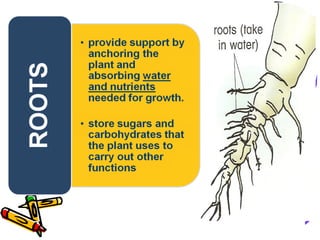
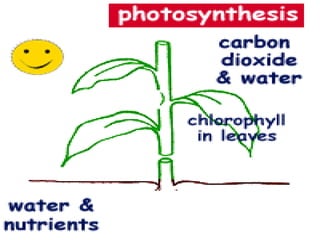
Why do plants need a transport system? Plants need water for photosynthesis as well mineral salts to stay healthy. The water and mineral salts go into the plants through the root hairs. These can only be transported through the  water-carrying tubes  in the stem also known as  xylem .
Why do plants need a transport system? Food made in the leaves need to be transported to the other plant parts in order for the plant to survive. This can only be transported by the  food-carrying tubes ,also known as  phloem .
 
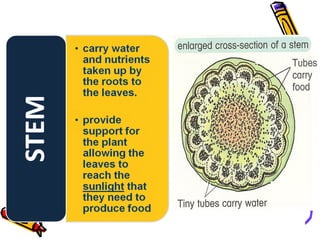
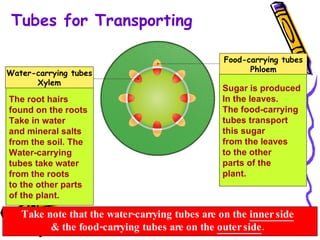
Tubes for Transporting Food-carrying tubes Phloem Water-carrying tubes Xylem Sugar is produced In the leaves. The food-carrying tubes transport this sugar  from the leaves to the other parts of the plant. The root hairs found on the roots Take in water and mineral salts from the soil. The  Water-carrying tubes take water from the roots to the other parts of the plant. Take note that the water-carrying tubes are on the  inner side & the food-carrying tubes are on the  outer side .
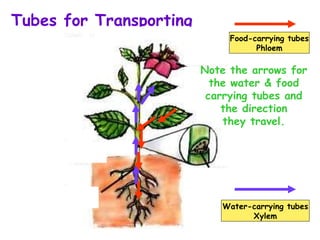
Tubes for Transporting Food-carrying tubes Phloem Water-carrying tubes Xylem Note the arrows for the water & food carrying tubes and the direction they travel.
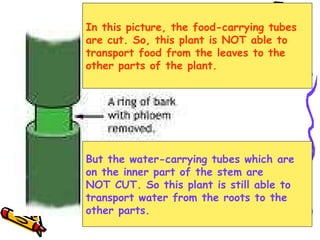
In this picture, the food-carrying tubes are cut. So, this plant is NOT able to transport food from the leaves to the other parts of the plant.  But the water-carrying tubes which are  on the inner part of the stem are  NOT CUT. So this plant is still able to  transport water from the roots to the other parts.
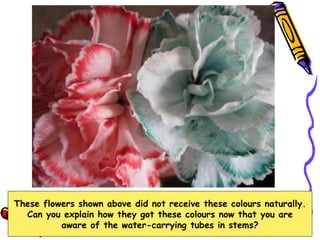
These flowers shown above did not receive these colours naturally. Can you explain how they got these colours now that you are aware of the water-carrying tubes in stems?
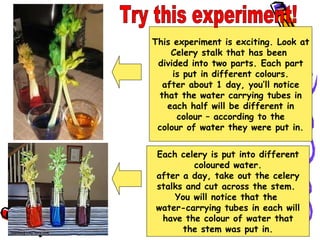
This experiment is exciting. Look at Celery stalk that has been  divided into two parts. Each part is put in different colours. after about 1 day, you’ll notice that the water carrying tubes in each half will be different in colour – according to the colour of water they were put in. Each celery is put into different coloured water. after a day, take out the celery stalks and cut across the stem.  You will notice that the  water-carrying tubes in each will have the colour of water that the stem was put in. Try this experiment!
Do Workbook Activity 1.1:  In the Flow Write down your observations and conclusion in your workbook page 1-2.

P5 Science - Plant Transport System

  • 1.
    P5 Home-Based LearningMAINSTREAM SCIENCE
  • 2.
    Plant Transport SystemYou may refer to Textbook pages 6 to 10.
  • 3.
    Parts of the Plant Transport System Roots Stem Leaves Water-carrying Tubes Food-carrying Tubes
  • 4.
  • 5.
  • 6.
  • 7.
    Why do plantsneed a transport system? Plants need water for photosynthesis as well mineral salts to stay healthy. The water and mineral salts go into the plants through the root hairs. These can only be transported through the water-carrying tubes in the stem also known as xylem .
  • 8.
    Why do plantsneed a transport system? Food made in the leaves need to be transported to the other plant parts in order for the plant to survive. This can only be transported by the food-carrying tubes ,also known as phloem .
  • 9.
  • 10.
    Tubes for TransportingFood-carrying tubes Phloem Water-carrying tubes Xylem Sugar is produced In the leaves. The food-carrying tubes transport this sugar from the leaves to the other parts of the plant. The root hairs found on the roots Take in water and mineral salts from the soil. The Water-carrying tubes take water from the roots to the other parts of the plant. Take note that the water-carrying tubes are on the inner side & the food-carrying tubes are on the outer side .
  • 11.
    Tubes for TransportingFood-carrying tubes Phloem Water-carrying tubes Xylem Note the arrows for the water & food carrying tubes and the direction they travel.
  • 12.
    In this picture,the food-carrying tubes are cut. So, this plant is NOT able to transport food from the leaves to the other parts of the plant. But the water-carrying tubes which are on the inner part of the stem are NOT CUT. So this plant is still able to transport water from the roots to the other parts.
  • 13.
    These flowers shownabove did not receive these colours naturally. Can you explain how they got these colours now that you are aware of the water-carrying tubes in stems?
  • 14.
    This experiment isexciting. Look at Celery stalk that has been divided into two parts. Each part is put in different colours. after about 1 day, you’ll notice that the water carrying tubes in each half will be different in colour – according to the colour of water they were put in. Each celery is put into different coloured water. after a day, take out the celery stalks and cut across the stem. You will notice that the water-carrying tubes in each will have the colour of water that the stem was put in. Try this experiment!
  • 15.
    Do Workbook Activity1.1: In the Flow Write down your observations and conclusion in your workbook page 1-2.

Editor's Notes

  • #6 NOTE: Transport system in plants. Xylem: Runs from roots to other parts of plants. Function: Transports water and minerals. Supports the plant Phloem: Runs from leaves to other parts of plants. Function: To transport food.