“LASER MATTER
INTERACTION”
“INTRODUCTION”
The interaction mechanism between laser light and
matter depend on:
• Laser parameters,
• Material’s properties.
“LIGHT PROPAGATION IN
MATERIAL”
Light-matter interaction causes different effects i.e.
coherent scattering,
photoelectric effect,
Compton Effect,
pair production.
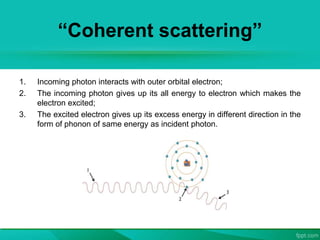
“Coherent scattering”
1. Incoming photon interacts with outer orbital electron;
2. The incoming photon gives up its all energy to electron which makes the
electron excited;
3. The excited electron gives up its excess energy in different direction in the
form of phonon of same energy as incident photon.
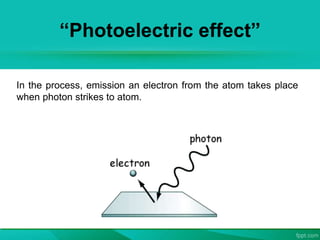
“Photoelectric effect”
In the process, emission an electron from the atom takes place
when photon strikes to atom.
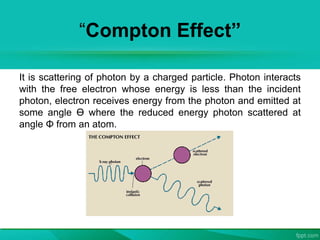
“Compton Effect”
It is scattering of photon by a charged particle. Photon interacts
with the free electron whose energy is less than the incident
photon, electron receives energy from the photon and emitted at
some angle ϴ where the reduced energy photon scattered at
angle Φ from an atom.
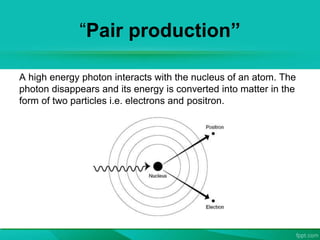
“Pair production”
A high energy photon interacts with the nucleus of an atom. The
photon disappears and its energy is converted into matter in the
form of two particles i.e. electrons and positron.
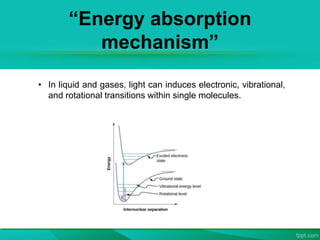
“Energy absorption
mechanism”
• In liquid and gases, light can induces electronic, vibrational,
and rotational transitions within single molecules.
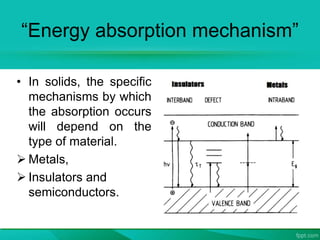
“Energy absorption mechanism”
• In solids, the specific
mechanisms by which
the absorption occurs
will depend on the
type of material.
 Metals,
 Insulators and
semiconductors.
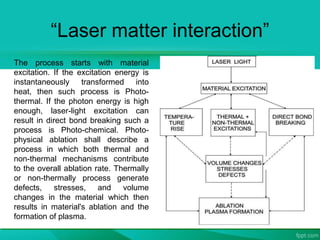
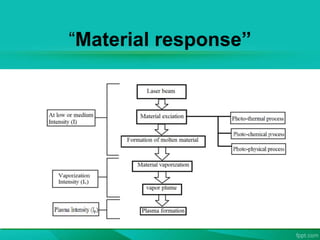
“Laser matter interaction”
The process starts with material
excitation. If the excitation energy is
instantaneously transformed into
heat, then such process is Photo-
thermal. If the photon energy is high
enough, laser-light excitation can
result in direct bond breaking such a
process is Photo-chemical. Photo-
physical ablation shall describe a
process in which both thermal and
non-thermal mechanisms contribute
to the overall ablation rate. Thermally
or non-thermally process generate
defects, stresses, and volume
changes in the material which then
results in material's ablation and the
formation of plasma.
“Photo-thermal process”
When the laser-induced excitation rate is low in comparison
to the thermalization rate, such processes are called photo-
thermal process. In thermal process the excitation energy
is instantaneously transformed into heat. The temperature
rise can result in thermal material ablation with or without
melting.
“Photo-chemical processes”
When the laser induced excitation rate is high in
comparison to the thermalization rate, such
processes are referred as photochemical
processes. In this case laser-light excitations can
result in direct bond breaking. The process can
take place without any change in surface
temperature.
“Photo-physical processes”
When photo-thermal and photo-chemical
processes contribute in overall processing
rate such processes are referred as photo-
physical processes.
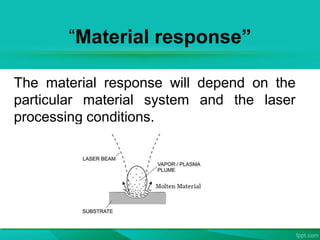
“Material response”
The material response will depend on the
particular material system and the laser
processing conditions.
“Material response”
“conclusion”
Laser matter interaction depends on laser parameters as well as
materials physical and chemical properties. Laser matters interaction
cause different energy losses and effects i.e. coherent scattering,
photoelectric effect, Compton Effect, and pair production. Energy
absorption mechanism of laser light by determined by the electrons
transition, in insulators and semiconductors inter-band and in metals
intra-band transition. Processing of laser light can be done by different
phenomena's which includes photo-thermal, photo-chemical and photo-
physical processes. The material response to the laser light depends
on laser conditions and material properties. Material will respond
differently at different intensities of laser light. The laser light
parameters and the material's properties the combination of all these
characteristics offers wide range of applications.

Laser matter interaction

  • 1.
  • 2.
    “INTRODUCTION” The interaction mechanismbetween laser light and matter depend on: • Laser parameters, • Material’s properties.
  • 3.
    “LIGHT PROPAGATION IN MATERIAL” Light-matterinteraction causes different effects i.e. coherent scattering, photoelectric effect, Compton Effect, pair production.
  • 4.
    “Coherent scattering” 1. Incomingphoton interacts with outer orbital electron; 2. The incoming photon gives up its all energy to electron which makes the electron excited; 3. The excited electron gives up its excess energy in different direction in the form of phonon of same energy as incident photon.
  • 5.
    “Photoelectric effect” In theprocess, emission an electron from the atom takes place when photon strikes to atom.
  • 6.
    “Compton Effect” It isscattering of photon by a charged particle. Photon interacts with the free electron whose energy is less than the incident photon, electron receives energy from the photon and emitted at some angle ϴ where the reduced energy photon scattered at angle Φ from an atom.
  • 7.
    “Pair production” A highenergy photon interacts with the nucleus of an atom. The photon disappears and its energy is converted into matter in the form of two particles i.e. electrons and positron.
  • 8.
    “Energy absorption mechanism” • Inliquid and gases, light can induces electronic, vibrational, and rotational transitions within single molecules.
  • 9.
    “Energy absorption mechanism” •In solids, the specific mechanisms by which the absorption occurs will depend on the type of material.  Metals,  Insulators and semiconductors.
  • 10.
    “Laser matter interaction” Theprocess starts with material excitation. If the excitation energy is instantaneously transformed into heat, then such process is Photo- thermal. If the photon energy is high enough, laser-light excitation can result in direct bond breaking such a process is Photo-chemical. Photo- physical ablation shall describe a process in which both thermal and non-thermal mechanisms contribute to the overall ablation rate. Thermally or non-thermally process generate defects, stresses, and volume changes in the material which then results in material's ablation and the formation of plasma.
  • 11.
    “Photo-thermal process” When thelaser-induced excitation rate is low in comparison to the thermalization rate, such processes are called photo- thermal process. In thermal process the excitation energy is instantaneously transformed into heat. The temperature rise can result in thermal material ablation with or without melting.
  • 12.
    “Photo-chemical processes” When thelaser induced excitation rate is high in comparison to the thermalization rate, such processes are referred as photochemical processes. In this case laser-light excitations can result in direct bond breaking. The process can take place without any change in surface temperature.
  • 13.
    “Photo-physical processes” When photo-thermaland photo-chemical processes contribute in overall processing rate such processes are referred as photo- physical processes.
  • 14.
    “Material response” The materialresponse will depend on the particular material system and the laser processing conditions.
  • 15.
  • 16.
    “conclusion” Laser matter interactiondepends on laser parameters as well as materials physical and chemical properties. Laser matters interaction cause different energy losses and effects i.e. coherent scattering, photoelectric effect, Compton Effect, and pair production. Energy absorption mechanism of laser light by determined by the electrons transition, in insulators and semiconductors inter-band and in metals intra-band transition. Processing of laser light can be done by different phenomena's which includes photo-thermal, photo-chemical and photo- physical processes. The material response to the laser light depends on laser conditions and material properties. Material will respond differently at different intensities of laser light. The laser light parameters and the material's properties the combination of all these characteristics offers wide range of applications.