A General Note
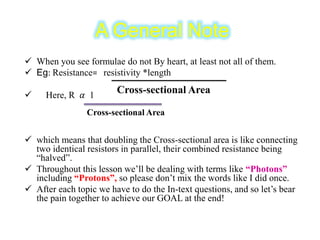
 When you see formulae do not By heart, at least not all of them.
 Eg: Resistance= resistivity *length
 Here, R 𝛼 1
 which means that doubling the Cross-sectional area is like connecting
two identical resistors in parallel, their combined resistance being
“halved”.
 Throughout this lesson we’ll be dealing with terms like “Photons”
including “Protons”, so please don’t mix the words like I did once.
 After each topic we have to do the In-text questions, and so let’s bear
the pain together to achieve our GOAL at the end!
Cross-sectional Area
What are waves?
• They are just a way in which
energy is transferred from one
place to another.
• The characteristic properties of
waves are that they all show
reflection, diffraction and
interference.
Light
• Light is a wave, why? – it shows diffraction,reflection
and allthose topicsIGCSE wanted us to learnfor the
exams.
• Butnow whatif I tell you it alsobehaves as a particle?.
• It’s almostas ifI’m saying a smallballthrown at a slit
willdiffractthrough it.
How?
• Let’s get real scientific now.
• To see how light multitasks being a wave and a particle,
we need to get our Geiger counters ready.
• The Geiger counter detects ionizing radiation such as
alpha particles, beta particles and gamma rays using
the ionization effect.
• If you place a Geiger counternext to a source of gamma
radiation (electromagnetic), you will hear an irregular series
of clicks whichare indistinguishable from the clicks givenby
alpha & beta particles, whichare of course PARTICLES.
Photons
• Light could behave as a stream of
particles.
• These particles are called photons
and we believe that all
electromagnetic radiation consists of
“photons”.
• A photon is a ‘packet of energy’ or a
quantum of electromagnetic energy.
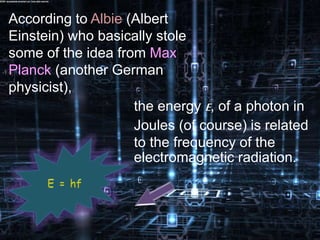
According to Albie (Albert
Einstein) who basically stole
some of the idea from Max
Planck (another German
physicist),
the energy E, of a photon in
Joules (of course) is related
to the frequency of the
electromagnetic radiation.
Photoelectric Effect
• In the photoelectric effect, light shines on a
metal surface and electrons are released from
it. But why?.
• A simple explanation is that light is a wave
that carries energy and this energy releases
electrons from the metal.
• But, detailed observations showed that there
is a minimum ‘Threshold frequency’ of light
below which no effect is observed.
Albie comes up again!
• In 1905, Albert Einstein came up with an
explanation of why weak ultraviolet radiation
could have an immediate effect on the
electrons in the metal, but very bright light
(high intensity) of ‘lower frequency’ had no
effect.
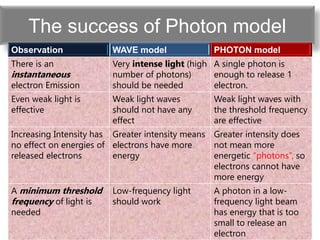
The success of Photon model
Observation WAVE model PHOTON model
There is an
instantaneous
electron Emission
Very intense light (high
number of photons)
should be needed
A single photon is
enough to release 1
electron.
Even weak light is
effective
Weak light waves
should not have any
effect
Weak light waves with
the threshold frequency
are effective
Increasing Intensity has
no effect on energies of
released electrons
Greater intensity means
electrons have more
energy
Greater intensity does
not mean more
energetic “photons”, so
electrons cannot have
more energy
A minimum threshold
frequency of light is
needed
Low-frequency light
should work
A photon in a low-
frequency light beam
has energy that is too
small to release an
electron
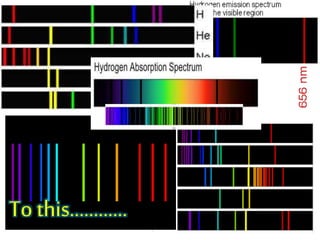
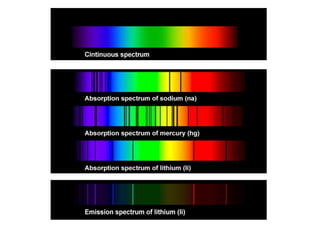
Line Spectra!
• From our previous knowledge of a line
spectra (product of dispersion of light),
we saw a beautiful array of continuous
spectrum of light.
• But now, Quantum mechanics does not
want to be left out, it wants to feel
equally loved and therefore it comes
with a new phenomenon called the
LINE SPECTRA.
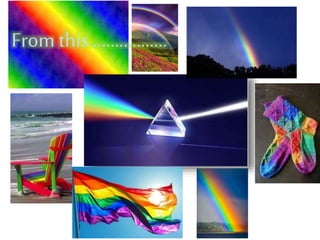
From this………………
To this…………
Emission Line Spectra
• Quantum mechanics made the spectrum of light
more interesting with the help of Hot and Cool
gases.
• In Emission Spectra, only hot gases produce such
result.
• If you look at a lamp that contains a gas such as
neon or sodium, you will see that only certain colors
are present.
• Each element has a spectrum with a unique
collection of wavelengths.
• Astronomers use this phenomenon, can you deduce
where?
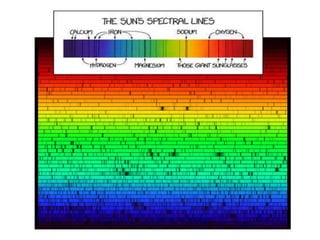
Absorption Line Spectra
• When light is passed through cool
gases……..what happens?
• After the light has passed through a
diffraction grating, the continuous white
light spectrum is found to have black lines
across it,WHAT!, yes.
• Here, certain wavelengths have been
absorbed as the white light passed through
these “Cool gases” – they are indeed cool eh?
Photon Energies!!!
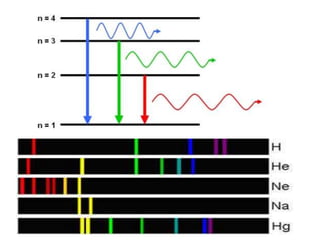
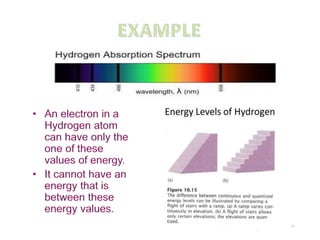
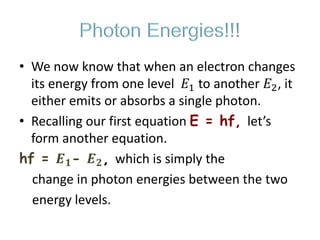
• We now know that when an electron changes
its energy from one level 𝐸1 to another 𝐸2, it
either emits or absorbs a single photon.
• Recalling our first equation E = hf, let’s
form another equation.
hf = 𝑬 𝟏- 𝑬 𝟐, which is simply the
change in photon energies between the two
energy levels.
• Gas atoms that exert negligible electrical
forces on each other are known as isolated
atoms – they give relatively simple line
spectra.
• Similar spectra can be obtained from some
gemstones and colored gas.
• In a solid or liquid, the atoms are close
together.
• This makes energy level diagrams much more
complicated, with closely packed energy levels.
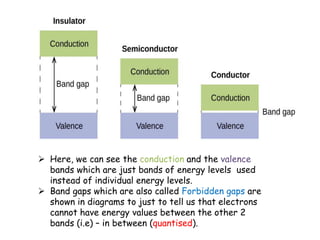
 Here, we can see the conduction and the valence
bands which are just bands of energy levels used
instead of individual energy levels.
 Band gaps which are also called Forbidden gaps are
shown in diagrams to just to tell us that electrons
cannot have energy values between the other 2
bands (i.e) – in between (quantised).
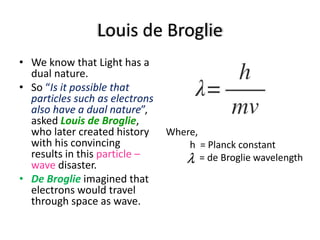
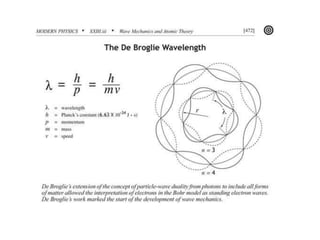
Louis de Broglie
• We know that Light has a
dual nature.
• So “Is it possible that
particles such as electrons
also have a dual nature”,
asked Louis de Broglie,
who later created history
with his convincing
results in this particle –
wave disaster.
• De Broglie imagined that
electrons would travel
through space as wave.
Where,
h = Planck constant
= de Broglie wavelength
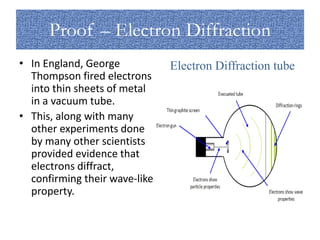
Proof – Electron Diffraction
• In England, George
Thompson fired electrons
into thin sheets of metal
in a vacuum tube.
• This, along with many
other experiments done
by many other scientists
provided evidence that
electrons diffract,
confirming their wave-like
property.
Electron Diffraction tube
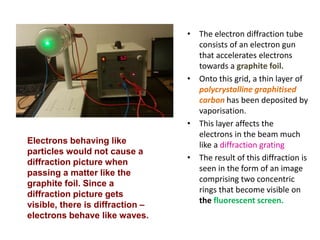
• The electron diffraction tube
consists of an electron gun
that accelerates electrons
towards a graphite foil.
• Onto this grid, a thin layer of
polycrystalline graphitised
carbon has been deposited by
vaporisation.
• This layer affects the
electrons in the beam much
like a diffraction grating
• The result of this diffraction is
seen in the form of an image
comprising two concentric
rings that become visible on
the fluorescent screen.
Electrons behaving like
particles would not cause a
diffraction picture when
passing a matter like the
graphite foil. Since a
diffraction picture gets
visible, there is diffraction –
electrons behave like waves.
Quantum physics

Quantum physics

  • 2.
    A General Note When you see formulae do not By heart, at least not all of them.  Eg: Resistance= resistivity *length  Here, R 𝛼 1  which means that doubling the Cross-sectional area is like connecting two identical resistors in parallel, their combined resistance being “halved”.  Throughout this lesson we’ll be dealing with terms like “Photons” including “Protons”, so please don’t mix the words like I did once.  After each topic we have to do the In-text questions, and so let’s bear the pain together to achieve our GOAL at the end! Cross-sectional Area Cross-sectional Area
  • 3.
    What are waves? •They are just a way in which energy is transferred from one place to another. • The characteristic properties of waves are that they all show reflection, diffraction and interference.
  • 4.
    Light • Light isa wave, why? – it shows diffraction,reflection and allthose topicsIGCSE wanted us to learnfor the exams. • Butnow whatif I tell you it alsobehaves as a particle?. • It’s almostas ifI’m saying a smallballthrown at a slit willdiffractthrough it.
  • 5.
    How? • Let’s getreal scientific now. • To see how light multitasks being a wave and a particle, we need to get our Geiger counters ready. • The Geiger counter detects ionizing radiation such as alpha particles, beta particles and gamma rays using the ionization effect. • If you place a Geiger counternext to a source of gamma radiation (electromagnetic), you will hear an irregular series of clicks whichare indistinguishable from the clicks givenby alpha & beta particles, whichare of course PARTICLES.
  • 6.
    Photons • Light couldbehave as a stream of particles. • These particles are called photons and we believe that all electromagnetic radiation consists of “photons”. • A photon is a ‘packet of energy’ or a quantum of electromagnetic energy.
  • 7.
    According to Albie(Albert Einstein) who basically stole some of the idea from Max Planck (another German physicist), the energy E, of a photon in Joules (of course) is related to the frequency of the electromagnetic radiation.
  • 8.
    Photoelectric Effect • Inthe photoelectric effect, light shines on a metal surface and electrons are released from it. But why?. • A simple explanation is that light is a wave that carries energy and this energy releases electrons from the metal. • But, detailed observations showed that there is a minimum ‘Threshold frequency’ of light below which no effect is observed.
  • 9.
    Albie comes upagain! • In 1905, Albert Einstein came up with an explanation of why weak ultraviolet radiation could have an immediate effect on the electrons in the metal, but very bright light (high intensity) of ‘lower frequency’ had no effect.
  • 10.
    The success ofPhoton model Observation WAVE model PHOTON model There is an instantaneous electron Emission Very intense light (high number of photons) should be needed A single photon is enough to release 1 electron. Even weak light is effective Weak light waves should not have any effect Weak light waves with the threshold frequency are effective Increasing Intensity has no effect on energies of released electrons Greater intensity means electrons have more energy Greater intensity does not mean more energetic “photons”, so electrons cannot have more energy A minimum threshold frequency of light is needed Low-frequency light should work A photon in a low- frequency light beam has energy that is too small to release an electron
  • 11.
    Line Spectra! • Fromour previous knowledge of a line spectra (product of dispersion of light), we saw a beautiful array of continuous spectrum of light. • But now, Quantum mechanics does not want to be left out, it wants to feel equally loved and therefore it comes with a new phenomenon called the LINE SPECTRA.
  • 12.
  • 13.
  • 14.
    Emission Line Spectra •Quantum mechanics made the spectrum of light more interesting with the help of Hot and Cool gases. • In Emission Spectra, only hot gases produce such result. • If you look at a lamp that contains a gas such as neon or sodium, you will see that only certain colors are present. • Each element has a spectrum with a unique collection of wavelengths. • Astronomers use this phenomenon, can you deduce where?
  • 16.
    Absorption Line Spectra •When light is passed through cool gases……..what happens? • After the light has passed through a diffraction grating, the continuous white light spectrum is found to have black lines across it,WHAT!, yes. • Here, certain wavelengths have been absorbed as the white light passed through these “Cool gases” – they are indeed cool eh?
  • 21.
    Photon Energies!!! • Wenow know that when an electron changes its energy from one level 𝐸1 to another 𝐸2, it either emits or absorbs a single photon. • Recalling our first equation E = hf, let’s form another equation. hf = 𝑬 𝟏- 𝑬 𝟐, which is simply the change in photon energies between the two energy levels.
  • 22.
    • Gas atomsthat exert negligible electrical forces on each other are known as isolated atoms – they give relatively simple line spectra. • Similar spectra can be obtained from some gemstones and colored gas. • In a solid or liquid, the atoms are close together. • This makes energy level diagrams much more complicated, with closely packed energy levels.
  • 23.
     Here, wecan see the conduction and the valence bands which are just bands of energy levels used instead of individual energy levels.  Band gaps which are also called Forbidden gaps are shown in diagrams to just to tell us that electrons cannot have energy values between the other 2 bands (i.e) – in between (quantised).
  • 24.
    Louis de Broglie •We know that Light has a dual nature. • So “Is it possible that particles such as electrons also have a dual nature”, asked Louis de Broglie, who later created history with his convincing results in this particle – wave disaster. • De Broglie imagined that electrons would travel through space as wave. Where, h = Planck constant = de Broglie wavelength
  • 25.
    Proof – ElectronDiffraction • In England, George Thompson fired electrons into thin sheets of metal in a vacuum tube. • This, along with many other experiments done by many other scientists provided evidence that electrons diffract, confirming their wave-like property. Electron Diffraction tube
  • 26.
    • The electrondiffraction tube consists of an electron gun that accelerates electrons towards a graphite foil. • Onto this grid, a thin layer of polycrystalline graphitised carbon has been deposited by vaporisation. • This layer affects the electrons in the beam much like a diffraction grating • The result of this diffraction is seen in the form of an image comprising two concentric rings that become visible on the fluorescent screen. Electrons behaving like particles would not cause a diffraction picture when passing a matter like the graphite foil. Since a diffraction picture gets visible, there is diffraction – electrons behave like waves.

Editor's Notes

  • #24 a valence electron is an outer shell electron that is associated with an atom, and that can participate in the formation of a chemical bond