CATHODE RAY OSCILLOSCOPE
PRESENTED BY,
AKSHARA.V.B
5/21/2020 1
CATHODE RAY OSCILLOSCOPE
PRINCIPAL:
The cathode ray oscilloscope (CRO) is a type of electrical instrument
which is used for showing the measurement and analysis of waveforms.
It is used to provide instrument that provides accurate time and
amplitude measurements of voltage signals over a wide range of
frequencies.
COMPONENTS:
Electron gun
Fluorescent screen
Glass envelope
Base
Deflection plate system
5/21/2020 2
5/21/2020 3
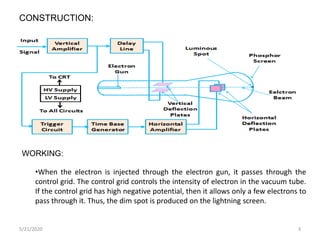
CONSTRUCTION:
WORKING:
•When the electron is injected through the electron gun, it passes through the
control grid. The control grid controls the intensity of electron in the vacuum tube.
If the control grid has high negative potential, then it allows only a few electrons to
pass through it. Thus, the dim spot is produced on the lightning screen.
5/21/2020 4
• If the negative potential on the control grid is low, then the bright spot is produced.
Hence the intensity of light depends on the negative potential of the control grid.
•After moving the control grid the electron beam passing through the focusing and
accelerating anodes. The accelerating anodes are at a high positive potential and hence
they converge the beam at a point on the screen.
•After moving from the accelerating anode, the beam comes under the effect of the
deflecting plates. When the deflecting plate is at zero potential, the beam produces a spot
at the centre.
•If the voltage is applied to the vertical deflecting plate, the electron beam focuses at the
upward and when the voltage is applied horizontally the spot of light will be deflected
horizontally
ADVANTAGE:
Time efficiency
Knowledge pool and problem solving capacity
5/21/2020 5
Regulatory compliance assurance
 A good CRO never manipulates data
Mostly cost effective than to develop and run the research in-house.
DISADVANTAGE:
Extreme care in choosing a right partner
Communication management.
APPLICATION:
Voltage measurement
Current measurement
Examination of waveform
Measurement of phase and frequency

CATHODE RAY OSCILLOSCOPE

  • 1.
    CATHODE RAY OSCILLOSCOPE PRESENTEDBY, AKSHARA.V.B 5/21/2020 1
  • 2.
    CATHODE RAY OSCILLOSCOPE PRINCIPAL: Thecathode ray oscilloscope (CRO) is a type of electrical instrument which is used for showing the measurement and analysis of waveforms. It is used to provide instrument that provides accurate time and amplitude measurements of voltage signals over a wide range of frequencies. COMPONENTS: Electron gun Fluorescent screen Glass envelope Base Deflection plate system 5/21/2020 2
  • 3.
    5/21/2020 3 CONSTRUCTION: WORKING: •When theelectron is injected through the electron gun, it passes through the control grid. The control grid controls the intensity of electron in the vacuum tube. If the control grid has high negative potential, then it allows only a few electrons to pass through it. Thus, the dim spot is produced on the lightning screen.
  • 4.
    5/21/2020 4 • Ifthe negative potential on the control grid is low, then the bright spot is produced. Hence the intensity of light depends on the negative potential of the control grid. •After moving the control grid the electron beam passing through the focusing and accelerating anodes. The accelerating anodes are at a high positive potential and hence they converge the beam at a point on the screen. •After moving from the accelerating anode, the beam comes under the effect of the deflecting plates. When the deflecting plate is at zero potential, the beam produces a spot at the centre. •If the voltage is applied to the vertical deflecting plate, the electron beam focuses at the upward and when the voltage is applied horizontally the spot of light will be deflected horizontally ADVANTAGE: Time efficiency Knowledge pool and problem solving capacity
  • 5.
    5/21/2020 5 Regulatory complianceassurance  A good CRO never manipulates data Mostly cost effective than to develop and run the research in-house. DISADVANTAGE: Extreme care in choosing a right partner Communication management. APPLICATION: Voltage measurement Current measurement Examination of waveform Measurement of phase and frequency