What is phonology?
Phonology
UNIT 3
• It includes phonemes, word stress,
sentence stress, and intonation
• It studies the sound features used in a
language
DEFINITION:
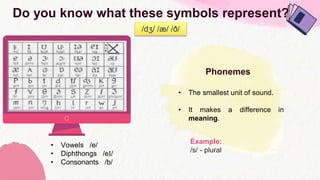
• The smallest unit of sound.
• It makes a difference in
meaning.
Do you know what these symbols represent?
Phonemes
/dʒ/ /æ/ /ð/
• Vowels /e/
• Diphthongs /eI/
• Consonants /b/
Example:
/s/ - plural
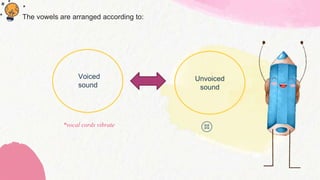
Voiced
sound
Unvoiced
sound
*vocal cords vibrate
The vowels are arranged according to:
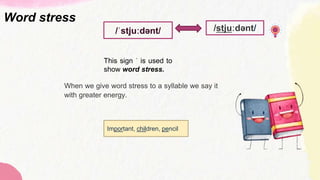
/ˈstjuːdənt/
This sign ˈ is used to
show word stress.
/stjuːdənt/
When we give word stress to a syllable we say it
with greater energy.
Word stress
Important, children, pencil
Sentence stress
● Different parts of the sentence
have more or less stress.
Main
stress
Secondary
stress
Example:
She came home late last night
Main stress: late
Secondary stress: came, home, last, night
Unstressed word: she
Contrastive stress
● To put the stress in an unexpected
word in a sentence.
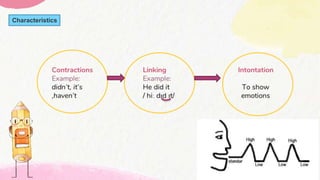
• It is when all the words join to make
a connected stream of sounds.
Do you know what is connected
speech?
ANSWER
Characteristics
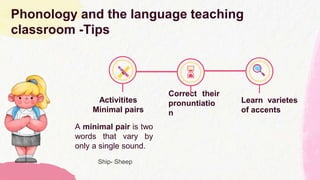
Activitites
Minimal pairs
Correct their
pronuntiatio
n
Learn varietes
of accents
Phonology and the language teaching
classroom -Tips
Ship- Sheep
A minimal pair is two
words that vary by
only a single sound.
Unit 4
Functions
“Education is not a problem.
Education is an opportunity.”
-Lyndon. B Johnson
11
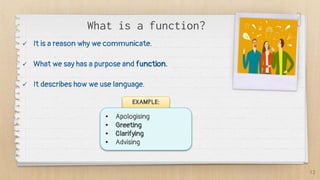
What is a function?
12
 It is a reason why we communicate.
 What we say has a purpose and function.
 It describes how we use language.
EXAMPLE:
• Apologising
• Greeting
• Clarifying
• Advising
What do you think
an exponent is?
Exponent
14
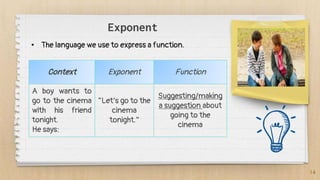
• The language we use to express a function.
Context Exponent Function
A boy wants to
go to the cinema
with his friend
tonight.
He says:
“Let’s go to the
cinema
tonight.”
Suggesting/making
a suggestion about
going to the
cinema
15
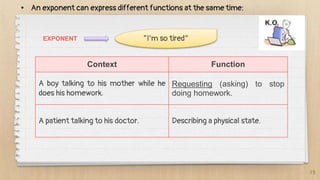
Context Function
A boy talking to his mother while he
does his homework.
Requesting (asking) to stop
doing homework.
A patient talking to his doctor. Describing a physical state.
• An exponent can express different functions at the same time:
“I’m so tired”
EXPONENT
16
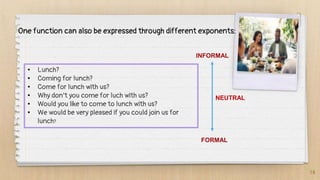
One function can also be expressed through different exponents:
• Lunch?
• Coming for lunch?
• Come for lunch with us?
• Why don’t you come for luch with us?
• Would you like to come to lunch with us?
• We would be very pleased if you could join us for
lunch?
INFORMAL
FORMAL
NEUTRAL
17
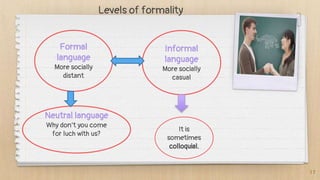
Levels of formality
Informal
language
More socially
casual
Formal
language
More socially
distant
It is
sometimes
colloquial.
Neutral language
Why don’t you come
for luch with us?
18
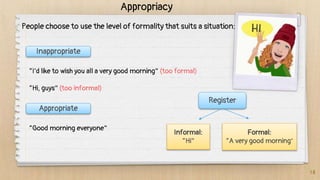
Appropriacy
People choose to use the level of formality that suits a situation:
Inappropriate
“I’d like to wish you all a very good morning” (too formal)
“Hi, guys” (too informal)
Appropriate
“Good morning everyone”
Register
Informal:
“Hi”
Formal:
“A very good morning”
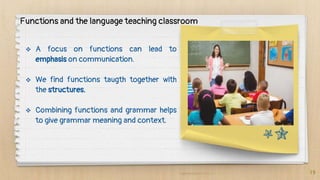
 A focus on functions can lead to
emphasis on communication.
 We find functions taugth together with
the structures.
 Combining functions and grammar helps
to give grammar meaning and context.
19
Functions and the language teaching classroom
20
Bibliography:
Spratt, M., Pulverness, A., & Williams, M. (2011). The TKT course (pp.21-29). Ernst Klett
Sprachen.

Phonology.pdf

  • 1.
  • 2.
    • It includesphonemes, word stress, sentence stress, and intonation • It studies the sound features used in a language DEFINITION:
  • 3.
    • The smallestunit of sound. • It makes a difference in meaning. Do you know what these symbols represent? Phonemes /dʒ/ /æ/ /ð/ • Vowels /e/ • Diphthongs /eI/ • Consonants /b/ Example: /s/ - plural
  • 4.
  • 5.
    /ˈstjuːdənt/ This sign ˈis used to show word stress. /stjuːdənt/ When we give word stress to a syllable we say it with greater energy. Word stress Important, children, pencil
  • 6.
    Sentence stress ● Differentparts of the sentence have more or less stress. Main stress Secondary stress Example: She came home late last night Main stress: late Secondary stress: came, home, last, night Unstressed word: she Contrastive stress ● To put the stress in an unexpected word in a sentence.
  • 7.
    • It iswhen all the words join to make a connected stream of sounds. Do you know what is connected speech? ANSWER
  • 8.
  • 9.
    Activitites Minimal pairs Correct their pronuntiatio n Learnvarietes of accents Phonology and the language teaching classroom -Tips Ship- Sheep A minimal pair is two words that vary by only a single sound.
  • 10.
  • 11.
    “Education is nota problem. Education is an opportunity.” -Lyndon. B Johnson 11
  • 12.
    What is afunction? 12  It is a reason why we communicate.  What we say has a purpose and function.  It describes how we use language. EXAMPLE: • Apologising • Greeting • Clarifying • Advising
  • 13.
    What do youthink an exponent is?
  • 14.
    Exponent 14 • The languagewe use to express a function. Context Exponent Function A boy wants to go to the cinema with his friend tonight. He says: “Let’s go to the cinema tonight.” Suggesting/making a suggestion about going to the cinema
  • 15.
    15 Context Function A boytalking to his mother while he does his homework. Requesting (asking) to stop doing homework. A patient talking to his doctor. Describing a physical state. • An exponent can express different functions at the same time: “I’m so tired” EXPONENT
  • 16.
    16 One function canalso be expressed through different exponents: • Lunch? • Coming for lunch? • Come for lunch with us? • Why don’t you come for luch with us? • Would you like to come to lunch with us? • We would be very pleased if you could join us for lunch? INFORMAL FORMAL NEUTRAL
  • 17.
    17 Levels of formality Informal language Moresocially casual Formal language More socially distant It is sometimes colloquial. Neutral language Why don’t you come for luch with us?
  • 18.
    18 Appropriacy People choose touse the level of formality that suits a situation: Inappropriate “I’d like to wish you all a very good morning” (too formal) “Hi, guys” (too informal) Appropriate “Good morning everyone” Register Informal: “Hi” Formal: “A very good morning”
  • 19.
     A focuson functions can lead to emphasis on communication.  We find functions taugth together with the structures.  Combining functions and grammar helps to give grammar meaning and context. 19 Functions and the language teaching classroom
  • 20.
    20 Bibliography: Spratt, M., Pulverness,A., & Williams, M. (2011). The TKT course (pp.21-29). Ernst Klett Sprachen.