Week 3 Phonology
SESSION 2
RUSSELL RODRIGO
2
Structure UsePragmatics
Meaning (semantics)Grammar
Medium of
Transmission
Phonetics Phonology MorphologySyntax Lexicon Discourse
Structure of Spoken Language (from Crystal 1997)
Phonology
The study of the sound patterns in languages
 Phonemes (vowels and consonants)
 Prosody (stress, rhythm and intonation)
3
PHONETICS
 The scientific study of speech sounds –
 their description, classification and transcription
(i) Articulatory phonetics: How speech sounds are articulated -- i.e. what speech organs are involved,
and what physical gestures or configurations are required to produce the sounds in question.
(ii) Acoustic phonetics: The physical properties of the sound waves generated by speech -- e.g. the
frequency of oscillation (how many cycles per second), amplitude (how loud), and duration (for how long).
(iii) Auditory phonetics: How speech sounds are perceived by the hearer as having certain auditory
properties that differentiate them from each other, such as the quality of the sound (is it [i] or [e]?), the
pitch (high or low), loudness, length, and so on.
PHONETIC CLASSIFICATION
 Two broad distinctions:
(i)Vowels: sounds which are made with a smooth,
continuous, unobstructed airflow through the oral cavity
(e.g. [i:] as in see or [u:] as in too)
(ii)Consonants: sounds which are made with some
obstruction to the airflow in the oral cavity (e.g. [s] as
in see or [t] as in too)
What is the difference between phonetics
and phonology?
 Phonology deals with the sound systems of languages
 Phonetics deals with the physical realisation of the
elements of the sound system, e.g. how the sound is physically
produced (articulatory phonetics), or the acoustic characteristics of
the speech sound (acoustic phonetics)
6
Key concepts: the phoneme
 The smallest speech sound that has linguistic value
 When a series of phones are similar in terms of articulation
and can be distinguished from another group in terms of
meaning and collocation, the group is given a name e.g.
/t/. This is a phoneme.
 The phoneme is an abstract term, specific to a particular
language.
7
Key concepts: phonetic
 Each time a speech sound is produced it is different.
 Each time you produce a /t/ it will be ever so slightly
different.
 Hence the concept of the phone: a physical realisation of a
speech sound.
8
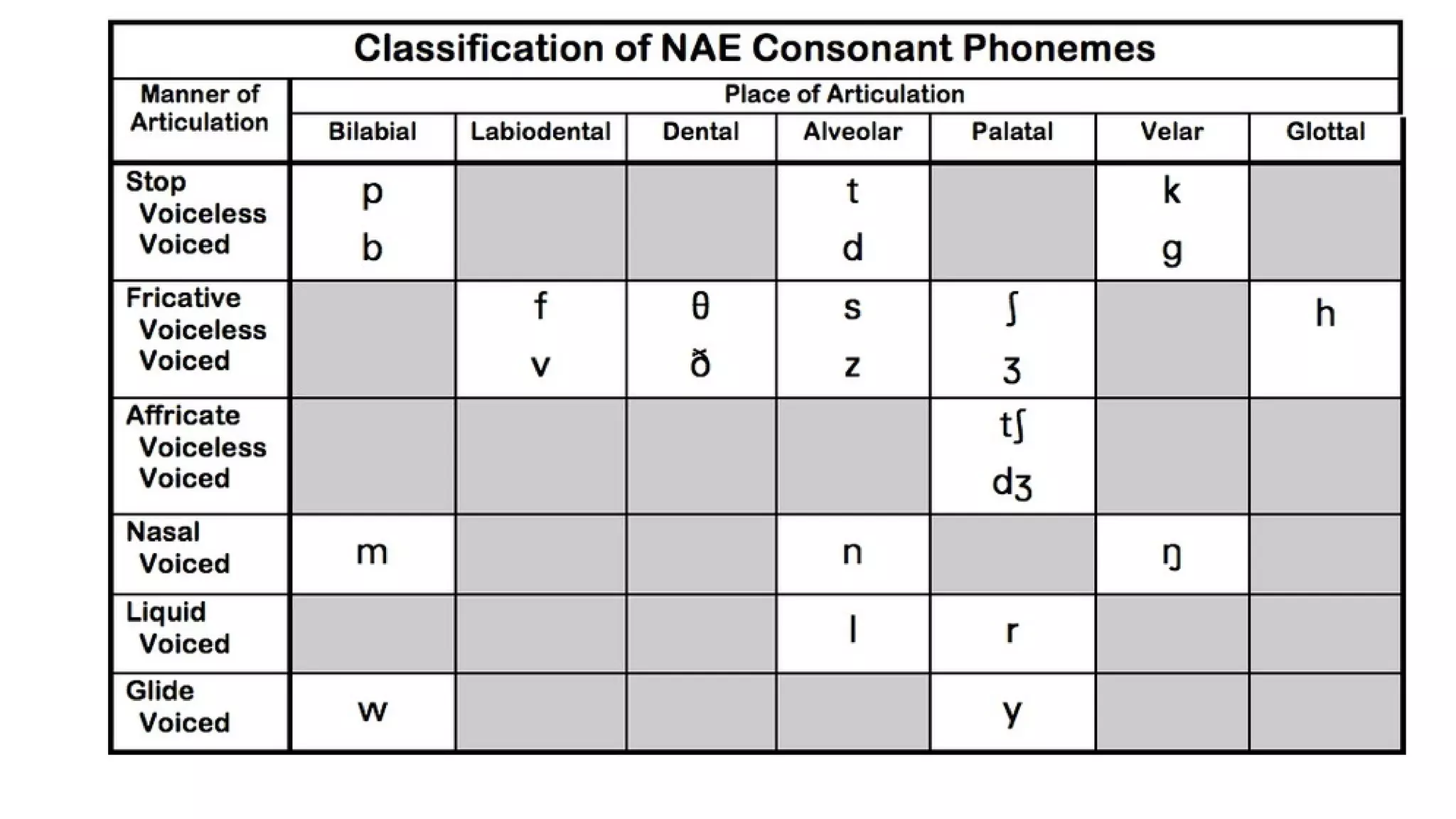
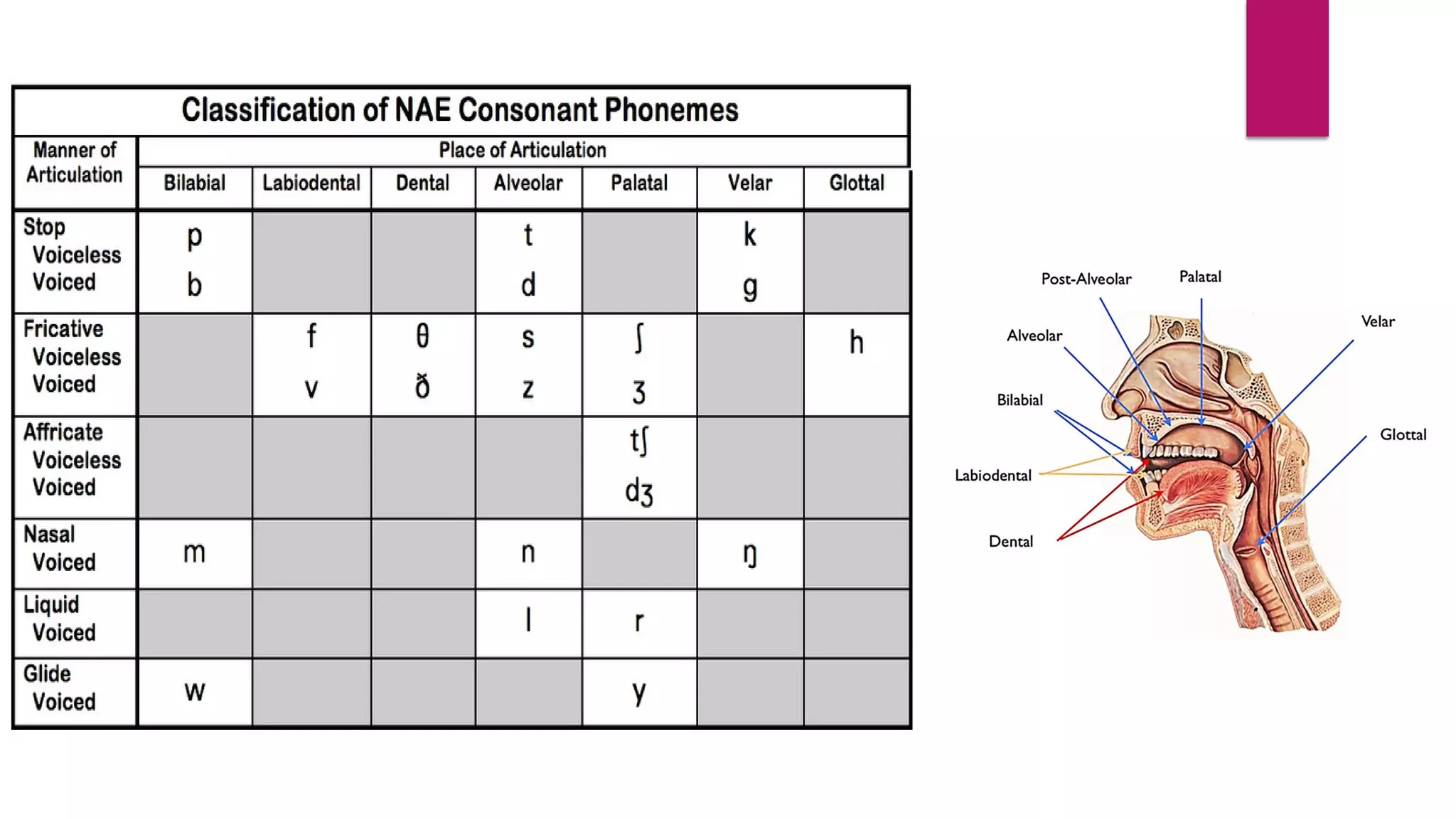
Place of
Articulation
Consonant
Phonemes
Ii. Place of Articulation
Consonants
I. Manner Of Articulation
14
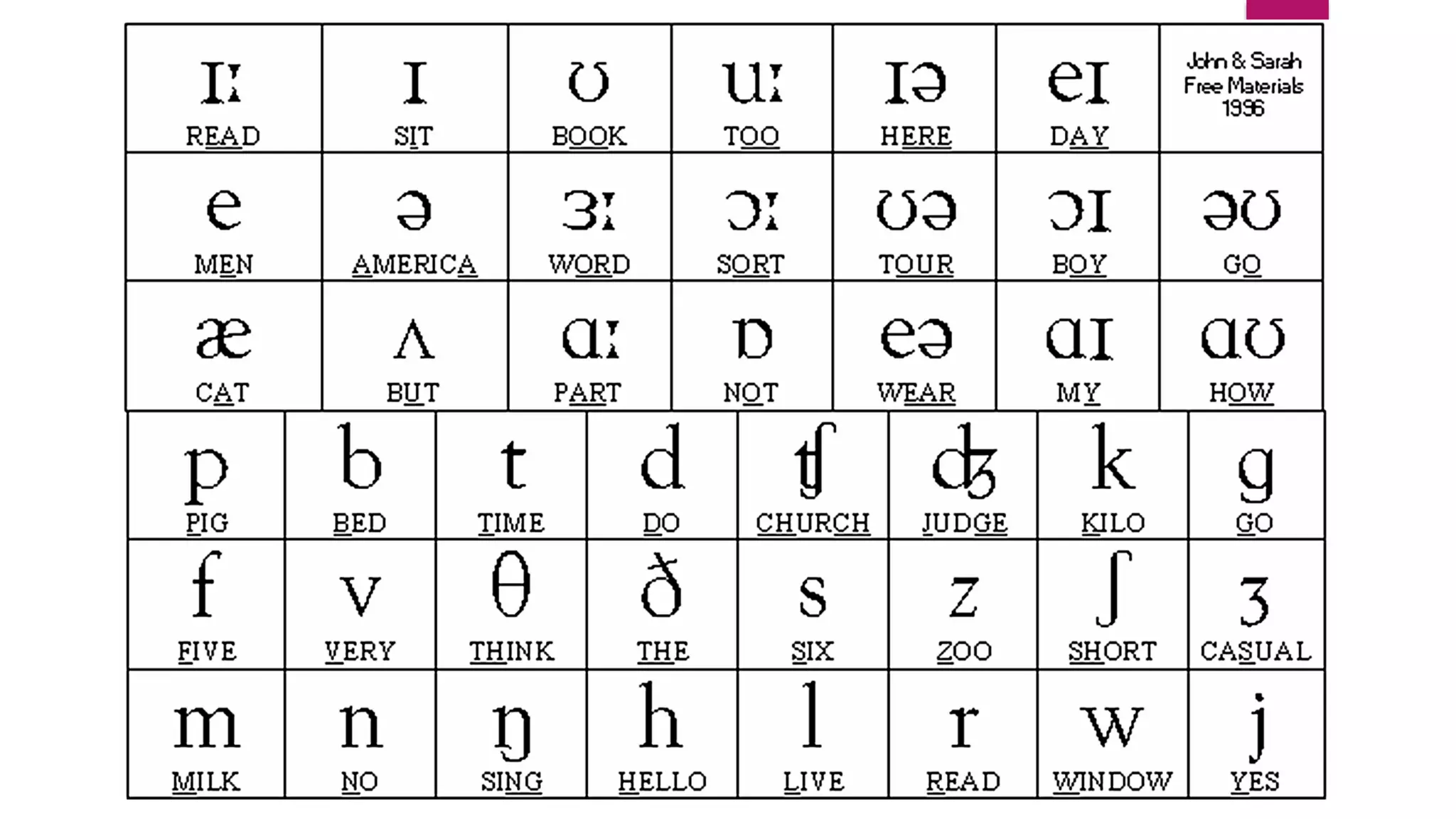
Vowels
Vowels
1. The height to which the body of the tongue is raised,
whether it is high, low, or in between (mid);
2. How forward the body of the tongue is, whether it is
front (advanced), central, or back (retracted);
3. Whether the lips are rounded or unrounded.
17
18
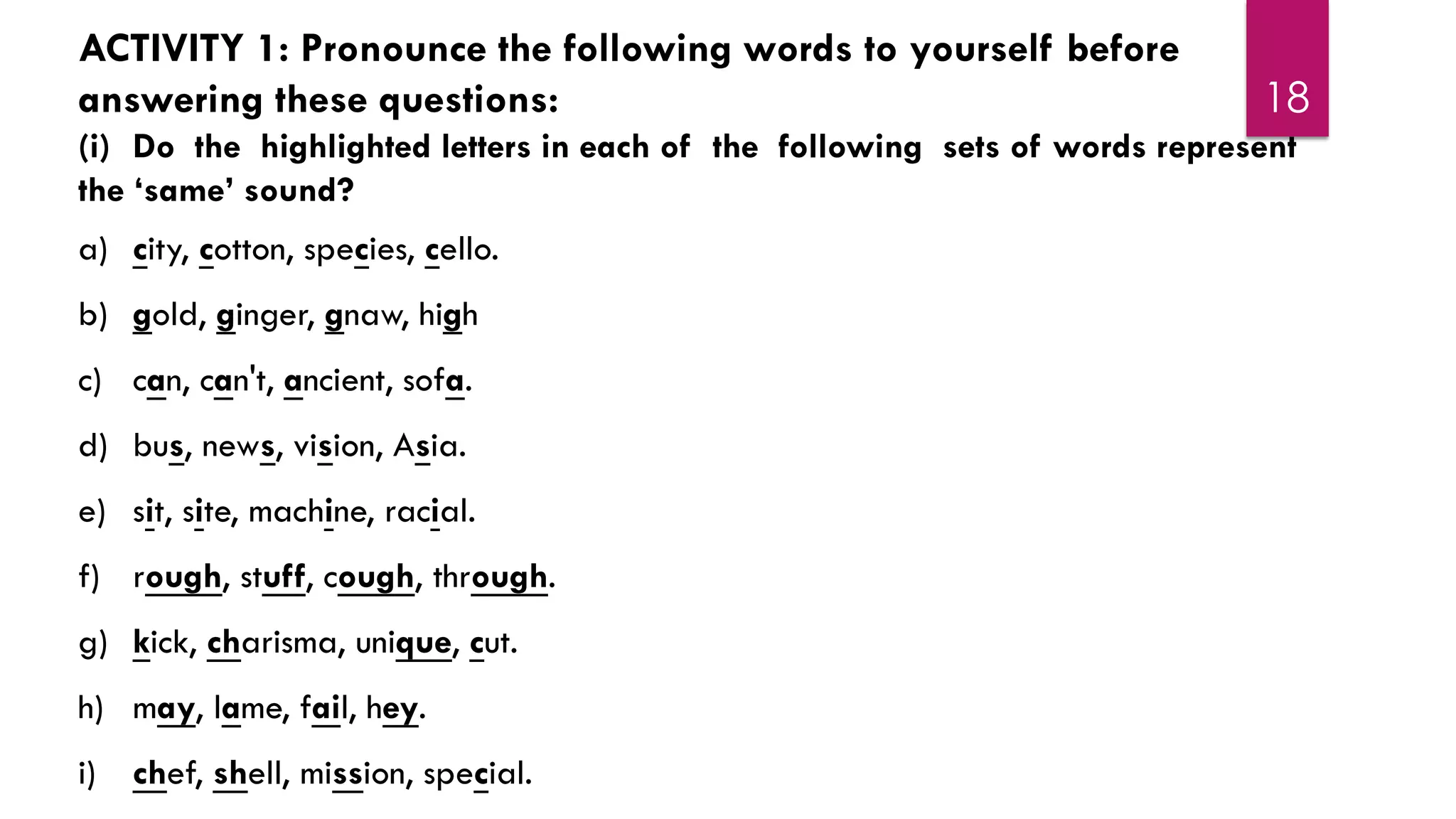
ACTIVITY 1: Pronounce the following words to yourself before
answering these questions:
(i) Do the highlighted letters in each of the following sets of words represent
the ‘same’ sound?
a) city, cotton, species, cello.
b) gold, ginger, gnaw, high
c) can, can't, ancient, sofa.
d) bus, news, vision, Asia.
e) sit, site, machine, racial.
f) rough, stuff, cough, through.
g) kick, charisma, unique, cut.
h) may, lame, fail, hey.
i) chef, shell, mission, special.
ii) How many sounds do the highlighted letters
represent in each of the following words?
tax, thing, schedule, school, are, though, chrome.
20
ACTIVITY 4
(i) Transcribe the following words, using the phonetic
alphabet given above. Remember: don't confuse letters
(or the spelling) with sounds. [NB. Some of you may
pronounce certain words differently, which will naturally
lead to differences in transcription. There's nothing wrong
with that.] Compare your transcriptions with each other,
and with those given in a standard dictionary (such as the
Longman Dictionary of Contemporary English).
(1) rough, (2) debt, (3) psyche, (4) schedule, (5) judge, (6)
yacht, (7) march, (8) useful, (9) queen, (10) chalk
Activity 5
Given below are some phonetic transcriptions. Can you
pronounce them aloud, and identify the words that they
represent?
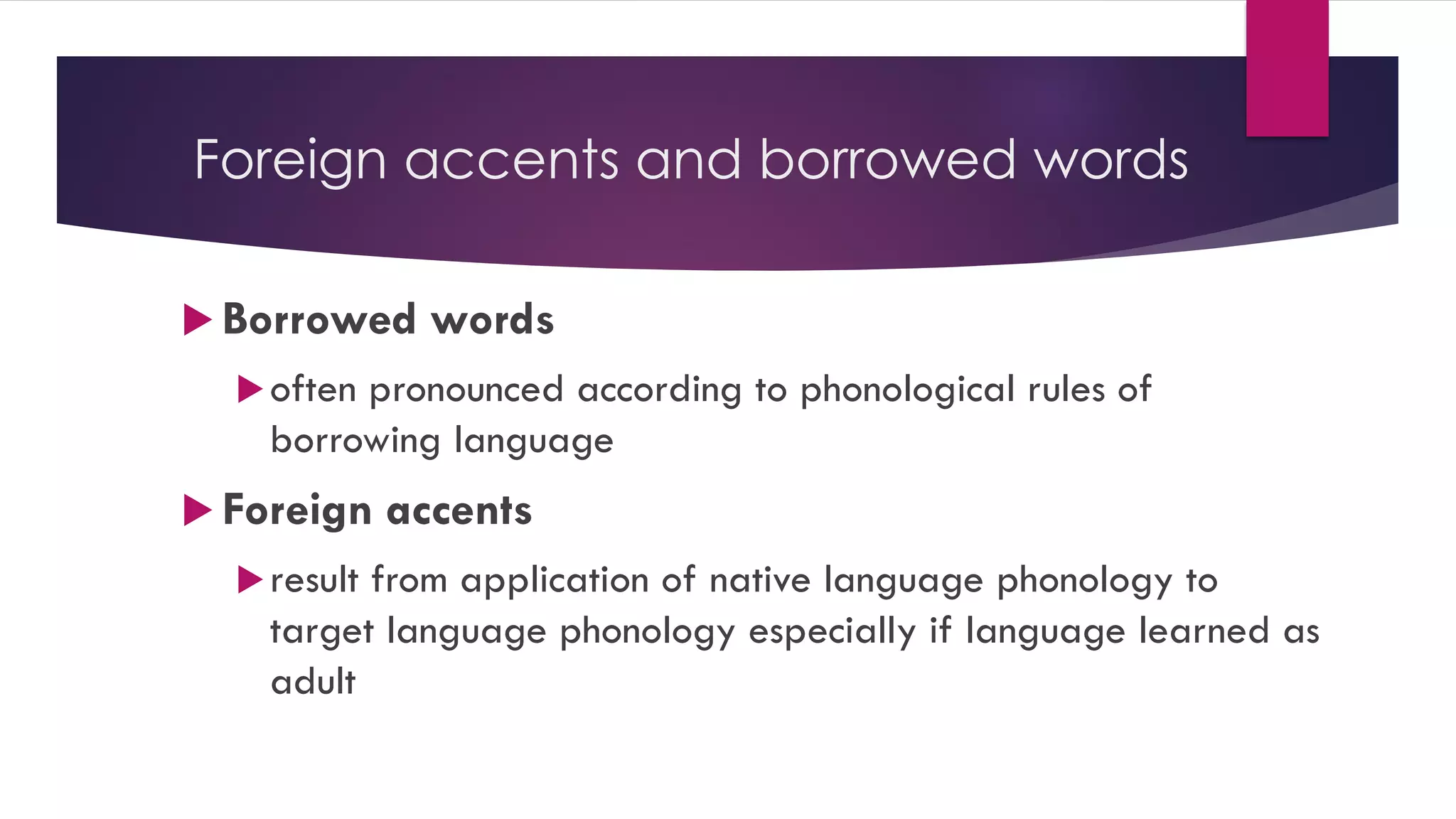
Foreign accents and borrowed words
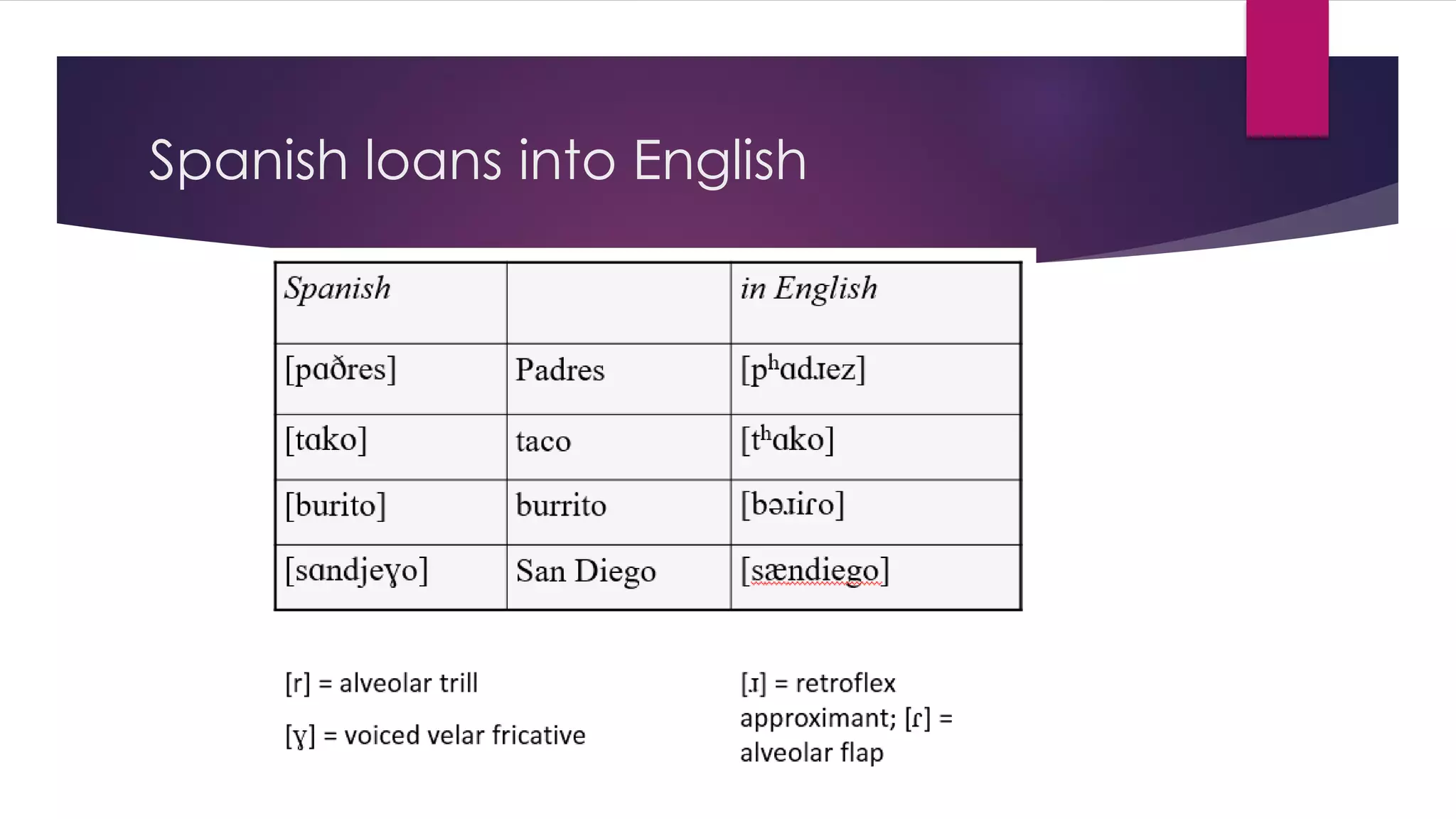
 Borrowed words
often pronounced according to phonological rules of
borrowing language
 Foreign accents
result from application of native language phonology to
target language phonology especially if language learned as
adult
Spanish loans into English
Usefulness of Phonetics
and Phonology
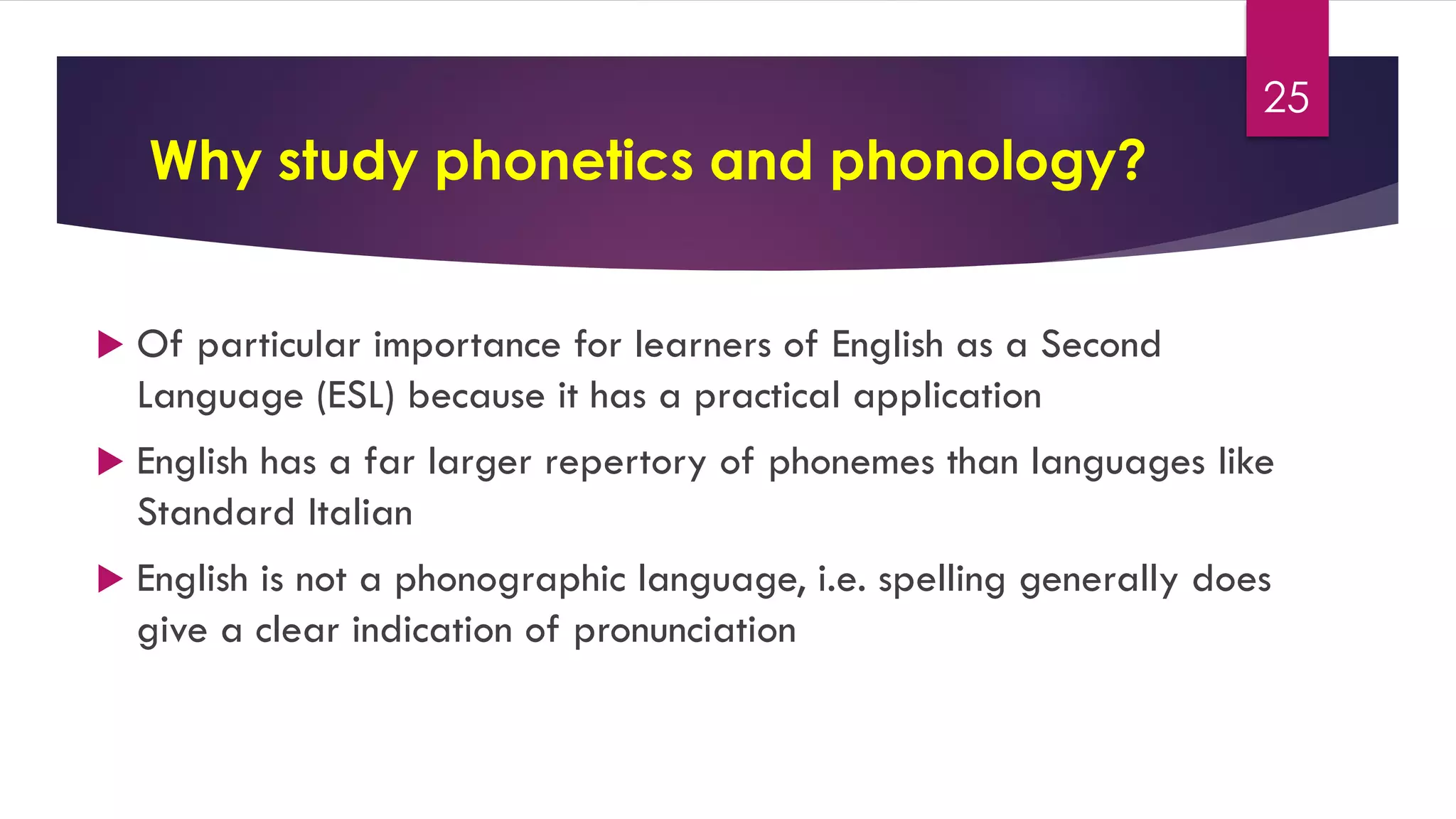
Why study phonetics and phonology?
 Of particular importance for learners of English as a Second
Language (ESL) because it has a practical application
 English has a far larger repertory of phonemes than languages like
Standard Italian
 English is not a phonographic language, i.e. spelling generally does
give a clear indication of pronunciation
25
English is not a phonographic
language
 Many sounds have several different spellings,
 e.g. go, though, foe, slow, boat;
 or George, Joe, badge, village
 Many “same spellings” have different sounds,
 e.g. <ough>: though, cough, bough, through, thought, and
enough.
26
The problem of pronunciation for
learners of ESL
 Learners cannot rely on the spelling of a word.
 The problem is the opposite for native speakers – English
schoolchildren spend incredible amounts of time learning to
read and esp. to write. Many adults have very poor spelling.
 To learn to pronounce English correctly it is of great help to
learn to read phonemic transcription and/or have a CD
dictionary with sound.
27
Even the predictable combinations in English
are different to those of other languages
<ai> usually corresponds to /ei/, e.g.
pain, paid, almost never to /ai/
<ch> usually, but not always,
corresponds to /tò/ at the start of a
word, e.g. cheese but not choir
28
Is English spelling really so erratic?
 83% of English words have predictable spelling.
 However, the remaining 17% is comprised of the most
commonly used, everyday words.
 Therefore the greatest difficulties are faced by the
learner at the start.
29
Why is English spelling so erratic? (1)
 Not enough vowel letters for vowel sounds
 English does not use accents, umlauts etc.
 English spelling reflects many archaic forms of
pronunciation e.g. night in the past, was
pronounced with a fricative
30
Why is English spelling so erratic? (2)
 English has always resisted spelling reforms and academies to
set standards.
 English spelling became fixed in the 16th-17th c. with the arrival
of printing. Many of the printers were Flemish and had little
knowledge of the language.
 English has borrowed extensively from other languages and has
tended to maintain original spelling.
31

Week 3 phonology copy

  • 1.
    Week 3 Phonology SESSION2 RUSSELL RODRIGO
  • 2.
    2 Structure UsePragmatics Meaning (semantics)Grammar Mediumof Transmission Phonetics Phonology MorphologySyntax Lexicon Discourse Structure of Spoken Language (from Crystal 1997)
  • 3.
    Phonology The study ofthe sound patterns in languages  Phonemes (vowels and consonants)  Prosody (stress, rhythm and intonation) 3
  • 4.
    PHONETICS  The scientificstudy of speech sounds –  their description, classification and transcription (i) Articulatory phonetics: How speech sounds are articulated -- i.e. what speech organs are involved, and what physical gestures or configurations are required to produce the sounds in question. (ii) Acoustic phonetics: The physical properties of the sound waves generated by speech -- e.g. the frequency of oscillation (how many cycles per second), amplitude (how loud), and duration (for how long). (iii) Auditory phonetics: How speech sounds are perceived by the hearer as having certain auditory properties that differentiate them from each other, such as the quality of the sound (is it [i] or [e]?), the pitch (high or low), loudness, length, and so on.
  • 5.
    PHONETIC CLASSIFICATION  Twobroad distinctions: (i)Vowels: sounds which are made with a smooth, continuous, unobstructed airflow through the oral cavity (e.g. [i:] as in see or [u:] as in too) (ii)Consonants: sounds which are made with some obstruction to the airflow in the oral cavity (e.g. [s] as in see or [t] as in too)
  • 6.
    What is thedifference between phonetics and phonology?  Phonology deals with the sound systems of languages  Phonetics deals with the physical realisation of the elements of the sound system, e.g. how the sound is physically produced (articulatory phonetics), or the acoustic characteristics of the speech sound (acoustic phonetics) 6
  • 7.
    Key concepts: thephoneme  The smallest speech sound that has linguistic value  When a series of phones are similar in terms of articulation and can be distinguished from another group in terms of meaning and collocation, the group is given a name e.g. /t/. This is a phoneme.  The phoneme is an abstract term, specific to a particular language. 7
  • 8.
    Key concepts: phonetic Each time a speech sound is produced it is different.  Each time you produce a /t/ it will be ever so slightly different.  Hence the concept of the phone: a physical realisation of a speech sound. 8
  • 9.
  • 10.
    Ii. Place ofArticulation
  • 11.
  • 14.
  • 15.
    Vowels 1. The heightto which the body of the tongue is raised, whether it is high, low, or in between (mid); 2. How forward the body of the tongue is, whether it is front (advanced), central, or back (retracted); 3. Whether the lips are rounded or unrounded.
  • 17.
  • 18.
    18 ACTIVITY 1: Pronouncethe following words to yourself before answering these questions: (i) Do the highlighted letters in each of the following sets of words represent the ‘same’ sound? a) city, cotton, species, cello. b) gold, ginger, gnaw, high c) can, can't, ancient, sofa. d) bus, news, vision, Asia. e) sit, site, machine, racial. f) rough, stuff, cough, through. g) kick, charisma, unique, cut. h) may, lame, fail, hey. i) chef, shell, mission, special.
  • 19.
    ii) How manysounds do the highlighted letters represent in each of the following words? tax, thing, schedule, school, are, though, chrome.
  • 20.
    20 ACTIVITY 4 (i) Transcribethe following words, using the phonetic alphabet given above. Remember: don't confuse letters (or the spelling) with sounds. [NB. Some of you may pronounce certain words differently, which will naturally lead to differences in transcription. There's nothing wrong with that.] Compare your transcriptions with each other, and with those given in a standard dictionary (such as the Longman Dictionary of Contemporary English). (1) rough, (2) debt, (3) psyche, (4) schedule, (5) judge, (6) yacht, (7) march, (8) useful, (9) queen, (10) chalk
  • 21.
    Activity 5 Given beloware some phonetic transcriptions. Can you pronounce them aloud, and identify the words that they represent?
  • 22.
    Foreign accents andborrowed words  Borrowed words often pronounced according to phonological rules of borrowing language  Foreign accents result from application of native language phonology to target language phonology especially if language learned as adult
  • 23.
  • 24.
  • 25.
    Why study phoneticsand phonology?  Of particular importance for learners of English as a Second Language (ESL) because it has a practical application  English has a far larger repertory of phonemes than languages like Standard Italian  English is not a phonographic language, i.e. spelling generally does give a clear indication of pronunciation 25
  • 26.
    English is nota phonographic language  Many sounds have several different spellings,  e.g. go, though, foe, slow, boat;  or George, Joe, badge, village  Many “same spellings” have different sounds,  e.g. <ough>: though, cough, bough, through, thought, and enough. 26
  • 27.
    The problem ofpronunciation for learners of ESL  Learners cannot rely on the spelling of a word.  The problem is the opposite for native speakers – English schoolchildren spend incredible amounts of time learning to read and esp. to write. Many adults have very poor spelling.  To learn to pronounce English correctly it is of great help to learn to read phonemic transcription and/or have a CD dictionary with sound. 27
  • 28.
    Even the predictablecombinations in English are different to those of other languages <ai> usually corresponds to /ei/, e.g. pain, paid, almost never to /ai/ <ch> usually, but not always, corresponds to /tò/ at the start of a word, e.g. cheese but not choir 28
  • 29.
    Is English spellingreally so erratic?  83% of English words have predictable spelling.  However, the remaining 17% is comprised of the most commonly used, everyday words.  Therefore the greatest difficulties are faced by the learner at the start. 29
  • 30.
    Why is Englishspelling so erratic? (1)  Not enough vowel letters for vowel sounds  English does not use accents, umlauts etc.  English spelling reflects many archaic forms of pronunciation e.g. night in the past, was pronounced with a fricative 30
  • 31.
    Why is Englishspelling so erratic? (2)  English has always resisted spelling reforms and academies to set standards.  English spelling became fixed in the 16th-17th c. with the arrival of printing. Many of the printers were Flemish and had little knowledge of the language.  English has borrowed extensively from other languages and has tended to maintain original spelling. 31