







By Ingrida Užkurytė
o Show the background of the approach
o Define the approach
o Give examples

o Make the concusion
o The origins of the communicative approach are found in
the changes in the British language teaching tradition in
the late 1960s.

o Situational

approach was the major approach at that

time.

o The

need to focus language teaching
communicative proficiency became important.

on

the
o In

the min-1970s the scope of the communicative
approach expanded.

o The

communicative approach changed the situational
approach.
o “A method of teaching a foreign language which stresses
the importance of learning to communicate information
and
ideas
in
the
language.”
(http://oald8.oxfordlearnersdictionaries.com)

o In other words, it is a kind of foreign language teaching,
which is based on the communication using the target
language.
o According to Larsen-Freeman (2000), the most important
characteristic of the communicative language teaching is
that: “almost everything that is done is done with the
communicative intent.”(2000:132).

o The

same author states that the best way to learn
foreign language by using a communicative approach is to
carry out activities in small groups of students. For
instance, the teacher gives for students a topic and then
they are divided into small groups to communicate with
each other about the given topic. Through this kind of
activities students are engaged in meaningful and
authentic language use rather than in the simply
mechanical practice of language patterns.
oAccording

to Richards (2006) completing tasks in this way
students gain several benefits:
• They can learn from hearing the language used by other
members of the group.
• They will produce a greater amount of language than
they would use in teacher-fronted activities.
• Their motivational level is likely to increase.
• They will have the chance to develop fluency.”(2006:20)

o An

example of the lesson where the communicative
approach is used for learning:
http://www.youtube.com/watch?v=3kRT-rsKxn4 (7:48 –
10:30)
o According

to Savignon (1972) the communicative competence
is: “the ability to function in a truly communicative setting –
that is, in a dynamic exchange in which linguistic competence
must adapt itself to the total informational input, both
linguistic and paralinguistic, of one or more interlocutors.”
(1972:8)

o Also,

Savignon (1972) describes the communicative
competence as: “the ability to engage in the interpretation,
expression, and negotiation of meaning.”(1972:8)
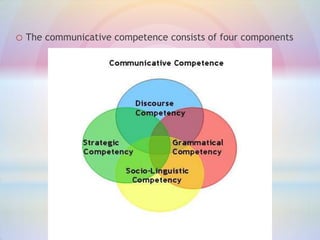
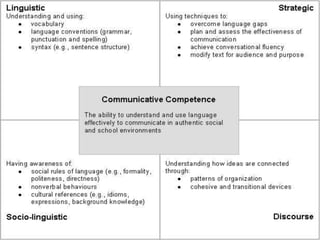
o The communicative competence consists of four components
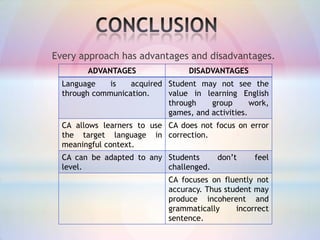
Every approach has advantages and disadvantages.
ADVANTAGES

DISADVANTAGES

Language
is
acquired Student may not see the
through communication.
value in learning English
through
group
work,
games, and activities.
CA allows learners to use CA does not focus on error
the target language in correction.
meaningful context.

CA can be adapted to any Students
don’t
level.
challenged.

feel

CA focuses on fluently not
accuracy. Thus student may
produce incoherent and
grammatically
incorrect
sentence.
o Youtube.com. (2013) http://www.youtube.com/watch?v=3kRT-rsKxn4
o Larsen-Freeman, Diane. 2000. Techniques and Principles in Language Teaching.
New York: Oxford University Press.

o Nunan, David. 1991. Language Teaching Methodology: A Textbook for Teachers.
Prentice Hall.

o Oxfordlearnersdictionary.com. (2013)
http://oald8.oxfordlearnersdictionaries.com/

o Richards, Jack Clifton. 2006. Communicative language teaching today. New York:
Cambridge University Press.

o Richards, Jack

Clifton, and Rodgers, Theodore S. 1986. Approaches and methods
in language teaching: A description and analysis. Cambridge: Cambridge
University Press.

o Savignon, Sandra J. 1972. Communicative Competence: An Experiment in ForeignLanguage Teaching. Philadelphia: The Centre for Curriculum Development
THANK YOU
FOR YOUR
ATTENTION!
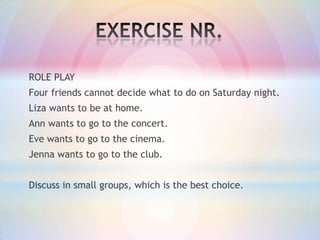
ROLE PLAY
Four friends cannot decide what to do on Saturday night.
Liza wants to be at home.
Ann wants to go to the concert.

Eve wants to go to the cinema.
Jenna wants to go to the club.
Discuss in small groups, which is the best choice.

Communicative approach

  • 1.
  • 2.
    o Show thebackground of the approach o Define the approach o Give examples o Make the concusion
  • 3.
    o The originsof the communicative approach are found in the changes in the British language teaching tradition in the late 1960s. o Situational approach was the major approach at that time. o The need to focus language teaching communicative proficiency became important. on the
  • 4.
    o In the min-1970sthe scope of the communicative approach expanded. o The communicative approach changed the situational approach.
  • 5.
    o “A methodof teaching a foreign language which stresses the importance of learning to communicate information and ideas in the language.” (http://oald8.oxfordlearnersdictionaries.com) o In other words, it is a kind of foreign language teaching, which is based on the communication using the target language.
  • 7.
    o According toLarsen-Freeman (2000), the most important characteristic of the communicative language teaching is that: “almost everything that is done is done with the communicative intent.”(2000:132). o The same author states that the best way to learn foreign language by using a communicative approach is to carry out activities in small groups of students. For instance, the teacher gives for students a topic and then they are divided into small groups to communicate with each other about the given topic. Through this kind of activities students are engaged in meaningful and authentic language use rather than in the simply mechanical practice of language patterns.
  • 8.
    oAccording to Richards (2006)completing tasks in this way students gain several benefits: • They can learn from hearing the language used by other members of the group. • They will produce a greater amount of language than they would use in teacher-fronted activities. • Their motivational level is likely to increase. • They will have the chance to develop fluency.”(2006:20) o An example of the lesson where the communicative approach is used for learning: http://www.youtube.com/watch?v=3kRT-rsKxn4 (7:48 – 10:30)
  • 9.
    o According to Savignon(1972) the communicative competence is: “the ability to function in a truly communicative setting – that is, in a dynamic exchange in which linguistic competence must adapt itself to the total informational input, both linguistic and paralinguistic, of one or more interlocutors.” (1972:8) o Also, Savignon (1972) describes the communicative competence as: “the ability to engage in the interpretation, expression, and negotiation of meaning.”(1972:8)
  • 10.
    o The communicativecompetence consists of four components
  • 12.
    Every approach hasadvantages and disadvantages. ADVANTAGES DISADVANTAGES Language is acquired Student may not see the through communication. value in learning English through group work, games, and activities. CA allows learners to use CA does not focus on error the target language in correction. meaningful context. CA can be adapted to any Students don’t level. challenged. feel CA focuses on fluently not accuracy. Thus student may produce incoherent and grammatically incorrect sentence.
  • 13.
    o Youtube.com. (2013)http://www.youtube.com/watch?v=3kRT-rsKxn4 o Larsen-Freeman, Diane. 2000. Techniques and Principles in Language Teaching. New York: Oxford University Press. o Nunan, David. 1991. Language Teaching Methodology: A Textbook for Teachers. Prentice Hall. o Oxfordlearnersdictionary.com. (2013) http://oald8.oxfordlearnersdictionaries.com/ o Richards, Jack Clifton. 2006. Communicative language teaching today. New York: Cambridge University Press. o Richards, Jack Clifton, and Rodgers, Theodore S. 1986. Approaches and methods in language teaching: A description and analysis. Cambridge: Cambridge University Press. o Savignon, Sandra J. 1972. Communicative Competence: An Experiment in ForeignLanguage Teaching. Philadelphia: The Centre for Curriculum Development
  • 14.
  • 16.
    ROLE PLAY Four friendscannot decide what to do on Saturday night. Liza wants to be at home. Ann wants to go to the concert. Eve wants to go to the cinema. Jenna wants to go to the club. Discuss in small groups, which is the best choice.