LODESTAR INSTITUTE
Spoken & Pronunciation Course 69
Part 01 Pronunciation skills
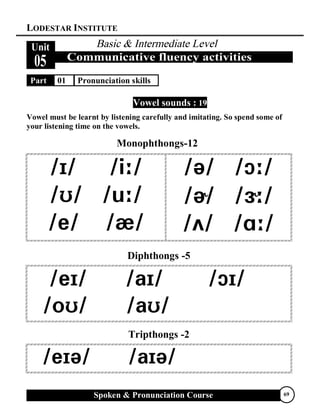
Vowel sounds : 19
Vowel must be learnt by listening carefully and imitating. So spend some of
your listening time on the vowels.
Monophthongs-12






Diphthongs -5


Tripthongs -2

LODESTAR INSTITUTE
Spoken & Pronunciation Course 70
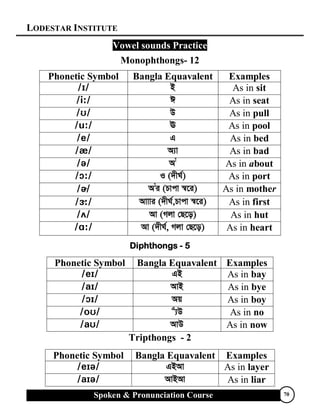
Vowel sounds Practice
Monophthongs- 12
Phonetic Symbol Bangla Equavalent Examples
 B As in sit
 C As in seat
 D As in pull
 E As in pool
 G As in bed
 A¨v As in bad
 Av
As in about
 I (`xN©) As in port
 Av
i (Pvcv ¯^‡i) As in mother
 Avvvi (`xN©,Pvcv ¯^‡i) As in first
 Av (Mjv †Q‡o) As in hut
 Av (`xN©, Mjv †Q‡o) As in heart
Diphthongs - 5
Phonetic Symbol Bangla Equavalent Examples
 GB As in bay
 AvB As in bye
 Aq As in boy
 G
¨D As in no
 AvD As in now
Tripthongs - 2
Phonetic Symbol Bangla Equavalent Examples
 GBAv As in layer
 AvBAv As in liar
LODESTAR INSTITUTE
Spoken & Pronunciation Course 71
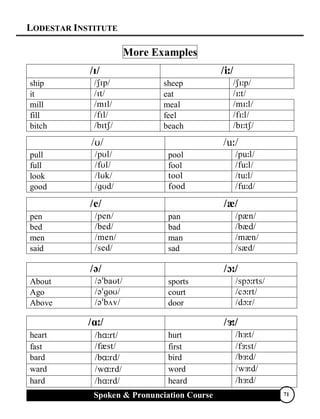
More Examples
 
ship  sheep 
it  eat 
mill  meal 
fill  feel 
bitch  beach 
 
pull  pool 
full  fool 
look   
good   
 
pen  pan 
bed  bad 
men  man 
said  sad 
 
About  sports 
Ago  court 
Above  door 

 
heart  hurt 
fast  first 
bard  bird 
ward  word 
hard  heard 
LODESTAR INSTITUTE
Spoken & Pronunciation Course 72
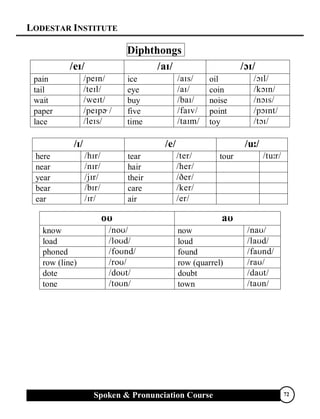
Diphthongs
  
pain  ice  oil 
tail  eye  coin 
wait  buy  noise 
paper  five  point 
lace  time  toy 
  
here  tear  tour 
near  hair  
year  their  
bear  care  
ear  air 
 
know  now 
load  loud 
phoned  found 
row (line)  row (quarrel) 
dote  doubt 
tone  town 
LODESTAR INSTITUTE
Spoken & Pronunciation Course 73
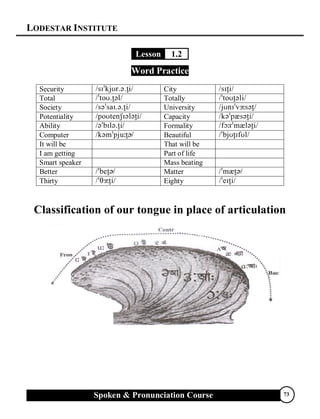
Lesson 1.2
Word Practice
Security  City 
Total  Totally 
Society  University 
Potentiality  Capacity 
Ability  Formality 
Computer  Beautiful 
It will be  That will be 
I am getting  Part of life 
Smart speaker  Mass beating 
Better  Matter 
Thirty  Eighty 
Classification of our tongue in place of articulation



LODESTAR INSTITUTE
Spoken & Pronunciation Course 74
How to pronounce a word
After learning 44 sounds you will have to learn how to pronounce a word
correctly. So, this chapter is very important for you. Let us go ahead.
1. Firstly, find out how many syllables are there in the word.
2. Secondly, notice on which syllable there is stress.
3. Thirdly, try to pronounce all syllables separately.
4. Then, pronounce all syllable together and emphasis the syllable on which there is a
stress.
Example: - Information
All about Syllable
What is syllable?
Phonetically a syllable means a group of one or more sounds.
Grammatically syllable is a part of word, can be pronounced at a time and which has got a
vowel sound.
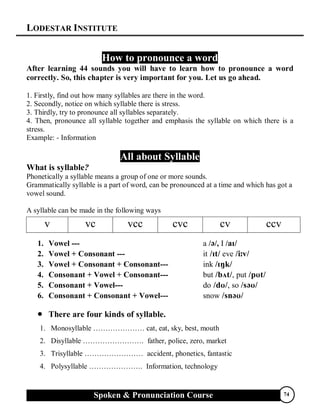
A syllable can be made in the following ways
1. Vowel --- a //, I /
2. Vowel + Consonant --- it eve 
3. Vowel + Consonant + Consonant--- ink 
4. Consonant + Vowel + Consonant--- but , put 
5. Consonant + Vowel--- do, so 
6. Consonant + Consonant + Vowel--- snow 
 There are four kinds of syllable.
1. Monosyllable ………………… cat, eat, sky, best, mouth
2. Disyllable ……………………. father, police, zero, market
3. Trisyllable …………………… accident, phonetics, fantastic
4. Polysyllable …………………. Information, technology
v vc vcc cvc cv ccv
LODESTAR INSTITUTE
Spoken & Pronunciation Course 75
Phonetic characteristics of a syllable
1. Weak syllable …… Always tends to be shorter and always unstressed
2. Strong syllable ….. Most of the time stressed.
 Schwa  is always associated with weak syllable.
 is most of the time associated with weak syllable.
 is most of the time associated with weak syllable.
 Syllabic consonant is always associated with weak syllable.
 On the other hand, all the strong syllable have the opposite characteristics.
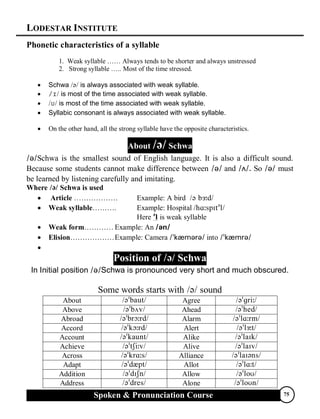
About  Schwa
Schwa is the smallest sound of English language. It is also a difficult sound.
Because some students cannot make difference between and So  must
be learned by listening carefully and imitating.
WhereSchwa is used
 Article ……………… Example: A bird 
 Weak syllable………. Example: Hospital 

    Here 
is weak syllable
 Weak form………… Example: An 
 Elision………………Example: Camera  into 

Position of/ Schwa
In Initial position Schwa is pronounced very short and much obscured.
Some words starts withsound
About  Agree 
Above  Ahead 
Abroad  Alarm 
Accord  Alert 
Account  Alike 
Achieve  Alive 
Across  Alliance 
Adapt  Allot 
Addition  Allow 
Address  Alone 
LODESTAR INSTITUTE
Spoken & Pronunciation Course 76
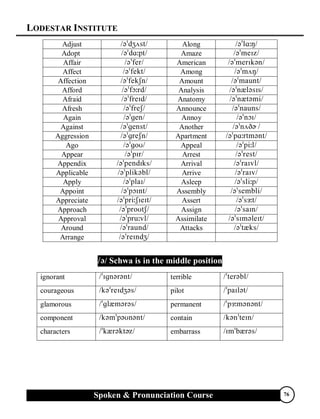
Adjust  Along 
Adopt  Amaze 
Affair  American 
Affect  Among 
Affection  Amount 
Afford  Analysis 
Afraid  Anatomy 
Afresh  Announce 
Again  Annoy 
Against  Another 
Aggression  Apartment 
Ago  Appeal 
Appear  Arrest 
Appendix  Arrival 
Applicable  Arrive 
Apply  Asleep 
Appoint  Assembly 
Appreciate  Assert 
Approach  Assign 
Approval  Assimilate 
Around  Attacks 
Arrange  

/ Schwa is in the middle position
ignorant  terrible 
courageous  pilot 
glamorous  permanent 
component  contain 
characters  embarrass 
LODESTAR INSTITUTE
Spoken & Pronunciation Course 77
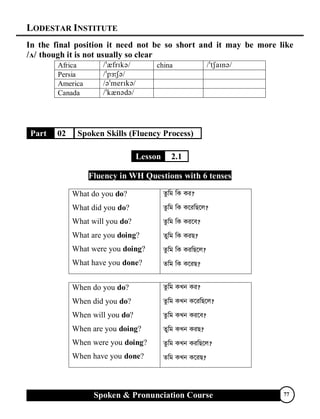
In the final position it need not be so short and it may be more like
though it is not usually so clear
Africa  china 
Persia  
America  
Canada  
Part 02 Spoken Skills (Fluency Process)
Lesson 2.1
Fluency in WH Questions with 6 tenses
What do you do?
What did you do?
What will you do?
What are you doing?
What were you doing?
What have you done?
Zzwg wK Ki?
Zzwg wK K‡iwQ‡j?
Zzwg wK Ki‡e?
Zywg wK KiQ?
Zzwg wK KiwQ‡j?
Zwg wK K‡iQ?
When do you do?
When did you do?
When will you do?
When are you doing?
When were you doing?
When have you done?
Zzwg KLb Ki?
Zzwg KLb K‡iwQ‡j?
Zzwg KLb Ki‡e?
Zywg KLb KiQ?
Zzwg KLb KiwQ‡j?
Zwg KLb K‡iQ?
LODESTAR INSTITUTE
Spoken & Pronunciation Course 78
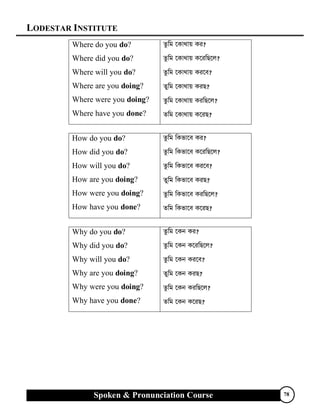
Where do you do?
Where did you do?
Where will you do?
Where are you doing?
Where were you doing?
Where have you done?
Zzwg ‡Kv_vq Ki?
Zzwg ‡Kv_vq K‡iwQ‡j?
Zzwg ‡Kv_vq Ki‡e?
Zywg ‡Kv_vq KiQ?
Zzwg ‡Kv_vq KiwQ‡j?
Zwg ‡Kv_vq K‡iQ?
How do you do?
How did you do?
How will you do?
How are you doing?
How were you doing?
How have you done?
Zzwg wKfv‡e Ki?
Zzwg wKfv‡e K‡iwQ‡j?
Zzwg wKfv‡e Ki‡e?
Zywg wKfv‡e KiQ?
Zzwg wKfv‡e KiwQ‡j?
Zwg wKfv‡e K‡iQ?
Why do you do?
Why did you do?
Why will you do?
Why are you doing?
Why were you doing?
Why have you done?
Zzwg ‡Kb Ki?
Zzwg ‡Kb K‡iwQ‡j?
Zzwg ‡Kb Ki‡e?
Zywg ‡Kb KiQ?
Zzwg ‡Kb KiwQ‡j?
Zwg ‡Kb K‡iQ?
LODESTAR INSTITUTE
Spoken & Pronunciation Course 79
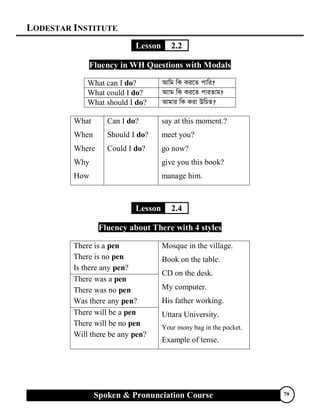
Lesson 2.2
Fluency in WH Questions with Modals
What can I do? Avwg wK Ki‡Z cvwi?
What could I do? Avvg wK Ki‡Z cviZvg?
What should I do? Avgvi wK Kiv DwPZ?
What
When
Where
Why
How
Can I do?
Should I do?
Could I do?
say at this moment.?
meet you?
go now?
give you this book?
manage him.
Lesson 2.4
Fluency about There with 4 styles
There is a pen
There is no pen
Is there any pen?
There was a pen
There was no pen
Was there any pen?
There will be a pen
There will be no pen
Will there be any pen?
Mosque in the village.
Book on the table.
CD on the desk.
My computer.
His father working.
Uttara University.
Your mony bag in the pocket.
Example of tense.
LODESTAR INSTITUTE
Spoken & Pronunciation Course 80
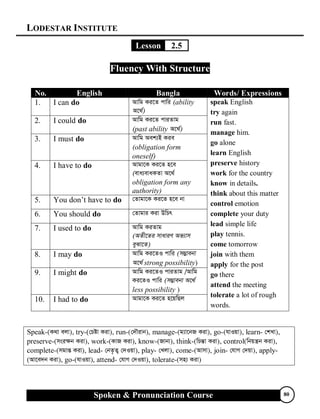
Lesson 2.5
Fluency With Structure
No. English Bangla Words/ Expressions
1. I can do Avwg Ki‡Z cvwi (ability
A‡_©)
2. I could do Avwg Ki‡Z cviZvg
(past ability A‡_©)
3. I must do Avwg Aek¨B Kie
(obligation form
oneself)
4. I have to do Avgv‡K Ki‡Z n‡e
(eva¨evaKZv A‡_©
obligation form any
authority)
5. You don’t have to do †Zvgv‡K Ki‡Z n‡e bv
6. You should do †Zvgvi Kiv DwPr
7. I used to do Avwg KiZvg
(AZx‡Zi mvaviY Af¨vm
eySv‡Z)
8. I may do Avwg Ki‡ZI cvwi (m¤¢vebv
A‡_© strong possibility)
9. I might do Avwg Ki‡ZI cviZvg /Avwg
Ki‡ZI cvwi (m¤¢vebv A‡_©
less possibility )
10. I had to do Avgv‡K Ki‡Z n‡qwQj
speak English
try again
run fast.
manage him.
go alone
learn English
preserve history
work for the country
know in details.
think about this matter
control emotion
complete your duty
lead simple life
play tennis.
come tomorrow
join with them
apply for the post
go there
attend the meeting
tolerate a lot of rough
words.
Speak-(K_v ejv), try-(†Póv Kiv), run-(†`Šivb), manage-(g¨v‡bR Kiv), go-(hvIqv), learn- †kLv),
preserve-(msi¶b Kiv), work-(KvR Kiv), know-(Rvbv), think-(wPš—v Kiv), control(wbqš¿b Kiv),
complete-(mgvß Kiv), lead- †bZ…Z¡ †`Iqv), play- †Ljv), come-(Avmv), join- †hvM †`qv), apply-
(Av‡e`b Kiv), go-(hvIqv), attend- †hvM †`Iqv), tolerate-(mn¨ Kiv)
LODESTAR INSTITUTE
Spoken & Pronunciation Course 81
Part 03 Practical Session
Lesson 3.1
Simple Past: I (did)
School Life
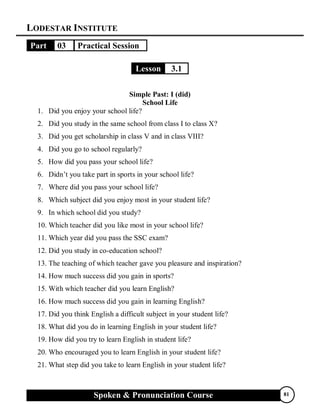
1. Did you enjoy your school life?
2. Did you study in the same school from class I to class X?
3. Did you get scholarship in class V and in class VIII?
4. Did you go to school regularly?
5. How did you pass your school life?
6. Didn’t you take part in sports in your school life?
7. Where did you pass your school life?
8. Which subject did you enjoy most in your student life?
9. In which school did you study?
10. Which teacher did you like most in your school life?
11. Which year did you pass the SSC exam?
12. Did you study in co-education school?
13. The teaching of which teacher gave you pleasure and inspiration?
14. How much success did you gain in sports?
15. With which teacher did you learn English?
16. How much success did you gain in learning English?
17. Did you think English a difficult subject in your student life?
18. What did you do in learning English in your student life?
19. How did you try to learn English in student life?
20. Who encouraged you to learn English in your student life?
21. What step did you take to learn English in your student life?
LODESTAR INSTITUTE
Spoken & Pronunciation Course 82
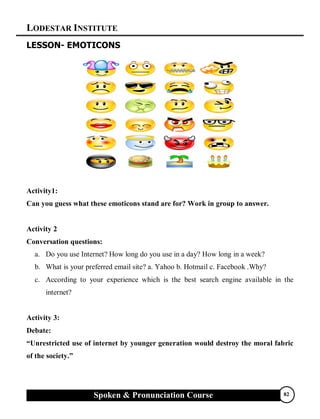
LESSON- EMOTICONS
Activity1:
Can you guess what these emoticons stand are for? Work in group to answer.
Activity 2
Conversation questions:
a. Do you use Internet? How long do you use in a day? How long in a week?
b. What is your preferred email site? a. Yahoo b. Hotmail c. Facebook .Why?
c. According to your experience which is the best search engine available in the
internet?
Activity 3:
Debate:
“Unrestricted use of internet by younger generation would destroy the moral fabric
of the society.”
LODESTAR INSTITUTE
Spoken & Pronunciation Course 83
Part 04 Additional Study Materials (Not for Class)
Lesson 4.1
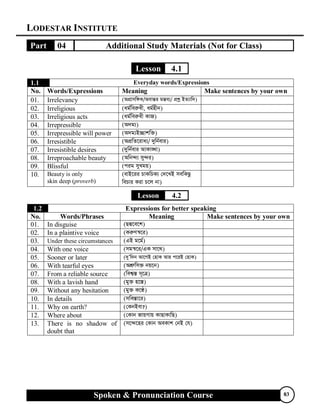
1.1 Everyday words/Expressions
No. Words/Expressions Meaning Make sentences by your own
01. Irrelevancy (AcÖvmw½K/Aevš—i gš—e¨/ cÖkœ BZ¨vw`)
02. Irreligious (ag©wei“ax, ag©nxb)
03. Irreligious acts (ag©wei“ax KvR)
04. Irrepressible (A`g¨)
05. Irrepressible will power (A`g¨B”Qvkw³)
06. Irresistible (AcÖwZ‡iva¨/ `ywb©evi)
07. Irresistible desires (`ywb©evi AvKv•Lv)
08. Irreproachable beauty (Awb›`¨ my›`i)
09. Blissful (cig myLgq)
10. Beauty is only
skin deep (proverb)
(evB‡ii PvKwPK¨ †`‡LB mewKQz
wePvi Kiv P‡j bv)
Lesson 4.2
1.2 Expressions for better speaking
No. Words/Phrases Meaning Make sentences by your own
01. In disguise (QÙ‡e‡k)
02. In a plaintive voice (Ki“Y¯^‡i)
03. Under these circumstances (GB g‡g©)
04. With one voice (mg¯^‡i/GK mv‡_)
05. Sooner or later (`yÕw`b Av‡MB †nvK Avi c‡iB †nvK)
06. With tearful eyes (AkÖ“wm³ bq‡b)
07. From a reliable source (wek¦¯— m~‡Î)
08. With a lavish hand (gy³ n‡¯—)
09. Without any hesitation (gy³ K‡É)
10. In details (mwe¯—v‡i)
11. Why on earth? (†KbBev?)
12. Where about (†Kvb RvqMvq KvQvKvwQ)
13. There is no shadow of
doubt that
(m‡›`‡ni †Kvb AeKvk †bB †h)
LODESTAR INSTITUTE
Spoken & Pronunciation Course 84
Lesson 4.3
Simple Past for Beginners
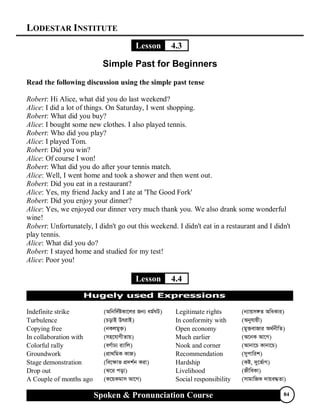
Read the following discussion using the simple past tense
Robert: Hi Alice, what did you do last weekend?
Alice: I did a lot of things. On Saturday, I went shopping.
Robert: What did you buy?
Alice: I bought some new clothes. I also played tennis.
Robert: Who did you play?
Alice: I played Tom.
Robert: Did you win?
Alice: Of course I won!
Robert: What did you do after your tennis match.
Alice: Well, I went home and took a shower and then went out.
Robert: Did you eat in a restaurant?
Alice: Yes, my friend Jacky and I ate at 'The Good Fork'
Robert: Did you enjoy your dinner?
Alice: Yes, we enjoyed our dinner very much thank you. We also drank some wonderful
wine!
Robert: Unfortunately, I didn't go out this weekend. I didn't eat in a restaurant and I didn't
play tennis.
Alice: What did you do?
Robert: I stayed home and studied for my test!
Alice: Poor you!
Lesson 4.4
Indefinite strike (Awbw`©óKv‡ji Rb¨ ag©NU) Legitimate rights (b¨vqm½Z AwaKvi)
Turbulence (PovB DrivB) In conformity with (Abyhvqx)
Copying free (bKjgy³) Open economy (gy³evRvi A_©bxwZ)
In collaboration with (mn‡hvMxZvq) Much earlier (A‡bK Av‡M)
Colorful rally (eY©vX¨ i¨vwj) Nook and corner (Avbv‡P Kvbv‡P)
Groundwork (cÖv_wgK KvR) Recommendation (mycvwik)
Stage demonstration (we‡¶vf cÖ`k©b Kiv) Hardship (Kó, `y‡f©vM)
Drop out (S‡i cov) Livelihood (RxweKv)
A Couple of months ago (K‡qKgvm Av‡M) Social responsibility (mvgvwRK `vqe×Zv)

Spoken & prounuciation lesson 05

  • 1.
    LODESTAR INSTITUTE Spoken &Pronunciation Course 69 Part 01 Pronunciation skills Vowel sounds : 19 Vowel must be learnt by listening carefully and imitating. So spend some of your listening time on the vowels. Monophthongs-12       Diphthongs -5   Tripthongs -2 
  • 2.
    LODESTAR INSTITUTE Spoken &Pronunciation Course 70 Vowel sounds Practice Monophthongs- 12 Phonetic Symbol Bangla Equavalent Examples  B As in sit  C As in seat  D As in pull  E As in pool  G As in bed  A¨v As in bad  Av As in about  I (`xN©) As in port  Av i (Pvcv ¯^‡i) As in mother  Avvvi (`xN©,Pvcv ¯^‡i) As in first  Av (Mjv †Q‡o) As in hut  Av (`xN©, Mjv †Q‡o) As in heart Diphthongs - 5 Phonetic Symbol Bangla Equavalent Examples  GB As in bay  AvB As in bye  Aq As in boy  G ¨D As in no  AvD As in now Tripthongs - 2 Phonetic Symbol Bangla Equavalent Examples  GBAv As in layer  AvBAv As in liar
  • 3.
    LODESTAR INSTITUTE Spoken &Pronunciation Course 71 More Examples   ship  sheep  it  eat  mill  meal  fill  feel  bitch  beach    pull  pool  full  fool  look    good      pen  pan  bed  bad  men  man  said  sad    About  sports  Ago  court  Above  door     heart  hurt  fast  first  bard  bird  ward  word  hard  heard 
  • 4.
    LODESTAR INSTITUTE Spoken &Pronunciation Course 72 Diphthongs    pain  ice  oil  tail  eye  coin  wait  buy  noise  paper  five  point  lace  time  toy     here  tear  tour  near  hair   year  their   bear  care   ear  air    know  now  load  loud  phoned  found  row (line)  row (quarrel)  dote  doubt  tone  town 
  • 5.
    LODESTAR INSTITUTE Spoken &Pronunciation Course 73 Lesson 1.2 Word Practice Security  City  Total  Totally  Society  University  Potentiality  Capacity  Ability  Formality  Computer  Beautiful  It will be  That will be  I am getting  Part of life  Smart speaker  Mass beating  Better  Matter  Thirty  Eighty  Classification of our tongue in place of articulation   
  • 6.
    LODESTAR INSTITUTE Spoken &Pronunciation Course 74 How to pronounce a word After learning 44 sounds you will have to learn how to pronounce a word correctly. So, this chapter is very important for you. Let us go ahead. 1. Firstly, find out how many syllables are there in the word. 2. Secondly, notice on which syllable there is stress. 3. Thirdly, try to pronounce all syllables separately. 4. Then, pronounce all syllable together and emphasis the syllable on which there is a stress. Example: - Information All about Syllable What is syllable? Phonetically a syllable means a group of one or more sounds. Grammatically syllable is a part of word, can be pronounced at a time and which has got a vowel sound. A syllable can be made in the following ways 1. Vowel --- a //, I / 2. Vowel + Consonant --- it eve  3. Vowel + Consonant + Consonant--- ink  4. Consonant + Vowel + Consonant--- but , put  5. Consonant + Vowel--- do, so  6. Consonant + Consonant + Vowel--- snow   There are four kinds of syllable. 1. Monosyllable ………………… cat, eat, sky, best, mouth 2. Disyllable ……………………. father, police, zero, market 3. Trisyllable …………………… accident, phonetics, fantastic 4. Polysyllable …………………. Information, technology v vc vcc cvc cv ccv
  • 7.
    LODESTAR INSTITUTE Spoken &Pronunciation Course 75 Phonetic characteristics of a syllable 1. Weak syllable …… Always tends to be shorter and always unstressed 2. Strong syllable ….. Most of the time stressed.  Schwa  is always associated with weak syllable.  is most of the time associated with weak syllable.  is most of the time associated with weak syllable.  Syllabic consonant is always associated with weak syllable.  On the other hand, all the strong syllable have the opposite characteristics. About  Schwa Schwa is the smallest sound of English language. It is also a difficult sound. Because some students cannot make difference between and So  must be learned by listening carefully and imitating. WhereSchwa is used  Article ……………… Example: A bird   Weak syllable………. Example: Hospital       Here  is weak syllable  Weak form………… Example: An   Elision………………Example: Camera  into   Position of/ Schwa In Initial position Schwa is pronounced very short and much obscured. Some words starts withsound About  Agree  Above  Ahead  Abroad  Alarm  Accord  Alert  Account  Alike  Achieve  Alive  Across  Alliance  Adapt  Allot  Addition  Allow  Address  Alone 
  • 8.
    LODESTAR INSTITUTE Spoken &Pronunciation Course 76 Adjust  Along  Adopt  Amaze  Affair  American  Affect  Among  Affection  Amount  Afford  Analysis  Afraid  Anatomy  Afresh  Announce  Again  Annoy  Against  Another  Aggression  Apartment  Ago  Appeal  Appear  Arrest  Appendix  Arrival  Applicable  Arrive  Apply  Asleep  Appoint  Assembly  Appreciate  Assert  Approach  Assign  Approval  Assimilate  Around  Attacks  Arrange    / Schwa is in the middle position ignorant  terrible  courageous  pilot  glamorous  permanent  component  contain  characters  embarrass 
  • 9.
    LODESTAR INSTITUTE Spoken &Pronunciation Course 77 In the final position it need not be so short and it may be more like though it is not usually so clear Africa  china  Persia   America   Canada   Part 02 Spoken Skills (Fluency Process) Lesson 2.1 Fluency in WH Questions with 6 tenses What do you do? What did you do? What will you do? What are you doing? What were you doing? What have you done? Zzwg wK Ki? Zzwg wK K‡iwQ‡j? Zzwg wK Ki‡e? Zywg wK KiQ? Zzwg wK KiwQ‡j? Zwg wK K‡iQ? When do you do? When did you do? When will you do? When are you doing? When were you doing? When have you done? Zzwg KLb Ki? Zzwg KLb K‡iwQ‡j? Zzwg KLb Ki‡e? Zywg KLb KiQ? Zzwg KLb KiwQ‡j? Zwg KLb K‡iQ?
  • 10.
    LODESTAR INSTITUTE Spoken &Pronunciation Course 78 Where do you do? Where did you do? Where will you do? Where are you doing? Where were you doing? Where have you done? Zzwg ‡Kv_vq Ki? Zzwg ‡Kv_vq K‡iwQ‡j? Zzwg ‡Kv_vq Ki‡e? Zywg ‡Kv_vq KiQ? Zzwg ‡Kv_vq KiwQ‡j? Zwg ‡Kv_vq K‡iQ? How do you do? How did you do? How will you do? How are you doing? How were you doing? How have you done? Zzwg wKfv‡e Ki? Zzwg wKfv‡e K‡iwQ‡j? Zzwg wKfv‡e Ki‡e? Zywg wKfv‡e KiQ? Zzwg wKfv‡e KiwQ‡j? Zwg wKfv‡e K‡iQ? Why do you do? Why did you do? Why will you do? Why are you doing? Why were you doing? Why have you done? Zzwg ‡Kb Ki? Zzwg ‡Kb K‡iwQ‡j? Zzwg ‡Kb Ki‡e? Zywg ‡Kb KiQ? Zzwg ‡Kb KiwQ‡j? Zwg ‡Kb K‡iQ?
  • 11.
    LODESTAR INSTITUTE Spoken &Pronunciation Course 79 Lesson 2.2 Fluency in WH Questions with Modals What can I do? Avwg wK Ki‡Z cvwi? What could I do? Avvg wK Ki‡Z cviZvg? What should I do? Avgvi wK Kiv DwPZ? What When Where Why How Can I do? Should I do? Could I do? say at this moment.? meet you? go now? give you this book? manage him. Lesson 2.4 Fluency about There with 4 styles There is a pen There is no pen Is there any pen? There was a pen There was no pen Was there any pen? There will be a pen There will be no pen Will there be any pen? Mosque in the village. Book on the table. CD on the desk. My computer. His father working. Uttara University. Your mony bag in the pocket. Example of tense.
  • 12.
    LODESTAR INSTITUTE Spoken &Pronunciation Course 80 Lesson 2.5 Fluency With Structure No. English Bangla Words/ Expressions 1. I can do Avwg Ki‡Z cvwi (ability A‡_©) 2. I could do Avwg Ki‡Z cviZvg (past ability A‡_©) 3. I must do Avwg Aek¨B Kie (obligation form oneself) 4. I have to do Avgv‡K Ki‡Z n‡e (eva¨evaKZv A‡_© obligation form any authority) 5. You don’t have to do †Zvgv‡K Ki‡Z n‡e bv 6. You should do †Zvgvi Kiv DwPr 7. I used to do Avwg KiZvg (AZx‡Zi mvaviY Af¨vm eySv‡Z) 8. I may do Avwg Ki‡ZI cvwi (m¤¢vebv A‡_© strong possibility) 9. I might do Avwg Ki‡ZI cviZvg /Avwg Ki‡ZI cvwi (m¤¢vebv A‡_© less possibility ) 10. I had to do Avgv‡K Ki‡Z n‡qwQj speak English try again run fast. manage him. go alone learn English preserve history work for the country know in details. think about this matter control emotion complete your duty lead simple life play tennis. come tomorrow join with them apply for the post go there attend the meeting tolerate a lot of rough words. Speak-(K_v ejv), try-(†Póv Kiv), run-(†`Šivb), manage-(g¨v‡bR Kiv), go-(hvIqv), learn- †kLv), preserve-(msi¶b Kiv), work-(KvR Kiv), know-(Rvbv), think-(wPš—v Kiv), control(wbqš¿b Kiv), complete-(mgvß Kiv), lead- †bZ…Z¡ †`Iqv), play- †Ljv), come-(Avmv), join- †hvM †`qv), apply- (Av‡e`b Kiv), go-(hvIqv), attend- †hvM †`Iqv), tolerate-(mn¨ Kiv)
  • 13.
    LODESTAR INSTITUTE Spoken &Pronunciation Course 81 Part 03 Practical Session Lesson 3.1 Simple Past: I (did) School Life 1. Did you enjoy your school life? 2. Did you study in the same school from class I to class X? 3. Did you get scholarship in class V and in class VIII? 4. Did you go to school regularly? 5. How did you pass your school life? 6. Didn’t you take part in sports in your school life? 7. Where did you pass your school life? 8. Which subject did you enjoy most in your student life? 9. In which school did you study? 10. Which teacher did you like most in your school life? 11. Which year did you pass the SSC exam? 12. Did you study in co-education school? 13. The teaching of which teacher gave you pleasure and inspiration? 14. How much success did you gain in sports? 15. With which teacher did you learn English? 16. How much success did you gain in learning English? 17. Did you think English a difficult subject in your student life? 18. What did you do in learning English in your student life? 19. How did you try to learn English in student life? 20. Who encouraged you to learn English in your student life? 21. What step did you take to learn English in your student life?
  • 14.
    LODESTAR INSTITUTE Spoken &Pronunciation Course 82 LESSON- EMOTICONS Activity1: Can you guess what these emoticons stand are for? Work in group to answer. Activity 2 Conversation questions: a. Do you use Internet? How long do you use in a day? How long in a week? b. What is your preferred email site? a. Yahoo b. Hotmail c. Facebook .Why? c. According to your experience which is the best search engine available in the internet? Activity 3: Debate: “Unrestricted use of internet by younger generation would destroy the moral fabric of the society.”
  • 15.
    LODESTAR INSTITUTE Spoken &Pronunciation Course 83 Part 04 Additional Study Materials (Not for Class) Lesson 4.1 1.1 Everyday words/Expressions No. Words/Expressions Meaning Make sentences by your own 01. Irrelevancy (AcÖvmw½K/Aevš—i gš—e¨/ cÖkœ BZ¨vw`) 02. Irreligious (ag©wei“ax, ag©nxb) 03. Irreligious acts (ag©wei“ax KvR) 04. Irrepressible (A`g¨) 05. Irrepressible will power (A`g¨B”Qvkw³) 06. Irresistible (AcÖwZ‡iva¨/ `ywb©evi) 07. Irresistible desires (`ywb©evi AvKv•Lv) 08. Irreproachable beauty (Awb›`¨ my›`i) 09. Blissful (cig myLgq) 10. Beauty is only skin deep (proverb) (evB‡ii PvKwPK¨ †`‡LB mewKQz wePvi Kiv P‡j bv) Lesson 4.2 1.2 Expressions for better speaking No. Words/Phrases Meaning Make sentences by your own 01. In disguise (QÙ‡e‡k) 02. In a plaintive voice (Ki“Y¯^‡i) 03. Under these circumstances (GB g‡g©) 04. With one voice (mg¯^‡i/GK mv‡_) 05. Sooner or later (`yÕw`b Av‡MB †nvK Avi c‡iB †nvK) 06. With tearful eyes (AkÖ“wm³ bq‡b) 07. From a reliable source (wek¦¯— m~‡Î) 08. With a lavish hand (gy³ n‡¯—) 09. Without any hesitation (gy³ K‡É) 10. In details (mwe¯—v‡i) 11. Why on earth? (†KbBev?) 12. Where about (†Kvb RvqMvq KvQvKvwQ) 13. There is no shadow of doubt that (m‡›`‡ni †Kvb AeKvk †bB †h)
  • 16.
    LODESTAR INSTITUTE Spoken &Pronunciation Course 84 Lesson 4.3 Simple Past for Beginners Read the following discussion using the simple past tense Robert: Hi Alice, what did you do last weekend? Alice: I did a lot of things. On Saturday, I went shopping. Robert: What did you buy? Alice: I bought some new clothes. I also played tennis. Robert: Who did you play? Alice: I played Tom. Robert: Did you win? Alice: Of course I won! Robert: What did you do after your tennis match. Alice: Well, I went home and took a shower and then went out. Robert: Did you eat in a restaurant? Alice: Yes, my friend Jacky and I ate at 'The Good Fork' Robert: Did you enjoy your dinner? Alice: Yes, we enjoyed our dinner very much thank you. We also drank some wonderful wine! Robert: Unfortunately, I didn't go out this weekend. I didn't eat in a restaurant and I didn't play tennis. Alice: What did you do? Robert: I stayed home and studied for my test! Alice: Poor you! Lesson 4.4 Indefinite strike (Awbw`©óKv‡ji Rb¨ ag©NU) Legitimate rights (b¨vqm½Z AwaKvi) Turbulence (PovB DrivB) In conformity with (Abyhvqx) Copying free (bKjgy³) Open economy (gy³evRvi A_©bxwZ) In collaboration with (mn‡hvMxZvq) Much earlier (A‡bK Av‡M) Colorful rally (eY©vX¨ i¨vwj) Nook and corner (Avbv‡P Kvbv‡P) Groundwork (cÖv_wgK KvR) Recommendation (mycvwik) Stage demonstration (we‡¶vf cÖ`k©b Kiv) Hardship (Kó, `y‡f©vM) Drop out (S‡i cov) Livelihood (RxweKv) A Couple of months ago (K‡qKgvm Av‡M) Social responsibility (mvgvwRK `vqe×Zv)