MODULE 1
Part 1 Describing language
and language skills
WHAT IS GRAMMAR?
UNIT 1
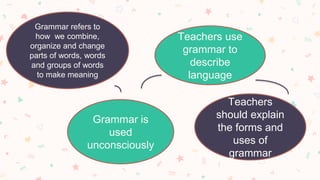
Grammar refers to
how we combine,
organize and change
parts of words, words
and groups of words
to make meaning
Grammar is
used
unconsciously
Teachers use
grammar to
describe
language
Teachers
should explain
the forms and
uses of
grammar
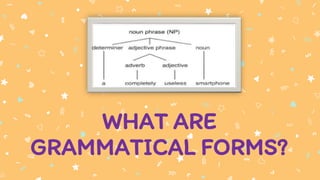
WHAT ARE
GRAMMATICAL FORMS?
WHAT ARE
GRAMMATICAL FORMS?
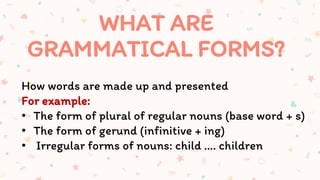
How words are made up and presented
For example:
• The form of plural of regular nouns (base word + s)
• The form of gerund (infinitive + ing)
• Irregular forms of nouns: child …. children
WHAT ARE
GRAMMATICAL FORMS?
Grammatical forms are found in:
• Parts of speech
• Grammatical structure
• Words that contains suffixes and prefixes
7
WHAT ARE PARTS OF
SPEECH?
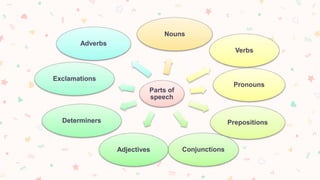
Parts of
speech
Nouns
Verbs
Pronouns
Prepositions
ConjunctionsAdjectives
Determiners
Exclamations
Adverbs
9
WHAT ARE PARTS OF
SPEECH?
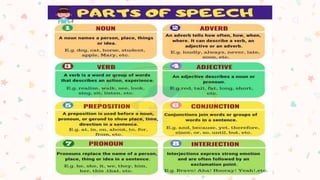
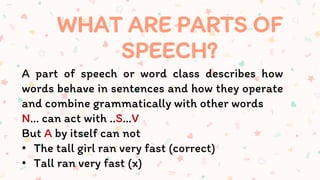
A part of speech or word class describes how
words behave in sentences and how they operate
and combine grammatically with other words
N… can act with ..S…V
But A by itself can not
• The tall girl ran very fast (correct)
• Tall ran very fast (x)
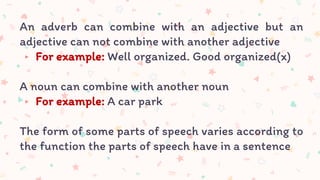
An adverb can combine with an adjective but an
adjective can not combine with another adjective
▸ For example: Well organized. Good organized(x)
A noun can combine with another noun
▸ For example: A car park
The form of some parts of speech varies according to
the function the parts of speech have in a sentence
GRAMMATICAL
STRUCTURES
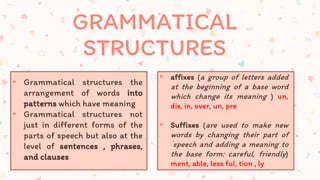
▸ Grammatical structures the
arrangement of words into
patterns which have meaning
▸ Grammatical structures not
just in different forms of the
parts of speech but also at the
level of sentences , phrases,
and clauses
▸ affixes (a group of letters added
at the beginning of a base word
which change its meaning ) un,
dis, in, over, un, pre
▸ Suffixes (are used to make new
words by changing their part of
´speech and adding a meaning to
the base form: careful, friendly)
ment, able, less ful, tion , ly
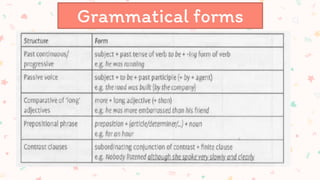
Grammatical forms
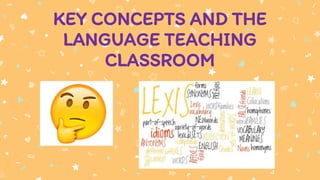
KEY CONCEPTS AND
THE LANGUAGE
TEACHING CLASSROOM
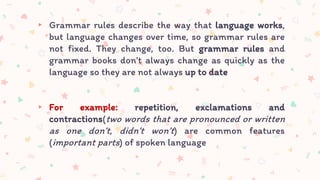
▸ Grammar rules describe the way that language works,
but language changes over time, so grammar rules are
not fixed. They change, too. But grammar rules and
grammar books don’t always change as quickly as the
language so they are not always up to date
▸ For example: repetition, exclamations and
contractions(two words that are pronounced or written
as one don’t, didn’t won’t) are common features
(important parts) of spoken language
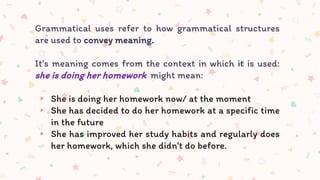
Grammatical uses refer to how grammatical structures
are used to convey meaning.
It’s meaning comes from the context in which it is used:
she is doing her homework might mean:
▸ She is doing her homework now/ at the moment
▸ She has decided to do her homework at a specific time
in the future
▸ She has improved her study habits and regularly does
her homework, which she didn't do before.
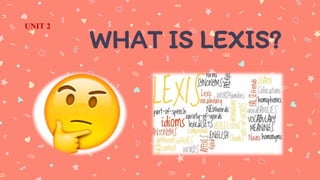
WHAT IS LEXIS?
UNIT 2
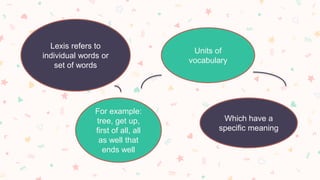
Lexis refers to
individual words or
set of words
For example:
tree, get up,
first of all, all
as well that
ends well
Units of
vocabulary
Which have a
specific meaning
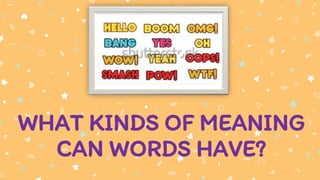
WHAT KINDS OF MEANING
CAN WORDS HAVE?
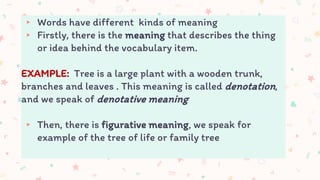
▸ Words have different kinds of meaning
▸ Firstly, there is the meaning that describes the thing
or idea behind the vocabulary item.
EXAMPLE: Tree is a large plant with a wooden trunk,
branches and leaves . This meaning is called denotation,
and we speak of denotative meaning
▸ Then, there is figurative meaning, we speak for
example of the tree of life or family tree
VOCABULARY
MEANING
23
24
• The meaning that a vocabulary item has in the context (situation) in
which it is used
EXAMPLE: We couldn’t see the house because of the tall trees in front of it’
this sentence is partly defined by the context
• The meaning of some vocabulary items can also come from their form:
from prefixes, suffixes or compounds (nouns made from two or more
separate words)
• Adding, prefixes or suffixes to base words , give them an opposite
meaning: unsafe, illegal
• The process of adding affixes is called affixation. Compound nouns get
their meaning from being together
▸ Collocations are words that often occur together; take a
holiday, heavy rain, arrive at, depend on
▸ Idioms are a kind of fixed expression as they can’t be changed
but their meaning is usually different from the combination of
the meaning of the individual words they contain
▸ Chunks refers to language that occurs in (semi-) fixed units
and that we usually learn as one piece. Have a good trip, I’d like
to….. How about…. My name’s …… are further examples of
chucks
26
WORDS HAVE
DIFFERENT
RELATIONSHIPS
▸ Words have different relationships with one another
▸ FOR EXAMPLE:
▸ Synonyms (words with the same meaning) Antonyms
(words with opposite meaning)
▸ They may be part of the same lexical set (groups pf
words that belong to the same topic area: family,
furniture, food)
▸ Word family (words that come through affixation
from the same base word : real really, realistic,
unreal)
▸ False friends, homophones, homonyms and
varieties of English are other ways in which words
can relate to one another
▸ False friends are words which have the same or a
similar form in two languages but a different
meaning.
▸ Embarazado for example means pregnant in
Spanish. It doesn’t mean embarrassed, though it
looks as if it does to an English speaker
▸ Homophones are words with the same pronunciation but
a different meaning or spelling: know - no: whether-
weather, there- their
▸ Homonyms are words with the same spelling and
pronunciation as another word but a different meaning
EXAMPLE: They sat on the river bank, he put all his savings
into the bank
▸ Words can also relate to one another through being
examples of different varieties of English
KEY CONCEPTS AND THE
LANGUAGE TEACHING
CLASSROOM
▸ Learners need to meet the same words again and
again as they advance in theirs language learning. In
this way their memory of them will be consolidated
▸ The words we recognize ae called our “receptive”
vocabulary: the words we can use are called or
“productive” vocabulary.
▸ The learners pick these words up, initially only
recognizing their meaing then eventually using them
productively
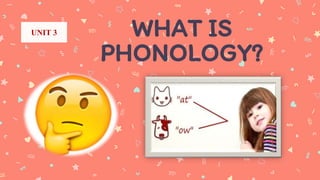
WHAT IS
PHONOLOGY?
UNIT 3
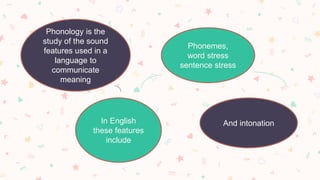
Phonology is the
study of the sound
features used in a
language to
communicate
meaning
In English
these features
include
Phonemes,
word stress
sentence stress
And intonation
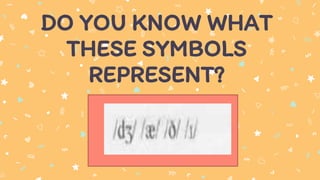
DO YOU KNOW WHAT
THESE SYMBOLS
REPRESENT?
/d/
▸ All these symbols represent phonemes.
▸ A phoneme is the smallest unit of sound that can make a
difference to meaning in a language.
▸ FOR EXAMPLE : books- it show us is plural
▸ Different languages use a different range of sounds and
not all of them have meaning in other languages
▸ FOR EXAMPLE: the distinction between /s/and /sh/ is an
important one in English
▸ Where it helps distinguish
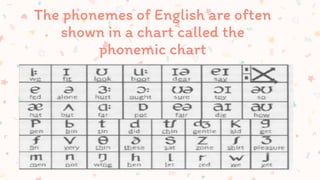
The phonemes of English are often
shown in a chart called the
phonemic chart
The chart groups the sounds into vowels(sounds made with the
mouth partly open and where the air is not stopped by the
tongue, lips or teeth)
In the top left-hand corner diphthongs (a movement from one
vowel sound to another within a single syllable, the vowel sound
in make/ merk
in the top right – hand corner and consonants (the flow of air is
partly blocked by the tongue lips or teeth when these sound are
made /b/)
Voice sounds (spoken using the vibration of our voice
/b//d//dz//g/)
• Unvoiced sounds(spoken without using our voice /p /t/tf//k/)
• The symbols is used to show word stress. /stjurdent/
• In English stress also influences how sentences and groups of
words are pronounced. We say different parts of the sentence
with more or less stress. Slower and louder
• This is called sentence stress
• .Normally one word in the sentence has primary or main stress.
This is the word which the speaker think is most important to
the meaning of the sentence other words can have secondary
streess
Spratt, M., Pulverness, A., & Williams, M. (2011).
The TKT Course Modules 1, 2 and 3 Modules 1, 2
and 3.
39
BIBLIOGRAPHY

Unit from 1 to 3

  • 1.
    MODULE 1 Part 1Describing language and language skills
  • 2.
  • 3.
    Grammar refers to howwe combine, organize and change parts of words, words and groups of words to make meaning Grammar is used unconsciously Teachers use grammar to describe language Teachers should explain the forms and uses of grammar
  • 4.
  • 5.
    WHAT ARE GRAMMATICAL FORMS? Howwords are made up and presented For example: • The form of plural of regular nouns (base word + s) • The form of gerund (infinitive + ing) • Irregular forms of nouns: child …. children
  • 6.
    WHAT ARE GRAMMATICAL FORMS? Grammaticalforms are found in: • Parts of speech • Grammatical structure • Words that contains suffixes and prefixes
  • 7.
    7 WHAT ARE PARTSOF SPEECH?
  • 8.
  • 9.
  • 10.
    WHAT ARE PARTSOF SPEECH? A part of speech or word class describes how words behave in sentences and how they operate and combine grammatically with other words N… can act with ..S…V But A by itself can not • The tall girl ran very fast (correct) • Tall ran very fast (x)
  • 11.
    An adverb cancombine with an adjective but an adjective can not combine with another adjective ▸ For example: Well organized. Good organized(x) A noun can combine with another noun ▸ For example: A car park The form of some parts of speech varies according to the function the parts of speech have in a sentence
  • 12.
    GRAMMATICAL STRUCTURES ▸ Grammatical structuresthe arrangement of words into patterns which have meaning ▸ Grammatical structures not just in different forms of the parts of speech but also at the level of sentences , phrases, and clauses ▸ affixes (a group of letters added at the beginning of a base word which change its meaning ) un, dis, in, over, un, pre ▸ Suffixes (are used to make new words by changing their part of ´speech and adding a meaning to the base form: careful, friendly) ment, able, less ful, tion , ly
  • 13.
  • 14.
    KEY CONCEPTS AND THELANGUAGE TEACHING CLASSROOM
  • 15.
    ▸ Grammar rulesdescribe the way that language works, but language changes over time, so grammar rules are not fixed. They change, too. But grammar rules and grammar books don’t always change as quickly as the language so they are not always up to date ▸ For example: repetition, exclamations and contractions(two words that are pronounced or written as one don’t, didn’t won’t) are common features (important parts) of spoken language
  • 16.
    Grammatical uses referto how grammatical structures are used to convey meaning. It’s meaning comes from the context in which it is used: she is doing her homework might mean: ▸ She is doing her homework now/ at the moment ▸ She has decided to do her homework at a specific time in the future ▸ She has improved her study habits and regularly does her homework, which she didn't do before.
  • 19.
  • 20.
    Lexis refers to individualwords or set of words For example: tree, get up, first of all, all as well that ends well Units of vocabulary Which have a specific meaning
  • 21.
    WHAT KINDS OFMEANING CAN WORDS HAVE?
  • 22.
    ▸ Words havedifferent kinds of meaning ▸ Firstly, there is the meaning that describes the thing or idea behind the vocabulary item. EXAMPLE: Tree is a large plant with a wooden trunk, branches and leaves . This meaning is called denotation, and we speak of denotative meaning ▸ Then, there is figurative meaning, we speak for example of the tree of life or family tree
  • 23.
  • 24.
    24 • The meaningthat a vocabulary item has in the context (situation) in which it is used EXAMPLE: We couldn’t see the house because of the tall trees in front of it’ this sentence is partly defined by the context • The meaning of some vocabulary items can also come from their form: from prefixes, suffixes or compounds (nouns made from two or more separate words) • Adding, prefixes or suffixes to base words , give them an opposite meaning: unsafe, illegal • The process of adding affixes is called affixation. Compound nouns get their meaning from being together
  • 25.
    ▸ Collocations arewords that often occur together; take a holiday, heavy rain, arrive at, depend on ▸ Idioms are a kind of fixed expression as they can’t be changed but their meaning is usually different from the combination of the meaning of the individual words they contain ▸ Chunks refers to language that occurs in (semi-) fixed units and that we usually learn as one piece. Have a good trip, I’d like to….. How about…. My name’s …… are further examples of chucks
  • 26.
  • 27.
    ▸ Words havedifferent relationships with one another ▸ FOR EXAMPLE: ▸ Synonyms (words with the same meaning) Antonyms (words with opposite meaning) ▸ They may be part of the same lexical set (groups pf words that belong to the same topic area: family, furniture, food) ▸ Word family (words that come through affixation from the same base word : real really, realistic, unreal)
  • 28.
    ▸ False friends,homophones, homonyms and varieties of English are other ways in which words can relate to one another ▸ False friends are words which have the same or a similar form in two languages but a different meaning. ▸ Embarazado for example means pregnant in Spanish. It doesn’t mean embarrassed, though it looks as if it does to an English speaker
  • 29.
    ▸ Homophones arewords with the same pronunciation but a different meaning or spelling: know - no: whether- weather, there- their ▸ Homonyms are words with the same spelling and pronunciation as another word but a different meaning EXAMPLE: They sat on the river bank, he put all his savings into the bank ▸ Words can also relate to one another through being examples of different varieties of English
  • 30.
    KEY CONCEPTS ANDTHE LANGUAGE TEACHING CLASSROOM
  • 31.
    ▸ Learners needto meet the same words again and again as they advance in theirs language learning. In this way their memory of them will be consolidated ▸ The words we recognize ae called our “receptive” vocabulary: the words we can use are called or “productive” vocabulary. ▸ The learners pick these words up, initially only recognizing their meaing then eventually using them productively
  • 32.
  • 33.
    Phonology is the studyof the sound features used in a language to communicate meaning In English these features include Phonemes, word stress sentence stress And intonation
  • 34.
    DO YOU KNOWWHAT THESE SYMBOLS REPRESENT? /d/
  • 35.
    ▸ All thesesymbols represent phonemes. ▸ A phoneme is the smallest unit of sound that can make a difference to meaning in a language. ▸ FOR EXAMPLE : books- it show us is plural ▸ Different languages use a different range of sounds and not all of them have meaning in other languages ▸ FOR EXAMPLE: the distinction between /s/and /sh/ is an important one in English ▸ Where it helps distinguish
  • 36.
    The phonemes ofEnglish are often shown in a chart called the phonemic chart
  • 37.
    The chart groupsthe sounds into vowels(sounds made with the mouth partly open and where the air is not stopped by the tongue, lips or teeth) In the top left-hand corner diphthongs (a movement from one vowel sound to another within a single syllable, the vowel sound in make/ merk in the top right – hand corner and consonants (the flow of air is partly blocked by the tongue lips or teeth when these sound are made /b/) Voice sounds (spoken using the vibration of our voice /b//d//dz//g/)
  • 38.
    • Unvoiced sounds(spokenwithout using our voice /p /t/tf//k/) • The symbols is used to show word stress. /stjurdent/ • In English stress also influences how sentences and groups of words are pronounced. We say different parts of the sentence with more or less stress. Slower and louder • This is called sentence stress • .Normally one word in the sentence has primary or main stress. This is the word which the speaker think is most important to the meaning of the sentence other words can have secondary streess
  • 39.
    Spratt, M., Pulverness,A., & Williams, M. (2011). The TKT Course Modules 1, 2 and 3 Modules 1, 2 and 3. 39 BIBLIOGRAPHY