The Sound System of English Education 453:10
Phonology The study of the sounds of language Everyone speaks with an accent The phonological system of a language consists of its individual speech sounds, as well as its stress, rhythm, and intonation patterns
Phonemes The smallest unit of sound that can affect meaning in a language Though the English alphabet has 26 letters, English speakers produce more than 40 sounds
International Phonetic Alphabet Most technical books for language teachers and dictionaries use phonetic symbols to represent English sounds and to describe difficulties (Our text: p. 56, 57) The International Phonetic Alphabet can be used to transcribe any language (handout)
Pronunciation Difficulties Interference from the first language The sounds of the first language are imprinted very early in the child’s development; however, most children are born with the vocal equipment to produce the sounds of any language
Problems in English Homographs (read and read) Homophones (red and read) Differs from language to language http:// www.btinternet.com/~ted.power/phono.html
Individual Sounds Especially difficult sounds are  th  in  think  and its unvoiced equivalent  th  in  then Consonant clusters  – spl, sks, etc. Some languages have no consonant clusters; other languages use consonant clusters differently
Stressed and Unstressed Syllables The degree of force with which a syllable is uttered In English words of more than one syllable, one of the syllables is uttered with stronger stress or emphasis than others (text p. 59) Stress patterns are different in other languages
Rhythm English has a characteristic rhythm or stress pattern In connected English speech the stresses or beats are spaced evenly through sentences… John speaks French…. Unstressed syllables are compressed or de-emphasized whereas in many languages, equal stress is placed on all the syllables in words
Sentence Stress In an English sentence, the words that carry the most information are stressed –  content words  – and the less important or grammatical function or form words are unstressed ESL students may have trouble understanding speech even if they recognize words in isolation… What do you mean? Next month or necks month http://www2.nkfust.edu.tw/~emchen/Pron/stress_exB.htm
Intonation English has characteristic patterns of rise and fall in pitch, and three basic levels of tone: High, Mid, and Low ESL students and ELLs need focused instruction on English intonation patterns…
Purposes of English Intonation Communicate meaning Communicate emotions or moods Stress for emphasis http:// www.youtube.com/watch?v =-toSnwSqqz0
Teaching Pronunciation Younger children who are learning English seldom need a great deal of help with pronunciation Learners older than 11 or 12 are more likely to have trouble with specific words, sounds, intonation patterns… require focused instruction
When to Teach Pronunciation A student confuses or distorts specific sounds that may interfere with comprehension Uses pronunciations that are stigmatized… tree for three Distorts the pronunciation of words by stressing the wrong syllable Uses inappropriate intonation
How to Teach Pronunciation Read aloud often Read the same statement several different ways Books on tape Language arts software Choral reading Minimal pairs
….How to Teach Pronunciation 7. Practice producing sounds 8. Make up sentences 9. Create posters or booklets for certain sounds 10. Allow pronunciation practice 11. Use pronunciation guides with older students 12.Rehearse, read aloud, short passages 13. Be creative…skits….
Basic Principle Understanding of sounds precedes understanding of the written word.
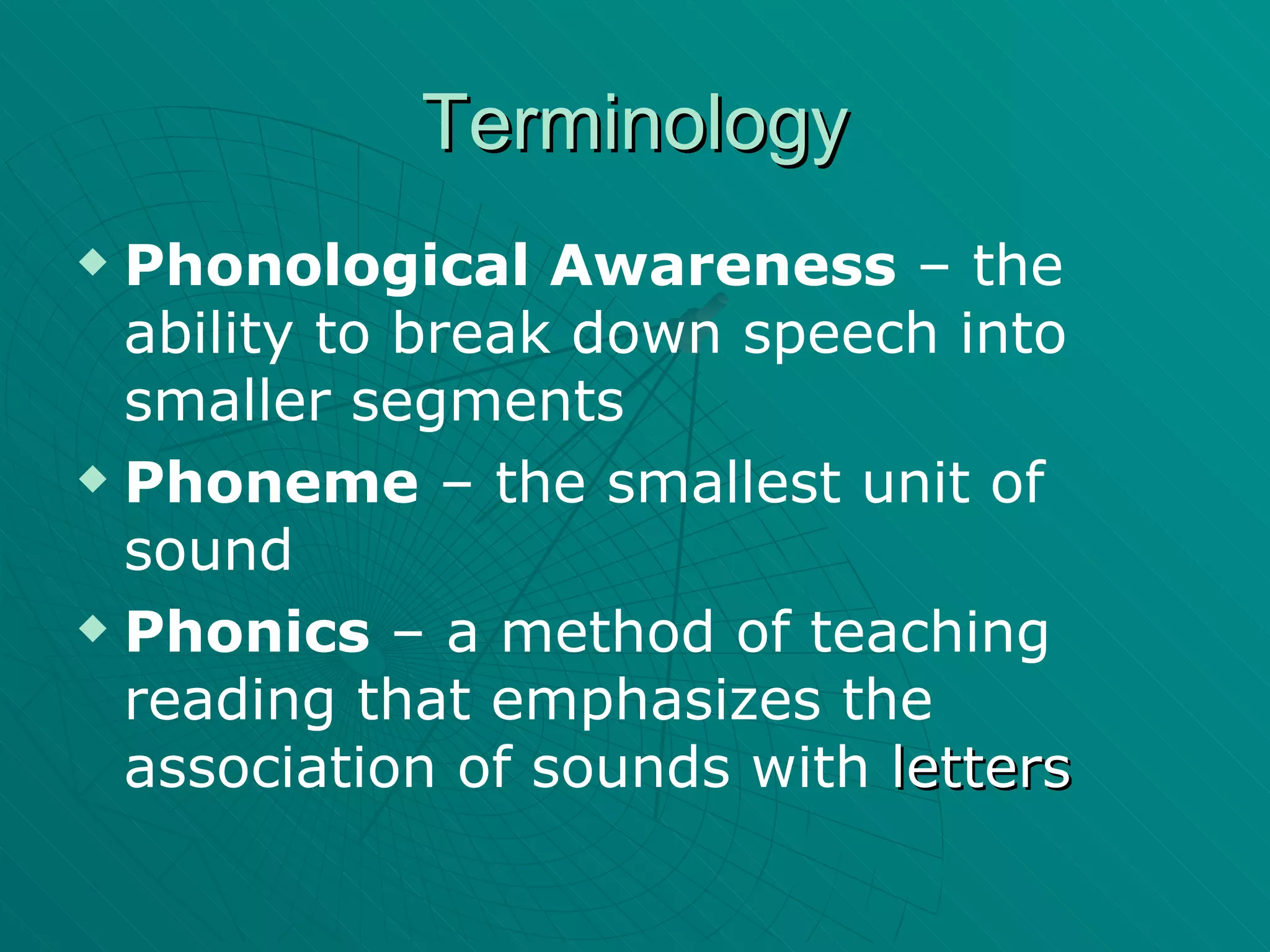
Terminology Phonological Awareness  – the ability to break down speech into smaller segments Phoneme  – the smallest unit of sound Phonics  – a method of teaching reading that emphasizes the association of sounds with  letters
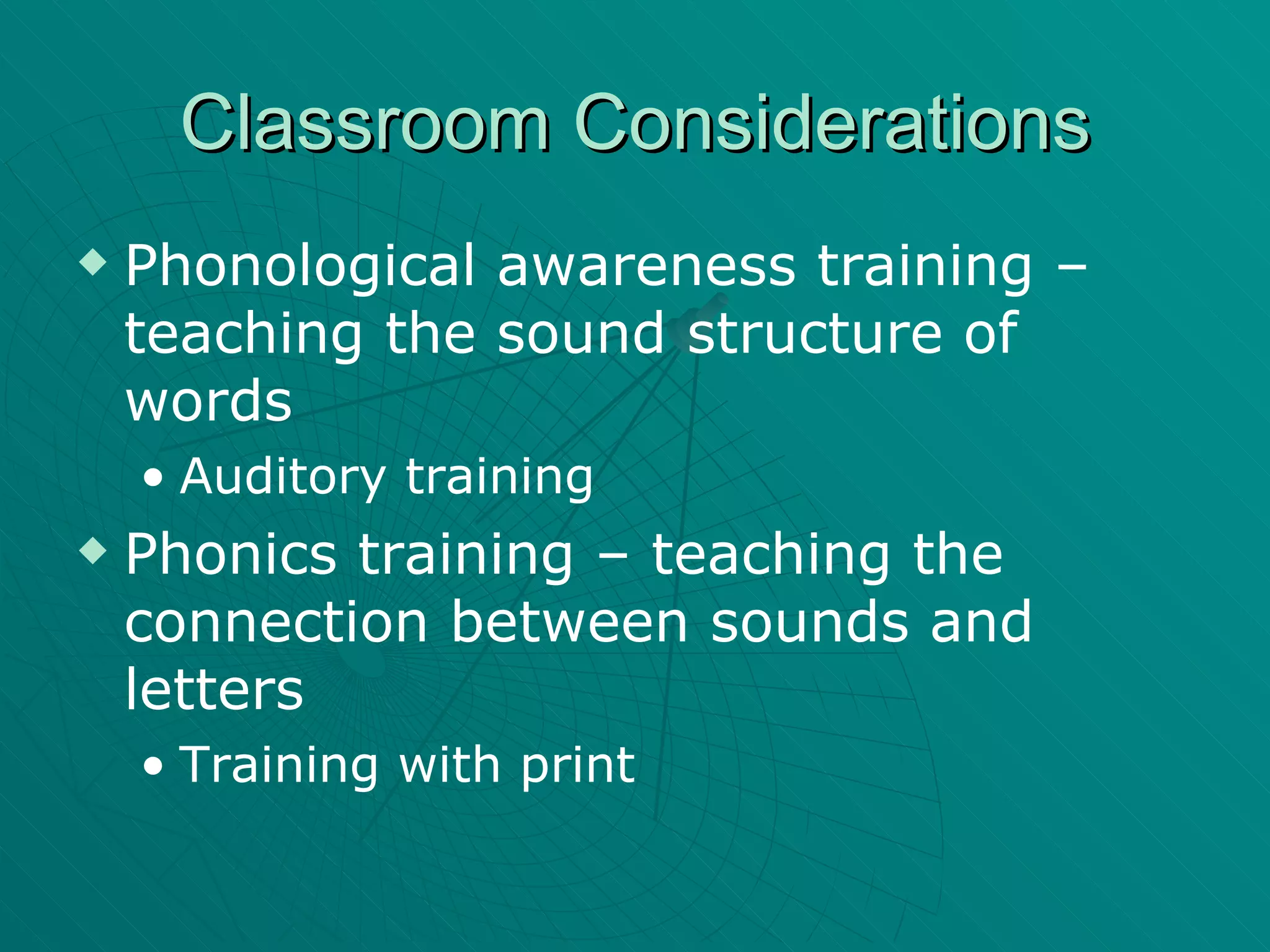
Classroom Considerations Phonological awareness training – teaching the sound structure of words Auditory training Phonics training – teaching the connection between sounds and letters Training with print
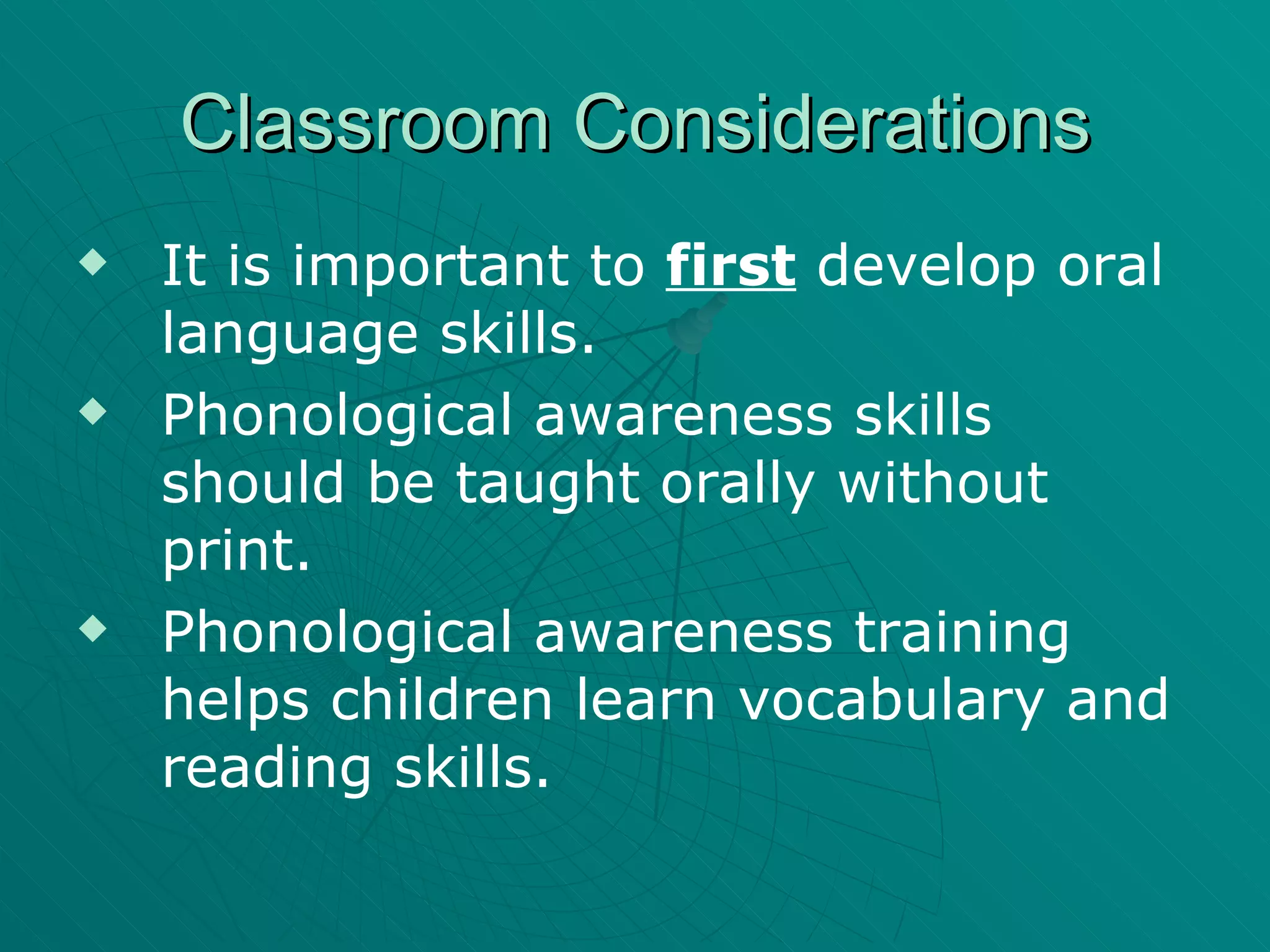
Classroom Considerations It is important to  first  develop oral language skills. Phonological awareness skills should be taught orally without print. Phonological awareness training helps children learn vocabulary and reading skills.
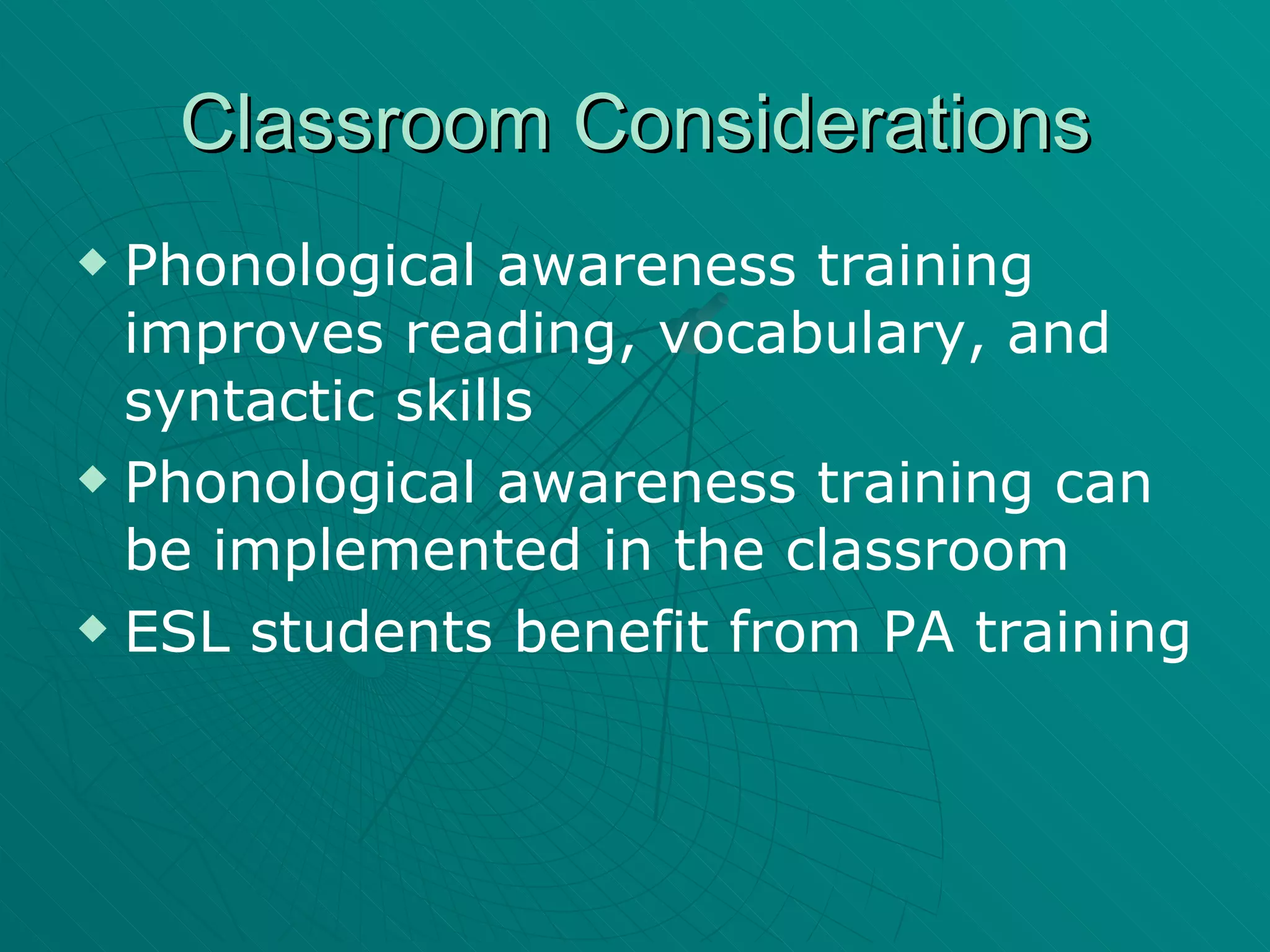
Classroom Considerations Phonological awareness training improves reading, vocabulary, and syntactic skills Phonological awareness training can be implemented in the classroom ESL students benefit from PA training
Teaching Pronunciation Abroad http://www.authorstream.com/presentation/Demetrio-39388-tup2007-Improve-English-Pronunciation-Five-Questions-Stress-gives-natural-rhythm-spoken-as-Education-ppt-powerpoint/

The Sound System Of English

  • 1.
    The Sound Systemof English Education 453:10
  • 2.
    Phonology The studyof the sounds of language Everyone speaks with an accent The phonological system of a language consists of its individual speech sounds, as well as its stress, rhythm, and intonation patterns
  • 3.
    Phonemes The smallestunit of sound that can affect meaning in a language Though the English alphabet has 26 letters, English speakers produce more than 40 sounds
  • 4.
    International Phonetic AlphabetMost technical books for language teachers and dictionaries use phonetic symbols to represent English sounds and to describe difficulties (Our text: p. 56, 57) The International Phonetic Alphabet can be used to transcribe any language (handout)
  • 5.
    Pronunciation Difficulties Interferencefrom the first language The sounds of the first language are imprinted very early in the child’s development; however, most children are born with the vocal equipment to produce the sounds of any language
  • 6.
    Problems in EnglishHomographs (read and read) Homophones (red and read) Differs from language to language http:// www.btinternet.com/~ted.power/phono.html
  • 7.
    Individual Sounds Especiallydifficult sounds are th in think and its unvoiced equivalent th in then Consonant clusters – spl, sks, etc. Some languages have no consonant clusters; other languages use consonant clusters differently
  • 8.
    Stressed and UnstressedSyllables The degree of force with which a syllable is uttered In English words of more than one syllable, one of the syllables is uttered with stronger stress or emphasis than others (text p. 59) Stress patterns are different in other languages
  • 9.
    Rhythm English hasa characteristic rhythm or stress pattern In connected English speech the stresses or beats are spaced evenly through sentences… John speaks French…. Unstressed syllables are compressed or de-emphasized whereas in many languages, equal stress is placed on all the syllables in words
  • 10.
    Sentence Stress Inan English sentence, the words that carry the most information are stressed – content words – and the less important or grammatical function or form words are unstressed ESL students may have trouble understanding speech even if they recognize words in isolation… What do you mean? Next month or necks month http://www2.nkfust.edu.tw/~emchen/Pron/stress_exB.htm
  • 11.
    Intonation English hascharacteristic patterns of rise and fall in pitch, and three basic levels of tone: High, Mid, and Low ESL students and ELLs need focused instruction on English intonation patterns…
  • 12.
    Purposes of EnglishIntonation Communicate meaning Communicate emotions or moods Stress for emphasis http:// www.youtube.com/watch?v =-toSnwSqqz0
  • 13.
    Teaching Pronunciation Youngerchildren who are learning English seldom need a great deal of help with pronunciation Learners older than 11 or 12 are more likely to have trouble with specific words, sounds, intonation patterns… require focused instruction
  • 14.
    When to TeachPronunciation A student confuses or distorts specific sounds that may interfere with comprehension Uses pronunciations that are stigmatized… tree for three Distorts the pronunciation of words by stressing the wrong syllable Uses inappropriate intonation
  • 15.
    How to TeachPronunciation Read aloud often Read the same statement several different ways Books on tape Language arts software Choral reading Minimal pairs
  • 16.
    ….How to TeachPronunciation 7. Practice producing sounds 8. Make up sentences 9. Create posters or booklets for certain sounds 10. Allow pronunciation practice 11. Use pronunciation guides with older students 12.Rehearse, read aloud, short passages 13. Be creative…skits….
  • 17.
    Basic Principle Understandingof sounds precedes understanding of the written word.
  • 18.
    Terminology Phonological Awareness – the ability to break down speech into smaller segments Phoneme – the smallest unit of sound Phonics – a method of teaching reading that emphasizes the association of sounds with letters
  • 19.
    Classroom Considerations Phonologicalawareness training – teaching the sound structure of words Auditory training Phonics training – teaching the connection between sounds and letters Training with print
  • 20.
    Classroom Considerations Itis important to first develop oral language skills. Phonological awareness skills should be taught orally without print. Phonological awareness training helps children learn vocabulary and reading skills.
  • 21.
    Classroom Considerations Phonologicalawareness training improves reading, vocabulary, and syntactic skills Phonological awareness training can be implemented in the classroom ESL students benefit from PA training
  • 22.
    Teaching Pronunciation Abroadhttp://www.authorstream.com/presentation/Demetrio-39388-tup2007-Improve-English-Pronunciation-Five-Questions-Stress-gives-natural-rhythm-spoken-as-Education-ppt-powerpoint/