PHONOLOGY
WHAT IS PHONOLOGY?
• Phonology is the study of how sounds are
organized and used in natural languages.
• Phonology is just one of several aspects of
language.
• It is related to other aspects such as phonetics,
morphology, syntax, and pragmatics.
THE PHONOLOGICAL
SYSTEM OF A LANGUAGE
• an inventory of sounds and their
features, and
• rules which specify how sounds
interact with each other.
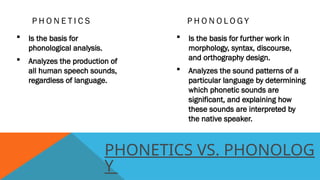
PHONETICS VS. PHONOLOG
Y
P H O N E T I C S
 Is the basis for
phonological analysis.
 Analyzes the production of
all human speech sounds,
regardless of language.
P H O N O L O G Y
 Is the basis for further work in
morphology, syntax, discourse,
and orthography design.
 Analyzes the sound patterns of a
particular language by determining
which phonetic sounds are
significant, and explaining how
these sounds are interpreted by
the native speaker.
WHY ARE PHONETICS IMPORTANT?
WHAT IS A PHONEME?
A phoneme is the smallest
contrastive unit in the sound
system of a language.
PHONOLOGISTS HAVE DIFFERING VIEWS OF THE PHONEME.
FOLLOWING ARE THE TWO MAJOR VIEWS CONSIDERED HERE:
In the American structuralist tradition, a phoneme is defined according to its allophones and
environments.
In the generative tradition, a phoneme is defined as a set of distinctive features.
DIFFERENCE BETWEEN PHONE AND
PHONEME
P H O N E
One of many possible sounds in the
languages of the world.
The smallest identifiable unit found
in a stream of speech.
Pronounced in a defined way.
Represented between brackets by
convention.
Example:
[b], [j], [o]
P H O N E M E
One of many possible sounds in the
languages of the world.
A minimal unit that serves to distinguish
between meanings of words.
Pronounced in one or more ways,
depending on the number of allophones.
Represented between slashes by
convention.
Example:
/b/, /j/, /o/
MODELS OF PHONOLOGY
In classical phonemics, phonemes and their possible combinations are central.
In standard generative phonology, distinctive features are central. A stream of
speech is portrayed as linear sequence of discrete sound-segments. Each
segment is composed of simultaneously occurring features.
In non-linear models of phonology, a stream of speech is represented as
multidimensional, not simply as a linear sequence of sound segments. These
non-linear models grew out of generative phonology:
 autosegmental phonology
 metrical phonology
 lexical phonology
GENERATIVE PHONOLOGY
Generative phonology is a component of
generative grammar that assigns the correct
phonetic representations to utterances in such a
way as to reflect a native speaker’s internalized
grammar.
LEVELS OF PHONOLOGICAL REPRESENTATION
An underlying representation is the most basic form of a
word before any phonological rules have been applied to
it. Underlying representations show what a native
speaker knows about the abstract underlying phonology
of the language.
A phonetic representation is the form of a word that is
spoken and heard.
DISTINCTIVE FEATURES
Distinctive features make it possible to capture the
generalities of phonological rules.
LINEARITY
A stream of speech is portrayed as a sequence
of discrete sound segments. Each segment is
composed of simultaneously occurring features.
WHAT IS AUTOSEGMENTAL
PHONOLOGY?
 Autosegmental phonology is a non-linear approach to
phonology that allows phonological processes, such as tone
and vowel harmony, to be independent of and extend beyond
individual consonants and vowels.
 Autosegmental phonology treats phonological representations
as multi-dimensional, having several tiers. Each tier is made
up of a linear arrangement of segments. The tiers are linked to
each other by association lines that indicate how the segments
on each tier are to be pronounced at the same time.
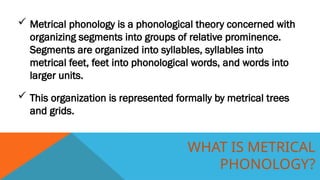
WHAT IS METRICAL
PHONOLOGY?
 Metrical phonology is a phonological theory concerned with
organizing segments into groups of relative prominence.
Segments are organized into syllables, syllables into
metrical feet, feet into phonological words, and words into
larger units.
 This organization is represented formally by metrical trees
and grids.
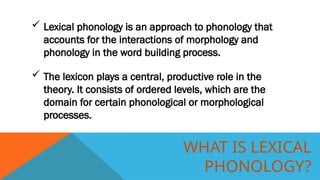
WHAT IS LEXICAL
PHONOLOGY?
 Lexical phonology is an approach to phonology that
accounts for the interactions of morphology and
phonology in the word building process.
 The lexicon plays a central, productive role in the
theory. It consists of ordered levels, which are the
domain for certain phonological or morphological
processes.
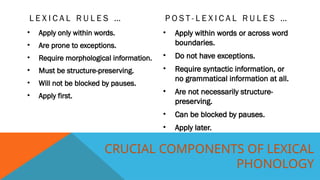
CRUCIAL COMPONENTS OF LEXICAL
PHONOLOGY
L E X I C A L R U L E S …
• Apply only within words.
• Are prone to exceptions.
• Require morphological information.
• Must be structure-preserving.
• Will not be blocked by pauses.
• Apply first.
P O S T - L E X I C A L R U L E S …
• Apply within words or across word
boundaries.
• Do not have exceptions.
• Require syntactic information, or
no grammatical information at all.
• Are not necessarily structure-
preserving.
• Can be blocked by pauses.
• Apply later.
HALLE AND MOHANAN PROPOSE THE FOLLOWING FOUR LEVELS OF MORPHOLOGY IN THE LEXICON:
Level 1: Class 1 derivation, irregular inflection
Level 2: Class 2 derivation
Level 3: Compounding
Level 4: Regular inflection
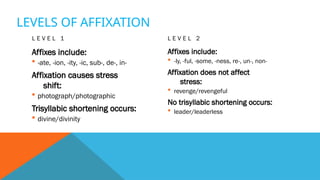
L E V E L 1
Affixes include:
 -ate, -ion, -ity, -ic, sub-, de-, in-
Affixation causes stress
shift:
 photograph/photographic
Trisyllabic shortening occurs:
 divine/divinity
L E V E L 2
Affixes include:
 -ly, -ful, -some, -ness, re-, un-, non-
Affixation does not affect
stress:
 revenge/revengeful
No trisyllabic shortening occurs:
 leader/leaderless
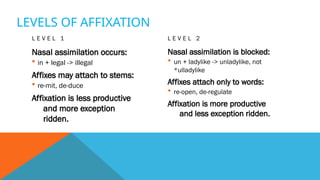
LEVELS OF AFFIXATION
L E V E L 1
Nasal assimilation occurs:
 in + legal -> illegal
Affixes may attach to stems:
 re-mit, de-duce
Affixation is less productive
and more exception
ridden.
L E V E L 2
Nasal assimilation is blocked:
 un + ladylike -> unladylike, not
*ulladylike
Affixes attach only to words:
 re-open, de-regulate
Affixation is more productive
and less exception ridden.

PHONOLOGY - Definition and Components.pptx

  • 1.
  • 2.
    WHAT IS PHONOLOGY? •Phonology is the study of how sounds are organized and used in natural languages. • Phonology is just one of several aspects of language. • It is related to other aspects such as phonetics, morphology, syntax, and pragmatics.
  • 3.
    THE PHONOLOGICAL SYSTEM OFA LANGUAGE • an inventory of sounds and their features, and • rules which specify how sounds interact with each other.
  • 4.
    PHONETICS VS. PHONOLOG Y PH O N E T I C S  Is the basis for phonological analysis.  Analyzes the production of all human speech sounds, regardless of language. P H O N O L O G Y  Is the basis for further work in morphology, syntax, discourse, and orthography design.  Analyzes the sound patterns of a particular language by determining which phonetic sounds are significant, and explaining how these sounds are interpreted by the native speaker.
  • 5.
  • 6.
    WHAT IS APHONEME? A phoneme is the smallest contrastive unit in the sound system of a language.
  • 7.
    PHONOLOGISTS HAVE DIFFERINGVIEWS OF THE PHONEME. FOLLOWING ARE THE TWO MAJOR VIEWS CONSIDERED HERE: In the American structuralist tradition, a phoneme is defined according to its allophones and environments. In the generative tradition, a phoneme is defined as a set of distinctive features.
  • 8.
    DIFFERENCE BETWEEN PHONEAND PHONEME P H O N E One of many possible sounds in the languages of the world. The smallest identifiable unit found in a stream of speech. Pronounced in a defined way. Represented between brackets by convention. Example: [b], [j], [o] P H O N E M E One of many possible sounds in the languages of the world. A minimal unit that serves to distinguish between meanings of words. Pronounced in one or more ways, depending on the number of allophones. Represented between slashes by convention. Example: /b/, /j/, /o/
  • 9.
    MODELS OF PHONOLOGY Inclassical phonemics, phonemes and their possible combinations are central. In standard generative phonology, distinctive features are central. A stream of speech is portrayed as linear sequence of discrete sound-segments. Each segment is composed of simultaneously occurring features. In non-linear models of phonology, a stream of speech is represented as multidimensional, not simply as a linear sequence of sound segments. These non-linear models grew out of generative phonology:  autosegmental phonology  metrical phonology  lexical phonology
  • 10.
    GENERATIVE PHONOLOGY Generative phonologyis a component of generative grammar that assigns the correct phonetic representations to utterances in such a way as to reflect a native speaker’s internalized grammar.
  • 11.
    LEVELS OF PHONOLOGICALREPRESENTATION An underlying representation is the most basic form of a word before any phonological rules have been applied to it. Underlying representations show what a native speaker knows about the abstract underlying phonology of the language. A phonetic representation is the form of a word that is spoken and heard.
  • 12.
    DISTINCTIVE FEATURES Distinctive featuresmake it possible to capture the generalities of phonological rules.
  • 13.
    LINEARITY A stream ofspeech is portrayed as a sequence of discrete sound segments. Each segment is composed of simultaneously occurring features.
  • 14.
    WHAT IS AUTOSEGMENTAL PHONOLOGY? Autosegmental phonology is a non-linear approach to phonology that allows phonological processes, such as tone and vowel harmony, to be independent of and extend beyond individual consonants and vowels.  Autosegmental phonology treats phonological representations as multi-dimensional, having several tiers. Each tier is made up of a linear arrangement of segments. The tiers are linked to each other by association lines that indicate how the segments on each tier are to be pronounced at the same time.
  • 15.
    WHAT IS METRICAL PHONOLOGY? Metrical phonology is a phonological theory concerned with organizing segments into groups of relative prominence. Segments are organized into syllables, syllables into metrical feet, feet into phonological words, and words into larger units.  This organization is represented formally by metrical trees and grids.
  • 16.
    WHAT IS LEXICAL PHONOLOGY? Lexical phonology is an approach to phonology that accounts for the interactions of morphology and phonology in the word building process.  The lexicon plays a central, productive role in the theory. It consists of ordered levels, which are the domain for certain phonological or morphological processes.
  • 17.
    CRUCIAL COMPONENTS OFLEXICAL PHONOLOGY L E X I C A L R U L E S … • Apply only within words. • Are prone to exceptions. • Require morphological information. • Must be structure-preserving. • Will not be blocked by pauses. • Apply first. P O S T - L E X I C A L R U L E S … • Apply within words or across word boundaries. • Do not have exceptions. • Require syntactic information, or no grammatical information at all. • Are not necessarily structure- preserving. • Can be blocked by pauses. • Apply later.
  • 18.
    HALLE AND MOHANANPROPOSE THE FOLLOWING FOUR LEVELS OF MORPHOLOGY IN THE LEXICON: Level 1: Class 1 derivation, irregular inflection Level 2: Class 2 derivation Level 3: Compounding Level 4: Regular inflection
  • 19.
    L E VE L 1 Affixes include:  -ate, -ion, -ity, -ic, sub-, de-, in- Affixation causes stress shift:  photograph/photographic Trisyllabic shortening occurs:  divine/divinity L E V E L 2 Affixes include:  -ly, -ful, -some, -ness, re-, un-, non- Affixation does not affect stress:  revenge/revengeful No trisyllabic shortening occurs:  leader/leaderless LEVELS OF AFFIXATION
  • 20.
    LEVELS OF AFFIXATION LE V E L 1 Nasal assimilation occurs:  in + legal -> illegal Affixes may attach to stems:  re-mit, de-duce Affixation is less productive and more exception ridden. L E V E L 2 Nasal assimilation is blocked:  un + ladylike -> unladylike, not *ulladylike Affixes attach only to words:  re-open, de-regulate Affixation is more productive and less exception ridden.