LCD 105 – Class 6 – Professor Nathacia
Languaging
Part 2
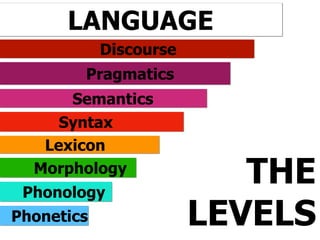
LANGUAGE
Phonetics
Phonology
Morphology
Lexicon
Syntax
Semantics
Pragmatics
Discourse
THE
LEVELS
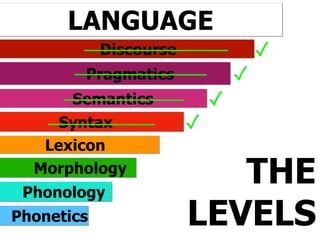
LANGUAGE
Phonetics
Phonology
Morphology
Lexicon
Syntax
Semantics
Pragmatics
Discourse
THE
LEVELS
✓
✓
✓
✓
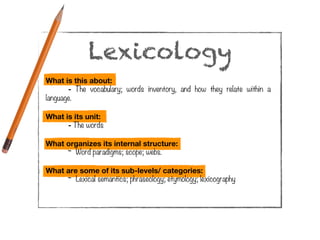
Lexicology
What is this about:
- The vocabulary; words inventory, and how they relate within a
language.
What is its unit:
- The words
What organizes its internal structure:
- Word paradigms; scope; webs.
What are some of its sub-levels/ categories:
- Lexical semantics; phraseology; etymology; lexicography
Metonym
Metonymy is a figure of speech in which a thing or concept is referred to
by the name of something closely associated with that thing or concept.
Example: I fueld my car (instead of “I fueld the gas tank of my car”)
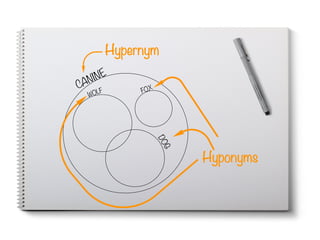
Hypernym and Hyponym
Hyponymy shows the relationship between a generic term (hypernym) and
a specific instance of it (hyponym). A hyponym is a word or phrase
whose semantic field is more specific than its hypernym. The semantic
field of a hypernym, also known as a superordinate, is broader than that
of a hyponym. An approach to the relationship between hyponyms and
hypernyms is to view a hypernym as consisting of hyponyms.
Hypernym
CANINE
WOLF
DOG
FOX
Hyponyms
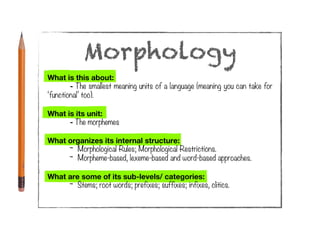
Morphology
What is this about:
- The smallest meaning units of a language (meaning you can take for
‘functional’ too).
What is its unit:
- The morphemes
What organizes its internal structure:
- Morphological Rules; Morphological Restrictions.
- Morpheme-based, lexeme-based and word-based approaches.
What are some of its sub-levels/ categories:
- Stems; root words; prefixes; suffixes; infixes, clitics.
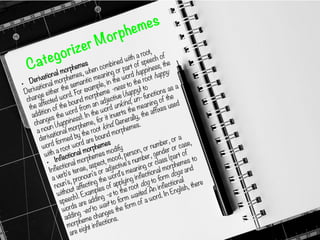
Categorizer Morphemes
‣ Derivational morphemes
Derivational morphemes, when combined with a root,
change either the semantic meaning or part of speech of
the affected word. For example, in the word happiness, the
addition of the bound morpheme -ness to the root happy
changes the word from an adjective (happy) to
a noun (happiness). In the word unkind, un- functions as a
derivational morpheme, for it inverts the meaning of the
word formed by the root kind. Generally, the affixes used
with a root word are bound morphemes.
‣ Inflectional morphemes
Inflectional morphemes modify
a verb's tense, aspect, mood, person, or number, or a
noun's, pronoun's or adjective's number, gender or case,
without affecting the word's meaning or class (part of
speech). Examples of applying inflectional morphemes to
words are adding -s to the root dog to form dogs and
adding -ed to wait to form waited. An inflectional
morpheme changes the form of a word. In English, there
are eight inflections.
Morphemes has
hierarchical structure
Morphemes have structure,
and many language use its
structure to built syntax
structure. That’s why some
theories call it
morphosyntactic structure
Video
Barney Stinson –
Wait For It Compilation
https://youtu.be/SqkYnfAhgy0
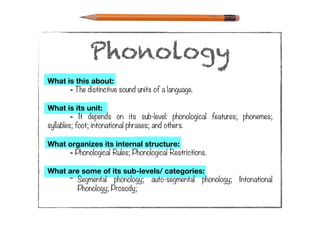
Phonology
What is this about:
- The distinctive sound units of a language.
What is its unit:
- It depends on its sub-level: phonological features; phonemes;
syllables; foot; intonational phrases; and others.
What organizes its internal structure:
- Phonological Rules; Phonological Restrictions.
What are some of its sub-levels/ categories:
- Segmental phonology; auto-segmental phonology; Intonational
Phonology; Prosody;
Identifying units in a sea
Linguistic VALUE and
PARADIGMATIC
relations determine what are
the phonemes of a language
Valuable Units
• Minimal pairs -> What a phoneme is (minimal distinctive
unit): Ex. dot x dog
• Analog pairs -> What a phoneme in complementary
distribution is (they do not occur in the exact same
context): Ex. /t/ in tea vs. tree vs. British vs.
Manhattan vs. eat.
• Phonemes in free variation (due to social factors;
irrelevant to the system)
At Macy’s:
- Where can I find Men’s shoes?
- 4th floor.
(Labov)
Valuable Units
[fɔɹθ flɔɹ]
[fɔɻθ flɔɻ]
Valuable Units
• There is NO direct
correspondence between lettersand phonemes!
• Examples: Sad; Laugh; Fase;
(Gussenhoven & Jacobs, 2011)
Valuable Units
The melodic Structure
• The Phonology level is where the
units are arranged into melodic
structure.
• It is an hierarchical structure (as
all language structures are).
• Some levels: syllable , foot,
phonological word, intonational
phrase.
The World of DAVE
[Difference in Pronunciation between
English/Korean/Japanese+Chinese 2]
https://youtu.be/2jMddKVDwUU
Phonetics
What is this about:
- The sounds of language/ speech.
What is its unit:
- It doesn’t have a proper unit but it is composed by sound waves.
What organizes its internal structure:
- Speech restrictions as breath, co-articulation, phonation conditions,
articulation conditions, propagation condition etc.
What are some of its sub-levels/ categories:
- Acoustic Phonetics; Articulatory Phonetics; Perceptual Phonetics;
Summing Up:
- We can count eight different levels to
language structure;
- They are: Discourse; Pragmatics;
Semantics; Syntax; Lexicon; Morphology;
Phonology; and Phonetics.
- The criteria to determine those levels are
based on its units and its way of operating
those units.
- Each level unit is composed by the
integration of lower lever units;
- But the lower level units are inaccessible to
the upper level (the new units become
opaque);
- Each level can be investigated and analyzed
by many different approaches.

Class6 - Languaging - part 2

  • 1.
    LCD 105 –Class 6 – Professor Nathacia Languaging Part 2
  • 2.
  • 3.
  • 4.
    Lexicology What is thisabout: - The vocabulary; words inventory, and how they relate within a language. What is its unit: - The words What organizes its internal structure: - Word paradigms; scope; webs. What are some of its sub-levels/ categories: - Lexical semantics; phraseology; etymology; lexicography
  • 6.
    Metonym Metonymy is afigure of speech in which a thing or concept is referred to by the name of something closely associated with that thing or concept. Example: I fueld my car (instead of “I fueld the gas tank of my car”) Hypernym and Hyponym Hyponymy shows the relationship between a generic term (hypernym) and a specific instance of it (hyponym). A hyponym is a word or phrase whose semantic field is more specific than its hypernym. The semantic field of a hypernym, also known as a superordinate, is broader than that of a hyponym. An approach to the relationship between hyponyms and hypernyms is to view a hypernym as consisting of hyponyms.
  • 7.
  • 9.
    Morphology What is thisabout: - The smallest meaning units of a language (meaning you can take for ‘functional’ too). What is its unit: - The morphemes What organizes its internal structure: - Morphological Rules; Morphological Restrictions. - Morpheme-based, lexeme-based and word-based approaches. What are some of its sub-levels/ categories: - Stems; root words; prefixes; suffixes; infixes, clitics.
  • 10.
    Categorizer Morphemes ‣ Derivationalmorphemes Derivational morphemes, when combined with a root, change either the semantic meaning or part of speech of the affected word. For example, in the word happiness, the addition of the bound morpheme -ness to the root happy changes the word from an adjective (happy) to a noun (happiness). In the word unkind, un- functions as a derivational morpheme, for it inverts the meaning of the word formed by the root kind. Generally, the affixes used with a root word are bound morphemes. ‣ Inflectional morphemes Inflectional morphemes modify a verb's tense, aspect, mood, person, or number, or a noun's, pronoun's or adjective's number, gender or case, without affecting the word's meaning or class (part of speech). Examples of applying inflectional morphemes to words are adding -s to the root dog to form dogs and adding -ed to wait to form waited. An inflectional morpheme changes the form of a word. In English, there are eight inflections.
  • 12.
    Morphemes has hierarchical structure Morphemeshave structure, and many language use its structure to built syntax structure. That’s why some theories call it morphosyntactic structure
  • 13.
    Video Barney Stinson – WaitFor It Compilation https://youtu.be/SqkYnfAhgy0
  • 16.
    Phonology What is thisabout: - The distinctive sound units of a language. What is its unit: - It depends on its sub-level: phonological features; phonemes; syllables; foot; intonational phrases; and others. What organizes its internal structure: - Phonological Rules; Phonological Restrictions. What are some of its sub-levels/ categories: - Segmental phonology; auto-segmental phonology; Intonational Phonology; Prosody;
  • 17.
    Identifying units ina sea Linguistic VALUE and PARADIGMATIC relations determine what are the phonemes of a language
  • 18.
    Valuable Units • Minimalpairs -> What a phoneme is (minimal distinctive unit): Ex. dot x dog • Analog pairs -> What a phoneme in complementary distribution is (they do not occur in the exact same context): Ex. /t/ in tea vs. tree vs. British vs. Manhattan vs. eat. • Phonemes in free variation (due to social factors; irrelevant to the system)
  • 19.
    At Macy’s: - Wherecan I find Men’s shoes? - 4th floor. (Labov) Valuable Units
  • 20.
  • 21.
    • There isNO direct correspondence between lettersand phonemes! • Examples: Sad; Laugh; Fase; (Gussenhoven & Jacobs, 2011) Valuable Units
  • 22.
    The melodic Structure •The Phonology level is where the units are arranged into melodic structure. • It is an hierarchical structure (as all language structures are). • Some levels: syllable , foot, phonological word, intonational phrase.
  • 23.
    The World ofDAVE [Difference in Pronunciation between English/Korean/Japanese+Chinese 2] https://youtu.be/2jMddKVDwUU
  • 24.
    Phonetics What is thisabout: - The sounds of language/ speech. What is its unit: - It doesn’t have a proper unit but it is composed by sound waves. What organizes its internal structure: - Speech restrictions as breath, co-articulation, phonation conditions, articulation conditions, propagation condition etc. What are some of its sub-levels/ categories: - Acoustic Phonetics; Articulatory Phonetics; Perceptual Phonetics;
  • 26.
    Summing Up: - Wecan count eight different levels to language structure; - They are: Discourse; Pragmatics; Semantics; Syntax; Lexicon; Morphology; Phonology; and Phonetics. - The criteria to determine those levels are based on its units and its way of operating those units. - Each level unit is composed by the integration of lower lever units; - But the lower level units are inaccessible to the upper level (the new units become opaque); - Each level can be investigated and analyzed by many different approaches.