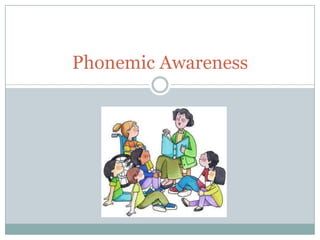
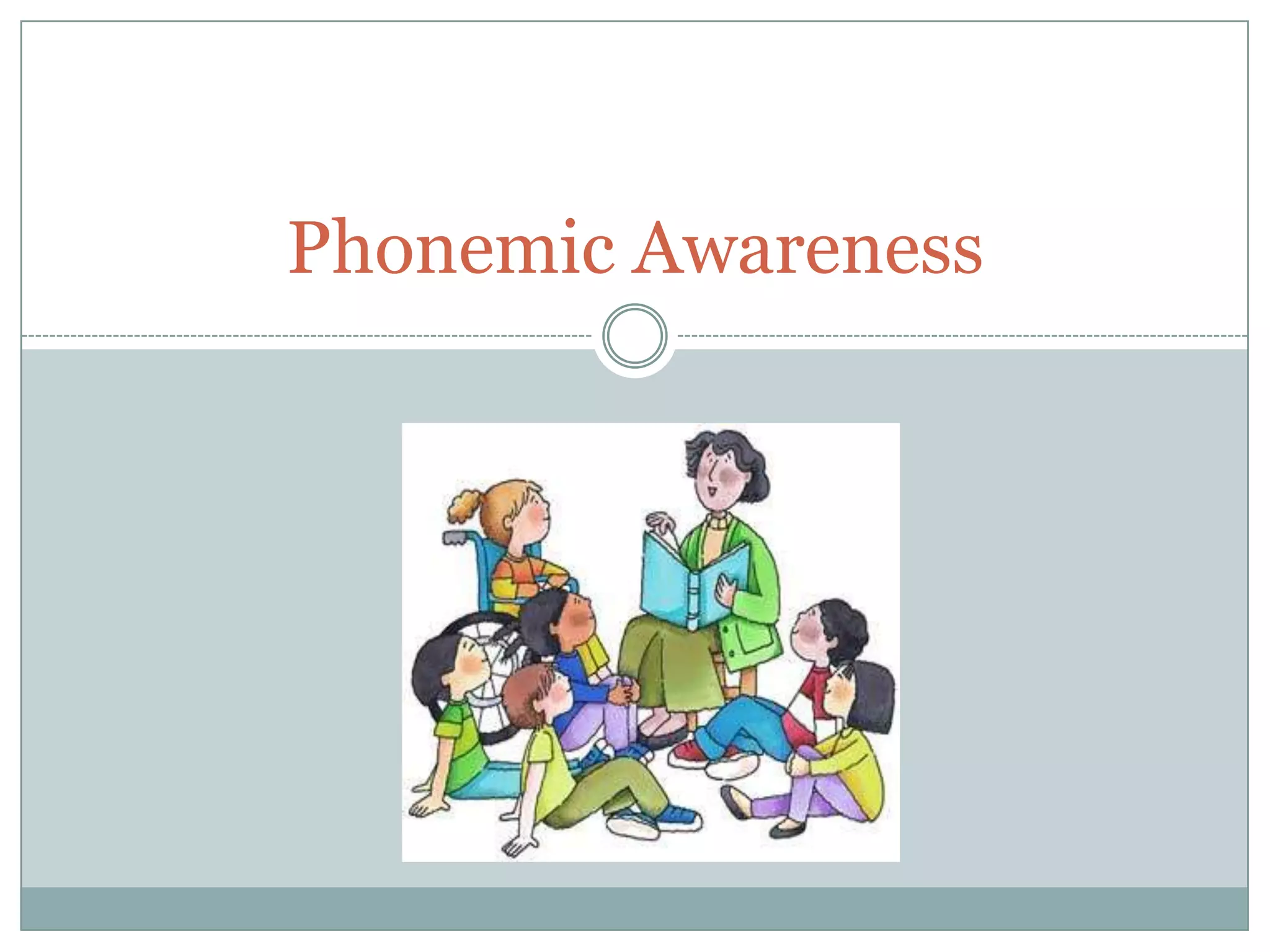

Phonemic Awareness
ď‚— Phonemic awareness refers to the ability to segment
  and manipulate the sounds of oral language.
ď‚— It is not the same as phonics, which involves
  knowing how written letters relate to spoken sounds.
 Research has shown that a child’s awareness of the
  sounds of spoken words is a strong predictor of his
  or her later success in learning to read
    -International Reading Association
7 Dimensions of Phonemic Awareness

1.   The ability to hear syllables within a word
2.   The ability to to hear initial sounds or recognize alliteration ( Sally
     Sells Seashells by the sea shore)
3.   The ability to distinguish rime and rhyme(Rime: hat cat sat;
     Rhyme: great late bait)
4.   The ability to distinguish oddity (man money cat)
5.   The ability to blend sounds orally to make a word (/a/ +/t/=at)
6.   The ability to segment words orally (at=/a/+/t/)
7.   The ability to manipulate sounds orally to create new words
     (Plug-/g/=Plu; Plu+/m/=Plum)
       -Devries
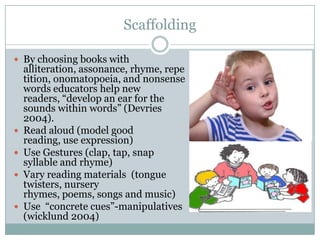
Scaffolding

ď‚— By choosing books with
    alliteration, assonance, rhyme, repe
    tition, onomatopoeia, and nonsense
    words educators help new
    readers, “develop an ear for the
    sounds within words” (Devries
    2004).
ď‚—   Read aloud (model good
    reading, use expression)
ď‚—   Use Gestures (clap, tap, snap
    syllable and rhyme)
ď‚—   Vary reading materials (tongue
    twisters, nursery
    rhymes, poems, songs and music)
   Use “concrete cues”-manipulatives
    (wicklund 2004)
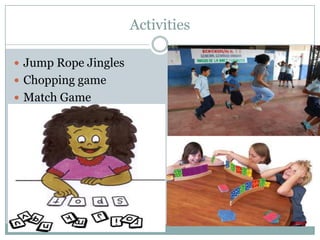
Activities

ď‚— Jump Rope Jingles
ď‚— Chopping game
ď‚— Match Game
ISEL

ď‚— Illinois Snapshot of Early Literacy
ď‚— Assesses phonemic awareness, letter
  recognition, and knowledge of letter sounds
ď‚— Given three times a year
ď‚— On Target vs On Watch
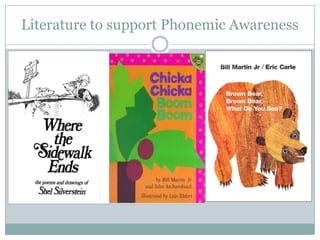
Literature to support Phonemic Awareness
References

ď‚— DeVries, B. A. (2011). Phonemic Awareness. Literacy assessment
  and intervention for the elementary       classroom (pp. 76-100).
  Scottsdale, Ariz.: Holcomb Hathaway Publishers.

ď‚— International Reading Association. (2012). Phonemic Awareness .
  Phonemic Awareness and the Teaching of Reading. Retrieved April
  10, 2012, fromhttp://reading.org/General/AboutIRA/PositionState
  ments/PhonemicAwarenessPosition.aspx

ď‚— Wicklund, B. (2004). Using scaffolding to teach
  phonological/phonemic awareness skills to english language
  learners Hamline University | Saint Paul, Minnesota. Hamline
  University | Saint Paul, Minnesota. Retrieved April 9, 2012, from
  www.hamline.edu/WorkArea/linkit.aspx? LinkIdentifier=id...

Phonemic Awareness

  • 1.
  • 2.
     Phonemic awarenessrefers to the ability to segment and manipulate the sounds of oral language.  It is not the same as phonics, which involves knowing how written letters relate to spoken sounds.  Research has shown that a child’s awareness of the sounds of spoken words is a strong predictor of his or her later success in learning to read  -International Reading Association
  • 3.
    7 Dimensions ofPhonemic Awareness 1. The ability to hear syllables within a word 2. The ability to to hear initial sounds or recognize alliteration ( Sally Sells Seashells by the sea shore) 3. The ability to distinguish rime and rhyme(Rime: hat cat sat; Rhyme: great late bait) 4. The ability to distinguish oddity (man money cat) 5. The ability to blend sounds orally to make a word (/a/ +/t/=at) 6. The ability to segment words orally (at=/a/+/t/) 7. The ability to manipulate sounds orally to create new words (Plug-/g/=Plu; Plu+/m/=Plum) -Devries
  • 4.
    Scaffolding  By choosingbooks with alliteration, assonance, rhyme, repe tition, onomatopoeia, and nonsense words educators help new readers, “develop an ear for the sounds within words” (Devries 2004).  Read aloud (model good reading, use expression)  Use Gestures (clap, tap, snap syllable and rhyme)  Vary reading materials (tongue twisters, nursery rhymes, poems, songs and music)  Use “concrete cues”-manipulatives (wicklund 2004)
  • 5.
    Activities ď‚— Jump RopeJingles ď‚— Chopping game ď‚— Match Game
  • 6.
    ISEL ď‚— Illinois Snapshotof Early Literacy ď‚— Assesses phonemic awareness, letter recognition, and knowledge of letter sounds ď‚— Given three times a year ď‚— On Target vs On Watch
  • 7.
    Literature to supportPhonemic Awareness
  • 8.
    References ď‚— DeVries, B.A. (2011). Phonemic Awareness. Literacy assessment and intervention for the elementary classroom (pp. 76-100). Scottsdale, Ariz.: Holcomb Hathaway Publishers. ď‚— International Reading Association. (2012). Phonemic Awareness . Phonemic Awareness and the Teaching of Reading. Retrieved April 10, 2012, fromhttp://reading.org/General/AboutIRA/PositionState ments/PhonemicAwarenessPosition.aspx ď‚— Wicklund, B. (2004). Using scaffolding to teach phonological/phonemic awareness skills to english language learners Hamline University | Saint Paul, Minnesota. Hamline University | Saint Paul, Minnesota. Retrieved April 9, 2012, from www.hamline.edu/WorkArea/linkit.aspx? LinkIdentifier=id...