DECEMBER 24
DECEMBER 24
DECEMBER 24
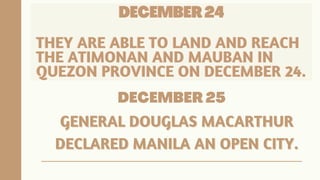
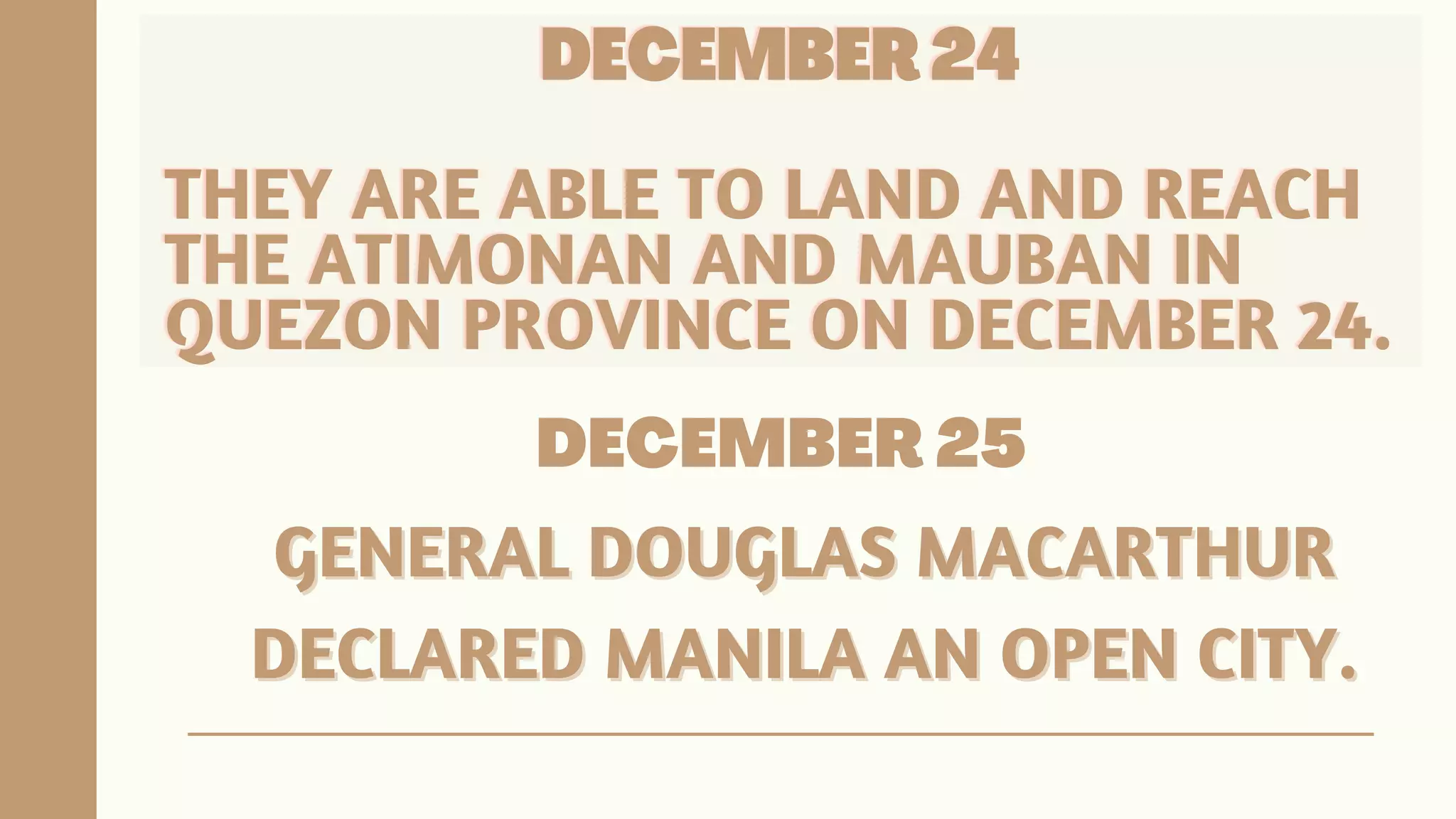
THEY ARE ABLE TO LAND AND REACH
THE ATIMONAN AND MAUBAN IN
QUEZON PROVINCE ON DECEMBER 24.
DECEMBER 25
GENERAL DOUGLAS MACARTHUR
DECLARED MANILA AN OPEN CITY.
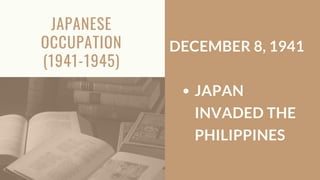
JAPANESE
OCCUPATION
(1941-1945)
JAPAN
INVADED THE
PHILIPPINES
DECEMBER 8, 1941
JANUARY
JANUARY
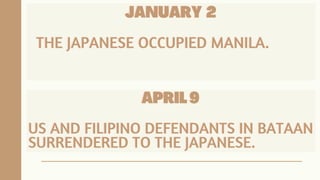
JANUARY 2
2
2
THE JAPANESE OCCUPIED MANILA.
APRIL 9
APRIL 9
APRIL 9
US AND FILIPINO DEFENDANTS IN BATAAN
SURRENDERED TO THE JAPANESE.
HUKBALAHAP
HUKBO NG BAYAN
LABAN SA HAPON
-Luis Taruc
-Castro Alejandrino
-Juan Feleo
-ESTABLISHED ON JANUARY 23, 1942
-noticeably lacked a bill of rights
-contained 12 articles lifted from the 1935
constitution that fitted the wishes of the Japanese
-was meant to be in effect only temporarily,
while the Philippines still in chaos
THE
SECOND
REPUBLIC
SEPTEMBER 20, 1943
- the KALIBAPI held a party convention to
elect 54 members of the National Assembly
OCTOBER 14
INAUGURATION ON THE FRONT STEPS OF
THE LEGISLATIVE BUILDING IN MANILA
Promoting Japanese propaganda was one of the main
objectives of the KALIBAP, but still Japanese failed
to gain the trust of the Filipinos.
I
SHALL
RETURN.
HE FINALLY FULFILLED HIS PROMISE
WHEN HIS FORCES LANDED IN
LEYTE ON OCTOBER 20,1944
THE RETURN OF
MACARTHUR
THE
RETURN
OF
MACARTHUR
OCTOBER 23-26, 1944
AMERICAN ENGAGED JAPANESE FORCES IN
THE BATTLE OF LEYTE GULF AND ALMOST
DESTROYED THE ENTIRE JAPANESE FLEET
-it took 3 weeks of intense fighting before
Japanese finally surrendered on February
23,1945
Proclaim general freedom from
the Japanese on July 4, 1945.
THE THIRD PHILIPPINE
REPUBLIC
(1946-1971)
TheThirdRepublicof
thePhilippineswas
inauguratedonJuly4,
1946.
It marked the culmination of the
peaceful campaign for Philippine
Independence—the two landmarks of
which were the enactment of the Jones
Law in 1916 (in which the U.S.
Congress pledged independence for
the Philippines once Filipinos have
proven their capability for self-
government) and the Philippine
Independence Act of 1934 (popularly
known as Tydings-McDuffie) which put
in place a ten-year transition period
during which the Philippines had
Commonwealth status.
Last President of the
Commonwealth
Term : May 28, 1946- July 4, 1946
First President of the Third
Republic of the Philippines
Term : July 4, 1946- April 15, 1948
The establishment of the Rehabilitation Finance
Corporation (which would be reorganized in 1958 as the
Development Bank of the Philippines)
the creation of the Department of Foreign Affair and
the organization of the foreign service through
Executive Order No. 18
the GI Bill of Rights for Filipino veterans
and the revision of taxation laws to increase
government revenues.
Among the undertakings of the Third
Republic’s initial year were:
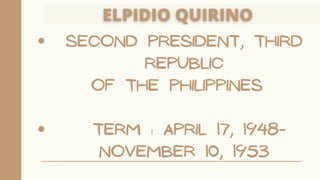
Second President, Third
Republic
Term : April 17, 1948-
November 10, 1953
of the Philippines
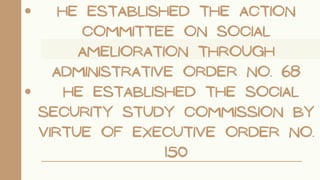
He established the Action
Committee on Social
Amelioration through
Administrative Order No. 68
He established the Social
Security Study Commission by
virtue of Executive Order No.
150
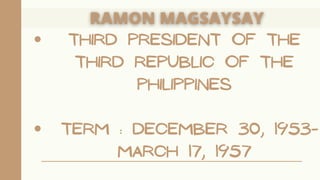
Third President of the
Third Republic of the
Philippines
Term : December 30, 1953-
March 17, 1957
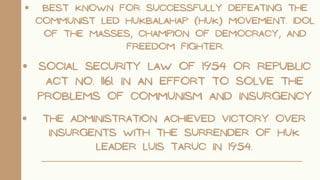
Best known for successfully defeating the
communist led Hukbalahap (Huk) Movement. Idol
of the masses, champion of democracy, and
freedom fighter.
Social Security Law of 1954 or Republic
Act No. 1161. In an effort to solve the
problems of communism and insurgency
The administration achieved victory over
insurgents with the surrender of Huk
leader Luis Taruc in 1954.
Agricultural Tenancy Act of the Philippines or
Republic Act No. 1199
the Land Reform Act of 1955 through Republic
Act No. 140
the formation of the Court of Agrarian
Relations through Republic Act No. 1267
National Resettlement and Rehabilitation
Administration (NARRA) through Republic Act No.
1160.
Fourth President of the
Third Republic of the
PhilippineS.
Term: March 18, 1957-
December 30, 1961
“Filipino First” policy, whose focal point was to
regain economic independence; a national effort
by Filipinos to “obtain major and dominant
participation in their economy.”
Anti Graft and Corrupt Practices Act, through
Republic Act No. 301, aimed to prevent corruption,
and promote honesty and public trust.
Another achievement of the Garcia administration
was the Bohlen–Serrano Agreement of 1959, which
shortened the term of lease of the US military
bases in the country from the previous 99 to 25
years.
Fifth President of the
Third Republic of the
Philippines
Term: December 30, 1961 -
December 30, 1965
Republic Act No. 3844 or the Agricultural Land Reform Code
(an act that established the Land Bank of the Philippines)
Republic Act No. 3466, which established the Emergency
Employment Administration
Republic Act No. 3518, which established the Philippine
Veterans Bank
Republic Act No. 3470, which established the National
Cottage Industries Development Authority (NACIDA) to
organize, revive, and promote the establishment of local
cottage industries
Republic Act No. 4156, which established the Philippine National
Railways (PNR) to operate the national railroad and tramway.
REVOLUTIONARY
PERIOD
(1868-1898)
THE REVOLUTION
Began in 1896 and
really ended only in
1901.
At first, it was a war
of independence
against the Spain.
CAUSES OF REVOLUTION
THE ABUSES OF SPANIS OFFICIALS AND PRIESTS
PERSECUTION OF FILIPINO LEADERS WHO
DEFENDED THE RIGHTS OF THEIR FELLOW
COUNTRYMEN
FILIPINOS DESIRE TO REGAIN THEIR INDEPENDENCE
DISCOVERY OF THE KATIPUNAN AND BONIFACIO'S
CALL FOR REVOLUTION
THE
CRY
OF
PUGADLAWIN
BONIFACIO WANTED THE WEALTHY FILIPINOS
TO HELP FINANCE THE KATIPUNAN IN ITS
STRUGGLE TO FREE THE COUNTRY FROM
SPAIN.
HE ORDERED SOME OF HIS TRUSTED MEN
TO APPROACH THE RICH FILIPINOS LIKE
FRANCISCO ROXAS.
SOME REFUSEF TO HELP THE KATIPUNAN,
WITH A FEW EXCEPTIONS LIKE THE
PHYSICIAN, DR. PIO VALENZUELA.
AGUINALDO
AND
FILIPINOS
VICTORY
THE GREATEST VICTORY IN BATTLE OF
THE FILIPINO WAS WON BY EMILIO
AGUINALDO IN THE BATTLE OF
BINAKAYAN, CAVITE ON NOVEMBER 9 - 11,
1896.
THE FILIPINOS FREEDOM FIGHTERS
FOUGHT WITH CRUDE WEAPONS;
BOLOS, CLUBS, STONES, BAMBOO
SPEARS, OLD MUSKETS, AND HOMEMADE
GUNS (PALTIK).
AT 17 YEARS OLD, HE WAS ELECTED AS A
BARANGAY HEAD (CABEZA DE BARANGAY)
AT 26 YEARS OLD, HE BECAME THE CAPTAIN
(MUNICIPAL MAYOR) OF THE KAWIT, LIKE HIS LATE
FATHER
HE WAS ALSO ELECTED AS A PRESIDENT OF THE
FIRST REVOLUTIONARY GOVERNMENT BY THE
TEJEROS ASSEMBLY
ON NOVEMBER 1, 1897, AGUINALDO WAS AGAIN
ELECTED AS THE PRESIDENT OF THE BIAK-NA-BATO
REPUBLIC.
ON JUNE 23, 1898 TO JANUARY 23, 1899, HE BECAME
PRESIDENT OF THE SECOND REVOLUTIONARY
GOVERNMENT.
JANUARY 23, 1898, HE BECAME PRESIDENT OF THE
AMERICANS AT PALAWAN, ISABELA ON MARCH 23, 1901.
HE SURRENDERED AND THE PHILIPPINE BECAME A
COLONY OF THE UNITED STATES.
PRE - COLONIAL
PERIOD
(BEFORE 1565)
Long before the
Spaniards came to the
Philippines, Filipinos had a
civilization of their own.
This civilization partly
came from the Malay
settlers and partly from
their response to the
new environment.
THERE WAS NO CENTRAL GOVERNMENT
BEFORE SPANIARDS CAME
GOVERNANCE CAME FROM BARANGAYS
SCATTERED THROUGHOUT THE ISLANDS OF
THE PHILLIPINES
"BARANGAY" = (AUSTRONESIAN : BALANGAY)
BOAT USED BY THE AUSTRONESIAN
IMMIGRANTS IN SAILING TO THE PHILIPPINE
DATU (CHIEFTAIN) RULED EACH BARANGAY, WHICH
WAS INDEPENDENT OF THE OTHER BARANGAYS
DATU = EXECUTIVE, LEGISLATIVE AND JUDICIAL
POWERS
RULE OF SUPREME COMMANDER DURING
WARTIME
ASSISTED BY A COUNCIL OF ELDERS CALLED
"MAGINOOS"
ISSUED LAWS AND CONSULT WITH
THE COUNCIL OF ELDERS
UMALOHOKAN = BARANGAY CRIER OR
ANNOUNCER TO ANNOUNCE TO THE
PEOPLE THE APPROVAL OF THE
NEW LAW
THE PRE-HISPANIC FILIPINOS BELIEVED THAT GOD
PROTECTED THE INNOCENT AND PUNISHED THE GUILTY
THIS SYSTEM OF DECISION-MAKING DID NOT RELY ON
LOGIC AND LEGAL REASONING
IT SHOWED THAT THE ANCIENT FILIPINOS BELIEVED IN
GOD AND IN DIVINE INTERVENTION
THE LOCAL CHIEFTAINS THEREFORE USED IN RELIGION
THEIR SUBJECTS
SPANISH PERIOD
(1565-1898)
THE GOVERNMENT WHICH SPAIN
ESTABLIHED IN THE PHILIPPINES
WAS CENTRALIZED IN STRUCTURE
AND NATIONAL IN SCOPE.
THE BARANGAYS WERE
CONSOLIDATED INTO TOWN EACH
HEADED BY A GOBERNADORCILLO
WITH ITS GOAL OF BRINGING THE CATHOLIC
RELIGION TO THE NEW WORLD, SPAIN WAS
ALSO ABLE TO USE THE EXISTING CHURCH
GOVERNMENTS FOR ITS OWN PRACTICAL USES.
FROM 1565-1821, PHILIPPINES WAS INDIRECTLY
GOVERNED BY THE KING OF SPAIN THROUGH
MEXICO.
FROM 1821-1898, THE PHILIPPINES WAS RULED
DIRECTLY FROM SPAIN.

Japanese occupation (1941-1945)

  • 1.
    DECEMBER 24 DECEMBER 24 DECEMBER24 THEY ARE ABLE TO LAND AND REACH THEY ARE ABLE TO LAND AND REACH THEY ARE ABLE TO LAND AND REACH THE ATIMONAN AND MAUBAN IN THE ATIMONAN AND MAUBAN IN THE ATIMONAN AND MAUBAN IN QUEZON PROVINCE ON DECEMBER 24. QUEZON PROVINCE ON DECEMBER 24. QUEZON PROVINCE ON DECEMBER 24. DECEMBER 25 GENERAL DOUGLAS MACARTHUR GENERAL DOUGLAS MACARTHUR DECLARED MANILA AN OPEN CITY. DECLARED MANILA AN OPEN CITY.
  • 2.
  • 3.
    JANUARY JANUARY JANUARY 2 2 2 THE JAPANESEOCCUPIED MANILA. THE JAPANESE OCCUPIED MANILA. THE JAPANESE OCCUPIED MANILA. APRIL 9 APRIL 9 APRIL 9 US AND FILIPINO DEFENDANTS IN BATAAN US AND FILIPINO DEFENDANTS IN BATAAN US AND FILIPINO DEFENDANTS IN BATAAN SURRENDERED TO THE JAPANESE. SURRENDERED TO THE JAPANESE. SURRENDERED TO THE JAPANESE.
  • 4.
    HUKBALAHAP HUKBO NG BAYAN LABANSA HAPON -Luis Taruc -Castro Alejandrino -Juan Feleo
  • 5.
    -ESTABLISHED ON JANUARY23, 1942 -ESTABLISHED ON JANUARY 23, 1942 -noticeably lacked a bill of rights -contained 12 articles lifted from the 1935 constitution that fitted the wishes of the Japanese -was meant to be in effect only temporarily, while the Philippines still in chaos
  • 6.
    THE SECOND REPUBLIC SEPTEMBER 20, 1943 -the KALIBAPI held a party convention to elect 54 members of the National Assembly OCTOBER 14 INAUGURATION ON THE FRONT STEPS OF THE LEGISLATIVE BUILDING IN MANILA Promoting Japanese propaganda was one of the main objectives of the KALIBAP, but still Japanese failed to gain the trust of the Filipinos.
  • 7.
    I SHALL RETURN. HE FINALLY FULFILLEDHIS PROMISE WHEN HIS FORCES LANDED IN LEYTE ON OCTOBER 20,1944 THE RETURN OF MACARTHUR
  • 8.
    THE RETURN OF MACARTHUR OCTOBER 23-26, 1944 AMERICANENGAGED JAPANESE FORCES IN THE BATTLE OF LEYTE GULF AND ALMOST DESTROYED THE ENTIRE JAPANESE FLEET -it took 3 weeks of intense fighting before Japanese finally surrendered on February 23,1945 Proclaim general freedom from the Japanese on July 4, 1945.
  • 9.
    THE THIRD PHILIPPINE REPUBLIC (1946-1971) TheThirdRepublicof thePhilippineswas inauguratedonJuly4, 1946. Itmarked the culmination of the peaceful campaign for Philippine Independence—the two landmarks of which were the enactment of the Jones Law in 1916 (in which the U.S. Congress pledged independence for the Philippines once Filipinos have proven their capability for self- government) and the Philippine Independence Act of 1934 (popularly known as Tydings-McDuffie) which put in place a ten-year transition period during which the Philippines had Commonwealth status.
  • 10.
    Last President ofthe Commonwealth Term : May 28, 1946- July 4, 1946 First President of the Third Republic of the Philippines Term : July 4, 1946- April 15, 1948
  • 11.
    The establishment ofthe Rehabilitation Finance Corporation (which would be reorganized in 1958 as the Development Bank of the Philippines) the creation of the Department of Foreign Affair and the organization of the foreign service through Executive Order No. 18 the GI Bill of Rights for Filipino veterans and the revision of taxation laws to increase government revenues. Among the undertakings of the Third Republic’s initial year were:
  • 12.
    Second President, Third Republic Term: April 17, 1948- November 10, 1953 of the Philippines
  • 13.
    He established theAction Committee on Social Amelioration through Administrative Order No. 68 He established the Social Security Study Commission by virtue of Executive Order No. 150
  • 14.
    Third President ofthe Third Republic of the Philippines Term : December 30, 1953- March 17, 1957
  • 15.
    Best known forsuccessfully defeating the communist led Hukbalahap (Huk) Movement. Idol of the masses, champion of democracy, and freedom fighter. Social Security Law of 1954 or Republic Act No. 1161. In an effort to solve the problems of communism and insurgency The administration achieved victory over insurgents with the surrender of Huk leader Luis Taruc in 1954.
  • 16.
    Agricultural Tenancy Actof the Philippines or Republic Act No. 1199 the Land Reform Act of 1955 through Republic Act No. 140 the formation of the Court of Agrarian Relations through Republic Act No. 1267 National Resettlement and Rehabilitation Administration (NARRA) through Republic Act No. 1160.
  • 17.
    Fourth President ofthe Third Republic of the PhilippineS. Term: March 18, 1957- December 30, 1961
  • 18.
    “Filipino First” policy,whose focal point was to regain economic independence; a national effort by Filipinos to “obtain major and dominant participation in their economy.” Anti Graft and Corrupt Practices Act, through Republic Act No. 301, aimed to prevent corruption, and promote honesty and public trust. Another achievement of the Garcia administration was the Bohlen–Serrano Agreement of 1959, which shortened the term of lease of the US military bases in the country from the previous 99 to 25 years.
  • 19.
    Fifth President ofthe Third Republic of the Philippines Term: December 30, 1961 - December 30, 1965
  • 20.
    Republic Act No.3844 or the Agricultural Land Reform Code (an act that established the Land Bank of the Philippines) Republic Act No. 3466, which established the Emergency Employment Administration Republic Act No. 3518, which established the Philippine Veterans Bank Republic Act No. 3470, which established the National Cottage Industries Development Authority (NACIDA) to organize, revive, and promote the establishment of local cottage industries Republic Act No. 4156, which established the Philippine National Railways (PNR) to operate the national railroad and tramway.
  • 21.
    REVOLUTIONARY PERIOD (1868-1898) THE REVOLUTION Began in1896 and really ended only in 1901. At first, it was a war of independence against the Spain.
  • 22.
    CAUSES OF REVOLUTION THEABUSES OF SPANIS OFFICIALS AND PRIESTS PERSECUTION OF FILIPINO LEADERS WHO DEFENDED THE RIGHTS OF THEIR FELLOW COUNTRYMEN FILIPINOS DESIRE TO REGAIN THEIR INDEPENDENCE DISCOVERY OF THE KATIPUNAN AND BONIFACIO'S CALL FOR REVOLUTION
  • 23.
    THE CRY OF PUGADLAWIN BONIFACIO WANTED THEWEALTHY FILIPINOS TO HELP FINANCE THE KATIPUNAN IN ITS STRUGGLE TO FREE THE COUNTRY FROM SPAIN. HE ORDERED SOME OF HIS TRUSTED MEN TO APPROACH THE RICH FILIPINOS LIKE FRANCISCO ROXAS. SOME REFUSEF TO HELP THE KATIPUNAN, WITH A FEW EXCEPTIONS LIKE THE PHYSICIAN, DR. PIO VALENZUELA.
  • 24.
    AGUINALDO AND FILIPINOS VICTORY THE GREATEST VICTORYIN BATTLE OF THE FILIPINO WAS WON BY EMILIO AGUINALDO IN THE BATTLE OF BINAKAYAN, CAVITE ON NOVEMBER 9 - 11, 1896. THE FILIPINOS FREEDOM FIGHTERS FOUGHT WITH CRUDE WEAPONS; BOLOS, CLUBS, STONES, BAMBOO SPEARS, OLD MUSKETS, AND HOMEMADE GUNS (PALTIK).
  • 25.
    AT 17 YEARSOLD, HE WAS ELECTED AS A BARANGAY HEAD (CABEZA DE BARANGAY) AT 26 YEARS OLD, HE BECAME THE CAPTAIN (MUNICIPAL MAYOR) OF THE KAWIT, LIKE HIS LATE FATHER HE WAS ALSO ELECTED AS A PRESIDENT OF THE FIRST REVOLUTIONARY GOVERNMENT BY THE TEJEROS ASSEMBLY
  • 26.
    ON NOVEMBER 1,1897, AGUINALDO WAS AGAIN ELECTED AS THE PRESIDENT OF THE BIAK-NA-BATO REPUBLIC. ON JUNE 23, 1898 TO JANUARY 23, 1899, HE BECAME PRESIDENT OF THE SECOND REVOLUTIONARY GOVERNMENT. JANUARY 23, 1898, HE BECAME PRESIDENT OF THE AMERICANS AT PALAWAN, ISABELA ON MARCH 23, 1901. HE SURRENDERED AND THE PHILIPPINE BECAME A COLONY OF THE UNITED STATES.
  • 27.
    PRE - COLONIAL PERIOD (BEFORE1565) Long before the Spaniards came to the Philippines, Filipinos had a civilization of their own. This civilization partly came from the Malay settlers and partly from their response to the new environment.
  • 28.
    THERE WAS NOCENTRAL GOVERNMENT BEFORE SPANIARDS CAME GOVERNANCE CAME FROM BARANGAYS SCATTERED THROUGHOUT THE ISLANDS OF THE PHILLIPINES "BARANGAY" = (AUSTRONESIAN : BALANGAY) BOAT USED BY THE AUSTRONESIAN IMMIGRANTS IN SAILING TO THE PHILIPPINE
  • 29.
    DATU (CHIEFTAIN) RULEDEACH BARANGAY, WHICH WAS INDEPENDENT OF THE OTHER BARANGAYS DATU = EXECUTIVE, LEGISLATIVE AND JUDICIAL POWERS RULE OF SUPREME COMMANDER DURING WARTIME ASSISTED BY A COUNCIL OF ELDERS CALLED "MAGINOOS"
  • 30.
    ISSUED LAWS ANDCONSULT WITH THE COUNCIL OF ELDERS UMALOHOKAN = BARANGAY CRIER OR ANNOUNCER TO ANNOUNCE TO THE PEOPLE THE APPROVAL OF THE NEW LAW
  • 31.
    THE PRE-HISPANIC FILIPINOSBELIEVED THAT GOD PROTECTED THE INNOCENT AND PUNISHED THE GUILTY THIS SYSTEM OF DECISION-MAKING DID NOT RELY ON LOGIC AND LEGAL REASONING IT SHOWED THAT THE ANCIENT FILIPINOS BELIEVED IN GOD AND IN DIVINE INTERVENTION THE LOCAL CHIEFTAINS THEREFORE USED IN RELIGION THEIR SUBJECTS
  • 32.
  • 33.
    THE GOVERNMENT WHICHSPAIN ESTABLIHED IN THE PHILIPPINES WAS CENTRALIZED IN STRUCTURE AND NATIONAL IN SCOPE. THE BARANGAYS WERE CONSOLIDATED INTO TOWN EACH HEADED BY A GOBERNADORCILLO
  • 34.
    WITH ITS GOALOF BRINGING THE CATHOLIC RELIGION TO THE NEW WORLD, SPAIN WAS ALSO ABLE TO USE THE EXISTING CHURCH GOVERNMENTS FOR ITS OWN PRACTICAL USES. FROM 1565-1821, PHILIPPINES WAS INDIRECTLY GOVERNED BY THE KING OF SPAIN THROUGH MEXICO. FROM 1821-1898, THE PHILIPPINES WAS RULED DIRECTLY FROM SPAIN.