3
2
1
 
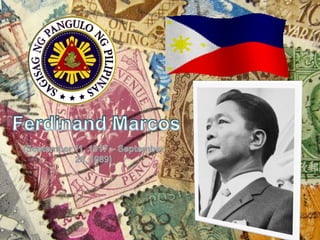
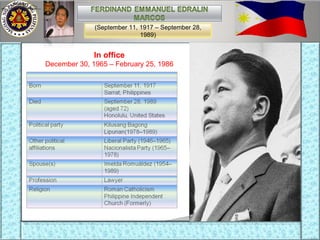
In office December 30, 1965 – February 25, 1986 (September 11, 1917 – September 28, 1989)
(September 11, 1917 – September 28, 1989)
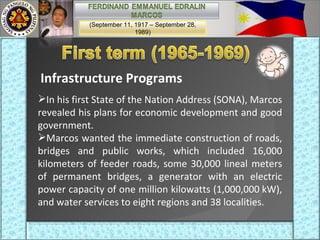
Infrastructure Programs In his first State of the Nation Address (SONA), Marcos revealed his plans for economic development and good government.  Marcos wanted the immediate construction of roads, bridges and public works, which included 16,000 kilometers of feeder roads, some 30,000 lineal meters of permanent bridges, a generator with an electric power capacity of one million kilowatts (1,000,000 kW), and water services to eight regions and 38 localities. (September 11, 1917 – September 28, 1989)
He also urged the revitalization of the judiciary, the national defense posture and the fight against smuggling, criminality, and graft and corruption in the government. He mobilized the manpower and resources of the Armed Forces of the Philippines (AFP) for action to complement civilian agencies in such activities as infrastructure construction; economic planning and program execution (September 11, 1917 – September 28, 1989)
He liberalized trade with the free world, hastening the industrialization of the Philippines.  He improved agricultural production to make the country self-sufficient in food, especially in rice.  Marcos also tried to strengthen the foreign relations of the Philippines. He hosted a seven-nation summit conference on the crisis in South Vietnam in October, 1966. In support for the U.S. military efforts in South Vietnam, he agreed to send Filipino troops to that war zone. (September 11, 1917 – September 28, 1989)
Marcos maintained a close alliance with the United States and was a close friend of Richard Nixon, Ronald Reagan and Lyndon Johnson. He launched major military campaigns against Communist New People's Army and Moro insurgents. He was an outspoken critic of communism. He sent forces to Vietnam to help the Americans, as well as medical teams to do humanitarian work. (September 11, 1917 – September 28, 1989)
The unemployment rate shrank from 7.20% in 1966 to just 5.20% in 1971. He developed a personality cult around himself, requiring businesses and schools all across the Philippines to have his official presidential picture displayed or their facilities shut down.  (September 11, 1917 – September 28, 1989)
(September 11, 1917 – September 28, 1989)
He spended too much money and looted the country and he had declared the martial law which made people more angry and Marcos placed the country under military countrol this all led to the fall of Ferdinand Marcos (September 11, 1917 – September 28, 1989)
His regime was marred by widespread corruption and political mismanagement by his cronies, which culminated with the assassination of Benigno Aquino Jr.. Marcos can be considered the quintessential kleptocrat, having supposedly looted billions of dollars from the Filipino treasury. Much of the lost sum has yet to be accounted for, but $684 million has been recovered and returned to the government. He was also a notorious nepotist, appointing family members and close friends to high positions in his government. (September 11, 1917 – September 28, 1989)
A restive studentry Marcos's health deteriorated rapidly due to kidney ailments, often described as lupus erythematosus. He was absent for weeks at a time for treatment, with no one to assume command. Marcos's regime was sensitive to publicity of his condition (September 11, 1917 – September 28, 1989)
 
 
Uy,,artista

Marcos administration

  • 1.
  • 2.
  • 3.
  • 4.
  • 5.
    In office December 30,1965 – February 25, 1986 (September 11, 1917 – September 28, 1989)
  • 6.
    (September 11, 1917– September 28, 1989)
  • 7.
    Infrastructure Programs Inhis first State of the Nation Address (SONA), Marcos revealed his plans for economic development and good government. Marcos wanted the immediate construction of roads, bridges and public works, which included 16,000 kilometers of feeder roads, some 30,000 lineal meters of permanent bridges, a generator with an electric power capacity of one million kilowatts (1,000,000 kW), and water services to eight regions and 38 localities. (September 11, 1917 – September 28, 1989)
  • 8.
    He also urgedthe revitalization of the judiciary, the national defense posture and the fight against smuggling, criminality, and graft and corruption in the government. He mobilized the manpower and resources of the Armed Forces of the Philippines (AFP) for action to complement civilian agencies in such activities as infrastructure construction; economic planning and program execution (September 11, 1917 – September 28, 1989)
  • 9.
    He liberalized tradewith the free world, hastening the industrialization of the Philippines. He improved agricultural production to make the country self-sufficient in food, especially in rice. Marcos also tried to strengthen the foreign relations of the Philippines. He hosted a seven-nation summit conference on the crisis in South Vietnam in October, 1966. In support for the U.S. military efforts in South Vietnam, he agreed to send Filipino troops to that war zone. (September 11, 1917 – September 28, 1989)
  • 10.
    Marcos maintained aclose alliance with the United States and was a close friend of Richard Nixon, Ronald Reagan and Lyndon Johnson. He launched major military campaigns against Communist New People's Army and Moro insurgents. He was an outspoken critic of communism. He sent forces to Vietnam to help the Americans, as well as medical teams to do humanitarian work. (September 11, 1917 – September 28, 1989)
  • 11.
    The unemployment rateshrank from 7.20% in 1966 to just 5.20% in 1971. He developed a personality cult around himself, requiring businesses and schools all across the Philippines to have his official presidential picture displayed or their facilities shut down. (September 11, 1917 – September 28, 1989)
  • 12.
    (September 11, 1917– September 28, 1989)
  • 13.
    He spended toomuch money and looted the country and he had declared the martial law which made people more angry and Marcos placed the country under military countrol this all led to the fall of Ferdinand Marcos (September 11, 1917 – September 28, 1989)
  • 14.
    His regime wasmarred by widespread corruption and political mismanagement by his cronies, which culminated with the assassination of Benigno Aquino Jr.. Marcos can be considered the quintessential kleptocrat, having supposedly looted billions of dollars from the Filipino treasury. Much of the lost sum has yet to be accounted for, but $684 million has been recovered and returned to the government. He was also a notorious nepotist, appointing family members and close friends to high positions in his government. (September 11, 1917 – September 28, 1989)
  • 15.
    A restive studentryMarcos's health deteriorated rapidly due to kidney ailments, often described as lupus erythematosus. He was absent for weeks at a time for treatment, with no one to assume command. Marcos's regime was sensitive to publicity of his condition (September 11, 1917 – September 28, 1989)
  • 16.
  • 17.
  • 18.

Editor's Notes

  • #16 The last years of the 1960s and the first two years of the 1970s witnessed the radicalization of the country's student population. Students in various colleges and universities held massive rallies and demonstrations to express their frustrations and resentments. On January 30, 1970, demonstrators numbering about 50,000 students and laborers stormed the Malacañang Palace, burning part of the medical building and crashing through Gate 4 with a fire truck that had been forcibly commandeered by laborers and students. The Metropolitan Command (Metrocom) of the Philippine Constabulary (PC) repulsed them, pushing them toward Mendiola Bridge, where, hours later, after an exchange of gunfire, four persons were killed and scores from both sides injured. Tear gas grenades finally dispersed the crowd. Many people questioned whether he still had capacity to govern, due to his grave illness and the ballooning political unrest