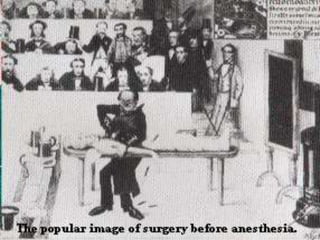
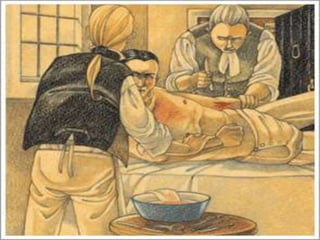
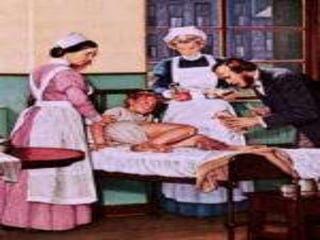








In the 1800s, hospitals were often
dangerous places. Many doctors didn't wear
caps and gowns or wash their hands before they
began to work. Doctors also hadn't discovered
how to put people to sleep so a patient was
usually awake during an operation.
Some people died from the pain,
but more often, they died from an infection,
when germs got into their wounds. Back then,
people believed that an infection was caused by
something in the air.
“Father Of Modern Surgery"
The hospital environment has not always
been a place of sterility and extreme cleanliness that is
associated with it so readily today. Prior to the work
of Joseph Lister, the hospital was a place to go to die,
not to be cured. If an individual was able to survive
the pain and torture of surgery without anesthesia, a
postoperative infection would most certainly be their
ultimate demise. Thanks to Joseph Lister, a hospital is
now a place of healing and cleanliness, not one of
death and filth.
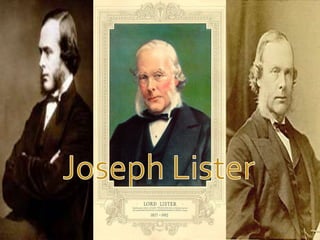
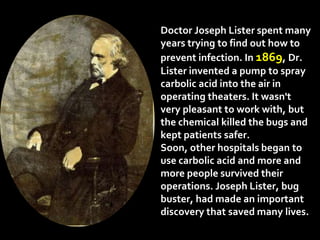
Doctor Joseph Lister spent many
years trying to find out how to
prevent infection. In 1869, Dr.
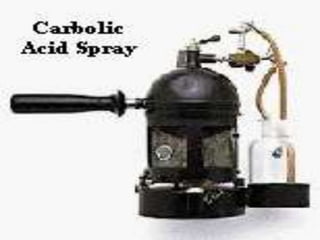
Lister invented a pump to spray
carbolic acid into the air in
operating theaters. It wasn't
very pleasant to work with, but
the chemical killed the bugs and
kept patients safer.
Soon, other hospitals began to
use carbolic acid and more and
more people survived their
operations. Joseph Lister, bug
buster, had made an important
discovery that saved many lives.
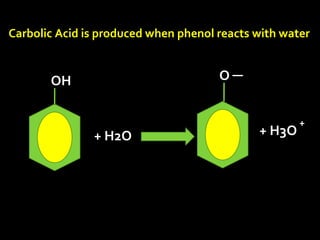
Carbolic Acid is produced when phenol reacts with water
+ H2O
OH O ─
+ H3O
+
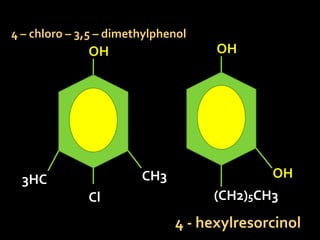
OH
CH3
Cl
3HC
OH
OH
(CH2)5CH3
4 – chloro – 3,5 – dimethylphenol
4 - hexylresorcinol
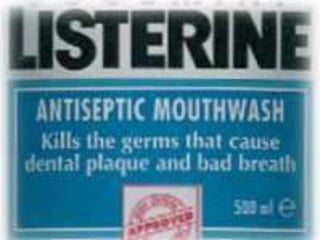
Because of Joseph Lister’s
contribution to science,
specifically in the field of
medicine…. The first
company that produces
health care and hygiene
products was name after
him to give him recognition
OH
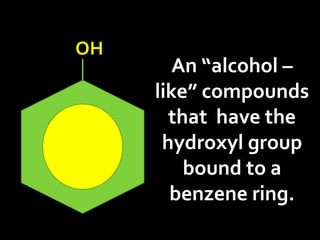
An “alcohol –
like” compounds
that have the
hydroxyl group
bound to a
benzene ring.
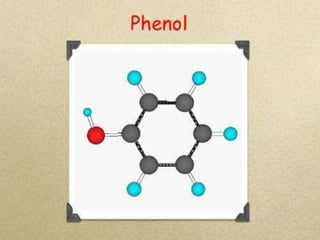
Phenol is derived from the old
name for benzene (phene), to include the
suffix that indicates it possesses a
hydroxyl group (ol).
CAUTION:
 The word phenol (C6H5-OH) is often
confused with phenyl (C6H5-).
 Phenols are acidic and are
important intermediates in the
preparation of aryl ethers, C6H5-OR .
Phenol may be found as a
translucent, clear, or light-pink crystalline
mass; a white powder, or a clear liquid. It
has a sweet, sharp odor or medicinal odor.
Addition of small amount of water causes
the solid to liquefy at room temperature.
Phenol is used in many commercially
available products including plastics,
resins, fertilizers, paints, photographic
developers, and some medicines.-wikipedia
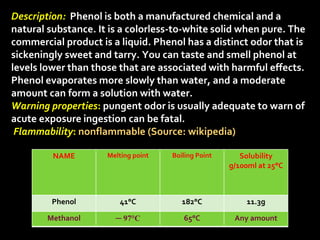
NAME Melting point Boiling Point Solubility
g/100ml at 25°C
Phenol 41°C 182°C 11.3g
Methanol ─ 97°C 65°C Any amount
Description: Phenol is both a manufactured chemical and a
natural substance. It is a colorless-to-white solid when pure. The
commercial product is a liquid. Phenol has a distinct odor that is
sickeningly sweet and tarry. You can taste and smell phenol at
levels lower than those that are associated with harmful effects.
Phenol evaporates more slowly than water, and a moderate
amount can form a solution with water.
Warning properties: pungent odor is usually adequate to warn of
acute exposure ingestion can be fatal.
Flammability: nonflammable (Source: wikipedia)
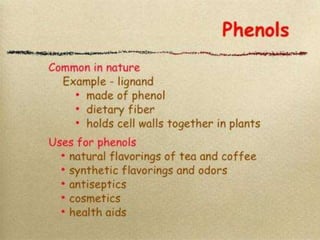
< TARGET="display">
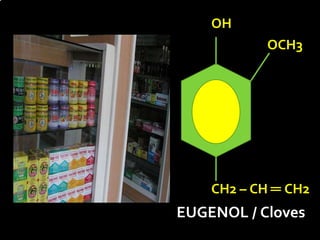
OH
OCH3
CH2 – CH ═ CH2
EUGENOL / Cloves
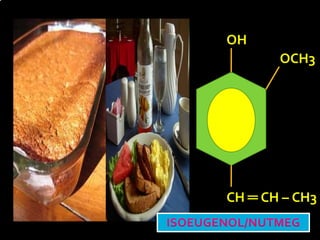
OH
OCH3
CH ═ CH – CH3
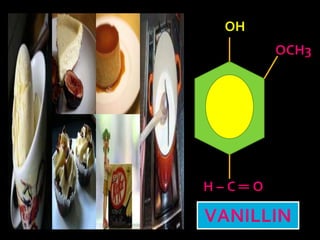
OH
C – O –
CH3
O
OH
OH
C
CH3
CH3
CH3
OCH3
Butylated Hydroxy Anisole
2 – t – butyl – 4 - methoxyphenol
OH
C
C
CH3
CH3
CH3
CH3
CH3
CH3
3HC
Butylated Hydroxy Toluene
2,6 – di – t – butyl – 4 - methylphenol
C – OH
O
OH
OH
CH2
OH
Cl
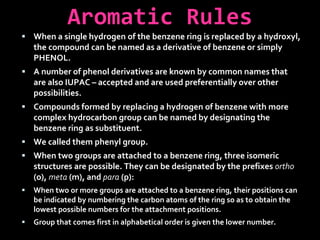
Aromatic Rules
 When a single hydrogen of the benzene ring is replaced by a hydroxyl,
the compound can be named as a derivative of benzene or simply
PHENOL.
 A number of phenol derivatives are known by common names that
are also IUPAC – accepted and are used preferentially over other
possibilities.
 Compounds formed by replacing a hydrogen of benzene with more
complex hydrocarbon group can be named by designating the
benzene ring as substituent.
 We called them phenyl group.
 When two groups are attached to a benzene ring, three isomeric
structures are possible. They can be designated by the prefixes ortho
(o), meta (m), and para (p):
 When two or more groups are attached to a benzene ring, their positions can
be indicated by numbering the carbon atoms of the ring so as to obtain the
lowest possible numbers for the attachment positions.
 Group that comes first in alphabetical order is given the lower number.
OH
CH3
CH3
3HC
OH
CH3CH2
2ON
NO2
HO
C6H5
C6H5
C6H5
OH
Br
Cl
2,3,4 - triphenylphenol
2 – ethyl – 4,5 -
dinitrophenol
3 – bromo – 5 – chlorophenol
3,4,5 - trimethylphenol
OH OH
OH
OH
OH
OH
OH
Phenol Cathecol Resorcinol
Hydroquinone
OH
CH3
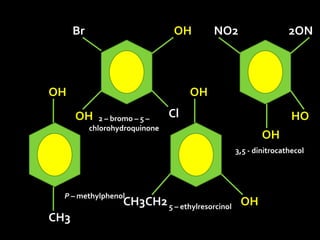
P – methylphenol
OH
OH
Br
Cl2 – bromo – 5 –
chlorohydroquinone
OH
OHCH3CH25 – ethylresorcinol
OH
HO
NO2 2ON
3,5 - dinitrocathecol
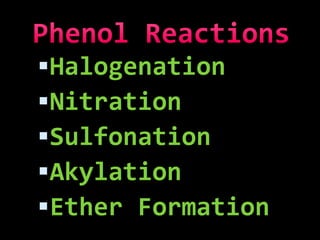
Halogenation
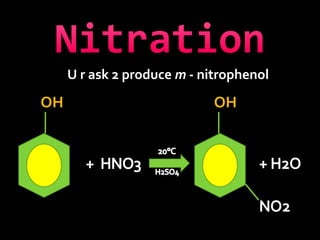
Nitration
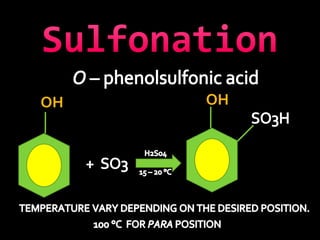
Sulfonation
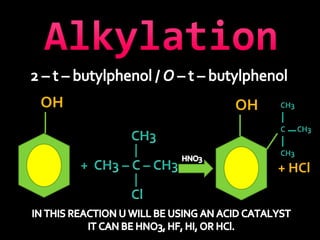
Akylation
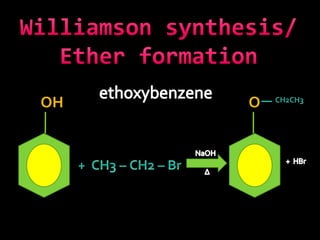
Ether Formation
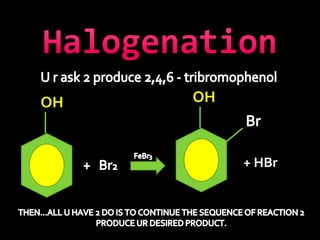
OH OH
+ HBr
U r ask 2 produce m - nitrophenol
OH OH
OH OH
OH OH
+ HCl
OH O

Phenol Juan C

  • 2.
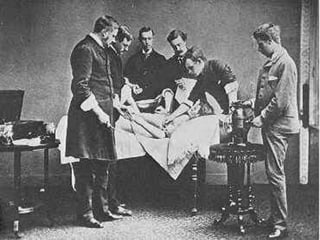
    In the 1800s,hospitals were often dangerous places. Many doctors didn't wear caps and gowns or wash their hands before they began to work. Doctors also hadn't discovered how to put people to sleep so a patient was usually awake during an operation. Some people died from the pain, but more often, they died from an infection, when germs got into their wounds. Back then, people believed that an infection was caused by something in the air.
  • 7.
    “Father Of ModernSurgery" The hospital environment has not always been a place of sterility and extreme cleanliness that is associated with it so readily today. Prior to the work of Joseph Lister, the hospital was a place to go to die, not to be cured. If an individual was able to survive the pain and torture of surgery without anesthesia, a postoperative infection would most certainly be their ultimate demise. Thanks to Joseph Lister, a hospital is now a place of healing and cleanliness, not one of death and filth.
  • 8.
    Doctor Joseph Listerspent many years trying to find out how to prevent infection. In 1869, Dr. Lister invented a pump to spray carbolic acid into the air in operating theaters. It wasn't very pleasant to work with, but the chemical killed the bugs and kept patients safer. Soon, other hospitals began to use carbolic acid and more and more people survived their operations. Joseph Lister, bug buster, had made an important discovery that saved many lives.
  • 11.
    Carbolic Acid isproduced when phenol reacts with water + H2O OH O ─ + H3O +
  • 13.
    OH CH3 Cl 3HC OH OH (CH2)5CH3 4 – chloro– 3,5 – dimethylphenol 4 - hexylresorcinol
  • 14.
    Because of JosephLister’s contribution to science, specifically in the field of medicine…. The first company that produces health care and hygiene products was name after him to give him recognition
  • 18.
    OH An “alcohol – like”compounds that have the hydroxyl group bound to a benzene ring.
  • 20.
    Phenol is derivedfrom the old name for benzene (phene), to include the suffix that indicates it possesses a hydroxyl group (ol). CAUTION:  The word phenol (C6H5-OH) is often confused with phenyl (C6H5-).  Phenols are acidic and are important intermediates in the preparation of aryl ethers, C6H5-OR .
  • 22.
    Phenol may befound as a translucent, clear, or light-pink crystalline mass; a white powder, or a clear liquid. It has a sweet, sharp odor or medicinal odor. Addition of small amount of water causes the solid to liquefy at room temperature. Phenol is used in many commercially available products including plastics, resins, fertilizers, paints, photographic developers, and some medicines.-wikipedia
  • 23.
    NAME Melting pointBoiling Point Solubility g/100ml at 25°C Phenol 41°C 182°C 11.3g Methanol ─ 97°C 65°C Any amount Description: Phenol is both a manufactured chemical and a natural substance. It is a colorless-to-white solid when pure. The commercial product is a liquid. Phenol has a distinct odor that is sickeningly sweet and tarry. You can taste and smell phenol at levels lower than those that are associated with harmful effects. Phenol evaporates more slowly than water, and a moderate amount can form a solution with water. Warning properties: pungent odor is usually adequate to warn of acute exposure ingestion can be fatal. Flammability: nonflammable (Source: wikipedia)
  • 24.
  • 27.
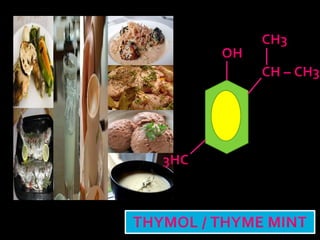
    OH OCH3 CH2 – CH═ CH2 EUGENOL / Cloves
  • 29.
  • 31.
  • 35.
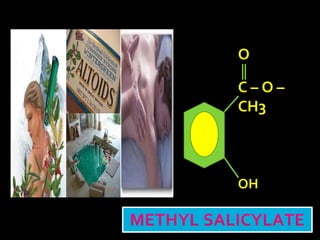
    C – O– CH3 O OH
  • 37.
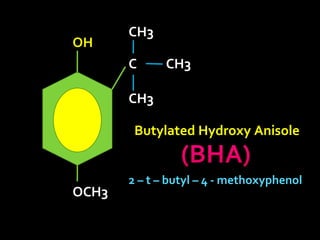
    OH C CH3 CH3 CH3 OCH3 Butylated Hydroxy Anisole 2– t – butyl – 4 - methoxyphenol
  • 38.
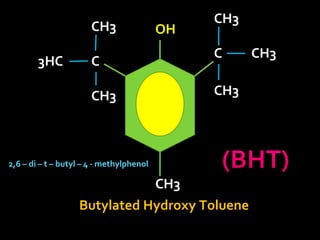
    OH C C CH3 CH3 CH3 CH3 CH3 CH3 3HC Butylated Hydroxy Toluene 2,6– di – t – butyl – 4 - methylphenol
  • 41.
  • 42.
  • 50.
    Aromatic Rules  Whena single hydrogen of the benzene ring is replaced by a hydroxyl, the compound can be named as a derivative of benzene or simply PHENOL.  A number of phenol derivatives are known by common names that are also IUPAC – accepted and are used preferentially over other possibilities.  Compounds formed by replacing a hydrogen of benzene with more complex hydrocarbon group can be named by designating the benzene ring as substituent.  We called them phenyl group.  When two groups are attached to a benzene ring, three isomeric structures are possible. They can be designated by the prefixes ortho (o), meta (m), and para (p):  When two or more groups are attached to a benzene ring, their positions can be indicated by numbering the carbon atoms of the ring so as to obtain the lowest possible numbers for the attachment positions.  Group that comes first in alphabetical order is given the lower number.
  • 51.
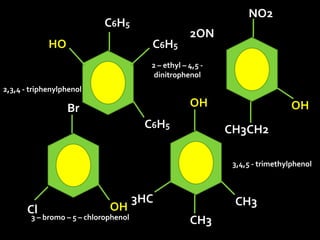
    OH CH3 CH3 3HC OH CH3CH2 2ON NO2 HO C6H5 C6H5 C6H5 OH Br Cl 2,3,4 - triphenylphenol 2– ethyl – 4,5 - dinitrophenol 3 – bromo – 5 – chlorophenol 3,4,5 - trimethylphenol
  • 52.
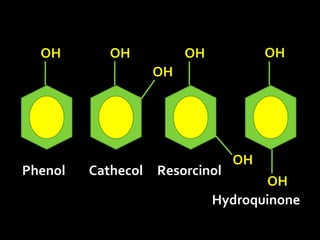
    OH OH OH OH OH OH OH Phenol CathecolResorcinol Hydroquinone
  • 53.
    OH CH3 P – methylphenol OH OH Br Cl2– bromo – 5 – chlorohydroquinone OH OHCH3CH25 – ethylresorcinol OH HO NO2 2ON 3,5 - dinitrocathecol
  • 55.
  • 56.
  • 57.
    U r ask2 produce m - nitrophenol OH OH
  • 58.
  • 59.
  • 60.