Ayman Elnashar
                                   ECMS (MobiNil)
Supervisors:

Prof. Dr. Hamdy El-Mikati   Prof. Dr. Said El-Noubi

  Mansoura University        Alexandria University
                                            30 April 2005
Agenda


         Introduction

         Numerically Robust Multiuser Receivers

         Quadratically Constrained Robust MUD

         Robust Adaptive Beamforming

         Thesis Contributions & Publications
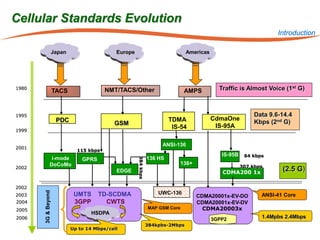
Cellular Standards Evolution
                                                                                                                      Introduction

                     Japan                    Europe                              Americas


1980                                                                                           Traffic is Almost Voice (1st G)
                     TACS                 NMT/TACS/Other                          AMPS


1995                                                                                                          Data 9.6-14.4
                      PDC                                                  TDMA              CdmaOne
                                             GSM                                                              Kbps (2nd G)
                                                                            IS-54             IS-95A
1999


                                                                       ANSI-136
2001
                               115 kbps
                                                                                                IS-95B    64 kbps
                i-mode                                            136 HS
                                                       384 kbps


                                 GPRS
               DoCoMo                                                            136+
2002                                                                                                     307 kbps
                                              EDGE                                              CDMA200 1x
                                                                                                                       (2.5 G)

2002
       3G & Beyond


2003                          UMTS      TD-SCDMA                      UWC-136                                   ANSI-41 Core
                                                                                        CDMA20001x-EV-DO
2004                          3GPP        CWTS                                          CDMA20001x-EV-DV
2005                                                              MAP GSM Core            CDMA20003x
                                    HSDPA
2006                                                                                         3GPP2              1.4Mpbs 2.4Mbps
                                                                  384kpbs-2Mbps
                             Up to 14 Mbps/cell
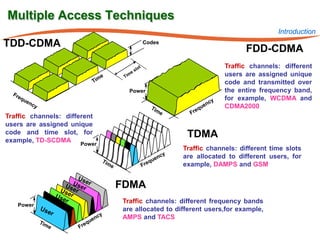
Multiple Access Techniques
                                                                               Introduction
TDD-CDMA                            Codes
                                                                     FDD-CDMA
                                                              Traffic channels: different
                                                              users are assigned unique
                                                              code and transmitted over
                                Power                         the entire frequency band,
                                                              for example, WCDMA and
                                                              CDMA2000
Traffic channels: different
users are assigned unique
code and time slot, for                           TDMA
example, TD-SCDMA Power
                                                 Traffic channels: different time slots
                                                 are allocated to different users, for
                                                 example, DAMPS and GSM


                              FDMA
                              Traffic channels: different frequency bands
   Power
                              are allocated to different users,for example,
                              AMPS and TACS
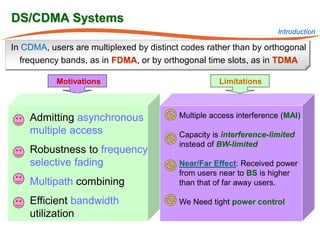
DS/CDMA Systems
                                                                     Introduction

In CDMA, users are multiplexed by distinct codes rather than by orthogonal
  frequency bands, as in FDMA, or by orthogonal time slots, as in TDMA

           Motivations                               Limitations


    Admitting asynchronous                Multiple access interference (MAI)
    multiple access                       Capacity is interference-limited
                                          instead of BW-limited
    Robustness to frequency
    selective fading                      Near/Far Effect: Received power
                                          from users near to BS is higher
    Multipath combining                   than that of far away users.

    Efficient bandwidth                   We Need tight power control
    utilization
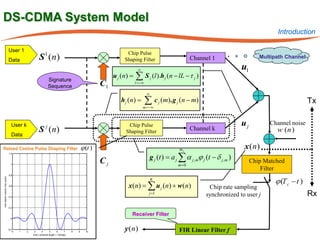
DS-CDMA System Model
                                                                                                                                                                                            Introduction

                                User 1
                                                                                                               Chip Pulse
                                Data                     S 1 ( n)                                             Shaping Filter                               Channel 1                  Multipath Channel

                                                                                                                      ∞                                                       u1
                                                                   Signature
                                                                                                        =
                                                                                                        u j ( n)    ∑S           j   (l ).h j (n − lL − τ j )
                                                                   Sequence                             C1          l = −∞

                                                                                                                             ∞
                                                                                                        =h j ( n)            ∑ c (m) .g (n − m)
                                                                                                                          m = −∞
                                                                                                                                        j        j                                                        Tx

                                   User k                      j                                                Chip Pulse                                                    uj          Channel noise
                                                        S ( n)                                                 Shaping Filter
                                                                                                                                                           Channel k                        w (n )
                                   Data

Raised Cosine Pulse Shaping Filter                                                             ϕ (t )                                                mj                        x ( n)
                                                                                                               = a j ∑ α j ,mϕ j (t − δ j ,m )
                                1.2

                                                                                                                g j (t )
                                  1
                                                                                                        Cj                                           m=0
                                                                                                                                                                                   Chip Matched
                                                                                                                                                                                       Filter
                                0.8


                                                                                                                                                                                           ϕ (T c − t )
root-raised cosine chip pulse


                                                                                                                                 K
                                0.6                                                                          =
                                                                                                             x ( n)           ∑ u ( n) + w ( n)
                                                                                                                                            j                    Chip rate sampling
                                0.4
                                                                                                                              j =1                              synchronized to user j                    Rx
                                0.2

                                                                                                                   Receiver Filter
                                  0


                                -0.2
                                       0   1   2     3      4       5      6      7    8   9     10
                                                                                                              y ( n)                                 FIR Linear Filter f
                                                   time t (channel length = 10chips)
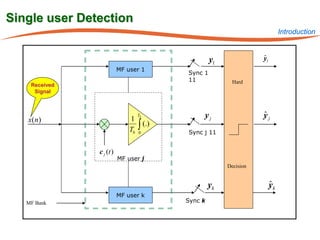
Single user Detection
                                                                            Introduction


                                                  y1              ˆ
                                                                  y1
                          MF user 1
                                         Sync 1
                                         11              Hard
    Received
     Signal


                              1 b
                                 T            yj                  ˆ
                                                                  yj
   x ( n)
                                 ∫ (.)
                              Tb 0       Sync j 11


               c j (t )
                          MF user j
                                                       Decision


                                                  yk                   ˆ
                                                                       yk
                          MF user k
   MF Bank                               Sync k
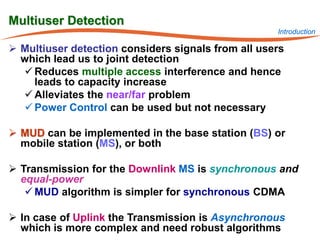
Multiuser Detection
                                                    Introduction

 Multiuser detection considers signals from all users
  which lead us to joint detection
   Reduces multiple access interference and hence
    leads to capacity increase
   Alleviates the near/far problem
   Power Control can be used but not necessary

 MUD can be implemented in the base station (BS) or
  mobile station (MS), or both

 Transmission for the Downlink MS is synchronous and
  equal-power
    MUD algorithm is simpler for synchronous CDMA

 In case of Uplink the Transmission is Asynchronous
  which is more complex and need robust algorithms
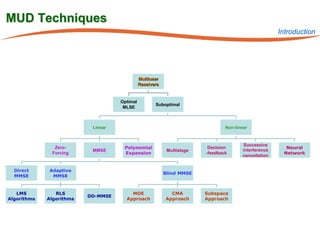
MUD Techniques
                                                                                                       Introduction


                                              Multiuser
                                              Receivers


                                    Optimal
                                                     Suboptimal
                                     MLSE


                           Linear                                               Non-linear


                                                                                        Successive
                Zero-                Polynomial                          Decision                        Neural
                           MMSE                            Multistage                   interference
               Forcing               Expansion                          -feedback                       Network
                                                                                        cancellation


  Direct     Adaptive
                                                          Blind MMSE
  MMSE        MMSE


   LMS          RLS                     MOE                 CMA         Subspace
                          DD-MMSE
Algorithms   Algorithms               Approach            Approach      Approach
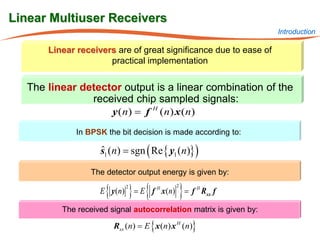
Linear Multiuser Receivers
                                                                    Introduction

       Linear receivers are of great significance due to ease of
                      practical implementation


   The linear detector output is a linear combination of the
                received chip sampled signals:
                          y ( n) = f    H
                                            ( n) x ( n)
              In BPSK the bit decision is made according to:

                    s1 (n) = sgn ( Re { y1 (n)} )
                    ˆ

                  The detector output energy is given by:

                      {
                  = E f H x ( n)
                  E y ( n)        } {
                           = f H Rxx f
                              2                  2
                                                     }
          The received signal autocorrelation matrix is given by:

                          Rxx (n) = E { x (n) x H (n)}
Agenda


         Introduction

         Numerically Robust Multiuser Detection

         Quadratically Constraint Robust MUD

         Robust Adaptive Beamforming

         Thesis Contributions & Publications
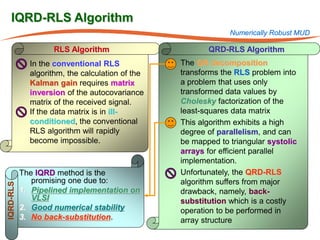
IQRD-RLS Algorithm
                                                                  Numerically Robust MUD

                   RLS Algorithm                            QRD-RLS Algorithm
             In the conventional RLS             •   The QR decomposition
             algorithm, the calculation of the       transforms the RLS problem into
             Kalman gain requires matrix             a problem that uses only
             inversion of the autocovariance         transformed data values by
             matrix of the received signal.          Cholesky factorization of the
             If the data matrix is in ill-           least-squares data matrix
             conditioned, the conventional       •   This algorithm exhibits a high
             RLS algorithm will rapidly              degree of parallelism, and can
             become impossible.                      be mapped to triangular systolic
                                                     arrays for efficient parallel
                                                     implementation.
           The IQRD method is the                •   Unfortunately, the QRD-RLS
              promising one due to:                  algorithm suffers from major
IQRD-RLS


           1. Pipelined implementation on            drawback, namely, back-
              VLSI                                   substitution which is a costly
           2. Good numerical stability               operation to be performed in
           3. No back-substitution.                  array structure
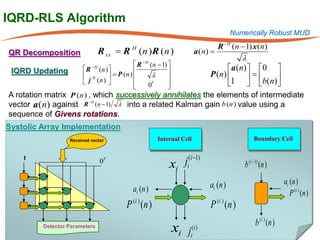
IQRD-RLS Algorithm
                                                                                        Numerically Robust MUD
                                                                                   R − H (n − 1) x (n)
QR Decomposition                R xx = R (n )R (n )
                                            H
                                                                        a ( n) =
                                                                                            λ
                                             R − H (n − 1) 
 IQRD Updating           R (n ) 
                           −H
                                                                                    a ( n)   0 
                         H       = P (n )         λ                       P ( n)          = b( n) 
                         j (n )           
                                                  0 T
                                                            
                                                                                    1                
A rotation matrix P (n ) , which successively annihilates the elements of intermediate
vector a ( n) against R − H (n − 1) λ into a related Kalman gain b (n ) value using a
sequence of Givens rotations.
Systolic Array Implementation
                   Received vector                      Internal Cell                             Boundary Cell


    1
                                0T
                                                            xi ji(i −1)                      b (i −1) (n )

                                                                              ai (n )                            ai (n )
                                             ai (n )                                                                P (i ) (n )
                                          P (i ) (n )                         P (i ) (n )
                                                                                                   b (i ) (n )
          Detector Parameters
                                                                xi   ji(i )
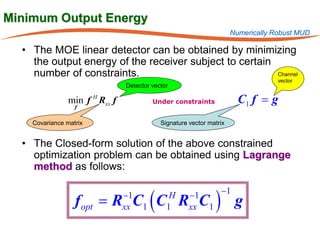
Minimum Output Energy
                                                                      Numerically Robust MUD

  • The MOE linear detector can be obtained by minimizing
    the output energy of the receiver subject to certain
    number of constraints.                               Channel
                                                                                   vector
                                Detector vector

                min f H Rxx f
                  f
                                         Under constraints              C1 f = g
    Covariance matrix                       Signature vector matrix


  • The Closed-form solution of the above constrained
    optimization problem can be obtained using Lagrange
    method as follows:


                  f opt = R C1 ( C R C1 ) g
                                −1             H      −1         −1
                                xx            1       xx
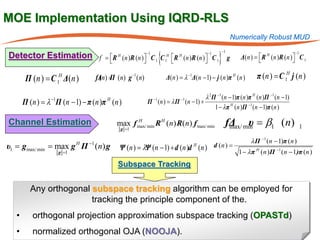
MOE Implementation Using IQRD-RLS
                                                                                                      Numerically Robust MUD


                                                                    {                        }
                                                                                                 −1                                  −1
Detector Estimation f = R H (n )R (n )  −1 C 1 C 1H R H (n )R (n )  −1 C 1 g                         Δ( n ) =  R H ( n ) R ( n )  C 1
                                                                                                                                     
                                                                   

         Π (n ) = C 1H Δ(n )           fΔn) = (n) g −1 (n)
                                        ( Π                             Δ= λ −1Δ(n − 1) − j (n )π H (n )
                                                                         (n )                                    π (n ) = C 1H j (n )

                                                                               λ 2 Π −1 (n − 1)π (n )π H (n )Π −1 (n − 1)
         Π (n ) λ Π (n − 1) − π (n )π (n )
          =       −1                       H
                                                             Π = λ Π (n − 1) +
                                                               −1
                                                               (n )           −1

                                                                                    1 − λπ H (n )Π −1 (n − 1)π (n )

Channel Estimation                             max f max/ min R H (n) R(n) f max/ min
                                                g =1
                                                     H
                                                                                                  fΔ min = β1 (n)
                                                                                                   max/ υ                                 1

                                  −1                                                                          λ Π −1 (n − 1)π (n )
υ1       gmax/ min max g Π (n) g
         =                    H
                                                Ψ (= λΨ (n − 1) + d (n )d H (n ) d (n ) = 1 − λπ H (n )Π −1 (n − 1)π (n )
                                                   n)
                       g =1

                                               Subspace Tracking


           Any orthogonal subspace tracking algorithm can be employed for
                          tracking the principle component of the.
     •      orthogonal projection approximation subspace tracking (OPASTd)
     •      normalized orthogonal OJA (NOOJA).
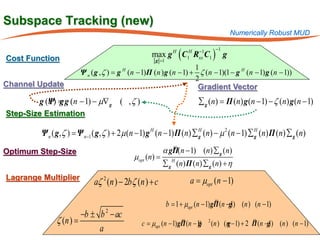
Subspace Tracking (new)
                                                                                        Numerically Robust MUD


                                                                (C     R C1 ) g
                                                            H      H    −1        −1

Cost Function                                    max g            1     xx
                                                   g =1
                                                                 1
                      Ψ n ( g , ζ ) g H (n − 1)Π (n ) g (n − 1) + ζ (n − 1)(1 − g H (n − 1) g (n − 1))
                                =
                                                                 2
Channel Update                                                    Gradient Vector
        g (Ψ) g g (n − 1) − µ∇ g ( , ζ )
           n=                                                           ∑ g (n) Π (n) g (n − 1) − ζ (n) g (n − 1)
                                                                        =
Step-Size Estimation

         Ψ = Ψ n −1 ( g, ζ ) + 2µ (n − 1) g H (n − 1) Π (n) ∑ H (n) − µ 2 (n − 1) ∑ H (n) Π (n) ∑ g (n)
           n ( g, ζ )                                         g                     g

Optimum Step-Size                                   α gΠ(n − 1) (n) ∑ g (n)
                                                       H

                                          µopt (n) = H
                                                    ∑ g ( n) Π ( n) ∑ g ( n) + η
Lagrange Multiplier
                           aζ 2 (n ) − 2b ζ (n ) + c            = µopt (n − 1)
                                                                 a

                                                            1+ µ
                                                          b =opt (n − 1) gΠ (n −g (n ) (n − 1)
                                                                          H
                                                                                1)
                       −b ± b 2 − ac
              ζ (n ) =                      = µopt (n − 1) gΠ (n − 1)
                                            c               H
                                                                   g         2
                                                                                 (n ) (n − 1) + 2 Π (n −g (n ) (n − 1)
                                                                                       g          H
                                                                                                        1)
                            a
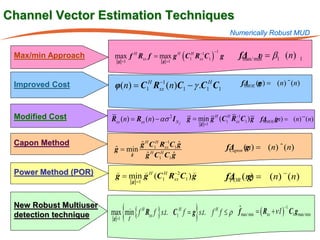
Channel Vector Estimation Techniques
                                                                       Numerically Robust MUD


                         max f H Rxx f = max g H ( C1H Rxx1C1 ) g        fΔ min = β1 (n)
                                                                          max/ υ
                                                        −        −1
 Max/min Approach                                                                           1
                 = 1= 1
                  g  g


 Improved Cost      = C1H Rxx1 (n)C1 − γ .C1H C1
                     φ(n)  −                                              fΔ (g ) = (n)  (n)
                                                                           IMOE n


 Modified Cost          Rxx (n) Rxx (n) − ασ 2 I N f g = min g H (C1H Rxx1C1 ) g fΔ gn) = (n) (n)
                         =                                             −
                                                                                  MMOE (
                                                          g =1


 Capon Method                              −
                                 g H C1H Rxx1C1 g
                                 ˆ              ˆ                     fΔ (g ) = (n) ˆ (n)
                         g = min
                         ˆ                                             Capon n
                              ˆ
                              g    g H C1H C1 g
                                    ˆ         ˆ

 Power Method (POR)                                                            
                                            −
                          g = min g H (C1H Rxx2C1 ) g
                                        g =1                           POR g
                                                                      fΔ (n) = (n) (n)


 New Robust Multiuser
 detection technique     g =1
                                {   f                 }
                        max min { f H Rxx f = g s.t. f H f ≤ ρ fˆmax/= ( Rxx +ν I ) C1 gmax/ min
                                            } s.t. C1H f             min
                                                                                   −1
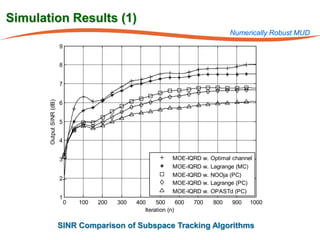
Simulation Results (1)
                                                                                       Numerically Robust MUD
                          9


                          8


                          7
       Output SINR (dB)


                          6


                          5


                          4


                          3                                        MOE-IQRD w.   Optimal channel
                                                                   MOE-IQRD w.   Lagrange (MC)
                                                                   MOE-IQRD w.   NOOja (PC)
                          2
                                                                   MOE-IQRD w.   Lagrange (PC)
                                                                   MOE-IQRD w.   OPASTd (PC)
                          1
                              0   100   200   300   400     500      600   700   800    900    1000
                                                       Iteration (n)

                          SINR Comparison of Subspace Tracking Algorithms
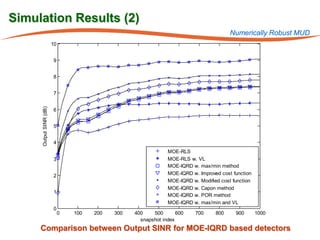
Simulation Results (2)
                                                                                         Numerically Robust MUD
                        10


                        9


                        8


                        7
     Output SINR (dB)


                        6


                        5


                        4
                                                                MOE-RLS
                        3                                       MOE-RLS w. VL
                                                                MOE-IQRD w. max/min method
                        2                                       MOE-IQRD w. Improved cost function
                                                                MOE-IQRD w. Modified cost function
                                                                MOE-IQRD w. Capon method
                        1
                                                                MOE-IQRD w. POR method
                                                                MOE-IQRD w. max/min and VL
                        0
                             0   100   200   300   400    500       600    700     800     900       1000
                                                     snapshot index
     Comparison between Output SINR for MOE-IQRD based detectors
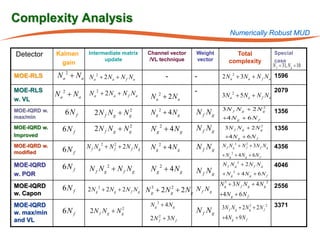
Complexity Analysis
                                                                                   Numerically Robust MUD

Detector      Kalman      Intermediate matrix       Channel vector   Weight          Total                     Special
                                update              /VL technique    vector        complexity                  case
                gain                                                                                         = 31, N g 10
                                                                                                             Nf =
MOE-RLS       Na 2 + Na Na2 + 2Na + N f Na                   -       -         2 N a 2 + 3 N a + N f N a 1596

MOE-RLS                   Na2 + 2Na + N f Na                         -                                         2079
              Na2 + Na                               Na + 2Na
                                                         2                     3N a 2 + 5 N a + N f N a
w. VL
                                                                               3N f N g + 2 N g
                                                                                              2
MOE-IQRD w.      6N f       2N f Ng + N     2
                                            g
                                                     Ng + 4Ng
                                                         2
                                                                     N f Ng                                    1356
max/min                                                                        +4 N g + 6 N f

                            2N f Ng + Ng
                                       2
                                                     Ng 2 + 4Ng                 3N f N g + 2 N g
                                                                                               2
MOE-IQRD w.     6N f                                                 N f Ng                                    1356
Improved                                                                        +4 N g + 6 N f
MOE-IQRD w.
                6N f     N f Ng 2 + N 2 + 2N f Ng
                                      f              Ng 2 + 4Ng      N f Ng    N f N g 2 + N 2 + 3N f N g
                                                                                             f                 4356
modified
                                                                               + Ng + 4Ng + 6N f
                                                                                    2


MOE-IQRD                                                                       N f Ng 2 + 2N f Ng              4046
                6N f      N f Ng + N f Ng
                                  2
                                                     Ng + 4Ng
                                                         2
                                                                     N f Ng
w. POR                                                                         + Ng 2 + 4Ng + 6N f

MOE-IQRD                                                                      N g + 3N f N g + 4 N g 2
                                                                                3
                                                                                                               2556
                6N f     2Ng + 2Ng + 2N f Ng
                              2
                                                    N + 2N + 2Ng N f Ng
                                                     3           2
w. Capon                                             g           g            +4 N g + 6 N f
MOE-IQRD                                             Ng 2 + 4Ng                3N f N g + 2 N g2 + 2 N f 2     3371
w. max/min      6N f      2N f Ng + Ng
                                     2
                                                                     N f Ng
and VL                                               2 N 2 + 3N f
                                                         f
                                                                               +4 N g + 9 N f
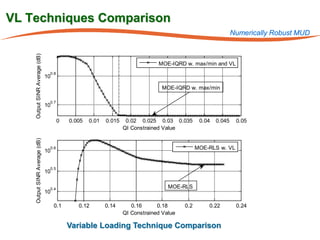
VL Techniques Comparison
                                                                                                              Numerically Robust MUD
    Output SINR Average (dB)


                                                                              MOE-IQRD w. max/min and VL
                                0.8
                               10

                                                                               MOE-IQRD w. max/min

                                0.7
                               10

                                      0   0.005   0.01   0.015    0.02 0.025 0.03 0.035        0.04   0.045    0.05
                                                                 QI Constrained Value
    Output SINR Average (dB)


                                0.6                                                           MOE-RLS w. VL
                               10


                                0.5
                               10


                                0.4                                               MOE-RLS
                               10

                                    0.1      0.12        0.14       0.16      0.18      0.2       0.22         0.24
                                                                 QI Constrained Value

                                          Variable Loading Technique Comparison
Agenda


         Introduction

         Numerically Robust Multiuser Receivers

         Quadratically Constrained Robust MUD

         Robust Adaptive Beamforming

         Thesis Contributions & Publications
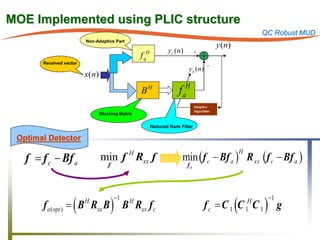
MOE Implemented using PLIC structure
                                                                                                                       QC Robust MUD
                         Non-Adaptive Part
                                                                                                 y ( n)
                                                                       yc (n)        +
                                                        f qH
       Received vector
                                                                                            -
                                                                                ya ( n )
                         x ( n)

                                                        BH                 f aH
                                                                                     Adaptive
                                                                                     Algorithm
                                  Blocking Matrix

                                                               Reduced Rank Filter

 Optimal Detector

                                                                             min ( f c − Bf a ) R xx ( f c − Bf a )
                                                                                                              H
   f= f c − Bf a
                                                    H
                                  min f Rxx f
                                      f                                         fa


                    (                     )                                                               (            )
                                              −1                                                                           −1
       f a ( opt ) = B Rxx B
                         H                          H
                                                   B Rxx f c                               fc = C 1 C C 1         1
                                                                                                                   H
                                                                                                                                g
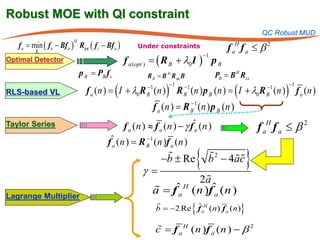
Robust MOE with QI constraint
                                                                                                        QC Robust MUD
   f a = f c − Bf a ) Rxx ( f c − Bf a )
       min (
                       H

         fa
                                                Under constraints                          f aH f a ≤ β 2
                                                          ( R B + λ0I        )
                                                                                 −1
Optimal Detector                           f a (=
                                                opt )                                 pB
                           p B = PB f c             R B = B H R xx B                  PB = B H Rxx

                                      ( I + λ0R (n ) ) R (n ( I + λ0R (n ) ) f a (n )
                                                    −1        −1    −1                                   −1    −1
RLS-based VL                 f a (n ) = ) p B (n ) =B               B                                    B
                                                                      −
                                                         f a (n ) = R B 1 (n ) p B (n )
Taylor Series                              f a (n ) ≈ f a (n ) − γ fˆa (n )                            f aH f a ≤ β 2
                                                  −
                                     fˆa (n ) = R B 1 (n )f a (n )

                                                  γ=
                                                            
                                                           −b ± Re        {             
                                                                                  b 2 − 4ac        }
                                                                            2a
                                                        
                                                        a = fˆ H
                                                             a           ( n )fˆ (n )
                                                                                a
Lagrange Multiplier
                                                                        {
                                                         b = −2 Re f aH ( n) f a ( n)
                                                                   ˆ                           }
                                     = f a H ( n )f a (n ) − β 2
                                      
                                      c
Robust MOE with QI constraint (RSD-VL)
                                                                                           QC Robust MUD

                                 Ψ fa = f c − Bf a ) Rxx ( f c − Bf a ) + λ0 s ( f aH f a − β 2 )
                                                                         1
                                       (
                                                    H
 Cost Function
                                                                         2
 Detector Update               f a (n ) f a (n − 1) − µ∇f a (n )
                                     =
 Gradient Vector           ∇f a (n ) = B H R xx (n )f c + B H R xx (n )Bf a (n − 1) + λ0f a (n − 1)
                                      −

 Robust Detector           f a (n= f a (n − 1) − µ (R B (n )f a (n − 1) − p B (n )) − µλ0f a (n − 1)
                                 )

 Non-Robust                f a (n= f a (n − 1) − µ [ R B (n )f a (n − 1) − p B (n )]
                            )

                           (                                ) (                             )
                                                             H
 QI Constraint                 f a (n ) − µλ0f a (n − 1)           f a (n ) − µλ0f a (n − 1) ≤ β 2
 Quadratic
 Equation
                   2   H                    2
                                            0            {   a         0  fa  }
                                                     H (n) f (n − 1) λ +  H (n)  (n) − β 2 =
                 µ f a (n − 1) f a (n − 1)λ − 2µ Re f a                           fa          0
                                                                     = µ 2 f a (n − 1)
                                                                                                    2
                                                                      a
                                             −b ± b 2 − 4ac
   Lagrange Multiplier                  λ0 =
                                                  2a
                                                                           b =(n − 1)
                                                                                    f
                                                                                      H
                                                                                       {
                                                                             −2µ Re  a (n) f a         }
                                                                          (n ) 2 − β 2
                                                                      = fa
                                                                       c
Optimum Step-size of MOE-RSD w. VL
                                                                                                             QC Robust MUD


                                                Ψ fa = f c − Bf a ) Rxx ( f c − Bf a ) + λ0 s ( f aH f a − β 2 )
                                                                                        1
                                                      (
                                                                   H
 Cost Function
                                                                                        2
 Non-Robust Detector                                     f a (n= f a (n − 1) − µ [ R B (n )f a (n − 1) − p B (n )]
                                                          )


                                                     (                             )                (                        )
                                                                                        H
 Updated Cost Function              Ψ fa (n)
                                           =             f (n − 1) + µ B∇ fa (n)           Rxx (n) f (n − 1) + µ B∇ fa (n)

 Quadratic Equation                                     
                                                                  
                       Ψ fa (= Ψ fa (n − 1) + 2µ (n)∇ Ha (n) PB f (n − 1) + µ 2 (n)∇ Ha (n) RB (n)∇ fa (n)
                              n)                                                       
                                                        f                              f


                       ∂Ψ fa (n)
 Differentiate                      =2∇ H (n) PB f (n − 1) + 2µ (n)∇ H (n) RB (n)∇ f (n)
                                        f                            f                                           zero
                        ∂µ (n)            a                                   a                   a


                                                                          2
                                                          α ∇ fa (n)
                              µopt (n) =
                                              ∇ H (n) RB (n)∇ f (n) + σ
                                                
                                                fa                    a


                                    Optimum Step-Size
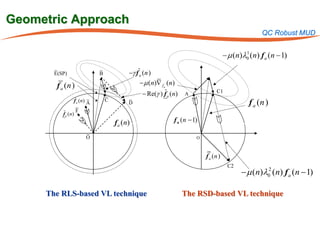
Geometric Approach
                                                                                                         QC Robust MUD


                                                                                          − µ (n)λ0 (n) f a (n − 1)
                                                                                                  1


       E(SP)                  B              −γ fˆa (n )
        f a (n )                                  − µ (n)∇ fa (n)
                                                    − Re(γ ) f (n)
                                                             ˆ
                                                             a
                                                                      A              C1
                 ˆ
                 f a ( n) A       C
                                             D                                                      f a (n )
          ˆ        F
          f a ( n)
                                      f a ( n)                   f a (n − 1)

                        O                                                  O


                                                                               f a (n )
                                                                                           C2
                                                                                                 − µ (n)λ02 (n) f a (n − 1)

     The RLS-based VL technique                                      The RSD-based VL technique
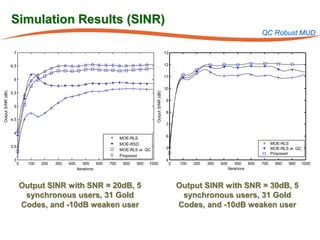
Simulation Results (SINR)
                                                                                                                                                                 QC Robust MUD

                    7                                                                                          13


                   6.5                                                                                         12

                                                                                                               11
                    6

                                                                                                               10
Output SINR (dB)


                                                                                            Output SINR (dB)
                   5.5
                                                                                                               9
                    5
                                                                                                               8
                   4.5
                                                                                                               7

                    4
                                                                            MOE-RLS                            6
                                                                            MOE-RSD                                                                                    MOE-RLS
                   3.5                                                                                         5                                                       MOE-RLS w. QC
                                                                            MOE-RLS w. QC
                                                                                                                                                                       Proposed
                                                                            Proposed
                    3                                                                                          4
                         0   100   200   300   400       500    600   700    800   900   1000                       0   100   200   300   400       500    600   700     800   900   1000
                                                     Iterations                                                                                 Iterations


                         Output SINR with SNR = 20dB, 5                                                                 Output SINR with SNR = 30dB, 5
                          synchronous users, 31 Gold                                                                     synchronous users, 31 Gold
                         Codes, and -10dB weaken user                                                                   Codes, and -10dB weaken user
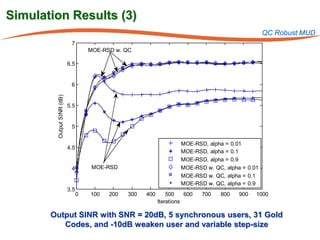
Simulation Results (3)
                                                                                                    QC Robust MUD
                            7
                                     MOE-RSD w. QC

                           6.5


                            6
        Output SINR (dB)


                           5.5


                            5


                                                                      MOE-RSD, alpha = 0.01
                           4.5
                                                                      MOE-RSD, alpha = 0.1
                                                                      MOE-RSD, alpha = 0.9
                            4         MOE-RSD                         MOE-RSD w. QC, alpha = 0.01
                                                                      MOE-RSD w. QC, alpha = 0.1
                                                                      MOE-RSD w. QC, alpha = 0.9
                           3.5
                                 0   100   200   300   400       500    600   700   800   900   1000
                                                             Iterations

       Output SINR with SNR = 20dB, 5 synchronous users, 31 Gold
          Codes, and -10dB weaken user and variable step-size
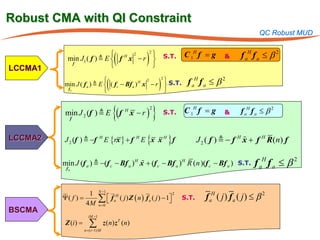
Robust CMA with QI Constraint
                                                                                                               QC Robust MUD

                             H 2       
                                          (            )                      C 1H f = g               f aH f a ≤ β 2
                                      2
           min J1 ( f )  E  f x − r  S.T.                                                    &
LCCMA1
            f
                                       

                           
                                      (             
                                                                   )           f aH f a ≤ β 2
                                                  2
         min J ( f a )  E  ( f c − Bf a ) x − r  S.T.
                                           H 2

          fa
                                                   


          min J 2 (f )  E
               f
                                          {(f H x − r )
                                                           2
                                                               }       S.T.   C 1H f = g        &      f aH f a ≤ β 2


LCCMA2    J 2 (f )  −f H E {rx } + f H E {x x H } f                                                   
                                                                                     J 2 ( f )  − f H x + f H R ( n) f

                                         
         min J (f a )  −(f c − Bf a ) H x + (f c − Bf a ) H R (n )(f c − Bf a ) S.T.
          fa
                                                                                                             f aH f a ≤ β 2

                               N −1
 =Ψ( f )
          1
                               ∑  f aH ( j ) Z ( n ) f a ( j ) − 1
                                                                  
                                                                         2
                                                                              S.T.      f aH ( j ) f a ( j ) ≤ β 2
         4M                    n =0
BSCMA
                       iM −1
          Z (i ) =      ∑
                     n= ( i −1) M
                                    z ( n) z T ( n)
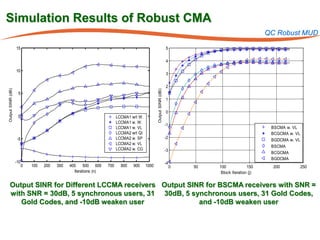
Simulation Results of Robust CMA
                                                                                                                                                       QC Robust MUD

                   15                                                                                             5

                                                                                                                  4

                   10
                                                                                                                  3

                                                                                                                  2
Output SINR (dB)


                                                                                               Output SINR (dB)
                    5
                                                                                                                  1

                                                                                                                  0
                    0                                                   LCCMA1 w/t W.
                                                                        LCCMA1 w. W.
                                                                                                                  -1
                                                                        LCCMA1 w. VL                                                                    BSCMA w. VL
                                                                        LCCMA2 w/t QI                                                                   BCGCMA w. VL
                    -5                                                  LCCMA2 w. SP                              -2
                                                                                                                                                        BGDCMA w. VL
                                                                        LCCMA2 w. VL
                                                                                                                                                        BSCMA
                                                                        LCCMA2 w. CG                              -3
                                                                                                                                                        BCGCMA
                                                                                                                                                        BGDCMA
                   -10                                                                                            -4
                         0   100   200   300   400    500 600     700     800   900     1000                           0   50   100             150      200       250
                                                 Iterations (n)                                                                  Block Iteration (j)


   Output SINR for Different LCCMA receivers Output SINR for BSCMA receivers with SNR =
   with SNR = 30dB, 5 synchronous users, 31 30dB, 5 synchronous users, 31 Gold Codes,
      Gold Codes, and -10dB weaken user                and -10dB weaken user
Agenda


         Introduction

         Numerically Robust Multiuser Receivers

         Quadratically Constrained Robust MUD

         Robust Adaptive Beamforming

         Thesis Contributions & Publications
LCMV Beamforming
                                                               Robust Beamforming
   Adaptive beamforming has been exploited in wireless communications,
    radar, sonar, speech processing, and other areas.
   Recently, there has been a great effort to design robust adaptive
    beamforming techniques which improve robustness against mismatch and
    modeling errors and enhancing interference cancellation capability.
   The mismatch may be caused by uncertainty in direction-of-arrival (DOA),
    imperfect array calibration, near-far effect, and other mismatch and modeling
    errors.
   The so-called linearly constrained minimum variance (LCMV) beamformer,
    also known as Capon’s method, has bean a popular beamforming technique.
 In LCMV beamforming method, the weights are chosen to minimize
  the array output power subject to side constraint (s) in the desired
  look direction (s).
                                                         Rxx1a0 (θ 0 )
                                                           −

            minw R xx w S. T. w a0 (θ0 ) = 1     w0 = H
                  H               H

             w                                       a0 (θ 0 ) Rxx1a0 (θ 0 )
                                                                −


   This method assumes that the array manifold is accurately known,
    unfortunately, even small discrepancy between the presumed and the actual
    array manifold can substantially degrade its performance.
Diagonal Loading Technique
                                                        Robust Beamforming

 Diagonal loading is a technique where the diagonal of the
  covariance matrix is augmented with a positive or negative constant
  prior to inversion
 Diagonal loading technique has been a widespread approach to
  improve robustness against mismatch errors and random
  perturbations
 Moreover, the performance of the signal detectors, which utilize the
  inverse of the data covariance matrix, experiences serious
  degradation when the sample support available for estimating the
  matrix is limited.
 This problem can be overcome also by diagonally loading the data
  covariance matrix
 Furthermore, it is well known that antenna sidelobes can be made
  small if the sample data correlation matrix is diagonally loaded
   before inversion is performed
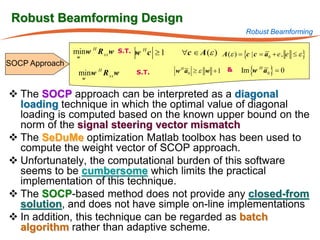
Robust Beamforming Design
                                                                        Robust Beamforming

                min w H R xx w
                 w
                                 S.T.   w Hc ≥1    ∀c ∈ A (ε ) A (ε ) = | c = + e , e ≤ ε }
                                                                      {c a0
SOCP Approach
                         H
                 min w R xx w           S.T.      w H a0 ≥ ε w + 1 &   Im {w H a 0 } = 0
                     w


 The SOCP approach can be interpreted as a diagonal
  loading technique in which the optimal value of diagonal
  loading is computed based on the known upper bound on the
  norm of the signal steering vector mismatch
 The SeDuMe optimization Matlab toolbox has been used to
  compute the weight vector of SCOP approach.
 Unfortunately, the computational burden of this software
  seems to be cumbersome which limits the practical
  implementation of this technique.
 The SOCP-based method does not provide any closed-from
  solution, and does not have simple on-line implementations
 In addition, this technique can be regarded as batch
  algorithm rather than adaptive scheme.
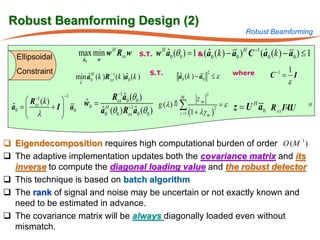
Robust Beamforming Design (2)
                                                                                          Robust Beamforming


   Ellipsoidal          max min w H Rxx w       S.T.   w H a0 (θ0 ) = 1 & (a0 (k ) − a0 ) H C −1 (a0 (k ) − a0 ) ≤ 1
                                                           ˆ               ˆ                      ˆ
                            ˆ
                            a0       w

   Constraint                                      S.T.                              where               1
                          ˆ      H
                                      ˆ  −1
                      min a (k )R (k )a0 (k )                  a 0 (k ) − a0 ≤ ε
                                                               ˆ
                                                                           2
                                                                                                   C −1 = I
                        ˆ
                        a
                                 0       xx
                                                                                                         ε

      R (k ) 
        −1       −1                 Rxx1a0 (θ 0 )
                                      −
                                          ˆ                      M
                                                                          zm
                                                                              2

             + I  a0       w0 = H
                            ˆ                           g (λ )  ∑                  = ε z = U H a R ΓU
                                                                                                   xx = U
        xx
  a0 
  ˆ                             a0 (θ 0 ) Rxx a0 (θ 0 )
                                            −1
                                                                                                                  H
                                 ˆ             ˆ                 j =1 (1 + λγ m )
                                                                                  2
      λ
                                                                                                 0
                 


 Eigendecomposition requires high computational burden of order O (M 3 )
 The adaptive implementation updates both the covariance matrix and its
  inverse to compute the diagonal loading value and the robust detector
 This technique is based on batch algorithm
 The rank of signal and noise may be uncertain or not exactly known and
  need to be estimated in advance.
 The covariance matrix will be always diagonally loaded even without
  mismatch.
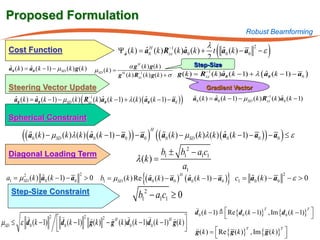
Proposed Formulation
                                                                                                                        Robust Beamforming

   Cost Function                               Ψ aˆ (k ) ˆ         ˆ
                                                                            λ
                                               = a0H (k ) Rxx1 (k )a0 (k ) + t a0 (k ) − a0 − ε
                                                           −

                                                                            2
                                                                               ˆ
                                                                                           2
                                                                                                          (                       )
   a0 (k= a0 (k − 1) − µ SD (k ) g (k )                        α g H (k ) g (k )                 Step-Size
   ˆ ) ˆ                                     µ SD (k ) =
                                                           g H (k ) Rxx1 (k ) g (k ) +=
                                                                     −
                                                                                      σ g (k )     Rxx1 ( k )a0 ( k − 1) + λ ( a0 ( k − 1) − a0 )
                                                                                                    −
                                                                                                             ˆ                 ˆ

   Steering Vector Update                                                                             Gradient Vector
    a0 (k= a0 (k − 1) − µ SD (k ) ( Rxx1 (k )a0 (k − 1) + λ (k ) ( a0 (k − 1) − a0 ) )       a0 (k= a0 (k − 1) − µ SD (k ) Rxx1 (k )a0 (k − 1)
                                                                                                                            −
     ˆ ) ˆ                           −
                                             ˆ                     ˆ                          ) ˆ                                  ˆ


   Spherical Constraint

         (( a (k ) − µ        (k )λ (k ) ( a0 (k − 1) − a0 ) ) − a0    ) (( a (k ) − µ                                                )
                                                                                                 (k )λ (k ) ( a0 (k − 1) − a0 ) ) − a0 ≤ ε
                                                                          H
              0           SD
                                            ˆ                                      0       SD
                                                                                                              ˆ

   Diagonal Loading Term                                                    b1 ± b12 − a1c1
                                                                 λ (k ) =
                                                                                     a1
  a1 µ SD (k ) a0 (k − 1)=
                         − a0 > 0 b1                  µ SD (k ) Re {( a0 (k ) − a0 ) ( a0 (k − 1) − a0 )} = a0 (k ) − a0 − ε > 0
                                                                                                          c1 
                                      2                                                                                 2
                                                                      
       2                                                                            H
               ˆ                                                                       ˆ
    Step-Size Constraint                                            b12 − a1c1 ≥ 0
                                                                                                 
                                                                                                 d 0 (k − 1)   Re {d 0 (k − 1)} , Im {d 0 (k − 1)} 
                                                                                                                                 T                  T
                   2                                                  
                       d (k − 1) 2 g (k ) 2 − g H (k )d (k − 1)d (k − 1) H g (k )                                                                  
µSD ≤ ε d 0 (k − 1)
                       0
                                                       0        0                 
                                                                                                
                                                                                                 g (k ) =  Re { g (k )} , Im { g (k )} 
                                                                                                                        T              T
                                                                                                                                        
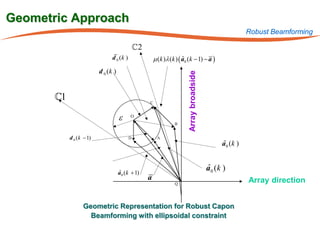
Geometric Approach
                                                                                                            Robust Beamforming

                                               2
                                d 0 (k )                µ (k )λ (k ) ( a0 (k − 1) − a )
                                                                       ˆ
                          d 0 (k )


                                                                          Array broadside
       1                                           C


                                     ε     O
                                                                  B


            d 0 (k − 1)                    D              A
                                                                                                 
                                                                                                 a 0 (k )


                                                                                            ˆ
                                                                                            a0 (k )
                                     a 0 (k + 1)
                                     ˆ
                                                    a                                                       Array direction
                                                                  Q


                   Geometric Representation for Robust Capon
                     Beamforming with ellipsoidal constraint
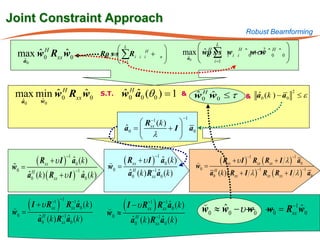
Joint Constraint Approach
                                                                                                        Robust Beamforming

                                           L                                     H L                                 
     ˆ     ˆ
 max w Rxx w0  H
                                     =s s ∑R i
                                      Rρ                    H
                                                                + n          max  wρ ∑ w i
                                                                                    ˆ0 s s i       i
                                                                                                    H
                                                                                                        ˆ 0w σw ˆ 0 ˆ 0 
                                                                                                            + 2 H
               0
                                                                                                                       
                                       xx                i i
                                           i=1                    
                                                                               ˆ
                                                                               a0
   ˆ
   a0                                                                                  i =1


         ˆH     ˆ
 max min w0 Rxx w0                       S.T.    w0 a0 (θ 0 ) = 1
                                                 ˆH ˆ                         &    w0 w0 ≤ τ
                                                                                   ˆH ˆ                 &    a 0 (k ) − a0
                                                                                                             ˆ
                                                                                                                             2
                                                                                                                                  ≤ε
   ˆ
   a0        ˆ
             w0

                                                                              −1
                                                Rxx1 (k )
                                                  −
                                                               
                                           = 
                                            ˆ
                                            a0             + I  a0
                                                λ             


           ( Rxx + υ I ) a0 (k )                  ( Rxx + υ I )
                           −1                                     −1
                                                                                           ( R + υ I ) Rxx ( Rxx + I λ ) a0
                                                                                                        −1                   −1
                         ˆ                                        ˆ
                                                                   a0 ( k )        

w0 =                                       w0   =                                  w0 = H xx
                                                                                       a0 (k ) ( Rxx + I λ ) Rxx ( Rxx + I λ ) a0
                                                                                                            −1                −1
        a0H (k ) ( Rxx + υ I ) a0 (k )
                                −1                            −
        ˆ                      ˆ                    a0H (k ) Rxx1a0 (k )
                                                    ˆ            ˆ


 ( I + υ R ) Rxx a0 (k )                         ( I −υ R ) R                       
                   −1 −1
                     −1                                      −1        −1
                        ˆ
w0 =            −
                   xx                     
                                          w0    ≈
                                                             xx
                                                                        ˆ
                                                                        a (k )
                                                                       xx 0          w0 ≈ w0 − υ w0 w0 = Rxx1w0
                                                                                          ˆ               −
                                                                                                             ˆ
                                                               −
      a0H (k ) Rxx1a0 (k )
       ˆ           ˆ                                 a0H (k ) Rxx1a0 (k )
                                                     ˆ            ˆ
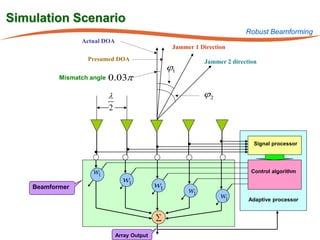
Simulation Scenario
                                                                             Robust Beamforming
                 Actual DOA
                                                     Jammer 1 Direction
                   Presumed DOA                                Jammer 2 direction
                                                    ϕ1
           Mismatch angle   0.03π
                            λ                                  ϕ2
                            2


                                                                                Signal processor


                     w1                                                        Control algorithm
                                  w1
    Beamformer                                 w1
                                                          w1
                                                                     w1       Adaptive processor


                                               ∑

                                Array Output
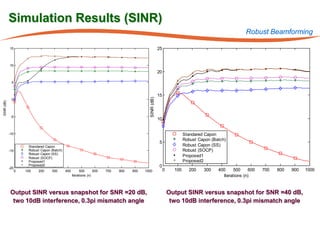
Simulation Results (SINR)
                                                                                                                                                       Robust Beamforming

            15                                                                                           25


            10
                                                                                                         20

             5


                                                                                                         15


                                                                                             SINR (dB)
             0
SINR (dB)


             -5
                                                                                                         10


            -10                                                                                                           Standared Capon
                                                                                                                          Robust Capon (Batch)
                                                                                                         5
                       Standared Capon                                                                                    Robust Capon (SS)
            -15        Robust Capon (Batch)                                                                               Robust (SOCP)
                       Robust Capon (SS)
                       Robust (SOCP)
                                                                                                                          Proposed1
                       Proposed1                                                                                          Proposed2
                       Proposed2                                                                         0
            -20
                  0   100   200     300       400        500       600   700   800   900   1000               0     100     200    300    400    500     600   700   800   900   1000
                                                    Iterations (n)                                                                          Iterations (n)


            Output SINR versus snapshot for SNR =20 dB,                                                           Output SINR versus snapshot for SNR =40 dB,
             two 10dB interference, 0.3pi mismatch angle                                                           two 10dB interference, 0.3pi mismatch angle
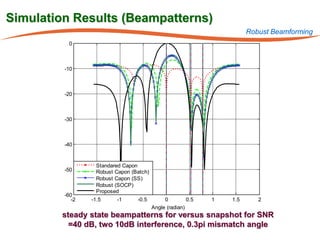
Simulation Results (Beampatterns)
                                                                        Robust Beamforming
           0


         -10


         -20


         -30


         -40


                  Standared Capon
         -50      Robust Capon (Batch)
                  Robust Capon (SS)
                  Robust (SOCP)
                  Proposed
         -60
            -2   -1.5    -1      -0.5         0         0.5   1   1.5      2
                                         Angle (radian)
        steady state beampatterns for versus snapshot for SNR
          =40 dB, two 10dB interference, 0.3pi mismatch angle
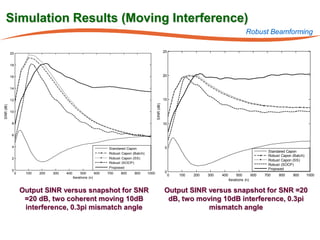
Simulation Results (Moving Interference)
                                                                                                                                                         Robust Beamforming

            20
                                                                                                             25


            18


            16                                                                                               20


            14


            12                                                                                               15


                                                                                                 SINR (dB)
SINR (dB)


            10


            8                                                                                                10


            6


            4                                                                                                5
                                                                   Standared Capon
                                                                                                                                                                    Standared Capon
                                                                   Robust Capon (Batch)
                                                                                                                                                                    Robust Capon (Batch)
            2                                                      Robust Capon (SS)
                                                                                                                                                                    Robust Capon (SS)
                                                                   Robust (SOCP)
                                                                                                                                                                    Robust (SOCP)
                                                                   Proposed                                                                                         Proposed
            0
                 0    100   200   300   400        500       600   700   800     900      1000               0
                                                                                                                  0   100   200   300   400         500      600   700   800     900       1000
                                              Iterations (n)
                                                                                                                                              Iterations (n)


                     Output SINR versus snapshot for SNR                                                     Output SINR versus snapshot for SNR =20
                      =20 dB, two coherent moving 10dB                                                        dB, two moving 10dB interference, 0.3pi
                      interference, 0.3pi mismatch angle                                                                 mismatch angle
Agenda


         Introduction

         Numerically Robust Multiuser Receivers

         Quadratically Constraint Robust MUD

         Robust Adaptive Beamforming

         Thesis Contributions & Publications
Contributions Summary (1)
                                                 Contributions &Publications

• A general DS/CDMA system model which account for
  asynchronism, multipath propagation, near-far effect, signature
  mismatch, and inter-symbol-interference (ISI) is developed.
• MUD survey and performance comparison for existing techniques
  is performed anchored in the proposed model.
• A fast subspace tracking algorithm is Developed and deployed for
  channel estimation with MOE detector.
• A generalized frame work for building IQRD-based multiuser
  receivers is offered.
• Based on the above proposed frame work, comparative analyses
  between the recently proposed channel estimation techniques,
  subspace tracking and the proposed techniques is conducted.
• A combined subspace approach and a quadratic constraint is
  proposed to produce robust and optimum multiuser receiver.
• The systolic array implementation is exploited to facilitate real-
  time implementation of the proposed IQRD-based receivers.
Contributions Summery (2)
                                                       Contributions &Publications
• A new VL technique is devised in this thesis and integrated into a
  recursive steepest descent (RSD) algorithm rather than the RLS
  algorithms to produce robust MOE detector with low-computational
  complexity. This VL is exploited to fulfill the quadratic constraint on the
  detector norm to improve the performance of the multiuser receiver
  against modeling and mismatch errors.
• Additionally, an optimum step-size closed-form expression for the
  proposed RSD algorithm is derived.
• The proposed VL technique has been integrated also into the LCCMA
  algorithms and the BSCMA algorithm to produce robust constant modulus
  based receivers for sample-by-sample and block-adaptive, respectively.
• We have proposed a low-complexity recursive implementation for the
  robust Capon beamforming algorithm which incorporating ellipsoidal
  constraint on the steering vector using the proposed RSD algorithm and
  the recursive conjugate gradient (RCG) algorithm.
• Additionally, a joint constraint approach is proposed to produce robust
  beamforming algorithm which is capable of providing robustness against
  steering vector mismatch and noise enhancement at low SNR.
• A comparative analysis is conducted between most recent beamforming
  algorithms as well as the proposed approaches in the presence of moving
  and coherent jamming.
Publications List (updated on Oct. 2011)
                                                                           Contributions &Publications
•   Major Publications in Refereed Journals:
•   A. Elnashar, “On efficient implementation of robust adaptive beamforming based on worst-case
    performance optimization” IET Signal Processing, Vol. 2, No. 4, pp. 381-393, Dec. 2008.
•   A. Elnashar, S. Elnoubi, and H. Elmikati “Performance Analysis of Blind Adaptive MOE Multiuser
    Receivers using Inverse QRD-RLS Algorithm,” IEEE Trans. On Circuits and systems I, Vol. 55, No. 1,
    pp. 398-411, Feb. 2008.
•   A. Elnashar, S. Elnoubi, and H. Elmikati “Further study on Robust Adaptive Beamforming with optimum
    diagonal loading,” IEEE Trans. on Antennas and Propagation, Vol. 54, No 12, pp. 3647-3658, Dec.
    2006.
•   A. Elnashar, S. Elnoubi, and H. Elmikati, “Low-Complexity Robust Adaptive Generalized Sidelobe
    Canceller Detector for DS/CDMA Systems,” International Journal of Adaptive Control and Signal
    Processing, vol. 23, no. 3, pp. 293-310,March 2008, John Wiley & Sons, Ltd.
•   T. Samir, S. Elnoubi, and A. Elnashar, “Block-Shanno Minimum BER Beamforming,” IEEE transactions
    on Vehicular Technology, Vol. 57, No. 5, pp. 2981-2990, Sept. 2008.
•   International Conferences:
•   T. Samir, S. Elnoubi, and A. Elnashar “Block-Shanno MBER algorithm in a spatial multiuser
    MIMO/OFDM” in Proc. 14th European Wireless Conference EW2008, 22-25 June 2008.
•   T. Samir, S. Elnoubi, and A. Elnashar “Class of Minimum Bit Error Rate Algorithms,” in Proc. ICACT
    2007, Korea, Feb. 2007, pp. 168-173.
•   T. Samir, S. Elnoubi, and A. Elnashar, “Block-Shanno Minimum BER Beamforming” in Proc. ISSPA
    2007, UAE, Feb. 2007.
•   A. Elnashar, “Robust Adaptive Beamforming,” ACE2 Network of Excellence Workshop on Smart
    Antennas, MIMO Systems and Related Technologies, Myconos, Greece, 8 June 2006.
Publications List (Cont.)
                                                                               Contributions &Publications

•   A. Elnashar, S. Elnoubi, and H. Elmikati, “Performance analysis of robust MOE detectors at low SNR
    based on the IQRD-RLS algorithm,” In Proc. IST Mobile and Wireless Communications Summit,
    Myconos, Greece, 4-8 June, 2006.
•   A. Elnashar, S. Elnoubi, and H. Elmikati “Robust Adaptive Beamforming with Variable Diagonal Loading,”
    In Proc. Sixth International Conference on 3G and Beyond - 3G 2005, 07-09 November 2005, The
    IEE, Savoy Place, London, UK, pp. 489-493.
•   A. Elnashar, S. Elnoubi, and H. Elmikati “A Robust Block-Shanno Adaptive Blind Multiuser Receiver for
    DS-CDMA Systems,” In Proc. IST Mobile & Wireless Communications Summit 2005, Dresden, Germany,
    19-23 June, 2005.
•   A. Elnashar, S. Elnoubi, and H. Elmikati “A Robust Linearly Constrained CMA for Adaptive Blind Multiuser
    Detection,” In Proc. IEEE WCNC 2005 conference, Vol. 1, pp. 233-238, New Orleans, LA, USA, 13-17
    March, 2005,
•   A. Elnashar, S. Elnoubi, and H. Elmikati “A Robust Quadratically Constrained Adaptive Blind Multiuser
    Receiver for DS/CDMA Systems,” IEEE International Symposium on Spread Spectrum Techniques and
    Applications (ISSSTA 2004), Sydney, Australia 30 Aug 2004 - 3 Sept 2004.
•   A. Elnashar, S. Elnoubi, and H. Elmikati “A Novel Adaptive Blind Multiuser Receiver for DS/CDMA Based
    on combined Inverse QRD-RLS Algorithm and constrained Optimization Approach,” in Proc. ISPACS
    2003, Awaji Island, Japan, pp. 423-428, December 7-10, 2003.
•   A. Elnashar, S. Elnoubi, and H. Elmikati “Computationally Efficient Real-Time Blind Multiuser Detection for
    cellular DS/CDMA Based on Inverse QRD-RLS Algorithm and Subspace Tracking,” in Proc. MWSCAS
    2003, Cairo, Egypt, December 28-31, 2003.
•   A. Elnashar, S. Elnoubi, and H. Elmikati “Robust Adaptive Blind Multiuser Receiver for DS/CDMA Based
    on combined Inverse QRD-RLS Algorithm and MOE” in Proc. SOFTCOM 2003 conference, Croatia, pp.
    512-515, Oct. 2003.
Phd Presentation

Phd Presentation

  • 1.
    Ayman Elnashar ECMS (MobiNil) Supervisors: Prof. Dr. Hamdy El-Mikati Prof. Dr. Said El-Noubi Mansoura University Alexandria University 30 April 2005
  • 2.
    Agenda Introduction Numerically Robust Multiuser Receivers Quadratically Constrained Robust MUD Robust Adaptive Beamforming Thesis Contributions & Publications
  • 3.
    Cellular Standards Evolution Introduction Japan Europe Americas 1980 Traffic is Almost Voice (1st G) TACS NMT/TACS/Other AMPS 1995 Data 9.6-14.4 PDC TDMA CdmaOne GSM Kbps (2nd G) IS-54 IS-95A 1999 ANSI-136 2001 115 kbps IS-95B 64 kbps i-mode 136 HS 384 kbps GPRS DoCoMo 136+ 2002 307 kbps EDGE CDMA200 1x (2.5 G) 2002 3G & Beyond 2003 UMTS TD-SCDMA UWC-136 ANSI-41 Core CDMA20001x-EV-DO 2004 3GPP CWTS CDMA20001x-EV-DV 2005 MAP GSM Core CDMA20003x HSDPA 2006 3GPP2 1.4Mpbs 2.4Mbps 384kpbs-2Mbps Up to 14 Mbps/cell
  • 4.
    Multiple Access Techniques Introduction TDD-CDMA Codes FDD-CDMA Traffic channels: different users are assigned unique code and transmitted over Power the entire frequency band, for example, WCDMA and CDMA2000 Traffic channels: different users are assigned unique code and time slot, for TDMA example, TD-SCDMA Power Traffic channels: different time slots are allocated to different users, for example, DAMPS and GSM FDMA Traffic channels: different frequency bands Power are allocated to different users,for example, AMPS and TACS
  • 5.
    DS/CDMA Systems Introduction In CDMA, users are multiplexed by distinct codes rather than by orthogonal frequency bands, as in FDMA, or by orthogonal time slots, as in TDMA Motivations Limitations Admitting asynchronous Multiple access interference (MAI) multiple access Capacity is interference-limited instead of BW-limited Robustness to frequency selective fading Near/Far Effect: Received power from users near to BS is higher Multipath combining than that of far away users. Efficient bandwidth We Need tight power control utilization
  • 6.
    DS-CDMA System Model Introduction User 1 Chip Pulse Data S 1 ( n) Shaping Filter Channel 1 Multipath Channel ∞ u1 Signature = u j ( n) ∑S j (l ).h j (n − lL − τ j ) Sequence C1 l = −∞ ∞ =h j ( n) ∑ c (m) .g (n − m) m = −∞ j j Tx User k j Chip Pulse uj Channel noise S ( n) Shaping Filter Channel k w (n ) Data Raised Cosine Pulse Shaping Filter ϕ (t ) mj x ( n) = a j ∑ α j ,mϕ j (t − δ j ,m ) 1.2 g j (t ) 1 Cj m=0 Chip Matched Filter 0.8 ϕ (T c − t ) root-raised cosine chip pulse K 0.6 = x ( n) ∑ u ( n) + w ( n) j Chip rate sampling 0.4 j =1 synchronized to user j Rx 0.2 Receiver Filter 0 -0.2 0 1 2 3 4 5 6 7 8 9 10 y ( n) FIR Linear Filter f time t (channel length = 10chips)
  • 7.
    Single user Detection Introduction y1 ˆ y1 MF user 1 Sync 1 11 Hard Received Signal 1 b T yj ˆ yj x ( n) ∫ (.) Tb 0 Sync j 11 c j (t ) MF user j Decision yk ˆ yk MF user k MF Bank Sync k
  • 8.
    Multiuser Detection Introduction  Multiuser detection considers signals from all users which lead us to joint detection  Reduces multiple access interference and hence leads to capacity increase  Alleviates the near/far problem  Power Control can be used but not necessary  MUD can be implemented in the base station (BS) or mobile station (MS), or both  Transmission for the Downlink MS is synchronous and equal-power  MUD algorithm is simpler for synchronous CDMA  In case of Uplink the Transmission is Asynchronous which is more complex and need robust algorithms
  • 9.
    MUD Techniques Introduction Multiuser Receivers Optimal Suboptimal MLSE Linear Non-linear Successive Zero- Polynomial Decision Neural MMSE Multistage interference Forcing Expansion -feedback Network cancellation Direct Adaptive Blind MMSE MMSE MMSE LMS RLS MOE CMA Subspace DD-MMSE Algorithms Algorithms Approach Approach Approach
  • 10.
    Linear Multiuser Receivers Introduction Linear receivers are of great significance due to ease of practical implementation The linear detector output is a linear combination of the received chip sampled signals: y ( n) = f H ( n) x ( n) In BPSK the bit decision is made according to: s1 (n) = sgn ( Re { y1 (n)} ) ˆ The detector output energy is given by: { = E f H x ( n) E y ( n) } { = f H Rxx f 2 2 } The received signal autocorrelation matrix is given by: Rxx (n) = E { x (n) x H (n)}
  • 11.
    Agenda Introduction Numerically Robust Multiuser Detection Quadratically Constraint Robust MUD Robust Adaptive Beamforming Thesis Contributions & Publications
  • 12.
    IQRD-RLS Algorithm Numerically Robust MUD RLS Algorithm QRD-RLS Algorithm In the conventional RLS • The QR decomposition algorithm, the calculation of the transforms the RLS problem into Kalman gain requires matrix a problem that uses only inversion of the autocovariance transformed data values by matrix of the received signal. Cholesky factorization of the If the data matrix is in ill- least-squares data matrix conditioned, the conventional • This algorithm exhibits a high RLS algorithm will rapidly degree of parallelism, and can become impossible. be mapped to triangular systolic arrays for efficient parallel implementation. The IQRD method is the • Unfortunately, the QRD-RLS promising one due to: algorithm suffers from major IQRD-RLS 1. Pipelined implementation on drawback, namely, back- VLSI substitution which is a costly 2. Good numerical stability operation to be performed in 3. No back-substitution. array structure
  • 13.
    IQRD-RLS Algorithm Numerically Robust MUD R − H (n − 1) x (n) QR Decomposition R xx = R (n )R (n ) H a ( n) = λ  R − H (n − 1)  IQRD Updating  R (n )  −H    a ( n)   0   H  = P (n )  λ  P ( n)   = b( n)   j (n )    0 T   1    A rotation matrix P (n ) , which successively annihilates the elements of intermediate vector a ( n) against R − H (n − 1) λ into a related Kalman gain b (n ) value using a sequence of Givens rotations. Systolic Array Implementation Received vector Internal Cell Boundary Cell 1 0T xi ji(i −1) b (i −1) (n ) ai (n ) ai (n ) ai (n ) P (i ) (n ) P (i ) (n ) P (i ) (n ) b (i ) (n ) Detector Parameters xi ji(i )
  • 14.
    Minimum Output Energy Numerically Robust MUD • The MOE linear detector can be obtained by minimizing the output energy of the receiver subject to certain number of constraints. Channel vector Detector vector min f H Rxx f f Under constraints C1 f = g Covariance matrix Signature vector matrix • The Closed-form solution of the above constrained optimization problem can be obtained using Lagrange method as follows: f opt = R C1 ( C R C1 ) g −1 H −1 −1 xx 1 xx
  • 15.
    MOE Implementation UsingIQRD-RLS Numerically Robust MUD { } −1 −1 Detector Estimation f = R H (n )R (n )  −1 C 1 C 1H R H (n )R (n )  −1 C 1 g Δ( n ) =  R H ( n ) R ( n )  C 1       Π (n ) = C 1H Δ(n ) fΔn) = (n) g −1 (n) ( Π Δ= λ −1Δ(n − 1) − j (n )π H (n ) (n ) π (n ) = C 1H j (n ) λ 2 Π −1 (n − 1)π (n )π H (n )Π −1 (n − 1) Π (n ) λ Π (n − 1) − π (n )π (n ) = −1 H Π = λ Π (n − 1) + −1 (n ) −1 1 − λπ H (n )Π −1 (n − 1)π (n ) Channel Estimation max f max/ min R H (n) R(n) f max/ min g =1 H fΔ min = β1 (n) max/ υ 1 −1 λ Π −1 (n − 1)π (n ) υ1 gmax/ min max g Π (n) g = H Ψ (= λΨ (n − 1) + d (n )d H (n ) d (n ) = 1 − λπ H (n )Π −1 (n − 1)π (n ) n) g =1 Subspace Tracking Any orthogonal subspace tracking algorithm can be employed for tracking the principle component of the. • orthogonal projection approximation subspace tracking (OPASTd) • normalized orthogonal OJA (NOOJA).
  • 16.
    Subspace Tracking (new) Numerically Robust MUD (C R C1 ) g H H −1 −1 Cost Function max g 1 xx g =1 1 Ψ n ( g , ζ ) g H (n − 1)Π (n ) g (n − 1) + ζ (n − 1)(1 − g H (n − 1) g (n − 1)) = 2 Channel Update Gradient Vector g (Ψ) g g (n − 1) − µ∇ g ( , ζ ) n= ∑ g (n) Π (n) g (n − 1) − ζ (n) g (n − 1) = Step-Size Estimation Ψ = Ψ n −1 ( g, ζ ) + 2µ (n − 1) g H (n − 1) Π (n) ∑ H (n) − µ 2 (n − 1) ∑ H (n) Π (n) ∑ g (n) n ( g, ζ ) g g Optimum Step-Size α gΠ(n − 1) (n) ∑ g (n) H µopt (n) = H ∑ g ( n) Π ( n) ∑ g ( n) + η Lagrange Multiplier aζ 2 (n ) − 2b ζ (n ) + c = µopt (n − 1) a 1+ µ b =opt (n − 1) gΠ (n −g (n ) (n − 1) H 1) −b ± b 2 − ac ζ (n ) = = µopt (n − 1) gΠ (n − 1) c H g 2 (n ) (n − 1) + 2 Π (n −g (n ) (n − 1) g H 1) a
  • 17.
    Channel Vector EstimationTechniques Numerically Robust MUD max f H Rxx f = max g H ( C1H Rxx1C1 ) g fΔ min = β1 (n) max/ υ − −1 Max/min Approach 1 = 1= 1 g g Improved Cost = C1H Rxx1 (n)C1 − γ .C1H C1 φ(n) − fΔ (g ) = (n)  (n) IMOE n Modified Cost Rxx (n) Rxx (n) − ασ 2 I N f g = min g H (C1H Rxx1C1 ) g fΔ gn) = (n) (n) = − MMOE ( g =1 Capon Method − g H C1H Rxx1C1 g ˆ ˆ fΔ (g ) = (n) ˆ (n) g = min ˆ Capon n ˆ g g H C1H C1 g ˆ ˆ Power Method (POR)     − g = min g H (C1H Rxx2C1 ) g g =1 POR g fΔ (n) = (n) (n) New Robust Multiuser detection technique g =1 { f } max min { f H Rxx f = g s.t. f H f ≤ ρ fˆmax/= ( Rxx +ν I ) C1 gmax/ min } s.t. C1H f min −1
  • 18.
    Simulation Results (1) Numerically Robust MUD 9 8 7 Output SINR (dB) 6 5 4 3 MOE-IQRD w. Optimal channel MOE-IQRD w. Lagrange (MC) MOE-IQRD w. NOOja (PC) 2 MOE-IQRD w. Lagrange (PC) MOE-IQRD w. OPASTd (PC) 1 0 100 200 300 400 500 600 700 800 900 1000 Iteration (n) SINR Comparison of Subspace Tracking Algorithms
  • 19.
    Simulation Results (2) Numerically Robust MUD 10 9 8 7 Output SINR (dB) 6 5 4 MOE-RLS 3 MOE-RLS w. VL MOE-IQRD w. max/min method 2 MOE-IQRD w. Improved cost function MOE-IQRD w. Modified cost function MOE-IQRD w. Capon method 1 MOE-IQRD w. POR method MOE-IQRD w. max/min and VL 0 0 100 200 300 400 500 600 700 800 900 1000 snapshot index Comparison between Output SINR for MOE-IQRD based detectors
  • 20.
    Complexity Analysis Numerically Robust MUD Detector Kalman Intermediate matrix Channel vector Weight Total Special update /VL technique vector complexity case gain = 31, N g 10 Nf = MOE-RLS Na 2 + Na Na2 + 2Na + N f Na - - 2 N a 2 + 3 N a + N f N a 1596 MOE-RLS Na2 + 2Na + N f Na - 2079 Na2 + Na Na + 2Na 2 3N a 2 + 5 N a + N f N a w. VL 3N f N g + 2 N g 2 MOE-IQRD w. 6N f 2N f Ng + N 2 g Ng + 4Ng 2 N f Ng 1356 max/min +4 N g + 6 N f 2N f Ng + Ng 2 Ng 2 + 4Ng 3N f N g + 2 N g 2 MOE-IQRD w. 6N f N f Ng 1356 Improved +4 N g + 6 N f MOE-IQRD w. 6N f N f Ng 2 + N 2 + 2N f Ng f Ng 2 + 4Ng N f Ng N f N g 2 + N 2 + 3N f N g f 4356 modified + Ng + 4Ng + 6N f 2 MOE-IQRD N f Ng 2 + 2N f Ng 4046 6N f N f Ng + N f Ng 2 Ng + 4Ng 2 N f Ng w. POR + Ng 2 + 4Ng + 6N f MOE-IQRD N g + 3N f N g + 4 N g 2 3 2556 6N f 2Ng + 2Ng + 2N f Ng 2 N + 2N + 2Ng N f Ng 3 2 w. Capon g g +4 N g + 6 N f MOE-IQRD Ng 2 + 4Ng 3N f N g + 2 N g2 + 2 N f 2 3371 w. max/min 6N f 2N f Ng + Ng 2 N f Ng and VL 2 N 2 + 3N f f +4 N g + 9 N f
  • 21.
    VL Techniques Comparison Numerically Robust MUD Output SINR Average (dB) MOE-IQRD w. max/min and VL 0.8 10 MOE-IQRD w. max/min 0.7 10 0 0.005 0.01 0.015 0.02 0.025 0.03 0.035 0.04 0.045 0.05 QI Constrained Value Output SINR Average (dB) 0.6 MOE-RLS w. VL 10 0.5 10 0.4 MOE-RLS 10 0.1 0.12 0.14 0.16 0.18 0.2 0.22 0.24 QI Constrained Value Variable Loading Technique Comparison
  • 22.
    Agenda Introduction Numerically Robust Multiuser Receivers Quadratically Constrained Robust MUD Robust Adaptive Beamforming Thesis Contributions & Publications
  • 23.
    MOE Implemented usingPLIC structure QC Robust MUD Non-Adaptive Part y ( n) yc (n) + f qH Received vector - ya ( n ) x ( n) BH f aH Adaptive Algorithm Blocking Matrix Reduced Rank Filter Optimal Detector min ( f c − Bf a ) R xx ( f c − Bf a ) H f= f c − Bf a H min f Rxx f f fa ( ) ( ) −1 −1 f a ( opt ) = B Rxx B H H B Rxx f c fc = C 1 C C 1 1 H g
  • 24.
    Robust MOE withQI constraint QC Robust MUD f a = f c − Bf a ) Rxx ( f c − Bf a ) min ( H fa Under constraints f aH f a ≤ β 2 ( R B + λ0I ) −1 Optimal Detector f a (= opt ) pB p B = PB f c R B = B H R xx B PB = B H Rxx ( I + λ0R (n ) ) R (n ( I + λ0R (n ) ) f a (n ) −1 −1 −1 −1 −1 RLS-based VL f a (n ) = ) p B (n ) =B B B − f a (n ) = R B 1 (n ) p B (n ) Taylor Series f a (n ) ≈ f a (n ) − γ fˆa (n ) f aH f a ≤ β 2 − fˆa (n ) = R B 1 (n )f a (n ) γ=  −b ± Re {   b 2 − 4ac } 2a  a = fˆ H a ( n )fˆ (n ) a Lagrange Multiplier  { b = −2 Re f aH ( n) f a ( n) ˆ } = f a H ( n )f a (n ) − β 2  c
  • 25.
    Robust MOE withQI constraint (RSD-VL) QC Robust MUD Ψ fa = f c − Bf a ) Rxx ( f c − Bf a ) + λ0 s ( f aH f a − β 2 ) 1 ( H Cost Function 2 Detector Update f a (n ) f a (n − 1) − µ∇f a (n ) = Gradient Vector ∇f a (n ) = B H R xx (n )f c + B H R xx (n )Bf a (n − 1) + λ0f a (n − 1) − Robust Detector f a (n= f a (n − 1) − µ (R B (n )f a (n − 1) − p B (n )) − µλ0f a (n − 1) ) Non-Robust f a (n= f a (n − 1) − µ [ R B (n )f a (n − 1) − p B (n )]  ) (  ) (  ) H QI Constraint f a (n ) − µλ0f a (n − 1) f a (n ) − µλ0f a (n − 1) ≤ β 2 Quadratic Equation 2 H 2 0 { a 0 fa }  H (n) f (n − 1) λ +  H (n)  (n) − β 2 = µ f a (n − 1) f a (n − 1)λ − 2µ Re f a fa 0 = µ 2 f a (n − 1) 2 a −b ± b 2 − 4ac Lagrange Multiplier λ0 = 2a b =(n − 1) f H { −2µ Re  a (n) f a }  (n ) 2 − β 2 = fa c
  • 26.
    Optimum Step-size ofMOE-RSD w. VL QC Robust MUD Ψ fa = f c − Bf a ) Rxx ( f c − Bf a ) + λ0 s ( f aH f a − β 2 ) 1 ( H Cost Function 2 Non-Robust Detector f a (n= f a (n − 1) − µ [ R B (n )f a (n − 1) − p B (n )]  ) (  )  ( ) H Updated Cost Function Ψ fa (n) = f (n − 1) + µ B∇ fa (n) Rxx (n) f (n − 1) + µ B∇ fa (n) Quadratic Equation   Ψ fa (= Ψ fa (n − 1) + 2µ (n)∇ Ha (n) PB f (n − 1) + µ 2 (n)∇ Ha (n) RB (n)∇ fa (n) n)  f f ∂Ψ fa (n) Differentiate =2∇ H (n) PB f (n − 1) + 2µ (n)∇ H (n) RB (n)∇ f (n) f f zero ∂µ (n) a a a 2 α ∇ fa (n) µopt (n) = ∇ H (n) RB (n)∇ f (n) + σ  fa a Optimum Step-Size
  • 27.
    Geometric Approach QC Robust MUD − µ (n)λ0 (n) f a (n − 1) 1 E(SP) B −γ fˆa (n ) f a (n ) − µ (n)∇ fa (n) − Re(γ ) f (n) ˆ a A C1 ˆ f a ( n) A C D f a (n ) ˆ F f a ( n) f a ( n) f a (n − 1) O O f a (n ) C2 − µ (n)λ02 (n) f a (n − 1) The RLS-based VL technique The RSD-based VL technique
  • 28.
    Simulation Results (SINR) QC Robust MUD 7 13 6.5 12 11 6 10 Output SINR (dB) Output SINR (dB) 5.5 9 5 8 4.5 7 4 MOE-RLS 6 MOE-RSD MOE-RLS 3.5 5 MOE-RLS w. QC MOE-RLS w. QC Proposed Proposed 3 4 0 100 200 300 400 500 600 700 800 900 1000 0 100 200 300 400 500 600 700 800 900 1000 Iterations Iterations Output SINR with SNR = 20dB, 5 Output SINR with SNR = 30dB, 5 synchronous users, 31 Gold synchronous users, 31 Gold Codes, and -10dB weaken user Codes, and -10dB weaken user
  • 29.
    Simulation Results (3) QC Robust MUD 7 MOE-RSD w. QC 6.5 6 Output SINR (dB) 5.5 5 MOE-RSD, alpha = 0.01 4.5 MOE-RSD, alpha = 0.1 MOE-RSD, alpha = 0.9 4 MOE-RSD MOE-RSD w. QC, alpha = 0.01 MOE-RSD w. QC, alpha = 0.1 MOE-RSD w. QC, alpha = 0.9 3.5 0 100 200 300 400 500 600 700 800 900 1000 Iterations Output SINR with SNR = 20dB, 5 synchronous users, 31 Gold Codes, and -10dB weaken user and variable step-size
  • 30.
    Robust CMA withQI Constraint QC Robust MUD  H 2  ( ) C 1H f = g f aH f a ≤ β 2 2 min J1 ( f )  E  f x − r  S.T. & LCCMA1 f    (  ) f aH f a ≤ β 2 2 min J ( f a )  E  ( f c − Bf a ) x − r  S.T. H 2 fa   min J 2 (f )  E f {(f H x − r ) 2 } S.T. C 1H f = g & f aH f a ≤ β 2 LCCMA2 J 2 (f )  −f H E {rx } + f H E {x x H } f  J 2 ( f )  − f H x + f H R ( n) f  min J (f a )  −(f c − Bf a ) H x + (f c − Bf a ) H R (n )(f c − Bf a ) S.T. fa f aH f a ≤ β 2 N −1 =Ψ( f ) 1 ∑  f aH ( j ) Z ( n ) f a ( j ) − 1   2 S.T. f aH ( j ) f a ( j ) ≤ β 2 4M n =0 BSCMA iM −1 Z (i ) = ∑ n= ( i −1) M z ( n) z T ( n)
  • 31.
    Simulation Results ofRobust CMA QC Robust MUD 15 5 4 10 3 2 Output SINR (dB) Output SINR (dB) 5 1 0 0 LCCMA1 w/t W. LCCMA1 w. W. -1 LCCMA1 w. VL BSCMA w. VL LCCMA2 w/t QI BCGCMA w. VL -5 LCCMA2 w. SP -2 BGDCMA w. VL LCCMA2 w. VL BSCMA LCCMA2 w. CG -3 BCGCMA BGDCMA -10 -4 0 100 200 300 400 500 600 700 800 900 1000 0 50 100 150 200 250 Iterations (n) Block Iteration (j) Output SINR for Different LCCMA receivers Output SINR for BSCMA receivers with SNR = with SNR = 30dB, 5 synchronous users, 31 30dB, 5 synchronous users, 31 Gold Codes, Gold Codes, and -10dB weaken user and -10dB weaken user
  • 32.
    Agenda Introduction Numerically Robust Multiuser Receivers Quadratically Constrained Robust MUD Robust Adaptive Beamforming Thesis Contributions & Publications
  • 33.
    LCMV Beamforming Robust Beamforming  Adaptive beamforming has been exploited in wireless communications, radar, sonar, speech processing, and other areas.  Recently, there has been a great effort to design robust adaptive beamforming techniques which improve robustness against mismatch and modeling errors and enhancing interference cancellation capability.  The mismatch may be caused by uncertainty in direction-of-arrival (DOA), imperfect array calibration, near-far effect, and other mismatch and modeling errors.  The so-called linearly constrained minimum variance (LCMV) beamformer, also known as Capon’s method, has bean a popular beamforming technique.  In LCMV beamforming method, the weights are chosen to minimize the array output power subject to side constraint (s) in the desired look direction (s). Rxx1a0 (θ 0 ) − minw R xx w S. T. w a0 (θ0 ) = 1 w0 = H H H w a0 (θ 0 ) Rxx1a0 (θ 0 ) −  This method assumes that the array manifold is accurately known, unfortunately, even small discrepancy between the presumed and the actual array manifold can substantially degrade its performance.
  • 34.
    Diagonal Loading Technique Robust Beamforming  Diagonal loading is a technique where the diagonal of the covariance matrix is augmented with a positive or negative constant prior to inversion  Diagonal loading technique has been a widespread approach to improve robustness against mismatch errors and random perturbations  Moreover, the performance of the signal detectors, which utilize the inverse of the data covariance matrix, experiences serious degradation when the sample support available for estimating the matrix is limited.  This problem can be overcome also by diagonally loading the data covariance matrix  Furthermore, it is well known that antenna sidelobes can be made small if the sample data correlation matrix is diagonally loaded before inversion is performed
  • 35.
    Robust Beamforming Design Robust Beamforming min w H R xx w w S.T. w Hc ≥1 ∀c ∈ A (ε ) A (ε ) = | c = + e , e ≤ ε } {c a0 SOCP Approach H min w R xx w S.T. w H a0 ≥ ε w + 1 & Im {w H a 0 } = 0 w  The SOCP approach can be interpreted as a diagonal loading technique in which the optimal value of diagonal loading is computed based on the known upper bound on the norm of the signal steering vector mismatch  The SeDuMe optimization Matlab toolbox has been used to compute the weight vector of SCOP approach.  Unfortunately, the computational burden of this software seems to be cumbersome which limits the practical implementation of this technique.  The SOCP-based method does not provide any closed-from solution, and does not have simple on-line implementations  In addition, this technique can be regarded as batch algorithm rather than adaptive scheme.
  • 36.
    Robust Beamforming Design(2) Robust Beamforming Ellipsoidal max min w H Rxx w S.T. w H a0 (θ0 ) = 1 & (a0 (k ) − a0 ) H C −1 (a0 (k ) − a0 ) ≤ 1 ˆ ˆ ˆ ˆ a0 w Constraint S.T. where 1 ˆ H ˆ −1 min a (k )R (k )a0 (k ) a 0 (k ) − a0 ≤ ε ˆ 2 C −1 = I ˆ a 0 xx ε  R (k )  −1 −1 Rxx1a0 (θ 0 ) − ˆ M zm 2 + I  a0 w0 = H ˆ g (λ )  ∑ = ε z = U H a R ΓU xx = U xx a0  ˆ a0 (θ 0 ) Rxx a0 (θ 0 ) −1 H ˆ ˆ j =1 (1 + λγ m ) 2  λ 0   Eigendecomposition requires high computational burden of order O (M 3 )  The adaptive implementation updates both the covariance matrix and its inverse to compute the diagonal loading value and the robust detector  This technique is based on batch algorithm  The rank of signal and noise may be uncertain or not exactly known and need to be estimated in advance.  The covariance matrix will be always diagonally loaded even without mismatch.
  • 37.
    Proposed Formulation Robust Beamforming Cost Function Ψ aˆ (k ) ˆ ˆ λ = a0H (k ) Rxx1 (k )a0 (k ) + t a0 (k ) − a0 − ε − 2 ˆ 2 ( ) a0 (k= a0 (k − 1) − µ SD (k ) g (k ) α g H (k ) g (k ) Step-Size ˆ ) ˆ µ SD (k ) = g H (k ) Rxx1 (k ) g (k ) += − σ g (k ) Rxx1 ( k )a0 ( k − 1) + λ ( a0 ( k − 1) − a0 ) − ˆ ˆ Steering Vector Update Gradient Vector a0 (k= a0 (k − 1) − µ SD (k ) ( Rxx1 (k )a0 (k − 1) + λ (k ) ( a0 (k − 1) − a0 ) ) a0 (k= a0 (k − 1) − µ SD (k ) Rxx1 (k )a0 (k − 1) − ˆ ) ˆ − ˆ ˆ  ) ˆ ˆ Spherical Constraint (( a (k ) − µ (k )λ (k ) ( a0 (k − 1) − a0 ) ) − a0 ) (( a (k ) − µ ) (k )λ (k ) ( a0 (k − 1) − a0 ) ) − a0 ≤ ε H 0 SD ˆ 0 SD ˆ Diagonal Loading Term b1 ± b12 − a1c1 λ (k ) = a1 a1 µ SD (k ) a0 (k − 1)= − a0 > 0 b1 µ SD (k ) Re {( a0 (k ) − a0 ) ( a0 (k − 1) − a0 )} = a0 (k ) − a0 − ε > 0 c1  2 2  2 H ˆ ˆ Step-Size Constraint b12 − a1c1 ≥ 0  d 0 (k − 1)   Re {d 0 (k − 1)} , Im {d 0 (k − 1)}  T T  2        d (k − 1) 2 g (k ) 2 − g H (k )d (k − 1)d (k − 1) H g (k )    µSD ≤ ε d 0 (k − 1)  0  0 0    g (k ) =  Re { g (k )} , Im { g (k )}  T T  
  • 38.
    Geometric Approach Robust Beamforming 2 d 0 (k ) µ (k )λ (k ) ( a0 (k − 1) − a ) ˆ d 0 (k ) Array broadside 1 C ε O B d 0 (k − 1) D A  a 0 (k ) ˆ a0 (k ) a 0 (k + 1) ˆ a Array direction Q Geometric Representation for Robust Capon Beamforming with ellipsoidal constraint
  • 39.
    Joint Constraint Approach Robust Beamforming  L   H L  ˆ ˆ max w Rxx w0 H =s s ∑R i Rρ H + n max  wρ ∑ w i ˆ0 s s i i H ˆ 0w σw ˆ 0 ˆ 0  + 2 H 0   xx i i  i=1  ˆ a0 ˆ a0 i =1 ˆH ˆ max min w0 Rxx w0 S.T. w0 a0 (θ 0 ) = 1 ˆH ˆ & w0 w0 ≤ τ ˆH ˆ & a 0 (k ) − a0 ˆ 2 ≤ε ˆ a0 ˆ w0 −1  Rxx1 (k ) −  =  ˆ a0 + I  a0  λ  ( Rxx + υ I ) a0 (k ) ( Rxx + υ I ) −1 −1 ( R + υ I ) Rxx ( Rxx + I λ ) a0 −1 −1 ˆ  ˆ a0 ( k )   w0 = w0 = w0 = H xx a0 (k ) ( Rxx + I λ ) Rxx ( Rxx + I λ ) a0 −1 −1 a0H (k ) ( Rxx + υ I ) a0 (k ) −1 − ˆ ˆ a0H (k ) Rxx1a0 (k ) ˆ ˆ  ( I + υ R ) Rxx a0 (k ) ( I −υ R ) R  −1 −1 −1 −1 −1 ˆ w0 = − xx  w0 ≈ xx ˆ a (k ) xx 0 w0 ≈ w0 − υ w0 w0 = Rxx1w0 ˆ − ˆ − a0H (k ) Rxx1a0 (k ) ˆ ˆ a0H (k ) Rxx1a0 (k ) ˆ ˆ
  • 40.
    Simulation Scenario Robust Beamforming Actual DOA Jammer 1 Direction Presumed DOA Jammer 2 direction ϕ1 Mismatch angle 0.03π λ ϕ2 2 Signal processor w1 Control algorithm w1 Beamformer w1 w1 w1 Adaptive processor ∑ Array Output
  • 41.
    Simulation Results (SINR) Robust Beamforming 15 25 10 20 5 15 SINR (dB) 0 SINR (dB) -5 10 -10 Standared Capon Robust Capon (Batch) 5 Standared Capon Robust Capon (SS) -15 Robust Capon (Batch) Robust (SOCP) Robust Capon (SS) Robust (SOCP) Proposed1 Proposed1 Proposed2 Proposed2 0 -20 0 100 200 300 400 500 600 700 800 900 1000 0 100 200 300 400 500 600 700 800 900 1000 Iterations (n) Iterations (n) Output SINR versus snapshot for SNR =20 dB, Output SINR versus snapshot for SNR =40 dB, two 10dB interference, 0.3pi mismatch angle two 10dB interference, 0.3pi mismatch angle
  • 42.
    Simulation Results (Beampatterns) Robust Beamforming 0 -10 -20 -30 -40 Standared Capon -50 Robust Capon (Batch) Robust Capon (SS) Robust (SOCP) Proposed -60 -2 -1.5 -1 -0.5 0 0.5 1 1.5 2 Angle (radian) steady state beampatterns for versus snapshot for SNR =40 dB, two 10dB interference, 0.3pi mismatch angle
  • 43.
    Simulation Results (MovingInterference) Robust Beamforming 20 25 18 16 20 14 12 15 SINR (dB) SINR (dB) 10 8 10 6 4 5 Standared Capon Standared Capon Robust Capon (Batch) Robust Capon (Batch) 2 Robust Capon (SS) Robust Capon (SS) Robust (SOCP) Robust (SOCP) Proposed Proposed 0 0 100 200 300 400 500 600 700 800 900 1000 0 0 100 200 300 400 500 600 700 800 900 1000 Iterations (n) Iterations (n) Output SINR versus snapshot for SNR Output SINR versus snapshot for SNR =20 =20 dB, two coherent moving 10dB dB, two moving 10dB interference, 0.3pi interference, 0.3pi mismatch angle mismatch angle
  • 44.
    Agenda Introduction Numerically Robust Multiuser Receivers Quadratically Constraint Robust MUD Robust Adaptive Beamforming Thesis Contributions & Publications
  • 45.
    Contributions Summary (1) Contributions &Publications • A general DS/CDMA system model which account for asynchronism, multipath propagation, near-far effect, signature mismatch, and inter-symbol-interference (ISI) is developed. • MUD survey and performance comparison for existing techniques is performed anchored in the proposed model. • A fast subspace tracking algorithm is Developed and deployed for channel estimation with MOE detector. • A generalized frame work for building IQRD-based multiuser receivers is offered. • Based on the above proposed frame work, comparative analyses between the recently proposed channel estimation techniques, subspace tracking and the proposed techniques is conducted. • A combined subspace approach and a quadratic constraint is proposed to produce robust and optimum multiuser receiver. • The systolic array implementation is exploited to facilitate real- time implementation of the proposed IQRD-based receivers.
  • 46.
    Contributions Summery (2) Contributions &Publications • A new VL technique is devised in this thesis and integrated into a recursive steepest descent (RSD) algorithm rather than the RLS algorithms to produce robust MOE detector with low-computational complexity. This VL is exploited to fulfill the quadratic constraint on the detector norm to improve the performance of the multiuser receiver against modeling and mismatch errors. • Additionally, an optimum step-size closed-form expression for the proposed RSD algorithm is derived. • The proposed VL technique has been integrated also into the LCCMA algorithms and the BSCMA algorithm to produce robust constant modulus based receivers for sample-by-sample and block-adaptive, respectively. • We have proposed a low-complexity recursive implementation for the robust Capon beamforming algorithm which incorporating ellipsoidal constraint on the steering vector using the proposed RSD algorithm and the recursive conjugate gradient (RCG) algorithm. • Additionally, a joint constraint approach is proposed to produce robust beamforming algorithm which is capable of providing robustness against steering vector mismatch and noise enhancement at low SNR. • A comparative analysis is conducted between most recent beamforming algorithms as well as the proposed approaches in the presence of moving and coherent jamming.
  • 47.
    Publications List (updatedon Oct. 2011) Contributions &Publications • Major Publications in Refereed Journals: • A. Elnashar, “On efficient implementation of robust adaptive beamforming based on worst-case performance optimization” IET Signal Processing, Vol. 2, No. 4, pp. 381-393, Dec. 2008. • A. Elnashar, S. Elnoubi, and H. Elmikati “Performance Analysis of Blind Adaptive MOE Multiuser Receivers using Inverse QRD-RLS Algorithm,” IEEE Trans. On Circuits and systems I, Vol. 55, No. 1, pp. 398-411, Feb. 2008. • A. Elnashar, S. Elnoubi, and H. Elmikati “Further study on Robust Adaptive Beamforming with optimum diagonal loading,” IEEE Trans. on Antennas and Propagation, Vol. 54, No 12, pp. 3647-3658, Dec. 2006. • A. Elnashar, S. Elnoubi, and H. Elmikati, “Low-Complexity Robust Adaptive Generalized Sidelobe Canceller Detector for DS/CDMA Systems,” International Journal of Adaptive Control and Signal Processing, vol. 23, no. 3, pp. 293-310,March 2008, John Wiley & Sons, Ltd. • T. Samir, S. Elnoubi, and A. Elnashar, “Block-Shanno Minimum BER Beamforming,” IEEE transactions on Vehicular Technology, Vol. 57, No. 5, pp. 2981-2990, Sept. 2008. • International Conferences: • T. Samir, S. Elnoubi, and A. Elnashar “Block-Shanno MBER algorithm in a spatial multiuser MIMO/OFDM” in Proc. 14th European Wireless Conference EW2008, 22-25 June 2008. • T. Samir, S. Elnoubi, and A. Elnashar “Class of Minimum Bit Error Rate Algorithms,” in Proc. ICACT 2007, Korea, Feb. 2007, pp. 168-173. • T. Samir, S. Elnoubi, and A. Elnashar, “Block-Shanno Minimum BER Beamforming” in Proc. ISSPA 2007, UAE, Feb. 2007. • A. Elnashar, “Robust Adaptive Beamforming,” ACE2 Network of Excellence Workshop on Smart Antennas, MIMO Systems and Related Technologies, Myconos, Greece, 8 June 2006.
  • 48.
    Publications List (Cont.) Contributions &Publications • A. Elnashar, S. Elnoubi, and H. Elmikati, “Performance analysis of robust MOE detectors at low SNR based on the IQRD-RLS algorithm,” In Proc. IST Mobile and Wireless Communications Summit, Myconos, Greece, 4-8 June, 2006. • A. Elnashar, S. Elnoubi, and H. Elmikati “Robust Adaptive Beamforming with Variable Diagonal Loading,” In Proc. Sixth International Conference on 3G and Beyond - 3G 2005, 07-09 November 2005, The IEE, Savoy Place, London, UK, pp. 489-493. • A. Elnashar, S. Elnoubi, and H. Elmikati “A Robust Block-Shanno Adaptive Blind Multiuser Receiver for DS-CDMA Systems,” In Proc. IST Mobile & Wireless Communications Summit 2005, Dresden, Germany, 19-23 June, 2005. • A. Elnashar, S. Elnoubi, and H. Elmikati “A Robust Linearly Constrained CMA for Adaptive Blind Multiuser Detection,” In Proc. IEEE WCNC 2005 conference, Vol. 1, pp. 233-238, New Orleans, LA, USA, 13-17 March, 2005, • A. Elnashar, S. Elnoubi, and H. Elmikati “A Robust Quadratically Constrained Adaptive Blind Multiuser Receiver for DS/CDMA Systems,” IEEE International Symposium on Spread Spectrum Techniques and Applications (ISSSTA 2004), Sydney, Australia 30 Aug 2004 - 3 Sept 2004. • A. Elnashar, S. Elnoubi, and H. Elmikati “A Novel Adaptive Blind Multiuser Receiver for DS/CDMA Based on combined Inverse QRD-RLS Algorithm and constrained Optimization Approach,” in Proc. ISPACS 2003, Awaji Island, Japan, pp. 423-428, December 7-10, 2003. • A. Elnashar, S. Elnoubi, and H. Elmikati “Computationally Efficient Real-Time Blind Multiuser Detection for cellular DS/CDMA Based on Inverse QRD-RLS Algorithm and Subspace Tracking,” in Proc. MWSCAS 2003, Cairo, Egypt, December 28-31, 2003. • A. Elnashar, S. Elnoubi, and H. Elmikati “Robust Adaptive Blind Multiuser Receiver for DS/CDMA Based on combined Inverse QRD-RLS Algorithm and MOE” in Proc. SOFTCOM 2003 conference, Croatia, pp. 512-515, Oct. 2003.