Tutorial ─ MIMO Communications with Applications to (B)3G and 4G
Systems

Introduction
Juha Ylitalo

Tutorial #2: MIMO Communications with Applications
to (B)3G and 4G Systems ─ Introduction

© J. Ylitalo & M. Juntti, University of Oulu, Dept. Electrical and
Inform. Eng., Centre for Wireless Communications (CWC) 1
Introduction
• Short historical note
• Advantages of multi-antenna techniques
• Adaptive antennas
– - Beamforming: spatial focusing of correlated signals
– - Rx/Tx diversity: combining of decorrelated signals
– - MIMO: increasing spectral efficiency/ data rates

• Simple example: SINR improvement
• Definition of MIMO
• Spatial correlation matrix
• Example: Diversity & MIMO in WCDMA

Tutorial #2: MIMO Communications with Applications
to (B)3G and 4G Systems ─ Introduction

© J. Ylitalo & M. Juntti, University of Oulu, Dept. Electrical and
Inform. Eng., Centre for Wireless Communications (CWC) 2
Historical Note
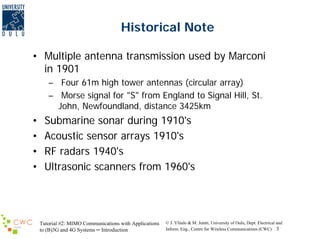
• Multiple antenna transmission used by Marconi
in 1901
– Four 61m high tower antennas (circular array)
– Morse signal for "S" from England to Signal Hill, St.
John, Newfoundland, distance 3425km

•
•
•
•

Submarine sonar during 1910's
Acoustic sensor arrays 1910's
RF radars 1940's
Ultrasonic scanners from 1960's

Tutorial #2: MIMO Communications with Applications
to (B)3G and 4G Systems ─ Introduction

© J. Ylitalo & M. Juntti, University of Oulu, Dept. Electrical and
Inform. Eng., Centre for Wireless Communications (CWC) 3
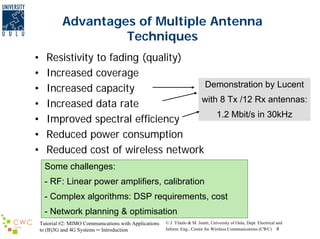
Advantages of Multiple Antenna
Techniques
•
•
•
•
•
•
•

Resistivity to fading (quality)
Increased coverage
Demonstration by Lucent
Increased capacity
with 8 Tx /12 Rx antennas:
Increased data rate
1.2 Mbit/s in 30kHz
Improved spectral efficiency
Reduced power consumption
Reduced cost of wireless network
Some challenges:
- RF: Linear power amplifiers, calibration
- Complex algorithms: DSP requirements, cost
- Network planning & optimisation
Tutorial #2: MIMO Communications with Applications
to (B)3G and 4G Systems ─ Introduction

© J. Ylitalo & M. Juntti, University of Oulu, Dept. Electrical and
Inform. Eng., Centre for Wireless Communications (CWC) 4
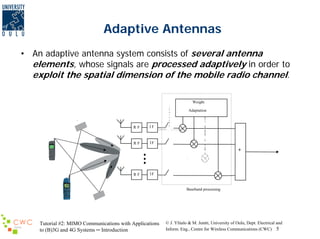
Adaptive Antennas
• An adaptive antenna system consists of several antenna
elements, whose signals are processed adaptively in order to
exploit the spatial dimension of the mobile radio channel.
Weight
Adaptation

RF

IF

RF

IF

+

RF

IF

Baseband processing

Tutorial #2: MIMO Communications with Applications
to (B)3G and 4G Systems ─ Introduction

© J. Ylitalo & M. Juntti, University of Oulu, Dept. Electrical and
Inform. Eng., Centre for Wireless Communications (CWC) 5
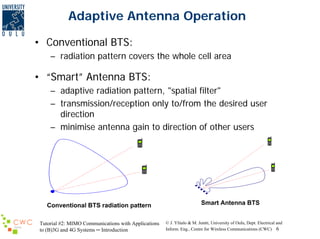
Adaptive Antenna Operation
• Conventional BTS:
– radiation pattern covers the whole cell area

• “Smart” Antenna BTS:
– adaptive radiation pattern, "spatial filter"
– transmission/reception only to/from the desired user
direction
– minimise antenna gain to direction of other users

Conventional BTS radiation pattern
Tutorial #2: MIMO Communications with Applications
to (B)3G and 4G Systems ─ Introduction

Smart Antenna BTS
© J. Ylitalo & M. Juntti, University of Oulu, Dept. Electrical and
Inform. Eng., Centre for Wireless Communications (CWC) 6
Beamforming (beam steering)
• Beamforming = phasing the antenna array elements
• Only Direction-of-Arrival (DOA) parameter needed in both
TX and RX: simple and robust
• Suits especially well to FDD systems
0

Array Gain [dB]

-5

DOA = 0 deg.
1
DOA = 30 deg.

M=8

2

-10
-15
-20
-25
-30

-50

0
Azimuth [deg]

Tutorial #2: MIMO Communications with Applications
to (B)3G and 4G Systems ─ Introduction

50

© J. Ylitalo & M. Juntti, University of Oulu, Dept. Electrical and
Inform. Eng., Centre for Wireless Communications (CWC) 7
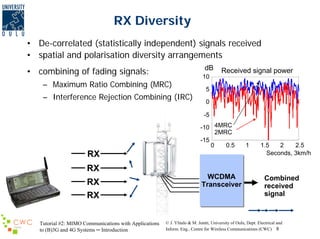
RX Diversity
• De-correlated (statistically independent) signals received
• spatial and polarisation diversity arrangements
dB

• combining of fading signals:
– Maximum Ratio Combining (MRC)
– Interference Rejection Combining (IRC)

10

Received signal power

5
0
-5
-10 4MRC
2MRC
-15
0
0.5

RX

1

1.5
2
2.5
Seconds, 3km/h

RX
RX
RX
Tutorial #2: MIMO Communications with Applications
to (B)3G and 4G Systems ─ Introduction

WCDMA
WCDMA
Transceiver
Transceiver

Combined
received
signal

© J. Ylitalo & M. Juntti, University of Oulu, Dept. Electrical and
Inform. Eng., Centre for Wireless Communications (CWC) 8
Transmission Diversity
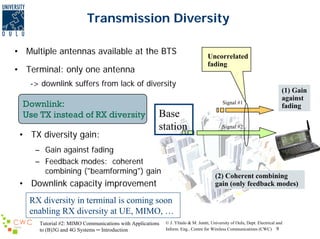
• Multiple antennas available at the BTS
• Terminal: only one antenna

Uncorrelated
fading

-> downlink suffers from lack of diversity

Downlink:
Use TX instead of RX diversity
• TX diversity gain:

Signal #1

Base
station

– Gain against fading
– Feedback modes: coherent
combining ("beamforming") gain

(1) Gain
against
fading

Signal #2

(2) Coherent combining
gain (only feedback modes)

• Downlink capacity improvement
RX diversity in terminal is coming soon
enabling RX diversity at UE, MIMO, …
Tutorial #2: MIMO Communications with Applications
to (B)3G and 4G Systems ─ Introduction

© J. Ylitalo & M. Juntti, University of Oulu, Dept. Electrical and
Inform. Eng., Centre for Wireless Communications (CWC) 9
SISO, SIMO, MISO, MIMO
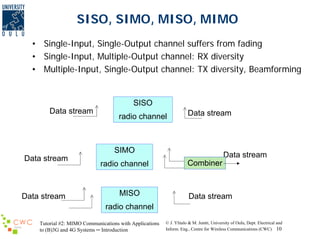
• Single-Input, Single-Output channel suffers from fading
• Single-Input, Multiple-Output channel: RX diversity
• Multiple-Input, Single-Output channel: TX diversity, Beamforming

SISO
Data stream

radio channel

Data stream

SIMO
Data stream

Data stream

radio channel

MISO

Data stream
Combiner

Data stream

radio channel
Tutorial #2: MIMO Communications with Applications
to (B)3G and 4G Systems ─ Introduction

© J. Ylitalo & M. Juntti, University of Oulu, Dept. Electrical and
Inform. Eng., Centre for Wireless Communications (CWC) 10
Definition of MIMO
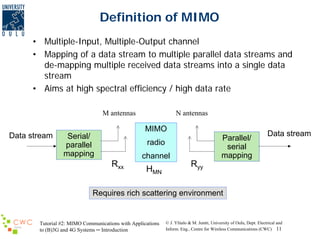
• Multiple-Input, Multiple-Output channel
• Mapping of a data stream to multiple parallel data streams and
de-mapping multiple received data streams into a single data
stream
• Aims at high spectral efficiency / high data rate
M antennas

Data stream

N antennas

MIMO

Serial/
parallel
mapping

Parallel/
serial
mapping

radio
channel

Rxx

HMN

Data stream

Ryy

Requires rich scattering environment

Tutorial #2: MIMO Communications with Applications
to (B)3G and 4G Systems ─ Introduction

© J. Ylitalo & M. Juntti, University of Oulu, Dept. Electrical and
Inform. Eng., Centre for Wireless Communications (CWC) 11
TX diversity& Beamforming vs. MIMO
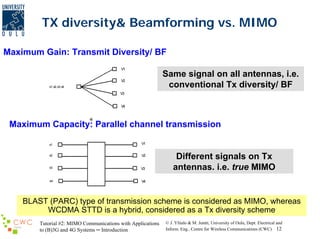
Maximum Gain: Transmit Diversity/ BF
V1

Same signal on all antennas, i.e.
conventional Tx diversity/ BF

V2
s1, s2, s3, s4

V3
V4
a)

Maximum Capacity: Parallel channel transmission
s1

V1

s2

V2

s3

V3

s4

V4

Different signals on Tx
antennas. i.e. true MIMO

b)
BLAST (PARC) type of transmission scheme is considered as MIMO, whereas
WCDMA STTD is a hybrid, considered as a Tx diversity scheme

Tutorial #2: MIMO Communications with Applications
to (B)3G and 4G Systems ─ Introduction

© J. Ylitalo & M. Juntti, University of Oulu, Dept. Electrical and
Inform. Eng., Centre for Wireless Communications (CWC) 12
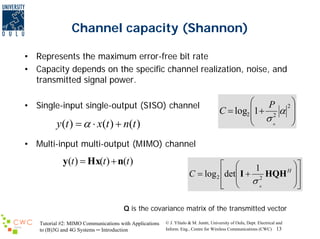
Channel capacity (Shannon)
• Represents the maximum error-free bit rate
• Capacity depends on the specific channel realization, noise, and
transmitted signal power.
• Single-input single-output (SISO) channel

y (t ) = α ⋅ x(t ) + n(t )

⎛
P 2⎞
C = log2 ⎜1 + 2 α ⎟
⎟
⎜ σ
n
⎠
⎝

• Multi-input multi-output (MIMO) channel

y(t ) = Hx(t ) + n(t )

⎡ ⎛
⎞⎤
1
H ⎟
C = log 2 ⎢det⎜ I + 2 HQH ⎥
⎟⎥
⎢ ⎜ σn
⎠⎦
⎣ ⎝

Q is the covariance matrix of the transmitted vector
Tutorial #2: MIMO Communications with Applications
to (B)3G and 4G Systems ─ Introduction

© J. Ylitalo & M. Juntti, University of Oulu, Dept. Electrical and
Inform. Eng., Centre for Wireless Communications (CWC) 13

Mathumathi

  • 1.
    Tutorial ─ MIMOCommunications with Applications to (B)3G and 4G Systems Introduction Juha Ylitalo Tutorial #2: MIMO Communications with Applications to (B)3G and 4G Systems ─ Introduction © J. Ylitalo & M. Juntti, University of Oulu, Dept. Electrical and Inform. Eng., Centre for Wireless Communications (CWC) 1
  • 2.
    Introduction • Short historicalnote • Advantages of multi-antenna techniques • Adaptive antennas – - Beamforming: spatial focusing of correlated signals – - Rx/Tx diversity: combining of decorrelated signals – - MIMO: increasing spectral efficiency/ data rates • Simple example: SINR improvement • Definition of MIMO • Spatial correlation matrix • Example: Diversity & MIMO in WCDMA Tutorial #2: MIMO Communications with Applications to (B)3G and 4G Systems ─ Introduction © J. Ylitalo & M. Juntti, University of Oulu, Dept. Electrical and Inform. Eng., Centre for Wireless Communications (CWC) 2
  • 3.
    Historical Note • Multipleantenna transmission used by Marconi in 1901 – Four 61m high tower antennas (circular array) – Morse signal for "S" from England to Signal Hill, St. John, Newfoundland, distance 3425km • • • • Submarine sonar during 1910's Acoustic sensor arrays 1910's RF radars 1940's Ultrasonic scanners from 1960's Tutorial #2: MIMO Communications with Applications to (B)3G and 4G Systems ─ Introduction © J. Ylitalo & M. Juntti, University of Oulu, Dept. Electrical and Inform. Eng., Centre for Wireless Communications (CWC) 3
  • 4.
    Advantages of MultipleAntenna Techniques • • • • • • • Resistivity to fading (quality) Increased coverage Demonstration by Lucent Increased capacity with 8 Tx /12 Rx antennas: Increased data rate 1.2 Mbit/s in 30kHz Improved spectral efficiency Reduced power consumption Reduced cost of wireless network Some challenges: - RF: Linear power amplifiers, calibration - Complex algorithms: DSP requirements, cost - Network planning & optimisation Tutorial #2: MIMO Communications with Applications to (B)3G and 4G Systems ─ Introduction © J. Ylitalo & M. Juntti, University of Oulu, Dept. Electrical and Inform. Eng., Centre for Wireless Communications (CWC) 4
  • 5.
    Adaptive Antennas • Anadaptive antenna system consists of several antenna elements, whose signals are processed adaptively in order to exploit the spatial dimension of the mobile radio channel. Weight Adaptation RF IF RF IF + RF IF Baseband processing Tutorial #2: MIMO Communications with Applications to (B)3G and 4G Systems ─ Introduction © J. Ylitalo & M. Juntti, University of Oulu, Dept. Electrical and Inform. Eng., Centre for Wireless Communications (CWC) 5
  • 6.
    Adaptive Antenna Operation •Conventional BTS: – radiation pattern covers the whole cell area • “Smart” Antenna BTS: – adaptive radiation pattern, "spatial filter" – transmission/reception only to/from the desired user direction – minimise antenna gain to direction of other users Conventional BTS radiation pattern Tutorial #2: MIMO Communications with Applications to (B)3G and 4G Systems ─ Introduction Smart Antenna BTS © J. Ylitalo & M. Juntti, University of Oulu, Dept. Electrical and Inform. Eng., Centre for Wireless Communications (CWC) 6
  • 7.
    Beamforming (beam steering) •Beamforming = phasing the antenna array elements • Only Direction-of-Arrival (DOA) parameter needed in both TX and RX: simple and robust • Suits especially well to FDD systems 0 Array Gain [dB] -5 DOA = 0 deg. 1 DOA = 30 deg. M=8 2 -10 -15 -20 -25 -30 -50 0 Azimuth [deg] Tutorial #2: MIMO Communications with Applications to (B)3G and 4G Systems ─ Introduction 50 © J. Ylitalo & M. Juntti, University of Oulu, Dept. Electrical and Inform. Eng., Centre for Wireless Communications (CWC) 7
  • 8.
    RX Diversity • De-correlated(statistically independent) signals received • spatial and polarisation diversity arrangements dB • combining of fading signals: – Maximum Ratio Combining (MRC) – Interference Rejection Combining (IRC) 10 Received signal power 5 0 -5 -10 4MRC 2MRC -15 0 0.5 RX 1 1.5 2 2.5 Seconds, 3km/h RX RX RX Tutorial #2: MIMO Communications with Applications to (B)3G and 4G Systems ─ Introduction WCDMA WCDMA Transceiver Transceiver Combined received signal © J. Ylitalo & M. Juntti, University of Oulu, Dept. Electrical and Inform. Eng., Centre for Wireless Communications (CWC) 8
  • 9.
    Transmission Diversity • Multipleantennas available at the BTS • Terminal: only one antenna Uncorrelated fading -> downlink suffers from lack of diversity Downlink: Use TX instead of RX diversity • TX diversity gain: Signal #1 Base station – Gain against fading – Feedback modes: coherent combining ("beamforming") gain (1) Gain against fading Signal #2 (2) Coherent combining gain (only feedback modes) • Downlink capacity improvement RX diversity in terminal is coming soon enabling RX diversity at UE, MIMO, … Tutorial #2: MIMO Communications with Applications to (B)3G and 4G Systems ─ Introduction © J. Ylitalo & M. Juntti, University of Oulu, Dept. Electrical and Inform. Eng., Centre for Wireless Communications (CWC) 9
  • 10.
    SISO, SIMO, MISO,MIMO • Single-Input, Single-Output channel suffers from fading • Single-Input, Multiple-Output channel: RX diversity • Multiple-Input, Single-Output channel: TX diversity, Beamforming SISO Data stream radio channel Data stream SIMO Data stream Data stream radio channel MISO Data stream Combiner Data stream radio channel Tutorial #2: MIMO Communications with Applications to (B)3G and 4G Systems ─ Introduction © J. Ylitalo & M. Juntti, University of Oulu, Dept. Electrical and Inform. Eng., Centre for Wireless Communications (CWC) 10
  • 11.
    Definition of MIMO •Multiple-Input, Multiple-Output channel • Mapping of a data stream to multiple parallel data streams and de-mapping multiple received data streams into a single data stream • Aims at high spectral efficiency / high data rate M antennas Data stream N antennas MIMO Serial/ parallel mapping Parallel/ serial mapping radio channel Rxx HMN Data stream Ryy Requires rich scattering environment Tutorial #2: MIMO Communications with Applications to (B)3G and 4G Systems ─ Introduction © J. Ylitalo & M. Juntti, University of Oulu, Dept. Electrical and Inform. Eng., Centre for Wireless Communications (CWC) 11
  • 12.
    TX diversity& Beamformingvs. MIMO Maximum Gain: Transmit Diversity/ BF V1 Same signal on all antennas, i.e. conventional Tx diversity/ BF V2 s1, s2, s3, s4 V3 V4 a) Maximum Capacity: Parallel channel transmission s1 V1 s2 V2 s3 V3 s4 V4 Different signals on Tx antennas. i.e. true MIMO b) BLAST (PARC) type of transmission scheme is considered as MIMO, whereas WCDMA STTD is a hybrid, considered as a Tx diversity scheme Tutorial #2: MIMO Communications with Applications to (B)3G and 4G Systems ─ Introduction © J. Ylitalo & M. Juntti, University of Oulu, Dept. Electrical and Inform. Eng., Centre for Wireless Communications (CWC) 12
  • 13.
    Channel capacity (Shannon) •Represents the maximum error-free bit rate • Capacity depends on the specific channel realization, noise, and transmitted signal power. • Single-input single-output (SISO) channel y (t ) = α ⋅ x(t ) + n(t ) ⎛ P 2⎞ C = log2 ⎜1 + 2 α ⎟ ⎟ ⎜ σ n ⎠ ⎝ • Multi-input multi-output (MIMO) channel y(t ) = Hx(t ) + n(t ) ⎡ ⎛ ⎞⎤ 1 H ⎟ C = log 2 ⎢det⎜ I + 2 HQH ⎥ ⎟⎥ ⎢ ⎜ σn ⎠⎦ ⎣ ⎝ Q is the covariance matrix of the transmitted vector Tutorial #2: MIMO Communications with Applications to (B)3G and 4G Systems ─ Introduction © J. Ylitalo & M. Juntti, University of Oulu, Dept. Electrical and Inform. Eng., Centre for Wireless Communications (CWC) 13