EITC Infrastructure
Outlook 2021
Whitepaper | July 2018
www.du.ae
A glimpse into du’s transformation journey towards being
a software defined network in the digital era.
www.du.ae 2
EITC Infrastructure Outlook
2021
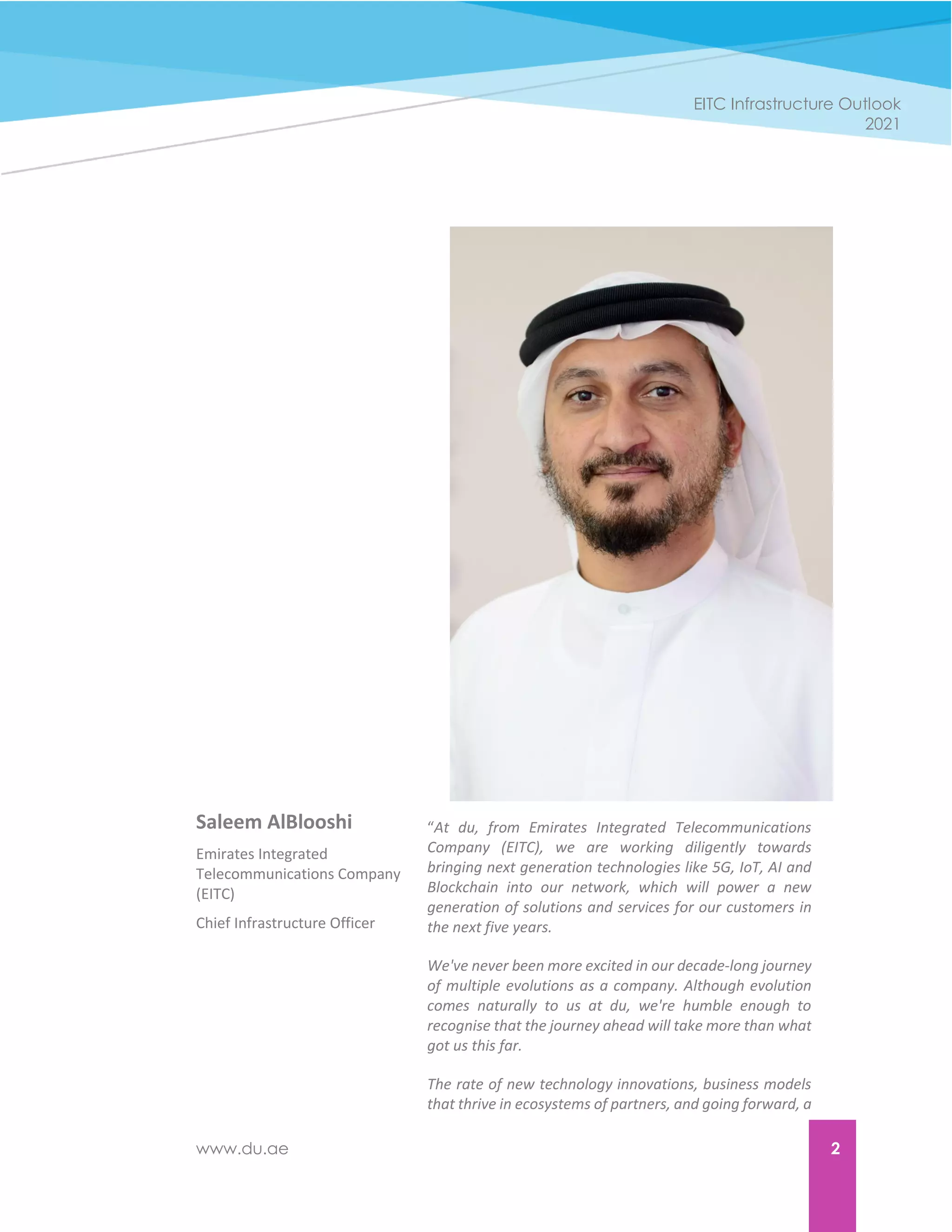
Saleem AlBlooshi
Emirates Integrated
Telecommunications Company
(EITC)
Chief Infrastructure Officer
“At du, from Emirates Integrated Telecommunications
Company (EITC), we are working diligently towards
bringing next generation technologies like 5G, IoT, AI and
Blockchain into our network, which will power a new
generation of solutions and services for our customers in
the next five years.
We've never been more excited in our decade-long journey
of multiple evolutions as a company. Although evolution
comes naturally to us at du, we're humble enough to
recognise that the journey ahead will take more than what
got us this far.
The rate of new technology innovations, business models
that thrive in ecosystems of partners, and going forward, a
www.du.ae 3
EITC Infrastructure Outlook
2021
data-driven economy has made it imperative for us to
undergo a digital transformation that not only impacts our
technology infrastructure but the way we operate with
agility to embrace the emerging new economic order.”
www.du.ae 4
EITC Infrastructure Outlook
2021
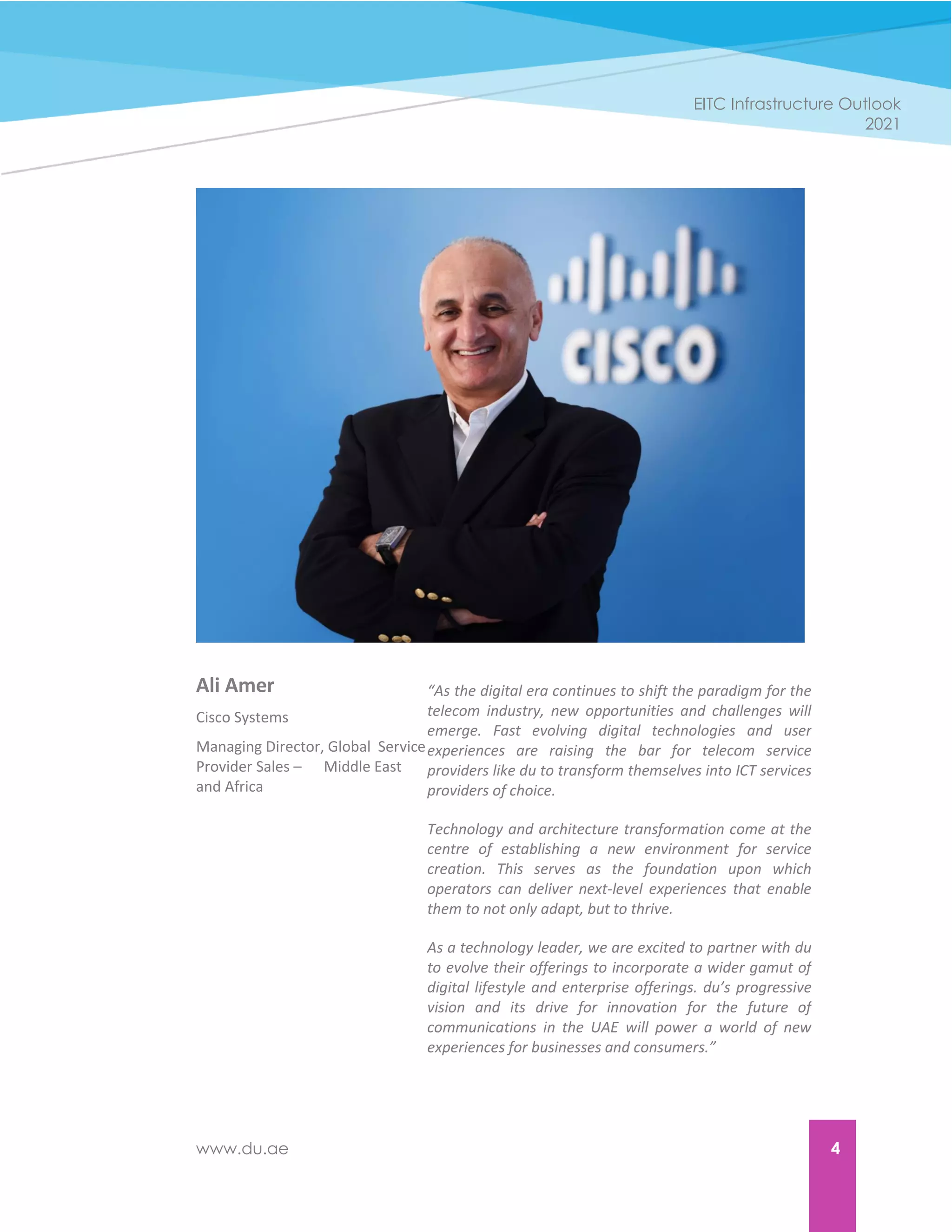
Ali Amer
Cisco Systems
Managing Director, Global Service
Provider Sales – Middle East
and Africa
“As the digital era continues to shift the paradigm for the
telecom industry, new opportunities and challenges will
emerge. Fast evolving digital technologies and user
experiences are raising the bar for telecom service
providers like du to transform themselves into ICT services
providers of choice.
Technology and architecture transformation come at the
centre of establishing a new environment for service
creation. This serves as the foundation upon which
operators can deliver next-level experiences that enable
them to not only adapt, but to thrive.
As a technology leader, we are excited to partner with du
to evolve their offerings to incorporate a wider gamut of
digital lifestyle and enterprise offerings. du’s progressive
vision and its drive for innovation for the future of
communications in the UAE will power a world of new
experiences for businesses and consumers.”
www.du.ae 5
EITC Infrastructure Outlook
2021
CONTENT
INTRODUCTION 7
NEED FOR CHANGE 8
Macro trends
Drivers of change
Evolution in business
SYNCING UP WITH CUSTOMERS 10
Consumers
Enterprise
Government
Internal
TOOLING FOR CHANGE 155
Capabilities stack
Transition journey
REORGANISING OURSELVES 177
RECALIBRAINTING OUR MEASURES OF SUCCESS 19
Service Operations
Development IT
Evolution of KPI’s
REORIENTING OUR PEOPLE 233
UPGRADING THE INFRASTRUCTURE 244
Virtualisation
Network Functions Virtualisation (NFV)
Automation and Orchestration
Machine Learning
CONCLUSION 30
WORKS CITED 31
www.du.ae 6
EITC Infrastructure Outlook
2021
EXHIBITS
EXHIBIT 1 DU'S STRATEGIC PILLARS AND TRANSFORMATION LAYERS 9
EXHIBIT 2 CONSUMER USE CASES FOR 5G 10
EXHIBIT 3 BUSINESS CUSTOMERS IN UAE 11
EXHIBIT 4 DU'S RECENT INITIATIVES IN MARKET 144
EXHIBIT 5 DU'S CAPABILITY STACK 155
EXHIBIT 6 DU'S TRANSITION JOURNEY 166
EXHIBIT 7 DU'S ORGANISATIONAL STRUCTURE 17
EXHIBIT 8 ELIMINATION OF MANUAL INTERVENTION 20
EXHIBIT 9 IMPACT OF AUTOMATION ON PROCESSES 20
EXHIBIT 10 DU'S EVOLUTION OF KPI'S 22
EXHIBIT 11 DATA CENTRE CONSOLIDATION 24
EXHIBIT 12 VIRTUALISATION AS AN ENABLER 255
EXHIBIT 13 SOFTWARE DEFINED SERVICE PROVIDER 277
EXHIBIT 14 SEAMLESS FUTURE 28
www.du.ae 7
EITC Infrastructure Outlook
2021
INTRODUCTION
Technology is hurtling into the future at ever
higher speeds, and the pace only multiplies
every two to five years. While consumers
enjoy superior new experiences and value
from new digital products, a great many
industries have been disrupted, leaving a
trail of iterated business models and new
value chains.
For businesses, change is the only constant
and the successful ones have to innovate
incessantly to stay in the game. They have to
be nimble to adapt their organisations, and
preferably lead the change in their industry.
Telecom service providers are not unique in
that regard, where many are riding the
change curve at its leading edge. du is in the
midst of such a digital transformation.
In this paper, we present infrastructure
technologies that du is investing in, such as
virtualisation, automation, big-data and
artificial intelligence (AI). These are laying
the foundation of what would prepare us to
embrace the change anticipated in the next
five years.
This paper does not cover the actual digital
services and applications, instead we focus
on the foundational infrastructure that
makes standing up these possible.
In the following sections, we present this
transformation journey at du, in a unifying
context of market drivers, service
capabilities, as well as operational and
organisational change that works in unison
with the underlying technology
infrastructure transformation.
www.du.ae 8
EITC Infrastructure Outlook
2021
NEED FOR CHANGE
MACRO TRENDS
We recognise a few large-scale trends in
computing and micro-processors that are
impacting nearly every industry.
Explosion in computing. A consistent
drop in cost of computing is driving an order
of magnitude change in the scale of
computing solutions and ubiquity of
connected devices. As a result, cloud
computing and IoT are changing the
landscape of digital services in addition to
powerful smartphones in every hand.
Explosion of data. Computing
everywhere is generating data at
unprecedented levels, for information
mining, with AI techniques. Economics of
data are much different than those of legacy
businesses, where business models are
bring re-imagined with digital and data-
driven offerings. Data is the ‘new oil’ [1].
Software is continuing to eat the
world [2]. Baseline complexities and costs
of physical assets and manual processes are
being eliminated by shift of functions to
software. Digital innovations are collapsing
industry barriers, making cross-functional
products and services possible, and mashing
up previously segregated markets and
industries. Every physical object can
potentially get networked and be
programmed.
DRIVERS OF CHANGE
Global Internet users’ penetration is
reaching 50%, and just above 90% in the
UAE [3]. Globally, Internet traffic is expected
to grow 3.2-fold from 2016 to 2021, a
compound annual growth rate of 26%.
Whereas mobile data traffic will grow 7-fold
over the same period.
The Internet-of-Things (IoT) is shifting
connectivity from end-user devices to
machine-to-machine (M2M) connections.
M2M modules will account for 51% of all
networked devices in 2021. 43% of all
networked devices will be mobile-
connected, of which smartphones will
account for half. [4].
Service providers (SP), around the world, are
witnessing drivers of change that are forcing
them to adapt accordingly.
Pressures on revenue. Cost per bit does
not match the growth in bandwidth. Legacy
SP’s struggle as they mostly compete on the
services layer ‘at connectivity terms’!
Shift of value in ICT industry. OTTs are
capturing bigger share of value away from
www.du.ae 9
EITC Infrastructure Outlook
2021
SPs with richer services and experiences.
OTT attack SP services as loss leaders to
grow their core business - ecommerce,
advertising, streaming.
Customers have greater expectations.
Customer expectations are evolving at
Internet speeds with continuous
introductions of newer digital experiences
and services from global OTT players.
Always connected, and everywhere, digital
consumption is expanding faster in newer
dimensions of ‘augmented’ and ‘virtual
reality’. Technology and digital experiences
for customers are raising the bar for SP’s to
transform into Digital Services Providers.
EVOLUTION IN BUSINESS
Expanding to digital services. telecom
service providers are evolving offerings
beyond traditional connectivity services to a
wider gamut of digital services.
Driving for operating agility. Most are
redesigning for efficiency and rapid
adaptation to market shifts, leveraging
technologies like virtualisation to shift HW
to SW. ‘It's not the big that eat the small, it's
the fast that eat the slow’.
Engage in ecosystems play. It is
becoming imperative to play in new sectors
or compete in new digital ways. Rapidly
introducing new services within an
ecosystem of partners by building enablers
for collaboration.
du is evolving beyond a traditional telco into
an ICT service provider. In its journey since
birth, du has endeavoured to delight
customers with simplicity and breakthrough
experiences across its three major customer
categories: 1) Individual consumers, 2)
Business customers, and 3) Government.
du maintains its focus with key strategic
pillars in driving change – a seamless
customer experience across channels,
innovative services and solutions, and agility
in operations. There is a fourth element of
‘continuous innovation’ that renews the
perpetual momentum needed behind each
pillar [Exhibit 1].
du’s digital transformation runs across the
various layers of the company, and is guided
by these pillars of success.
In the following sections, we shall go
through these layers to lay out changes in
each and how they are all connected.
Exhibit 1 du's strategic pillars and transformation layers
www.du.ae 10
EITC Infrastructure Outlook
2021
SYNCING UP WITH CUSTOMERS
CONSUMERS
Ultra-performance. Smartphones have
become intertwined with our lives in
countless ways, but there is a wide set of
new use cases that are driving the need for
new service capabilities for du which
becomes the basis for accelerated
deployment of 5G [Exhibit 2].
As an example, video consumption is rapidly
evolving from linear to on-demand, with
higher interactivity in content. Consumers
demand for unified user interface (UI)
across devices as wells as intuitive ways of
integrating external OTT services [5].
Globally, mobile video traffic is estimated to
reach 79% of total mobile data traffic in
2021, compared to 60% at the end of 2016
[4]. Gaming related Internet traffic is
expected to grow 10-fold from 2016 to
2021.
Multi-channel support. Consumers expect
uniform service experience and continuity in
interaction across channels. Single sign-on
across services portfolio, high degree of
interactivity and personalisation are among
table stakes.
Exhibit 2 Consumer use cases for 5G
www.du.ae 11
EITC Infrastructure Outlook
2021
ENTERPRISE
Customer expectations
In the Business sector, customer expectations mirror those of consumer apps. End users in
enterprise are demanding consumer-quality in product experiences.
Exhibit 3 Business customers in UAE
 Service Scaling. They want the flexibility
to deal with variance in operations and
demands, with particular seasonality in
Dubai market [Exhibit 3].
 Cost Efficiency. Our customers want the
flexibility to scale consumption of
services as-needed, with payments on a
pay-as-you-go basis that reflect the
usage models. Shift from CapEx to OpEx
model for better cost control.
 Transparency. Customers expect to have
greater control of their own product,
service or brand experience, not only to
customise product features but also
necessary tools and information to
resolve issues.
 Ease in management of moves, adds,
changes and deletes. Monitor usage of
services, bandwidth, congestion, etc.
 Managed services. Move business
workloads and data to hosted private
cloud. Businesses, in our market, look to
outsource non-core operations and
focus on their strengths with managed
services.
 Security. More applications mean more
vulnerabilities. Which brings security
among the top explicit asks from
customers, where risk management of
hacking and ransomware are top
concerns.
 Reliability. There is expectation of high
availability of service with zero
downtime.
5 times as many visitors, as resident population, visit Dubai during the tourism season. This
creates a need for flexibility in usage of resources to serve the seasonality.
72% customers express interest in VMS, where all or some of the capabilities delivered by
CPE are delivered either fully or hybrid cloud solutions.
88% of business customers surveyed want a bundled security service with network service.
Source: Cisco Survey of MEA enterprise customers in 2017
GOVERNMENT
du is also committed to supporting government infrastructure services towards the UAE vision
2021, a key partner in the smart city initiative [Exhibit 4].
Customer Expectations
 Bespoke Services. du is a strategic UAE
government partner for providing
futuristic services
 Security. Government solutions have the
highest demands to ensure the security
of citizen’s data.
Service capabilities
 Managed Services
 Data Security
INTERNAL
Internal platform innovation is a key stakeholder for setting the agenda for new revenue
opportunities and readiness for future solutions and applications.
Expectations
Following is a list of prominent needs that
are high on setting the agenda for digital
services.
 Data Driven Insights. Digital sense, AR.
 Chatbot and other A.I based applications
across the services portfolio.
 Developer and Partner Ecosystem.
Bringing openness to partners and
customers faster partner on-boarding
and service creation with partners.
 Streamlining customer experience.
Centralisation of API repository and
capabilities for holistic view of services.
Service capabilities
These translate into an advanced set of
capabilities that are expected to support
advanced new solutions of the future.
 Open API GW
 Big Data, analytics
 Artificial Intelligence
 Machine Learning (ML)
 Deep Machine Learning
www.du.ae 13
EITC Infrastructure Outlook
2021
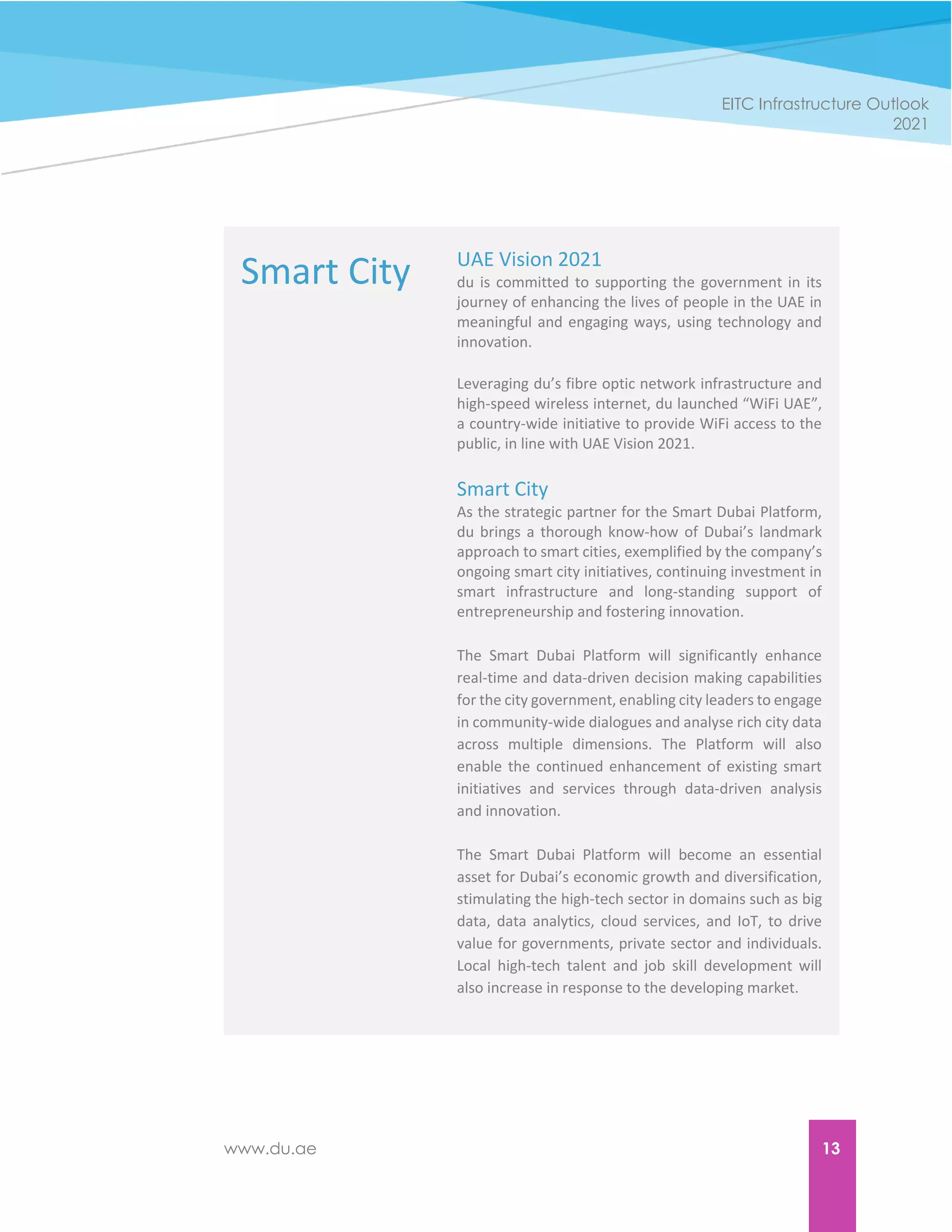
Smart City UAE Vision 2021
du is committed to supporting the government in its
journey of enhancing the lives of people in the UAE in
meaningful and engaging ways, using technology and
innovation.
Leveraging du’s fibre optic network infrastructure and
high-speed wireless internet, du launched “WiFi UAE”,
a country-wide initiative to provide WiFi access to the
public, in line with UAE Vision 2021.
Smart City
As the strategic partner for the Smart Dubai Platform,
du brings a thorough know-how of Dubai’s landmark
approach to smart cities, exemplified by the company’s
ongoing smart city initiatives, continuing investment in
smart infrastructure and long-standing support of
entrepreneurship and fostering innovation.
The Smart Dubai Platform will significantly enhance
real-time and data-driven decision making capabilities
for the city government, enabling city leaders to engage
in community-wide dialogues and analyse rich city data
across multiple dimensions. The Platform will also
enable the continued enhancement of existing smart
initiatives and services through data-driven analysis
and innovation.
The Smart Dubai Platform will become an essential
asset for Dubai’s economic growth and diversification,
stimulating the high-tech sector in domains such as big
data, data analytics, cloud services, and IoT, to drive
value for governments, private sector and individuals.
Local high-tech talent and job skill development will
also increase in response to the developing market.
www.du.ae 14
EITC Infrastructure Outlook
2021
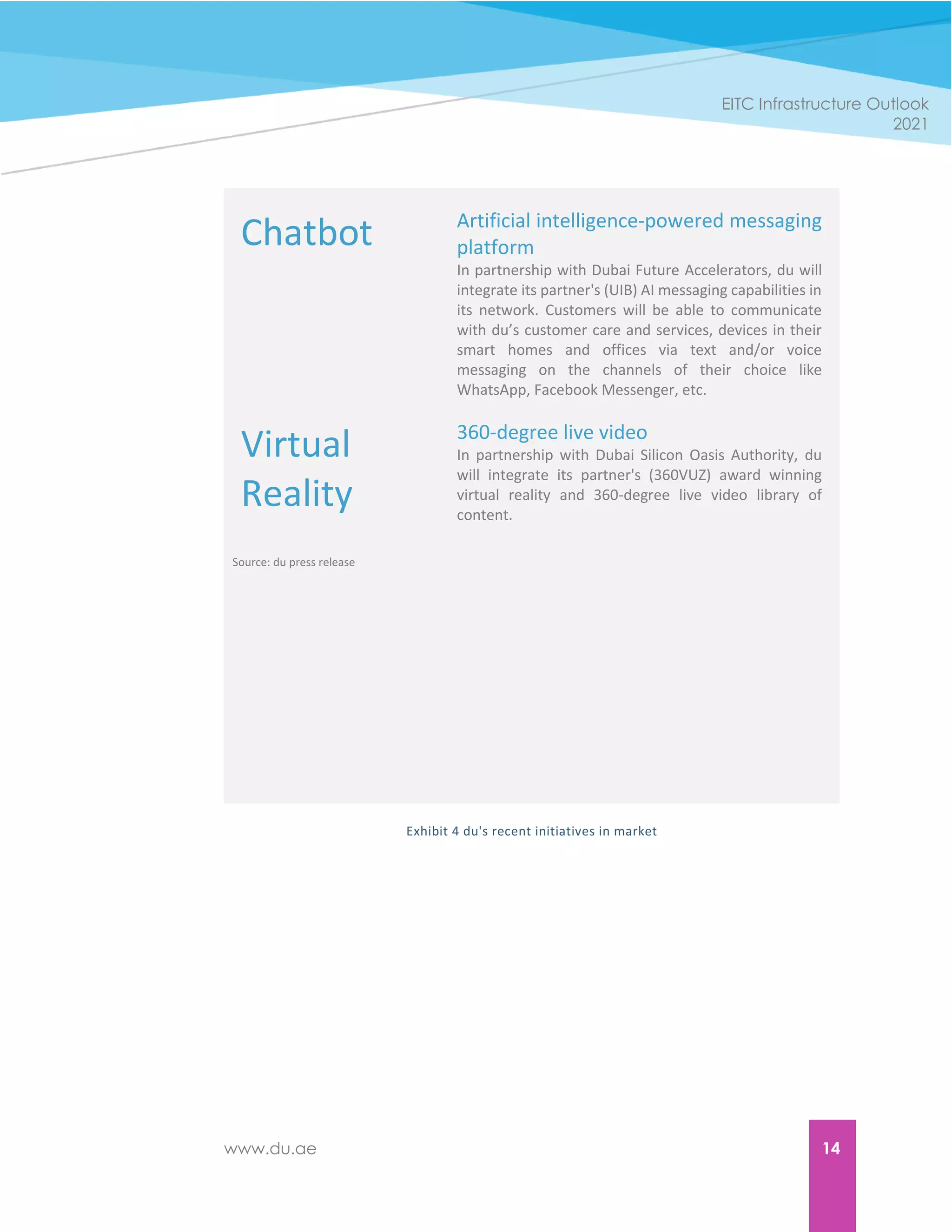
Chatbot Artificial intelligence-powered messaging
platform
In partnership with Dubai Future Accelerators, du will
integrate its partner's (UIB) AI messaging capabilities in
its network. Customers will be able to communicate
with du’s customer care and services, devices in their
smart homes and offices via text and/or voice
messaging on the channels of their choice like
WhatsApp, Facebook Messenger, etc.
Virtual
Reality
360-degree live video
In partnership with Dubai Silicon Oasis Authority, du
will integrate its partner's (360VUZ) award winning
virtual reality and 360-degree live video library of
content.
Source: du press release
Exhibit 4 du's recent initiatives in market
www.du.ae 15
EITC Infrastructure Outlook
2021
TOOLING FOR CHANGE
CAPABILITIES STACK
Combining the service capabilities identified
in the previous section across customer
segments, we layer them over the
transformation layers to build the ‘stack of
capabilities’ across the transformation
layers. In the following sections of this
paper, we discuss the technology enablers
in detail, shown here in [Exhibit 5], as the
foundational layer. We will also discuss the
capabilities in the operations, organisation
and people domain accordingly.
Exhibit 5 du's capability stack
www.du.ae 16
EITC Infrastructure Outlook
2021
TRANSITION JOURNEY
While there is urgency to prepare for new
services with technology enablers shown
[Exhibit 5], du cannot lose focus on the
stability and continuity of existing
businesses. The transition to a software
defined service provider is gradual.
This ‘upgrade’ is a transition journey for du,
into becoming a software defined service
provider by gradually introducing these new
tech capabilities identified over the next two
to three years.
Most significantly, we envision two co-
existing platforms that will live over this
period, where the old will gradually give way
to the new paradigm [Exhibit 6].
Moving from a dedicated infrastructure to a
shared one (convergent SP cloud) for all
network and IT functions will be done in
phases. Some services will be virtualised and
migrated to the new cloud. Others will reach
the end of life. Finally, numerous new
services will be introduced and hosted on
the new platform.
The duality exists not only in infrastructure
and technologies, but operations as well.
We are building agility without
overshadowing existing businesses, by
adapting both simultaneously and
iteratively.
As an example, the duality necessitates a
‘mode-1’ and ‘mode-2’ for IT to deliver for
both legacy waterfall approach and DevOps
(agile) approach simultaneously.
Product Lifecycle Management (PLM) has to
manage both the traditional with our legacy
model of operating along with the ‘fast
track’ that has elements like DevOps,
automated testing on datasets for security
vulnerabilities and consistency.
Exhibit 6 du's transition journey
www.du.ae 17
EITC Infrastructure Outlook
2021
REORGANISING OURSELVES
The right organisational design is the first
step for intended operations and processes.
As Conway’s law [6] indicates, an
organisation ends up producing designs
whose structure is a copy of the
organisation's communication structure. du
intends to reinvent the processes and
culture that drives the operations to a more
agile environment that is abreast with
software development and DevOps. The
new organisation [Exhibit 7] focusses on
harmonising the infrastructure as a single
business unit that serves all businesses
within the ETIC.
Exhibit 7 du's organisation structure
BEFORE AFTER
Network IT
Product /
offer
Operations
infrastructure
Product /
offer
Operations
infrastructure
Horizontal and Converged
Infrastructure
Connectivity
Solutions
Adjacent
ICT
Solutions
Digital
and
Life Style
Digital Mobile
Services
www.du.ae 18
EITC Infrastructure Outlook
2021
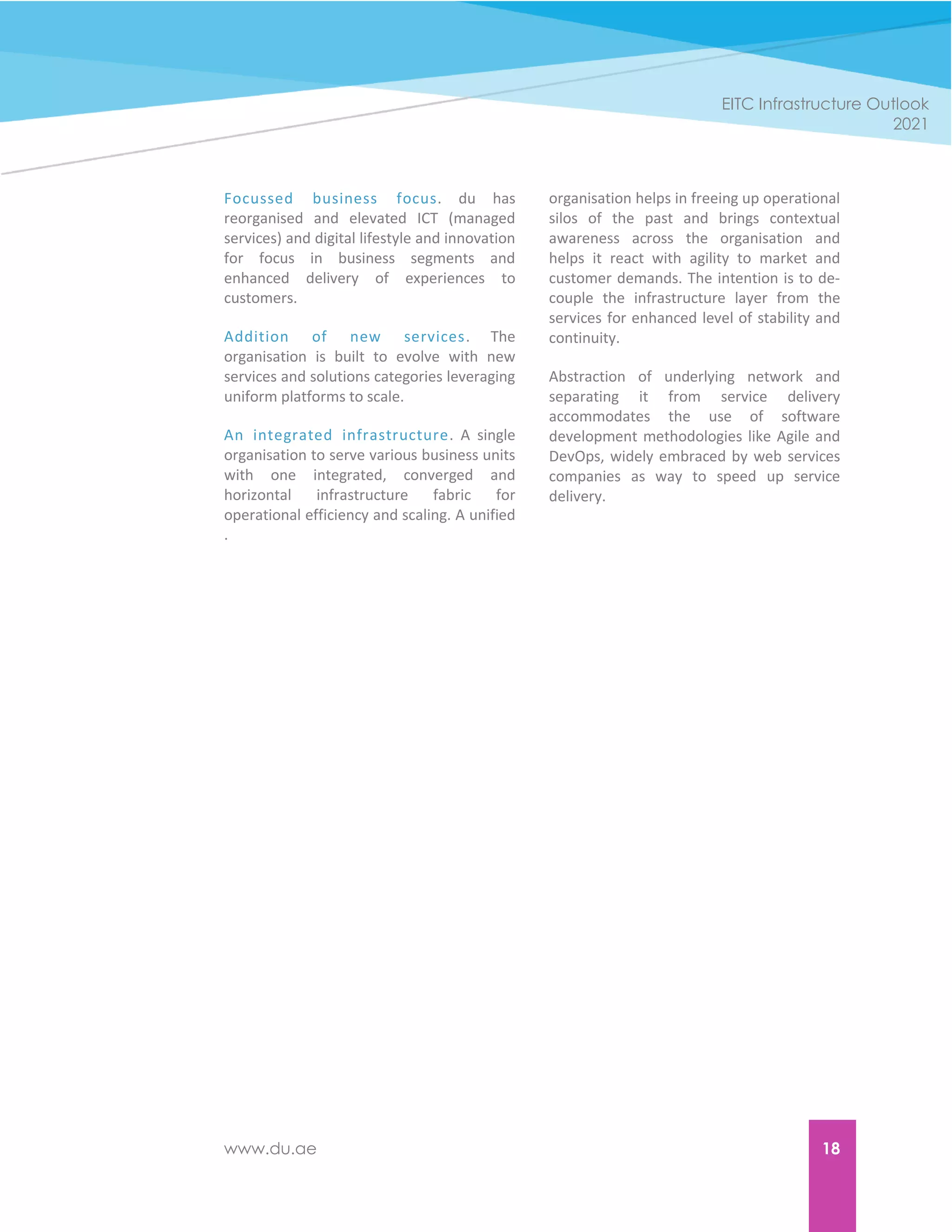
Focussed business focus. du has
reorganised and elevated ICT (managed
services) and digital lifestyle and innovation
for focus in business segments and
enhanced delivery of experiences to
customers.
Addition of new services. The
organisation is built to evolve with new
services and solutions categories leveraging
uniform platforms to scale.
An integrated infrastructure. A single
organisation to serve various business units
with one integrated, converged and
horizontal infrastructure fabric for
operational efficiency and scaling. A unified
organisation helps in freeing up operational
silos of the past and brings contextual
awareness across the organisation and
helps it react with agility to market and
customer demands. The intention is to de-
couple the infrastructure layer from the
services for enhanced level of stability and
continuity.
Abstraction of underlying network and
separating it from service delivery
accommodates the use of software
development methodologies like Agile and
DevOps, widely embraced by web services
companies as way to speed up service
delivery.
.
www.du.ae 19
EITC Infrastructure Outlook
2021
RECALIBRAINTING OUR
MEASURES OF SUCCESS
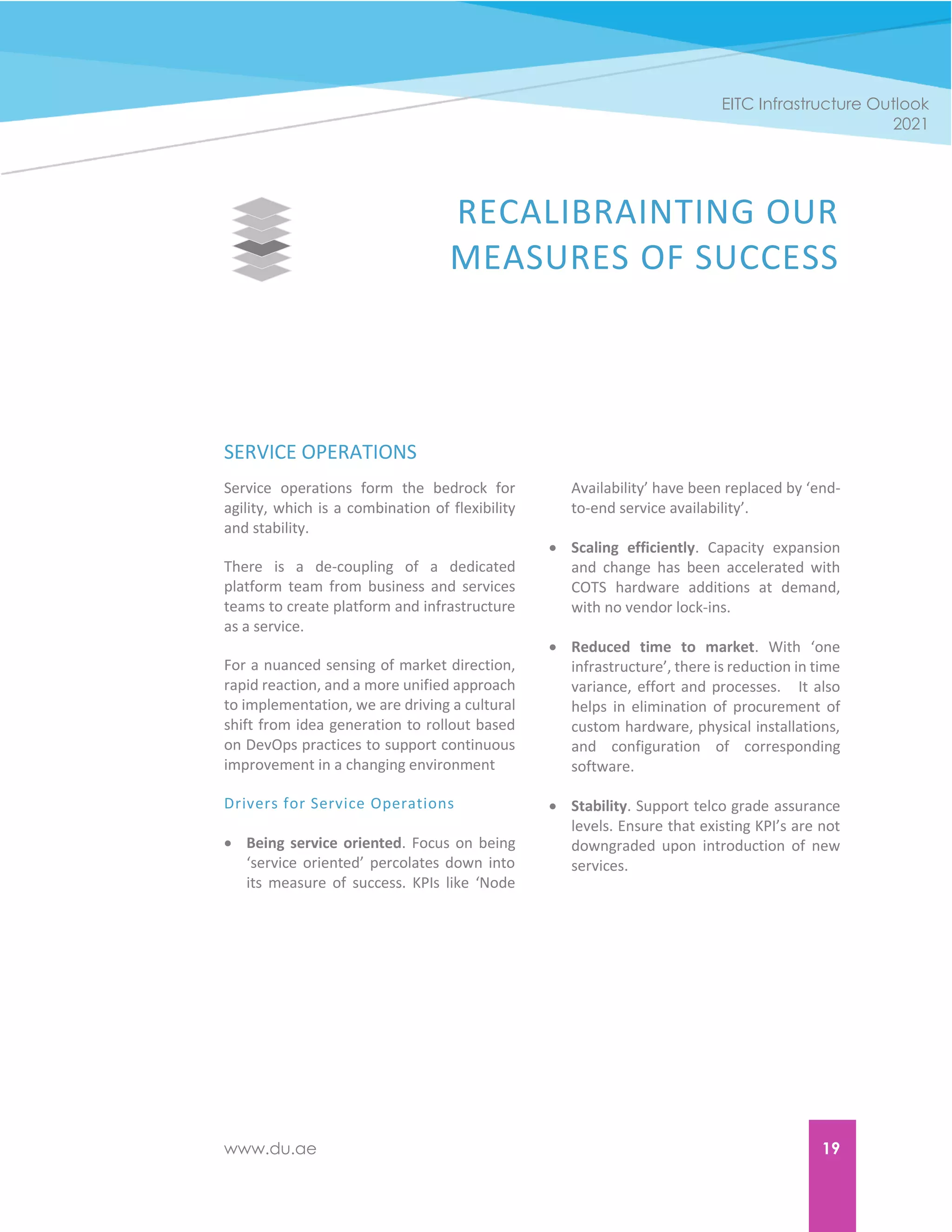
SERVICE OPERATIONS
Service operations form the bedrock for
agility, which is a combination of flexibility
and stability.
There is a de-coupling of a dedicated
platform team from business and services
teams to create platform and infrastructure
as a service.
For a nuanced sensing of market direction,
rapid reaction, and a more unified approach
to implementation, we are driving a cultural
shift from idea generation to rollout based
on DevOps practices to support continuous
improvement in a changing environment
Drivers for Service Operations
 Being service oriented. Focus on being
‘service oriented’ percolates down into
its measure of success. KPIs like ‘Node
Availability’ have been replaced by ‘end-
to-end service availability’.
 Scaling efficiently. Capacity expansion
and change has been accelerated with
COTS hardware additions at demand,
with no vendor lock-ins.
 Reduced time to market. With ‘one
infrastructure’, there is reduction in time
variance, effort and processes. It also
helps in elimination of procurement of
custom hardware, physical installations,
and configuration of corresponding
software.
 Stability. Support telco grade assurance
levels. Ensure that existing KPI’s are not
downgraded upon introduction of new
services.
www.du.ae 20
EITC Infrastructure Outlook
2021
Exhibit 8 Elimination of manual intervention
Automation will minimise the manual steps
leading to greater speed and precision
[Exhibit 8]. The benefits of change are
perceived across operating areas [Exhibit 9],
which are quantitative measures of bringing
about agility.
Apart from the obvious speed in delivery
and reduction in manual errors, the benefits
go as far as elevation of people’s role in the
organisation by freeing up the engineering
talent, which is now applied instead to more
advanced next generation technologies and
applications and solutions design.
Exhibit 9 Impact of automation on processes
www.du.ae 21
EITC Infrastructure Outlook
2021
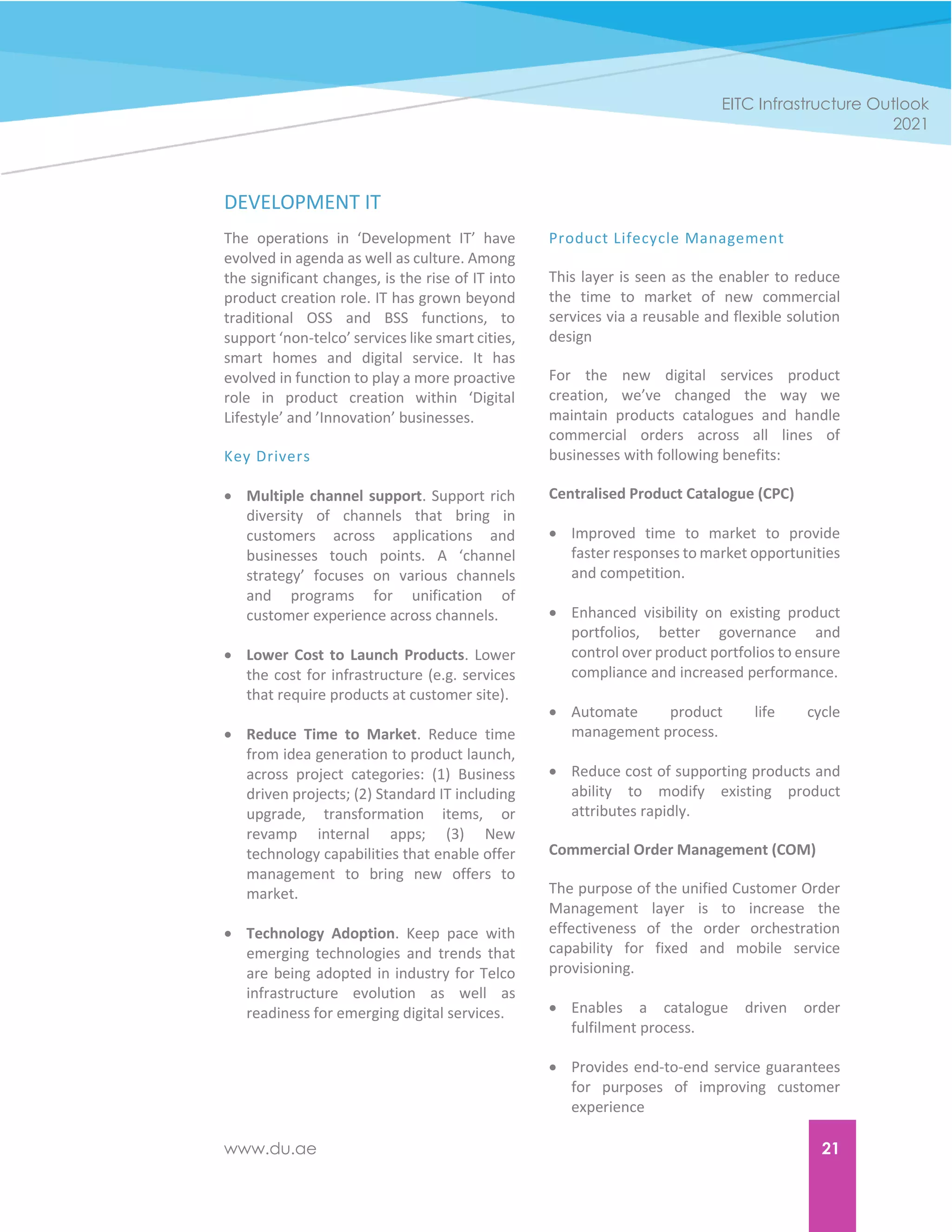
DEVELOPMENT IT
The operations in ‘Development IT’ have
evolved in agenda as well as culture. Among
the significant changes, is the rise of IT into
product creation role. IT has grown beyond
traditional OSS and BSS functions, to
support ‘non-telco’ services like smart cities,
smart homes and digital service. It has
evolved in function to play a more proactive
role in product creation within ‘Digital
Lifestyle’ and ’Innovation’ businesses.
Key Drivers
 Multiple channel support. Support rich
diversity of channels that bring in
customers across applications and
businesses touch points. A ‘channel
strategy’ focuses on various channels
and programs for unification of
customer experience across channels.
 Lower Cost to Launch Products. Lower
the cost for infrastructure (e.g. services
that require products at customer site).
 Reduce Time to Market. Reduce time
from idea generation to product launch,
across project categories: (1) Business
driven projects; (2) Standard IT including
upgrade, transformation items, or
revamp internal apps; (3) New
technology capabilities that enable offer
management to bring new offers to
market.
 Technology Adoption. Keep pace with
emerging technologies and trends that
are being adopted in industry for Telco
infrastructure evolution as well as
readiness for emerging digital services.
Product Lifecycle Management
This layer is seen as the enabler to reduce
the time to market of new commercial
services via a reusable and flexible solution
design
For the new digital services product
creation, we’ve changed the way we
maintain products catalogues and handle
commercial orders across all lines of
businesses with following benefits:
Centralised Product Catalogue (CPC)
 Improved time to market to provide
faster responses to market opportunities
and competition.
 Enhanced visibility on existing product
portfolios, better governance and
control over product portfolios to ensure
compliance and increased performance.
 Automate product life cycle
management process.
 Reduce cost of supporting products and
ability to modify existing product
attributes rapidly.
Commercial Order Management (COM)
The purpose of the unified Customer Order
Management layer is to increase the
effectiveness of the order orchestration
capability for fixed and mobile service
provisioning.
 Enables a catalogue driven order
fulfilment process.
 Provides end-to-end service guarantees
for purposes of improving customer
experience
www.du.ae 22
EITC Infrastructure Outlook
2021
 Reduces provisioning complexities and
gives a mechanism to gracefully
integrate and manage orders between
multiple systems.
 It presents a consistent and unified view
to the business support applications
whilst using a unique framework to
introduce efficiency in managing and
orchestrating convergent or bundled
offers and the operations and
maintenance of the platform.
EVOLUTION OF KPIS
There is a significant improvement factor of
traditional KPIs driven by underlying
technology evolution and DevOps operation
in measures such as time to market,
provisioning and activation, trouble tickets
and faults.
There is also the emergence of new KPI’s
[Exhibit 10] that reflect new services and an
‘internet services’ paradigm – customer
satisfaction, agility, innovation, self service
provisioning, deflection to self-serving
channel, self-care du App usage, new
revenue generated, new applications using
big-data and mashups, and external API
usage.
Exhibit 10 du's evolution of KPI's
www.du.ae 23
EITC Infrastructure Outlook
2021
REORIENTING OUR PEOPLE
du’s employees are evolving with new ways
of operating powered by automation. New
skills in analytics, software, and DevOps are
being adopted to step up the speed and
scale of change. There are emerging roles
with more diverse set of digital product
owners and agile-implementation guides.
We aspire to change the culture where we
can relentlessly test and learn, launch early
prototypes, and refine results in real time—
cutting down the development time in some
sectors from several months to a few days.
As part of adopting DevOps processes, tools
that allow to standardize and automate
deployment and configuration of servers
and applications such as container
technologies, like Docker, and container
orchestration and scheduling tools such as
Kubernetes.
It simplifies software development process,
improves consistency between testing and
production environments, as well as reduce
complexity of managing and updating apps
due to a more modular approach.
Culture. New organisational culture of
DevOps is breaking existing silos and shift to
a “software-centric” mentality. An
innovation mentality, which is enabled in
part by the ability to launch services in beta,
test “on-the-fly,” and iterate fast.
Roles and Responsibilities. People are
evolving to next generation roles as they
free up from legacy middleware installation
and hardware configuration. There is an
extended influence of IT in operations
support, fulfilment, assurance and billing
processes.
Skills. There is a merging and elevation of
skillsets. Software engineers and network
engineers to become IT generalists. For
example, re-skilling of a Network SME from
legacy network engineer into an SDN & NFV
expert.
www.du.ae 24
EITC Infrastructure Outlook
2021
UPGRADING THE
INFRASTRUCTURE
VIRTUALISATION
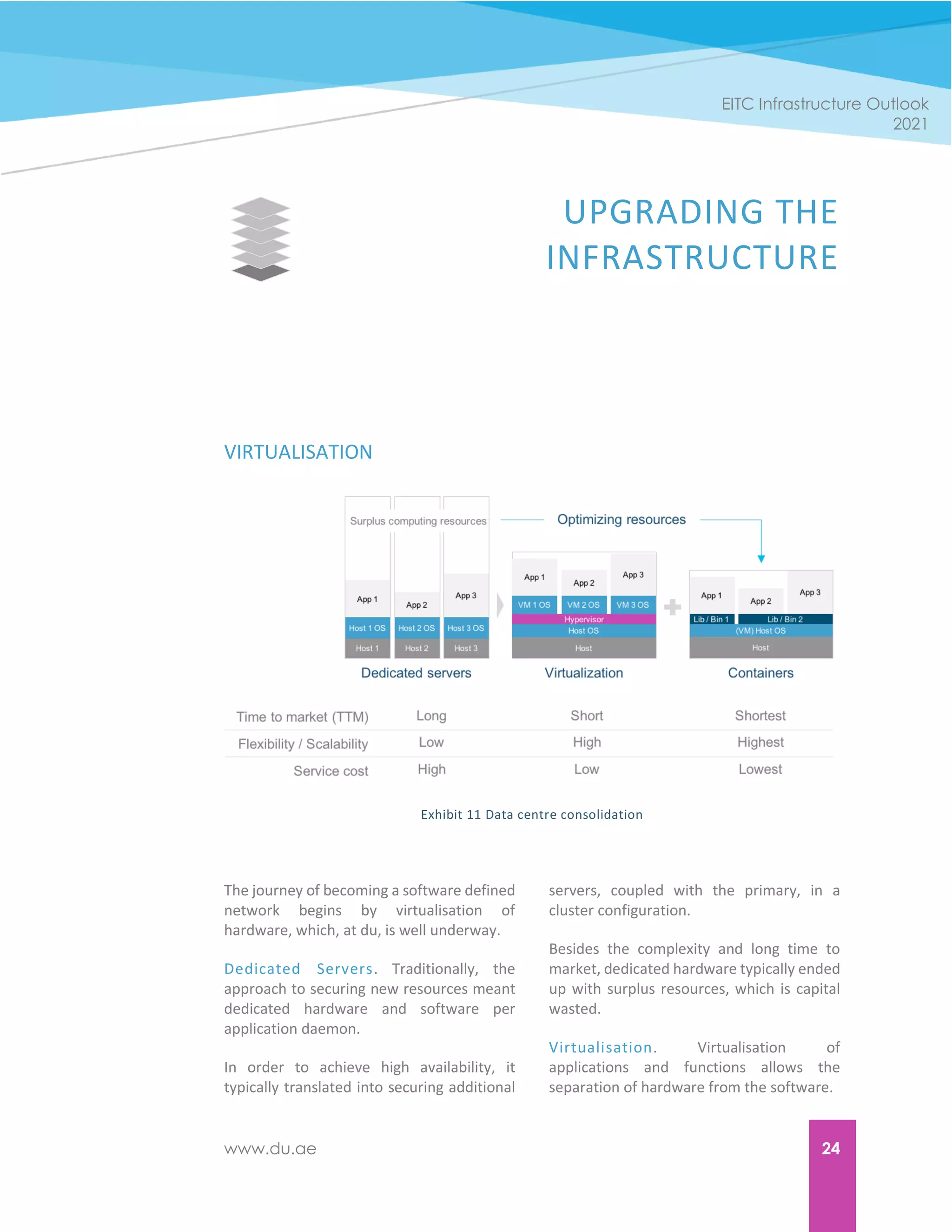
Exhibit 11 Data centre consolidation
The journey of becoming a software defined
network begins by virtualisation of
hardware, which, at du, is well underway.
Dedicated Servers. Traditionally, the
approach to securing new resources meant
dedicated hardware and software per
application daemon.
In order to achieve high availability, it
typically translated into securing additional
servers, coupled with the primary, in a
cluster configuration.
Besides the complexity and long time to
market, dedicated hardware typically ended
up with surplus resources, which is capital
wasted.
Virtualisation. Virtualisation of
applications and functions allows the
separation of hardware from the software.
www.du.ae 25
EITC Infrastructure Outlook
2021
All hardware resources can be pooled into a
uniform platform, in cloud, whereas the
differences across functionalities and
applications are transferred over into the
software domain.
The introduction of Hypervisor allowed
handling of single or multiple physical
servers and present these as multiple virtual
servers to the virtual machine’s OS. It
enables rapid scaling of the number and size
of servers deployed.
Containers – Encapsulating server
application workloads in containers
together with stripped down set of, needed
only, OS libraries reduces the resource
overhead.
It also makes the migration of the services
workload easy and rapid. Containers
technology drives virtualisation much
further and used in combination for
flexibility and higher availability of the
infrastructure
NETWORK FUNCTIONS VIRTUALISATION (NFV)
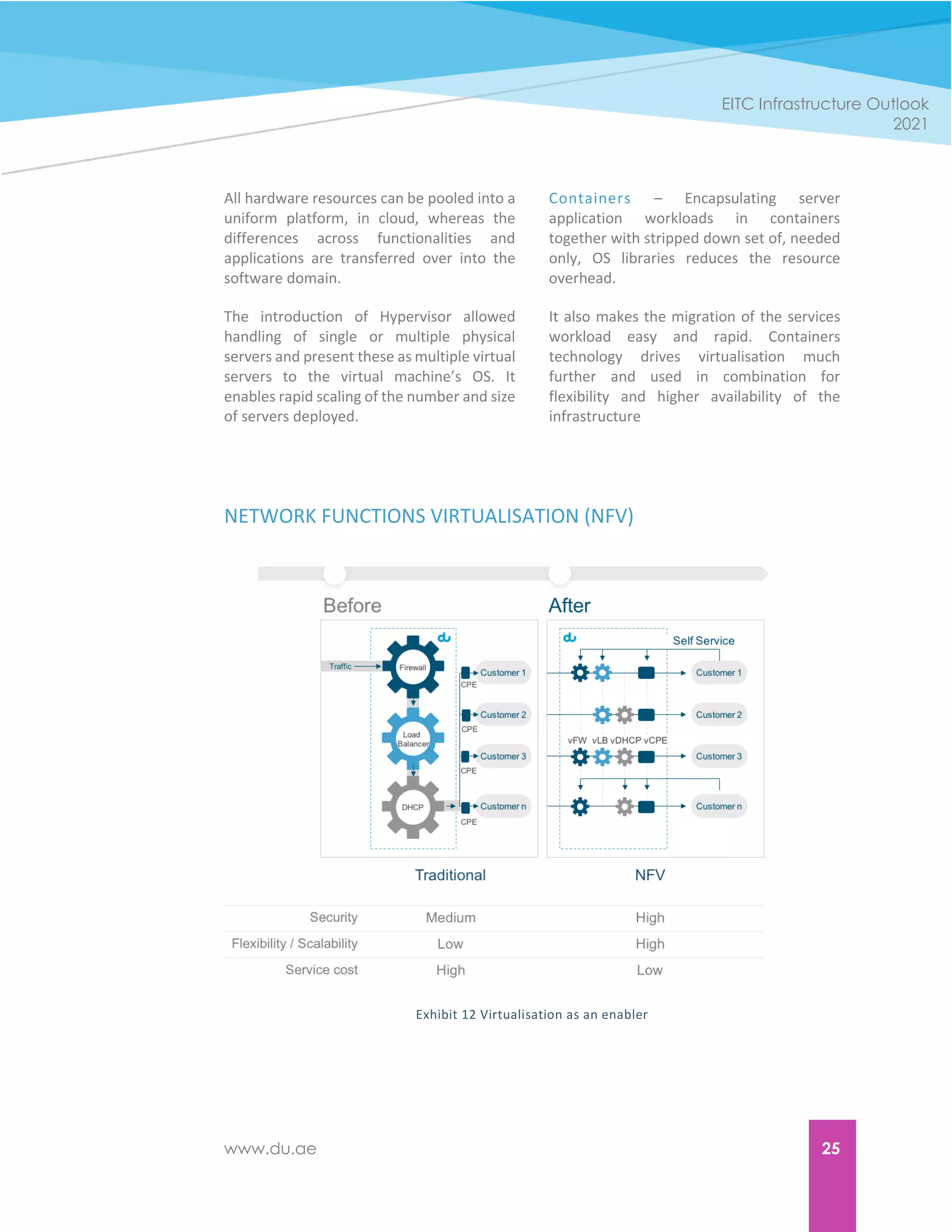
Exhibit 12 Virtualisation as an enabler
www.du.ae 26
EITC Infrastructure Outlook
2021
NFV. Virtualisation as a concept was an
enabler for the development of network
functions virtualisation and micro services.
Traditionally, one big data centre dedicated-
device would filter the traffic for the various
customers, behind a single firewall. It was
administrated centrally by operations
engineers, who needed specific knowledge
in firewall management. Those large
firewalls were usually procured in advance
and would usually be underutilized.
Using virtualisation and installing firewall
software in one of the virtual machines
makes it easy to spin-up a new small firewall
at any time a customer asks for one.
With dedicated firewall for each customer,
it allows us to expose it to the customer for
self-management through the self-care UI.
This is possible without the risk of impacting
other users and their firewall functionality.
In case the firewall needs scaling of
infrastructure resources, hypervisor delivers
it transparently, in the real time.
Similarly, many other network functions can
be virtualised, such as load balancer,
intrusion detection and prevention, address
management, customer premises
equipment, packet core, etc.
Micro Services. With utilisation of
containers, NFVs can be disaggregated into
even smaller functional parts and chained
together into completely new network
function only when needed.
Network Function Virtualisation is the
underlying layer for the introduction of
automation.
AUTOMATION AND ORCHESTRATION
Automation enables du into becoming a
software defined service provider. It brings
real-time, faultless control of provisioning
and management of services.
Automation helps adopt a programmable
orchestration framework that accelerates
time to market with minimum intervention.
Moreover, it transcends into customer
experiences, such as deflection of customer
service to self-service.
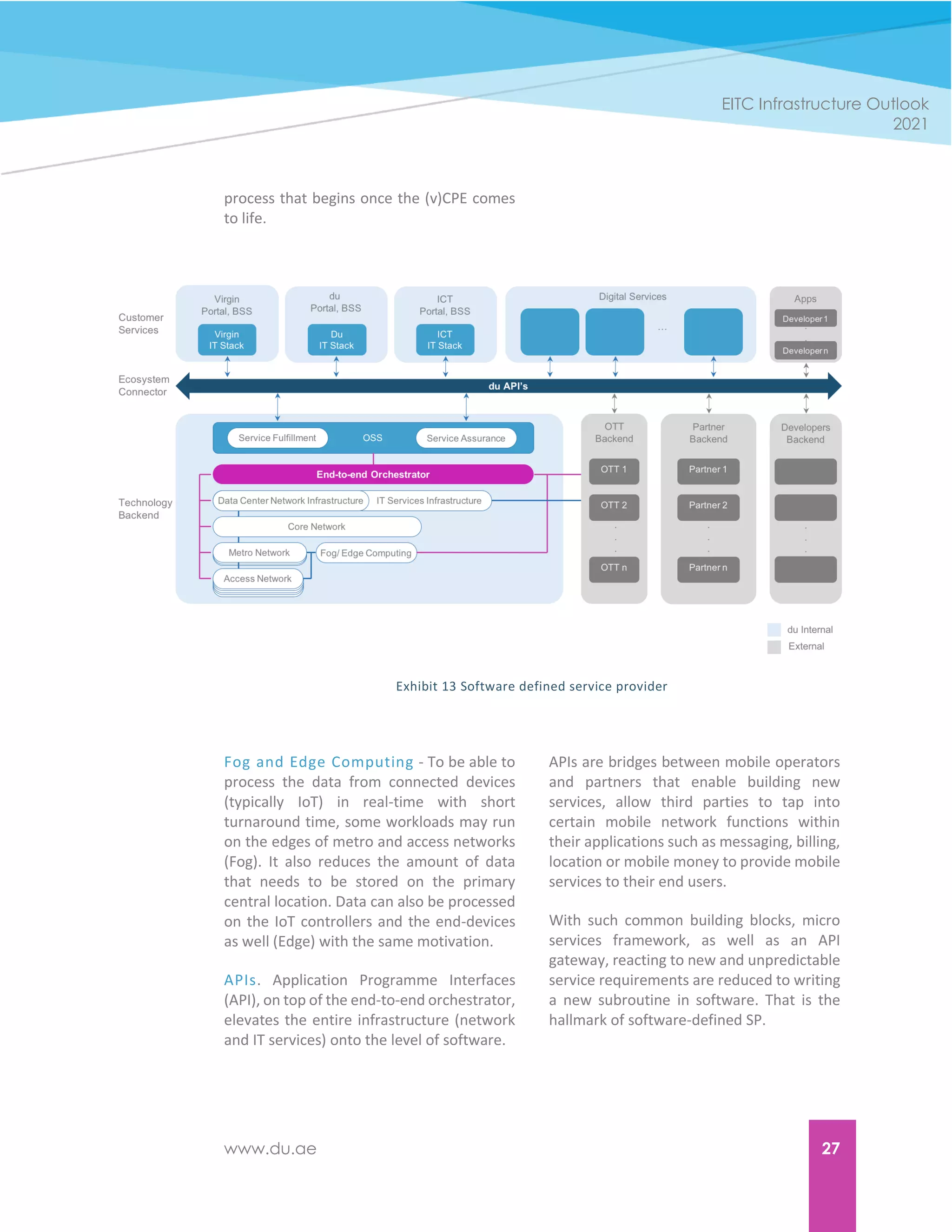
Orchestrator. The end-to-end
orchestrator is the abstraction layer
between the business and operations
support systems (BSS & OSS). It can ‘speak’
both the language of the infrastructure as
well as the BSS and OSS. The end-to-end
orchestrator, in turn uses, sub-orchestrators
to talk to all the infrastructure elements -
both on the network and applications. It is
also capable of provisioning and managing
over-the-top (OTT) providers of
infrastructure and applications, creating
customer specific service chains [Exhibit 13].
Zero Touch. ‘Zero-touch provisioning’ is a
term usually used to refer to the process of
provisioning, e.g. a Customer-premises
equipment (CPE) without a technician on-
site.
Provisioning is done using the orchestrator
to push the configuration on to the devices
or their NFVs as part of an automated
www.du.ae 27
EITC Infrastructure Outlook
2021
process that begins once the (v)CPE comes
to life.
Exhibit 13 Software defined service provider
Fog and Edge Computing - To be able to
process the data from connected devices
(typically IoT) in real-time with short
turnaround time, some workloads may run
on the edges of metro and access networks
(Fog). It also reduces the amount of data
that needs to be stored on the primary
central location. Data can also be processed
on the IoT controllers and the end-devices
as well (Edge) with the same motivation.
APIs. Application Programme Interfaces
(API), on top of the end-to-end orchestrator,
elevates the entire infrastructure (network
and IT services) onto the level of software.
APIs are bridges between mobile operators
and partners that enable building new
services, allow third parties to tap into
certain mobile network functions within
their applications such as messaging, billing,
location or mobile money to provide mobile
services to their end users.
With such common building blocks, micro
services framework, as well as an API
gateway, reacting to new and unpredictable
service requirements are reduced to writing
a new subroutine in software. That is the
hallmark of software-defined SP.
www.du.ae 28
EITC Infrastructure Outlook
2021
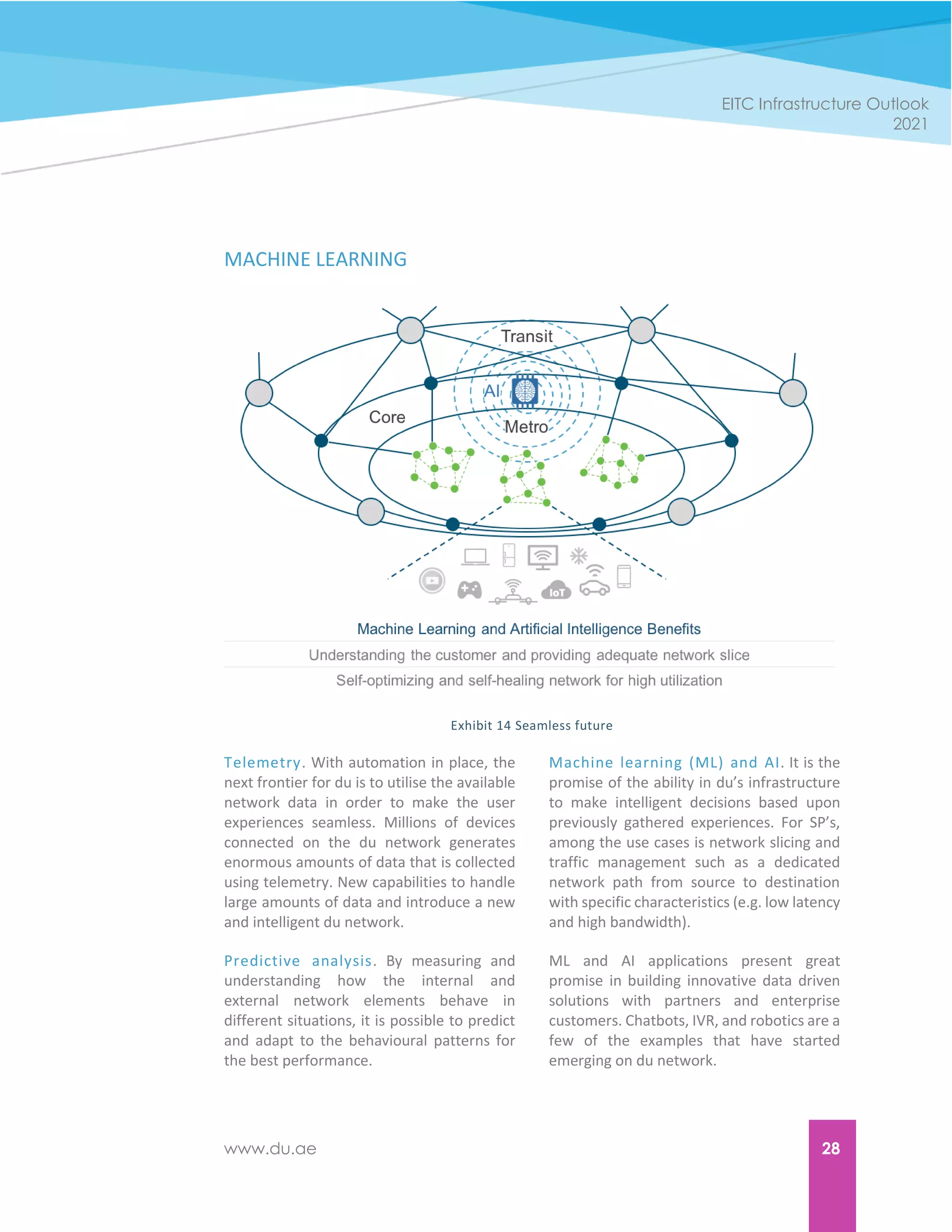
MACHINE LEARNING
Exhibit 14 Seamless future
Telemetry. With automation in place, the
next frontier for du is to utilise the available
network data in order to make the user
experiences seamless. Millions of devices
connected on the du network generates
enormous amounts of data that is collected
using telemetry. New capabilities to handle
large amounts of data and introduce a new
and intelligent du network.
Predictive analysis. By measuring and
understanding how the internal and
external network elements behave in
different situations, it is possible to predict
and adapt to the behavioural patterns for
the best performance.
Machine learning (ML) and AI. It is the
promise of the ability in du’s infrastructure
to make intelligent decisions based upon
previously gathered experiences. For SP’s,
among the use cases is network slicing and
traffic management such as a dedicated
network path from source to destination
with specific characteristics (e.g. low latency
and high bandwidth).
ML and AI applications present great
promise in building innovative data driven
solutions with partners and enterprise
customers. Chatbots, IVR, and robotics are a
few of the examples that have started
emerging on du network.
www.du.ae 29
EITC Infrastructure Outlook
2021
Seamless Future. Our journey does not
stop here, as there are new technologies on
the horizon that will disrupt the future and
make customer experience even more
natural.
www.du.ae 30
EITC Infrastructure Outlook
2021
CONCLUSION
Imagine a network infrastructure, where
whatever you plug into it, whether a device
or application like voice, gaming or
streaming, it adapts to provide the best
possible user experience and the best
available quality of service. Without the
need for special packages, the network is
smart enough to recognise the device and
application traffic and adapt
its behaviour accordingly.
For instance, video and voice
communication mandate low network
latency and real-time experience at the
expense of some traffic loss. On the other
hand, for streaming services like video or
live TV, the quality of sound and video is of
the essence. There should not be traffic loss,
whereas latency may be relaxed. Services
like high volume trading in financial
markets, real-time gaming, VR, or remote
surgery that demand very low network
latency, no traffic loss and high bandwidth.
A network that can recognise the user
application and in return be nimble in
providing the required end-to-end
experience is the winner. du is building the
winning network based on the premise that
every customer is different. We believe that
the network should be aware of the
customer applications and agile in adapting
without requiring the customer
to struggle with multiple packages and
endless options. Making the network
natural to use and transparent to the users
is our goal.
The road to such simplicity in the customer
experience is not a simple one. In order to
get from where we are today to where we
want to be for our customers in 2021, we
have embarked on a voyage in multiple
dimensions. du had to transform and will
keep transforming in order to be able to
lead the way.
We continue to stress that the change is the
only constant and du’s success equals the
success of its customers and the success of
our employees.
www.du.ae 31
EITC Infrastructure Outlook
2021
WORKS CITED
[1] The Economist, "The world’s most valuable resource is no longer oil, but data," 6 May
2017. [Online]. Available: https://www.economist.com/news/leaders/21721656-data-
economy-demands-new-approach-antitrust-rules-worlds-most-valuable-resource.
[2] M. Andreesen, "a16z Podcast: Software Programs the World," 10 06 2016. [Online].
Available: https://a16z.com/2016/07/10/software-programs-the-world/.
[3] Internet World Stats, "Internet Usage in the Middle East," 2017. [Online]. Available:
http://www.internetworldstats.com/stats5.htm. [Accessed 01 2018].
[4] Cisco, "Cisco Visual Networking Index: Forecast and Methodology, 2016–2021," 06 06
2017. [Online]. Available: https://www.cisco.com/c/en/us/solutions/collateral/service-
provider/visual-networking-index-vni/complete-white-paper-c11-481360.pdf.
[5] Kagan Industry Report, "On-demand: Video's present and future," S&P Global Market
Intelligence, 2017.
[6] M. Conway, "Conway's law," [Online]. Available:
https://en.wikipedia.org/wiki/Conway%27s_law.
www.du.ae 32
EITC Infrastructure Outlook
2021
CONTRIBUTION
THIS PAPER WAS JOINTLY DEVELOPED
BY DU AND CISCO TEAMS.

Eitc Infrastructure outlook 2021

  • 1.
    EITC Infrastructure Outlook 2021 Whitepaper| July 2018 www.du.ae A glimpse into du’s transformation journey towards being a software defined network in the digital era.
  • 2.
    www.du.ae 2 EITC InfrastructureOutlook 2021 Saleem AlBlooshi Emirates Integrated Telecommunications Company (EITC) Chief Infrastructure Officer “At du, from Emirates Integrated Telecommunications Company (EITC), we are working diligently towards bringing next generation technologies like 5G, IoT, AI and Blockchain into our network, which will power a new generation of solutions and services for our customers in the next five years. We've never been more excited in our decade-long journey of multiple evolutions as a company. Although evolution comes naturally to us at du, we're humble enough to recognise that the journey ahead will take more than what got us this far. The rate of new technology innovations, business models that thrive in ecosystems of partners, and going forward, a
  • 3.
    www.du.ae 3 EITC InfrastructureOutlook 2021 data-driven economy has made it imperative for us to undergo a digital transformation that not only impacts our technology infrastructure but the way we operate with agility to embrace the emerging new economic order.”
  • 4.
    www.du.ae 4 EITC InfrastructureOutlook 2021 Ali Amer Cisco Systems Managing Director, Global Service Provider Sales – Middle East and Africa “As the digital era continues to shift the paradigm for the telecom industry, new opportunities and challenges will emerge. Fast evolving digital technologies and user experiences are raising the bar for telecom service providers like du to transform themselves into ICT services providers of choice. Technology and architecture transformation come at the centre of establishing a new environment for service creation. This serves as the foundation upon which operators can deliver next-level experiences that enable them to not only adapt, but to thrive. As a technology leader, we are excited to partner with du to evolve their offerings to incorporate a wider gamut of digital lifestyle and enterprise offerings. du’s progressive vision and its drive for innovation for the future of communications in the UAE will power a world of new experiences for businesses and consumers.”
  • 5.
    www.du.ae 5 EITC InfrastructureOutlook 2021 CONTENT INTRODUCTION 7 NEED FOR CHANGE 8 Macro trends Drivers of change Evolution in business SYNCING UP WITH CUSTOMERS 10 Consumers Enterprise Government Internal TOOLING FOR CHANGE 155 Capabilities stack Transition journey REORGANISING OURSELVES 177 RECALIBRAINTING OUR MEASURES OF SUCCESS 19 Service Operations Development IT Evolution of KPI’s REORIENTING OUR PEOPLE 233 UPGRADING THE INFRASTRUCTURE 244 Virtualisation Network Functions Virtualisation (NFV) Automation and Orchestration Machine Learning CONCLUSION 30 WORKS CITED 31
  • 6.
    www.du.ae 6 EITC InfrastructureOutlook 2021 EXHIBITS EXHIBIT 1 DU'S STRATEGIC PILLARS AND TRANSFORMATION LAYERS 9 EXHIBIT 2 CONSUMER USE CASES FOR 5G 10 EXHIBIT 3 BUSINESS CUSTOMERS IN UAE 11 EXHIBIT 4 DU'S RECENT INITIATIVES IN MARKET 144 EXHIBIT 5 DU'S CAPABILITY STACK 155 EXHIBIT 6 DU'S TRANSITION JOURNEY 166 EXHIBIT 7 DU'S ORGANISATIONAL STRUCTURE 17 EXHIBIT 8 ELIMINATION OF MANUAL INTERVENTION 20 EXHIBIT 9 IMPACT OF AUTOMATION ON PROCESSES 20 EXHIBIT 10 DU'S EVOLUTION OF KPI'S 22 EXHIBIT 11 DATA CENTRE CONSOLIDATION 24 EXHIBIT 12 VIRTUALISATION AS AN ENABLER 255 EXHIBIT 13 SOFTWARE DEFINED SERVICE PROVIDER 277 EXHIBIT 14 SEAMLESS FUTURE 28
  • 7.
    www.du.ae 7 EITC InfrastructureOutlook 2021 INTRODUCTION Technology is hurtling into the future at ever higher speeds, and the pace only multiplies every two to five years. While consumers enjoy superior new experiences and value from new digital products, a great many industries have been disrupted, leaving a trail of iterated business models and new value chains. For businesses, change is the only constant and the successful ones have to innovate incessantly to stay in the game. They have to be nimble to adapt their organisations, and preferably lead the change in their industry. Telecom service providers are not unique in that regard, where many are riding the change curve at its leading edge. du is in the midst of such a digital transformation. In this paper, we present infrastructure technologies that du is investing in, such as virtualisation, automation, big-data and artificial intelligence (AI). These are laying the foundation of what would prepare us to embrace the change anticipated in the next five years. This paper does not cover the actual digital services and applications, instead we focus on the foundational infrastructure that makes standing up these possible. In the following sections, we present this transformation journey at du, in a unifying context of market drivers, service capabilities, as well as operational and organisational change that works in unison with the underlying technology infrastructure transformation.
  • 8.
    www.du.ae 8 EITC InfrastructureOutlook 2021 NEED FOR CHANGE MACRO TRENDS We recognise a few large-scale trends in computing and micro-processors that are impacting nearly every industry. Explosion in computing. A consistent drop in cost of computing is driving an order of magnitude change in the scale of computing solutions and ubiquity of connected devices. As a result, cloud computing and IoT are changing the landscape of digital services in addition to powerful smartphones in every hand. Explosion of data. Computing everywhere is generating data at unprecedented levels, for information mining, with AI techniques. Economics of data are much different than those of legacy businesses, where business models are bring re-imagined with digital and data- driven offerings. Data is the ‘new oil’ [1]. Software is continuing to eat the world [2]. Baseline complexities and costs of physical assets and manual processes are being eliminated by shift of functions to software. Digital innovations are collapsing industry barriers, making cross-functional products and services possible, and mashing up previously segregated markets and industries. Every physical object can potentially get networked and be programmed. DRIVERS OF CHANGE Global Internet users’ penetration is reaching 50%, and just above 90% in the UAE [3]. Globally, Internet traffic is expected to grow 3.2-fold from 2016 to 2021, a compound annual growth rate of 26%. Whereas mobile data traffic will grow 7-fold over the same period. The Internet-of-Things (IoT) is shifting connectivity from end-user devices to machine-to-machine (M2M) connections. M2M modules will account for 51% of all networked devices in 2021. 43% of all networked devices will be mobile- connected, of which smartphones will account for half. [4]. Service providers (SP), around the world, are witnessing drivers of change that are forcing them to adapt accordingly. Pressures on revenue. Cost per bit does not match the growth in bandwidth. Legacy SP’s struggle as they mostly compete on the services layer ‘at connectivity terms’! Shift of value in ICT industry. OTTs are capturing bigger share of value away from
  • 9.
    www.du.ae 9 EITC InfrastructureOutlook 2021 SPs with richer services and experiences. OTT attack SP services as loss leaders to grow their core business - ecommerce, advertising, streaming. Customers have greater expectations. Customer expectations are evolving at Internet speeds with continuous introductions of newer digital experiences and services from global OTT players. Always connected, and everywhere, digital consumption is expanding faster in newer dimensions of ‘augmented’ and ‘virtual reality’. Technology and digital experiences for customers are raising the bar for SP’s to transform into Digital Services Providers. EVOLUTION IN BUSINESS Expanding to digital services. telecom service providers are evolving offerings beyond traditional connectivity services to a wider gamut of digital services. Driving for operating agility. Most are redesigning for efficiency and rapid adaptation to market shifts, leveraging technologies like virtualisation to shift HW to SW. ‘It's not the big that eat the small, it's the fast that eat the slow’. Engage in ecosystems play. It is becoming imperative to play in new sectors or compete in new digital ways. Rapidly introducing new services within an ecosystem of partners by building enablers for collaboration. du is evolving beyond a traditional telco into an ICT service provider. In its journey since birth, du has endeavoured to delight customers with simplicity and breakthrough experiences across its three major customer categories: 1) Individual consumers, 2) Business customers, and 3) Government. du maintains its focus with key strategic pillars in driving change – a seamless customer experience across channels, innovative services and solutions, and agility in operations. There is a fourth element of ‘continuous innovation’ that renews the perpetual momentum needed behind each pillar [Exhibit 1]. du’s digital transformation runs across the various layers of the company, and is guided by these pillars of success. In the following sections, we shall go through these layers to lay out changes in each and how they are all connected. Exhibit 1 du's strategic pillars and transformation layers
  • 10.
    www.du.ae 10 EITC InfrastructureOutlook 2021 SYNCING UP WITH CUSTOMERS CONSUMERS Ultra-performance. Smartphones have become intertwined with our lives in countless ways, but there is a wide set of new use cases that are driving the need for new service capabilities for du which becomes the basis for accelerated deployment of 5G [Exhibit 2]. As an example, video consumption is rapidly evolving from linear to on-demand, with higher interactivity in content. Consumers demand for unified user interface (UI) across devices as wells as intuitive ways of integrating external OTT services [5]. Globally, mobile video traffic is estimated to reach 79% of total mobile data traffic in 2021, compared to 60% at the end of 2016 [4]. Gaming related Internet traffic is expected to grow 10-fold from 2016 to 2021. Multi-channel support. Consumers expect uniform service experience and continuity in interaction across channels. Single sign-on across services portfolio, high degree of interactivity and personalisation are among table stakes. Exhibit 2 Consumer use cases for 5G
  • 11.
    www.du.ae 11 EITC InfrastructureOutlook 2021 ENTERPRISE Customer expectations In the Business sector, customer expectations mirror those of consumer apps. End users in enterprise are demanding consumer-quality in product experiences. Exhibit 3 Business customers in UAE  Service Scaling. They want the flexibility to deal with variance in operations and demands, with particular seasonality in Dubai market [Exhibit 3].  Cost Efficiency. Our customers want the flexibility to scale consumption of services as-needed, with payments on a pay-as-you-go basis that reflect the usage models. Shift from CapEx to OpEx model for better cost control.  Transparency. Customers expect to have greater control of their own product, service or brand experience, not only to customise product features but also necessary tools and information to resolve issues.  Ease in management of moves, adds, changes and deletes. Monitor usage of services, bandwidth, congestion, etc.  Managed services. Move business workloads and data to hosted private cloud. Businesses, in our market, look to outsource non-core operations and focus on their strengths with managed services.  Security. More applications mean more vulnerabilities. Which brings security among the top explicit asks from customers, where risk management of hacking and ransomware are top concerns.  Reliability. There is expectation of high availability of service with zero downtime. 5 times as many visitors, as resident population, visit Dubai during the tourism season. This creates a need for flexibility in usage of resources to serve the seasonality. 72% customers express interest in VMS, where all or some of the capabilities delivered by CPE are delivered either fully or hybrid cloud solutions. 88% of business customers surveyed want a bundled security service with network service. Source: Cisco Survey of MEA enterprise customers in 2017
  • 12.
    GOVERNMENT du is alsocommitted to supporting government infrastructure services towards the UAE vision 2021, a key partner in the smart city initiative [Exhibit 4]. Customer Expectations  Bespoke Services. du is a strategic UAE government partner for providing futuristic services  Security. Government solutions have the highest demands to ensure the security of citizen’s data. Service capabilities  Managed Services  Data Security INTERNAL Internal platform innovation is a key stakeholder for setting the agenda for new revenue opportunities and readiness for future solutions and applications. Expectations Following is a list of prominent needs that are high on setting the agenda for digital services.  Data Driven Insights. Digital sense, AR.  Chatbot and other A.I based applications across the services portfolio.  Developer and Partner Ecosystem. Bringing openness to partners and customers faster partner on-boarding and service creation with partners.  Streamlining customer experience. Centralisation of API repository and capabilities for holistic view of services. Service capabilities These translate into an advanced set of capabilities that are expected to support advanced new solutions of the future.  Open API GW  Big Data, analytics  Artificial Intelligence  Machine Learning (ML)  Deep Machine Learning
  • 13.
    www.du.ae 13 EITC InfrastructureOutlook 2021 Smart City UAE Vision 2021 du is committed to supporting the government in its journey of enhancing the lives of people in the UAE in meaningful and engaging ways, using technology and innovation. Leveraging du’s fibre optic network infrastructure and high-speed wireless internet, du launched “WiFi UAE”, a country-wide initiative to provide WiFi access to the public, in line with UAE Vision 2021. Smart City As the strategic partner for the Smart Dubai Platform, du brings a thorough know-how of Dubai’s landmark approach to smart cities, exemplified by the company’s ongoing smart city initiatives, continuing investment in smart infrastructure and long-standing support of entrepreneurship and fostering innovation. The Smart Dubai Platform will significantly enhance real-time and data-driven decision making capabilities for the city government, enabling city leaders to engage in community-wide dialogues and analyse rich city data across multiple dimensions. The Platform will also enable the continued enhancement of existing smart initiatives and services through data-driven analysis and innovation. The Smart Dubai Platform will become an essential asset for Dubai’s economic growth and diversification, stimulating the high-tech sector in domains such as big data, data analytics, cloud services, and IoT, to drive value for governments, private sector and individuals. Local high-tech talent and job skill development will also increase in response to the developing market.
  • 14.
    www.du.ae 14 EITC InfrastructureOutlook 2021 Chatbot Artificial intelligence-powered messaging platform In partnership with Dubai Future Accelerators, du will integrate its partner's (UIB) AI messaging capabilities in its network. Customers will be able to communicate with du’s customer care and services, devices in their smart homes and offices via text and/or voice messaging on the channels of their choice like WhatsApp, Facebook Messenger, etc. Virtual Reality 360-degree live video In partnership with Dubai Silicon Oasis Authority, du will integrate its partner's (360VUZ) award winning virtual reality and 360-degree live video library of content. Source: du press release Exhibit 4 du's recent initiatives in market
  • 15.
    www.du.ae 15 EITC InfrastructureOutlook 2021 TOOLING FOR CHANGE CAPABILITIES STACK Combining the service capabilities identified in the previous section across customer segments, we layer them over the transformation layers to build the ‘stack of capabilities’ across the transformation layers. In the following sections of this paper, we discuss the technology enablers in detail, shown here in [Exhibit 5], as the foundational layer. We will also discuss the capabilities in the operations, organisation and people domain accordingly. Exhibit 5 du's capability stack
  • 16.
    www.du.ae 16 EITC InfrastructureOutlook 2021 TRANSITION JOURNEY While there is urgency to prepare for new services with technology enablers shown [Exhibit 5], du cannot lose focus on the stability and continuity of existing businesses. The transition to a software defined service provider is gradual. This ‘upgrade’ is a transition journey for du, into becoming a software defined service provider by gradually introducing these new tech capabilities identified over the next two to three years. Most significantly, we envision two co- existing platforms that will live over this period, where the old will gradually give way to the new paradigm [Exhibit 6]. Moving from a dedicated infrastructure to a shared one (convergent SP cloud) for all network and IT functions will be done in phases. Some services will be virtualised and migrated to the new cloud. Others will reach the end of life. Finally, numerous new services will be introduced and hosted on the new platform. The duality exists not only in infrastructure and technologies, but operations as well. We are building agility without overshadowing existing businesses, by adapting both simultaneously and iteratively. As an example, the duality necessitates a ‘mode-1’ and ‘mode-2’ for IT to deliver for both legacy waterfall approach and DevOps (agile) approach simultaneously. Product Lifecycle Management (PLM) has to manage both the traditional with our legacy model of operating along with the ‘fast track’ that has elements like DevOps, automated testing on datasets for security vulnerabilities and consistency. Exhibit 6 du's transition journey
  • 17.
    www.du.ae 17 EITC InfrastructureOutlook 2021 REORGANISING OURSELVES The right organisational design is the first step for intended operations and processes. As Conway’s law [6] indicates, an organisation ends up producing designs whose structure is a copy of the organisation's communication structure. du intends to reinvent the processes and culture that drives the operations to a more agile environment that is abreast with software development and DevOps. The new organisation [Exhibit 7] focusses on harmonising the infrastructure as a single business unit that serves all businesses within the ETIC. Exhibit 7 du's organisation structure BEFORE AFTER Network IT Product / offer Operations infrastructure Product / offer Operations infrastructure Horizontal and Converged Infrastructure Connectivity Solutions Adjacent ICT Solutions Digital and Life Style Digital Mobile Services
  • 18.
    www.du.ae 18 EITC InfrastructureOutlook 2021 Focussed business focus. du has reorganised and elevated ICT (managed services) and digital lifestyle and innovation for focus in business segments and enhanced delivery of experiences to customers. Addition of new services. The organisation is built to evolve with new services and solutions categories leveraging uniform platforms to scale. An integrated infrastructure. A single organisation to serve various business units with one integrated, converged and horizontal infrastructure fabric for operational efficiency and scaling. A unified organisation helps in freeing up operational silos of the past and brings contextual awareness across the organisation and helps it react with agility to market and customer demands. The intention is to de- couple the infrastructure layer from the services for enhanced level of stability and continuity. Abstraction of underlying network and separating it from service delivery accommodates the use of software development methodologies like Agile and DevOps, widely embraced by web services companies as way to speed up service delivery. .
  • 19.
    www.du.ae 19 EITC InfrastructureOutlook 2021 RECALIBRAINTING OUR MEASURES OF SUCCESS SERVICE OPERATIONS Service operations form the bedrock for agility, which is a combination of flexibility and stability. There is a de-coupling of a dedicated platform team from business and services teams to create platform and infrastructure as a service. For a nuanced sensing of market direction, rapid reaction, and a more unified approach to implementation, we are driving a cultural shift from idea generation to rollout based on DevOps practices to support continuous improvement in a changing environment Drivers for Service Operations  Being service oriented. Focus on being ‘service oriented’ percolates down into its measure of success. KPIs like ‘Node Availability’ have been replaced by ‘end- to-end service availability’.  Scaling efficiently. Capacity expansion and change has been accelerated with COTS hardware additions at demand, with no vendor lock-ins.  Reduced time to market. With ‘one infrastructure’, there is reduction in time variance, effort and processes. It also helps in elimination of procurement of custom hardware, physical installations, and configuration of corresponding software.  Stability. Support telco grade assurance levels. Ensure that existing KPI’s are not downgraded upon introduction of new services.
  • 20.
    www.du.ae 20 EITC InfrastructureOutlook 2021 Exhibit 8 Elimination of manual intervention Automation will minimise the manual steps leading to greater speed and precision [Exhibit 8]. The benefits of change are perceived across operating areas [Exhibit 9], which are quantitative measures of bringing about agility. Apart from the obvious speed in delivery and reduction in manual errors, the benefits go as far as elevation of people’s role in the organisation by freeing up the engineering talent, which is now applied instead to more advanced next generation technologies and applications and solutions design. Exhibit 9 Impact of automation on processes
  • 21.
    www.du.ae 21 EITC InfrastructureOutlook 2021 DEVELOPMENT IT The operations in ‘Development IT’ have evolved in agenda as well as culture. Among the significant changes, is the rise of IT into product creation role. IT has grown beyond traditional OSS and BSS functions, to support ‘non-telco’ services like smart cities, smart homes and digital service. It has evolved in function to play a more proactive role in product creation within ‘Digital Lifestyle’ and ’Innovation’ businesses. Key Drivers  Multiple channel support. Support rich diversity of channels that bring in customers across applications and businesses touch points. A ‘channel strategy’ focuses on various channels and programs for unification of customer experience across channels.  Lower Cost to Launch Products. Lower the cost for infrastructure (e.g. services that require products at customer site).  Reduce Time to Market. Reduce time from idea generation to product launch, across project categories: (1) Business driven projects; (2) Standard IT including upgrade, transformation items, or revamp internal apps; (3) New technology capabilities that enable offer management to bring new offers to market.  Technology Adoption. Keep pace with emerging technologies and trends that are being adopted in industry for Telco infrastructure evolution as well as readiness for emerging digital services. Product Lifecycle Management This layer is seen as the enabler to reduce the time to market of new commercial services via a reusable and flexible solution design For the new digital services product creation, we’ve changed the way we maintain products catalogues and handle commercial orders across all lines of businesses with following benefits: Centralised Product Catalogue (CPC)  Improved time to market to provide faster responses to market opportunities and competition.  Enhanced visibility on existing product portfolios, better governance and control over product portfolios to ensure compliance and increased performance.  Automate product life cycle management process.  Reduce cost of supporting products and ability to modify existing product attributes rapidly. Commercial Order Management (COM) The purpose of the unified Customer Order Management layer is to increase the effectiveness of the order orchestration capability for fixed and mobile service provisioning.  Enables a catalogue driven order fulfilment process.  Provides end-to-end service guarantees for purposes of improving customer experience
  • 22.
    www.du.ae 22 EITC InfrastructureOutlook 2021  Reduces provisioning complexities and gives a mechanism to gracefully integrate and manage orders between multiple systems.  It presents a consistent and unified view to the business support applications whilst using a unique framework to introduce efficiency in managing and orchestrating convergent or bundled offers and the operations and maintenance of the platform. EVOLUTION OF KPIS There is a significant improvement factor of traditional KPIs driven by underlying technology evolution and DevOps operation in measures such as time to market, provisioning and activation, trouble tickets and faults. There is also the emergence of new KPI’s [Exhibit 10] that reflect new services and an ‘internet services’ paradigm – customer satisfaction, agility, innovation, self service provisioning, deflection to self-serving channel, self-care du App usage, new revenue generated, new applications using big-data and mashups, and external API usage. Exhibit 10 du's evolution of KPI's
  • 23.
    www.du.ae 23 EITC InfrastructureOutlook 2021 REORIENTING OUR PEOPLE du’s employees are evolving with new ways of operating powered by automation. New skills in analytics, software, and DevOps are being adopted to step up the speed and scale of change. There are emerging roles with more diverse set of digital product owners and agile-implementation guides. We aspire to change the culture where we can relentlessly test and learn, launch early prototypes, and refine results in real time— cutting down the development time in some sectors from several months to a few days. As part of adopting DevOps processes, tools that allow to standardize and automate deployment and configuration of servers and applications such as container technologies, like Docker, and container orchestration and scheduling tools such as Kubernetes. It simplifies software development process, improves consistency between testing and production environments, as well as reduce complexity of managing and updating apps due to a more modular approach. Culture. New organisational culture of DevOps is breaking existing silos and shift to a “software-centric” mentality. An innovation mentality, which is enabled in part by the ability to launch services in beta, test “on-the-fly,” and iterate fast. Roles and Responsibilities. People are evolving to next generation roles as they free up from legacy middleware installation and hardware configuration. There is an extended influence of IT in operations support, fulfilment, assurance and billing processes. Skills. There is a merging and elevation of skillsets. Software engineers and network engineers to become IT generalists. For example, re-skilling of a Network SME from legacy network engineer into an SDN & NFV expert.
  • 24.
    www.du.ae 24 EITC InfrastructureOutlook 2021 UPGRADING THE INFRASTRUCTURE VIRTUALISATION Exhibit 11 Data centre consolidation The journey of becoming a software defined network begins by virtualisation of hardware, which, at du, is well underway. Dedicated Servers. Traditionally, the approach to securing new resources meant dedicated hardware and software per application daemon. In order to achieve high availability, it typically translated into securing additional servers, coupled with the primary, in a cluster configuration. Besides the complexity and long time to market, dedicated hardware typically ended up with surplus resources, which is capital wasted. Virtualisation. Virtualisation of applications and functions allows the separation of hardware from the software.
  • 25.
    www.du.ae 25 EITC InfrastructureOutlook 2021 All hardware resources can be pooled into a uniform platform, in cloud, whereas the differences across functionalities and applications are transferred over into the software domain. The introduction of Hypervisor allowed handling of single or multiple physical servers and present these as multiple virtual servers to the virtual machine’s OS. It enables rapid scaling of the number and size of servers deployed. Containers – Encapsulating server application workloads in containers together with stripped down set of, needed only, OS libraries reduces the resource overhead. It also makes the migration of the services workload easy and rapid. Containers technology drives virtualisation much further and used in combination for flexibility and higher availability of the infrastructure NETWORK FUNCTIONS VIRTUALISATION (NFV) Exhibit 12 Virtualisation as an enabler
  • 26.
    www.du.ae 26 EITC InfrastructureOutlook 2021 NFV. Virtualisation as a concept was an enabler for the development of network functions virtualisation and micro services. Traditionally, one big data centre dedicated- device would filter the traffic for the various customers, behind a single firewall. It was administrated centrally by operations engineers, who needed specific knowledge in firewall management. Those large firewalls were usually procured in advance and would usually be underutilized. Using virtualisation and installing firewall software in one of the virtual machines makes it easy to spin-up a new small firewall at any time a customer asks for one. With dedicated firewall for each customer, it allows us to expose it to the customer for self-management through the self-care UI. This is possible without the risk of impacting other users and their firewall functionality. In case the firewall needs scaling of infrastructure resources, hypervisor delivers it transparently, in the real time. Similarly, many other network functions can be virtualised, such as load balancer, intrusion detection and prevention, address management, customer premises equipment, packet core, etc. Micro Services. With utilisation of containers, NFVs can be disaggregated into even smaller functional parts and chained together into completely new network function only when needed. Network Function Virtualisation is the underlying layer for the introduction of automation. AUTOMATION AND ORCHESTRATION Automation enables du into becoming a software defined service provider. It brings real-time, faultless control of provisioning and management of services. Automation helps adopt a programmable orchestration framework that accelerates time to market with minimum intervention. Moreover, it transcends into customer experiences, such as deflection of customer service to self-service. Orchestrator. The end-to-end orchestrator is the abstraction layer between the business and operations support systems (BSS & OSS). It can ‘speak’ both the language of the infrastructure as well as the BSS and OSS. The end-to-end orchestrator, in turn uses, sub-orchestrators to talk to all the infrastructure elements - both on the network and applications. It is also capable of provisioning and managing over-the-top (OTT) providers of infrastructure and applications, creating customer specific service chains [Exhibit 13]. Zero Touch. ‘Zero-touch provisioning’ is a term usually used to refer to the process of provisioning, e.g. a Customer-premises equipment (CPE) without a technician on- site. Provisioning is done using the orchestrator to push the configuration on to the devices or their NFVs as part of an automated
  • 27.
    www.du.ae 27 EITC InfrastructureOutlook 2021 process that begins once the (v)CPE comes to life. Exhibit 13 Software defined service provider Fog and Edge Computing - To be able to process the data from connected devices (typically IoT) in real-time with short turnaround time, some workloads may run on the edges of metro and access networks (Fog). It also reduces the amount of data that needs to be stored on the primary central location. Data can also be processed on the IoT controllers and the end-devices as well (Edge) with the same motivation. APIs. Application Programme Interfaces (API), on top of the end-to-end orchestrator, elevates the entire infrastructure (network and IT services) onto the level of software. APIs are bridges between mobile operators and partners that enable building new services, allow third parties to tap into certain mobile network functions within their applications such as messaging, billing, location or mobile money to provide mobile services to their end users. With such common building blocks, micro services framework, as well as an API gateway, reacting to new and unpredictable service requirements are reduced to writing a new subroutine in software. That is the hallmark of software-defined SP.
  • 28.
    www.du.ae 28 EITC InfrastructureOutlook 2021 MACHINE LEARNING Exhibit 14 Seamless future Telemetry. With automation in place, the next frontier for du is to utilise the available network data in order to make the user experiences seamless. Millions of devices connected on the du network generates enormous amounts of data that is collected using telemetry. New capabilities to handle large amounts of data and introduce a new and intelligent du network. Predictive analysis. By measuring and understanding how the internal and external network elements behave in different situations, it is possible to predict and adapt to the behavioural patterns for the best performance. Machine learning (ML) and AI. It is the promise of the ability in du’s infrastructure to make intelligent decisions based upon previously gathered experiences. For SP’s, among the use cases is network slicing and traffic management such as a dedicated network path from source to destination with specific characteristics (e.g. low latency and high bandwidth). ML and AI applications present great promise in building innovative data driven solutions with partners and enterprise customers. Chatbots, IVR, and robotics are a few of the examples that have started emerging on du network.
  • 29.
    www.du.ae 29 EITC InfrastructureOutlook 2021 Seamless Future. Our journey does not stop here, as there are new technologies on the horizon that will disrupt the future and make customer experience even more natural.
  • 30.
    www.du.ae 30 EITC InfrastructureOutlook 2021 CONCLUSION Imagine a network infrastructure, where whatever you plug into it, whether a device or application like voice, gaming or streaming, it adapts to provide the best possible user experience and the best available quality of service. Without the need for special packages, the network is smart enough to recognise the device and application traffic and adapt its behaviour accordingly. For instance, video and voice communication mandate low network latency and real-time experience at the expense of some traffic loss. On the other hand, for streaming services like video or live TV, the quality of sound and video is of the essence. There should not be traffic loss, whereas latency may be relaxed. Services like high volume trading in financial markets, real-time gaming, VR, or remote surgery that demand very low network latency, no traffic loss and high bandwidth. A network that can recognise the user application and in return be nimble in providing the required end-to-end experience is the winner. du is building the winning network based on the premise that every customer is different. We believe that the network should be aware of the customer applications and agile in adapting without requiring the customer to struggle with multiple packages and endless options. Making the network natural to use and transparent to the users is our goal. The road to such simplicity in the customer experience is not a simple one. In order to get from where we are today to where we want to be for our customers in 2021, we have embarked on a voyage in multiple dimensions. du had to transform and will keep transforming in order to be able to lead the way. We continue to stress that the change is the only constant and du’s success equals the success of its customers and the success of our employees.
  • 31.
    www.du.ae 31 EITC InfrastructureOutlook 2021 WORKS CITED [1] The Economist, "The world’s most valuable resource is no longer oil, but data," 6 May 2017. [Online]. Available: https://www.economist.com/news/leaders/21721656-data- economy-demands-new-approach-antitrust-rules-worlds-most-valuable-resource. [2] M. Andreesen, "a16z Podcast: Software Programs the World," 10 06 2016. [Online]. Available: https://a16z.com/2016/07/10/software-programs-the-world/. [3] Internet World Stats, "Internet Usage in the Middle East," 2017. [Online]. Available: http://www.internetworldstats.com/stats5.htm. [Accessed 01 2018]. [4] Cisco, "Cisco Visual Networking Index: Forecast and Methodology, 2016–2021," 06 06 2017. [Online]. Available: https://www.cisco.com/c/en/us/solutions/collateral/service- provider/visual-networking-index-vni/complete-white-paper-c11-481360.pdf. [5] Kagan Industry Report, "On-demand: Video's present and future," S&P Global Market Intelligence, 2017. [6] M. Conway, "Conway's law," [Online]. Available: https://en.wikipedia.org/wiki/Conway%27s_law.
  • 32.
    www.du.ae 32 EITC InfrastructureOutlook 2021 CONTRIBUTION THIS PAPER WAS JOINTLY DEVELOPED BY DU AND CISCO TEAMS.