HUAWEITECHNOLOGIES CO., LTD. All rights reserved
www.huawei.com
Internal
OWA200002
WCDMA RAN Basic
Principle
ISSUE1.0
HUAWEITECHNOLOGIES CO., LTD. Page 2All rights reserved
Chapter 1 Radio Transmission EnvironmentChapter 1 Radio Transmission Environment
Chapter 2 CDMA FundamentalChapter 2 CDMA Fundamental
Chapter 3 Performance Enhancement MethodsChapter 3 Performance Enhancement Methods
Chapter 4 WCDMA FDD ModeChapter 4 WCDMA FDD Mode
HUAWEITECHNOLOGIES CO., LTD. Page 3All rights reserved
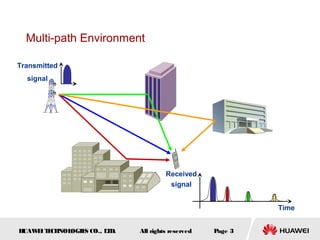
Multi-path Environment
Time
Received
signal
Transmitted
signal
HUAWEITECHNOLOGIES CO., LTD. Page 4All rights reserved
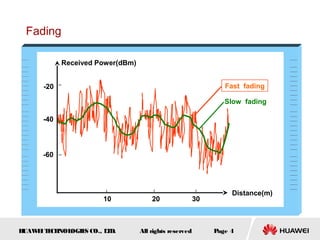
Fading
Distance(m)
Received Power(dBm)
10 20 30
-20
-40
-60
Slow fading
Fast fading
HUAWEITECHNOLOGIES CO., LTD. Page 5All rights reserved
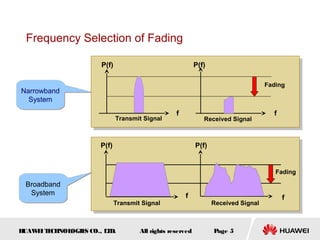
Frequency Selection of Fading
Narrowband
System
Narrowband
System
Fading
Transmit Signal Received Signal
ff
P(f) P(f)
Fading
Transmit Signal Received Signal
ff
P(f) P(f)
Broadband
System
Broadband
System
HUAWEITECHNOLOGIES CO., LTD. Page 6All rights reserved
Chapter 1 Radio Transmission EnvironmentChapter 1 Radio Transmission Environment
Chapter 2 CDMA FundamentalChapter 2 CDMA Fundamental
Chapter 3 Performance Enhancement MethodsChapter 3 Performance Enhancement Methods
Chapter 4 WCDMA FDD ModeChapter 4 WCDMA FDD Mode
HUAWEITECHNOLOGIES CO., LTD. Page 7All rights reserved
Chapter 2 CDMA FundamentalChapter 2 CDMA Fundamental
2.1 Multiple Access Technology and Duplex Technology2.1 Multiple Access Technology and Duplex Technology
2.2 CDMA Principle and RAKE Technology2.2 CDMA Principle and RAKE Technology
HUAWEITECHNOLOGIES CO., LTD. Page 8All rights reserved
Multiple Access Technology and Duplex Technology
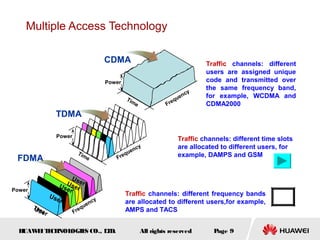
 Multiple access technology
 Time division multiple access (TDMA)
 Frequency division multiple access (FDMA)
 Code division multiple access (CDMA)
 Duplex technology
 Time division duplex (TDD)
 Frequency division duplex (FDD)
HUAWEITECHNOLOGIES CO., LTD. Page 9All rights reserved
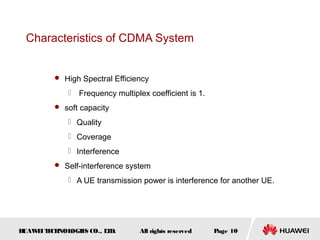
Traffic channels: different
users are assigned unique
code and transmitted over
the same frequency band,
for example, WCDMA and
CDMA2000
Traffic channels: different frequency bands
are allocated to different users,for example,
AMPS and TACS
Traffic channels: different time slots
are allocated to different users, for
example, DAMPS and GSM
Frequency
Time
Power
Frequency
Time
Power
Frequency
Time
Power
FDMA
TDMA
CDMA
User
User
User
User
User
User
Multiple Access Technology
HUAWEITECHNOLOGIES CO., LTD. Page 10All rights reserved
Characteristics of CDMA System
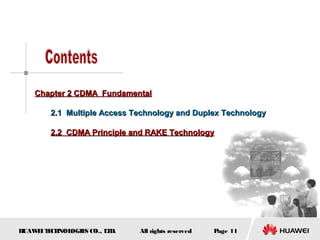
 High Spectral Efficiency
 Frequency multiplex coefficient is 1.
 soft capacity
 Quality
 Coverage
 Interference
 Self-interference system
 A UE transmission power is interference for another UE.
HUAWEITECHNOLOGIES CO., LTD. Page 11All rights reserved
Chapter 2 CDMA FundamentalChapter 2 CDMA Fundamental
2.1 Multiple Access Technology and Duplex Technology2.1 Multiple Access Technology and Duplex Technology
2.2 CDMA Principle and RAKE Technology2.2 CDMA Principle and RAKE Technology
HUAWEITECHNOLOGIES CO., LTD. Page 12All rights reserved
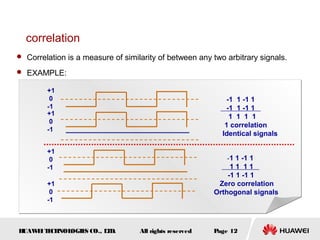
correlation
 Correlation is a measure of similarity of between any two arbitrary signals.
 EXAMPLE:
-1 1 -1 1
1 1 1 1
-1 1 -1 1
Zero correlation
Orthogonal signals
-1 1 -1 1
-1 1 -1 1
1 1 1 1
1 correlation
Identical signals
+1
0
-1
+1
0
-1
+1
0
-1
+1
0
-1
HUAWEITECHNOLOGIES CO., LTD. Page 13All rights reserved
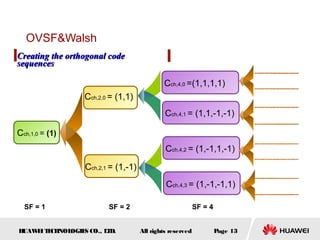
OVSF&Walsh
Creating the orthogonal codeCreating the orthogonal code
sequencessequences
SF = 1 SF = 2 SF = 4
Cch,1,0 = (1)
Cch,2,0 = (1,1)
Cch,2,1 = (1,-1)
Cch,4,0 =(1,1,1,1)
Cch,4,1 = (1,1,-1,-1)
Cch,4,2 = (1,-1,1,-1)
Cch,4,3 = (1,-1,-1,1)
HUAWEITECHNOLOGIES CO., LTD. Page 14All rights reserved
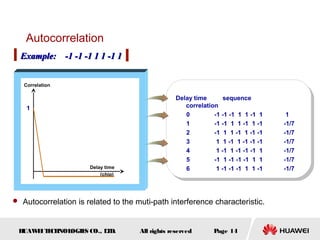
Autocorrelation
 Autocorrelation is related to the muti-path interference characteristic.
Delay time sequence
correlation
0 -1 -1 -1 1 1 -1 1 1
1 -1 -1 1 1 -1 1 -1 -1/7
2 -1 1 1 -1 1 -1 -1 -1/7
3 1 1 -1 1 -1 -1 -1 -1/7
4 1 -1 1 -1 -1 -1 1 -1/7
5 -1 1 -1 -1 -1 1 1 -1/7
6 1 -1 -1 -1 1 1 -1 -1/7Delay time
(chip)
Correlation
1
Example: -1 -1 -1 1 1 -1 1Example: -1 -1 -1 1 1 -1 1
HUAWEITECHNOLOGIES CO., LTD. Page 15All rights reserved
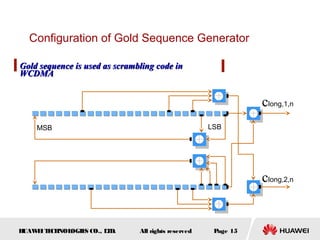
Configuration of Gold Sequence Generator
Gold sequence is used as scrambling code inGold sequence is used as scrambling code in
WCDMAWCDMA
clong,1,n
clong,2,n
MSB LSB
HUAWEITECHNOLOGIES CO., LTD. Page 16All rights reserved
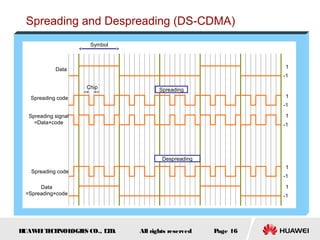
Spreading
Despreading
Chip
Symbol
Data
Spreading code
Spreading signal
=Data×code
Data
=Spreading×code
1
-1
1
-1
1
-1
1
-1
1
-1
Spreading code
Spreading and Despreading (DS-CDMA)
HUAWEITECHNOLOGIES CO., LTD. Page 17All rights reserved
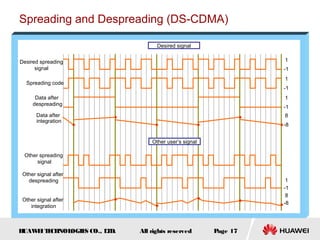
Desired signal
Other user’s signal
Desired spreading
signal
Spreading code
Data after
despreading
Other spreading
signal
Other signal after
integration
1
-1
1
-1
1
-1
8
-8
1
-1
8
-8
Data after
integration
Other signal after
despreading
Spreading and Despreading (DS-CDMA)
HUAWEITECHNOLOGIES CO., LTD. Page 18All rights reserved
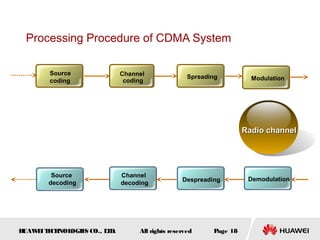
Source
coding
Channel
coding
Spreading Modulation
Source
decoding
Channel
decoding
Despreading Demodulation
Radio channelRadio channel
Processing Procedure of CDMA System
HUAWEITECHNOLOGIES CO., LTD. Page 19All rights reserved
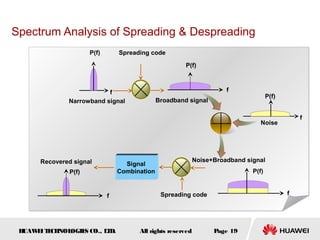
Spectrum Analysis of Spreading & Despreading
Spreading code
Spreading code
Signal
Combination
Narrowband signal
f
P(f)
Broadband signal
P(f)
f
Noise
P(f)
f
Noise+Broadband signal
P(f)
f
Recovered signal
P(f)
f
HUAWEITECHNOLOGIES CO., LTD. Page 20All rights reserved
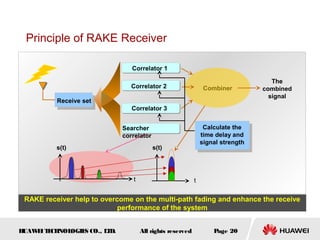
Principle of RAKE Receiver
Receive set
Correlator 1
Correlator 2
Correlator 3
Searcher
correlator
Calculate the
time delay and
signal strength
Combiner
The
combined
signal
tt
s(t) s(t)
RAKE receiver help to overcome on the multi-path fading and enhance the receive
performance of the system
HUAWEITECHNOLOGIES CO., LTD. Page 21All rights reserved
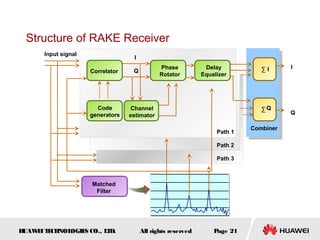
Structure of RAKE Receiver
∑ Q
∑ I
Combiner
I
Matched
Filter
Phase
Rotator
Channel
estimator
Delay
Equalizer
I
Q
Path 1
Path 2
Path 3
Input signal
Correlator
Code
generators Q
HUAWEITECHNOLOGIES CO., LTD. Page 22All rights reserved
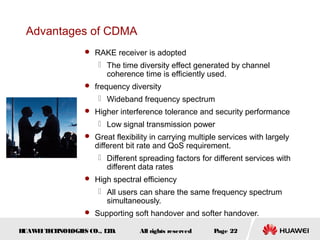
Advantages of CDMA
 RAKE receiver is adopted
 The time diversity effect generated by channel
coherence time is efficiently used.
 frequency diversity
 Wideband frequency spectrum
 Higher interference tolerance and security performance
 Low signal transmission power
 Great flexibility in carrying multiple services with largely
different bit rate and QoS requirement.
 Different spreading factors for different services with
different data rates
 High spectral efficiency
 All users can share the same frequency spectrum
simultaneously.
 Supporting soft handover and softer handover.
HUAWEITECHNOLOGIES CO., LTD. Page 23All rights reserved
Chapter 1 Radio Transmission EnvironmentChapter 1 Radio Transmission Environment
Chapter 2 CDMA FundamentalChapter 2 CDMA Fundamental
Chapter 3 Performance Enhancement MethodsChapter 3 Performance Enhancement Methods
Chapter 4 WCDMA FDD ModeChapter 4 WCDMA FDD Mode
HUAWEITECHNOLOGIES CO., LTD. Page 24All rights reserved
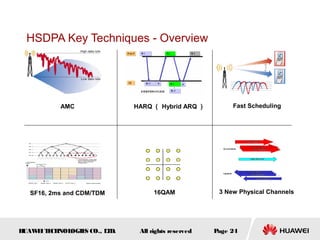
HSDPA Key Techniques - Overview
AMC Fast SchedulingHARQ ( Hybrid ARQ )
16QAMSF16, 2ms and CDM/TDM 3 New Physical Channels
HUAWEITECHNOLOGIES CO., LTD. Page 25All rights reserved
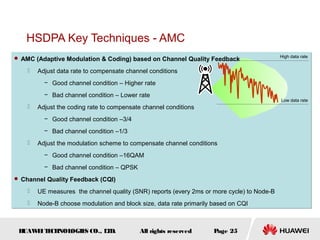
 AMC (Adaptive Modulation & Coding) based on Channel Quality Feedback
 Adjust data rate to compensate channel conditions
− Good channel condition – Higher rate
− Bad channel condition – Lower rate
 Adjust the coding rate to compensate channel conditions
− Good channel condition –3/4
− Bad channel condition –1/3
 Adjust the modulation scheme to compensate channel conditions
− Good channel condition –16QAM
− Bad channel condition – QPSK
 Channel Quality Feedback (CQI)
 UE measures the channel quality (SNR) reports (every 2ms or more cycle) to Node-B
 Node-B choose modulation and block size, data rate primarily based on CQI
 AMC (Adaptive Modulation & Coding) based on Channel Quality Feedback
 Adjust data rate to compensate channel conditions
− Good channel condition – Higher rate
− Bad channel condition – Lower rate
 Adjust the coding rate to compensate channel conditions
− Good channel condition –3/4
− Bad channel condition –1/3
 Adjust the modulation scheme to compensate channel conditions
− Good channel condition –16QAM
− Bad channel condition – QPSK
 Channel Quality Feedback (CQI)
 UE measures the channel quality (SNR) reports (every 2ms or more cycle) to Node-B
 Node-B choose modulation and block size, data rate primarily based on CQI
HSDPA Key Techniques - AMC
High data rate
Low data rate
HUAWEITECHNOLOGIES CO., LTD. Page 26All rights reserved
HSDPA Key Techniques - HARQ
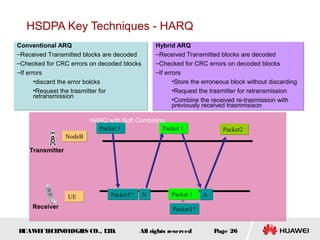
Conventional ARQ
–Received Transmitted blocks are decoded
–Checked for CRC errors on decoded blocks
–If errors
•discard the error bolcks
•Request the trasmitter for
retransmission
Conventional ARQ
–Received Transmitted blocks are decoded
–Checked for CRC errors on decoded blocks
–If errors
•discard the error bolcks
•Request the trasmitter for
retransmission
Hybrid ARQ
–Received Transmitted blocks are decoded
–Checked for CRC errors on decoded blocks
–If errors
•Store the erroneous block without discarding
•Request the trasmitter for retransmission
•Combine the received re-trasmission with
previously received trasnmisison
Hybrid ARQ
–Received Transmitted blocks are decoded
–Checked for CRC errors on decoded blocks
–If errors
•Store the erroneous block without discarding
•Request the trasmitter for retransmission
•Combine the received re-trasmission with
previously received trasnmisison
HARQ with Soft Combining
NodeBNodeB
UEUE Packet1?Packet1? NN
Packet 1Packet 1 Packet 1Packet 1
Packet 1Packet 1
Packet1?Packet1?
+
AA
Packet2Packet2
Transmitter
Receiver
HUAWEITECHNOLOGIES CO., LTD. Page 27All rights reserved
HSDPA Key Techniques - Fast scheduling
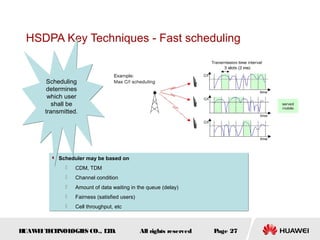
 Scheduler may be based on
 CDM, TDM
 Channel condition
 Amount of data waiting in the queue (delay)
 Fairness (satisfied users)
 Cell throughput, etc
 Scheduler may be based on
 CDM, TDM
 Channel condition
 Amount of data waiting in the queue (delay)
 Fairness (satisfied users)
 Cell throughput, etc
Scheduling
determines
which user
shall be
transmitted.
Scheduling
determines
which user
shall be
transmitted.
HUAWEITECHNOLOGIES CO., LTD. Page 28All rights reserved
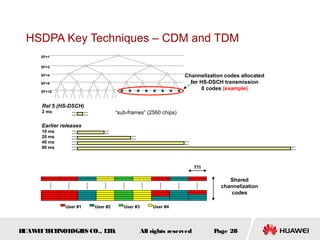
HSDPA Key Techniques – CDM and TDM
Channelization codes allocated
for HS-DSCH transmission
8 codes (example)
SF=16
SF=8
SF=4
SF=2
SF=1
User #1 User #2 User #3 User #4
TTI
Shared
channelization
codes
10 ms
20 ms
40 ms
80 ms
Earlier releases
2 ms
Rel 5 (HS-DSCH)
“sub-frames” (2560 chips)
HUAWEITECHNOLOGIES CO., LTD. Page 29All rights reserved
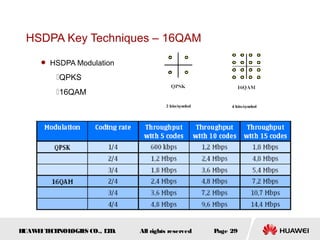
HSDPA Key Techniques – 16QAM
 HSDPA Modulation
QPKS
16QAM
HUAWEITECHNOLOGIES CO., LTD. Page 30All rights reserved
Introduction to Diversity Technique
 Diversity technique is used to obtain
uncorrelated signals for combining
 Reduce the effects of fading
 fast fading caused by multi-path
 Slow fading caused by shadowing
 Improve the reliability of communication
 Increase the coverage and capacity
 Macroscopic diversity
 Soft handover and softer handover
 Reduce large-scale fading
 Microscopic diversity
HUAWEITECHNOLOGIES CO., LTD. Page 31All rights reserved
Microscopic Diversity
 Time diversity
 Channel coding, Block interleaving,
error-correction
 Frequency diversity
 The user signal is distributed on the
whole bandwidth frequency spectrum
 Space diversity
 Receive diversity
 Transmit diversity
 Polarization diversity
 Vertical polarization
 Horizontal polarization
HUAWEITECHNOLOGIES CO., LTD. Page 32All rights reserved
Basic Combining Methods
 Maximal-Ratio Combiner
 The multi-path signals are weighted
proportional to their signal SNR and then
summed.
 Equal-Gain Combiner
 Equal-gain combining is similar to maximal-
ratio combining, but there is no attempt to
weight the signal before addition.
 Selection Combiner
 Choose the signal with the highest
instantaneous quality, so the output quality is
equal to that of the best incoming signal.
HUAWEITECHNOLOGIES CO., LTD. Page 33All rights reserved
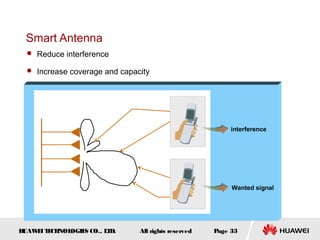
Smart Antenna
 Reduce interference
 Increase coverage and capacity
Wanted signal
interference
HUAWEITECHNOLOGIES CO., LTD. Page 34All rights reserved
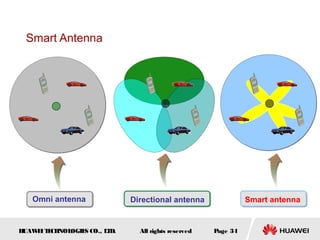
Smart Antenna
Omni antenna Directional antenna Smart antenna
HUAWEITECHNOLOGIES CO., LTD. Page 35All rights reserved
Chapter 1 Radio Transmission EnvironmentChapter 1 Radio Transmission Environment
Chapter 2 CDMA FundamentalChapter 2 CDMA Fundamental
Chapter 3 Performance Enhancement MethodsChapter 3 Performance Enhancement Methods
Chapter 4 WCDMA FDD ModeChapter 4 WCDMA FDD Mode
HUAWEITECHNOLOGIES CO., LTD. Page 36All rights reserved
Characteristics of WCDMA FDD
 Channel bandwidth: 5MHz
 Chip rate: 3.84Mcps
 Frame length: 10ms
 Voice coding: AMR (Adaptive Multi-Rate)
 Uplink and downlink modulation: QPSK/QPSK
 Coherence demodulation aided with pilot
 Fast closed loop power control: 1500Hz
 Handover: soft/hard handover
 Support synchronous and asynchronous NodeB
operation
HUAWEITECHNOLOGIES CO., LTD. Page 37All rights reserved
Characteristics of WCDMA FDD
 Satisfy the minimum performance requirement of IMT2000
 Compatible with GSM-MAP core network
 Comparatively steady version R99 has been released
 Support open loop and closed loop transmit diversity mode
 Support Common Packet Channel(CPCH) and Downlink
Share Channel, adapt to Internet data access mode
 Support macro diversity, selection diversity of NodeB
location
 Support different fast power control algorithms and open
loop, out loop power control
 Fully support UE locating services
HUAWEITECHNOLOGIES CO., LTD. Page 38All rights reserved
WCDMA Voice Evolution
 Adopt AMR voice coding, and support voice
quality of 4.75Kbps ~ 12.2Kbps
 Adopt soft handover and transmit diversity to
improve system capacity
 Provide high fidelity voice mode
 Fast power control
HUAWEITECHNOLOGIES CO., LTD. Page 39All rights reserved
Data Service Evolution of WCDMA
 Support maximum 2Mbps data service
 Support packet switch
 Adopt ATM platform currently
 Provide QoS
 Common Packet Channel(CPCH) and Downlink
Share Channel(DSCH) can support Internet packet
services better
 Provide mobile IP service(dynamic allocation of IP
addresses)
 TFCI domain provides dynamic data rate
 Provide high-quality support for uplink-downlink
symmetric data service, such as voice, video
phone, conference TV
www.huawei.com
Thank You

Owa200002 wcdma basic principle issue1.0

  • 1.
    HUAWEITECHNOLOGIES CO., LTD.All rights reserved www.huawei.com Internal OWA200002 WCDMA RAN Basic Principle ISSUE1.0
  • 2.
    HUAWEITECHNOLOGIES CO., LTD.Page 2All rights reserved Chapter 1 Radio Transmission EnvironmentChapter 1 Radio Transmission Environment Chapter 2 CDMA FundamentalChapter 2 CDMA Fundamental Chapter 3 Performance Enhancement MethodsChapter 3 Performance Enhancement Methods Chapter 4 WCDMA FDD ModeChapter 4 WCDMA FDD Mode
  • 3.
    HUAWEITECHNOLOGIES CO., LTD.Page 3All rights reserved Multi-path Environment Time Received signal Transmitted signal
  • 4.
    HUAWEITECHNOLOGIES CO., LTD.Page 4All rights reserved Fading Distance(m) Received Power(dBm) 10 20 30 -20 -40 -60 Slow fading Fast fading
  • 5.
    HUAWEITECHNOLOGIES CO., LTD.Page 5All rights reserved Frequency Selection of Fading Narrowband System Narrowband System Fading Transmit Signal Received Signal ff P(f) P(f) Fading Transmit Signal Received Signal ff P(f) P(f) Broadband System Broadband System
  • 6.
    HUAWEITECHNOLOGIES CO., LTD.Page 6All rights reserved Chapter 1 Radio Transmission EnvironmentChapter 1 Radio Transmission Environment Chapter 2 CDMA FundamentalChapter 2 CDMA Fundamental Chapter 3 Performance Enhancement MethodsChapter 3 Performance Enhancement Methods Chapter 4 WCDMA FDD ModeChapter 4 WCDMA FDD Mode
  • 7.
    HUAWEITECHNOLOGIES CO., LTD.Page 7All rights reserved Chapter 2 CDMA FundamentalChapter 2 CDMA Fundamental 2.1 Multiple Access Technology and Duplex Technology2.1 Multiple Access Technology and Duplex Technology 2.2 CDMA Principle and RAKE Technology2.2 CDMA Principle and RAKE Technology
  • 8.
    HUAWEITECHNOLOGIES CO., LTD.Page 8All rights reserved Multiple Access Technology and Duplex Technology  Multiple access technology  Time division multiple access (TDMA)  Frequency division multiple access (FDMA)  Code division multiple access (CDMA)  Duplex technology  Time division duplex (TDD)  Frequency division duplex (FDD)
  • 9.
    HUAWEITECHNOLOGIES CO., LTD.Page 9All rights reserved Traffic channels: different users are assigned unique code and transmitted over the same frequency band, for example, WCDMA and CDMA2000 Traffic channels: different frequency bands are allocated to different users,for example, AMPS and TACS Traffic channels: different time slots are allocated to different users, for example, DAMPS and GSM Frequency Time Power Frequency Time Power Frequency Time Power FDMA TDMA CDMA User User User User User User Multiple Access Technology
  • 10.
    HUAWEITECHNOLOGIES CO., LTD.Page 10All rights reserved Characteristics of CDMA System  High Spectral Efficiency  Frequency multiplex coefficient is 1.  soft capacity  Quality  Coverage  Interference  Self-interference system  A UE transmission power is interference for another UE.
  • 11.
    HUAWEITECHNOLOGIES CO., LTD.Page 11All rights reserved Chapter 2 CDMA FundamentalChapter 2 CDMA Fundamental 2.1 Multiple Access Technology and Duplex Technology2.1 Multiple Access Technology and Duplex Technology 2.2 CDMA Principle and RAKE Technology2.2 CDMA Principle and RAKE Technology
  • 12.
    HUAWEITECHNOLOGIES CO., LTD.Page 12All rights reserved correlation  Correlation is a measure of similarity of between any two arbitrary signals.  EXAMPLE: -1 1 -1 1 1 1 1 1 -1 1 -1 1 Zero correlation Orthogonal signals -1 1 -1 1 -1 1 -1 1 1 1 1 1 1 correlation Identical signals +1 0 -1 +1 0 -1 +1 0 -1 +1 0 -1
  • 13.
    HUAWEITECHNOLOGIES CO., LTD.Page 13All rights reserved OVSF&Walsh Creating the orthogonal codeCreating the orthogonal code sequencessequences SF = 1 SF = 2 SF = 4 Cch,1,0 = (1) Cch,2,0 = (1,1) Cch,2,1 = (1,-1) Cch,4,0 =(1,1,1,1) Cch,4,1 = (1,1,-1,-1) Cch,4,2 = (1,-1,1,-1) Cch,4,3 = (1,-1,-1,1)
  • 14.
    HUAWEITECHNOLOGIES CO., LTD.Page 14All rights reserved Autocorrelation  Autocorrelation is related to the muti-path interference characteristic. Delay time sequence correlation 0 -1 -1 -1 1 1 -1 1 1 1 -1 -1 1 1 -1 1 -1 -1/7 2 -1 1 1 -1 1 -1 -1 -1/7 3 1 1 -1 1 -1 -1 -1 -1/7 4 1 -1 1 -1 -1 -1 1 -1/7 5 -1 1 -1 -1 -1 1 1 -1/7 6 1 -1 -1 -1 1 1 -1 -1/7Delay time (chip) Correlation 1 Example: -1 -1 -1 1 1 -1 1Example: -1 -1 -1 1 1 -1 1
  • 15.
    HUAWEITECHNOLOGIES CO., LTD.Page 15All rights reserved Configuration of Gold Sequence Generator Gold sequence is used as scrambling code inGold sequence is used as scrambling code in WCDMAWCDMA clong,1,n clong,2,n MSB LSB
  • 16.
    HUAWEITECHNOLOGIES CO., LTD.Page 16All rights reserved Spreading Despreading Chip Symbol Data Spreading code Spreading signal =Data×code Data =Spreading×code 1 -1 1 -1 1 -1 1 -1 1 -1 Spreading code Spreading and Despreading (DS-CDMA)
  • 17.
    HUAWEITECHNOLOGIES CO., LTD.Page 17All rights reserved Desired signal Other user’s signal Desired spreading signal Spreading code Data after despreading Other spreading signal Other signal after integration 1 -1 1 -1 1 -1 8 -8 1 -1 8 -8 Data after integration Other signal after despreading Spreading and Despreading (DS-CDMA)
  • 18.
    HUAWEITECHNOLOGIES CO., LTD.Page 18All rights reserved Source coding Channel coding Spreading Modulation Source decoding Channel decoding Despreading Demodulation Radio channelRadio channel Processing Procedure of CDMA System
  • 19.
    HUAWEITECHNOLOGIES CO., LTD.Page 19All rights reserved Spectrum Analysis of Spreading & Despreading Spreading code Spreading code Signal Combination Narrowband signal f P(f) Broadband signal P(f) f Noise P(f) f Noise+Broadband signal P(f) f Recovered signal P(f) f
  • 20.
    HUAWEITECHNOLOGIES CO., LTD.Page 20All rights reserved Principle of RAKE Receiver Receive set Correlator 1 Correlator 2 Correlator 3 Searcher correlator Calculate the time delay and signal strength Combiner The combined signal tt s(t) s(t) RAKE receiver help to overcome on the multi-path fading and enhance the receive performance of the system
  • 21.
    HUAWEITECHNOLOGIES CO., LTD.Page 21All rights reserved Structure of RAKE Receiver ∑ Q ∑ I Combiner I Matched Filter Phase Rotator Channel estimator Delay Equalizer I Q Path 1 Path 2 Path 3 Input signal Correlator Code generators Q
  • 22.
    HUAWEITECHNOLOGIES CO., LTD.Page 22All rights reserved Advantages of CDMA  RAKE receiver is adopted  The time diversity effect generated by channel coherence time is efficiently used.  frequency diversity  Wideband frequency spectrum  Higher interference tolerance and security performance  Low signal transmission power  Great flexibility in carrying multiple services with largely different bit rate and QoS requirement.  Different spreading factors for different services with different data rates  High spectral efficiency  All users can share the same frequency spectrum simultaneously.  Supporting soft handover and softer handover.
  • 23.
    HUAWEITECHNOLOGIES CO., LTD.Page 23All rights reserved Chapter 1 Radio Transmission EnvironmentChapter 1 Radio Transmission Environment Chapter 2 CDMA FundamentalChapter 2 CDMA Fundamental Chapter 3 Performance Enhancement MethodsChapter 3 Performance Enhancement Methods Chapter 4 WCDMA FDD ModeChapter 4 WCDMA FDD Mode
  • 24.
    HUAWEITECHNOLOGIES CO., LTD.Page 24All rights reserved HSDPA Key Techniques - Overview AMC Fast SchedulingHARQ ( Hybrid ARQ ) 16QAMSF16, 2ms and CDM/TDM 3 New Physical Channels
  • 25.
    HUAWEITECHNOLOGIES CO., LTD.Page 25All rights reserved  AMC (Adaptive Modulation & Coding) based on Channel Quality Feedback  Adjust data rate to compensate channel conditions − Good channel condition – Higher rate − Bad channel condition – Lower rate  Adjust the coding rate to compensate channel conditions − Good channel condition –3/4 − Bad channel condition –1/3  Adjust the modulation scheme to compensate channel conditions − Good channel condition –16QAM − Bad channel condition – QPSK  Channel Quality Feedback (CQI)  UE measures the channel quality (SNR) reports (every 2ms or more cycle) to Node-B  Node-B choose modulation and block size, data rate primarily based on CQI  AMC (Adaptive Modulation & Coding) based on Channel Quality Feedback  Adjust data rate to compensate channel conditions − Good channel condition – Higher rate − Bad channel condition – Lower rate  Adjust the coding rate to compensate channel conditions − Good channel condition –3/4 − Bad channel condition –1/3  Adjust the modulation scheme to compensate channel conditions − Good channel condition –16QAM − Bad channel condition – QPSK  Channel Quality Feedback (CQI)  UE measures the channel quality (SNR) reports (every 2ms or more cycle) to Node-B  Node-B choose modulation and block size, data rate primarily based on CQI HSDPA Key Techniques - AMC High data rate Low data rate
  • 26.
    HUAWEITECHNOLOGIES CO., LTD.Page 26All rights reserved HSDPA Key Techniques - HARQ Conventional ARQ –Received Transmitted blocks are decoded –Checked for CRC errors on decoded blocks –If errors •discard the error bolcks •Request the trasmitter for retransmission Conventional ARQ –Received Transmitted blocks are decoded –Checked for CRC errors on decoded blocks –If errors •discard the error bolcks •Request the trasmitter for retransmission Hybrid ARQ –Received Transmitted blocks are decoded –Checked for CRC errors on decoded blocks –If errors •Store the erroneous block without discarding •Request the trasmitter for retransmission •Combine the received re-trasmission with previously received trasnmisison Hybrid ARQ –Received Transmitted blocks are decoded –Checked for CRC errors on decoded blocks –If errors •Store the erroneous block without discarding •Request the trasmitter for retransmission •Combine the received re-trasmission with previously received trasnmisison HARQ with Soft Combining NodeBNodeB UEUE Packet1?Packet1? NN Packet 1Packet 1 Packet 1Packet 1 Packet 1Packet 1 Packet1?Packet1? + AA Packet2Packet2 Transmitter Receiver
  • 27.
    HUAWEITECHNOLOGIES CO., LTD.Page 27All rights reserved HSDPA Key Techniques - Fast scheduling  Scheduler may be based on  CDM, TDM  Channel condition  Amount of data waiting in the queue (delay)  Fairness (satisfied users)  Cell throughput, etc  Scheduler may be based on  CDM, TDM  Channel condition  Amount of data waiting in the queue (delay)  Fairness (satisfied users)  Cell throughput, etc Scheduling determines which user shall be transmitted. Scheduling determines which user shall be transmitted.
  • 28.
    HUAWEITECHNOLOGIES CO., LTD.Page 28All rights reserved HSDPA Key Techniques – CDM and TDM Channelization codes allocated for HS-DSCH transmission 8 codes (example) SF=16 SF=8 SF=4 SF=2 SF=1 User #1 User #2 User #3 User #4 TTI Shared channelization codes 10 ms 20 ms 40 ms 80 ms Earlier releases 2 ms Rel 5 (HS-DSCH) “sub-frames” (2560 chips)
  • 29.
    HUAWEITECHNOLOGIES CO., LTD.Page 29All rights reserved HSDPA Key Techniques – 16QAM  HSDPA Modulation QPKS 16QAM
  • 30.
    HUAWEITECHNOLOGIES CO., LTD.Page 30All rights reserved Introduction to Diversity Technique  Diversity technique is used to obtain uncorrelated signals for combining  Reduce the effects of fading  fast fading caused by multi-path  Slow fading caused by shadowing  Improve the reliability of communication  Increase the coverage and capacity  Macroscopic diversity  Soft handover and softer handover  Reduce large-scale fading  Microscopic diversity
  • 31.
    HUAWEITECHNOLOGIES CO., LTD.Page 31All rights reserved Microscopic Diversity  Time diversity  Channel coding, Block interleaving, error-correction  Frequency diversity  The user signal is distributed on the whole bandwidth frequency spectrum  Space diversity  Receive diversity  Transmit diversity  Polarization diversity  Vertical polarization  Horizontal polarization
  • 32.
    HUAWEITECHNOLOGIES CO., LTD.Page 32All rights reserved Basic Combining Methods  Maximal-Ratio Combiner  The multi-path signals are weighted proportional to their signal SNR and then summed.  Equal-Gain Combiner  Equal-gain combining is similar to maximal- ratio combining, but there is no attempt to weight the signal before addition.  Selection Combiner  Choose the signal with the highest instantaneous quality, so the output quality is equal to that of the best incoming signal.
  • 33.
    HUAWEITECHNOLOGIES CO., LTD.Page 33All rights reserved Smart Antenna  Reduce interference  Increase coverage and capacity Wanted signal interference
  • 34.
    HUAWEITECHNOLOGIES CO., LTD.Page 34All rights reserved Smart Antenna Omni antenna Directional antenna Smart antenna
  • 35.
    HUAWEITECHNOLOGIES CO., LTD.Page 35All rights reserved Chapter 1 Radio Transmission EnvironmentChapter 1 Radio Transmission Environment Chapter 2 CDMA FundamentalChapter 2 CDMA Fundamental Chapter 3 Performance Enhancement MethodsChapter 3 Performance Enhancement Methods Chapter 4 WCDMA FDD ModeChapter 4 WCDMA FDD Mode
  • 36.
    HUAWEITECHNOLOGIES CO., LTD.Page 36All rights reserved Characteristics of WCDMA FDD  Channel bandwidth: 5MHz  Chip rate: 3.84Mcps  Frame length: 10ms  Voice coding: AMR (Adaptive Multi-Rate)  Uplink and downlink modulation: QPSK/QPSK  Coherence demodulation aided with pilot  Fast closed loop power control: 1500Hz  Handover: soft/hard handover  Support synchronous and asynchronous NodeB operation
  • 37.
    HUAWEITECHNOLOGIES CO., LTD.Page 37All rights reserved Characteristics of WCDMA FDD  Satisfy the minimum performance requirement of IMT2000  Compatible with GSM-MAP core network  Comparatively steady version R99 has been released  Support open loop and closed loop transmit diversity mode  Support Common Packet Channel(CPCH) and Downlink Share Channel, adapt to Internet data access mode  Support macro diversity, selection diversity of NodeB location  Support different fast power control algorithms and open loop, out loop power control  Fully support UE locating services
  • 38.
    HUAWEITECHNOLOGIES CO., LTD.Page 38All rights reserved WCDMA Voice Evolution  Adopt AMR voice coding, and support voice quality of 4.75Kbps ~ 12.2Kbps  Adopt soft handover and transmit diversity to improve system capacity  Provide high fidelity voice mode  Fast power control
  • 39.
    HUAWEITECHNOLOGIES CO., LTD.Page 39All rights reserved Data Service Evolution of WCDMA  Support maximum 2Mbps data service  Support packet switch  Adopt ATM platform currently  Provide QoS  Common Packet Channel(CPCH) and Downlink Share Channel(DSCH) can support Internet packet services better  Provide mobile IP service(dynamic allocation of IP addresses)  TFCI domain provides dynamic data rate  Provide high-quality support for uplink-downlink symmetric data service, such as voice, video phone, conference TV
  • 40.

Editor's Notes

  • #4 Radio environment is very complex. The transmission signal of BS reaches the UE through all kinds of paths including reflection,scattering and diffraction. The received signals is different in power and delay time. But the multi-path signal can be used by RAKE receiver through multi-path combination.
  • #9 In third generation mobile communication systems, TD-SCDMA adopts time division duplex (TDD); WCDMA and cdma2000 adopt frequency division duplex (FDD). WCDMA FDD mode has been consolidated with TD-SCDMA.
  • #10 Frequency Division Multiple Access: frequency division, sometimes called channelization, means dividing the whole available spectrum into many single radio channels (transmit/receive carrier pair). Each channel can transmit one-way voice or control information. Under the control of the system, any user can be accessed to any of these channels. Analog cellular system is a typical example of FDMA structure. Similarly, FDMA can also be used in a digital cellular system,except that pure frequency division is not adopted. For example, FDMA is adopted in GSM and CDMA. Time Division Multiple Access means that the wireless carrier of one bandwidth is divided into multiple time division channels in terms of time (or called timeslot). Each user occupies a timeslot and receives/transmits signals within this specified timeslot. Therefore, it is called time division multiple access. This multiple access mode is adopted in both a digital cellular system and a GSM. TDMA is a complex architecture and the simplest case is that a single channel carrier is divided into many different timeslots, each of which transmits one-way burst-oriented information. The key part in TDMA is the user part, in which each user is allocated with one timeslot (allocated when a call begins). The user communicates with a base station in a synchronous mode and counts the timeslot. When his own timeslot comes, the mobile station starts a receiving and demodulation circuit to decode the burst-oriented information sent from the base station. Likewise, when a user wants to send any information, he should first cache the information and waits for his timeslot to come. After a timeslot begins, the information is transmitted at a double rate and next burst-oriented transmission begins to be accumulated. CDMA is a multiple access mode implemented by Spread Spectrum Modulation. Unlike FDMA and TDMA, both of which separate the user information in terms of time and frequency, CDMA can transmit the information of multiple users on a channel at the same time. That is to say,mutual interference between users is permitted. The key is that every information before transmission should be modulated by different Spread Spectrum Code-Sequence to broadband signal, then all the signals should be mixed and send. The mixed signal would be demodulated by different Spread Spectrum Code-Sequence at the different receiver.Because all the Spread Spectrum Code-Sequence is orthogonal,only the information that was be demodulated by same Spread Spectrum Code-Sequence can be reverted in mixed signal.
  • #11 In CDMA, channel data rate is smaller than delay extension. So RAKE Rx technology can be used.
  • #14 Channelisation code uses OVSF code, for keeping the orthogonality of different subscriber physical channels. OVSF can be defined as the code tree illustrated in the following diagram. Channelisation code is defined as Cch,SF, k,, where, SF is the spreading factor of the code, and k is the sequence of code, 0≤k≤SF-1.Each level definition length of code tree is SF channelisation code, and the left most value of each channelisation code character is corresponding to the chip which is transmitted earliest.
  • #17 Suppose bit sequence modulated with BPSK is adopted for the subscriber data, with a rate of R, then 1 value is adopted for the bit of subscriber data. The spreading here means to multiply each subscriber data bit with the spreading code chip including N bits..Assume N=8,then data rate after spreading will be 8R, with same random attribute as the spreading code.We name its spreading factor as 8. And the broad band signal obtained after spreading will be sent to the receiving end via the radio channel. As the product of signal rate and factor 8 equals to the bandwidth spreading of subscriber data signal,CDMA system is also called the spreading system. During dispreading, the spread subscriber data will be multiplied, bit duration by bit duration, with the same 8 code chips that are used during the spreading of these bits.If only excellent synchronization can be realized between the spread subscriber signal and the despreading code, can the subscriber bit sequence be retrieved.The despreading operation restores the signal bandwidth to the original value R.
  • #18 During the process of receiving the expected correct signal that belongs to the subscriber, complete synchronous despreading codes are adopted for the despreading operation. After obtaining the despreading data, the correlation receiver integrates the resulting products, then get the integration data. Signals of other subscribers using different spreading codes are actually the interference signals to the first subscriber. In this case, multiply the signals and the despreading code of the first subscriber to get the despreading signal, and then perform integration. Finally, an interference signal with a signal value fluctuating along with 0 will be got.It can be viewed that the signal amplitude of the subscriber increases by 8 times than that of the other interference systems in average. That is to say, the correlation detection increases the expected subscriber signal by the multiple of spreading factor value within the interference of CDMA system.This effect is called “processing gain”, and it is the basic characteristic of the spreading system.Elementarily, this kind of correlation receivers are adopted for the BTS and UE in the WCDMA system.Because the existence of multipath propagation and multi receiving antennas, multiple correlation receivers are necessary for retrieving the signal energy from all the paths or antennas.And the collection of these correlation receivers forms the CDMA RAKE receiver.
  • #22 For the digitized signals input to the baseband, despreading and integration of subscriber data symbols is completed via the correlator and local code generator, specifics are as follows:Channel estimator uses the pilot signal to estimate the channel status; Phase spinner deletes the phase affection caused by the channel from the received signal according to the estimated channel status. The function of delay estimation is to obtain the signal energy distribution at different delay positions via the matching filter, and identify the multipaths with large energy, and allocate their time values to different receive paths of the RAKE receiver.The delay equalizer is to compensate the difference of symbol arriving time for each path.At last, the RAKE combiner adds the symbols after channel compensation to provide multipath diversity to withstand fading.From the aspect of realization, the processing of RAKE receiver can be based on either chip level or symbol level.The correlator, local code generator and matching filter belong to the chip level processing, and this is generally realized via ASIC device; Channel estimation, phase spinning and combination belong to symbol level processing, and this is realized via DSP.Though the realization methods and functions of the RAKE receiver between UE and BTS are different, the principles are complete the same.
  • #31 Diversity technology means that after receiving two or more input signals with mutually uncorrelated fading at the same time, the system demodulates these signals and adds them up. Thus, the system can receive more useful signals and overcome fading. A mobile communication channel is a multi-path fading channel and any transmitted signal reaches a receive end by means of multiple transmission paths, such as direct transmission, reflection, scatter, etc. Furthermore, with the moving of a mobile station, the signal amplitude, delay and phase on various transmission paths vary with time and place. Therefore, the levels of received signals are fluctuating and unstable and these multi-path signals, if overlaid, will lead to fading. The mid-value field strength of Rayleigh fading has relatively gentle change and is called “Slow fading”. And it conforms to lognormal distribution. Diversity technology is an effective way to overcome overlaid fading. Because it can be selected in terms of frequency, time and space, diversity technology includes frequency diversity, time diversity and space diversity.
  • #32 Diversity technology means that after receiving two or more input signals with mutually uncorrelated fading at the same time, the system demodulates these signals and adds them up. Thus, the system can receive more useful signals and overcome fading. A mobile communication channel is a multi-path fading channel and any transmitted signal reaches a receive end by means of multiple transmission paths, such as direct transmission, reflection, scatter, etc. Furthermore, with the moving of a mobile station, the signal amplitude, delay and phase on various transmission paths vary with time and place. Therefore, the levels of received signals are fluctuating and unstable and these multi-path signals, if overlaid, will lead to fading. The mid-value field strength of Rayleigh fading has relatively gentle change and is called “Slow fading”. And it conforms to lognormal distribution. Diversity technology is an effective way to overcome overlaid fading. Because it can be selected in terms of frequency, time and space, diversity technology includes frequency diversity, time diversity and space diversity.
  • #33 Diversity technology means that after receiving two or more input signals with mutually uncorrelated fading at the same time, the system demodulates these signals and adds them up. Thus, the system can receive more useful signals and overcome fading. A mobile communication channel is a multi-path fading channel and any transmitted signal reaches a receive end by means of multiple transmission paths, such as direct transmission, reflection, scatter, etc. Furthermore, with the moving of a mobile station, the signal amplitude, delay and phase on various transmission paths vary with time and place. Therefore, the levels of received signals are fluctuating and unstable and these multi-path signals, if overlaid, will lead to fading. The mid-value field strength of Rayleigh fading has relatively gentle change and is called “Slow fading”. And it conforms to lognormal distribution. Diversity technology is an effective way to overcome overlaid fading. Because it can be selected in terms of frequency, time and space, diversity technology includes frequency diversity, time diversity and space diversity.
  • #34 Diversity technology means that after receiving two or more input signals with mutually uncorrelated fading at the same time, the system demodulates these signals and adds them up. Thus, the system can receive more useful signals and overcome fading. A mobile communication channel is a multi-path fading channel and any transmitted signal reaches a receive end by means of multiple transmission paths, such as direct transmission, reflection, scatter, etc. Furthermore, with the moving of a mobile station, the signal amplitude, delay and phase on various transmission paths vary with time and place. Therefore, the levels of received signals are fluctuating and unstable and these multi-path signals, if overlaid, will lead to fading. The mid-value field strength of Rayleigh fading has relatively gentle change and is called “Slow fading”. And it conforms to lognormal distribution. Diversity technology is an effective way to overcome overlaid fading. Because it can be selected in terms of frequency, time and space, diversity technology includes frequency diversity, time diversity and space diversity.
  • #35 Diversity technology means that after receiving two or more input signals with mutually uncorrelated fading at the same time, the system demodulates these signals and adds them up. Thus, the system can receive more useful signals and overcome fading. A mobile communication channel is a multi-path fading channel and any transmitted signal reaches a receive end by means of multiple transmission paths, such as direct transmission, reflection, scatter, etc. Furthermore, with the moving of a mobile station, the signal amplitude, delay and phase on various transmission paths vary with time and place. Therefore, the levels of received signals are fluctuating and unstable and these multi-path signals, if overlaid, will lead to fading. The mid-value field strength of Rayleigh fading has relatively gentle change and is called “Slow fading”. And it conforms to lognormal distribution. Diversity technology is an effective way to overcome overlaid fading. Because it can be selected in terms of frequency, time and space, diversity technology includes frequency diversity, time diversity and space diversity.
  • #37 1,The DS-CDMA system with a bandwidth of approximately 1MHz, i.e. IS-95, is generally named as narrowband CDMA system.But WCDMA owns a chip rate of 3.84Mcps, bringing approximately 5MHz carrier bandwidth.This feature enables the system to support higher bit rate, and at the same time brings other benefits, for example, increasing of multi-path diversity. 2,In IS-95, only coherence detection is used in the downlink, but in WCDMA, coherence detection based on pilot symbol or common pilot is adopted for both the uplink and the downlink, increasing the coverage scope and the capacity of the uplink. 3,IS-95 only uses closed loop power control in the uplink, while WCDMA uses this in both of the uplink and the downlink.With the closed loop power control used in the downlink, link performance and downlink capacity is improved. 4,IS-95 system mainly aims at macro cell. Because BTS synchronization is necessary, BTS is generally placed on the roof, etc. for the sake of receiving GPS signal.In this case, a global time reference can be used. But this application is difficult to carry out in the places where it is hard to receive the GPS signals. WCDMA system supports asynchronous BTS operation, and it may not use the global reference, thus it is different with the IS-95 system requiring BTS synchronization operating mode. Thus, the application of indoor cell and microcell is much simpler. This makes that the handover of WCDMA is slightly different with that of IS-95.