THE HOOK
The Phases of the Moon Rap
Phases of the moon
LEARNING INTENTION
•To become familiar with the phases
of the moon
•To understand how and why they
appear
SUCCESS CRITERIA
•I understand how and why the
phases of the moon occur
•I know the 8 phases of the moon
Phases of the Moon
Video
Why does the moon
appear to change
shape?
The moon orbits the earth.
It takes 28 days for the moon
to go around the earth once
The only reason we can see
the moon is because it reflects
the light from the sun
Only one half of the moon is
ever lit
As the moon travels around
the earth we see different
amounts of the lit side of the
moon
Day 1 - New
moon
The dark side of the moon is
facing the earth
New moon
The dark side of the
moon is facing the earth
Day 4 – Waxing
Crescent
Waxing Crescent
We begin to see part of the
side of the moon that is lit up
Day 7 – First quarter
First Quarter
Confused!? It’s obviously a half moon but
is called a quarter moon because it has
gone quarter of the way around the earth
Day 10 – Waxing
Gibbous
Waxing Gibbous
The moon is now in a position where
we can see most of the side that is lit
up
Day 14 – Full
moon
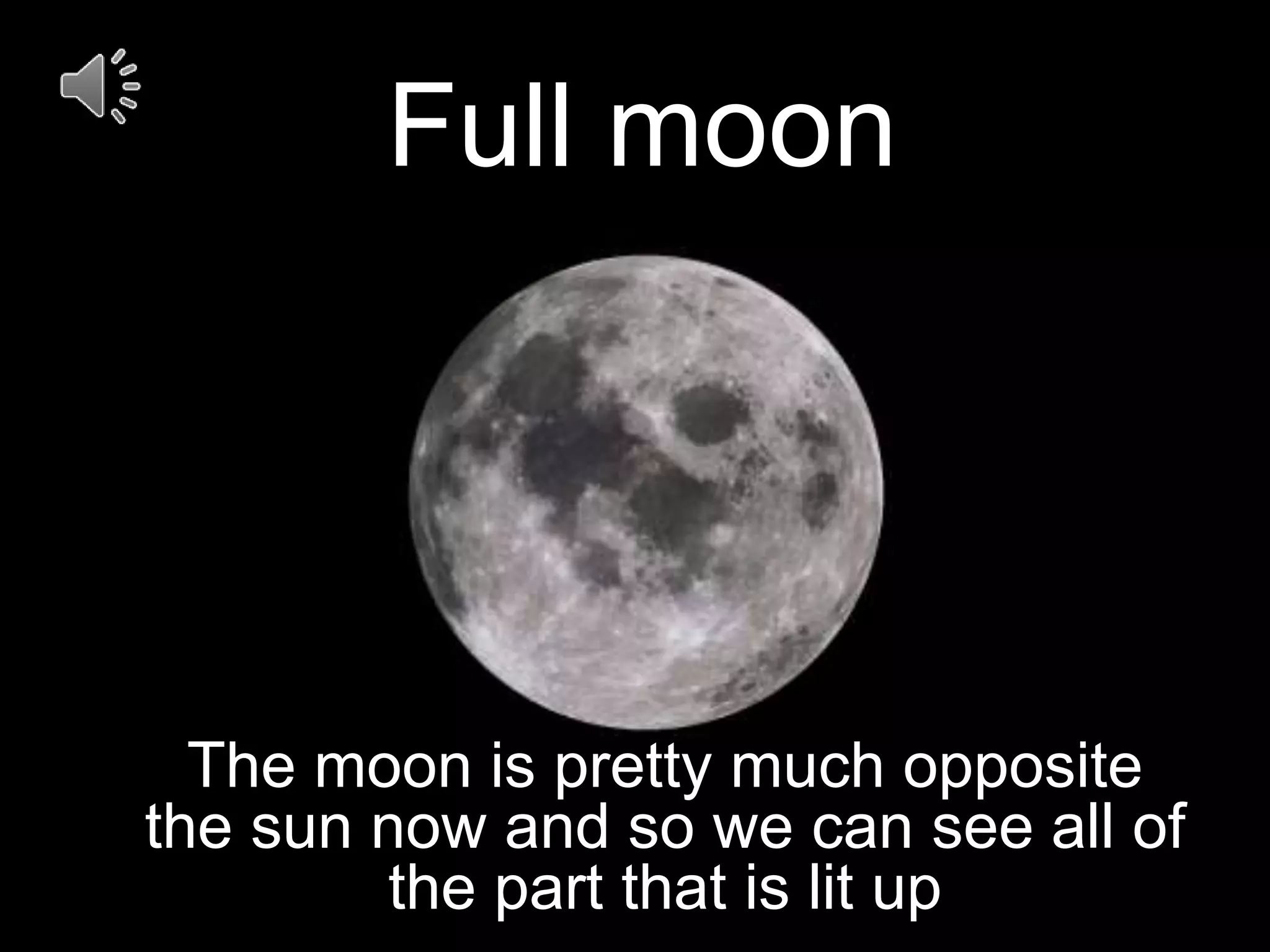
Full moon
The moon is pretty much opposite
the sun now and so we can see all of
the part that is lit up
Day 18 – Waning
Gibbous
Waning Gibbous
The moon is now in a position where
we can see most of the lit side of the
moon
Day 21 – Last
quarter
Last Quarter
The moon is in the last
quarter of it’s way around the
Day 24 – Waning
Crescent
Waning Crescent
We are starting to lose sight of
the side of the moon that is lit up
Day 28 - New
moon
The dark side of the moon is
facing the earth again
The Phases of the Moon
The dotted lines represent our line of sight from Earth
New Moon
The New Moon occurs when the moon is positioned between
the earth and sun. The three objects are in approximate
alignment. The entire illuminated portion of the moon is on
the back side of the moon, the half that we cannot see.
After the new moon, the sunlit portion is
increasing, but less than half, so it is a
WAXING CRESCENT
Waxing Crescent
Waxing Crescent
Waxing Crescent
Half Moon Waxing
The first quarter and third quarter moons (both often called a "half moon"), happen when the
moon is at a 90 degree angle with respect to the earth and sun. So we are seeing exactly half of
the moon illuminated and half in shadow.
Waxing Gibbous
After the first quarter, the sunlit portion is still
increasing, but now it is more than half, so it is waxing
gibbous
Waxing Gibbous
Waxing Gibbous
Waxing Gibbous
Full Moon
At a full moon, the earth, moon, and sun are in approximate
alignment, just as the new moon, but the moon is on the opposite
side of the earth, so the entire sunlit part of the moon is facing us.
The shadowed portion is entirely hidden from view.
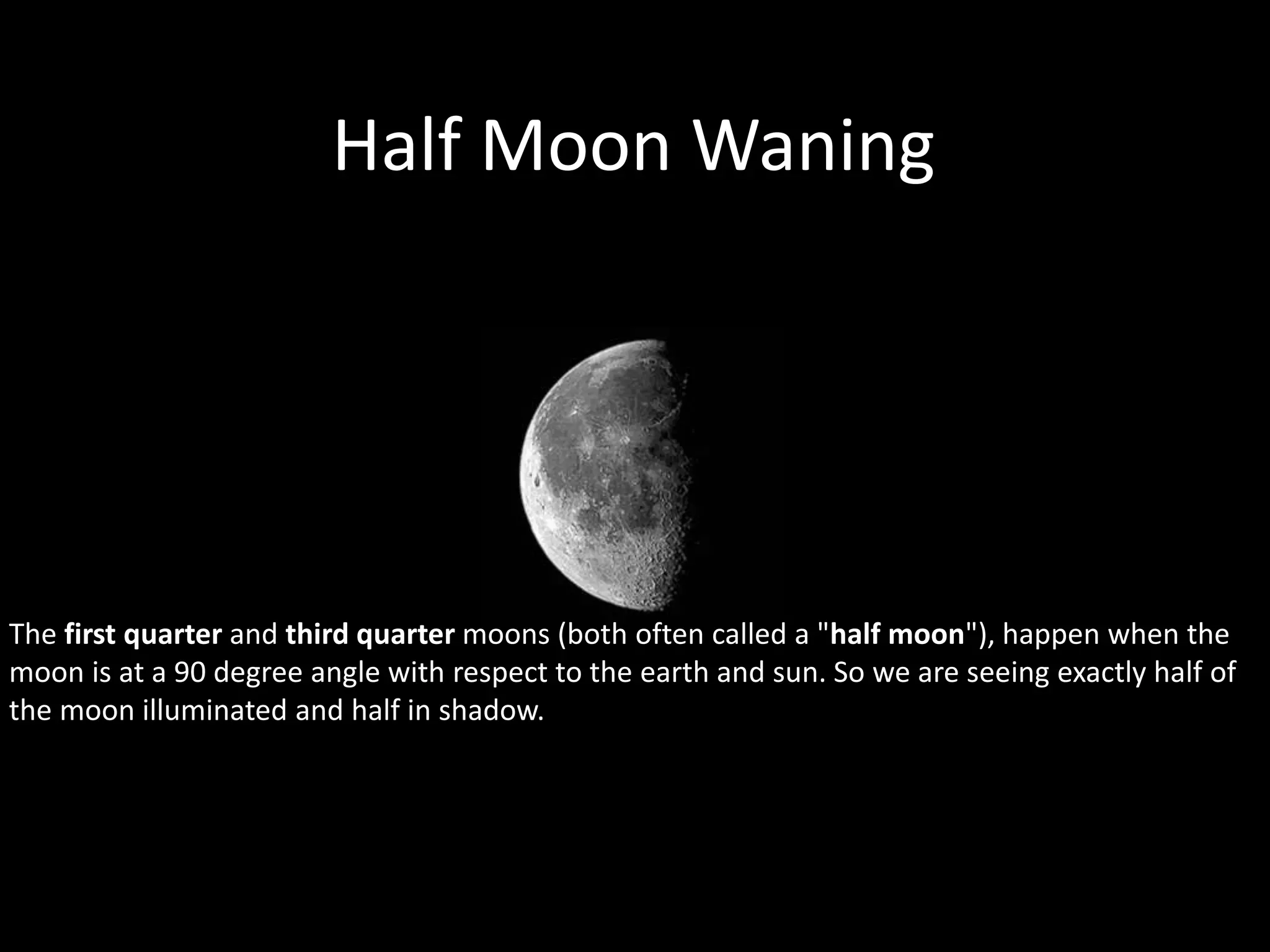
Half Moon Waning
The first quarter and third quarter moons (both often called a "half moon"), happen when the
moon is at a 90 degree angle with respect to the earth and sun. So we are seeing exactly half of
the moon illuminated and half in shadow.
Waning Gibbous
Waning Gibbous
Waning Gibbous
Waning Gibbous
Waning Gibbous
After the full moon (maximum illumination), the light
continually decreases. So the waning gibbous phase
occurs next.
Waning Crescent
Waning Crescent
Waning Crescent
Waning Crescent
Following the third quarter is the waning crescent,
which wanes until the light is completely gone
New Moon
the new moon occurs when the moon is
positioned between the earth and sun. The
three objects are in approximate alignment. The
entire illuminated portion of the moon is on the
back side of the moon, the half that we cannot
see.
Modelling the phases of the moon
You will need:
polystyrene ball, lamp and a retort stand
Working in groups of 3 –
1. One person acts as the earth and the other holds the ball
(moon) and the other holds the lamp (sun).
2. Darken the room and aim the lamp (sun) at the ball
(moon). The student holding the moon walks around the
earth in an anticlockwise direction, holding the same side
towards the earth.
3. Try to identify each of the 8 phases of the moon as they
are seen by the person representing the earth.
4. Stop rotating briefly when each of the phases is identified
so that the positions of the sun, earth an moon can be
recorded on your worksheet.
Make your own Phases of the Moon
Flip Book
Review
1. How many phases does the moon have?
2. What side of the moon do we see first?
3. What is it called when the moon appears to grow?
4. What is it called when the moon appears to get smaller?
5. How many days does it take the moon to complete a cycle?
6. Name the eight phases of the moon?
7. What is it called when you see more light in the moon (greater than
semicircle and less than a circle)?
8. What is it called when you see less light in the moon
9. What is a natural body that revolves around a planet
10. One of the shapes the moon seems to have as it orbits Earth.
11. How long does it take the earth to make one full turn on it's axis?
12. How long does the Earth's orbit take?
Answers
1. eight
2. dark side
3. waxing
4. wane
5. 29 1/2 days or 1 month
6. new moon, waxing crescent, first quarter, waxing gibbous, full moon, waning
gibbous, last quarter, waning crescent
7. gibbous
8. Crescent
9. Moon
10. Phase
11. 24 Hours
12. 365 days

Phases of the_moon

  • 1.
    THE HOOK The Phasesof the Moon Rap
  • 2.
  • 3.
    LEARNING INTENTION •To becomefamiliar with the phases of the moon •To understand how and why they appear
  • 4.
    SUCCESS CRITERIA •I understandhow and why the phases of the moon occur •I know the 8 phases of the moon
  • 5.
    Phases of theMoon Video
  • 6.
    Why does themoon appear to change shape? The moon orbits the earth. It takes 28 days for the moon to go around the earth once The only reason we can see the moon is because it reflects the light from the sun Only one half of the moon is ever lit As the moon travels around the earth we see different amounts of the lit side of the moon
  • 7.
    Day 1 -New moon The dark side of the moon is facing the earth
  • 8.
    New moon The darkside of the moon is facing the earth
  • 9.
    Day 4 –Waxing Crescent
  • 10.
    Waxing Crescent We beginto see part of the side of the moon that is lit up
  • 11.
    Day 7 –First quarter
  • 12.
    First Quarter Confused!? It’sobviously a half moon but is called a quarter moon because it has gone quarter of the way around the earth
  • 13.
    Day 10 –Waxing Gibbous
  • 14.
    Waxing Gibbous The moonis now in a position where we can see most of the side that is lit up
  • 15.
    Day 14 –Full moon
  • 16.
    Full moon The moonis pretty much opposite the sun now and so we can see all of the part that is lit up
  • 17.
    Day 18 –Waning Gibbous
  • 18.
    Waning Gibbous The moonis now in a position where we can see most of the lit side of the moon
  • 19.
    Day 21 –Last quarter
  • 20.
    Last Quarter The moonis in the last quarter of it’s way around the
  • 21.
    Day 24 –Waning Crescent
  • 22.
    Waning Crescent We arestarting to lose sight of the side of the moon that is lit up
  • 23.
    Day 28 -New moon The dark side of the moon is facing the earth again
  • 25.
    The Phases ofthe Moon The dotted lines represent our line of sight from Earth
  • 26.
    New Moon The NewMoon occurs when the moon is positioned between the earth and sun. The three objects are in approximate alignment. The entire illuminated portion of the moon is on the back side of the moon, the half that we cannot see.
  • 27.
    After the newmoon, the sunlit portion is increasing, but less than half, so it is a WAXING CRESCENT
  • 28.
  • 29.
  • 30.
  • 31.
    Half Moon Waxing Thefirst quarter and third quarter moons (both often called a "half moon"), happen when the moon is at a 90 degree angle with respect to the earth and sun. So we are seeing exactly half of the moon illuminated and half in shadow.
  • 32.
    Waxing Gibbous After thefirst quarter, the sunlit portion is still increasing, but now it is more than half, so it is waxing gibbous
  • 33.
  • 34.
  • 35.
  • 36.
    Full Moon At afull moon, the earth, moon, and sun are in approximate alignment, just as the new moon, but the moon is on the opposite side of the earth, so the entire sunlit part of the moon is facing us. The shadowed portion is entirely hidden from view.
  • 37.
    Half Moon Waning Thefirst quarter and third quarter moons (both often called a "half moon"), happen when the moon is at a 90 degree angle with respect to the earth and sun. So we are seeing exactly half of the moon illuminated and half in shadow.
  • 38.
  • 39.
  • 40.
  • 41.
  • 42.
    Waning Gibbous After thefull moon (maximum illumination), the light continually decreases. So the waning gibbous phase occurs next.
  • 43.
  • 44.
  • 45.
  • 46.
    Waning Crescent Following thethird quarter is the waning crescent, which wanes until the light is completely gone
  • 47.
    New Moon the newmoon occurs when the moon is positioned between the earth and sun. The three objects are in approximate alignment. The entire illuminated portion of the moon is on the back side of the moon, the half that we cannot see.
  • 48.
    Modelling the phasesof the moon You will need: polystyrene ball, lamp and a retort stand Working in groups of 3 – 1. One person acts as the earth and the other holds the ball (moon) and the other holds the lamp (sun). 2. Darken the room and aim the lamp (sun) at the ball (moon). The student holding the moon walks around the earth in an anticlockwise direction, holding the same side towards the earth. 3. Try to identify each of the 8 phases of the moon as they are seen by the person representing the earth. 4. Stop rotating briefly when each of the phases is identified so that the positions of the sun, earth an moon can be recorded on your worksheet.
  • 49.
    Make your ownPhases of the Moon Flip Book
  • 50.
    Review 1. How manyphases does the moon have? 2. What side of the moon do we see first? 3. What is it called when the moon appears to grow? 4. What is it called when the moon appears to get smaller? 5. How many days does it take the moon to complete a cycle? 6. Name the eight phases of the moon? 7. What is it called when you see more light in the moon (greater than semicircle and less than a circle)? 8. What is it called when you see less light in the moon 9. What is a natural body that revolves around a planet 10. One of the shapes the moon seems to have as it orbits Earth. 11. How long does it take the earth to make one full turn on it's axis? 12. How long does the Earth's orbit take?
  • 51.
    Answers 1. eight 2. darkside 3. waxing 4. wane 5. 29 1/2 days or 1 month 6. new moon, waxing crescent, first quarter, waxing gibbous, full moon, waning gibbous, last quarter, waning crescent 7. gibbous 8. Crescent 9. Moon 10. Phase 11. 24 Hours 12. 365 days