Learning Intention Success Criteria
• Understand what states of matter are.
• Understand what the particles in solid liquids and gases look like.
• Begin to understand the process of changing state.
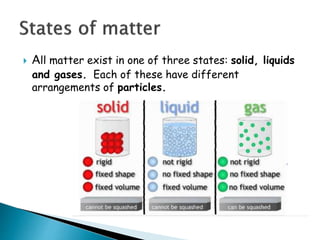
 All matter exist in one of three states: solid, liquids
and gases. Each of these have different
arrangements of particles.

All matter is made up of tiny particles called
atoms or molecules. Molecules are always
moving. They move differently depending on
whether they are a solid, liquid or gas.
Simulation of the States of Matter
-Practical Activity-
Role modelling the states of matter (in open area)
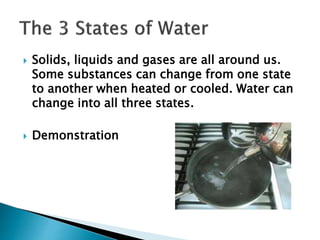
 Solids, liquids and gases are all around us.
Some substances can change from one state
to another when heated or cooled. Water can
change into all three states.
 Demonstration
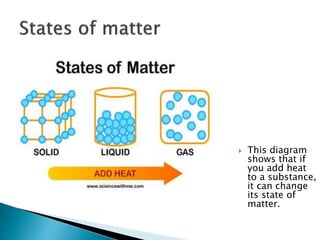
 This diagram
shows that if
you add heat
to a substance,
it can change
its state of
matter.
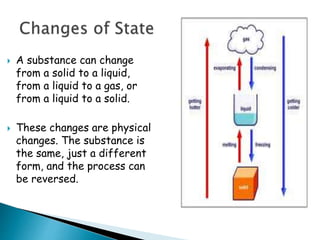
 A substance can change
from a solid to a liquid,
from a liquid to a gas, or
from a liquid to a solid.
 These changes are physical
changes. The substance is
the same, just a different
form, and the process can
be reversed.
 Solids and liquids expand when they get hotter
because the particles move further apart.
When they cool, they contract because the
particles become closer together.
What are the 3 states of matter? _________, _________ and _________
Fill in the gaps:
__________________ occurs when a solid becomes a liquid.
__________________ occurs when a gas becomes a liquid.
__________________ occurs when a liquid becomes a solid.
___________________occurs when a liquid becomes a gas.
How would you describe the arrangement of particles in a solid?
What are the particles in a liquid able to do that means a liquid can
take on the shape of the container?

Solids, liquids and_gases

  • 1.
    Learning Intention SuccessCriteria • Understand what states of matter are. • Understand what the particles in solid liquids and gases look like. • Begin to understand the process of changing state.
  • 3.
     All matterexist in one of three states: solid, liquids and gases. Each of these have different arrangements of particles.
  • 4.
     All matter ismade up of tiny particles called atoms or molecules. Molecules are always moving. They move differently depending on whether they are a solid, liquid or gas. Simulation of the States of Matter -Practical Activity- Role modelling the states of matter (in open area)
  • 5.
     Solids, liquidsand gases are all around us. Some substances can change from one state to another when heated or cooled. Water can change into all three states.  Demonstration
  • 6.
     This diagram showsthat if you add heat to a substance, it can change its state of matter.
  • 7.
     A substancecan change from a solid to a liquid, from a liquid to a gas, or from a liquid to a solid.  These changes are physical changes. The substance is the same, just a different form, and the process can be reversed.
  • 8.
     Solids andliquids expand when they get hotter because the particles move further apart. When they cool, they contract because the particles become closer together.
  • 9.
    What are the3 states of matter? _________, _________ and _________ Fill in the gaps: __________________ occurs when a solid becomes a liquid. __________________ occurs when a gas becomes a liquid. __________________ occurs when a liquid becomes a solid. ___________________occurs when a liquid becomes a gas. How would you describe the arrangement of particles in a solid? What are the particles in a liquid able to do that means a liquid can take on the shape of the container?