
Using A HYPHEN
Lapu-lapu o Lapulapu?
General Rule
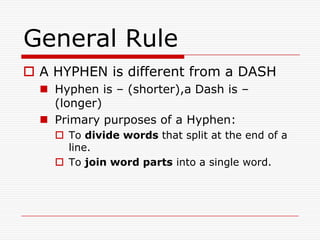
 A HYPHEN is different from a DASH
 Hyphen is – (shorter),a Dash is –
(longer)
 Primary purposes of a Hyphen:
 To divide words that split at the end of a
line.
 To join word parts into a single word.
General Rule
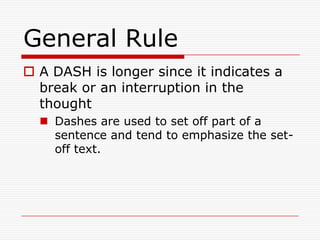
 A DASH is longer since it indicates a
break or an interruption in the
thought
 Dashes are used to set off part of a
sentence and tend to emphasize the set-
off text.
General Rule
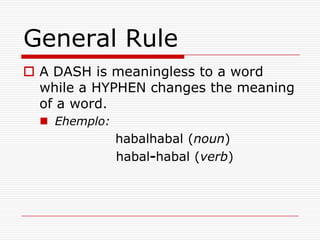
 A DASH is meaningless to a word
while a HYPHEN changes the meaning
of a word.
 Ehemplo:
habalhabal (noun)
habal-habal (verb)
Hyphen Rule for
Cebuano Writing
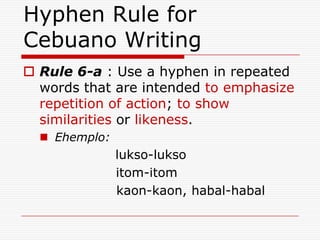
 Rule 6-a : Use a hyphen in repeated
words that are intended to emphasize
repetition of action; to show
similarities or likeness.
 Ehemplo:
lukso-lukso
itom-itom
kaon-kaon, habal-habal
Hyphen Rule for
Cebuano Writing
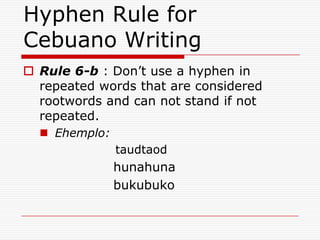
 Rule 6-b : Don’t use a hyphen in
repeated words that are considered
rootwords and can not stand if not
repeated.
 Ehemplo:
taudtaod
hunahuna
bukubuko
Hyphen Rule for
Cebuano Writing
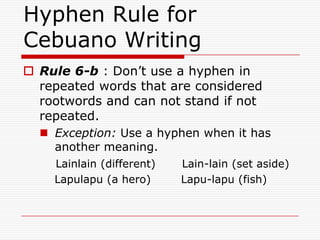
 Rule 6-b : Don’t use a hyphen in
repeated words that are considered
rootwords and can not stand if not
repeated.
 Exception: Use a hyphen when it has
another meaning.
Lainlain (different) Lain-lain (set aside)
Lapulapu (a hero) Lapu-lapu (fish)
Hyphen Rule for
Cebuano Writing
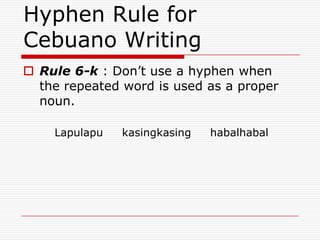
 Rule 6-k : Don’t use a hyphen when
the repeated word is used as a proper
noun.
Lapulapu kasingkasing habalhabal
Hyphen Rule for
Cebuano Writing
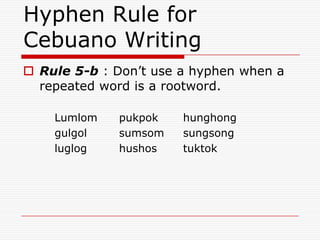
 Rule 5-b : Don’t use a hyphen when a
repeated word is a rootword.
Lumlom pukpok hunghong
gulgol sumsom sungsong
luglog hushos tuktok
Hyphen Rule for
Cebuano Writing
 Combined words : Each of the
combined words are of different
meaning and the hyphen replaces a
missing word.
gipusil-patay
balay-lungsod
batakan-balaod

Using a hyphen

  • 1.
  • 2.
    General Rule  AHYPHEN is different from a DASH  Hyphen is – (shorter),a Dash is – (longer)  Primary purposes of a Hyphen:  To divide words that split at the end of a line.  To join word parts into a single word.
  • 3.
    General Rule  ADASH is longer since it indicates a break or an interruption in the thought  Dashes are used to set off part of a sentence and tend to emphasize the set- off text.
  • 4.
    General Rule  ADASH is meaningless to a word while a HYPHEN changes the meaning of a word.  Ehemplo: habalhabal (noun) habal-habal (verb)
  • 5.
    Hyphen Rule for CebuanoWriting  Rule 6-a : Use a hyphen in repeated words that are intended to emphasize repetition of action; to show similarities or likeness.  Ehemplo: lukso-lukso itom-itom kaon-kaon, habal-habal
  • 6.
    Hyphen Rule for CebuanoWriting  Rule 6-b : Don’t use a hyphen in repeated words that are considered rootwords and can not stand if not repeated.  Ehemplo: taudtaod hunahuna bukubuko
  • 7.
    Hyphen Rule for CebuanoWriting  Rule 6-b : Don’t use a hyphen in repeated words that are considered rootwords and can not stand if not repeated.  Exception: Use a hyphen when it has another meaning. Lainlain (different) Lain-lain (set aside) Lapulapu (a hero) Lapu-lapu (fish)
  • 8.
    Hyphen Rule for CebuanoWriting  Rule 6-k : Don’t use a hyphen when the repeated word is used as a proper noun. Lapulapu kasingkasing habalhabal
  • 9.
    Hyphen Rule for CebuanoWriting  Rule 5-b : Don’t use a hyphen when a repeated word is a rootword. Lumlom pukpok hunghong gulgol sumsom sungsong luglog hushos tuktok
  • 10.
    Hyphen Rule for CebuanoWriting  Combined words : Each of the combined words are of different meaning and the hyphen replaces a missing word. gipusil-patay balay-lungsod batakan-balaod