CEBUANO ALPHABETCEBUANO ALPHABET
(Sinugbuanong Titikanan)(Sinugbuanong Titikanan)
5 Vowels, 14 Consonants5 Vowels, 14 Consonants
a, e, i, o, ua, e, i, o, u
b, k, d, g, h, l, m, n, p, r, s, t, w, yb, k, d, g, h, l, m, n, p, r, s, t, w, y
5 Vowels, 14 Consonants5 Vowels, 14 Consonants
a, e, i, o, ua, e, i, o, u
b, k, d, g, h, l, m, n, p, r, s, t, w, yb, k, d, g, h, l, m, n, p, r, s, t, w, y
(not in the Alphabet)(not in the Alphabet)
C, Ch, F, J, LL, Ñ, Ph, Q, RR, V, X, ZC, Ch, F, J, LL, Ñ, Ph, Q, RR, V, X, Z
C, Ch, F, J, LL, Ñ, Ph, Q,C, Ch, F, J, LL, Ñ, Ph, Q,
RR, V, X, ZRR, V, X, Z
CC beforebefore AA,, OO,, UU becomesbecomes KK
Carro (KARO)Carro (KARO)
Common (KOMON)Common (KOMON)
CC beforebefore E, IE, I becomesbecomes SS
Centro (SENTRO)Centro (SENTRO)
Civil (SIBIL)Civil (SIBIL)
C, Ch, F, J, LL, Ñ, Ph, Q,C, Ch, F, J, LL, Ñ, Ph, Q,
RR, V, X, ZRR, V, X, Z
CHCH becomesbecomes TSTS
China (TSINA)China (TSINA)
Chicharon (TSITSARON)Chicharon (TSITSARON)
FF becomesbecomes PP
Filipinas (PILIPINAS)Filipinas (PILIPINAS)
JJ becomesbecomes HH
July (HULYO)July (HULYO)
Japanese (HAPONES)Japanese (HAPONES)
C, Ch, F, J, LL, Ñ, Q, R, V,C, Ch, F, J, LL, Ñ, Q, R, V,
X, ZX, Z
LLLL becomesbecomes LYLY
Sello (SELYO)Sello (SELYO)
Cuchillo (KUTSILYO)Cuchillo (KUTSILYO)
ÑÑ becomesbecomes NYNY
Señal (SINYAL)Señal (SINYAL)
Señor (SENYOR)Señor (SENYOR)
QQ beforebefore UIUI becomesbecomes KI,KI,
Mannequin (MANIKIN)Mannequin (MANIKIN)
Maquina (MAKINA)Maquina (MAKINA)
Taquilla (TAKILYA)Taquilla (TAKILYA)
C, Ch, F, J, LL, Ñ, Q, RR,C, Ch, F, J, LL, Ñ, Q, RR,
V, X, ZV, X, Z
QQ beforebefore UEUE becomesbecomes KE,KE,
Plaque (PLAKE)Plaque (PLAKE)
Tanque (TANGKE)Tanque (TANGKE)
Querida (KERIDA)Querida (KERIDA)
RRRR becomesbecomes RR
Carrera (KARERA)Carrera (KARERA)
Correo (KOREYO)Correo (KOREYO)
Arras (ARAS)Arras (ARAS)
C, Ch, F, J, LL, Ñ, Q, RR,C, Ch, F, J, LL, Ñ, Q, RR,
V, X, ZV, X, Z
VV becomesbecomes BB
Aviva (ABIBA)Aviva (ABIBA)
Favor (PABOR)Favor (PABOR)
Vino (BINO)Vino (BINO)
XX becomesbecomes KSKS
Exact (EKSAKTO)Exact (EKSAKTO)
Examine (EKSAMINASYON)Examine (EKSAMINASYON)
ZZ becomesbecomes SS
Cruzada (KRUSADA)Cruzada (KRUSADA)
Lapiz (LAPIS)Lapiz (LAPIS)
AZUL (Asul)AZUL (Asul)
The VOWELS (Patingog)The VOWELS (Patingog)
““A” (short “a”)A” (short “a”)
Short “a”Short “a” (as n abaga, baha, dalaga)(as n abaga, baha, dalaga)
Not long “a”Not long “a” (as in base, mate)(as in base, mate)
Use in adopted English wordUse in adopted English word (natural,(natural,
abnormal)abnormal)
The VOWELS (Patingog)The VOWELS (Patingog)
““E”E”
General Rule: “General Rule: “II” should be used in all native” should be used in all native
words.words.
Use in adopted FOREIGN word with sameUse in adopted FOREIGN word with same
spellingspelling
– AlegreAlegre
– BoteBote
– EntranteEntrante
– EsposaEsposa
– GabineteGabinete
– LibreLibre
– petsapetsa
The VOWELS (Patingog)The VOWELS (Patingog)
““E”E”
Use in FOREIGN words with differentUse in FOREIGN words with different
consonant spellingconsonant spelling
– Coche (KOTSE)Coche (KOTSE)
– Fuerte (PUWERTE)Fuerte (PUWERTE)
– Fecha (PETSA)Fecha (PETSA)
– Camote (KAMOTE)Camote (KAMOTE)
– Leche (LETSE)Leche (LETSE)
The VOWELS (Patingog)The VOWELS (Patingog)
““E”E”
Exception: When a Spanish word has no sameException: When a Spanish word has no same
sound equivalent English word or vice-versa,sound equivalent English word or vice-versa,
““ee” is changed to “” is changed to “II””
– Capella (KAPILYA)Capella (KAPILYA)
– Empacho (IMPATSO)Empacho (IMPATSO)
– Escultor (ISKULTOR)Escultor (ISKULTOR)
– Estacion (ISTASYON)Estacion (ISTASYON)
– Estilo (ESTILO)Estilo (ESTILO)
The VOWELS (Patingog)The VOWELS (Patingog)
““E”E”
Exception: When a foreign word is adopted asException: When a foreign word is adopted as
a native word, “a native word, “ee” is changed to “” is changed to “II””
– Ataque (ATAKI)Ataque (ATAKI)
– Espejo (ISPIHO)Espejo (ISPIHO)
– Mantel (MANTIL)Mantel (MANTIL)
– Tendera (TINDERA)Tendera (TINDERA)
– Caldero (KALDIRO)Caldero (KALDIRO)
– Ventana (BINTANA)Ventana (BINTANA)
The VOWELS (Patingog)The VOWELS (Patingog)
““E”E”
Exception: When a Spanish word with an “Exception: When a Spanish word with an “II””
has an equivalent English word but with an “has an equivalent English word but with an “ee”,”,
the English word shall be adopted.the English word shall be adopted.
– Actriz = Actress = (AKTRES)Actriz = Actress = (AKTRES)
The VOWELS (Patingog)The VOWELS (Patingog)
““E”E”
Exception: When a a borrowed rootword endedException: When a a borrowed rootword ended
in “in “ee” and joined with a suffix, “” and joined with a suffix, “ee” is changed to” is changed to
““II”.”.
– Bayle (BAYLIHAN)Bayle (BAYLIHAN)
– Kamote (KAMOTIHAN)Kamote (KAMOTIHAN)
– Higante (HIGANTING hayop)Higante (HIGANTING hayop)
– Peste (PESTING iroa)Peste (PESTING iroa)
– Bigote (BIGOTILYO)Bigote (BIGOTILYO)
– Kape (KAPIHAN)Kape (KAPIHAN)
The VOWELS (Patingog)The VOWELS (Patingog)
““I”I”
General Rule: “General Rule: “II” should be used in all native” should be used in all native
words.words.
– BakiBaki Exception:Exception:
– ItiIti babayebabaye
– KitiwKitiw pangadyepangadye
– PiniliPinili butetebutete
– BahiBahi sikwatesikwate
– GahiGahi dayegdayeg
– ItikItik
The VOWELS (Patingog)The VOWELS (Patingog)
““I”I”
““II” to replace” to replace UEUE,, UIUI,, UIEUIE..
– Guerra (GIYERA)Guerra (GIYERA)
– Guia (GIYA)Guia (GIYA)
– Guirrilla (GIRILYA)Guirrilla (GIRILYA)
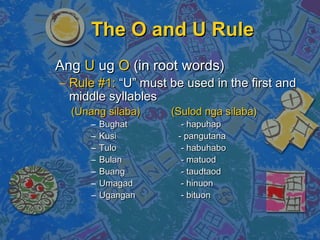
The O and U RuleThe O and U Rule
AngAng UU ugug OO (in root words)(in root words)
– Rule #1:Rule #1: “U” must be used in the first and“U” must be used in the first and
middle syllablesmiddle syllables
(Unang silaba)(Unang silaba) (Sulod nga silaba)(Sulod nga silaba)
– BughatBughat - hapuhap- hapuhap
– KusiKusi - pangutana- pangutana
– TuloTulo - habuhabo- habuhabo
– BulanBulan - matuod- matuod
– BuangBuang - taudtaod- taudtaod
– UmagadUmagad - hinuon- hinuon
– UganganUgangan - bituon- bituon
The O and U RuleThe O and U Rule
AngAng UU ugug OO (in root words)(in root words)
– Rule #2:Rule #2: “O” must be used in the last“O” must be used in the last
syllablesyllable
(kataposang silaba)(kataposang silaba)
– pakopako
– lungsodlungsod
– taobtaob
– dakodako
– tulotulo
– matodmatod
– nasodnasod
The O and U RuleThe O and U Rule
AngAng UU ugug OO (in repeated action words)(in repeated action words)
– Rule #6-a:Rule #6-a: “O” and “U” shall be retained“O” and “U” shall be retained
– lukso-luksolukso-lukso - inom-inom- inom-inom
– Hubo-huboHubo-hubo - buot-buot- buot-buot
– Dakop-dakopDakop-dakop - hubog-hubog- hubog-hubog
OO andand UU in repeated rootwordsin repeated rootwords
– Rule #6-b:Rule #6-b: “O” if in last syllable; “U” if first“O” if in last syllable; “U” if first
and middle syllableand middle syllable
– TaudtaodTaudtaod - hunahuna- hunahuna
– BukubukoBukubuko - habuhabo- habuhabo
– BagulbagolBagulbagol - tuwaytuway- tuwaytuway
The O and U RuleThe O and U Rule
AngAng UU ugug OO (in repeated proper noun)(in repeated proper noun)
– Rule #6-k:Rule #6-k: (same with rule 6-b)(same with rule 6-b)
– LapulapuLapulapu
– tubatubatubatuba
– BagulbagolBagulbagol
The O and U RuleThe O and U Rule
UU andand OO is always retained when theis always retained when the
rootword is affixedrootword is affixed
Himoon (himo + on)Himoon (himo + on)
Handomanan (handom + anan)Handomanan (handom + anan)
Lungsoranon (Lungsod + anon)Lungsoranon (Lungsod + anon)
UU is retained in words when the firstis retained in words when the first
syllable is repeatedsyllable is repeated
Magtutudlo (tudlo)Magtutudlo (tudlo)
Maghuhukom (hukom)Maghuhukom (hukom)
Magsusulat (sulat)Magsusulat (sulat)

Cebuano alphabet

  • 1.
    CEBUANO ALPHABETCEBUANO ALPHABET (SinugbuanongTitikanan)(Sinugbuanong Titikanan)
  • 2.
    5 Vowels, 14Consonants5 Vowels, 14 Consonants a, e, i, o, ua, e, i, o, u b, k, d, g, h, l, m, n, p, r, s, t, w, yb, k, d, g, h, l, m, n, p, r, s, t, w, y
  • 3.
    5 Vowels, 14Consonants5 Vowels, 14 Consonants a, e, i, o, ua, e, i, o, u b, k, d, g, h, l, m, n, p, r, s, t, w, yb, k, d, g, h, l, m, n, p, r, s, t, w, y (not in the Alphabet)(not in the Alphabet) C, Ch, F, J, LL, Ñ, Ph, Q, RR, V, X, ZC, Ch, F, J, LL, Ñ, Ph, Q, RR, V, X, Z
  • 4.
    C, Ch, F,J, LL, Ñ, Ph, Q,C, Ch, F, J, LL, Ñ, Ph, Q, RR, V, X, ZRR, V, X, Z CC beforebefore AA,, OO,, UU becomesbecomes KK Carro (KARO)Carro (KARO) Common (KOMON)Common (KOMON) CC beforebefore E, IE, I becomesbecomes SS Centro (SENTRO)Centro (SENTRO) Civil (SIBIL)Civil (SIBIL)
  • 5.
    C, Ch, F,J, LL, Ñ, Ph, Q,C, Ch, F, J, LL, Ñ, Ph, Q, RR, V, X, ZRR, V, X, Z CHCH becomesbecomes TSTS China (TSINA)China (TSINA) Chicharon (TSITSARON)Chicharon (TSITSARON) FF becomesbecomes PP Filipinas (PILIPINAS)Filipinas (PILIPINAS) JJ becomesbecomes HH July (HULYO)July (HULYO) Japanese (HAPONES)Japanese (HAPONES)
  • 6.
    C, Ch, F,J, LL, Ñ, Q, R, V,C, Ch, F, J, LL, Ñ, Q, R, V, X, ZX, Z LLLL becomesbecomes LYLY Sello (SELYO)Sello (SELYO) Cuchillo (KUTSILYO)Cuchillo (KUTSILYO) ÑÑ becomesbecomes NYNY Señal (SINYAL)Señal (SINYAL) Señor (SENYOR)Señor (SENYOR) QQ beforebefore UIUI becomesbecomes KI,KI, Mannequin (MANIKIN)Mannequin (MANIKIN) Maquina (MAKINA)Maquina (MAKINA) Taquilla (TAKILYA)Taquilla (TAKILYA)
  • 7.
    C, Ch, F,J, LL, Ñ, Q, RR,C, Ch, F, J, LL, Ñ, Q, RR, V, X, ZV, X, Z QQ beforebefore UEUE becomesbecomes KE,KE, Plaque (PLAKE)Plaque (PLAKE) Tanque (TANGKE)Tanque (TANGKE) Querida (KERIDA)Querida (KERIDA) RRRR becomesbecomes RR Carrera (KARERA)Carrera (KARERA) Correo (KOREYO)Correo (KOREYO) Arras (ARAS)Arras (ARAS)
  • 8.
    C, Ch, F,J, LL, Ñ, Q, RR,C, Ch, F, J, LL, Ñ, Q, RR, V, X, ZV, X, Z VV becomesbecomes BB Aviva (ABIBA)Aviva (ABIBA) Favor (PABOR)Favor (PABOR) Vino (BINO)Vino (BINO) XX becomesbecomes KSKS Exact (EKSAKTO)Exact (EKSAKTO) Examine (EKSAMINASYON)Examine (EKSAMINASYON) ZZ becomesbecomes SS Cruzada (KRUSADA)Cruzada (KRUSADA) Lapiz (LAPIS)Lapiz (LAPIS) AZUL (Asul)AZUL (Asul)
  • 9.
    The VOWELS (Patingog)TheVOWELS (Patingog) ““A” (short “a”)A” (short “a”) Short “a”Short “a” (as n abaga, baha, dalaga)(as n abaga, baha, dalaga) Not long “a”Not long “a” (as in base, mate)(as in base, mate) Use in adopted English wordUse in adopted English word (natural,(natural, abnormal)abnormal)
  • 10.
    The VOWELS (Patingog)TheVOWELS (Patingog) ““E”E” General Rule: “General Rule: “II” should be used in all native” should be used in all native words.words. Use in adopted FOREIGN word with sameUse in adopted FOREIGN word with same spellingspelling – AlegreAlegre – BoteBote – EntranteEntrante – EsposaEsposa – GabineteGabinete – LibreLibre – petsapetsa
  • 11.
    The VOWELS (Patingog)TheVOWELS (Patingog) ““E”E” Use in FOREIGN words with differentUse in FOREIGN words with different consonant spellingconsonant spelling – Coche (KOTSE)Coche (KOTSE) – Fuerte (PUWERTE)Fuerte (PUWERTE) – Fecha (PETSA)Fecha (PETSA) – Camote (KAMOTE)Camote (KAMOTE) – Leche (LETSE)Leche (LETSE)
  • 12.
    The VOWELS (Patingog)TheVOWELS (Patingog) ““E”E” Exception: When a Spanish word has no sameException: When a Spanish word has no same sound equivalent English word or vice-versa,sound equivalent English word or vice-versa, ““ee” is changed to “” is changed to “II”” – Capella (KAPILYA)Capella (KAPILYA) – Empacho (IMPATSO)Empacho (IMPATSO) – Escultor (ISKULTOR)Escultor (ISKULTOR) – Estacion (ISTASYON)Estacion (ISTASYON) – Estilo (ESTILO)Estilo (ESTILO)
  • 13.
    The VOWELS (Patingog)TheVOWELS (Patingog) ““E”E” Exception: When a foreign word is adopted asException: When a foreign word is adopted as a native word, “a native word, “ee” is changed to “” is changed to “II”” – Ataque (ATAKI)Ataque (ATAKI) – Espejo (ISPIHO)Espejo (ISPIHO) – Mantel (MANTIL)Mantel (MANTIL) – Tendera (TINDERA)Tendera (TINDERA) – Caldero (KALDIRO)Caldero (KALDIRO) – Ventana (BINTANA)Ventana (BINTANA)
  • 14.
    The VOWELS (Patingog)TheVOWELS (Patingog) ““E”E” Exception: When a Spanish word with an “Exception: When a Spanish word with an “II”” has an equivalent English word but with an “has an equivalent English word but with an “ee”,”, the English word shall be adopted.the English word shall be adopted. – Actriz = Actress = (AKTRES)Actriz = Actress = (AKTRES)
  • 15.
    The VOWELS (Patingog)TheVOWELS (Patingog) ““E”E” Exception: When a a borrowed rootword endedException: When a a borrowed rootword ended in “in “ee” and joined with a suffix, “” and joined with a suffix, “ee” is changed to” is changed to ““II”.”. – Bayle (BAYLIHAN)Bayle (BAYLIHAN) – Kamote (KAMOTIHAN)Kamote (KAMOTIHAN) – Higante (HIGANTING hayop)Higante (HIGANTING hayop) – Peste (PESTING iroa)Peste (PESTING iroa) – Bigote (BIGOTILYO)Bigote (BIGOTILYO) – Kape (KAPIHAN)Kape (KAPIHAN)
  • 16.
    The VOWELS (Patingog)TheVOWELS (Patingog) ““I”I” General Rule: “General Rule: “II” should be used in all native” should be used in all native words.words. – BakiBaki Exception:Exception: – ItiIti babayebabaye – KitiwKitiw pangadyepangadye – PiniliPinili butetebutete – BahiBahi sikwatesikwate – GahiGahi dayegdayeg – ItikItik
  • 17.
    The VOWELS (Patingog)TheVOWELS (Patingog) ““I”I” ““II” to replace” to replace UEUE,, UIUI,, UIEUIE.. – Guerra (GIYERA)Guerra (GIYERA) – Guia (GIYA)Guia (GIYA) – Guirrilla (GIRILYA)Guirrilla (GIRILYA)
  • 18.
    The O andU RuleThe O and U Rule AngAng UU ugug OO (in root words)(in root words) – Rule #1:Rule #1: “U” must be used in the first and“U” must be used in the first and middle syllablesmiddle syllables (Unang silaba)(Unang silaba) (Sulod nga silaba)(Sulod nga silaba) – BughatBughat - hapuhap- hapuhap – KusiKusi - pangutana- pangutana – TuloTulo - habuhabo- habuhabo – BulanBulan - matuod- matuod – BuangBuang - taudtaod- taudtaod – UmagadUmagad - hinuon- hinuon – UganganUgangan - bituon- bituon
  • 19.
    The O andU RuleThe O and U Rule AngAng UU ugug OO (in root words)(in root words) – Rule #2:Rule #2: “O” must be used in the last“O” must be used in the last syllablesyllable (kataposang silaba)(kataposang silaba) – pakopako – lungsodlungsod – taobtaob – dakodako – tulotulo – matodmatod – nasodnasod
  • 20.
    The O andU RuleThe O and U Rule AngAng UU ugug OO (in repeated action words)(in repeated action words) – Rule #6-a:Rule #6-a: “O” and “U” shall be retained“O” and “U” shall be retained – lukso-luksolukso-lukso - inom-inom- inom-inom – Hubo-huboHubo-hubo - buot-buot- buot-buot – Dakop-dakopDakop-dakop - hubog-hubog- hubog-hubog OO andand UU in repeated rootwordsin repeated rootwords – Rule #6-b:Rule #6-b: “O” if in last syllable; “U” if first“O” if in last syllable; “U” if first and middle syllableand middle syllable – TaudtaodTaudtaod - hunahuna- hunahuna – BukubukoBukubuko - habuhabo- habuhabo – BagulbagolBagulbagol - tuwaytuway- tuwaytuway
  • 21.
    The O andU RuleThe O and U Rule AngAng UU ugug OO (in repeated proper noun)(in repeated proper noun) – Rule #6-k:Rule #6-k: (same with rule 6-b)(same with rule 6-b) – LapulapuLapulapu – tubatubatubatuba – BagulbagolBagulbagol
  • 22.
    The O andU RuleThe O and U Rule UU andand OO is always retained when theis always retained when the rootword is affixedrootword is affixed Himoon (himo + on)Himoon (himo + on) Handomanan (handom + anan)Handomanan (handom + anan) Lungsoranon (Lungsod + anon)Lungsoranon (Lungsod + anon) UU is retained in words when the firstis retained in words when the first syllable is repeatedsyllable is repeated Magtutudlo (tudlo)Magtutudlo (tudlo) Maghuhukom (hukom)Maghuhukom (hukom) Magsusulat (sulat)Magsusulat (sulat)