Phases and Phase Transition
Dr. K. Shahzad Baig
Memorial University of Newfoundland
(MUN)
Canada
Petrucci, et al. 2011. General Chemistry: Principles and Modern Applications. Pearson Canada Inc., Toronto, Ontario.
Tro, N.J. 2010. Principles of Chemistry. : a molecular approach. Pearson Education, Inc
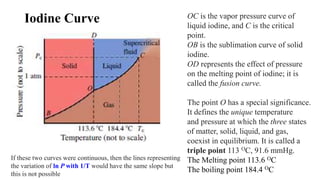
OC is the vapor pressure curve of
liquid iodine, and C is the critical
point.
OB is the sublimation curve of solid
iodine.
OD represents the effect of pressure
on the melting point of iodine; it is
called the fusion curve.
The point O has a special significance.
It defines the unique temperature
and pressure at which the three states
of matter, solid, liquid, and gas,
coexist in equilibrium. It is called a
triple point 113 OC, 91.6 mmHg.
The Melting point 113.6 OC
The boiling point 184.4 OC
Iodine Curve
If these two curves were continuous, then the lines representing
the variation of ln P with 1/T would have the same slope but
this is not possible
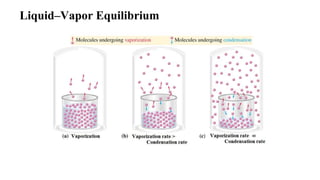
Liquid–Vapor Equilibrium
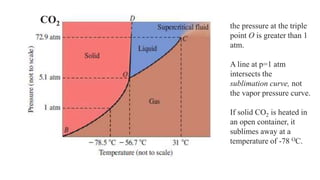
the pressure at the triple
point O is greater than 1
atm.
A line at p=1 atm
intersects the
sublimation curve, not
the vapor pressure curve.
If solid CO2 is heated in
an open container, it
sublimes away at a
temperature of -78 OC.
CO2
It does not melt at atmospheric pressure, called dry ice. Dry ice is widely used in
freezing and preserving foods.
Liquid CO2 can be obtained above 5.1 atm and it is most frequently encountered in CO2
fire extinguishers.
All three states of matter are involved in the action of these fire extinguishers. When the
liquid CO2 is released, most of it quickly vaporizes. The heat required for this
vaporization is extracted from the remaining CO2 (l) which has its temperature lowered
to the point that it freezes and falls as a snow. In turn, the quickly sublimes to CO2 (g).
It displaces the air around the fire with a blanket of CO2 (g).
Supercritical Fluids
A supercritical fluid is any substance at a temperature and pressure above its critical point,
where distinct liquid and gas phases do not exist.
There is no surface tension in a supercritical fluid, as there is no liquid/gas phase boundary.
By changing the pressure and temperature of the fluid, the properties can be "tuned" to be
more liquid-like or more gas-like.
Liquids and solids become much more soluble in a gas that is above its critical pressure
and temperature, mostly because the density of the SCF is high and approaches that of a
liquid.
Molecules in supercritical fluids, SCF, being in much closer proximity than in ordinary
gases, can exert strong attractive forces on the molecules of a liquid or solid solute.
Decaffeinating coffee
green coffee beans are brought into contact with supercritical fluid CO2at about and 160 to
220 atm. The caffeine content of coffee is reduced from ‘1-3% to 0.02%’ .
When the T and P of the CO2 are reduced, the caffeine precipitates and CO2 is recycled
Water
The phase diagram of water presents several features.
1. the fusion curve OD has a negative slope; i.e., it slopes
toward the pressure axis.
The melting point of ice decreases with an increase in
pressure, and this is rather unusual behavior for a solid.
2. Polymorphism of ice
Ordinary ice, ice I, exists under ordinary pressures.
The other forms exist only at high pressures.
Polymorphism where it occurs, a phase diagram has triple
points. For example at point D ice I, ice III, and liquid H2O
are in equilibrium at -22 OCand 2045 atm.
Note that the fusion curves for the forms of ice other than
ice I have positive slopes. Thus, the triple point with ice VI,
ice VII, and liquid water is at 81 OC and 21,700 atm.
Phases and Phase Transitions
A phase is any sample of matter with definite composition and uniform properties
that is distinguishable from other phases with which it is in contact.
Thus, liquid water in equilibrium with its vapor as a two-phase mixture.
Other example is triethylamine, N(CH2CH3)3, and water H2O at 25 OC, two physically
distinct liquid phases.
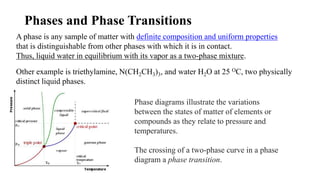
Phase diagrams illustrate the variations
between the states of matter of elements or
compounds as they relate to pressure and
temperatures.
The crossing of a two-phase curve in a phase
diagram a phase transition.
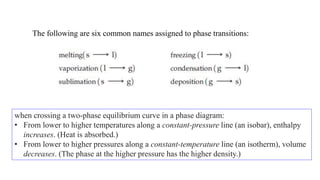
The following are six common names assigned to phase transitions:
when crossing a two-phase equilibrium curve in a phase diagram:
• From lower to higher temperatures along a constant-pressure line (an isobar), enthalpy
increases. (Heat is absorbed.)
• From lower to higher pressures along a constant-temperature line (an isotherm), volume
decreases. (The phase at the higher pressure has the higher density.)

Phases and phase transitions, 12(3)

  • 1.
    Phases and PhaseTransition Dr. K. Shahzad Baig Memorial University of Newfoundland (MUN) Canada Petrucci, et al. 2011. General Chemistry: Principles and Modern Applications. Pearson Canada Inc., Toronto, Ontario. Tro, N.J. 2010. Principles of Chemistry. : a molecular approach. Pearson Education, Inc
  • 2.
    OC is thevapor pressure curve of liquid iodine, and C is the critical point. OB is the sublimation curve of solid iodine. OD represents the effect of pressure on the melting point of iodine; it is called the fusion curve. The point O has a special significance. It defines the unique temperature and pressure at which the three states of matter, solid, liquid, and gas, coexist in equilibrium. It is called a triple point 113 OC, 91.6 mmHg. The Melting point 113.6 OC The boiling point 184.4 OC Iodine Curve If these two curves were continuous, then the lines representing the variation of ln P with 1/T would have the same slope but this is not possible
  • 3.
  • 4.
    the pressure atthe triple point O is greater than 1 atm. A line at p=1 atm intersects the sublimation curve, not the vapor pressure curve. If solid CO2 is heated in an open container, it sublimes away at a temperature of -78 OC. CO2
  • 5.
    It does notmelt at atmospheric pressure, called dry ice. Dry ice is widely used in freezing and preserving foods. Liquid CO2 can be obtained above 5.1 atm and it is most frequently encountered in CO2 fire extinguishers. All three states of matter are involved in the action of these fire extinguishers. When the liquid CO2 is released, most of it quickly vaporizes. The heat required for this vaporization is extracted from the remaining CO2 (l) which has its temperature lowered to the point that it freezes and falls as a snow. In turn, the quickly sublimes to CO2 (g). It displaces the air around the fire with a blanket of CO2 (g).
  • 6.
    Supercritical Fluids A supercriticalfluid is any substance at a temperature and pressure above its critical point, where distinct liquid and gas phases do not exist. There is no surface tension in a supercritical fluid, as there is no liquid/gas phase boundary. By changing the pressure and temperature of the fluid, the properties can be "tuned" to be more liquid-like or more gas-like. Liquids and solids become much more soluble in a gas that is above its critical pressure and temperature, mostly because the density of the SCF is high and approaches that of a liquid. Molecules in supercritical fluids, SCF, being in much closer proximity than in ordinary gases, can exert strong attractive forces on the molecules of a liquid or solid solute. Decaffeinating coffee green coffee beans are brought into contact with supercritical fluid CO2at about and 160 to 220 atm. The caffeine content of coffee is reduced from ‘1-3% to 0.02%’ . When the T and P of the CO2 are reduced, the caffeine precipitates and CO2 is recycled
  • 7.
    Water The phase diagramof water presents several features. 1. the fusion curve OD has a negative slope; i.e., it slopes toward the pressure axis. The melting point of ice decreases with an increase in pressure, and this is rather unusual behavior for a solid. 2. Polymorphism of ice Ordinary ice, ice I, exists under ordinary pressures. The other forms exist only at high pressures. Polymorphism where it occurs, a phase diagram has triple points. For example at point D ice I, ice III, and liquid H2O are in equilibrium at -22 OCand 2045 atm. Note that the fusion curves for the forms of ice other than ice I have positive slopes. Thus, the triple point with ice VI, ice VII, and liquid water is at 81 OC and 21,700 atm.
  • 8.
    Phases and PhaseTransitions A phase is any sample of matter with definite composition and uniform properties that is distinguishable from other phases with which it is in contact. Thus, liquid water in equilibrium with its vapor as a two-phase mixture. Other example is triethylamine, N(CH2CH3)3, and water H2O at 25 OC, two physically distinct liquid phases. Phase diagrams illustrate the variations between the states of matter of elements or compounds as they relate to pressure and temperatures. The crossing of a two-phase curve in a phase diagram a phase transition.
  • 9.
    The following aresix common names assigned to phase transitions: when crossing a two-phase equilibrium curve in a phase diagram: • From lower to higher temperatures along a constant-pressure line (an isobar), enthalpy increases. (Heat is absorbed.) • From lower to higher pressures along a constant-temperature line (an isotherm), volume decreases. (The phase at the higher pressure has the higher density.)

Editor's Notes

  • #3 1 atm is equal to 760 mm Hg
  • #8 the existence of a solid substance in more than one form. Normally the solid/liquid phase line slopes positively to the right (as in the diagram for carbon dioxide below). However for other substances, notably water, the line slopes to the left as the diagram for water shows. This indicates that the liquid phase is more dense than the solid phase.
  • #9 The liquid is one phase and the gas, or vapor, is the other. In this case, the phases (liquid and gas) are the same as the states of matter present (liquid and gas).