

For more help contact me

Muhammad Umair Bukhari

        Engr.umair.bukhari@gmail.com

           www.bzuiam.webs.com
                03136050151
Nucleation of Liquid:
 The solidification of metals occurs by
  nucleation & growth. Same is also true for
  melting.
 Nucleation of solid phase during freezing is
  much more difficult process than formation of
  nuclei of liquid phase during melting.
 Metals do not superheat to any appreciable
  extent before they are liquefied, whereas some
  super cooling occurs almost every time a metal
  is frozen.
 In melting most metals do not normally
  superheat, although superheating of the order
  of 0.1k has been reported for gallium.
Cont’d….
 Nucleation in melting occurs on the surfaces of
  solids .
 In this case, the nucleus , consisting of a
  region of the liquid phase , will be enveloped
  by two different surfaces .
 One side is liquid-solid interface and other is
  gas-liquid interface.
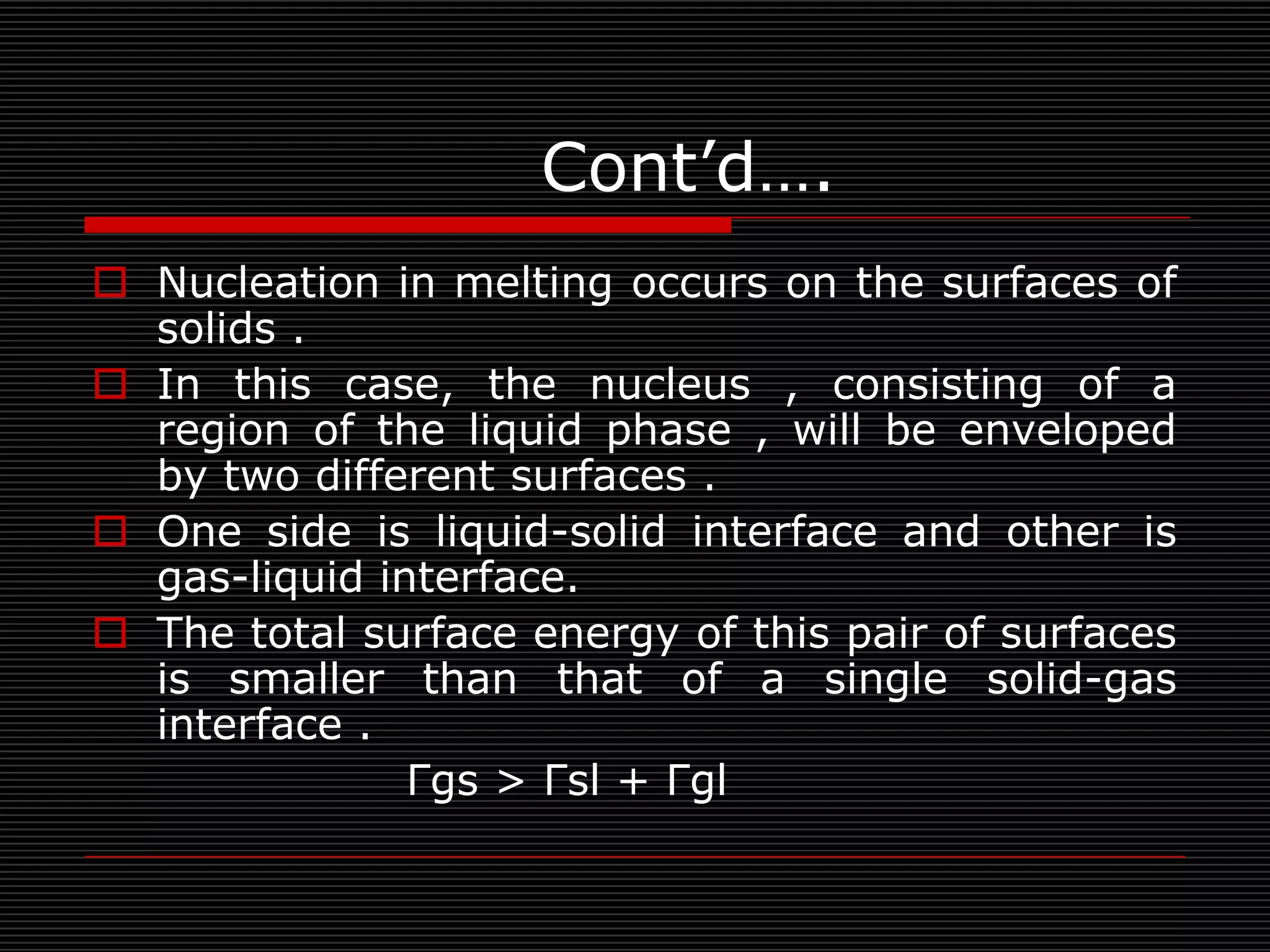
 The total surface energy of this pair of surfaces
  is smaller than that of a single solid-gas
  interface .
               Γgs > Γsl + Γgl
Cont’d….
 The fig(a) represents a liquid nucleus at an
  early stage of development & fig(b) of the
  same nucleus at slightly later time.
 Spreading of the liquid nucleus along the
  surface, in these figures, decreases the
  area on gas solid interface .
 As a result, there is a decrease in surface
  energy so any rise of temperature above
  the equilibrium melting temperature causes
  a decrease in volume free energies .
Cont’d…..

 It can be seen that both surface and
  volume free energies favor melting for even
  the slightest amount of super heating.
 There is also another factor, diffusion rate
  also increases with rising temperature.
 The rate of a melting reaction should
  therefore tend to increase with super
  heating.
Freezing in Alloys:
 Consider an isomorphous-alloy system with the
  phase diagram shown in fig(a). In this system
  at temperature T1 , solid of composition (a) is
  in equilibrium with liquid of composition (b).
 Let it now be assumed that fig(b) represents a
  volume of liquid of composition (b) placed in a
  long tabular mold & that heat is only removed
  from left end of the mold so that heat flow is
  linear & from right to left.
 Under these conditions, freezing will start at
  the left end of the liquid and the small volume
  element (dx) may be taken to represent the
  first solid to form.
Cont’d…….
 The freezing of this volume element will take
  place at temperature T1 and the composition
  of the solid will correspond to point (a) in fig(a)
 If this layer of solid is frozen in a relatively
  short period of time with negligible solid-state
  diffusion, we can assume that it is formed from
  the liquid layer adjacent to the interface and
  not from the entire volume of the liquid.
 Since the solid contains a higher ratio of A to B
  atoms than does the liquid layer from which it
  forms, the latter is depleted in A atoms and
  enriched in B atoms.
Cont’d…..
 This composition change in the liquid just
  ahead of the interface increases as more solid
  is formed , but the increase eventually stops
  when a steady state condition is attained.
 The change in composition of the liquid next to
  the interface is a similar change in the
  composition of the solid that can form from
  this layer of liquid.
 Thus If the composition of the liquid
  correspond to point d in fig (a), than the solid
  that freezes must have the composition of
  point c.
Cont’d….
 The indicated freezing process can only occur if
  the temperature at interface is lowered from
  T1 to T2.
 The concentration of an excess of B atoms in
  the liquid adjacent to the interface reaches a
  maximum when when the liquid next to the
  solid attains the composition of point e.
 At this instant the solid is able to freeze solid of
  composition b.when this occur, the steady
  state has been attained and the solid, which is
  formed from the liquid layer enriched in B atoms is
  the same as the liquid drawn into this layer.
 At this time, the temperature at the interface
  must be T3.
Cont’d….
 Notice that, In both cases, the composition of the
  solid rises from its original value a to that of the
  original liquid b. At the interface there is also a
  sudden rise in composition to the value e as one
  passes from solid into liquid.
 Following this sudden rise, the composition in the
  liquid decreases exponentially back to the value to
  the original liquid, which is b.
 It is important to note that in the above discussion
  it is implied that there are no liquid convection
  currents. In the presence of such currents it is not
  possible to attain as large a concentration of B
  atoms in advance of the interface.
cont’d….
 There are other factors that may also limit the
  magnitude of the composition change in the
  liquid at the interface .
 However, for our purposes we can assume that
  the distance composition curves shown in fig(c)
  are representative of what can actually happen
  under similar conditions during the freezing of
  an alloy.
Nucleation of liquid

Nucleation of liquid

  • 2.
    For more helpcontact me Muhammad Umair Bukhari Engr.umair.bukhari@gmail.com www.bzuiam.webs.com 03136050151
  • 3.
    Nucleation of Liquid: The solidification of metals occurs by nucleation & growth. Same is also true for melting.  Nucleation of solid phase during freezing is much more difficult process than formation of nuclei of liquid phase during melting.  Metals do not superheat to any appreciable extent before they are liquefied, whereas some super cooling occurs almost every time a metal is frozen.  In melting most metals do not normally superheat, although superheating of the order of 0.1k has been reported for gallium.
  • 4.
    Cont’d….  Nucleation inmelting occurs on the surfaces of solids .  In this case, the nucleus , consisting of a region of the liquid phase , will be enveloped by two different surfaces .  One side is liquid-solid interface and other is gas-liquid interface.  The total surface energy of this pair of surfaces is smaller than that of a single solid-gas interface . Γgs > Γsl + Γgl
  • 5.
    Cont’d….  The fig(a)represents a liquid nucleus at an early stage of development & fig(b) of the same nucleus at slightly later time.  Spreading of the liquid nucleus along the surface, in these figures, decreases the area on gas solid interface .  As a result, there is a decrease in surface energy so any rise of temperature above the equilibrium melting temperature causes a decrease in volume free energies .
  • 6.
    Cont’d…..  It canbe seen that both surface and volume free energies favor melting for even the slightest amount of super heating.  There is also another factor, diffusion rate also increases with rising temperature.  The rate of a melting reaction should therefore tend to increase with super heating.
  • 7.
    Freezing in Alloys: Consider an isomorphous-alloy system with the phase diagram shown in fig(a). In this system at temperature T1 , solid of composition (a) is in equilibrium with liquid of composition (b).  Let it now be assumed that fig(b) represents a volume of liquid of composition (b) placed in a long tabular mold & that heat is only removed from left end of the mold so that heat flow is linear & from right to left.  Under these conditions, freezing will start at the left end of the liquid and the small volume element (dx) may be taken to represent the first solid to form.
  • 8.
    Cont’d…….  The freezingof this volume element will take place at temperature T1 and the composition of the solid will correspond to point (a) in fig(a)  If this layer of solid is frozen in a relatively short period of time with negligible solid-state diffusion, we can assume that it is formed from the liquid layer adjacent to the interface and not from the entire volume of the liquid.  Since the solid contains a higher ratio of A to B atoms than does the liquid layer from which it forms, the latter is depleted in A atoms and enriched in B atoms.
  • 9.
    Cont’d…..  This compositionchange in the liquid just ahead of the interface increases as more solid is formed , but the increase eventually stops when a steady state condition is attained.  The change in composition of the liquid next to the interface is a similar change in the composition of the solid that can form from this layer of liquid.  Thus If the composition of the liquid correspond to point d in fig (a), than the solid that freezes must have the composition of point c.
  • 10.
    Cont’d….  The indicatedfreezing process can only occur if the temperature at interface is lowered from T1 to T2.
  • 11.
     The concentrationof an excess of B atoms in the liquid adjacent to the interface reaches a maximum when when the liquid next to the solid attains the composition of point e.  At this instant the solid is able to freeze solid of composition b.when this occur, the steady state has been attained and the solid, which is formed from the liquid layer enriched in B atoms is the same as the liquid drawn into this layer.  At this time, the temperature at the interface must be T3.
  • 12.
    Cont’d….  Notice that,In both cases, the composition of the solid rises from its original value a to that of the original liquid b. At the interface there is also a sudden rise in composition to the value e as one passes from solid into liquid.  Following this sudden rise, the composition in the liquid decreases exponentially back to the value to the original liquid, which is b.  It is important to note that in the above discussion it is implied that there are no liquid convection currents. In the presence of such currents it is not possible to attain as large a concentration of B atoms in advance of the interface.
  • 13.
    cont’d….  There areother factors that may also limit the magnitude of the composition change in the liquid at the interface .  However, for our purposes we can assume that the distance composition curves shown in fig(c) are representative of what can actually happen under similar conditions during the freezing of an alloy.