Power
competenc
y
Apply the properties of liquids
and solids to the nature of
forces in designing a simple
investigation to determine the
effect on boiling point or
freezing point when a solid is
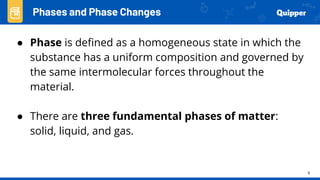
dissolved in water
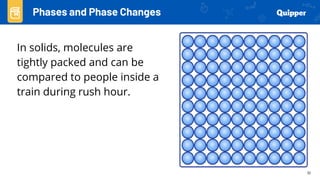
Sub-
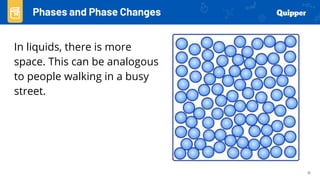
competency
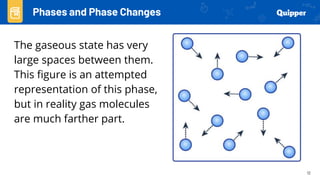
● interpret the phase diagram of water and
carbon dioxide STEM_GC11IMF-IIIa-c-107
● Determine and explain the heating and
cooling curve of a substance
STEM_GC11IMF-IIIa-c-10
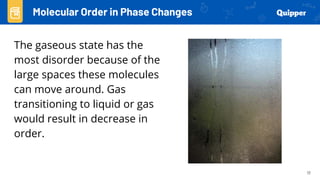
Learning
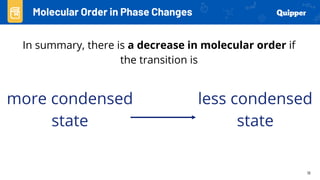
targets
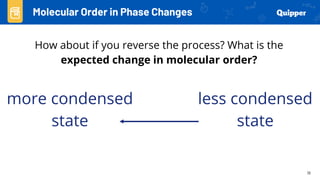
● I can interpret the phase
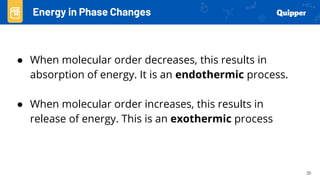
diagram of water and carbon
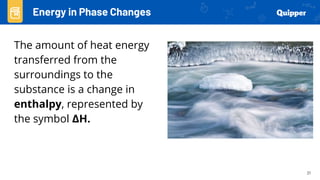
dioxide.
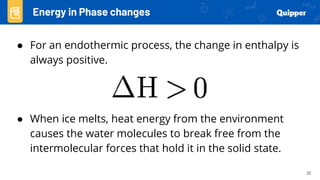
● I can determine and explain
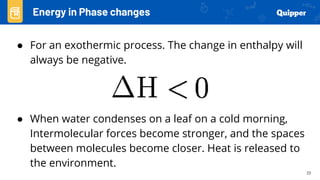
the heating and cooling curve
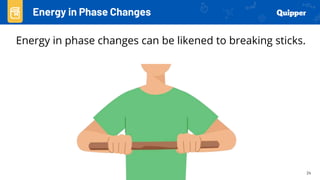
of a substance
4
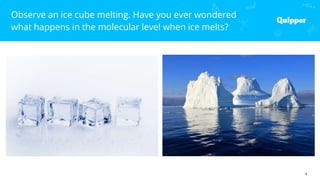
Observe an ice cube melting. Have you ever wondered
what happens in the molecular level when ice melts?
5
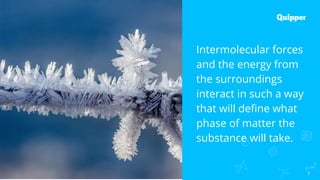
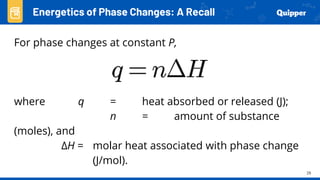
Intermolecular forces
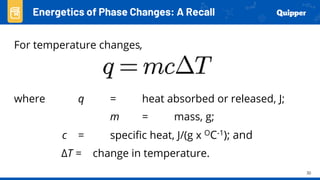
and the energy from
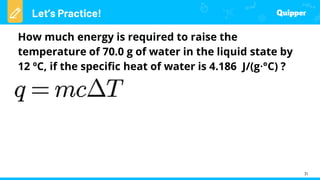
the surroundings
interact in such a way
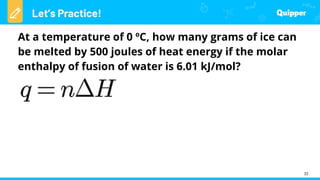
that will define what
phase of matter the
substance will take.
6
In this lesson, you are going to learn about phase
changes and how they occur on a molecular level.
You will also learn to calculate the change of energy
that occurs whenever there is a transition between
phases of matter.
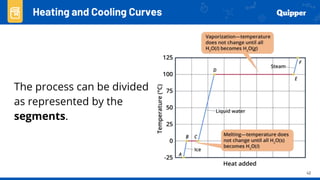
General Chemistry 2
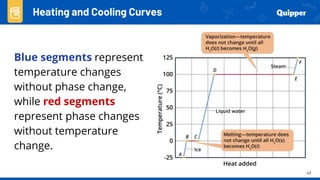
Science, Technology, Engineering, and Mathematics
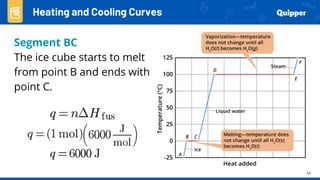
Lesson 2.1
Energy Changes Accom
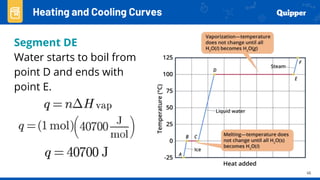
panying
Phase Changes
8
How can phase change
affect the molecular order
in matter?
9
● Phase is defined as a homogeneous state in which the
substance has a uniform composition and governed by
the same intermolecular forces throughout the
material.
● There are three fundamental phases of matter:
solid, liquid, and gas.
Phases and Phase Changes
10
In solids, molecules are
tightly packed and can be
compared to people inside a
train during rush hour.
Phases and Phase Changes
11
In liquids, there is more
space. This can be analogous
to people walking in a busy
street.
Phases and Phase Changes
12
The gaseous state has very
large spaces between them.
This figure is an attempted
representation of this phase,
but in reality gas molecules
are much farther part.
Phases and Phase Changes
13
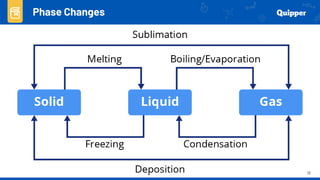
Phase Changes
14
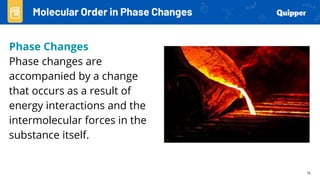
Phase Changes
Phase changes are
accompanied by a change
that occurs as a result of
energy interactions and the
intermolecular forces in the
substance itself.
Molecular Order in Phase Changes
15
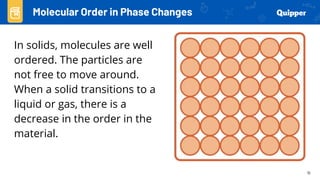
In solids, molecules are well
ordered. The particles are
not free to move around.
When a solid transitions to a
liquid or gas, there is a
decrease in the order in the
material.
Molecular Order in Phase Changes
16
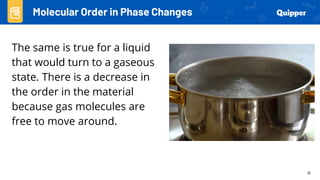
The same is true for a liquid
that would turn to a gaseous
state. There is a decrease in
the order in the material
because gas molecules are
free to move around.
Molecular Order in Phase Changes
17
The gaseous state has the
most disorder because of the
large spaces these molecules
can move around. Gas
transitioning to liquid or gas
would result in decrease in
order.
Molecular Order in Phase Changes
18
In summary, there is a decrease in molecular order if
the transition is
Molecular Order in Phase Changes
more condensed
state
less condensed
state
19
How about if you reverse the process? What is the
expected change in molecular order?
Molecular Order in Phase Changes
more condensed
state
less condensed
state
20
● When molecular order decreases, this results in
absorption of energy. It is an endothermic process.
● When molecular order increases, this results in
release of energy. This is an exothermic process
Energy in Phase Changes
21
The amount of heat energy
transferred from the
surroundings to the
substance is a change in
enthalpy, represented by
the symbol ΔH.
Energy in Phase Changes
22
● For an endothermic process, the change in enthalpy is
always positive.
● When ice melts, heat energy from the environment
causes the water molecules to break free from the
intermolecular forces that hold it in the solid state.
Energy in Phase changes
23
● For an exothermic process. The change in enthalpy will
always be negative.
● When water condenses on a leaf on a cold morning,
Intermolecular forces become stronger, and the spaces
between molecules become closer. Heat is released to
the environment.
Energy in Phase changes
24
Energy in phase changes can be likened to breaking sticks.
Energy in Phase Changes
Tips
25
To remember if a process is
endothermic or exothermic:
○ When heat is absorbed, it is
endothermic; heat enters the
system.
○ When heat is released, it is
exothermic; heat exits the
system.
Tips
26
● In endothermic processes, heat is
added (+). Therefore, ΔH is positive
(+).
● In exothermic processes, heat is
removed (-). Therefore, ΔH is
negative (-).
27
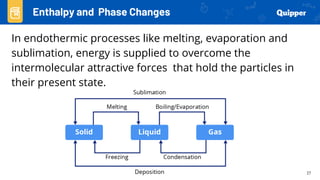
In endothermic processes like melting, evaporation and
sublimation, energy is supplied to overcome the
intermolecular attractive forces that hold the particles in
their present state.
Enthalpy and Phase Changes
28
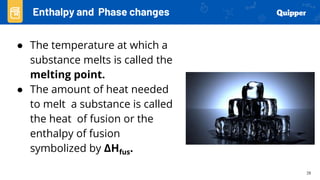
● The temperature at which a
substance melts is called the
melting point.
● The amount of heat needed
to melt a substance is called
the heat of fusion or the
enthalpy of fusion
symbolized by ΔHfus.
Enthalpy and Phase changes
29
Energetics of Phase Changes: A Recall
For phase changes at constant P,
where q = heat absorbed or released (J);
n = amount of substance
(moles), and
ΔH = molar heat associated with phase change
(J/mol).
30
Energetics of Phase Changes: A Recall
For temperature changes,
where q = heat absorbed or released, J;
m = mass, g;
c = specific heat, J/(g x OC-1); and
ΔT = change in temperature.
Let’s Practice!
31
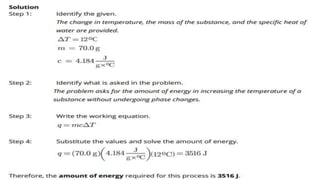
How much energy is required to raise the
temperature of 70.0 g of water in the liquid state by
12 ºC, if the specific heat of water is 4.186 J/(g∙°C) ?
Let’s Practice!
32
Let’s Practice!
33
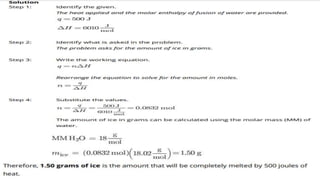
At a temperature of 0 ºC, how many grams of ice can
be melted by 500 joules of heat energy if the molar
enthalpy of fusion of water is 6.01 kJ/mol?
Let’s Practice!
34
35
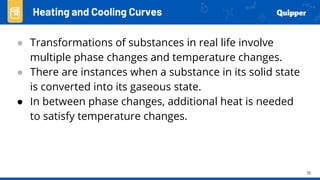
Heating and Cooling Curves
● Transformations of substances in real life involve
multiple phase changes and temperature changes.
● There are instances when a substance in its solid state
is converted into its gaseous state.
● In between phase changes, additional heat is needed
to satisfy temperature changes.
36
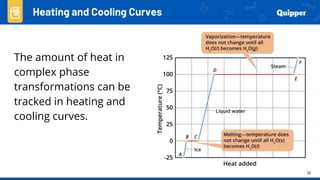
Heating and Cooling Curves
The amount of heat in
complex phase
transformations can be
tracked in heating and
cooling curves.
37
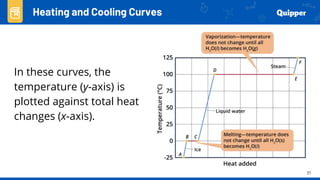
Heating and Cooling Curves
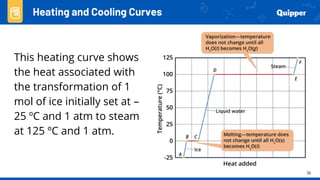
In these curves, the
temperature (y-axis) is
plotted against total heat
changes (x-axis).
38
Heating and Cooling Curves
This heating curve shows
the heat associated with
the transformation of 1
mol of ice initially set at –
25 ºC and 1 atm to steam
at 125 ºC and 1 atm.
39
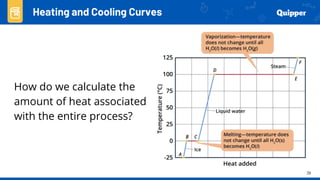
Heating and Cooling Curves
How do we calculate the
amount of heat associated
with the entire process?
40
How can one calculate the
heat associated with
consecutive phase
transformations?
41
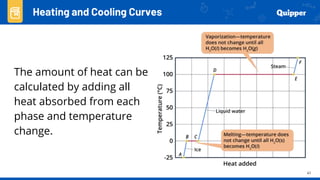
Heating and Cooling Curves
The amount of heat can be
calculated by adding all
heat absorbed from each
phase and temperature
change.
42
Heating and Cooling Curves
The process can be divided
as represented by the
segments.
43
Heating and Cooling Curves
Blue segments represent
temperature changes
without phase change,
while red segments
represent phase changes
without temperature
change.
44
Heating and Cooling Curves
Segment BC
The ice cube starts to melt
from point B and ends with
point C.
45
Heating and Cooling Curves
Segment DE
Water starts to boil from
point D and ends with
point E.
46
Heating and Cooling Curves
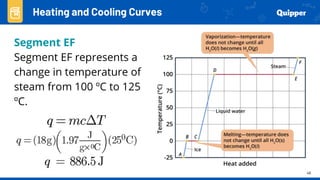
Segment EF
Segment EF represents a
change in temperature of
steam from 100 ºC to 125
ºC.
47
Heating and Cooling Curves
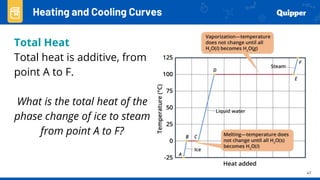
Total Heat
Total heat is additive, from
point A to F.
What is the total heat of the
phase change of ice to steam
from point A to F?
Bibliography
48
Bettelheim, Frederick A. ,William H. Brown, Mary K. Campbell, and Shawn O. Farrell. Introduction to
General, Organic, and Biochemistry. Boston, MA: Cengage Learning, 2016. Print.
Brown, Theodore E. Hill, James C.,, H. Eugene LeMay, Bruce Edward. Bursten, Catherine J. Murphy,
Patrick M. Woodward, and Matthew Stoltzfus. Chemistry: The Central Science, 13th Edition. NJ:
Pearson, 2015. Print.
Chang, Raymond, and Kenneth A. Goldsby. General Chemistry: The Essential Concepts. New York:
McGraw-Hill, 2014. Print.
Petrucci, Ralph H, F G. Herring, Jeffry Madura, and Carey Bissonnette. General Chemistry: Principles
and Modern Applications. 2016. Print.
Silberberg, Martin S. Principles of General Chemistry. Boston: McGraw-Hill Higher Education, 2007.
Print.

Colligative Properties of Solution - Gen Chem 2

  • 1.
    Power competenc y Apply the propertiesof liquids and solids to the nature of forces in designing a simple investigation to determine the effect on boiling point or freezing point when a solid is dissolved in water
  • 2.
    Sub- competency ● interpret thephase diagram of water and carbon dioxide STEM_GC11IMF-IIIa-c-107 ● Determine and explain the heating and cooling curve of a substance STEM_GC11IMF-IIIa-c-10
  • 3.
    Learning targets ● I caninterpret the phase diagram of water and carbon dioxide. ● I can determine and explain the heating and cooling curve of a substance
  • 4.
    4 Observe an icecube melting. Have you ever wondered what happens in the molecular level when ice melts?
  • 5.
    5 Intermolecular forces and theenergy from the surroundings interact in such a way that will define what phase of matter the substance will take.
  • 6.
    6 In this lesson,you are going to learn about phase changes and how they occur on a molecular level. You will also learn to calculate the change of energy that occurs whenever there is a transition between phases of matter.
  • 7.
    General Chemistry 2 Science,Technology, Engineering, and Mathematics Lesson 2.1 Energy Changes Accom panying Phase Changes
  • 8.
    8 How can phasechange affect the molecular order in matter?
  • 9.
    9 ● Phase isdefined as a homogeneous state in which the substance has a uniform composition and governed by the same intermolecular forces throughout the material. ● There are three fundamental phases of matter: solid, liquid, and gas. Phases and Phase Changes
  • 10.
    10 In solids, moleculesare tightly packed and can be compared to people inside a train during rush hour. Phases and Phase Changes
  • 11.
    11 In liquids, thereis more space. This can be analogous to people walking in a busy street. Phases and Phase Changes
  • 12.
    12 The gaseous statehas very large spaces between them. This figure is an attempted representation of this phase, but in reality gas molecules are much farther part. Phases and Phase Changes
  • 13.
  • 14.
    14 Phase Changes Phase changesare accompanied by a change that occurs as a result of energy interactions and the intermolecular forces in the substance itself. Molecular Order in Phase Changes
  • 15.
    15 In solids, moleculesare well ordered. The particles are not free to move around. When a solid transitions to a liquid or gas, there is a decrease in the order in the material. Molecular Order in Phase Changes
  • 16.
    16 The same istrue for a liquid that would turn to a gaseous state. There is a decrease in the order in the material because gas molecules are free to move around. Molecular Order in Phase Changes
  • 17.
    17 The gaseous statehas the most disorder because of the large spaces these molecules can move around. Gas transitioning to liquid or gas would result in decrease in order. Molecular Order in Phase Changes
  • 18.
    18 In summary, thereis a decrease in molecular order if the transition is Molecular Order in Phase Changes more condensed state less condensed state
  • 19.
    19 How about ifyou reverse the process? What is the expected change in molecular order? Molecular Order in Phase Changes more condensed state less condensed state
  • 20.
    20 ● When molecularorder decreases, this results in absorption of energy. It is an endothermic process. ● When molecular order increases, this results in release of energy. This is an exothermic process Energy in Phase Changes
  • 21.
    21 The amount ofheat energy transferred from the surroundings to the substance is a change in enthalpy, represented by the symbol ΔH. Energy in Phase Changes
  • 22.
    22 ● For anendothermic process, the change in enthalpy is always positive. ● When ice melts, heat energy from the environment causes the water molecules to break free from the intermolecular forces that hold it in the solid state. Energy in Phase changes
  • 23.
    23 ● For anexothermic process. The change in enthalpy will always be negative. ● When water condenses on a leaf on a cold morning, Intermolecular forces become stronger, and the spaces between molecules become closer. Heat is released to the environment. Energy in Phase changes
  • 24.
    24 Energy in phasechanges can be likened to breaking sticks. Energy in Phase Changes
  • 25.
    Tips 25 To remember ifa process is endothermic or exothermic: ○ When heat is absorbed, it is endothermic; heat enters the system. ○ When heat is released, it is exothermic; heat exits the system.
  • 26.
    Tips 26 ● In endothermicprocesses, heat is added (+). Therefore, ΔH is positive (+). ● In exothermic processes, heat is removed (-). Therefore, ΔH is negative (-).
  • 27.
    27 In endothermic processeslike melting, evaporation and sublimation, energy is supplied to overcome the intermolecular attractive forces that hold the particles in their present state. Enthalpy and Phase Changes
  • 28.
    28 ● The temperatureat which a substance melts is called the melting point. ● The amount of heat needed to melt a substance is called the heat of fusion or the enthalpy of fusion symbolized by ΔHfus. Enthalpy and Phase changes
  • 29.
    29 Energetics of PhaseChanges: A Recall For phase changes at constant P, where q = heat absorbed or released (J); n = amount of substance (moles), and ΔH = molar heat associated with phase change (J/mol).
  • 30.
    30 Energetics of PhaseChanges: A Recall For temperature changes, where q = heat absorbed or released, J; m = mass, g; c = specific heat, J/(g x OC-1); and ΔT = change in temperature.
  • 31.
    Let’s Practice! 31 How muchenergy is required to raise the temperature of 70.0 g of water in the liquid state by 12 ºC, if the specific heat of water is 4.186 J/(g∙°C) ?
  • 32.
  • 33.
    Let’s Practice! 33 At atemperature of 0 ºC, how many grams of ice can be melted by 500 joules of heat energy if the molar enthalpy of fusion of water is 6.01 kJ/mol?
  • 34.
  • 35.
    35 Heating and CoolingCurves ● Transformations of substances in real life involve multiple phase changes and temperature changes. ● There are instances when a substance in its solid state is converted into its gaseous state. ● In between phase changes, additional heat is needed to satisfy temperature changes.
  • 36.
    36 Heating and CoolingCurves The amount of heat in complex phase transformations can be tracked in heating and cooling curves.
  • 37.
    37 Heating and CoolingCurves In these curves, the temperature (y-axis) is plotted against total heat changes (x-axis).
  • 38.
    38 Heating and CoolingCurves This heating curve shows the heat associated with the transformation of 1 mol of ice initially set at – 25 ºC and 1 atm to steam at 125 ºC and 1 atm.
  • 39.
    39 Heating and CoolingCurves How do we calculate the amount of heat associated with the entire process?
  • 40.
    40 How can onecalculate the heat associated with consecutive phase transformations?
  • 41.
    41 Heating and CoolingCurves The amount of heat can be calculated by adding all heat absorbed from each phase and temperature change.
  • 42.
    42 Heating and CoolingCurves The process can be divided as represented by the segments.
  • 43.
    43 Heating and CoolingCurves Blue segments represent temperature changes without phase change, while red segments represent phase changes without temperature change.
  • 44.
    44 Heating and CoolingCurves Segment BC The ice cube starts to melt from point B and ends with point C.
  • 45.
    45 Heating and CoolingCurves Segment DE Water starts to boil from point D and ends with point E.
  • 46.
    46 Heating and CoolingCurves Segment EF Segment EF represents a change in temperature of steam from 100 ºC to 125 ºC.
  • 47.
    47 Heating and CoolingCurves Total Heat Total heat is additive, from point A to F. What is the total heat of the phase change of ice to steam from point A to F?
  • 48.
    Bibliography 48 Bettelheim, Frederick A.,William H. Brown, Mary K. Campbell, and Shawn O. Farrell. Introduction to General, Organic, and Biochemistry. Boston, MA: Cengage Learning, 2016. Print. Brown, Theodore E. Hill, James C.,, H. Eugene LeMay, Bruce Edward. Bursten, Catherine J. Murphy, Patrick M. Woodward, and Matthew Stoltzfus. Chemistry: The Central Science, 13th Edition. NJ: Pearson, 2015. Print. Chang, Raymond, and Kenneth A. Goldsby. General Chemistry: The Essential Concepts. New York: McGraw-Hill, 2014. Print. Petrucci, Ralph H, F G. Herring, Jeffry Madura, and Carey Bissonnette. General Chemistry: Principles and Modern Applications. 2016. Print. Silberberg, Martin S. Principles of General Chemistry. Boston: McGraw-Hill Higher Education, 2007. Print.