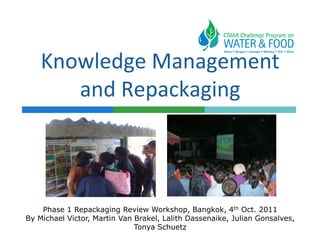
Knowledge Management
       and Repackaging


    Phase 1 Repackaging Review Workshop, Bangkok, 4th Oct. 2011
By Michael Victor, Martin Van Brakel, Lalith Dassenaike, Julian Gonsalves,
                              Tonya Schuetz
Presentation Content
 Knowledge management (KM) processes and
 research and CPWF approach
 Perspectives from Julian on
   CPWF Research utilization and knowledge management
   Development of the resource package, where we are
   now
   Stories to tell
Why KM is important
  Research and development institutions are being
  challenged to demonstrate a poverty orientation
  (pro-poor), show impact and ensure results are
  cost-effective.
  Research generation is not more important than
  research utilization: both are equally important.
  Knowledge management makes the big difference.
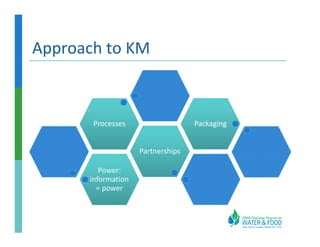
Approach to KM


       Processes                   Packaging


                    Partnerships

         Power:
      information
        = power
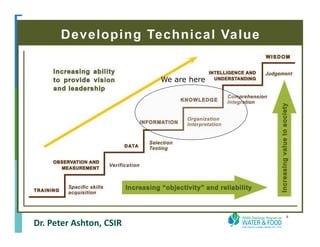
We are here


                                       5

Dr. Peter Ashton, CSIR
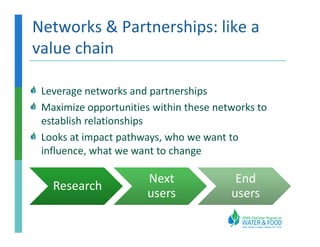
Networks & Partnerships: like a
value chain

 Leverage networks and partnerships
 Maximize opportunities within these networks to
 establish relationships
 Looks at impact pathways, who we want to
 influence, what we want to change

                       Next              End
   Research
                       users            users
From research to next users
Of importance:
  the simplification of science
  the breaking down of scientific results into easily
  understood “information bits”
  ensure relevance of information
  Boil down the information to the “essence”: the
  most important idea only needs to be shared.
  Knowledge management is often a function of good
  packaging or repackaging.
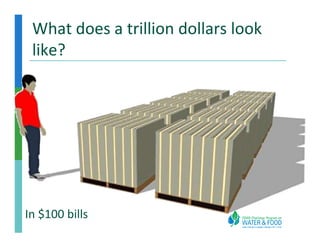
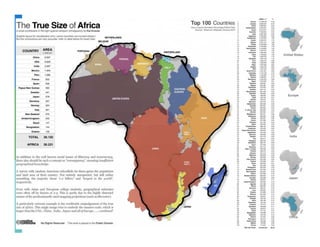
What does a trillion dollars look
 like?


In $100 bills
Learning as we went along in the
       repackaging effort
     Julian F. Gonsalves, PhD
Knowledge management is about
research utilization and application
 Desk reviews of research outputs to
 identify relevant topics and messages
 Value of evidence-based
 recommendations
 Ideas with potential for up-scaling and
 wider uptake
Research utilization can be enhanced by
proper packaging and delivery (beyond
"extension“). Research reports are difficult
to read and use.
CPWF Phase One understood the need
for enhancing research-use (with
emphasis on uptake, up-scaling, impact
pathways, research into use, etc.).
CWPF Phase One: Classified some of the
projects as "legacy projects". Some were
identified for special attention for follow up
work.
Project reports were expected to report on
impacts, outcomes not just outputs.
Significant impact stories were collected. A
water and food global forum was
organized in Ethiopia.
The repackaging exercise built on this rich
background. We have only done partial
justice to Phase One outputs. That’s a
reality. Phase One is a treasure trove of
useful ideas.
We started with posters. Posters are
probably the most neglected mechanism
for conveying research-derived messages.
Bringing more attention to the value of
posters as a user-friendly attractive
mechanism.
Outcome stories not project summaries
not impact stories... even intermediary
outcomes, even processes and
partnerships are featured.
Source book articles: source book as key
mechanism to encourage people to further
explore available research resources.
Briefing notes: terminal reports might lend
themselves to this preparation of research
briefs.
Stories to tell
 IRRI Rainfed Rice and RWC reports
 Agrobio and Participatory Research
 source books
 ICRAF Shifting Cultivation and
 Agroforestry source book
 Lao Uplands Sourcebook
Lao Uplands Sourcebook
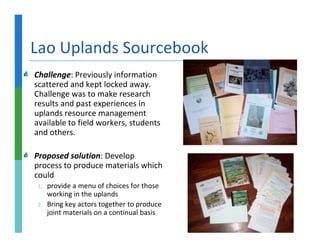
Challenge: Previously information
scattered and kept locked away.
Challenge was to make research
results and past experiences in
uplands resource management
available to field workers, students
and others.

Proposed solution: Develop
process to produce materials which
could
 1.   provide a menu of choices for those
      working in the uplands
 2.   Bring key actors together to produce
      joint materials on a continual basis
Lessons learned
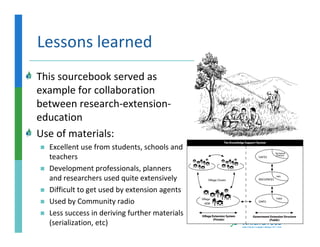
This sourcebook served as
example for collaboration
between research-extension-
education
Use of materials:
  Excellent use from students, schools and
  teachers
  Development professionals, planners
  and researchers used quite extensively
  Difficult to get used by extension agents
  Used by Community radio
  Less success in deriving further materials
  (serialization, etc)
Work in progress (near completion)
 Editing not undertaken
 Focus on the value of an idea then shift to
 editing and presentation
 Gaps exist and opportunities for building on
 (within limits)
 Time to get outputs out and add on other
 products or adaptations (e.g. basin specific) later
 on.
 Prototype value of products (e.g. CAPRI work)

Phase1 review ws-intro-2_km&julian

  • 1.
    Knowledge Management and Repackaging Phase 1 Repackaging Review Workshop, Bangkok, 4th Oct. 2011 By Michael Victor, Martin Van Brakel, Lalith Dassenaike, Julian Gonsalves, Tonya Schuetz
  • 2.
    Presentation Content Knowledgemanagement (KM) processes and research and CPWF approach Perspectives from Julian on CPWF Research utilization and knowledge management Development of the resource package, where we are now Stories to tell
  • 3.
    Why KM isimportant Research and development institutions are being challenged to demonstrate a poverty orientation (pro-poor), show impact and ensure results are cost-effective. Research generation is not more important than research utilization: both are equally important. Knowledge management makes the big difference.
  • 4.
    Approach to KM Processes Packaging Partnerships Power: information = power
  • 5.
    We are here 5 Dr. Peter Ashton, CSIR
  • 6.
    Networks & Partnerships:like a value chain Leverage networks and partnerships Maximize opportunities within these networks to establish relationships Looks at impact pathways, who we want to influence, what we want to change Next End Research users users
  • 7.
    From research tonext users Of importance: the simplification of science the breaking down of scientific results into easily understood “information bits” ensure relevance of information Boil down the information to the “essence”: the most important idea only needs to be shared. Knowledge management is often a function of good packaging or repackaging.
  • 8.
    What does atrillion dollars look like? In $100 bills
  • 10.
    Learning as wewent along in the repackaging effort Julian F. Gonsalves, PhD
  • 11.
    Knowledge management isabout research utilization and application Desk reviews of research outputs to identify relevant topics and messages Value of evidence-based recommendations Ideas with potential for up-scaling and wider uptake
  • 12.
    Research utilization canbe enhanced by proper packaging and delivery (beyond "extension“). Research reports are difficult to read and use.
  • 13.
    CPWF Phase Oneunderstood the need for enhancing research-use (with emphasis on uptake, up-scaling, impact pathways, research into use, etc.).
  • 14.
    CWPF Phase One:Classified some of the projects as "legacy projects". Some were identified for special attention for follow up work.
  • 15.
    Project reports wereexpected to report on impacts, outcomes not just outputs. Significant impact stories were collected. A water and food global forum was organized in Ethiopia.
  • 16.
    The repackaging exercisebuilt on this rich background. We have only done partial justice to Phase One outputs. That’s a reality. Phase One is a treasure trove of useful ideas.
  • 17.
    We started withposters. Posters are probably the most neglected mechanism for conveying research-derived messages. Bringing more attention to the value of posters as a user-friendly attractive mechanism.
  • 18.
    Outcome stories notproject summaries not impact stories... even intermediary outcomes, even processes and partnerships are featured.
  • 19.
    Source book articles:source book as key mechanism to encourage people to further explore available research resources.
  • 20.
    Briefing notes: terminalreports might lend themselves to this preparation of research briefs.
  • 21.
    Stories to tell IRRI Rainfed Rice and RWC reports Agrobio and Participatory Research source books ICRAF Shifting Cultivation and Agroforestry source book Lao Uplands Sourcebook
  • 22.
    Lao Uplands Sourcebook Challenge:Previously information scattered and kept locked away. Challenge was to make research results and past experiences in uplands resource management available to field workers, students and others. Proposed solution: Develop process to produce materials which could 1. provide a menu of choices for those working in the uplands 2. Bring key actors together to produce joint materials on a continual basis
  • 23.
    Lessons learned This sourcebookserved as example for collaboration between research-extension- education Use of materials: Excellent use from students, schools and teachers Development professionals, planners and researchers used quite extensively Difficult to get used by extension agents Used by Community radio Less success in deriving further materials (serialization, etc)
  • 24.
    Work in progress(near completion) Editing not undertaken Focus on the value of an idea then shift to editing and presentation Gaps exist and opportunities for building on (within limits) Time to get outputs out and add on other products or adaptations (e.g. basin specific) later on. Prototype value of products (e.g. CAPRI work)