 Speakers:
• Peter Holmgren, Director General CIFOR
• Niels Elers Koch, President of IUFRO
• Gillian Petrokofsky, Oxford University
 Interactive session:
• What are the priority policy questions, according to YOU?
 Discussion
Vision
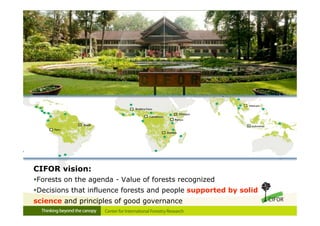
CIFOR vision:
Forests on the agenda - Value of forests recognized
Decisions that influence forests and people supported by solid
science and principles of good governance
 Sustainable landscapes: Forests are an integral part of
the landscape and essential for livelihoods as well as long-
term resilience and productivity of food systems. We must
bridge institutional boundaries and find integrated
solutions.
 Green growth: Policies for a green economy should
generate sustainable forest products and services, ensure
good governance of natural resources, and reduce poverty.
Evidence-based forestry
 Background to the EBF initiative
 Experience in other sectors
 Are we using evidence properly in forestry?
 Are we referring to evidence properly in forestry?
 Is forestry science reliable / relied on?
 How inform UNFF process (and other forest-
related processes)?
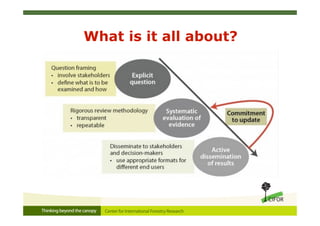
What is it all about?
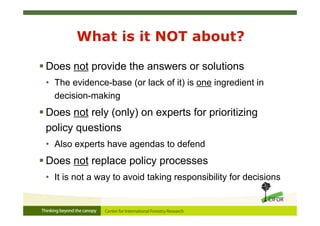
What is it NOT about?
 Does not provide the answers or solutions
• The evidence-base (or lack of it) is one ingredient in
decision-making
 Does not rely (only) on experts for prioritizing
policy questions
• Also experts have agendas to defend
 Does not replace policy processes
• It is not a way to avoid taking responsibility for decisions
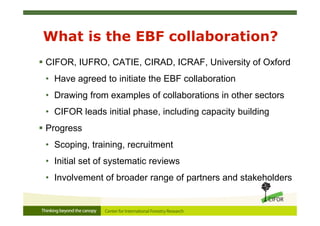
What is the EBF collaboration?
 CIFOR, IUFRO, CATIE, CIRAD, ICRAF, University of Oxford
• Have agreed to initiate the EBF collaboration
• Drawing from examples of collaborations in other sectors
• CIFOR leads initial phase, including capacity building
 Progress
• Scoping, training, recruitment
• Initial set of systematic reviews
• Involvement of broader range of partners and stakeholders
What next?
 This is a collaborative initiative.
 We expect the outputs of this initiative to be
highly relevant to UNFF and others.
 We hope you will help bridge science and policy.
 We want you and your institutions to participate.
 We will start today with an interactive session.

Evidence-based forestry

  • 1.
     Speakers: • PeterHolmgren, Director General CIFOR • Niels Elers Koch, President of IUFRO • Gillian Petrokofsky, Oxford University  Interactive session: • What are the priority policy questions, according to YOU?  Discussion
  • 2.
    Vision CIFOR vision: Forests onthe agenda - Value of forests recognized Decisions that influence forests and people supported by solid science and principles of good governance
  • 3.
     Sustainable landscapes:Forests are an integral part of the landscape and essential for livelihoods as well as long- term resilience and productivity of food systems. We must bridge institutional boundaries and find integrated solutions.  Green growth: Policies for a green economy should generate sustainable forest products and services, ensure good governance of natural resources, and reduce poverty.
  • 4.
    Evidence-based forestry  Backgroundto the EBF initiative  Experience in other sectors  Are we using evidence properly in forestry?  Are we referring to evidence properly in forestry?  Is forestry science reliable / relied on?  How inform UNFF process (and other forest- related processes)?
  • 5.
    What is itall about?
  • 6.
    What is itNOT about?  Does not provide the answers or solutions • The evidence-base (or lack of it) is one ingredient in decision-making  Does not rely (only) on experts for prioritizing policy questions • Also experts have agendas to defend  Does not replace policy processes • It is not a way to avoid taking responsibility for decisions
  • 7.
    What is theEBF collaboration?  CIFOR, IUFRO, CATIE, CIRAD, ICRAF, University of Oxford • Have agreed to initiate the EBF collaboration • Drawing from examples of collaborations in other sectors • CIFOR leads initial phase, including capacity building  Progress • Scoping, training, recruitment • Initial set of systematic reviews • Involvement of broader range of partners and stakeholders
  • 8.
    What next?  Thisis a collaborative initiative.  We expect the outputs of this initiative to be highly relevant to UNFF and others.  We hope you will help bridge science and policy.  We want you and your institutions to participate.  We will start today with an interactive session.