M A S T E R O F S C I E N C E I N
Information and Knowledge Strategy
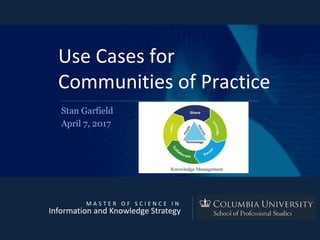
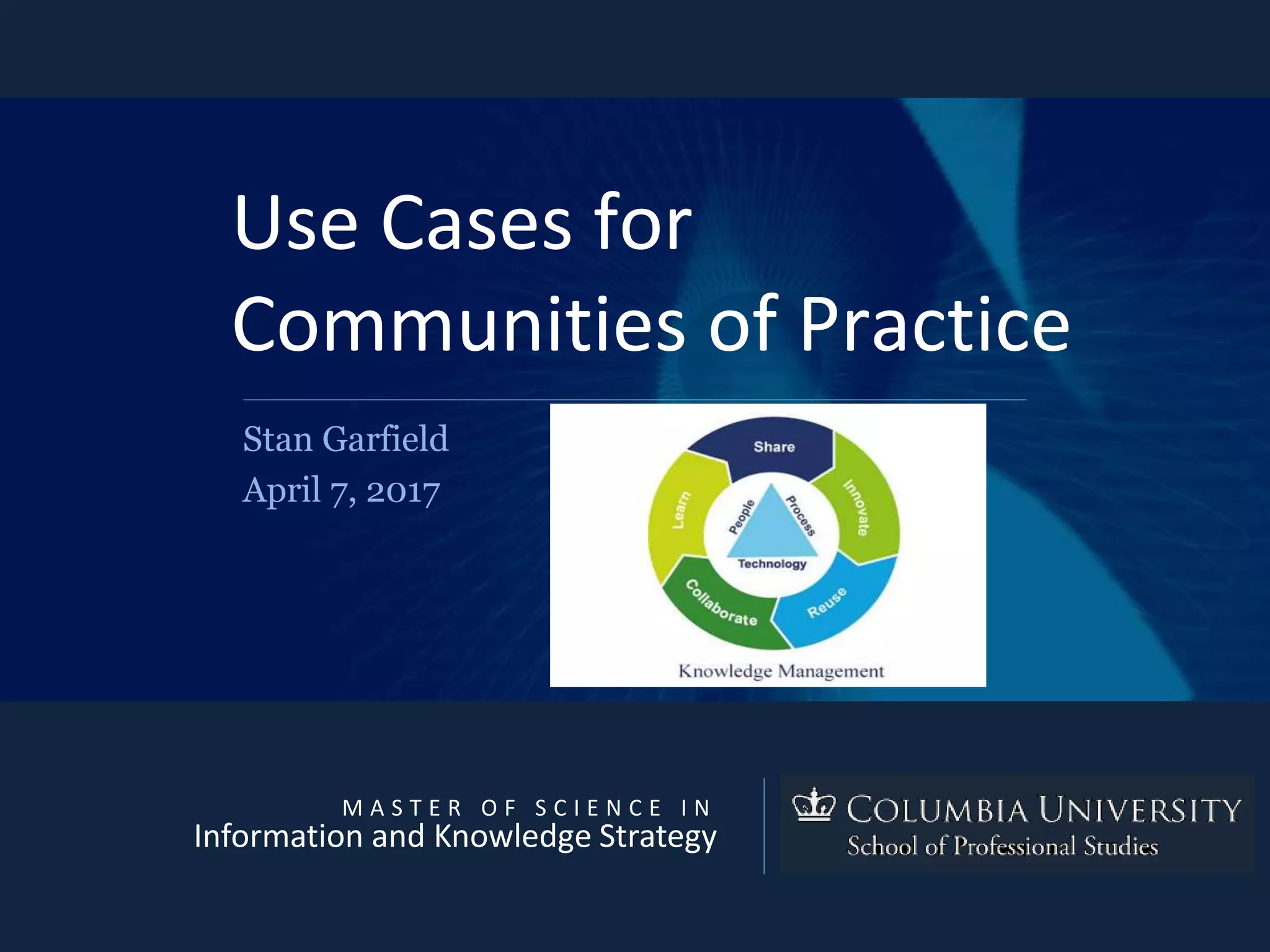
Use Cases for
Communities of Practice
Stan Garfield
April 7, 2017
2
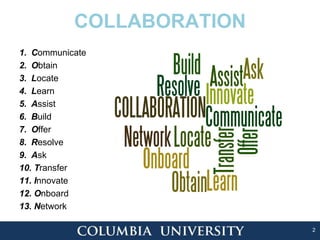
COLLABORATION
1. Communicate
2. Obtain
3. Locate
4. Learn
5. Assist
6. Build
7. Offer
8. Resolve
9. Ask
10. Transfer
11. Innovate
12. Onboard
13. Network
3
1. Communicate
• Inform the organization
about your activities.
plans, and progress
• Interact with colleagues
• Solicit input, feedback,
advice
• Relax, refresh, relieve
tension, laugh
4
2. Obtain
• Gain assistance from
others
• Find out what others are
doing
• Retrieve information
• Receive answers to
questions
5
3. Locate
• Locate subject matter
specialists
• Find documents, credentials,
references, sites, official
methods, lessons learned,
proven practices
• Find needed resources
6
4. Learn
• Learn more about
a topic
• Deepen expertise
• Keep current on
the latest news
7
5. Assist
• Respond to a request
• Respond to a client
request for information.
proposal, or support
• Submit a proposal
• Deliver a product, project,
service, or client
engagement
• Provide thought
leadership
8
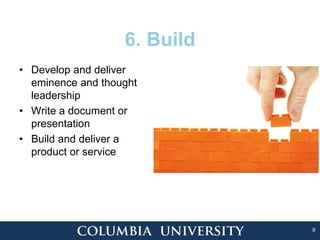
6. Build
• Develop and deliver
eminence and thought
leadership
• Write a document or
presentation
• Build and deliver a
product or service
9
7. Offer
• Answer questions
• Provide points of view,
proven practices, lessons
learned, examples,
official methods
• Get staffed on a project
or client engagement
• Lead an effort
• Praise, recognize, and
thank colleagues
10
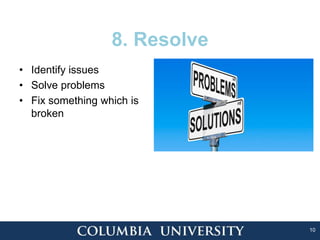
8. Resolve
• Identify issues
• Solve problems
• Fix something which is
broken
11
9. Ask
• Ask questions
• Request advice
• Submit a query or request
12
10. Transfer
• Transfer knowledge
• Share links, insights, lessons
learned, tips, tricks, techniques
• Contribute reusable content
13
11. Innovate
• Develop new and better ways
of serving clients
• Solicit ideas
• Manage the innovation
process
• Improve existing products,
services, processes, and tools
• Invent new products, services,
processes, and tools
14
12. Onboard
• Onboard new hires or team
members
• Get oriented as a new hire or
team member
• Orient new clients
15
13. Network
• Connect to others with similar
interests
• Work together as part of a
team
• Connect multiple organizations
to deliver services as one
16
SIRCL
• Share new ideas, lessons learned, proven practices,
insights, and practical suggestions.
• Innovate through brainstorming, building on each other's
ideas, and keeping informed on emerging developments.
• Reuse solutions through asking and answering
questions, applying shared insights, and retrieving
posted material.
• Collaborate through threaded discussions,
conversations, and interactions.
• Learn from other members of the community; from
invited guest speakers about successes, failures, case
studies, and new trends; and through mentoring.
17
Communities of Practice
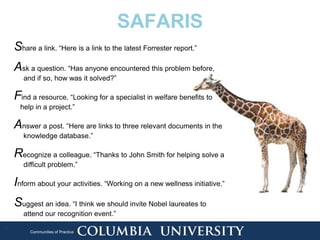
Share a link. “Here is a link to the latest Forrester report.”
Ask a question. “Has anyone encountered this problem before,
and if so, how was it solved?”
Find a resource. “Looking for a specialist in welfare benefits to
help in a project.”
Answer a post. “Here are links to three relevant documents in the
knowledge database.”
Recognize a colleague. “Thanks to John Smith for helping solve a
difficult problem.”
Inform about your activities. “Working on a new wellness initiative.”
Suggest an idea. “I think we should invite Nobel laureates to
attend our recognition event.”
SAFARIS
18
5 Questions to Ask Before
Starting a New Community
1. Is there an existing community which
covers the topic or a related one?
2. Is the topic defined using widely-
understood terminology?
3. Are people likely to want to join in
sufficient numbers to achieve critical
mass?
4. Are you willing to spend the time it takes to
lead a community?
5. Are you willing to measure the community
using monthly health indicators?
19
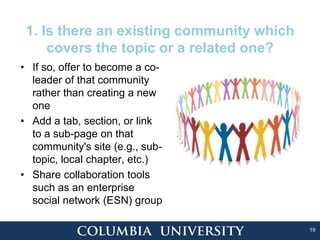
1. Is there an existing community which
covers the topic or a related one?
• If so, offer to become a co-
leader of that community
rather than creating a new
one
• Add a tab, section, or link
to a sub-page on that
community's site (e.g., sub-
topic, local chapter, etc.)
• Share collaboration tools
such as an enterprise
social network (ESN) group
20
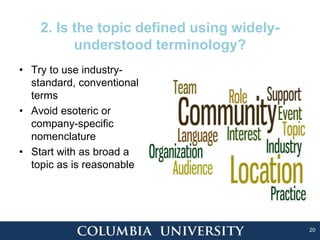
2. Is the topic defined using widely-
understood terminology?
• Try to use industry-
standard, conventional
terms
• Avoid esoteric or
company-specific
nomenclature
• Start with as broad a
topic as is reasonable
21
3. Are people likely to want to join in
sufficient numbers to achieve critical
mass (100 or more)? They should:
• Identify with it: view
themselves as specializing
in it
• Be deeply interested in it,
view it as relevant to their
work, and want to deepen
their understanding of it
• Be willing to spend time
learning and collaborating
about it
22
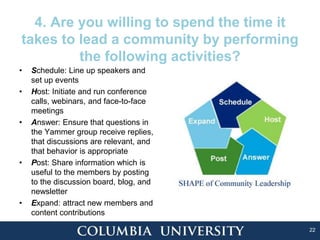
4. Are you willing to spend the time it
takes to lead a community by performing
the following activities?
• Schedule: Line up speakers and
set up events
• Host: Initiate and run conference
calls, webinars, and face-to-face
meetings
• Answer: Ensure that questions in
the Yammer group receive replies,
that discussions are relevant, and
that behavior is appropriate
• Post: Share information which is
useful to the members by posting
to the discussion board, blog, and
newsletter
• Expand: attract new members and
content contributions
23
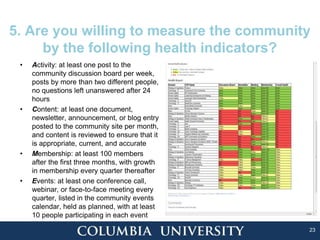
5. Are you willing to measure the community
by the following health indicators?
• Activity: at least one post to the
community discussion board per week,
posts by more than two different people,
no questions left unanswered after 24
hours
• Content: at least one document,
newsletter, announcement, or blog entry
posted to the community site per month,
and content is reviewed to ensure that it
is appropriate, current, and accurate
• Membership: at least 100 members
after the first three months, with growth
in membership every quarter thereafter
• Events: at least one conference call,
webinar, or face-to-face meeting every
quarter, listed in the community events
calendar, held as planned, with at least
10 people participating in each event
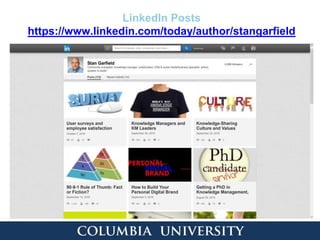
LinkedIn Posts
https://www.linkedin.com/today/author/stangarfield
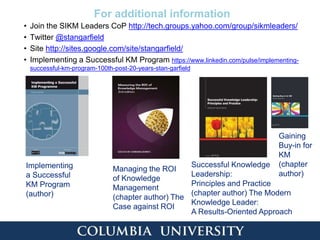
For additional information
• Join the SIKM Leaders CoP http://tech.groups.yahoo.com/group/sikmleaders/
• Twitter @stangarfield
• Site http://sites.google.com/site/stangarfield/
• Implementing a Successful KM Program https://www.linkedin.com/pulse/implementing-
successful-km-program-100th-post-20-years-stan-garfield
Implementing
a Successful
KM Program
(author)
Successful Knowledge
Leadership:
Principles and Practice
(chapter author) The Modern
Knowledge Leader:
A Results-Oriented Approach
Gaining
Buy-in for
KM
(chapter
author)
Managing the ROI
of Knowledge
Management
(chapter author) The
Case against ROI

Use Cases for Communities of Practice

  • 1.
    M A ST E R O F S C I E N C E I N Information and Knowledge Strategy Use Cases for Communities of Practice Stan Garfield April 7, 2017
  • 2.
    2 COLLABORATION 1. Communicate 2. Obtain 3.Locate 4. Learn 5. Assist 6. Build 7. Offer 8. Resolve 9. Ask 10. Transfer 11. Innovate 12. Onboard 13. Network
  • 3.
    3 1. Communicate • Informthe organization about your activities. plans, and progress • Interact with colleagues • Solicit input, feedback, advice • Relax, refresh, relieve tension, laugh
  • 4.
    4 2. Obtain • Gainassistance from others • Find out what others are doing • Retrieve information • Receive answers to questions
  • 5.
    5 3. Locate • Locatesubject matter specialists • Find documents, credentials, references, sites, official methods, lessons learned, proven practices • Find needed resources
  • 6.
    6 4. Learn • Learnmore about a topic • Deepen expertise • Keep current on the latest news
  • 7.
    7 5. Assist • Respondto a request • Respond to a client request for information. proposal, or support • Submit a proposal • Deliver a product, project, service, or client engagement • Provide thought leadership
  • 8.
    8 6. Build • Developand deliver eminence and thought leadership • Write a document or presentation • Build and deliver a product or service
  • 9.
    9 7. Offer • Answerquestions • Provide points of view, proven practices, lessons learned, examples, official methods • Get staffed on a project or client engagement • Lead an effort • Praise, recognize, and thank colleagues
  • 10.
    10 8. Resolve • Identifyissues • Solve problems • Fix something which is broken
  • 11.
    11 9. Ask • Askquestions • Request advice • Submit a query or request
  • 12.
    12 10. Transfer • Transferknowledge • Share links, insights, lessons learned, tips, tricks, techniques • Contribute reusable content
  • 13.
    13 11. Innovate • Developnew and better ways of serving clients • Solicit ideas • Manage the innovation process • Improve existing products, services, processes, and tools • Invent new products, services, processes, and tools
  • 14.
    14 12. Onboard • Onboardnew hires or team members • Get oriented as a new hire or team member • Orient new clients
  • 15.
    15 13. Network • Connectto others with similar interests • Work together as part of a team • Connect multiple organizations to deliver services as one
  • 16.
    16 SIRCL • Share newideas, lessons learned, proven practices, insights, and practical suggestions. • Innovate through brainstorming, building on each other's ideas, and keeping informed on emerging developments. • Reuse solutions through asking and answering questions, applying shared insights, and retrieving posted material. • Collaborate through threaded discussions, conversations, and interactions. • Learn from other members of the community; from invited guest speakers about successes, failures, case studies, and new trends; and through mentoring.
  • 17.
    17 Communities of Practice Sharea link. “Here is a link to the latest Forrester report.” Ask a question. “Has anyone encountered this problem before, and if so, how was it solved?” Find a resource. “Looking for a specialist in welfare benefits to help in a project.” Answer a post. “Here are links to three relevant documents in the knowledge database.” Recognize a colleague. “Thanks to John Smith for helping solve a difficult problem.” Inform about your activities. “Working on a new wellness initiative.” Suggest an idea. “I think we should invite Nobel laureates to attend our recognition event.” SAFARIS
  • 18.
    18 5 Questions toAsk Before Starting a New Community 1. Is there an existing community which covers the topic or a related one? 2. Is the topic defined using widely- understood terminology? 3. Are people likely to want to join in sufficient numbers to achieve critical mass? 4. Are you willing to spend the time it takes to lead a community? 5. Are you willing to measure the community using monthly health indicators?
  • 19.
    19 1. Is therean existing community which covers the topic or a related one? • If so, offer to become a co- leader of that community rather than creating a new one • Add a tab, section, or link to a sub-page on that community's site (e.g., sub- topic, local chapter, etc.) • Share collaboration tools such as an enterprise social network (ESN) group
  • 20.
    20 2. Is thetopic defined using widely- understood terminology? • Try to use industry- standard, conventional terms • Avoid esoteric or company-specific nomenclature • Start with as broad a topic as is reasonable
  • 21.
    21 3. Are peoplelikely to want to join in sufficient numbers to achieve critical mass (100 or more)? They should: • Identify with it: view themselves as specializing in it • Be deeply interested in it, view it as relevant to their work, and want to deepen their understanding of it • Be willing to spend time learning and collaborating about it
  • 22.
    22 4. Are youwilling to spend the time it takes to lead a community by performing the following activities? • Schedule: Line up speakers and set up events • Host: Initiate and run conference calls, webinars, and face-to-face meetings • Answer: Ensure that questions in the Yammer group receive replies, that discussions are relevant, and that behavior is appropriate • Post: Share information which is useful to the members by posting to the discussion board, blog, and newsletter • Expand: attract new members and content contributions
  • 23.
    23 5. Are youwilling to measure the community by the following health indicators? • Activity: at least one post to the community discussion board per week, posts by more than two different people, no questions left unanswered after 24 hours • Content: at least one document, newsletter, announcement, or blog entry posted to the community site per month, and content is reviewed to ensure that it is appropriate, current, and accurate • Membership: at least 100 members after the first three months, with growth in membership every quarter thereafter • Events: at least one conference call, webinar, or face-to-face meeting every quarter, listed in the community events calendar, held as planned, with at least 10 people participating in each event
  • 24.
  • 25.
    For additional information •Join the SIKM Leaders CoP http://tech.groups.yahoo.com/group/sikmleaders/ • Twitter @stangarfield • Site http://sites.google.com/site/stangarfield/ • Implementing a Successful KM Program https://www.linkedin.com/pulse/implementing- successful-km-program-100th-post-20-years-stan-garfield Implementing a Successful KM Program (author) Successful Knowledge Leadership: Principles and Practice (chapter author) The Modern Knowledge Leader: A Results-Oriented Approach Gaining Buy-in for KM (chapter author) Managing the ROI of Knowledge Management (chapter author) The Case against ROI

Editor's Notes