



The Ecology of Sharing: Synthesizing OER Research
        Patrick McAndrew & Robert Farrow
HOW SHOULD WE RESEARCH OPENNESS IN EDUCATION?
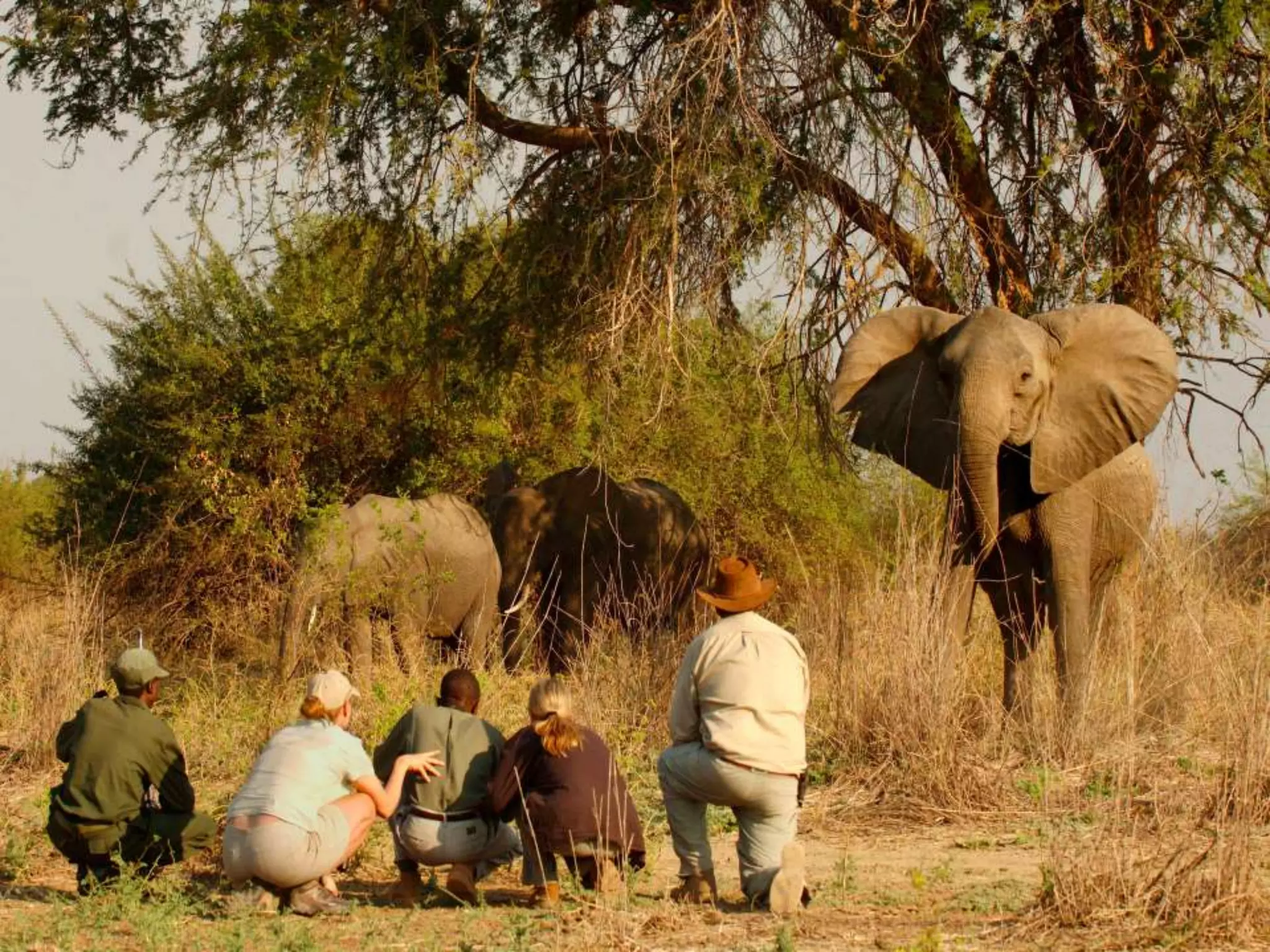
Is OER research more like this…


The Open University's Institute of Educational Technology
WHY ‘ECOLOGY’?


•   The education ecosystem itself is changing


•   There exists an evidence gap relating to the widespread adoption of OER:
    benefits; barriers


•   Manifold factors with complex relationships between diverse elements


•   We need a holistic, flexible approach


•   OER/ecology metaphor recognises the lifecycles of OER creation and
    (re)use, evolution into new forms and adoption in new contexts


•   Emphasis on evolution, interconnectedness and interdependence
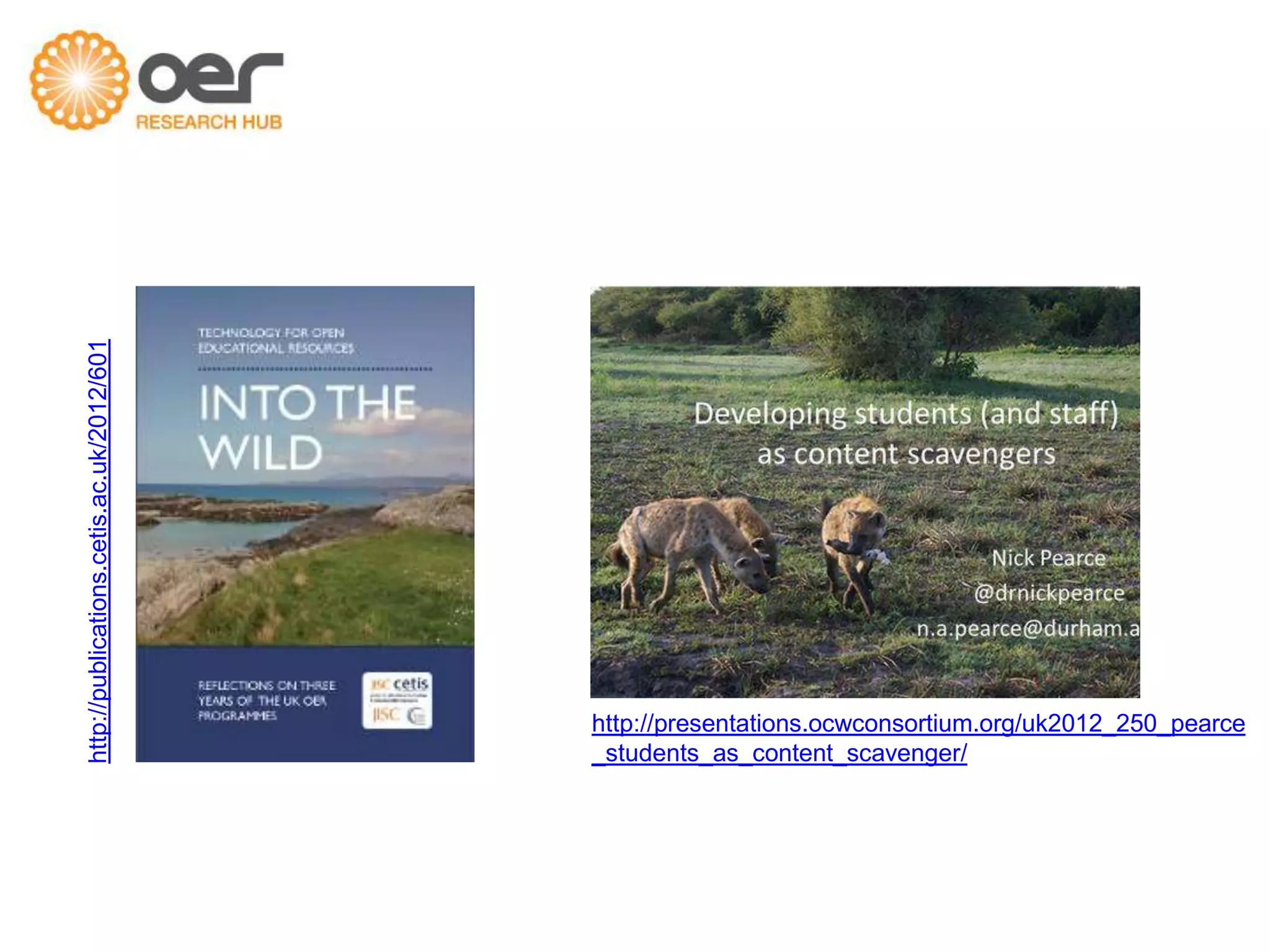
http://publications.cetis.ac.uk/2012/601


                                           http://presentations.ocwconsortium.org/uk2012_250_pearce
                                           _students_as_content_scavenger/
ABOUT THE PROJECT


The OER Research Hub at The Open University combines:

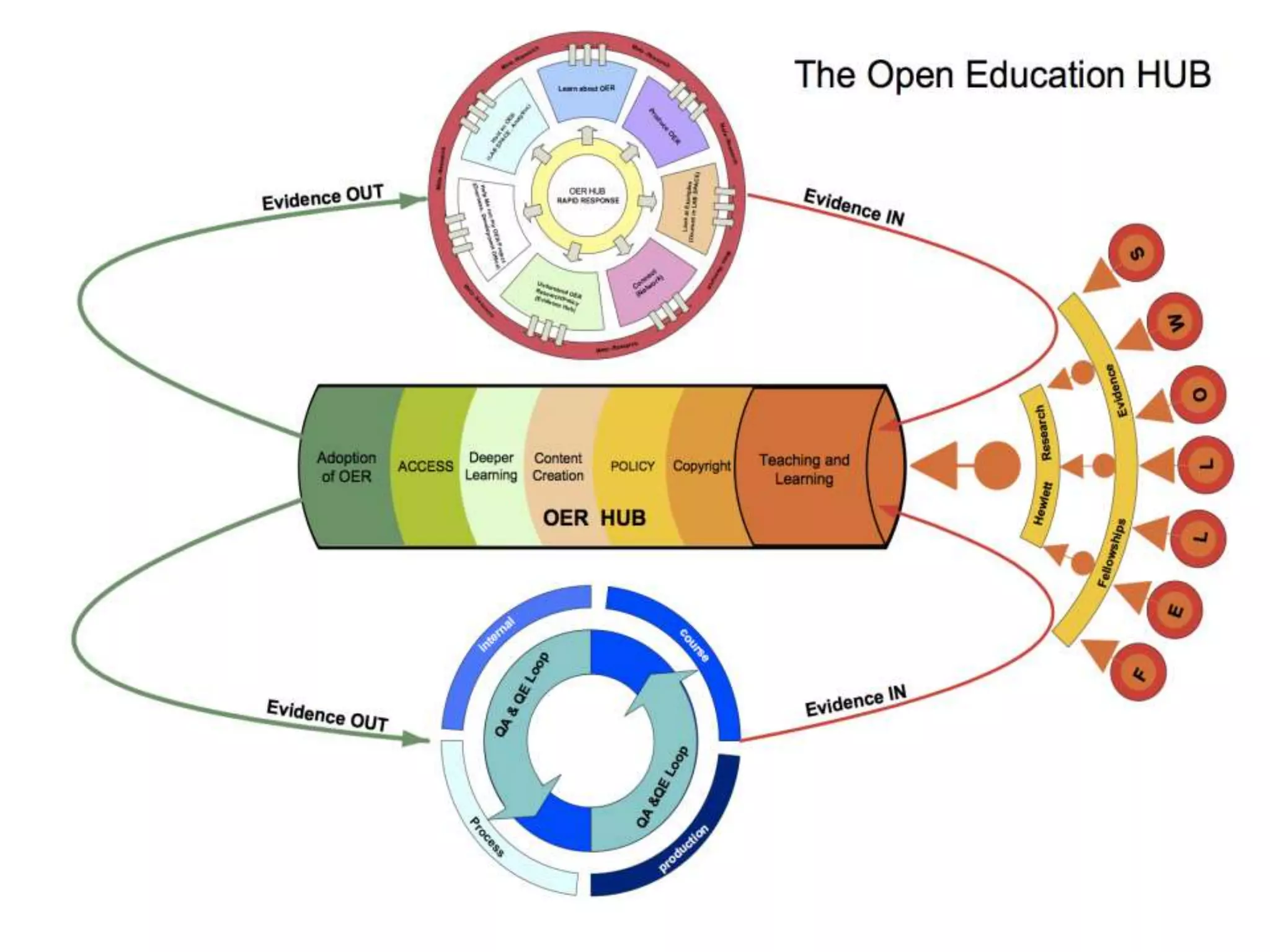
•   A hub for research data and OER practice
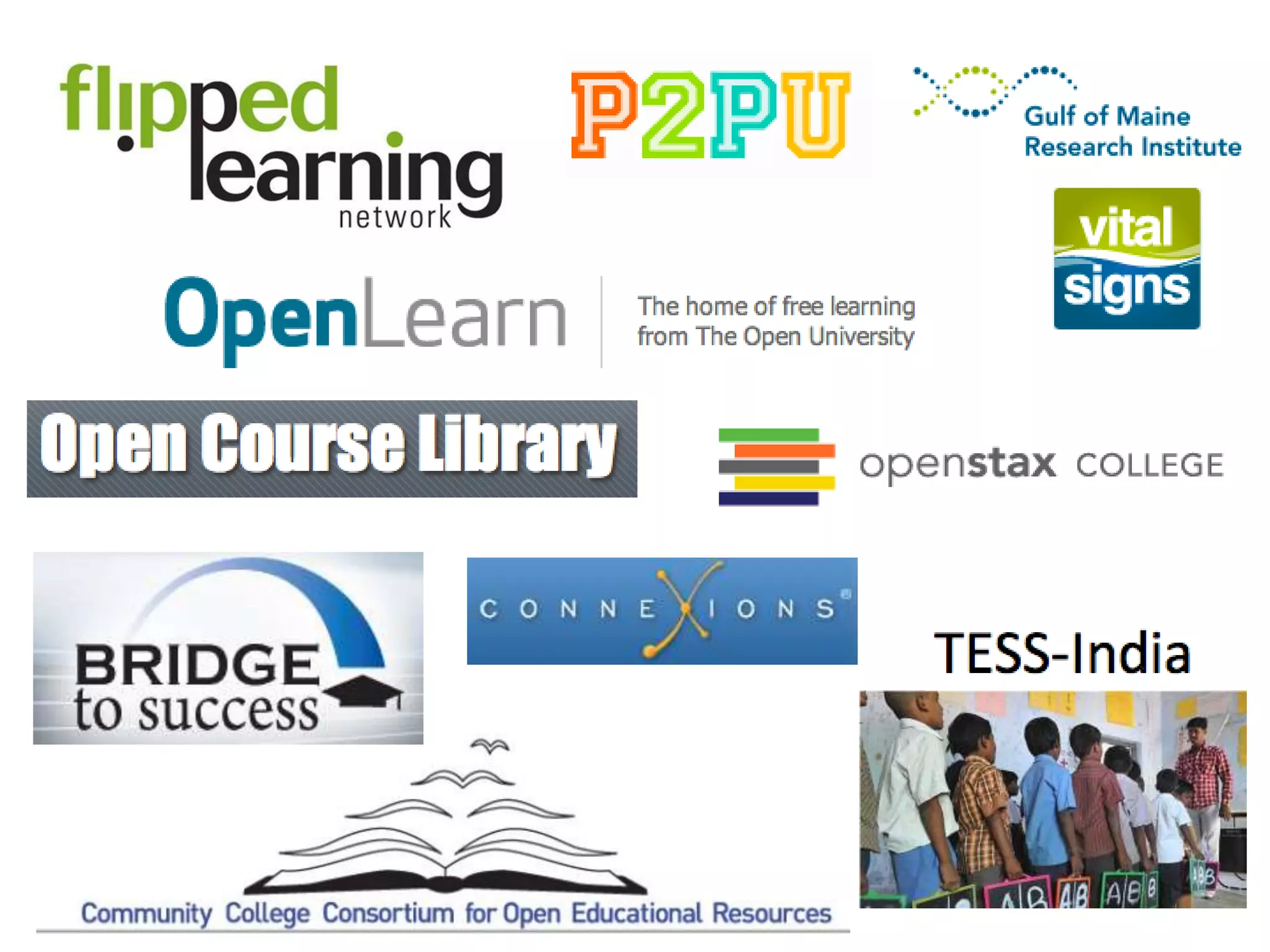
•   A schedule of targeted collaboration with existing OER projects
•   An international fellowship programme
•   Facilitating networking, participation and advocacy in the OER world

OER Hub is located at The Institute of Educational Technology (IET) at
The Open University (OU) and the project draws on the general strengths
of the OU as a provider, user and developer of OER.

The project is based on research through collaboration and partnership
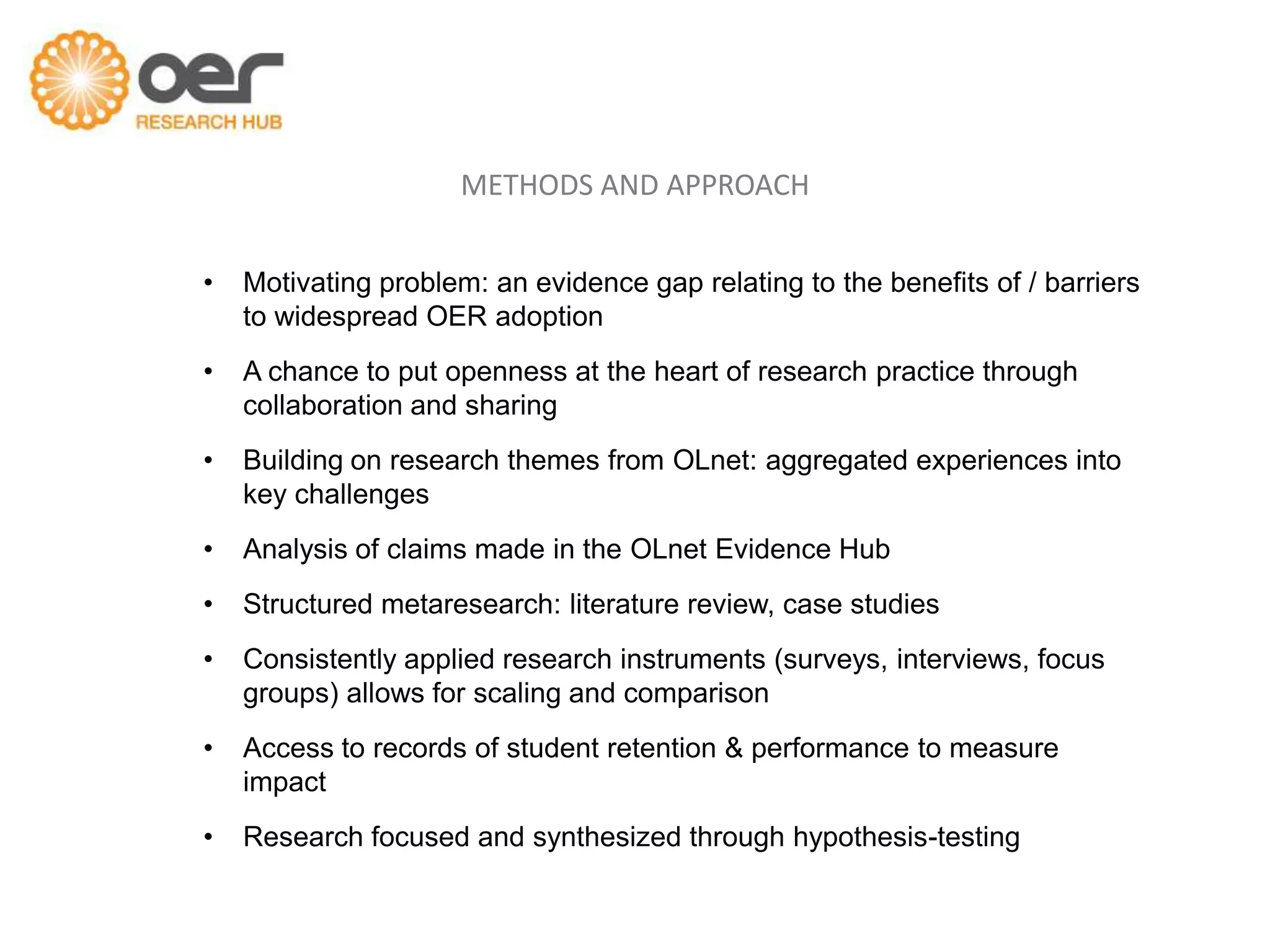
METHODS AND APPROACH


•   Motivating problem: an evidence gap relating to the benefits of / barriers
    to widespread OER adoption
•   A chance to put openness at the heart of research practice through
    collaboration and sharing
•   Building on research themes from OLnet: aggregated experiences into
    key challenges
•   Analysis of claims made in the OLnet Evidence Hub
•   Structured metaresearch: literature review, case studies
•   Consistently applied research instruments (surveys, interviews, focus
    groups) allows for scaling and comparison
•   Access to records of student retention & performance to measure
    impact
•   Research focused and synthesized through hypothesis-testing
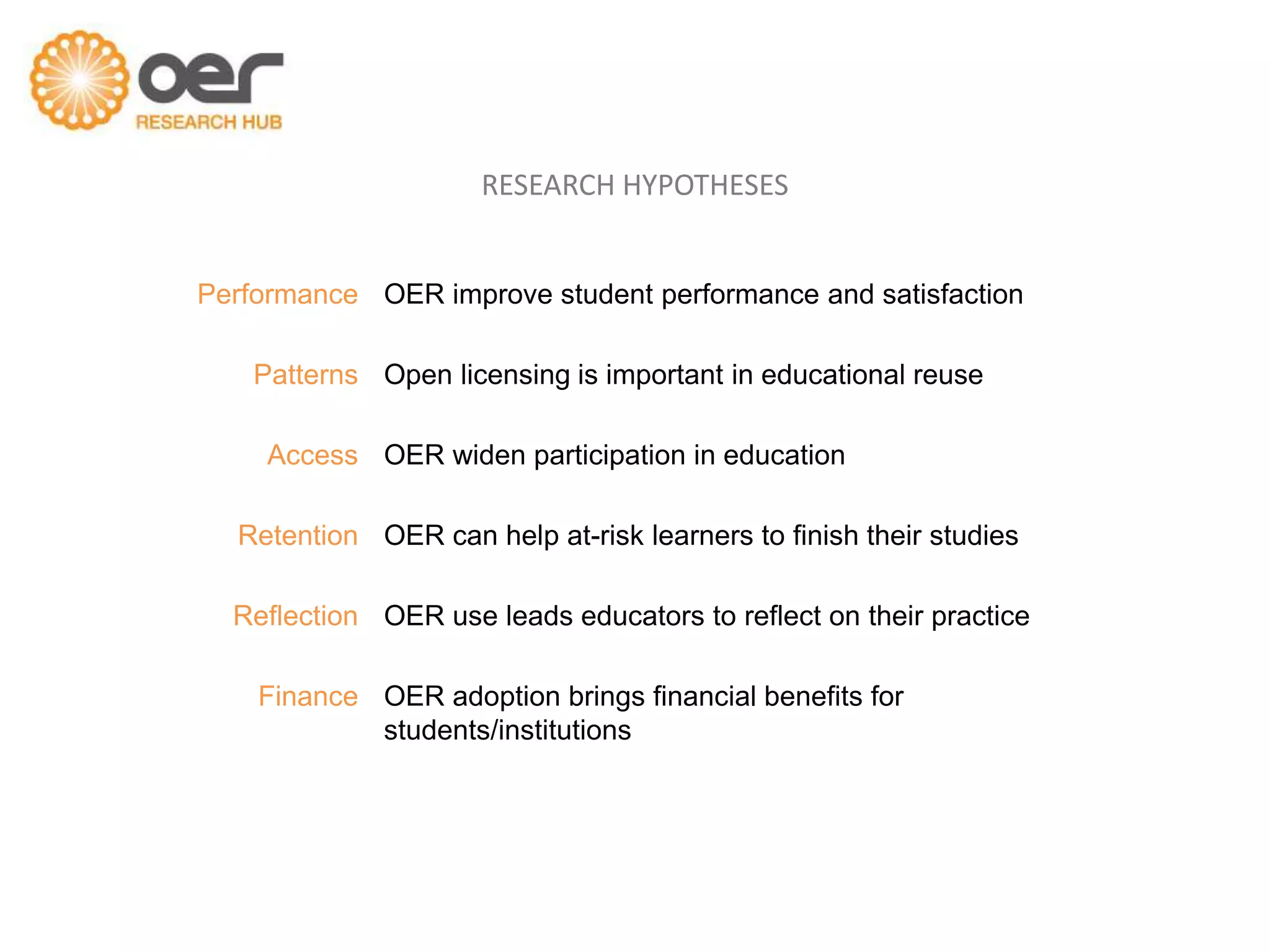
RESEARCH HYPOTHESES


Performance OER improve student performance and satisfaction

    Patterns Open licensing is important in educational reuse

     Access OER widen participation in education

  Retention OER can help at-risk learners to finish their studies

  Reflection OER use leads educators to reflect on their practice

    Finance OER adoption brings financial benefits for
            students/institutions
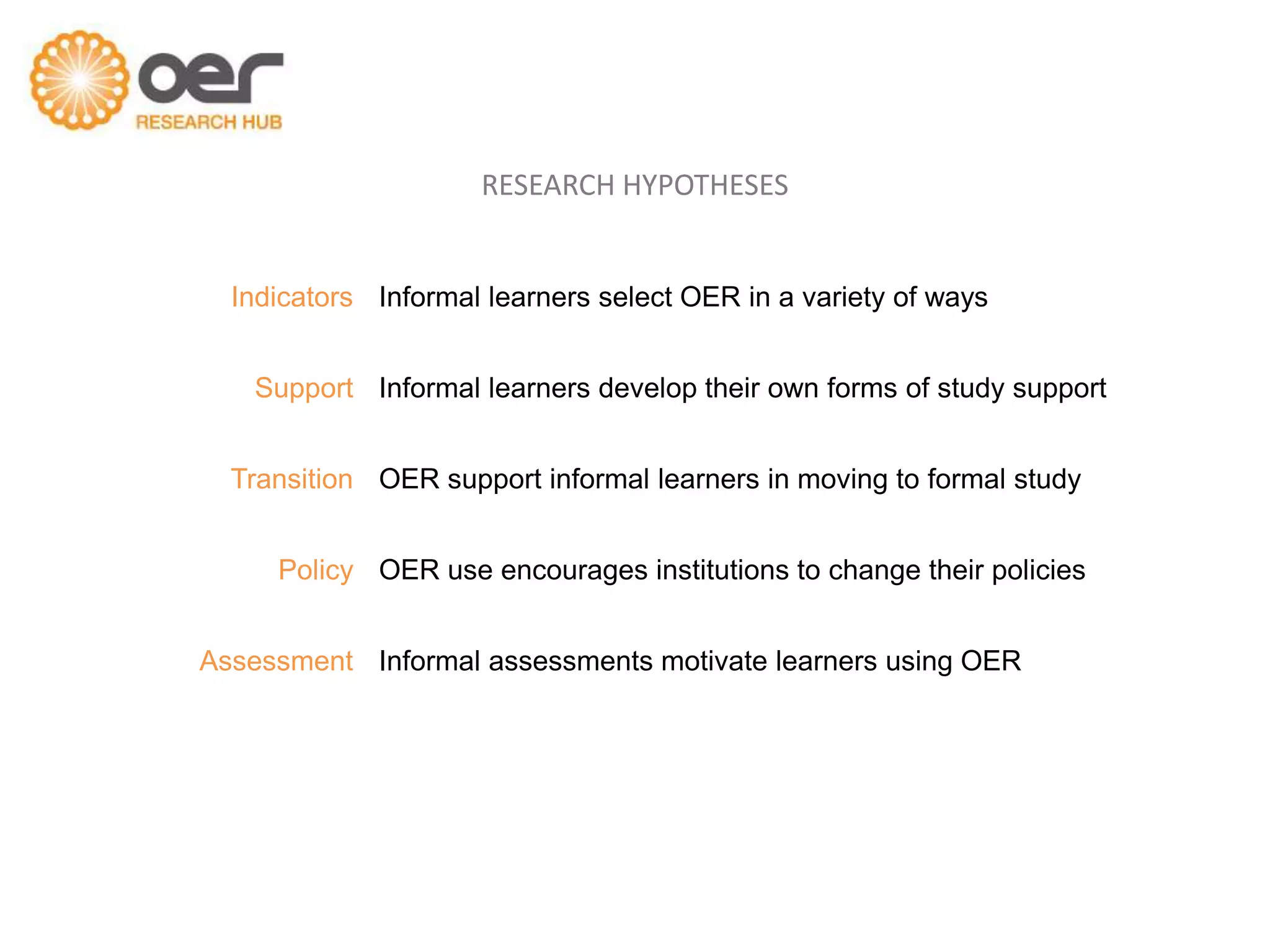
RESEARCH HYPOTHESES


  Indicators Informal learners select OER in a variety of ways


   Support Informal learners develop their own forms of study support


  Transition OER support informal learners in moving to formal study


     Policy OER use encourages institutions to change their policies


Assessment Informal assessments motivate learners using OER
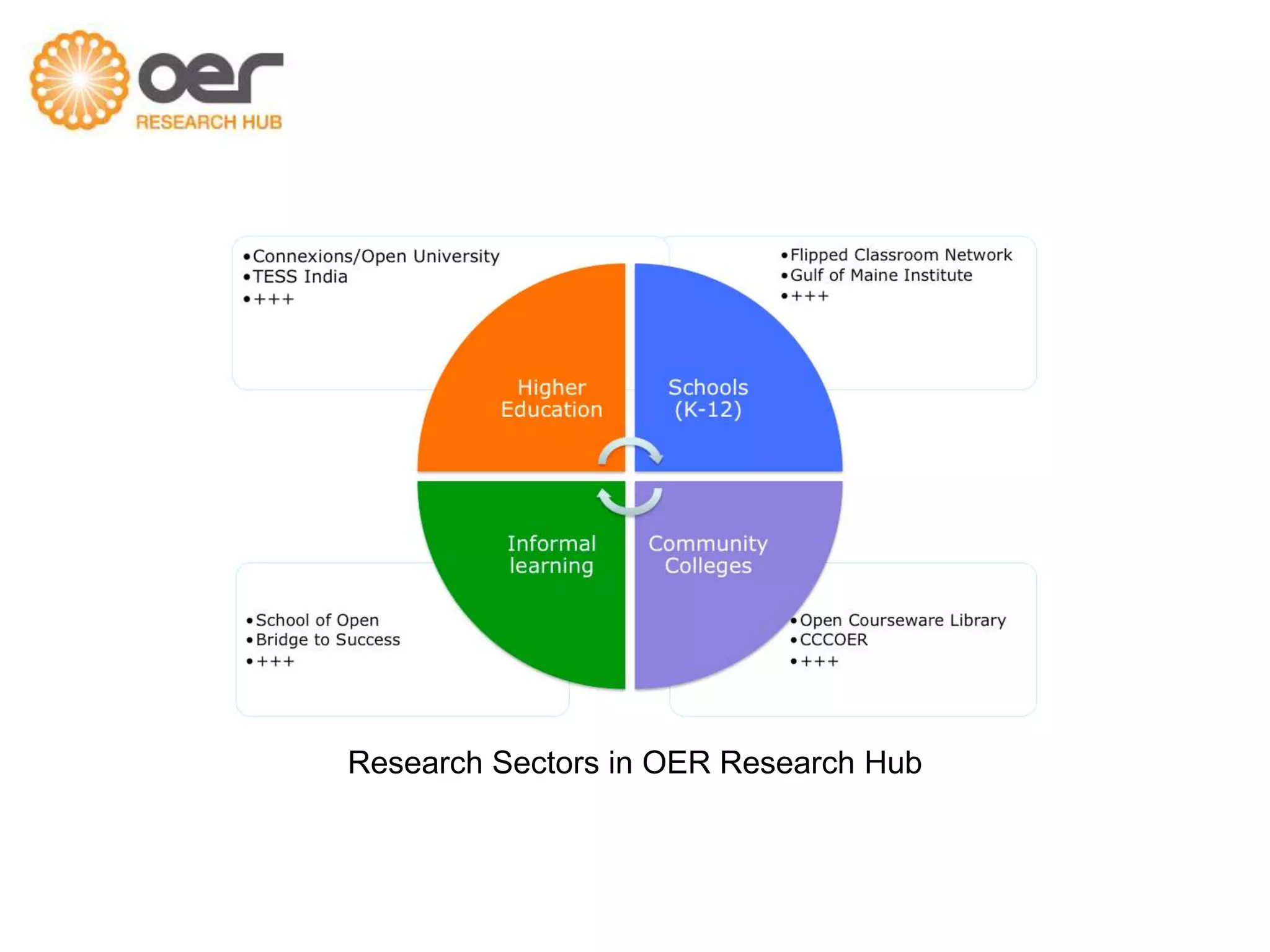
Research Sectors in OER Research Hub
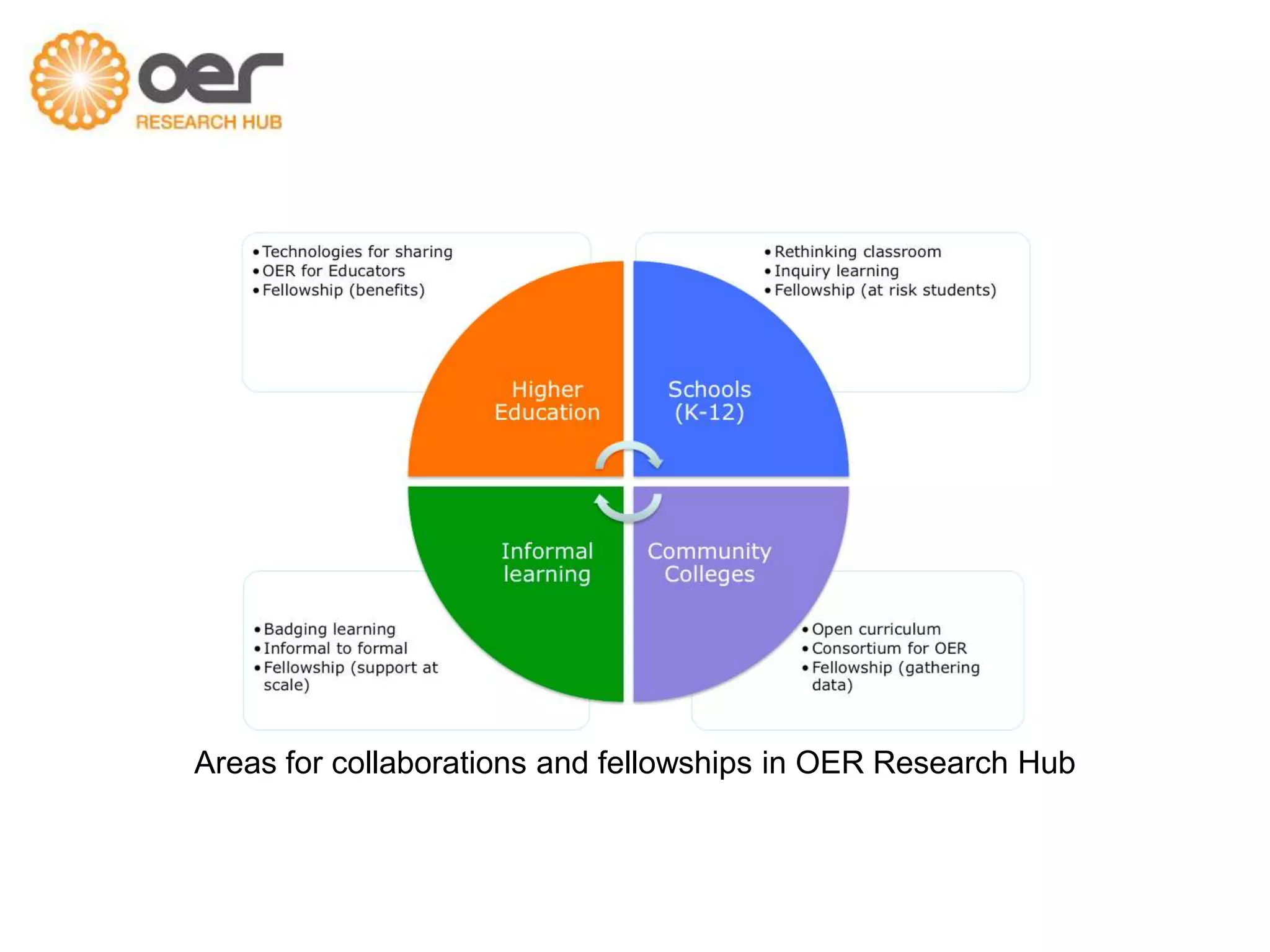
Areas for collaborations and fellowships in OER Research Hub
The Open University's Institute
of Educational Technology
ANTICIPATED OUTCOMES


• Greater transparency and openness
• Fostering fellowship, collegiality and community
• The most complete ‘global’ understanding of OER impact
• Research outcomes which inform new collaborations
• A new and improved OER Evidence Hub
• Better understanding of what works and why
• Finding ways around barriers to OER
• Aggregation of data relevant to OER advocacy
HOW TO GET INVOLVED


  Projects Can be added to the evidence hub with key findings and
           analysis, then linked up to the research hypotheses


Fellowship An open call has been published on our website


Research Make use of our openly licensed instruments and share
         data


     Data Can be released on an open licence and added to our
          evidence base


  Sharing The whole is greater than the sum of the parts: we can all
          benefit from openness
http://oerresearchhub.org
REFERENCES

•   Andrewartha, H. G. and Birch, L. C. (1954). The Distribution and Abundance of Animals.
    The University of Chicago Press, Chicago, Illinois.
•   Coughlan, T., Pitt, R. & McAndrew, P., (2013) Building Open Bridges: Collaborative
    Remixing and Reuse of Open Educational Resources across Organisations. In
    Proceedings of the ACM SIGCHI Conference on Human Factors in Computing
    Systems. ACM Press.
•   Daniel, J. (2012). Making Sense of MOOCs: Musings in a Maze of Myth, Paradox and
    Possibility. Journal of Interactive Media in Education (JiME). Retrieved from
    http://jime.open.ac.uk/jime/article/view/2012-18.
•   De Liddo, A., Buckingham Shum, S., McAndrew, P., and Farrow, R. (2012). The Open
    Education Evidence Hub: A Collective Intelligence Tool for Evidence Based Policy. In
    Proceedings of Cambridge 2012: Innovation and Impact - Openly Collaborating to
    Enhance Education. Cambridge, UK.
•   Hewlett (2010). Education Program Strategic Plan. Retrieved from
    http://www.hewlett.org/uploads/documents/Education_Strategic_Plan_2010.pdf .
REFERENCES

•   McAndrew, P., Farrow, R., Law, P. and Elliot-Cirigotis, G. (2012). Learning the Lessons of
    Openness, Journal of Interactive Media in Education (JiME) Cambridge OER 2012 special
    issue. Retrieved from http://jime.open.ac.uk/jime/article/view/2012-10.
•   McNiff, Jean and Whitehead, Jack (2002). Action research: Principles and practice. London:
    Routledge.
•   NAE (2013). NAE Grand Challenges for Engineering. Retrieved from
    http://www.engineeringchallenges.org/.
•   NSF (2011). A Report of the National Science Foundation Advisory Committee for
    Cyberinfrastructure Task Force on Grand Challenges. Retrieved from
    http://www.nsf.gov/od/oci/taskforces/TaskForceReport_GrandChallenges.pdf.
•   Odum, E. P. (1971). Fundamentals of Ecology. London: Saunders.
•   OERRH (2013). OER Research Hub. Retrieved from http://oerresearchhub.org/.
•   OLnet (2013). Open Learning Network. Retrieved from http://www.olnet.org.
•   SCORE (2013). Support Centre for Open Resources in Education. Retrieved from
    http://www.open.ac.uk/score/.
REFERENCES

•   UNESCO/COL (2013). The UNESCO/COL OER Knowledge Cloud. Retrieved from
    http://oerknowledgecloud.org/.
•   Weller, Martin (2011). A pedagogy of abundance. Spanish Journal of Pedagogy, 249 pp. 223–
    236.
•   Whyte, William Foote, Greenwood, Davyd & Lazes, Peter (1991). Participatory action
    research: Through practice to science in social research. In William Foote Whyte
    (Ed.), Participatory action research (pp.19-55). Newbury Park, California: Sage.
Institute of Educational Technology
The Open University
Walton Hall
Milton Keynes
MK7 6AA


www.open.ac.uk/iet

The Ecology of Sharing: Synthesizing OER Research

  • 2.
    The Ecology ofSharing: Synthesizing OER Research Patrick McAndrew & Robert Farrow
  • 3.
    HOW SHOULD WERESEARCH OPENNESS IN EDUCATION?
  • 4.
    Is OER researchmore like this… The Open University's Institute of Educational Technology
  • 5.
    WHY ‘ECOLOGY’? • The education ecosystem itself is changing • There exists an evidence gap relating to the widespread adoption of OER: benefits; barriers • Manifold factors with complex relationships between diverse elements • We need a holistic, flexible approach • OER/ecology metaphor recognises the lifecycles of OER creation and (re)use, evolution into new forms and adoption in new contexts • Emphasis on evolution, interconnectedness and interdependence
  • 6.
    http://publications.cetis.ac.uk/2012/601 http://presentations.ocwconsortium.org/uk2012_250_pearce _students_as_content_scavenger/
  • 7.
    ABOUT THE PROJECT TheOER Research Hub at The Open University combines: • A hub for research data and OER practice • A schedule of targeted collaboration with existing OER projects • An international fellowship programme • Facilitating networking, participation and advocacy in the OER world OER Hub is located at The Institute of Educational Technology (IET) at The Open University (OU) and the project draws on the general strengths of the OU as a provider, user and developer of OER. The project is based on research through collaboration and partnership
  • 8.
    METHODS AND APPROACH • Motivating problem: an evidence gap relating to the benefits of / barriers to widespread OER adoption • A chance to put openness at the heart of research practice through collaboration and sharing • Building on research themes from OLnet: aggregated experiences into key challenges • Analysis of claims made in the OLnet Evidence Hub • Structured metaresearch: literature review, case studies • Consistently applied research instruments (surveys, interviews, focus groups) allows for scaling and comparison • Access to records of student retention & performance to measure impact • Research focused and synthesized through hypothesis-testing
  • 9.
    RESEARCH HYPOTHESES Performance OERimprove student performance and satisfaction Patterns Open licensing is important in educational reuse Access OER widen participation in education Retention OER can help at-risk learners to finish their studies Reflection OER use leads educators to reflect on their practice Finance OER adoption brings financial benefits for students/institutions
  • 10.
    RESEARCH HYPOTHESES Indicators Informal learners select OER in a variety of ways Support Informal learners develop their own forms of study support Transition OER support informal learners in moving to formal study Policy OER use encourages institutions to change their policies Assessment Informal assessments motivate learners using OER
  • 12.
    Research Sectors inOER Research Hub
  • 13.
    Areas for collaborationsand fellowships in OER Research Hub
  • 14.
    The Open University'sInstitute of Educational Technology
  • 15.
    ANTICIPATED OUTCOMES • Greatertransparency and openness • Fostering fellowship, collegiality and community • The most complete ‘global’ understanding of OER impact • Research outcomes which inform new collaborations • A new and improved OER Evidence Hub • Better understanding of what works and why • Finding ways around barriers to OER • Aggregation of data relevant to OER advocacy
  • 16.
    HOW TO GETINVOLVED Projects Can be added to the evidence hub with key findings and analysis, then linked up to the research hypotheses Fellowship An open call has been published on our website Research Make use of our openly licensed instruments and share data Data Can be released on an open licence and added to our evidence base Sharing The whole is greater than the sum of the parts: we can all benefit from openness
  • 17.
  • 18.
    REFERENCES • Andrewartha, H. G. and Birch, L. C. (1954). The Distribution and Abundance of Animals. The University of Chicago Press, Chicago, Illinois. • Coughlan, T., Pitt, R. & McAndrew, P., (2013) Building Open Bridges: Collaborative Remixing and Reuse of Open Educational Resources across Organisations. In Proceedings of the ACM SIGCHI Conference on Human Factors in Computing Systems. ACM Press. • Daniel, J. (2012). Making Sense of MOOCs: Musings in a Maze of Myth, Paradox and Possibility. Journal of Interactive Media in Education (JiME). Retrieved from http://jime.open.ac.uk/jime/article/view/2012-18. • De Liddo, A., Buckingham Shum, S., McAndrew, P., and Farrow, R. (2012). The Open Education Evidence Hub: A Collective Intelligence Tool for Evidence Based Policy. In Proceedings of Cambridge 2012: Innovation and Impact - Openly Collaborating to Enhance Education. Cambridge, UK. • Hewlett (2010). Education Program Strategic Plan. Retrieved from http://www.hewlett.org/uploads/documents/Education_Strategic_Plan_2010.pdf .
  • 19.
    REFERENCES • McAndrew, P., Farrow, R., Law, P. and Elliot-Cirigotis, G. (2012). Learning the Lessons of Openness, Journal of Interactive Media in Education (JiME) Cambridge OER 2012 special issue. Retrieved from http://jime.open.ac.uk/jime/article/view/2012-10. • McNiff, Jean and Whitehead, Jack (2002). Action research: Principles and practice. London: Routledge. • NAE (2013). NAE Grand Challenges for Engineering. Retrieved from http://www.engineeringchallenges.org/. • NSF (2011). A Report of the National Science Foundation Advisory Committee for Cyberinfrastructure Task Force on Grand Challenges. Retrieved from http://www.nsf.gov/od/oci/taskforces/TaskForceReport_GrandChallenges.pdf. • Odum, E. P. (1971). Fundamentals of Ecology. London: Saunders. • OERRH (2013). OER Research Hub. Retrieved from http://oerresearchhub.org/. • OLnet (2013). Open Learning Network. Retrieved from http://www.olnet.org. • SCORE (2013). Support Centre for Open Resources in Education. Retrieved from http://www.open.ac.uk/score/.
  • 20.
    REFERENCES • UNESCO/COL (2013). The UNESCO/COL OER Knowledge Cloud. Retrieved from http://oerknowledgecloud.org/. • Weller, Martin (2011). A pedagogy of abundance. Spanish Journal of Pedagogy, 249 pp. 223– 236. • Whyte, William Foote, Greenwood, Davyd & Lazes, Peter (1991). Participatory action research: Through practice to science in social research. In William Foote Whyte (Ed.), Participatory action research (pp.19-55). Newbury Park, California: Sage.
  • 21.
    Institute of EducationalTechnology The Open University Walton Hall Milton Keynes MK7 6AA www.open.ac.uk/iet