Base paper: http://ieeexplore.ieee.org/xpls/abs_all.jsp?arnumber=544547
Phase-Locked Loop Techniques for FM Demodulation and Modulation
Institute of Electrical and Electronics Engineering
Abstract:
Phase locked demodulators are widely used for reception of amplitude modulation(AM), phase
modulation(PM), and frequency modulation(FM). In this research, we concentrated on phase locked FM
demodulators. Our main two parts are the PLL block and the Optimum Time Varying Filter block. We
started our work by building up three basic blocks of the PLL; the PFD, the Loop Filter and the VCO. By
carefully studying the structure and the operation of these blocks, we were able to make good choices
regarding the types of each block and their parameters. As a result, we got the desired results in our PLL
simulations. After that, in order to improve the quality of the FM signal, we worked on the Optimum
Time Varying Filter which is the main research part in the overall thesis. We studied the relationship of
the optimum filter (or matched filter), the optimum time-varying filter and our band pass filter. We then
derived the necessary equations to realize our synchronous filter. Based on the theory and equation
discussion, we were able to design the band pass filter. After we put all of the blocks together to realize
our FM PLL demodulator, we simulated the whole demodulator and recovered the FM demodulated
signal which showed that we had achieved our research goal-namely, to improve the quality of the PLL
FM Demodulator.
Base paper: http://ieeexplore.ieee.org/xpls/abs_all.jsp?arnumber=544547
A: - Building Blocks and Circuit Diagrams
(a) PLL FM Demodulator with BPF Building Block
(b) Phase Locked Loop (PLL) Block
Base paper: http://ieeexplore.ieee.org/xpls/abs_all.jsp?arnumber=544547
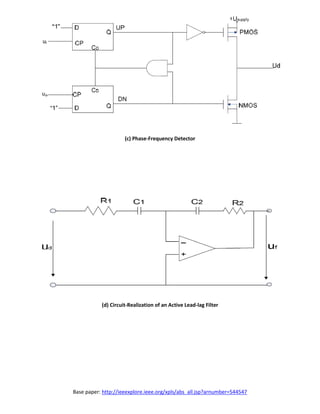
(c) Phase-Frequency Detector
(d) Circuit-Realization of an Active Lead-lag Filter
Base paper: http://ieeexplore.ieee.org/xpls/abs_all.jsp?arnumber=544547
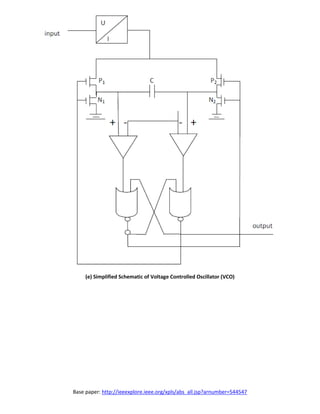
(e) Simplified Schematic of Voltage Controlled Oscillator (VCO)
Base paper: http://ieeexplore.ieee.org/xpls/abs_all.jsp?arnumber=544547
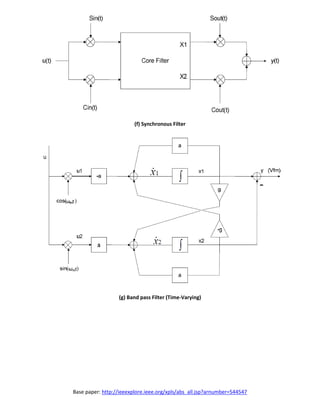
(f) Synchronous Filter
(g) Band pass Filter (Time-Varying)
Base paper: http://ieeexplore.ieee.org/xpls/abs_all.jsp?arnumber=544547
B: - Designs
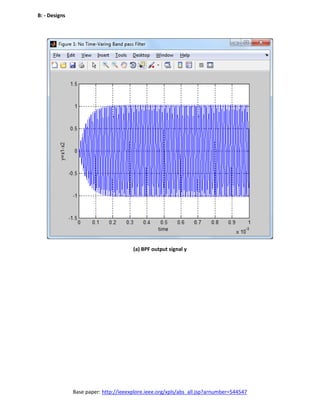
(a) BPF output signal y
Base paper: http://ieeexplore.ieee.org/xpls/abs_all.jsp?arnumber=544547
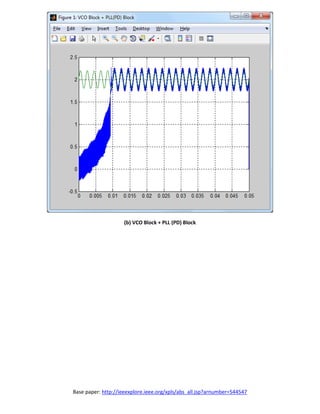
(b) VCO Block + PLL (PD) Block
Base paper: http://ieeexplore.ieee.org/xpls/abs_all.jsp?arnumber=544547
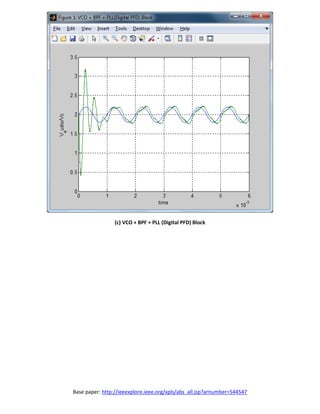
(c) VCO + BPF + PLL (Digital PFD) Block
Base paper: http://ieeexplore.ieee.org/xpls/abs_all.jsp?arnumber=544547
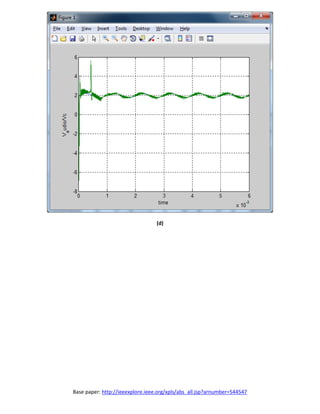
(d)
Base paper: http://ieeexplore.ieee.org/xpls/abs_all.jsp?arnumber=544547
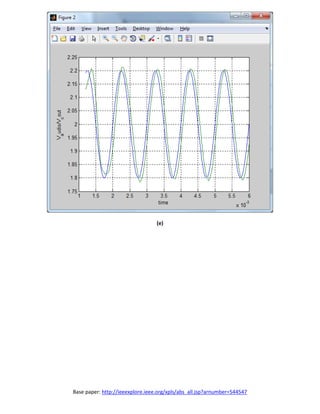
(e)
Base paper: http://ieeexplore.ieee.org/xpls/abs_all.jsp?arnumber=544547
Conclusion:
Phase locked demodulators are widely used for reception of amplitude modulation(AM), phase
modulation(PM), and frequency modulation(FM). In this research, we concentrated on phase locked FM
demodulators. Our main two parts are the PLL block and the Optimum Time Varying Filter block. We
started our work by building up three basic blocks of the PLL; the PFD, the Loop Filter and the VCO. By
carefully studying the structure and the operation of these blocks, we were able to make good choices
regarding the types of each block and their parameters. As a result, we got the desired results in our PLL
simulations. After that, in order to improve the quality of the FM signal, we worked on the Optimum
Time Varying Filter which is the main research part in the overall thesis. We studied the relationship of
the optimum filter (or matched filter), the optimum time-varying filter and our band pass filter. We then
derived the necessary equations to realize our synchronous filter. Based on the theory and equation
discussion, we were able to design the band pass filter. After we put all of the blocks together to realize
our FM PLL demodulator, we simulated the whole demodulator and recovered the FM demodulated
signal which showed that we had achieved our research goal-namely, to improve the quality of the PLL
FM Demodulator.
These results were very satisfying when I finished the simulations. At the same time, I noticed the
distortion problem in the Vcout signal which was affected by the feedback of the band pass filter. The
choice of constant “C” is critical. If I had more time, I would work on this and find a way to get rid of the
Vaudio signal in the BPF feedback and only keep the Vcout signal as part of the feedback. In that case, if
we still could get a good quality FM signal (Vcout), it would be perfect.
References:
D. R. Frey, “Optimal Filtering of AM and FM signal”, submitted to Iscas 2009
D. R. Frey, "Synchronous Filtering", Trans. Circuits and Syst, I: Reg. papers, vol. 53, no. 8, 2006, pp.1772-
1782
D. H. Wolaver, Phase-Locked Loop Circuit Design, Prentice Hall, Englewood Cliffs, NJ, 1991
W. R. Evans, Control-System Dynamics, McGraw-Hill, New York, 1954 H. W. Bode, Network Analysis and
Feedback Amplifier Design, Van Nostrand, New York, 1945
A. Blanchard, Phase-Locked Loops, Wiley, New York, 1976 J.W.M. Bergmans, ”Effect of Loop Delay on
stability of Discrete-time PLL”, IEEE Trans, Circuits & Sys, I, 42, 229-231, Apr.1995

Phase locked loop techniques for fm demodulation and modulation

  • 1.
    Base paper: http://ieeexplore.ieee.org/xpls/abs_all.jsp?arnumber=544547 Phase-LockedLoop Techniques for FM Demodulation and Modulation Institute of Electrical and Electronics Engineering Abstract: Phase locked demodulators are widely used for reception of amplitude modulation(AM), phase modulation(PM), and frequency modulation(FM). In this research, we concentrated on phase locked FM demodulators. Our main two parts are the PLL block and the Optimum Time Varying Filter block. We started our work by building up three basic blocks of the PLL; the PFD, the Loop Filter and the VCO. By carefully studying the structure and the operation of these blocks, we were able to make good choices regarding the types of each block and their parameters. As a result, we got the desired results in our PLL simulations. After that, in order to improve the quality of the FM signal, we worked on the Optimum Time Varying Filter which is the main research part in the overall thesis. We studied the relationship of the optimum filter (or matched filter), the optimum time-varying filter and our band pass filter. We then derived the necessary equations to realize our synchronous filter. Based on the theory and equation discussion, we were able to design the band pass filter. After we put all of the blocks together to realize our FM PLL demodulator, we simulated the whole demodulator and recovered the FM demodulated signal which showed that we had achieved our research goal-namely, to improve the quality of the PLL FM Demodulator.
  • 2.
    Base paper: http://ieeexplore.ieee.org/xpls/abs_all.jsp?arnumber=544547 A:- Building Blocks and Circuit Diagrams (a) PLL FM Demodulator with BPF Building Block (b) Phase Locked Loop (PLL) Block
  • 3.
    Base paper: http://ieeexplore.ieee.org/xpls/abs_all.jsp?arnumber=544547 (c)Phase-Frequency Detector (d) Circuit-Realization of an Active Lead-lag Filter
  • 4.
    Base paper: http://ieeexplore.ieee.org/xpls/abs_all.jsp?arnumber=544547 (e)Simplified Schematic of Voltage Controlled Oscillator (VCO)
  • 5.
    Base paper: http://ieeexplore.ieee.org/xpls/abs_all.jsp?arnumber=544547 (f)Synchronous Filter (g) Band pass Filter (Time-Varying)
  • 6.
  • 7.
  • 8.
  • 9.
  • 10.
  • 11.
    Base paper: http://ieeexplore.ieee.org/xpls/abs_all.jsp?arnumber=544547 Conclusion: Phaselocked demodulators are widely used for reception of amplitude modulation(AM), phase modulation(PM), and frequency modulation(FM). In this research, we concentrated on phase locked FM demodulators. Our main two parts are the PLL block and the Optimum Time Varying Filter block. We started our work by building up three basic blocks of the PLL; the PFD, the Loop Filter and the VCO. By carefully studying the structure and the operation of these blocks, we were able to make good choices regarding the types of each block and their parameters. As a result, we got the desired results in our PLL simulations. After that, in order to improve the quality of the FM signal, we worked on the Optimum Time Varying Filter which is the main research part in the overall thesis. We studied the relationship of the optimum filter (or matched filter), the optimum time-varying filter and our band pass filter. We then derived the necessary equations to realize our synchronous filter. Based on the theory and equation discussion, we were able to design the band pass filter. After we put all of the blocks together to realize our FM PLL demodulator, we simulated the whole demodulator and recovered the FM demodulated signal which showed that we had achieved our research goal-namely, to improve the quality of the PLL FM Demodulator. These results were very satisfying when I finished the simulations. At the same time, I noticed the distortion problem in the Vcout signal which was affected by the feedback of the band pass filter. The choice of constant “C” is critical. If I had more time, I would work on this and find a way to get rid of the Vaudio signal in the BPF feedback and only keep the Vcout signal as part of the feedback. In that case, if we still could get a good quality FM signal (Vcout), it would be perfect. References: D. R. Frey, “Optimal Filtering of AM and FM signal”, submitted to Iscas 2009 D. R. Frey, "Synchronous Filtering", Trans. Circuits and Syst, I: Reg. papers, vol. 53, no. 8, 2006, pp.1772- 1782 D. H. Wolaver, Phase-Locked Loop Circuit Design, Prentice Hall, Englewood Cliffs, NJ, 1991 W. R. Evans, Control-System Dynamics, McGraw-Hill, New York, 1954 H. W. Bode, Network Analysis and Feedback Amplifier Design, Van Nostrand, New York, 1945 A. Blanchard, Phase-Locked Loops, Wiley, New York, 1976 J.W.M. Bergmans, ”Effect of Loop Delay on stability of Discrete-time PLL”, IEEE Trans, Circuits & Sys, I, 42, 229-231, Apr.1995