ANATOMY &
PHYSIOLOGY OF
PHARYNX
ANATOMY-PHARYNX
12-14 cm.long conical
fibromuscular tube extending
from base of skull to lower
border of cricoid cartilage.
 Width 3.5cm at base , & 1.5cm at
pharyngo-esophageal junction.
Structure of pharyngeal
wall
from within outwards :
 Mucous membrane.
 Pharyngeal aponeurosis
(pharyngobasilar fascia).
 Muscular coat.
 Buccopharyngeal fascia..
DIVISIONS OF PHARYNX:
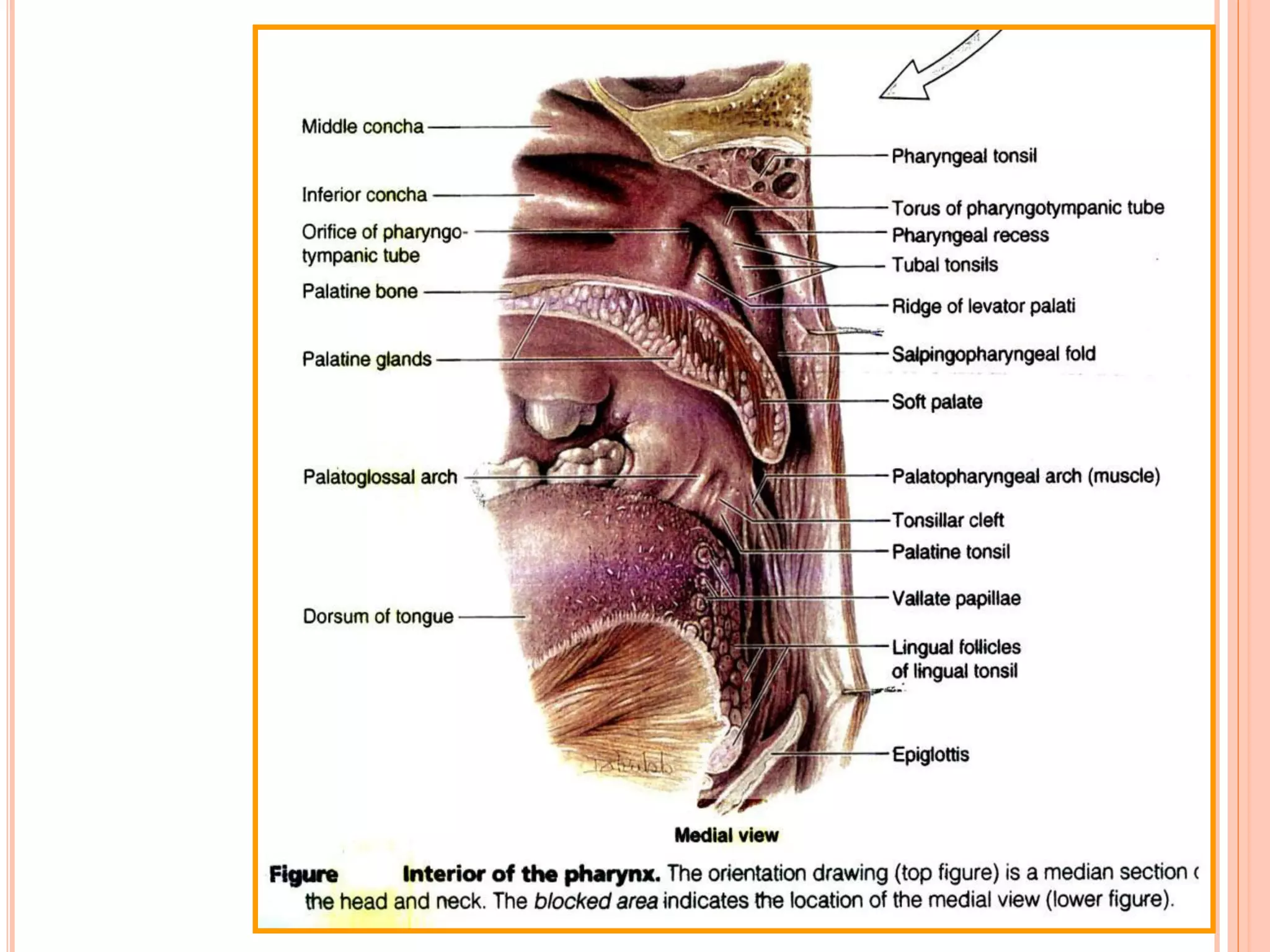
1. Nasopharynx
2. Oropharynx
3. Hypo or laryngopharynx.
NASOPHARYNX
• Upper most part of pharynx.
• Extends from base of skull to the
soft palate or a horizontal plane
passing through hard palate.
• Epipharynx.
OROPHARYNX
• Extends from the plane of hard palate above to
the plane of hyoid bone below.
HYPO OR
LARYNGOPHARYNX
• Lowest part of the pharynx.
• Lies opposite 3rd,4th,5th& 6th cervical vertebrae
• Superiorly from the plane passing from the
body of hyoid bone to posterior pharyngeal
wall, to inferiorly the lower border of cricoid
cartilage.
SINUS OF MORGAGNI
 Space between the base of the skull & upper
free border of superior constrictor muscle.
 Following pass through it
 Eustachian tube
 Levator veli palatini
 Tensor veli palatini.
 Ascending palatine branch of facial
KILLIAN’S DEHISCENCE
 Between two parts of inferior constrictor muscle.
 Potential gap between thyropharyngeus(oblique)
& cricopharyngeal(transverse) muscle fibres.
 ‘ Gateway of Tears ’
 Pharyngeal pouch.
WALDEYER’S RING
Scattered through out the pharynx is its sub-
epithelial layer is the lymphoid tissue which is
aggregated at places to form masses
collectively called Waldeyer’s Ring
The masses are :
 Nasopharyngeal tonsil or the adenoids
 Palatine tonsils
 Lingual tonsils
 Tubal tonsils
 Lateral pharyngeal bands
 Nodules is posterior pharyngeal wall
NASOPHARYNX
• Upper most part of pharynx.
• Extends from base of skull to the
soft palate or a horizontal plane
passing through hard palate.
• Epipharynx.
ANATOMY:
• Roof – basisphenoid & basiocciput
• Anterior wall – Choanae, Septum, Turb & Meati
• Posterior wall – Arch of Atlas, Prevertebral
muscles & fascia
• Lateral wall – ET, Torus, R. Fossa, & Fold
• Floor – Soft pal., N P Isthmus
ADENOIDS ANATOMY
 Site – Roof & Post wall NPX
 Vertical ridges & clefts
 Sub epithelial collection of lymphoid tissue.
 Ciliated columnar epithelium
 No crypts & no capsule
 Increases in size up to 6yrs & then gradually
atrophies.
 Directly to Upper Jugular N. & Post. Triangle nodes
or through Retropharyngeal N., Parapharyngeal N.,
NASOPHARYNGEAL
BURSA
 Epithelial-lined median recess within adenoid
mass.
 Extends from pharyngeal mucosa to periosteum
of basiocciput.
 Represents attachment of notochord to
pharyngeal endoderm.
 Thornwald’s disease.
THORNWALD’S DISEASE
 This is an abscess that develops in
nasopharyngeal bursa. Infected bursa usually
presents with persistent postnasal discharge or
crusting.
RATHKE’S POUCH
 Represented by a dimple just above the adenoids.
 Reminiscent of the buccal mucosal invagination
to form the anterior lobe of pituitary.
 Craniopharyngioma.
TUBAL TONSIL
 Collection of subepithelial lymphoid tissue
situated at the tubal elevation.
 Part of waldeyer’s ring.
 If enlarged – can cause eustachian tube occlusion.
PASSAVANT’S RIDGE
Mucosal ridge raised by fibers of
palatopharyngeus muscle.
Encircles the posterior & lateral
wall of nasopharyngeal isthmus.
In deglutition & denasal speech –
soft palate contracts touches this
ridge
LYMPHATIC DRAINAGE
OF NASOPHARYNX
 Directly to Upper Jugular
Nodes.
 Posterior Triangle nodes
 Or Through Retropharyngeal
Nodes, & Parapharyngeal Nodes
FUNCTIONS OF NASOPHARYNX
 Acts as conduit for air.
 Through Eustachian tube ventilates middle ear.
 Acts as resonating chamber during voice
production.
 Elevating soft palate against posterior
pharyngeal wall in swallowing , vomiting,
gagging & speech
 Acts as a drainage channel for mucus.
OROPHARYNX
• Extends from the plane of hard palate above to
the plane of hyoid bone below.
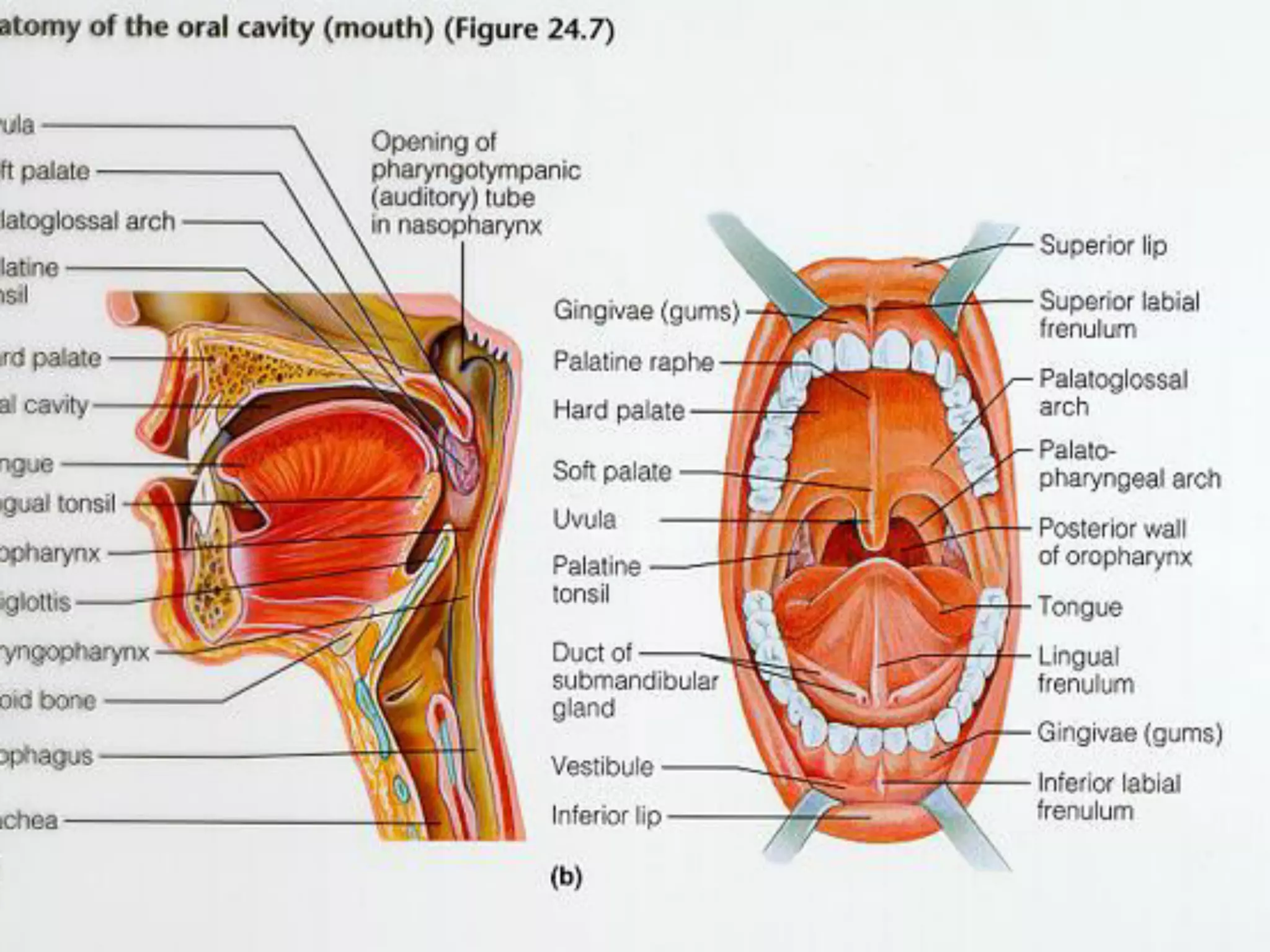
• anatomically,
anterior wall,posterior wall & lateral wall.
OROPHARYNX SITE
 Posterior to the oral cavity -Oro
Pharyngeal Isthmus
 Inferior to the level of the soft
palate and
 Superior to the upper margin of the
epiglottis
 Sides by Palatoglossal Arches
OROPHARYNX- WALLS
 Lateral wall of the oro-pharynx presents on each side
the palatine tonsil which lodges in a triangular tonsillar
fossa.
 Boundaries of the tonsillar fossa
 Front : Palato-glossal arch containing the
corresponding muscle.
 Behind : Palato-pharyngeal arch containing the
corresponding muscle.
 Apex : Soft palate while both arches meet.
 Base : Dorsal surface of posterior third of tongue,
(vallecula, & folds)
 Floor : Superior constrictor and stylo-glossus
muscles covered internally by pharyngo-basilar
fascia.
OROPHARYNX MECHANISM
 The oro-pharyngeal isthmus in closed deglutition
 This is to prevent regurgitation of food from the
pharynx to the mouth.
 This is achieved by :
 Depression of the soft palate
 Elevation by back of tongue and movement
towards the midline of palatoglossal and
palatopharyngeal folds.
 This allows a person to breath while chewing or
manipulating material in oral cavity.
FUNCTIONS OF
OROPHARYNX:
As a conduit for passage of air &
food.
Helps in pharyngeal stage of
deglutition.
Provides local defence &
immunity Sentinels - Waldeyers
ring – Ig A, M, & D
Appreciation of taste.
Vocal tract for Sounds
HYPO OR
LARYNGOPHARYNX
• Lowest part of the pharynx.
• Lies opposite 3rd,4th,5th& 6th cervical vertebrae
• Superiorly from the plane passing from the
body of hyoid bone to posterior pharyngeal
wall, to inferiorly the lower border of cricoid
cartilage.
DED INTO THREE
REGIONS:
1.Pyriform sinus(fossa)
2.Post cricoid region
3.Posterior pharygeal wall
PYRIFORM SINUS(FOSSA)
 Lies on either sides of larynx & extends
from pharyngoepiglottic fold to upper end
of esophagus.
 Bounded laterally by thyrohyoid
membrane & thyroid cartilage and
medially by aryepiglottic fold ,
posterolateral surfaces of arytenoid &
cricoid cartilages.
 FBs, Ca
 Internal laryngeal nerve – pain, refd pain,
LA
 Post cricoid region : between upper &
lower borders of cricoid lamina.-
Plummer vinson, Ca
 Posterior pharygeal wall : extends from
the level of hyoid bone (floor of
vallecula) to the level of
cricoarytenoid joint.
FUNCTIONS OF
LARYNGOPHARYNX:
• common pathway for air & food.
• provides a vocal tract for
resonance of certain speech
sounds &
• helps in deglutition
• Killians- Pouch
WALDEYER’S RING
Scattered through out the pharynx is its sub-
epithelial layer is the lymphoid tissue which is
aggregated at places to form masses
collectively called Waldeyer’s Ring
The masses are :
 Nasopharyngeal tonsil or the adenoids
 Palatine tonsils
 Lingual tonsils
 Tubal tonsils
 Lateral pharyngeal bands
 Nodules is posterior pharyngeal wall
WALDEYERS RING
THE PALATINE TONSILS
 It is an ovoid mass of lymphoid tissues situated
is the lateral wall of the oropharynx in the
tonsillar fossa.
Each tonsil presents
 Two surfaces-Medial and lateral
Two poles-upper and lower
THE PALATINE TONSILS-Contd….
Upper pole :
Extends into the soft palate
Its medial surface covered by a semilunar
fold and encloses a potential space called
supratonsillar fossa.
Lower pole :
It is continuous with the tongue,
Tonsillo-lingual sulcus separates the tonsil
from the tongue.
THE PALATINE TONSILS-Contd….
Medial surface :
 Covered by non-keratinised
stratified squamous epithelium.
 The epithelium dips into the
substance by the tonsil in the
form of crypts.
 Crypts – 12 to 15 primary ,
secondary, debris
 One of the crypts, situated near
the upper pole is large and
deep and in called crypta
magna or intra-tonsillar cleft –
cause for peritonsillar abscess.
THE PALATINE TONSILS-Contd….
Lateral surface :
 Presents a well defined fibrous capsule.
 Between the capsule and bed of tonsil is the
loose areolar tissue.
 It is the site for collection of pus is peritonsillar
abscess.
 Plane of dissection in tonslllection
TONSILLAR BED INSIDE OUT
 Superior constrictor &
styloglossus muscle
 Glossopharyngeal Nerve, &
Styloid process
 Facial artery,
Submandibular salivary
gland,
 Digastric (post belly), Med
Pterygoid, Mand angle
HISTOLOGY OF TONSIL
 It is covered by stratified squamous epithelium
 Tonsil consists of numerous lymphatic follicles
which surround the tonsillar crypts.
 Each follicle presents a germinal centre
composed of lymphoblasts
ARTERIAL SUPPLY TO TONSIL
Tonsillar branch of –
Descending palatine of maxillary
Ascending pharyngeal
Ascending palatine of facial
Tonsillar br of facial - main
Dorsalis linguae of Lingual
VENOUS DRAINAGE OF TONSIL
 Veins drain into Para tonsillar vein
( Dennis brown vein)
 Then to common facial vein & pharyngeal
plexus
Lymphatic drainage :
 Drains into jugulo-digastric lymph node.
 Situated below and behind the angle of
mandible.
 It is considered as the principal lymph mode
of tonsil.
Nerve supply :
 Glossopharyngeal nerve.
 Lesser palatine branches of sphenopalatine
ganglion.
APPLIED ANATOMY
 Have a protective role, act as sentinals at
the portal of air and food passage.
 Tonsils may themselves get infected and
act as septic foci indicating surgical
removal of tonsils.
 Post tonsillectomy loss of taste sensation
can occur due to involvement of
glossopharyngeal nerve.
 Some times referred pain from the infected
tonsil may extend into middle ear.
RETROPHARYNGEAL
SPACE
Lies - behind the pharynx between the
buccopharyngeal
fascia covering pharyngeal constrictor
muscles and the prevertebral fascia
Extension - From the base of the skull to
bifurcation of
trachea.
PARA PHARYNGEAL SPACE
 It is Pyramidal in shape with its base at the base
of the skull and its apex at the hyoid bone.
 Relations:
Medial - Buccopharyngeal fascia
Posterior - Prevertebral fascia covering
prevertebral muscles and transverse
process of cervical vertebra
Lateral - Medial Pterygoid Muscle,
Mandible and deep surface of parotid
gland.
PARA PHARYNGEAL
SPACE
 Styloid process and muscles attached to it
divide the space into anterior and posterior
compartments
 Anterior Compartment :
Related to tonsillar fossa &
medial pterygoid fossa
laterally.
 Posterior Compartment :
Related to posterior part of
lateral
pharyngeal wall medially and
pharynx- anat & physio lect - aug 07.pdf

pharynx- anat & physio lect - aug 07.pdf

  • 1.
  • 2.
    ANATOMY-PHARYNX 12-14 cm.long conical fibromusculartube extending from base of skull to lower border of cricoid cartilage.  Width 3.5cm at base , & 1.5cm at pharyngo-esophageal junction.
  • 3.
    Structure of pharyngeal wall fromwithin outwards :  Mucous membrane.  Pharyngeal aponeurosis (pharyngobasilar fascia).  Muscular coat.  Buccopharyngeal fascia..
  • 4.
    DIVISIONS OF PHARYNX: 1.Nasopharynx 2. Oropharynx 3. Hypo or laryngopharynx.
  • 6.
    NASOPHARYNX • Upper mostpart of pharynx. • Extends from base of skull to the soft palate or a horizontal plane passing through hard palate. • Epipharynx.
  • 7.
    OROPHARYNX • Extends fromthe plane of hard palate above to the plane of hyoid bone below.
  • 8.
    HYPO OR LARYNGOPHARYNX • Lowestpart of the pharynx. • Lies opposite 3rd,4th,5th& 6th cervical vertebrae • Superiorly from the plane passing from the body of hyoid bone to posterior pharyngeal wall, to inferiorly the lower border of cricoid cartilage.
  • 11.
    SINUS OF MORGAGNI Space between the base of the skull & upper free border of superior constrictor muscle.  Following pass through it  Eustachian tube  Levator veli palatini  Tensor veli palatini.  Ascending palatine branch of facial
  • 12.
    KILLIAN’S DEHISCENCE  Betweentwo parts of inferior constrictor muscle.  Potential gap between thyropharyngeus(oblique) & cricopharyngeal(transverse) muscle fibres.  ‘ Gateway of Tears ’  Pharyngeal pouch.
  • 13.
    WALDEYER’S RING Scattered throughout the pharynx is its sub- epithelial layer is the lymphoid tissue which is aggregated at places to form masses collectively called Waldeyer’s Ring The masses are :  Nasopharyngeal tonsil or the adenoids  Palatine tonsils  Lingual tonsils  Tubal tonsils  Lateral pharyngeal bands  Nodules is posterior pharyngeal wall
  • 14.
    NASOPHARYNX • Upper mostpart of pharynx. • Extends from base of skull to the soft palate or a horizontal plane passing through hard palate. • Epipharynx.
  • 15.
    ANATOMY: • Roof –basisphenoid & basiocciput • Anterior wall – Choanae, Septum, Turb & Meati • Posterior wall – Arch of Atlas, Prevertebral muscles & fascia • Lateral wall – ET, Torus, R. Fossa, & Fold • Floor – Soft pal., N P Isthmus
  • 17.
    ADENOIDS ANATOMY  Site– Roof & Post wall NPX  Vertical ridges & clefts  Sub epithelial collection of lymphoid tissue.  Ciliated columnar epithelium  No crypts & no capsule  Increases in size up to 6yrs & then gradually atrophies.  Directly to Upper Jugular N. & Post. Triangle nodes or through Retropharyngeal N., Parapharyngeal N.,
  • 18.
    NASOPHARYNGEAL BURSA  Epithelial-lined medianrecess within adenoid mass.  Extends from pharyngeal mucosa to periosteum of basiocciput.  Represents attachment of notochord to pharyngeal endoderm.  Thornwald’s disease.
  • 19.
    THORNWALD’S DISEASE  Thisis an abscess that develops in nasopharyngeal bursa. Infected bursa usually presents with persistent postnasal discharge or crusting.
  • 20.
    RATHKE’S POUCH  Representedby a dimple just above the adenoids.  Reminiscent of the buccal mucosal invagination to form the anterior lobe of pituitary.  Craniopharyngioma.
  • 21.
    TUBAL TONSIL  Collectionof subepithelial lymphoid tissue situated at the tubal elevation.  Part of waldeyer’s ring.  If enlarged – can cause eustachian tube occlusion.
  • 22.
    PASSAVANT’S RIDGE Mucosal ridgeraised by fibers of palatopharyngeus muscle. Encircles the posterior & lateral wall of nasopharyngeal isthmus. In deglutition & denasal speech – soft palate contracts touches this ridge
  • 23.
    LYMPHATIC DRAINAGE OF NASOPHARYNX Directly to Upper Jugular Nodes.  Posterior Triangle nodes  Or Through Retropharyngeal Nodes, & Parapharyngeal Nodes
  • 24.
    FUNCTIONS OF NASOPHARYNX Acts as conduit for air.  Through Eustachian tube ventilates middle ear.  Acts as resonating chamber during voice production.  Elevating soft palate against posterior pharyngeal wall in swallowing , vomiting, gagging & speech  Acts as a drainage channel for mucus.
  • 25.
    OROPHARYNX • Extends fromthe plane of hard palate above to the plane of hyoid bone below. • anatomically, anterior wall,posterior wall & lateral wall.
  • 26.
    OROPHARYNX SITE  Posteriorto the oral cavity -Oro Pharyngeal Isthmus  Inferior to the level of the soft palate and  Superior to the upper margin of the epiglottis  Sides by Palatoglossal Arches
  • 27.
    OROPHARYNX- WALLS  Lateralwall of the oro-pharynx presents on each side the palatine tonsil which lodges in a triangular tonsillar fossa.  Boundaries of the tonsillar fossa  Front : Palato-glossal arch containing the corresponding muscle.  Behind : Palato-pharyngeal arch containing the corresponding muscle.  Apex : Soft palate while both arches meet.  Base : Dorsal surface of posterior third of tongue, (vallecula, & folds)  Floor : Superior constrictor and stylo-glossus muscles covered internally by pharyngo-basilar fascia.
  • 29.
    OROPHARYNX MECHANISM  Theoro-pharyngeal isthmus in closed deglutition  This is to prevent regurgitation of food from the pharynx to the mouth.  This is achieved by :  Depression of the soft palate  Elevation by back of tongue and movement towards the midline of palatoglossal and palatopharyngeal folds.  This allows a person to breath while chewing or manipulating material in oral cavity.
  • 30.
    FUNCTIONS OF OROPHARYNX: As aconduit for passage of air & food. Helps in pharyngeal stage of deglutition. Provides local defence & immunity Sentinels - Waldeyers ring – Ig A, M, & D Appreciation of taste. Vocal tract for Sounds
  • 31.
    HYPO OR LARYNGOPHARYNX • Lowestpart of the pharynx. • Lies opposite 3rd,4th,5th& 6th cervical vertebrae • Superiorly from the plane passing from the body of hyoid bone to posterior pharyngeal wall, to inferiorly the lower border of cricoid cartilage.
  • 32.
    DED INTO THREE REGIONS: 1.Pyriformsinus(fossa) 2.Post cricoid region 3.Posterior pharygeal wall
  • 33.
    PYRIFORM SINUS(FOSSA)  Lieson either sides of larynx & extends from pharyngoepiglottic fold to upper end of esophagus.  Bounded laterally by thyrohyoid membrane & thyroid cartilage and medially by aryepiglottic fold , posterolateral surfaces of arytenoid & cricoid cartilages.  FBs, Ca  Internal laryngeal nerve – pain, refd pain, LA
  • 34.
     Post cricoidregion : between upper & lower borders of cricoid lamina.- Plummer vinson, Ca  Posterior pharygeal wall : extends from the level of hyoid bone (floor of vallecula) to the level of cricoarytenoid joint.
  • 35.
    FUNCTIONS OF LARYNGOPHARYNX: • commonpathway for air & food. • provides a vocal tract for resonance of certain speech sounds & • helps in deglutition • Killians- Pouch
  • 38.
    WALDEYER’S RING Scattered throughout the pharynx is its sub- epithelial layer is the lymphoid tissue which is aggregated at places to form masses collectively called Waldeyer’s Ring The masses are :  Nasopharyngeal tonsil or the adenoids  Palatine tonsils  Lingual tonsils  Tubal tonsils  Lateral pharyngeal bands  Nodules is posterior pharyngeal wall
  • 39.
  • 40.
    THE PALATINE TONSILS It is an ovoid mass of lymphoid tissues situated is the lateral wall of the oropharynx in the tonsillar fossa. Each tonsil presents  Two surfaces-Medial and lateral Two poles-upper and lower
  • 41.
    THE PALATINE TONSILS-Contd…. Upperpole : Extends into the soft palate Its medial surface covered by a semilunar fold and encloses a potential space called supratonsillar fossa. Lower pole : It is continuous with the tongue, Tonsillo-lingual sulcus separates the tonsil from the tongue.
  • 42.
    THE PALATINE TONSILS-Contd…. Medialsurface :  Covered by non-keratinised stratified squamous epithelium.  The epithelium dips into the substance by the tonsil in the form of crypts.  Crypts – 12 to 15 primary , secondary, debris  One of the crypts, situated near the upper pole is large and deep and in called crypta magna or intra-tonsillar cleft – cause for peritonsillar abscess.
  • 43.
    THE PALATINE TONSILS-Contd…. Lateralsurface :  Presents a well defined fibrous capsule.  Between the capsule and bed of tonsil is the loose areolar tissue.  It is the site for collection of pus is peritonsillar abscess.  Plane of dissection in tonslllection
  • 44.
    TONSILLAR BED INSIDEOUT  Superior constrictor & styloglossus muscle  Glossopharyngeal Nerve, & Styloid process  Facial artery, Submandibular salivary gland,  Digastric (post belly), Med Pterygoid, Mand angle
  • 46.
    HISTOLOGY OF TONSIL It is covered by stratified squamous epithelium  Tonsil consists of numerous lymphatic follicles which surround the tonsillar crypts.  Each follicle presents a germinal centre composed of lymphoblasts
  • 47.
    ARTERIAL SUPPLY TOTONSIL Tonsillar branch of – Descending palatine of maxillary Ascending pharyngeal Ascending palatine of facial Tonsillar br of facial - main Dorsalis linguae of Lingual
  • 48.
    VENOUS DRAINAGE OFTONSIL  Veins drain into Para tonsillar vein ( Dennis brown vein)  Then to common facial vein & pharyngeal plexus
  • 49.
    Lymphatic drainage : Drains into jugulo-digastric lymph node.  Situated below and behind the angle of mandible.  It is considered as the principal lymph mode of tonsil. Nerve supply :  Glossopharyngeal nerve.  Lesser palatine branches of sphenopalatine ganglion.
  • 50.
    APPLIED ANATOMY  Havea protective role, act as sentinals at the portal of air and food passage.  Tonsils may themselves get infected and act as septic foci indicating surgical removal of tonsils.  Post tonsillectomy loss of taste sensation can occur due to involvement of glossopharyngeal nerve.  Some times referred pain from the infected tonsil may extend into middle ear.
  • 52.
    RETROPHARYNGEAL SPACE Lies - behindthe pharynx between the buccopharyngeal fascia covering pharyngeal constrictor muscles and the prevertebral fascia Extension - From the base of the skull to bifurcation of trachea.
  • 53.
    PARA PHARYNGEAL SPACE It is Pyramidal in shape with its base at the base of the skull and its apex at the hyoid bone.  Relations: Medial - Buccopharyngeal fascia Posterior - Prevertebral fascia covering prevertebral muscles and transverse process of cervical vertebra Lateral - Medial Pterygoid Muscle, Mandible and deep surface of parotid gland.
  • 54.
    PARA PHARYNGEAL SPACE  Styloidprocess and muscles attached to it divide the space into anterior and posterior compartments  Anterior Compartment : Related to tonsillar fossa & medial pterygoid fossa laterally.  Posterior Compartment : Related to posterior part of lateral pharyngeal wall medially and