Dr Rajesh Kar,
MBBS, MS, DNB
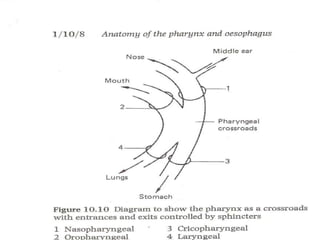
Pharynx( greek- Throat)
 Pharynx is a conical(half-cylinder ) fibromuscular
tube
 12-14 cm long
 extends from base of the skull (basiocciput
and basisphenoid) to the lower border of
cricoid cartilage.
 The width is 3.5 cm at its base and this
narrows to 1.5 cm at pharyngo-oesophageal
junction which is the narrowest part of
digestive tract apart from the appendix.
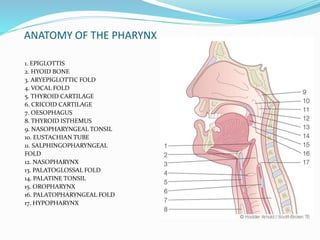
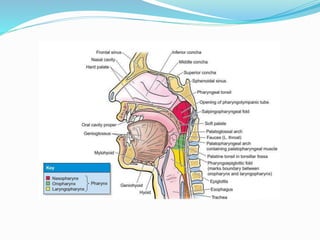
ANATOMY OF THE PHARYNX
1. EPIGLOTTIS
2. HYOID BONE
3. ARYEPIGLOTTIC FOLD
4. VOCAL FOLD
5. THYROID CARTILAGE
6. CRICOID CARTILAGE
7. OESOPHAGUS
8. THYROID ISTHEMUS
9. NASOPHARYNGEAL TONSIL
10. EUSTACHIAN TUBE
11. SALPHINGOPHARYNGEAL
FOLD
12. NASOPHARYNX
13. PALATOGLOSSAL FOLD
14. PALATINE TONSIL
15. OROPHARYNX
16. PALATOPHARYNGEAL FOLD
17. HYPOPHARYNX
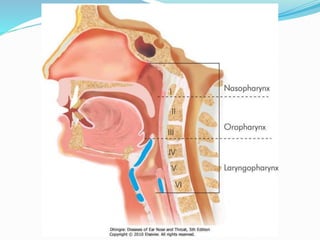
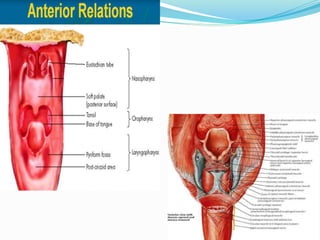
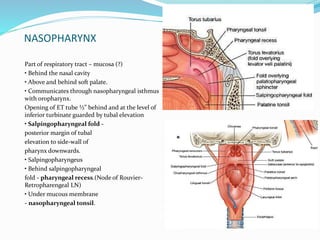
NASOPHARYNX
Part of respiratory tract – mucosa (?)
• Behind the nasal cavity
• Above and behind soft palate.
• Communicates through nasopharyngeal isthmus
with oropharynx.
Opening of ET tube ½” behind and at the level of
inferior turbinate guarded by tubal elevation
• Salpingopharyngeal fold -
posterior margin of tubal
elevation to side-wall of
pharynx downwards.
• Salpingopharyngeus
• Behind salpingopharyngeal
fold - pharyngeal recess.(Node of Rouvier-
Retropharengeal LN)
• Under mucous membrane
- nasopharyngeal tonsil.
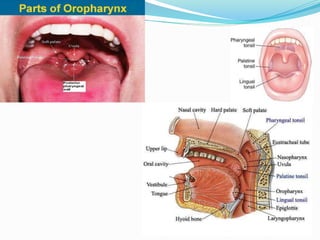
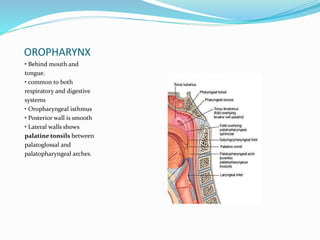
OROPHARYNX
• Behind mouth and
tongue.
• common to both
respiratory and digestive
systems
• Oropharyngeal isthmus
• Posterior wall is smooth
• Lateral walls shows
palatine tonsils between
palatoglossal and
palatopharyngeal arches.
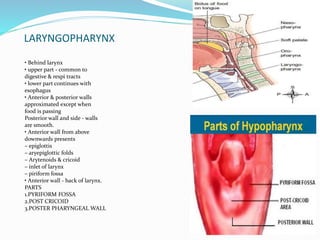
LARYNGOPHARYNX
• Behind larynx
• upper part - common to
digestive & respi tracts
• lower part continues with
esophagus
• Anterior & posterior walls
approximated except when
food is passing
Posterior wall and side - walls
are smooth.
• Anterior wall from above
downwards presents
– epiglottis
– aryepiglottic folds
– Arytenoids & cricoid
– inlet of larynx
– piriform fossa
• Anterior wall - back of larynx.
PARTS
1.PYRIFORM FOSSA
2.POST CRICOID
3.POSTER PHARYNGEAL WALL
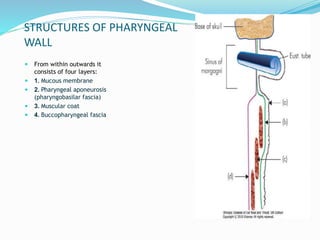
STRUCTURES OF PHARYNGEAL
WALL
 From within outwards it
consists of four layers:
 1. Mucous membrane
 2. Pharyngeal aponeurosis
(pharyngobasilar fascia)
 3. Muscular coat
 4. Buccopharyngeal fascia
1. Mucous membrane
 It lines the pharyngeal cavity and is continuous with
mucous membrane of eustachian tubes, nasal
cavities, mouth, larynx and oesophagus.
 The epithelium is ciliated columnar in the
nasopharynx and stratified squamous elsewhere.
 There are numerous mucous glands scattered in it.
2. Pharyngeal aponeurosis (pharyngobasilar fascia)
  It is a fibrous layer
  lines the muscular coat
  It is thick near the base of skull but is thin
and indistinct inferiorly.
  It fills up the gap left in the muscular coat
near the base of skull.
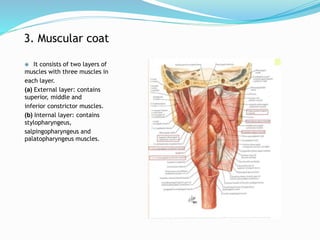
3. Muscular coat
 It consists of two layers of
muscles with three muscles in
each layer.
(a) External layer: contains
superior, middle and
inferior constrictor muscles.
(b) Internal layer: contains
stylopharyngeus,
salpingopharyngeus and
palatopharyngeus muscles.
 4. Buccopharyngeal fascia
  It covers outer surface of the constrictor
muscles
  Upper part  prolonged forwards to cover
the buccinator muscles
 Above the upper border of superior constrictor,
it blends with pharyngeal aponeurosis.
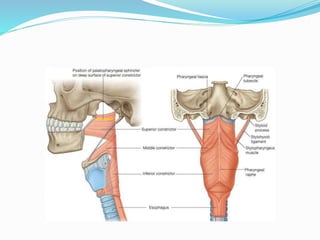
Constrictor muscles
 •The 3 constrictor muscle on each side -major contributors
to the structure of the pharyngeal wall
 –Superior, Middle and inferior
 •Posteriorly, the muscles from each side are joined together
by the pharyngeal raphe
 •Anteriorly, these muscles attach to bones and ligaments
related to the lateral margins of the nasal and oral cavities
and the larynx.
 •Walls of three flower pots stacked one on the other
 •Constrict or narrow the pharyngeal cavity.
 •Innervated by the pharyngeal branch of the vagus nerve
[X]
Superior constrictors
 •Upper part of the pharyngeal cavity
 •Attached anteriorly to the pterygoidhamulus,
pterygomandibularraphe, and adjacent bone of the
mandible.
 •Muscle fans out posteriorly and joins with its partner
muscle from the other side at the pharyngeal raphe
 •Palatopharyngeal sphincter
 –Special band of muscle originating from anterolateral
surface of the soft palate
 –Circles the inner aspect of the pharyngeal wall
 •Functions: constricts during swallowing -prominent ridge
on the deep aspect of the pharyngeal wall
Middle constrictors
 •Attached to the lower aspect of the
stylohyoidligament
 •lesser horn of the hyoid bone, and the entire upper
surface of the greater horn of the hyoid
 •Muscles fan out posteriorly and attach to the
pharyngeal raphe
 •Posterior part of the middle constrictors overlaps
the superior constrictors
Inferior constrictors
 •Attach anteriorly to the oblique line of the thyroid
cartilage and the cricoidcartilage.
 •There are ligament that spans between these two
attachments to cartilage -crosses the cricothyroidmuscle
 •Spread out posteriorly and attach to the pharyngeal
raphe
 •Posterior part of the inferior constrictors overlaps the
middle constrictors
 •Inferiorly, the muscle fibers blend with and attach into
the wall of the esophagus
 •Narrowest part of the pharyngeal cavity
GAPS BETWEEN
CONSTRICTORS
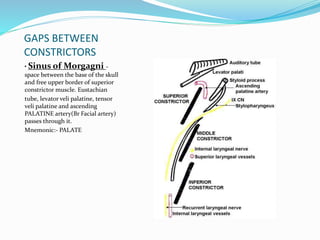
• Sinus of Morgagni -
space between the base of the skull
and free upper border of superior
constrictor muscle. Eustachian
tube, levator veli palatine, tensor
veli palatine and ascending
PALATINE artery(Br Facial artery)
passes through it.
Mnemonic:- PALATE
Longitudinal
muscles
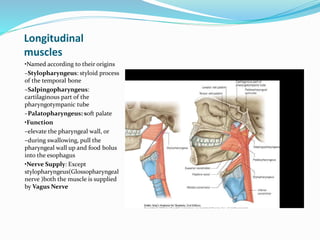
•Named according to their origins
–Stylopharyngeus: styloid process
of the temporal bone
–Salpingopharyngeus:
cartilaginous part of the
pharyngotympanic tube
–Palatopharyngeus: soft palate
•Function
–elevate the pharyngeal wall, or
–during swallowing, pull the
pharyngeal wall up and food bolus
into the esophagus
•Nerve Supply: Except
stylopharyngeus(Glossopharyngeal
nerve )both the muscle is supplied
by Vagus Nerve
Artery Supply
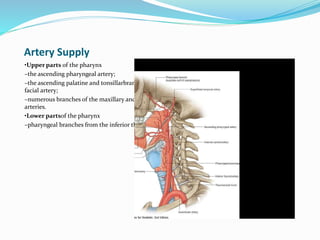
•Upper parts of the pharynx
–the ascending pharyngeal artery;
–the ascending palatine and tonsillarbranches of the
facial artery;
–numerous branches of the maxillary and the lingual
arteries.
•Lower partsof the pharynx
–pharyngeal branches from the inferior thyroid artery
Veins and
Lymphatic Drainage
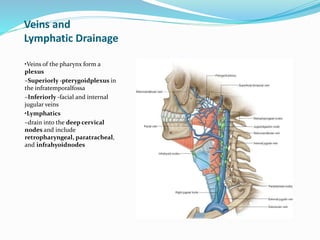
•Veins of the pharynx form a
plexus
–Superiorly -pterygoidplexus in
the infratemporalfossa
–Inferiorly -facial and internal
jugular veins
•Lymphatics
–drain into the deep cervical
nodes and include
retropharyngeal, paratracheal,
and infrahyoidnodes
Nerves
•Motor and most sensory
innervation-branches of the
vagus[X] &
glossopharyngeal[IX] nerves
•This 2 nerved forms a plexus in
the outer fascia of the pharyngeal
wall, consisting of
–the pharyngeal branch of the
vagusnerve [X];
–branches from the external
laryngeal nervefrom the
superior laryngeal branchof the
vagusnerve [X];
–pharyngeal branches of the
glossopharyngealnerve [IX]
FUNCTIONS OF PHARYNX
 Passageway for air and food.
 The pharynx is involved in both the respiratory
and the digestive systems: air passes through the
nasal and oral sections, and food through the oral
and laryngeal sections.
 Warming and humidifying. By the same
methods as in the nose, the air is further warmed
and moistened as it passes through the pharynx.
 Taste :there are gustatory nerve endings of the
sense of taste in the epithelium of the oral and
pharyngeal parts.
 Hearing : the auditory tube , extending from
the nasopharynx to each middle ear , allows air
to enter the middle ear. Satisfactory hearing
depends on the presence of air at atmospheric
pressure on each side of the tympanic membrane.
 Protection: the lymphatic tissue of the pharyngeal
and laryngeal tonsils produces antibodies in response
to antigens , eg bacteria.
The tonsils are larger in children and tend to
atrophy in adults.
 Speech: the pharynx functions in speech , by acting as
a resonating chamber for sound ascending from the
larynx, it helps to give the voice its individual
characteristics.
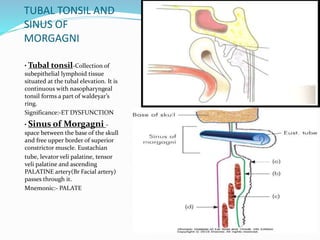
TUBAL TONSIL AND
SINUS OF
MORGAGNI
• Tubal tonsil-Collection of
subepithelial lymphoid tissue
situated at the tubal elevation. It is
continuous with nasopharyngeal
tonsil forms a part of waldeyar’s
ring.
Significance:-ET DYSFUNCTION
• Sinus of Morgagni -
space between the base of the skull
and free upper border of superior
constrictor muscle. Eustachian
tube, levator veli palatine, tensor
veli palatine and ascending
PALATINE artery(Br Facial artery)
passes through it.
Mnemonic:- PALATE
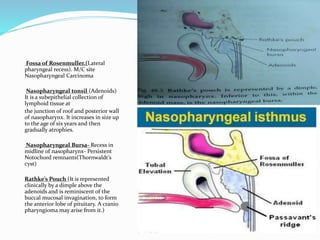
Fossa of Rosenmuller.(Lateral
pharyngeal recess). M/C site
Nasopharyngeal Carcinoma
Nasopharyngeal tonsil (Adenoids)
It is a subepithelial collection of
lymphoid tissue at
the junction of roof and posterior wall
of nasopharynx. It increases in size up
to the age of six years and then
gradually atrophies.
Nasopharyngeal Bursa- Recess in
midline of nasopharynx- Persistent
Notochord remnants(Thornwaldt’s
cyst)
Rathke’s Pouch (It is represented
clinically by a dimple above the
adenoids and is reminiscent of the
buccal mucosal invagination, to form
the anterior lobe of pituitary. A cranio
pharyngioma may arise from it.)
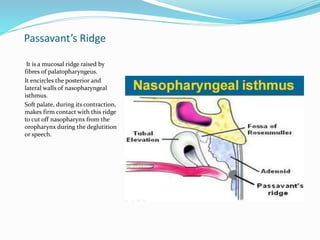
Passavant’s Ridge
It is a mucosal ridge raised by
fibres of palatopharyngeus.
It encircles the posterior and
lateral walls of nasopharyngeal
isthmus.
Soft palate, during its contraction,
makes firm contact with this ridge
to cut off nasopharynx from the
oropharynx during the deglutition
or speech.
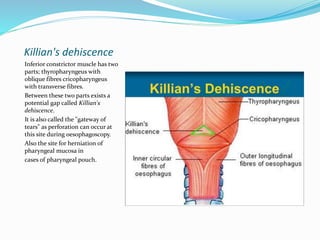
Killian's dehiscence
Inferior constrictor muscle has two
parts; thyropharyngeus with
oblique fibres cricopharyngeus
with transverse fibres.
Between these two parts exists a
potential gap called Killian's
dehiscence.
It is also called the "gateway of
tears" as perforation can occur at
this site during oesophagoscopy.
Also the site for herniation of
pharyngeal mucosa in
cases of pharyngeal pouch.
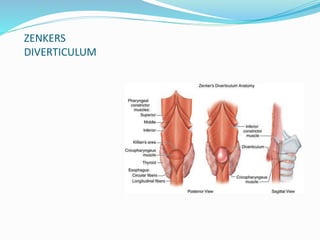
ZENKERS
DIVERTICULUM
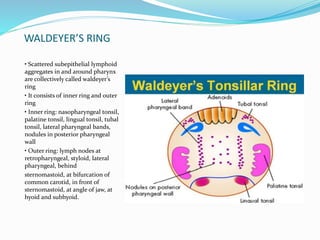
WALDEYER’S RING
• Scattered subepithelial lymphoid
aggregates in and around pharynx
are collectively called waldeyer’s
ring
• It consists of inner ring and outer
ring
• Inner ring: nasopharyngeal tonsil,
palatine tonsil, lingual tonsil, tubal
tonsil, lateral pharyngeal bands,
nodules in posterior pharyngeal
wall
• Outer ring: lymph nodes at
retropharyngeal, styloid, lateral
pharyngeal, behind
sternomastoid, at bifurcation of
common carotid, in front of
sternomastoid, at angle of jaw, at
hyoid and subhyoid.
.
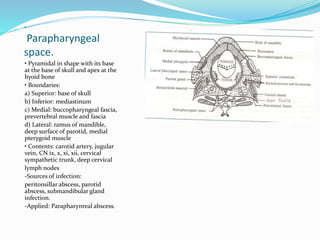
Parapharyngeal
space.
• Pyramidal in shape with its base
at the base of skull and apex at the
hyoid bone
• Boundaries:
a) Superior: base of skull
b) Inferior: mediastinum
c) Medial: buccopharyngeal fascia,
prevertebral muscle and fascia
d) Lateral: ramus of mandible,
deep surface of parotid, medial
pterygoid muscle
• Contents: carotid artery, jugular
vein, CN ix, x, xi, xii, cervical
sympathetic trunk, deep cervical
lymph nodes
-Sources of infection:
peritonsillar abscess, parotid
abscess, submandibular gland
infection.
-Applied: Parapharynreal abscess.
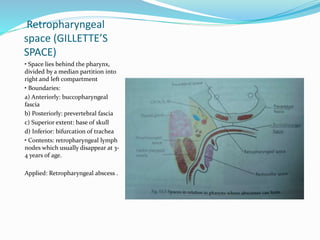
Retropharyngeal
space (GILLETTE’S
SPACE)
• Space lies behind the pharynx,
divided by a median partition into
right and left compartment
• Boundaries:
a) Anteriorly: buccopharyngeal
fascia
b) Posteriorly: prevertebral fascia
c) Superior extent: base of skull
d) Inferior: bifurcation of trachea
• Contents: retropharyngeal lymph
nodes which usually disappear at 3-
4 years of age.
Applied: Retropharyngeal abscess .
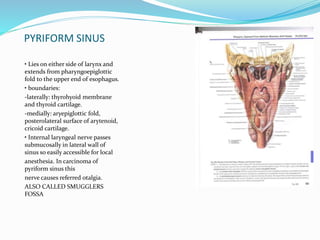
PYRIFORM SINUS
• Lies on either side of larynx and
extends from pharyngoepiglottic
fold to the upper end of esophagus.
• boundaries:
-laterally: thyrohyoid membrane
and thyroid cartilage.
-medially: aryepiglottic fold,
posterolateral surface of arytenoid,
cricoid cartilage.
• Internal laryngeal nerve passes
submucosally in lateral wall of
sinus so easily accessible for local
anesthesia. In carcinoma of
pyriform sinus this
nerve causes referred otalgia.
ALSO CALLED SMUGGLERS
FOSSA
Pharynx Anatomy and physiology

Pharynx Anatomy and physiology

  • 1.
  • 2.
    Pharynx( greek- Throat) Pharynx is a conical(half-cylinder ) fibromuscular tube  12-14 cm long  extends from base of the skull (basiocciput and basisphenoid) to the lower border of cricoid cartilage.  The width is 3.5 cm at its base and this narrows to 1.5 cm at pharyngo-oesophageal junction which is the narrowest part of digestive tract apart from the appendix.
  • 3.
    ANATOMY OF THEPHARYNX 1. EPIGLOTTIS 2. HYOID BONE 3. ARYEPIGLOTTIC FOLD 4. VOCAL FOLD 5. THYROID CARTILAGE 6. CRICOID CARTILAGE 7. OESOPHAGUS 8. THYROID ISTHEMUS 9. NASOPHARYNGEAL TONSIL 10. EUSTACHIAN TUBE 11. SALPHINGOPHARYNGEAL FOLD 12. NASOPHARYNX 13. PALATOGLOSSAL FOLD 14. PALATINE TONSIL 15. OROPHARYNX 16. PALATOPHARYNGEAL FOLD 17. HYPOPHARYNX
  • 8.
    NASOPHARYNX Part of respiratorytract – mucosa (?) • Behind the nasal cavity • Above and behind soft palate. • Communicates through nasopharyngeal isthmus with oropharynx. Opening of ET tube ½” behind and at the level of inferior turbinate guarded by tubal elevation • Salpingopharyngeal fold - posterior margin of tubal elevation to side-wall of pharynx downwards. • Salpingopharyngeus • Behind salpingopharyngeal fold - pharyngeal recess.(Node of Rouvier- Retropharengeal LN) • Under mucous membrane - nasopharyngeal tonsil.
  • 9.
    OROPHARYNX • Behind mouthand tongue. • common to both respiratory and digestive systems • Oropharyngeal isthmus • Posterior wall is smooth • Lateral walls shows palatine tonsils between palatoglossal and palatopharyngeal arches.
  • 10.
    LARYNGOPHARYNX • Behind larynx •upper part - common to digestive & respi tracts • lower part continues with esophagus • Anterior & posterior walls approximated except when food is passing Posterior wall and side - walls are smooth. • Anterior wall from above downwards presents – epiglottis – aryepiglottic folds – Arytenoids & cricoid – inlet of larynx – piriform fossa • Anterior wall - back of larynx. PARTS 1.PYRIFORM FOSSA 2.POST CRICOID 3.POSTER PHARYNGEAL WALL
  • 11.
    STRUCTURES OF PHARYNGEAL WALL From within outwards it consists of four layers:  1. Mucous membrane  2. Pharyngeal aponeurosis (pharyngobasilar fascia)  3. Muscular coat  4. Buccopharyngeal fascia
  • 12.
    1. Mucous membrane It lines the pharyngeal cavity and is continuous with mucous membrane of eustachian tubes, nasal cavities, mouth, larynx and oesophagus.  The epithelium is ciliated columnar in the nasopharynx and stratified squamous elsewhere.  There are numerous mucous glands scattered in it.
  • 13.
    2. Pharyngeal aponeurosis(pharyngobasilar fascia)   It is a fibrous layer   lines the muscular coat   It is thick near the base of skull but is thin and indistinct inferiorly.   It fills up the gap left in the muscular coat near the base of skull.
  • 14.
    3. Muscular coat It consists of two layers of muscles with three muscles in each layer. (a) External layer: contains superior, middle and inferior constrictor muscles. (b) Internal layer: contains stylopharyngeus, salpingopharyngeus and palatopharyngeus muscles.
  • 15.
     4. Buccopharyngealfascia   It covers outer surface of the constrictor muscles   Upper part  prolonged forwards to cover the buccinator muscles  Above the upper border of superior constrictor, it blends with pharyngeal aponeurosis.
  • 16.
    Constrictor muscles  •The3 constrictor muscle on each side -major contributors to the structure of the pharyngeal wall  –Superior, Middle and inferior  •Posteriorly, the muscles from each side are joined together by the pharyngeal raphe  •Anteriorly, these muscles attach to bones and ligaments related to the lateral margins of the nasal and oral cavities and the larynx.  •Walls of three flower pots stacked one on the other  •Constrict or narrow the pharyngeal cavity.  •Innervated by the pharyngeal branch of the vagus nerve [X]
  • 18.
    Superior constrictors  •Upperpart of the pharyngeal cavity  •Attached anteriorly to the pterygoidhamulus, pterygomandibularraphe, and adjacent bone of the mandible.  •Muscle fans out posteriorly and joins with its partner muscle from the other side at the pharyngeal raphe  •Palatopharyngeal sphincter  –Special band of muscle originating from anterolateral surface of the soft palate  –Circles the inner aspect of the pharyngeal wall  •Functions: constricts during swallowing -prominent ridge on the deep aspect of the pharyngeal wall
  • 19.
    Middle constrictors  •Attachedto the lower aspect of the stylohyoidligament  •lesser horn of the hyoid bone, and the entire upper surface of the greater horn of the hyoid  •Muscles fan out posteriorly and attach to the pharyngeal raphe  •Posterior part of the middle constrictors overlaps the superior constrictors
  • 20.
    Inferior constrictors  •Attachanteriorly to the oblique line of the thyroid cartilage and the cricoidcartilage.  •There are ligament that spans between these two attachments to cartilage -crosses the cricothyroidmuscle  •Spread out posteriorly and attach to the pharyngeal raphe  •Posterior part of the inferior constrictors overlaps the middle constrictors  •Inferiorly, the muscle fibers blend with and attach into the wall of the esophagus  •Narrowest part of the pharyngeal cavity
  • 21.
    GAPS BETWEEN CONSTRICTORS • Sinusof Morgagni - space between the base of the skull and free upper border of superior constrictor muscle. Eustachian tube, levator veli palatine, tensor veli palatine and ascending PALATINE artery(Br Facial artery) passes through it. Mnemonic:- PALATE
  • 22.
    Longitudinal muscles •Named according totheir origins –Stylopharyngeus: styloid process of the temporal bone –Salpingopharyngeus: cartilaginous part of the pharyngotympanic tube –Palatopharyngeus: soft palate •Function –elevate the pharyngeal wall, or –during swallowing, pull the pharyngeal wall up and food bolus into the esophagus •Nerve Supply: Except stylopharyngeus(Glossopharyngeal nerve )both the muscle is supplied by Vagus Nerve
  • 23.
    Artery Supply •Upper partsof the pharynx –the ascending pharyngeal artery; –the ascending palatine and tonsillarbranches of the facial artery; –numerous branches of the maxillary and the lingual arteries. •Lower partsof the pharynx –pharyngeal branches from the inferior thyroid artery
  • 24.
    Veins and Lymphatic Drainage •Veinsof the pharynx form a plexus –Superiorly -pterygoidplexus in the infratemporalfossa –Inferiorly -facial and internal jugular veins •Lymphatics –drain into the deep cervical nodes and include retropharyngeal, paratracheal, and infrahyoidnodes
  • 25.
    Nerves •Motor and mostsensory innervation-branches of the vagus[X] & glossopharyngeal[IX] nerves •This 2 nerved forms a plexus in the outer fascia of the pharyngeal wall, consisting of –the pharyngeal branch of the vagusnerve [X]; –branches from the external laryngeal nervefrom the superior laryngeal branchof the vagusnerve [X]; –pharyngeal branches of the glossopharyngealnerve [IX]
  • 26.
    FUNCTIONS OF PHARYNX Passageway for air and food.  The pharynx is involved in both the respiratory and the digestive systems: air passes through the nasal and oral sections, and food through the oral and laryngeal sections.  Warming and humidifying. By the same methods as in the nose, the air is further warmed and moistened as it passes through the pharynx.
  • 27.
     Taste :thereare gustatory nerve endings of the sense of taste in the epithelium of the oral and pharyngeal parts.  Hearing : the auditory tube , extending from the nasopharynx to each middle ear , allows air to enter the middle ear. Satisfactory hearing depends on the presence of air at atmospheric pressure on each side of the tympanic membrane.
  • 28.
     Protection: thelymphatic tissue of the pharyngeal and laryngeal tonsils produces antibodies in response to antigens , eg bacteria. The tonsils are larger in children and tend to atrophy in adults.  Speech: the pharynx functions in speech , by acting as a resonating chamber for sound ascending from the larynx, it helps to give the voice its individual characteristics.
  • 29.
    TUBAL TONSIL AND SINUSOF MORGAGNI • Tubal tonsil-Collection of subepithelial lymphoid tissue situated at the tubal elevation. It is continuous with nasopharyngeal tonsil forms a part of waldeyar’s ring. Significance:-ET DYSFUNCTION • Sinus of Morgagni - space between the base of the skull and free upper border of superior constrictor muscle. Eustachian tube, levator veli palatine, tensor veli palatine and ascending PALATINE artery(Br Facial artery) passes through it. Mnemonic:- PALATE
  • 30.
    Fossa of Rosenmuller.(Lateral pharyngealrecess). M/C site Nasopharyngeal Carcinoma Nasopharyngeal tonsil (Adenoids) It is a subepithelial collection of lymphoid tissue at the junction of roof and posterior wall of nasopharynx. It increases in size up to the age of six years and then gradually atrophies. Nasopharyngeal Bursa- Recess in midline of nasopharynx- Persistent Notochord remnants(Thornwaldt’s cyst) Rathke’s Pouch (It is represented clinically by a dimple above the adenoids and is reminiscent of the buccal mucosal invagination, to form the anterior lobe of pituitary. A cranio pharyngioma may arise from it.)
  • 31.
    Passavant’s Ridge It isa mucosal ridge raised by fibres of palatopharyngeus. It encircles the posterior and lateral walls of nasopharyngeal isthmus. Soft palate, during its contraction, makes firm contact with this ridge to cut off nasopharynx from the oropharynx during the deglutition or speech.
  • 32.
    Killian's dehiscence Inferior constrictormuscle has two parts; thyropharyngeus with oblique fibres cricopharyngeus with transverse fibres. Between these two parts exists a potential gap called Killian's dehiscence. It is also called the "gateway of tears" as perforation can occur at this site during oesophagoscopy. Also the site for herniation of pharyngeal mucosa in cases of pharyngeal pouch.
  • 33.
  • 34.
    WALDEYER’S RING • Scatteredsubepithelial lymphoid aggregates in and around pharynx are collectively called waldeyer’s ring • It consists of inner ring and outer ring • Inner ring: nasopharyngeal tonsil, palatine tonsil, lingual tonsil, tubal tonsil, lateral pharyngeal bands, nodules in posterior pharyngeal wall • Outer ring: lymph nodes at retropharyngeal, styloid, lateral pharyngeal, behind sternomastoid, at bifurcation of common carotid, in front of sternomastoid, at angle of jaw, at hyoid and subhyoid.
  • 36.
    . Parapharyngeal space. • Pyramidal inshape with its base at the base of skull and apex at the hyoid bone • Boundaries: a) Superior: base of skull b) Inferior: mediastinum c) Medial: buccopharyngeal fascia, prevertebral muscle and fascia d) Lateral: ramus of mandible, deep surface of parotid, medial pterygoid muscle • Contents: carotid artery, jugular vein, CN ix, x, xi, xii, cervical sympathetic trunk, deep cervical lymph nodes -Sources of infection: peritonsillar abscess, parotid abscess, submandibular gland infection. -Applied: Parapharynreal abscess.
  • 37.
    Retropharyngeal space (GILLETTE’S SPACE) • Spacelies behind the pharynx, divided by a median partition into right and left compartment • Boundaries: a) Anteriorly: buccopharyngeal fascia b) Posteriorly: prevertebral fascia c) Superior extent: base of skull d) Inferior: bifurcation of trachea • Contents: retropharyngeal lymph nodes which usually disappear at 3- 4 years of age. Applied: Retropharyngeal abscess .
  • 38.
    PYRIFORM SINUS • Lieson either side of larynx and extends from pharyngoepiglottic fold to the upper end of esophagus. • boundaries: -laterally: thyrohyoid membrane and thyroid cartilage. -medially: aryepiglottic fold, posterolateral surface of arytenoid, cricoid cartilage. • Internal laryngeal nerve passes submucosally in lateral wall of sinus so easily accessible for local anesthesia. In carcinoma of pyriform sinus this nerve causes referred otalgia. ALSO CALLED SMUGGLERS FOSSA